

{"cover":"Professional landscape format (1536x1024) hero image featuring bold text overlay 'Valuation Challenges in Northern England's 2026 Price Surge' in extra large 72pt white sans-serif font with dark shadow and semi-transparent navy overlay box, positioned in upper third. Background shows aerial view of Northern England cityscape with Manchester and Leeds skyline featuring Victorian terraced houses and modern developments, overlaid with subtle property price graph trending upward. Color scheme: deep navy blue, white, gold accents representing growth. High contrast, magazine cover quality, editorial style with RICS professional aesthetic. Include subtle property valuation documents and calculator elements in lower third for context.","content":["Detailed landscape format (1536x1024) illustration showing Northern England regional map with Manchester, Leeds, Liverpool, and Newcastle highlighted in different color zones representing price growth percentages. Overlay transparent data visualization showing +5% to +8% growth indicators with upward arrows. Include side-by-side comparison chart contrasting Northern England versus Southern England property prices with clear bar graphs. Professional color palette of navy blue, emerald green, and gold. Add small icons representing terraced houses, apartment buildings, and buy-to-let properties. Clean infographic style with RICS branding elements and 2026 timeline marker. High-quality editorial visualization suitable for professional surveying publication.","Detailed landscape format (1536x1024) professional photograph of RICS chartered surveyor in business attire conducting property inspection inside Northern England terraced house conversion. Surveyor holding tablet displaying Red Book valuation software and digital floor plans. Background shows exposed brick walls, period features, and modern renovations typical of buy-to-let properties. Include visible RICS accreditation badge, measuring tools, and property assessment checklist on clipboard. Warm natural lighting through sash windows. Color scheme: professional navy, warm browns, white accents. Sharp focus on surveyor with slight depth of field. Editorial quality suitable for professional property journal with authentic Northern England architectural details.","Detailed landscape format (1536x1024) split-screen composition showing traditional RICS valuation methods versus modern AVM technology for buy-to-let assessments. Left side: professional surveyor reviewing comparable property data with physical Red Book guidelines, property photographs, and rental yield calculations spread on desk. Right side: laptop screen displaying automated valuation model interface with heat maps, algorithm-generated valuations, and data analytics dashboards. Center dividing line with versus symbol. Include Northern England property images, rental income charts, and yield percentage overlays. Color scheme: traditional burgundy and navy transitioning to modern tech blue and white. Professional financial services aesthetic with clear data visualization elements and RICS methodology frameworks visible."]}

Northern England's property market is experiencing an unprecedented transformation in 2026. While Southern England grapples with affordability pressures and stagnant growth, cities like Manchester, Leeds, Liverpool, and Newcastle are witnessing remarkable price surges that are reshaping the investment landscape. This regional divergence presents unique valuation challenges for chartered surveyors and buy-to-let investors seeking accurate property assessments in a rapidly evolving market.
Understanding the Valuation Challenges in Northern England's 2026 Price Surge: RICS Techniques for Accurate Buy-to-Let Assessments has become essential for investors, lenders, and property professionals navigating this dynamic environment. The combination of strong rental demand, infrastructure investment, and relative affordability compared to London has created a perfect storm of opportunity—and complexity—for those conducting property valuations.
Key Takeaways
- 🏘️ Northern England is outpacing Southern markets with growth rates exceeding +5% in key cities, creating regional valuation disparities that require specialized assessment approaches
- 📊 RICS Red Book standards provide the framework for accurate buy-to-let valuations, emphasizing comparable evidence, rental yield analysis, and market sentiment evaluation
- 💡 Automated Valuation Models (AVMs) are increasingly complementing traditional surveyor assessments, though human expertise remains critical for nuanced buy-to-let property evaluation
- 🔍 Surveyor checklists must adapt to capture Northern England's unique characteristics, including terraced house conversions, HMO potential, and regeneration area premiums
- 📈 Policy changes and affordability shifts are driving investor migration northward, requiring valuers to incorporate forward-looking market intelligence into their assessments
Understanding Northern England's 2026 Property Price Dynamics
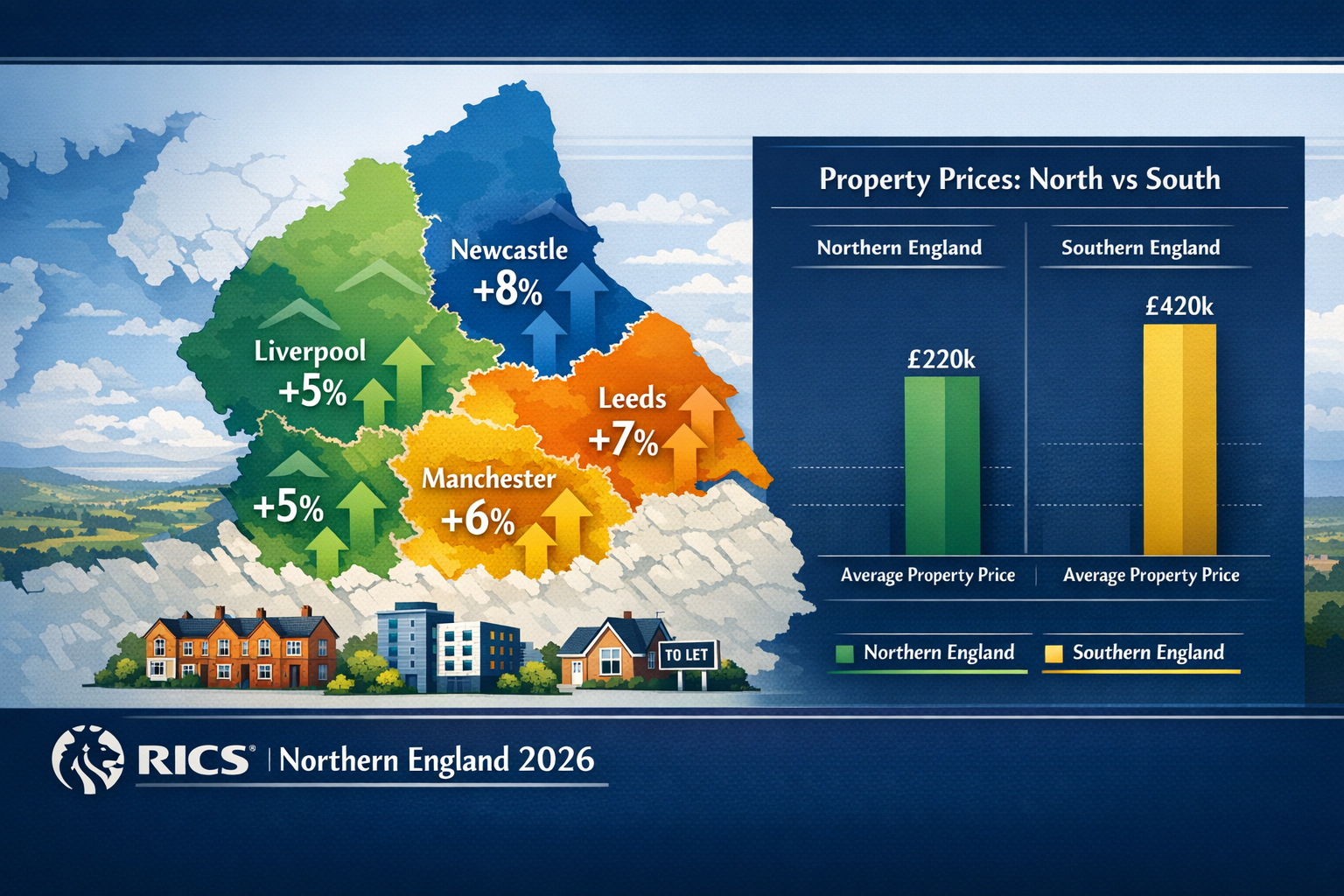
The Great Regional Divergence
The property market landscape across England has fundamentally shifted in 2026. While Southern England experiences cooling demand due to affordability constraints, Northern England cities are experiencing robust growth driven by several converging factors.
Key growth drivers include:
- Infrastructure investment: HS2 connectivity and local transport improvements
- Remote work flexibility: Professionals relocating from expensive Southern markets
- Rental yield advantages: Buy-to-let investors seeking superior returns
- Regeneration projects: City center redevelopment attracting young professionals
- University expansion: Student accommodation demand in Manchester, Leeds, and Newcastle
Recent market data reveals that Northern England property prices have increased by +5% to +8% in major cities during early 2026, significantly outpacing the national average. Manchester's city center apartments and Leeds' converted Victorian properties have seen particularly strong appreciation, creating valuation complexities for surveyors accustomed to more stable market conditions.
Buy-to-Let Investment Migration Patterns
Investors are increasingly viewing Northern England as the new frontier for buy-to-let opportunities. The combination of lower entry costs, higher rental yields (often 5-7% compared to 2-3% in London), and strong tenant demand has triggered a northward migration of property investment capital.
This shift presents unique challenges for property valuations. Surveyors must now account for:
- Increased competition among investors inflating comparable sales data
- Rapid neighborhood transformation affecting location premiums
- Mixed-use development changing traditional residential valuation parameters
- Student and professional tenant mix influencing rental income projections
Policy developments are expected to further shape Northern England property valuations throughout 2026, requiring surveyors to monitor regulatory changes and incorporate forward-looking assessments into their methodologies[1].
RICS Valuation Standards for Buy-to-Let Properties
The Red Book Framework
The Royal Institution of Chartered Surveyors (RICS) provides comprehensive guidance through its Red Book valuation standards, which establish the professional framework for property assessments. For buy-to-let properties in Northern England's dynamic 2026 market, these standards are more critical than ever.
Understanding professional valuation methods is essential for accurate property assessments. The RICS framework emphasizes:
| Valuation Component | Application to Buy-to-Let | Northern England Considerations |
|---|---|---|
| Market Value | Current sale price based on comparable evidence | Rapidly changing comparables require recent data |
| Investment Value | Worth to specific investor based on yield | Higher yields attracting premium pricing |
| Rental Income | Sustainable market rent analysis | Strong tenant demand supporting rent growth |
| Capital Growth | Future appreciation potential | Infrastructure projects boosting expectations |
Red Book valuation standards require surveyors to adopt systematic approaches that account for both current market conditions and reasonably foreseeable changes[2].
Comparable Evidence Analysis in Volatile Markets
One of the primary valuation challenges in Northern England's 2026 price surge involves identifying truly comparable evidence. Traditional comparable analysis assumes relatively stable market conditions, but rapid price appreciation creates complications:
Challenges with comparable evidence:
- Properties sold 3-6 months ago may significantly undervalue current market conditions
- Limited transaction volume in specific property types (HMOs, purpose-built student accommodation)
- Regeneration areas experiencing micro-market variations within single postcodes
- New-build developments setting premium pricing not yet reflected in resale market
Surveyors must apply time adjustments to comparable evidence, typically adding 1-2% monthly appreciation factors in the strongest Northern England markets. This requires professional judgment and thorough market knowledge beyond simple data analysis.
Rental Yield Calculations and Investment Returns
For buy-to-let properties, rental yield represents a critical valuation metric. The calculation appears straightforward:
Gross Rental Yield = (Annual Rental Income ÷ Property Value) × 100
However, Northern England's 2026 market introduces complexity:
- Rental growth rates varying significantly between property types
- Service charge and management costs impacting net yields
- Void periods differing by location and tenant demographic
- Licensing requirements for HMOs affecting profitability
Professional surveyors conducting freehold valuations must incorporate comprehensive income and expense analysis, not merely headline rental figures.
"Accurate buy-to-let valuation requires understanding both capital appreciation potential and sustainable rental income streams. In Northern England's current market, these factors are evolving rapidly and require constant recalibration." — RICS Valuation Guidance
Surveyor Checklists for Accurate Buy-to-Let Assessments
Pre-Valuation Research and Market Intelligence
Before conducting physical inspections, surveyors must gather comprehensive market intelligence specific to Northern England's 2026 conditions. This preparatory research forms the foundation for accurate assessments.
Essential pre-valuation research:
✅ Local market analysis: Review recent sales data within 0.5-mile radius
✅ Rental market assessment: Analyze current listings and achieved rents for comparable properties
✅ Infrastructure mapping: Identify planned transport, commercial, and residential developments
✅ Regulatory review: Check local licensing requirements, Article 4 directions, and planning policies
✅ Tenant demographic research: Understand primary renter profiles (students, professionals, families)
✅ Comparable adjustment factors: Establish time, condition, and location adjustment percentages
Understanding the price of professional valuations helps investors budget appropriately for thorough assessments that incorporate this comprehensive research.
Physical Inspection Checklist
The property inspection for buy-to-let assessments extends beyond standard residential surveys. Surveyors must evaluate features specifically relevant to rental investment performance.
Critical inspection elements:
Structural and Condition Factors:
- Building construction type and age
- Evidence of structural movement, damp, or subsidence
- Roof condition and remaining lifespan
- Window quality (energy efficiency impacts tenant appeal)
- Heating system efficiency and running costs
Rental-Specific Features:
- Room sizes and configuration for target tenant demographic
- Kitchen and bathroom quality and quantity
- Storage and parking availability
- Garden or outdoor space condition
- Security features (locks, lighting, access control)
Investment Considerations:
- Potential for value-add improvements
- HMO conversion feasibility
- Extension or loft conversion opportunities
- Energy Performance Certificate (EPC) rating and improvement potential
Conducting thorough RICS building surveys provides the detailed condition information necessary for accurate buy-to-let valuations.
Yield Analysis and Income Verification
Accurate rental income assessment separates professional valuations from speculative estimates. In Northern England's competitive 2026 market, this requires systematic verification.
Income verification process:
- Market rent analysis: Review 10-15 comparable rental properties currently advertised
- Achieved rent verification: Contact letting agents to confirm actual tenancy agreements (not just asking prices)
- Void period assessment: Calculate realistic vacancy rates based on property type and location
- Tenant turnover costs: Include redecoration, cleaning, and re-letting fees
- Management costs: Factor professional management fees (typically 10-15% of rent)
- Maintenance reserves: Allocate 1-2% of property value annually for repairs
Example calculation for Manchester two-bedroom apartment:
- Property value: £200,000
- Monthly market rent: £1,100
- Annual gross rent: £13,200
- Gross yield: 6.6%
- Less management (12%): -£1,584
- Less maintenance (1.5%): -£3,000
- Less void period (4 weeks): -£1,100
- Net annual income: £7,516
- Net yield: 3.76%
This comprehensive analysis provides realistic investment return expectations, essential for accurate valuation assessments.
Addressing Specific Valuation Challenges in Northern England's 2026 Market

Terraced House Conversions and HMO Valuations
Northern England's property stock includes extensive terraced housing, much of which has been converted for multi-occupancy use. These properties present unique valuation challenges in 2026's market.
HMO-specific valuation considerations:
- Licensing compliance: Properties requiring mandatory or selective licensing may command premiums or discounts depending on compliance status
- Room configuration: Optimal bedroom count (typically 5-6 rooms) maximizes rental yield
- Shared facility quality: Modern kitchens and multiple bathrooms significantly impact tenant appeal
- Management intensity: Higher management costs offset increased rental income
- Exit strategy: Resale market for HMOs may be limited compared to standard residential properties
Surveyors must evaluate whether HMO conversion represents the highest and best use of the property, or whether reconversion to single-family occupancy might maximize value in specific neighborhoods experiencing gentrification.
New-Build Apartment Developments
Manchester, Leeds, and other Northern cities have experienced significant new-build apartment development in 2026. These properties require specialized valuation approaches.
New-build valuation challenges:
- Limited comparable evidence for recently completed schemes
- Developer pricing vs. secondary market values often diverge significantly
- Service charge uncertainty (first-year charges may not reflect long-term costs)
- Build quality variations between developers affecting longevity
- Oversupply risks in specific city center locations
Professional surveyors must distinguish between developer marketing prices and genuine market value. In some Northern England locations, new-build premiums have compressed in 2026 as supply increased, requiring careful analysis of both new and resale comparable evidence.
Regeneration Area Premium Assessment
Government and private investment in Northern England regeneration projects creates micro-market variations that challenge traditional valuation approaches. Properties within regeneration zones may experience rapid appreciation, but timing and execution risks require careful assessment.
Regeneration valuation framework:
📍 Stage 1 – Planning Announced: 0-5% premium for confirmed projects
📍 Stage 2 – Construction Commenced: 5-10% premium as infrastructure develops
📍 Stage 3 – Partial Completion: 10-20% premium as amenities become operational
📍 Stage 4 – Full Integration: Premium normalizes as area becomes established
Surveyors must verify project timelines, funding certainty, and realistic completion dates before applying regeneration premiums to valuations. Overly optimistic assessments based on speculative development can significantly overvalue properties.
Automated Valuation Models (AVMs) and Technology Integration
The property market is increasingly adopting Automated Valuation Models (AVMs) due to their speed, cost efficiency, and reduction of human error[2]. However, their application to buy-to-let properties in Northern England's dynamic 2026 market requires careful consideration.
AVM strengths:
- Rapid initial valuations for portfolio screening
- Consistent methodology across multiple properties
- Real-time data integration from land registry and rental platforms
- Cost-effective for refinancing and portfolio monitoring
AVM limitations:
- Difficulty capturing unique property features affecting rental appeal
- Limited ability to assess condition and maintenance requirements
- Challenges modeling micro-market variations in regeneration areas
- Inability to evaluate highest and best use considerations
Professional surveyors in 2026 increasingly use hybrid approaches, employing AVMs for initial screening while conducting detailed physical inspections and market analysis for final valuations. This combination leverages technology efficiency while maintaining professional judgment for complex assessments.
Case Studies: RICS Survey Data Showing +5% Growth Contrasts
Case Study 1: Manchester City Center Apartment Portfolio
Property Type: Purpose-built two-bedroom apartments in Northern Quarter
Valuation Date: February 2026
Previous Valuation: August 2025 (6 months prior)
Market Analysis:
- August 2025 valuation: £185,000 per unit
- February 2026 valuation: £195,000 per unit
- Appreciation: +5.4% in 6 months
Valuation Methodology:
The surveyor identified 12 comparable sales within 0.3 miles, with transactions ranging from November 2025 to January 2026. Time adjustments of +0.8% monthly were applied to earlier comparables. Rental income verification showed market rents increased from £950 to £1,000 monthly, supporting capital value appreciation.
Key Challenges Addressed:
- New-build supply in adjacent development required assessment of competition impact
- Service charges increased 8% due to energy cost inflation
- Student vs. professional tenant mix affecting rental stability
Case Study 2: Leeds Victorian Terraced House Conversion
Property Type: Five-bedroom HMO in Hyde Park area
Valuation Date: January 2026
Previous Valuation: January 2025 (12 months prior)
Market Analysis:
- January 2025 valuation: £240,000
- January 2026 valuation: £258,000
- Appreciation: +7.5% annually
Valuation Methodology:
The surveyor conducted comprehensive rental income analysis showing gross yields of 7.2% based on verified achieved rents of £1,550 monthly (£310 per room × 5 rooms). Comparable HMO sales were limited, requiring adjustment of standard residential comparables with yield-based premiums.
Key Challenges Addressed:
- Mandatory HMO licensing compliance verification
- Assessment of recent refurbishment quality and remaining useful life
- Student demand sustainability given university enrollment trends
- Comparison with purpose-built student accommodation competition
Case Study 3: Liverpool Dockside New-Build Development
Property Type: One-bedroom apartments in waterfront regeneration scheme
Valuation Date: March 2026
Previous Valuation: Developer valuation at purchase (off-plan, 2024)
Market Analysis:
- Developer off-plan price (2024): £155,000
- Surveyor market valuation (2026): £162,000
- Appreciation: +4.5% from purchase, but below developer projections
Valuation Methodology:
Limited comparable evidence for the specific development required analysis of similar waterfront schemes completed 1-2 years earlier. The surveyor identified a new-build premium compression as secondary market sales in comparable developments traded 5-8% below original developer prices.
Key Challenges Addressed:
- Service charge uncertainty (estimated vs. actual costs)
- Oversupply assessment in Liverpool city center apartment market
- Build quality verification through inspection of common areas
- Rental demand verification showing strong occupancy but limited rent growth
These case studies demonstrate the +5% growth contrasts across Northern England markets, while highlighting the varied valuation challenges requiring RICS-compliant professional assessment rather than simplistic appreciation assumptions.
Future-Proofing Valuations: Policy Changes and Market Evolution
Anticipated Regulatory Developments
Surveyors conducting valuations in 2026 must incorporate forward-looking analysis of policy changes that may impact buy-to-let investment returns. Several regulatory developments are expected to shape Northern England property valuations throughout the year.
Key policy considerations:
🏛️ Energy Efficiency Standards: Potential tightening of minimum EPC requirements for rental properties may require capital investment
🏛️ Selective Licensing Expansion: Additional local authorities implementing landlord licensing schemes
🏛️ Planning Policy Changes: Article 4 directions limiting HMO concentrations in specific areas
🏛️ Tenant Protection Legislation: Evolving rental regulations affecting landlord flexibility and costs
Surveyors are expected to monitor and incorporate policy developments into their 2026 valuations for Northern England properties[1], adjusting assessments based on compliance costs and regulatory risks.
Sustainability and ESG Factors
Environmental, Social, and Governance (ESG) considerations are increasingly influencing property valuations. Buy-to-let investors in 2026 face growing pressure to improve energy efficiency and sustainability credentials.
ESG valuation impacts:
- Properties with EPC ratings below C may face rental restrictions or value discounts
- Solar panel installation and heat pump upgrades creating value premiums
- Green mortgages offering preferential financing for energy-efficient properties
- Tenant preferences shifting toward sustainable, low-running-cost homes
Professional surveyors must assess both current EPC ratings and improvement potential, factoring upgrade costs against future value enhancement and rental income protection.
Conclusion

The Valuation Challenges in Northern England's 2026 Price Surge: RICS Techniques for Accurate Buy-to-Let Assessments represent a complex intersection of regional market dynamics, professional standards, and evolving investment strategies. As Northern England continues to outpace Southern markets with growth rates exceeding +5% in key cities, chartered surveyors must adapt their methodologies to capture the nuances of this transformation.
Key principles for accurate valuations include:
✅ Rigorous comparable evidence analysis with appropriate time and condition adjustments
✅ Comprehensive rental income verification beyond headline asking rents
✅ Detailed physical inspection addressing buy-to-let specific features and investment potential
✅ Technology integration through hybrid AVM and professional surveyor approaches
✅ Forward-looking policy assessment incorporating regulatory and sustainability developments
The regional divergence between Northern and Southern England property markets creates both opportunities and risks for buy-to-let investors. Professional RICS valuations provide the foundation for informed investment decisions, protecting against overpayment in heated markets while identifying genuine value in emerging locations.
Actionable Next Steps
For investors and property professionals navigating Northern England's 2026 market:
- Engage RICS-qualified surveyors with specific Northern England market expertise and recent comparable evidence
- Request detailed rental income analysis including verified achieved rents, not just asking prices
- Assess regulatory compliance for HMO licensing, EPC requirements, and local planning policies
- Evaluate improvement potential for value-add opportunities through refurbishment or configuration changes
- Monitor infrastructure developments that may create regeneration premiums or oversupply risks
- Consider professional building surveys to identify hidden maintenance costs affecting investment returns
- Review commercial valuation approaches for mixed-use or larger portfolio assessments
The Northern England property market's 2026 price surge presents significant opportunities for well-informed investors supported by professional RICS valuations. By addressing the specific challenges outlined in this analysis and applying rigorous assessment methodologies, surveyors and investors can navigate this dynamic market with confidence and accuracy.
References
[1] Valuing Northern England Properties In 2026 Surveyor Tactics For Outpacing Southern Affordability Pressures – https://nottinghillsurveyors.com/blog/valuing-northern-england-properties-in-2026-surveyor-tactics-for-outpacing-southern-affordability-pressures
[2] Valuation Standards – https://www.rics.org/profession-standards/rics-standards-and-guidance/sector-standards/valuation-standards