
nn

The housing market landscape across England is experiencing a dramatic shift in 2026, with Northern regions outpacing their Southern counterparts at rates not seen in over a decade. For chartered surveyors and valuation professionals, this regional divergence presents unprecedented challenges—and opportunities. Understanding the Valuation Challenges in Northern England's 2026 Housing Recovery: Surveyor Strategies for Price Uplifts has become essential for accurate property assessments in a market where traditional North-South dynamics are fundamentally changing.
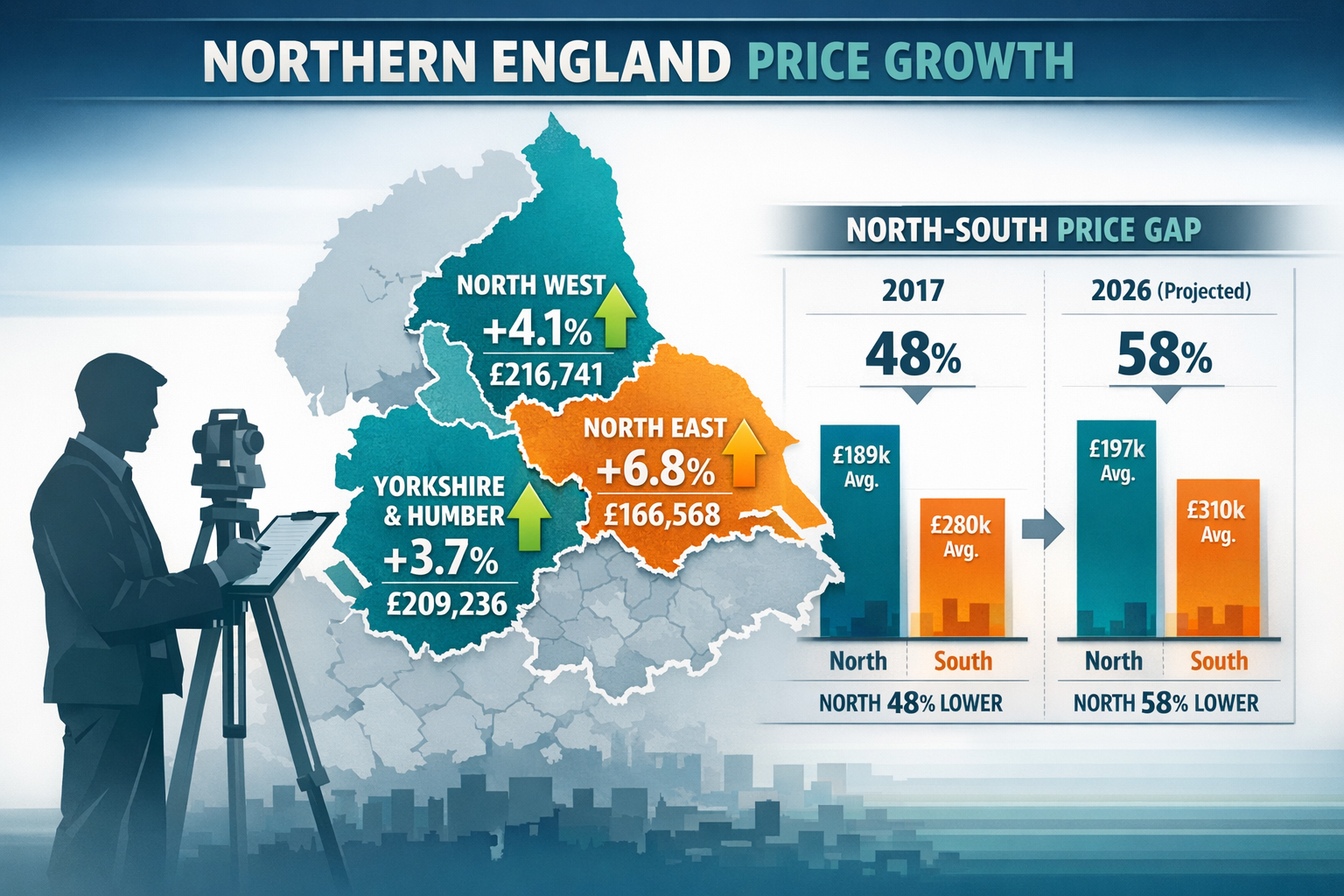
Recent RICS data reveals that Northern England is experiencing robust price growth, with the North East achieving +6.8% annual growth projections and Yorkshire & Humber following at +3.7%. This recovery, fueled by improved affordability, first-time buyer activity at decade highs, and increased stock availability, demands that surveyors adapt their methodologies to capture the nuances of regional market momentum.
Key Takeaways
- 📈 Northern regions are significantly outperforming Southern England, with the price differential narrowing to its lowest level since 2013—Northern properties now average 58% of Southern prices compared to just 48% in 2017
- 🏡 First-time buyer activity has reached decade-high levels in Northern markets, with high loan-to-value lending (deposits of 15% or less) driving demand and price uplifts
- 📊 RICS surveyor sentiment has improved sharply in early 2026, with short-term sales expectations reaching their most optimistic levels since late 2024
- 🔧 Valuation methodologies require regional adjustments to account for market momentum factors, supply constraints, and demographic shifts unique to Northern England
- 💼 Professional surveyors must integrate multiple data sources—including comparable analysis, rental yield assessments, and local economic indicators—to deliver accurate valuations in this evolving market
Understanding Northern England's 2026 Market Dynamics
The North-South Price Convergence
The traditional North-South divide in English property markets is undergoing a fundamental transformation in 2026. Northern regions have achieved average prices at almost 58% of Southern regions' prices—a remarkable shift from the 2017 lows of approximately 48%. This convergence represents more than a cyclical market adjustment; it reflects structural changes in housing affordability, employment patterns, and buyer demographics.
For surveyors conducting valuations, this convergence creates specific challenges:
- Historical comparables may undervalue current market conditions when Northern properties were consistently discounted at higher rates
- Regional growth trajectories vary significantly even within Northern England, requiring granular local knowledge
- Price momentum factors must be weighted more heavily in valuation calculations than in stable or declining markets
The North East region exemplifies this dynamic, recording +1.8% growth in early 2026 forecasts with +6.8% annual projected growth and average prices of £166,568. Yorkshire & Humber follows with +1.2% early-year growth and +3.7% annual projections at £209,236, while the North West shows +0.9% early-year growth with +4.1% annual growth at £216,741.
First-Time Buyer Momentum and Market Activity
First-time buyers are driving unprecedented momentum across Northern markets in 2026. The combination of lower mortgage rates, relaxed affordability tests, and entry-level prices significantly below Southern equivalents has created ideal conditions for new homeowners.
Key indicators include:
- First-time buyer share of house purchase activity above the long-run average, supported by easier credit availability
- High loan-to-value lending (deposits of 15% or less) reaching its highest level for over a decade
- Buyer demand that jumped 57% in the two weeks after Christmas 2025 compared to the previous fortnight
This demographic shift requires surveyors to consider entry-level property segments more carefully. Properties suitable for first-time buyers—typically two to three-bedroom terraced houses and apartments—may experience stronger price uplifts than larger family homes in certain Northern submarkets.
Supply Dynamics and Stock Availability
The average estate agent began January 2026 with 32 homes for sale—the highest early-January figure in eight years. However, supply variations across regions significantly impact valuation approaches. Parts of Northern England demonstrate greater scarcity and stronger price resilience, while Southern regions see larger stock increases that moderate price growth.
For valuation professionals, understanding local supply dynamics is crucial when applying methods of valuation in the current market. Areas with constrained supply relative to demand require adjustments to comparable analysis, while markets with abundant stock may see price uplifts moderate despite strong buyer interest.
Valuation Challenges in Northern England's 2026 Housing Recovery: Key Professional Considerations
Comparable Analysis in Rapidly Appreciating Markets
Traditional comparable analysis relies on recent sales data to establish market value. However, in rapidly appreciating Northern markets, this approach presents specific challenges:
Time Lag Issues: Properties sold three to six months ago may not reflect current market conditions when annual growth rates exceed 5-6%. Surveyors must apply appropriate time adjustments to historical comparables, using regional house price indices and local market intelligence to bridge the gap between sale dates and valuation dates.
Limited Comparable Stock: In some Northern submarkets experiencing strong growth, the volume of recent comparable sales may be limited. This scarcity requires surveyors to:
- Expand geographic search parameters while maintaining comparability
- Consider properties in similar stages of market recovery in adjacent areas
- Weight more recent comparables more heavily in valuation calculations
- Utilize rental yield analysis as a supporting valuation methodology
Quality and Condition Variations: Northern England's housing stock includes significant proportions of Victorian and Edwardian terraced properties, many requiring varying levels of modernization. Accurately adjusting comparables for property condition becomes essential when similar properties may differ substantially in internal specification and energy efficiency.
Professional surveyors conducting homebuyer surveys must document property condition thoroughly to support valuation adjustments and provide clients with comprehensive market context.
Regional Economic Indicators and Valuation Adjustments
Valuation Challenges in Northern England's 2026 Housing Recovery: Surveyor Strategies for Price Uplifts must incorporate regional economic indicators beyond property-specific factors:
Employment and Wage Growth: Northern regions with strong employment sectors—particularly technology, advanced manufacturing, and professional services—demonstrate more sustainable price growth. Surveyors should consider:
- Local employment rates and job creation trends
- Average earnings growth relative to house price growth
- Major employer announcements and infrastructure investments
- Commuter connectivity to major employment centers
Affordability Metrics: The easing of affordability constraints through price growth below earnings growth and steady mortgage rate declines supports Northern market recovery. Calculating price-to-income ratios for specific localities helps surveyors assess sustainability of price uplifts and identify areas at risk of correction.
Infrastructure Development: Transport improvements, including Northern Powerhouse Rail proposals and local transport enhancements, create localized price premiums. Properties within walking distance of improved transport links may warrant higher valuations than comparable properties in less connected areas.
RICS Red Book Compliance in Dynamic Markets
The RICS Valuation – Global Standards (Red Book) provides the framework for professional valuations, but applying these standards in rapidly changing markets requires careful consideration. Registered RICS valuers must ensure their reports adequately address market uncertainty and regional variations.
Market Uncertainty Clauses: When market conditions are changing rapidly, valuations should include appropriate uncertainty clauses and commentary on market direction. The 2026 Northern England recovery, while positive, still carries uncertainties around:
- Interest rate trajectory and mortgage availability
- Economic conditions and employment stability
- Government policy changes affecting housing demand
- Regional supply responses to increased prices
Assumptions and Special Assumptions: Clearly stating assumptions becomes particularly important when valuing properties in areas experiencing structural market changes. Assumptions regarding market conditions, planning permissions, or property condition should be explicitly documented.
Valuation Approach Selection: The Red Book requires valuers to select appropriate valuation approaches for the asset and purpose. In Northern England's 2026 market, this often means employing multiple approaches and reconciling results:
- Market approach (comparable sales analysis)
- Income approach (rental yield analysis for investment properties)
- Cost approach (for unique properties or new builds)
Surveyor Strategies for Accurate Price Uplift Assessment

Multi-Source Data Integration
Professional surveyors in 2026 have access to unprecedented data sources. Integrating multiple data streams produces more accurate valuations than relying on any single source:
Land Registry Data: Provides definitive sold price information but with a time lag. Surveyors should supplement Land Registry data with:
- Real-time asking price trends from property portals
- Estate agent market reports and local intelligence
- Auction results for comparable properties
- New build sales data from developers
RICS Market Surveys: The UK Residential Market Survey from RICS provides invaluable sentiment data from chartered surveyors across regions. The 2026 data showing "short-term sales expectations risen sharply to the most optimistic levels since late 2024" helps contextualize individual valuations within broader market trends.
Local Authority Planning Data: Understanding planned developments, infrastructure projects, and planning permissions in the locality provides forward-looking context for valuations. Properties in areas with significant planned improvements may justify premiums over comparable properties in static areas.
Case Study: Yorkshire Terrace Valuation Strategy
Consider a typical scenario: valuing a three-bedroom Victorian terraced house in a West Yorkshire market town experiencing strong first-time buyer demand.
Property Details:
- Three-bedroom mid-terrace
- Partially modernized (new kitchen, original bathroom)
- Gas central heating, double glazing
- Small rear garden
- Off-street parking
Valuation Approach:
- Comparable Analysis: Identified five sales within 0.5 miles in past six months, ranging £185,000-£205,000
- Time Adjustments: Applied +1.5% monthly uplift based on regional index data, adjusting older comparables upward
- Condition Adjustments: Deducted £8,000-£12,000 from fully modernized comparables to reflect bathroom condition
- Location Micro-Adjustments: Added £5,000 premium for off-street parking based on local market intelligence
- Market Momentum Factor: Applied additional 2% uplift to reflect strong buyer demand and limited stock
Concluded Value: £198,000 (reflecting current market conditions and property-specific factors)
This systematic approach, documented thoroughly in the valuation report, provides defensible conclusions supported by multiple data points and transparent adjustments.
Technology-Enabled Valuation Practices
Modern surveying increasingly incorporates technology to enhance accuracy and efficiency:
Automated Valuation Models (AVMs): While AVMs provide useful initial estimates, professional surveyors should use them as starting points rather than conclusions. In rapidly changing Northern markets, AVMs may lag current conditions or fail to capture local nuances.
Geographic Information Systems (GIS): Mapping tools help visualize comparable properties, identify location-specific factors, and analyze spatial patterns in price growth. GIS integration allows surveyors to:
- Identify comparable properties more systematically
- Analyze distance-based adjustments (proximity to schools, transport, amenities)
- Visualize market "heat zones" of strong price growth
- Document location factors in client-friendly formats
Digital Inspection Tools: Laser measuring devices, thermal imaging cameras, and digital photography enhance inspection accuracy and documentation quality. Detailed photographic records support valuation conclusions and provide valuable reference for future assessments.
Addressing Valuation Challenges in Northern England's 2026 Housing Recovery Through Client Communication
Transparent reporting is essential when valuations reflect significant price uplifts. Clients—whether homebuyers, lenders, or investors—need to understand the basis for valuations that may exceed their expectations.
Effective communication strategies include:
📋 Executive Summaries: Begin reports with clear summaries of value conclusions and key factors driving the valuation
📊 Visual Data Presentation: Include charts showing regional price trends, comparable sales maps, and adjustment calculations
💬 Market Commentary: Provide context on Northern England's recovery, regional variations, and sustainability of price growth
⚠️ Risk Factors: Clearly articulate potential risks to value, including market uncertainty, property-specific issues, or local economic factors
🔍 Methodology Transparency: Explain valuation approaches, data sources, and adjustment rationales in accessible language
This approach builds client confidence and demonstrates professional competence, particularly important when valuations support significant financial decisions.
Specialized Valuation Scenarios in Northern Markets
New Build Premium Assessment
Northern England's housing recovery includes significant new build development, particularly in regeneration areas. Valuing new builds requires specific considerations:
Developer Incentives: Many developers offer incentives (stamp duty contributions, furniture packages, Help to Buy) that can distort comparable analysis. Surveyors must assess whether asking prices reflect genuine market value or incentive-inflated figures.
New Build Premium: New builds typically command premiums over comparable resale properties. In Northern markets, this premium varies from 5-15% depending on location, specification, and local supply dynamics. Surveyors should:
- Compare new builds to both new and resale comparables
- Adjust for warranty coverage (NHBC or similar)
- Consider energy efficiency advantages
- Account for lack of chain and immediate availability
For properties requiring Help to Buy valuations, additional considerations around equity loan implications and scheme-specific requirements apply.
Investment Property Valuation
Buy-to-let investors are increasingly active in Northern markets, attracted by higher rental yields and lower entry prices. Investment property valuations require dual consideration of capital value and income potential:
Rental Yield Analysis: Northern England offers significantly higher rental yields than Southern regions—often 5-7% gross yields compared to 3-4% in London and the South East. Surveyors should:
- Analyze comparable rental evidence for similar properties
- Calculate gross and net yields
- Consider void periods and management costs
- Assess tenant demand and local rental market dynamics
Capital Growth Prospects: While yields attract investors, sustainable capital growth determines long-term investment success. Valuations should comment on:
- Historical price growth trends
- Local economic indicators supporting future growth
- Supply pipeline and potential oversupply risks
- Regulatory changes affecting buy-to-let viability
For commercial property investors requiring rent review services, similar principles apply with additional complexity around lease terms and commercial market dynamics.
Heritage and Conservation Area Properties
Northern England's historic housing stock includes numerous conservation areas and listed buildings. These properties present unique valuation challenges:
Heritage Premium or Discount: Conservation area properties may command premiums for character and location, or discounts due to maintenance costs and planning restrictions. Surveyors must assess:
- Local market appetite for period properties
- Extent of planning restrictions and impact on alterations
- Condition and maintenance requirements
- Energy efficiency limitations and upgrade costs
Specialist Knowledge Requirements: Valuing heritage properties often requires understanding of traditional construction methods, conservation principles, and specialist repair costs. Surveyors should consider obtaining specialist defect surveys when significant heritage features or condition concerns exist.
Risk Management and Professional Standards
Quality Assurance in Valuation Practice
Maintaining high professional standards protects both clients and surveyors. Quality assurance processes should include:
Peer Review: Complex or high-value valuations benefit from internal peer review before finalization. This second-opinion approach identifies potential oversights and ensures methodology consistency.
Continuing Professional Development: The 2026 market environment differs significantly from previous years. Surveyors should engage in CPD focused on:
- Regional market trends and economic indicators
- Emerging valuation technologies and data sources
- RICS guidance updates and best practice developments
- Local market knowledge through networking and market observation
Documentation Standards: Comprehensive file notes, comparable property records, and calculation worksheets support valuation conclusions and provide essential evidence if valuations are later questioned.
Professional Indemnity Considerations
Rapidly appreciating markets create potential professional indemnity risks. Conservative valuation approaches may undervalue properties and disappoint clients, while aggressive valuations risk over-valuation claims if markets correct.
Risk mitigation strategies include:
✅ Robust Methodology: Document valuation approaches thoroughly, demonstrating compliance with RICS standards
✅ Market Uncertainty Commentary: Include appropriate caveats about market conditions and potential volatility
✅ Assumption Clarity: Clearly state all assumptions and special assumptions underlying valuations
✅ Comparable Evidence: Maintain comprehensive records of comparable properties and adjustment rationales
✅ Regular Market Monitoring: Stay informed about regional and local market developments affecting valuations
For surveyors providing expert witness services, these documentation standards become even more critical when valuations face legal scrutiny.
Future Outlook and Emerging Trends
Sustainability and Energy Efficiency Impact
Energy efficiency is increasingly influencing property values across all regions. In Northern England's 2026 market, this trend manifests in several ways:
EPC Rating Premiums: Properties with higher EPC ratings (A-B) command premiums over comparable properties with lower ratings (D-E), particularly as buyers anticipate future regulatory changes and energy cost savings.
Retrofit Potential: Victorian and Edwardian properties—common in Northern England—often have poor energy efficiency but significant retrofit potential. Surveyors should consider:
- Cost of achieving higher EPC ratings
- Impact on property value post-improvement
- Available grants and incentives for energy upgrades
- Market demand for energy-efficient properties
Technology and Data Evolution
Valuation practice continues evolving with technological advancement:
Big Data Analytics: Integration of multiple data sources through AI and machine learning promises more accurate automated valuations, though professional judgment remains essential for complex properties and unusual market conditions.
Blockchain and Property Records: Emerging blockchain-based property record systems may streamline comparable analysis and reduce data lag in future years.
Virtual Inspections: While physical inspections remain the gold standard, hybrid approaches incorporating virtual tours and remote assessment tools may supplement traditional methods for certain valuation purposes.
Regional Policy Impacts
Government policy significantly influences regional housing markets. Potential 2026 developments affecting Northern England valuations include:
- Levelling Up initiatives providing infrastructure investment and economic development funding
- Planning reform potentially increasing housing supply in high-demand areas
- Stamp duty policies affecting transaction volumes and buyer behavior
- Interest rate trajectory influencing mortgage affordability and buyer demand
Surveyors should monitor policy developments and assess implications for local markets when conducting valuations.
Conclusion
The Valuation Challenges in Northern England's 2026 Housing Recovery: Surveyor Strategies for Price Uplifts reflect a fundamentally changing regional property landscape. Northern regions are experiencing robust price growth, narrowing the historic North-South divide and creating opportunities—and complexities—for valuation professionals.
Successful surveying practice in this environment requires:
🎯 Multi-faceted analysis integrating comparable sales, rental yields, regional economics, and market momentum factors
📈 Time-sensitive adjustments accounting for rapid price appreciation and market dynamics
🔍 Local market expertise understanding subregional variations within Northern England
📋 Transparent methodology clearly documenting approaches and assumptions
⚖️ RICS compliance maintaining professional standards while adapting to market conditions
For property professionals, buyers, and investors navigating Northern England's housing recovery, engaging qualified chartered surveyors ensures valuations accurately reflect current market conditions while identifying risks and opportunities. The region's strong fundamentals—improved affordability, first-time buyer momentum, and economic development—support continued price growth, but local variations and market uncertainties require expert assessment.
Actionable Next Steps
For Homebuyers: Obtain professional valuations before making offers in competitive Northern markets. Understanding true market value prevents overpaying while ensuring mortgage valuations support your purchase.
For Investors: Engage surveyors with local Northern England expertise to assess both capital growth prospects and rental yield potential. Request comprehensive market commentary alongside valuation figures.
For Lenders: Ensure valuation panels include surveyors with current Northern England market knowledge. Review valuation reports for adequate market commentary and risk assessment.
For Property Professionals: Invest in continuing professional development focused on regional market trends, data analytics, and emerging valuation technologies. Build local networks providing market intelligence beyond formal data sources.
The Northern England housing recovery of 2026 represents a significant market shift requiring professional adaptation and expertise. By implementing robust valuation strategies, maintaining professional standards, and staying informed about regional developments, surveyors can deliver accurate assessments that serve clients and support sustainable market growth.