The Royal Institution of Chartered Surveyors (RICS) February 2026 survey revealed a stark reality: buyer enquiries plummeted to a net balance of -26%, down from -15% in January, signaling the most significant monthly deterioration in demand since late 2025 [1]. This rapid decline, which worsened further to -39% by March 2026 [5], has forced property valuers and surveyors to fundamentally reassess their methodologies in an environment characterized by geopolitical turbulence, inflation concerns, and interest rate uncertainty.
Understanding Valuation Adjustments for Subdued Buyer Enquiries in RICS February 2026 Survey: Surveyor Tactics Amid Geopolitical Uncertainty has become essential for professionals navigating this challenging landscape. When buyer demand weakens dramatically, traditional valuation approaches require recalibration to reflect genuine market conditions rather than historical precedents that no longer apply.
Key Takeaways
- 📉 Buyer enquiries fell to -26% net balance in February 2026, deteriorating further to -39% in March, marking the weakest demand since surveys began tracking this metric
- 💷 Near-term price expectations collapsed from +33% to +2% between February and March 2026, reflecting a stark shift toward flat pricing amid uncertainty
- 🔍 Surveyors increasingly employ Level 2 detailed surveys to identify defects that justify price renegotiations in cautious market conditions
- ⚖️ Expert witnesses face heightened scrutiny in mortgage disputes as low transaction volumes create fewer comparable sales for valuation evidence
- 🎯 Realistic pricing from the outset has become critically important, with sensibly priced homes still experiencing limited viewing traction due to buyer price sensitivity
Understanding the February 2026 Market Deterioration
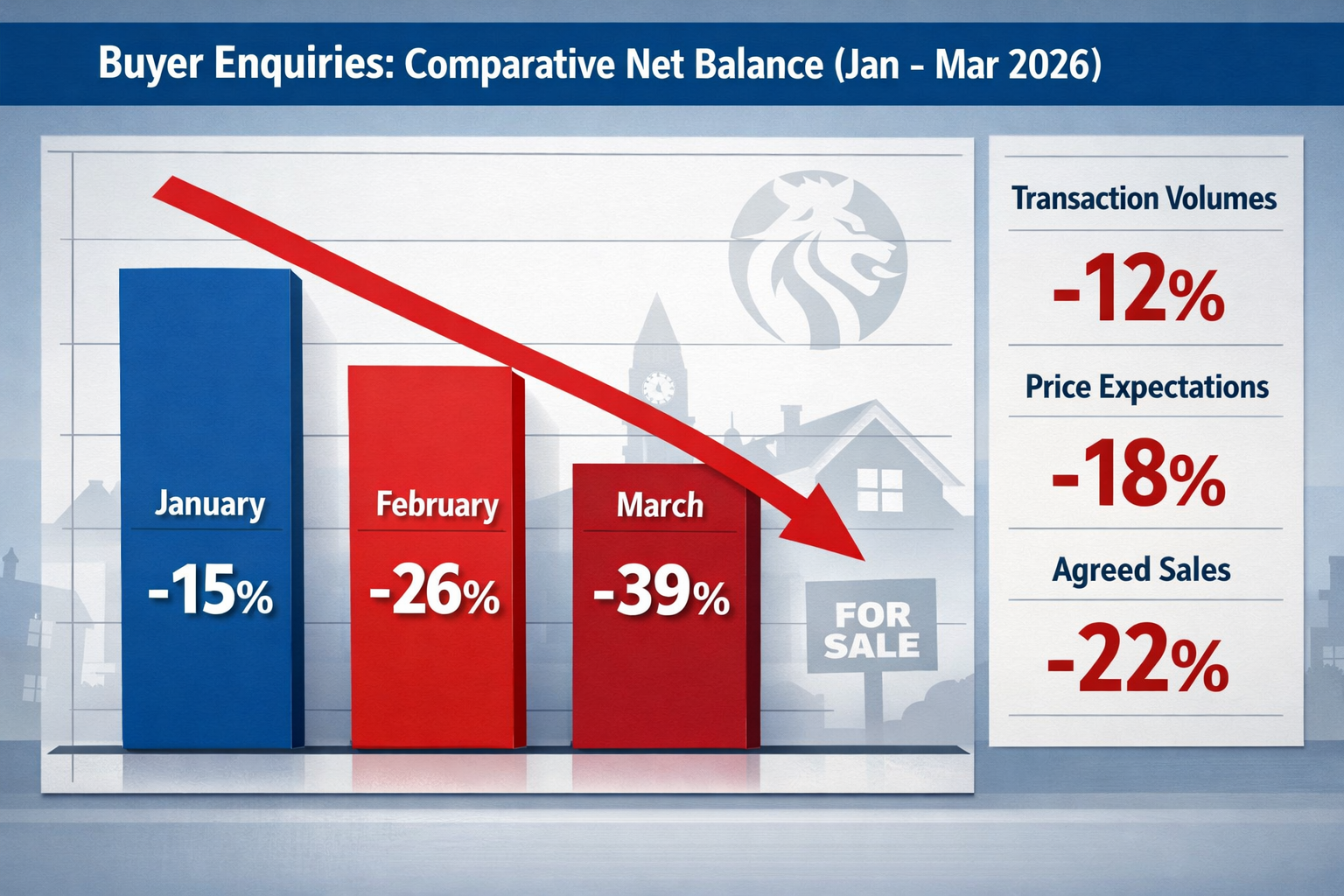
The February 2026 RICS survey data paints a picture of a market in retreat. Beyond the headline -26% net balance for new buyer enquiries, several interconnected metrics reveal the depth of the challenge facing registered RICS valuers across the United Kingdom.
Key Market Indicators from February 2026
| Metric | February 2026 | Previous Period | Change |
|---|---|---|---|
| New Buyer Enquiries | -26% | -15% (Jan) | ⬇️ -11pts |
| Agreed Sales | -12% | -8% (Jan) | ⬇️ -4pts |
| 12-Month Sales Expectations | +17% | +35% (Jan) | ⬇️ -18pts |
| Near-Term Price Expectations | +33% | +56% (Jan, London) | ⬇️ -23pts |
| New Instructions | +2% | +3% (Jan) | ⬇️ -1pt |
These figures demonstrate that Valuation Adjustments for Subdued Buyer Enquiries in RICS February 2026 Survey: Surveyor Tactics Amid Geopolitical Uncertainty are not merely academic exercises but practical necessities. The agreed sales figure of -12% net balance indicates that even properties reaching the point of sale agreement face challenges in completion [1].
Geopolitical and Economic Drivers
The February 2026 downturn didn't emerge in isolation. Several factors converged to create this subdued environment:
- Interest rate uncertainty following renewed inflation concerns
- Geopolitical tensions affecting consumer confidence and economic stability
- Mortgage affordability pressures limiting buyer purchasing power
- Economic uncertainty causing potential buyers to delay major financial commitments
Surveyors operating in this environment must account for these macro-level pressures when conducting property valuations and providing professional advice to clients.
Regional Variations in Market Weakness
While the national picture appeared challenging, regional disparities added complexity to valuation work. London experienced particularly sharp deterioration, with 12-month price expectations plummeting from +56% in January to just +7% in February—a dramatic 49-percentage-point collapse [1]. This regional volatility requires surveyors to apply location-specific adjustments rather than relying on national trends alone.
Valuation Methodology Adjustments for Weak Demand Conditions
When buyer enquiries weaken substantially, as demonstrated in the Valuation Adjustments for Subdued Buyer Enquiries in RICS February 2026 Survey: Surveyor Tactics Amid Geopolitical Uncertainty, traditional valuation approaches require careful reconsideration. The fundamental challenge lies in determining market value when market activity itself becomes sparse and unreliable.
Comparative Method Challenges in Low-Volume Markets
The comparative method—the cornerstone of residential valuation—depends on recent, relevant comparable evidence. However, January 2026 UK residential transactions totaled just 94,680 (seasonally adjusted), down 5% from December 2025 [4]. This reduced transaction volume creates several complications:
- Fewer recent comparables available within appropriate timeframes
- Wider variation in sale prices due to individual buyer circumstances
- Increased time lags between comparable sales and valuation dates
- Greater uncertainty about whether historical sales reflect current market conditions
Experienced valuers address these challenges by:
- Expanding geographic search parameters while maintaining relevance
- Applying time adjustments more aggressively to account for rapid market changes
- Weighting recent evidence more heavily than historical precedents
- Considering withdrawn or reduced-price listings as market indicators
Incorporating Survey Feedback into Valuations
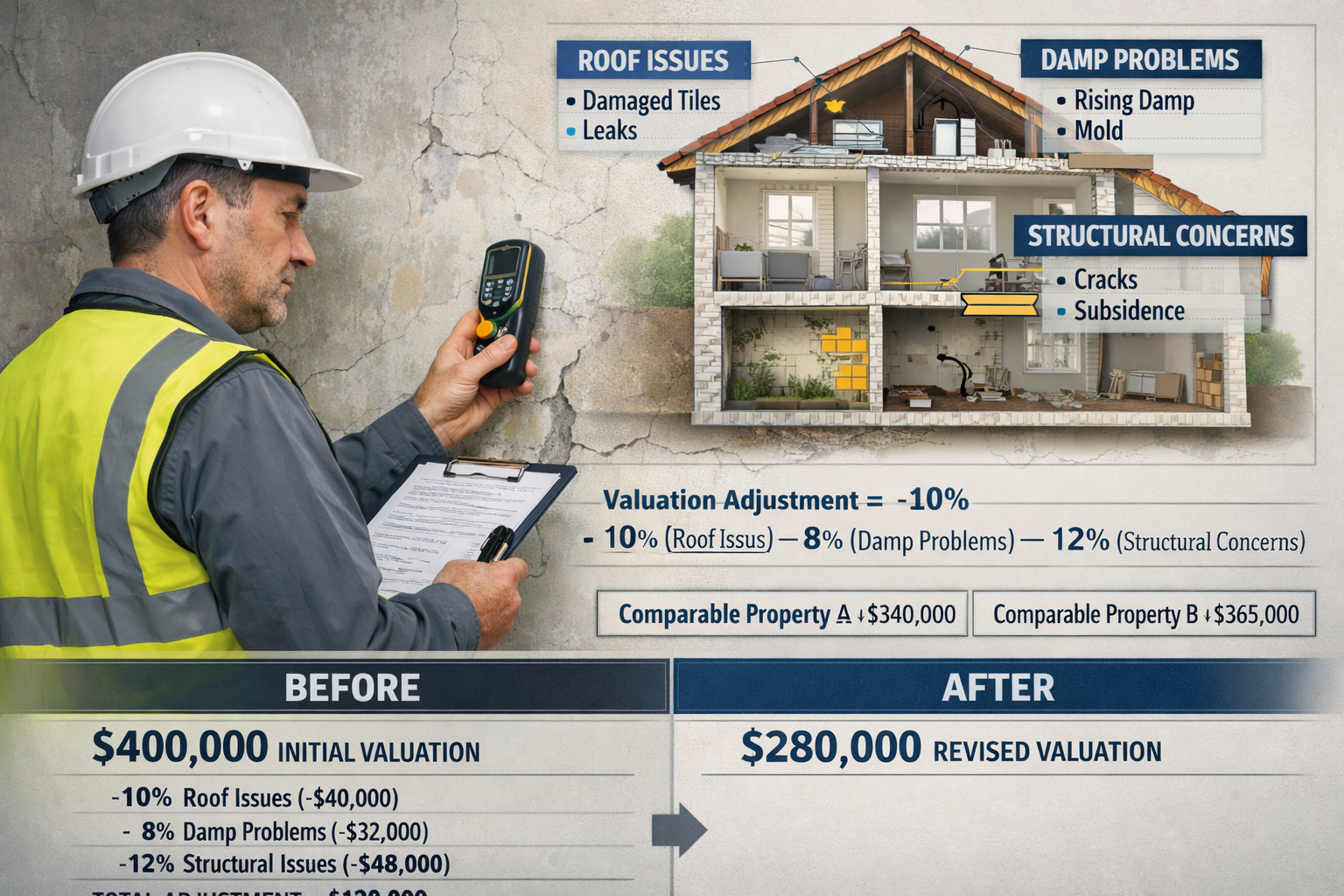
The February 2026 RICS survey revealed that surveyors increasingly use detailed Level 2 surveys (formerly RICS HomeBuyer Reports) to identify defects that justify price renegotiations [2]. This trend has significant implications for valuation factors that must be considered:
Defect-Based Adjustments:
- 🏚️ Structural issues (subsidence, cracking, movement)
- 💧 Damp and moisture penetration
- 🔧 Defective installations (electrical, plumbing, heating)
- 🏗️ Deferred maintenance and repair backlogs
When conducting valuations in markets characterized by subdued buyer enquiries, surveyors must anticipate that buyers will commission comprehensive surveys and negotiate based on findings. This reality necessitates conservative initial valuations that account for likely discovered defects rather than assuming best-case property condition.
Adjusting for Buyer Negotiating Power
The -26% net balance in buyer enquiries indicates a market where sellers significantly outnumber active buyers. This imbalance shifts negotiating power decisively toward buyers, who can:
- Demand price reductions based on survey findings
- Walk away from transactions without significant opportunity cost
- Negotiate extended completion periods and favorable terms
- Require sellers to address defects before completion
Valuers must incorporate this power dynamic into their assessments. Market commentary from the February survey noted that buyers remain "very price sensitive," translating to protracted negotiations at the point of sale agreement [2]. A realistic valuation in this environment should reflect the likely negotiated outcome rather than an optimistic asking price.
Methods of Valuation in Uncertain Markets
Different methods of valuation carry varying degrees of reliability during periods of market uncertainty:
Comparative Method: Remains primary but requires extensive adjustments and conservative interpretation of limited comparable evidence.
Investment Method: More stable for rental properties, as the February survey showed tenant demand at +2% net balance with rents expected to rise [1], providing clearer income-based valuation foundations.
Residual Method: Becomes more speculative as development profit margins compress and end-value uncertainty increases.
Profits Method: For specialized properties, becomes increasingly theoretical as trading conditions and business viability face heightened uncertainty.
Surveyor Tactics for Navigating the February 2026 Market Conditions
The practical application of Valuation Adjustments for Subdued Buyer Enquiries in RICS February 2026 Survey: Surveyor Tactics Amid Geopolitical Uncertainty requires specific tactical approaches that balance professional standards with market realities.
Enhanced Due Diligence and Investigation
In markets where buyers exercise increased caution, surveyors must conduct more thorough investigations:
Pre-Valuation Research:
- Review planning history and building control records more extensively
- Investigate local market conditions through agent interviews
- Analyze Days on Market (DOM) data for comparable properties
- Assess local economic indicators and employment trends
Physical Inspection Protocols:
- Allocate additional time for thorough property examination
- Use moisture meters, thermal imaging, and other diagnostic tools
- Document condition issues photographically for valuation support
- Identify potential negotiation points buyers might raise
This enhanced approach aligns with the increased use of specific defect reports and detailed surveys observed in the February 2026 market [2].
Realistic Pricing Strategies
The February survey emphasized that "realistic pricing from the outset became critically important" [2]. Surveyors advising clients on pricing strategy should:
✅ Recommend conservative initial pricing that reflects genuine market conditions
✅ Avoid optimistic valuations based on pre-downturn comparable evidence
✅ Build in negotiation buffers to account for buyer survey findings
✅ Consider seasonal factors and likely market trajectory over marketing period
Properties that enter the market overpriced experience limited viewing traction even when subsequently reduced, as buyer confidence in the seller's realism remains damaged.
Documentation and Audit Trail Enhancement
In an environment where valuations face increased scrutiny—particularly in mortgage lending contexts—comprehensive documentation becomes essential:
- Detailed comparable analysis with explicit adjustment rationale
- Market condition commentary explaining valuation context
- Assumption and special assumption documentation clearly stated
- Limitation acknowledgment regarding comparable evidence quality
- Uncertainty quantification where appropriate
This documentation proves invaluable if valuations are later challenged or if the valuer is called upon to serve as an expert witness in disputes.
Client Communication and Expectation Management
Subdued market conditions require particularly clear communication with clients:
For Sellers:
- Explain market conditions evidenced by RICS survey data
- Contextualize valuation within current demand environment
- Discuss realistic timeframes for sale completion
- Prepare for buyer negotiations and potential survey-based reductions
For Buyers:
- Highlight negotiating opportunities in current market
- Recommend comprehensive surveys to identify negotiation points
- Advise on realistic offer strategies that balance opportunity with risk
- Explain how geopolitical uncertainty affects property values
For Lenders:
- Provide market context for mortgage valuation decisions
- Highlight risks of overvaluation in declining demand environment
- Recommend conservative loan-to-value ratios where appropriate
- Flag properties with heightened value uncertainty
Expert Witness Considerations in Low Transaction Volume Environments
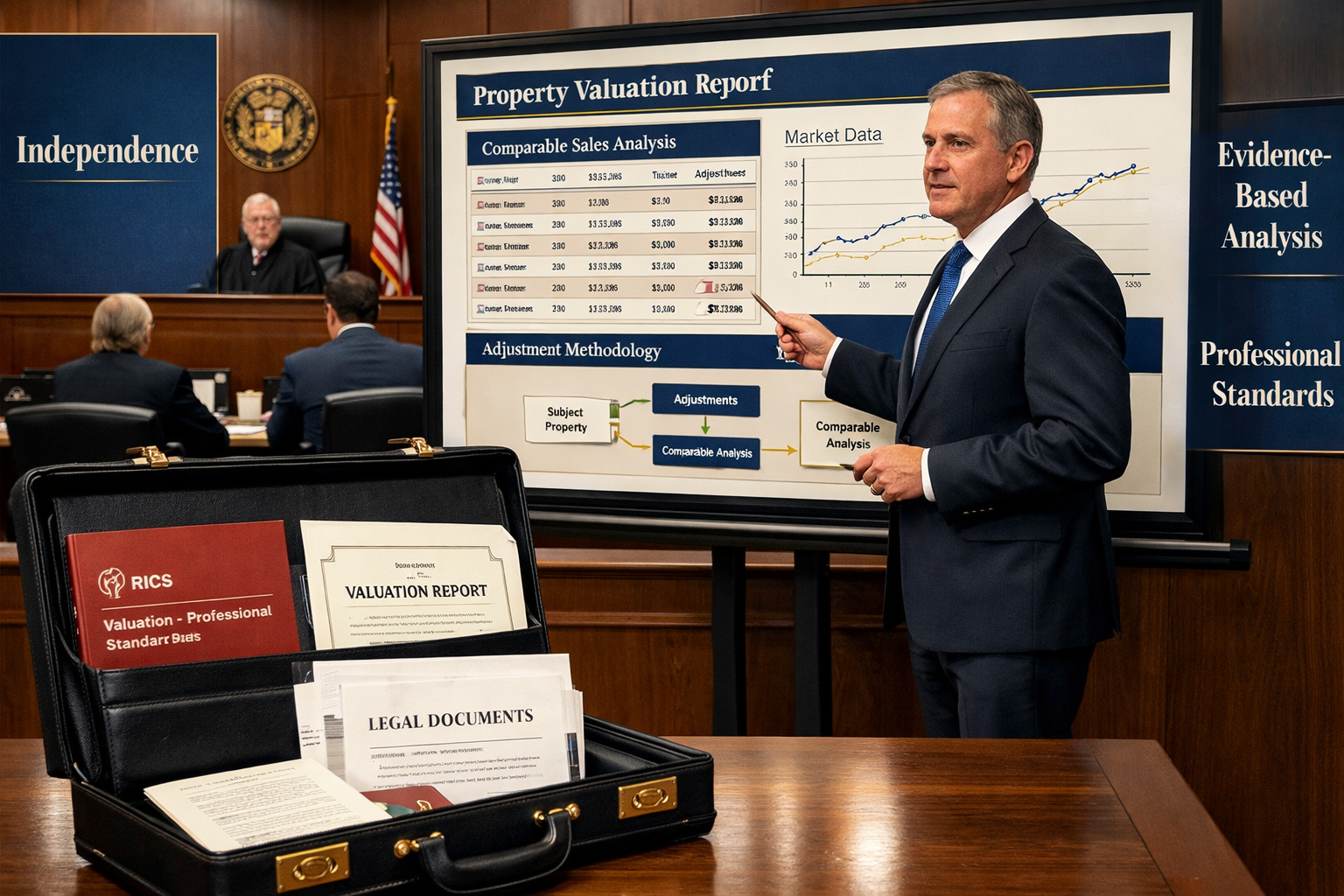
The Valuation Adjustments for Subdued Buyer Enquiries in RICS February 2026 Survey: Surveyor Tactics Amid Geopolitical Uncertainty create particular challenges for surveyors serving as expert witnesses in property disputes, mortgage lending disagreements, and valuation challenges.
Comparable Evidence Challenges in Tribunal Settings
When transaction volumes decline—as evidenced by the 94,680 transactions in January 2026 (down 5% from December) [4]—expert witnesses face heightened scrutiny regarding comparable evidence selection and adjustment. Tribunals and courts expect:
Rigorous Comparable Selection:
- Demonstrated efforts to identify all relevant transactions
- Explicit criteria for inclusion and exclusion of comparables
- Acknowledgment of limitations when comparable evidence is sparse
- Alternative valuation approaches when comparables are inadequate
Transparent Adjustment Methodology:
- Clear explanation of each adjustment applied to comparables
- Quantification of adjustment quantum with supporting rationale
- Consistency in adjustment approach across all comparables
- Recognition of increased uncertainty in adjustment precision
Market Condition Evidence and Expert Opinion
Expert witnesses must substantiate their valuation opinions with credible market evidence. The RICS February 2026 survey provides authoritative third-party evidence of market conditions that can support expert testimony:
📊 Quantifiable Market Indicators:
- Buyer enquiry trends (-26% net balance) demonstrating demand weakness
- Agreed sales figures (-12% net balance) showing transaction challenges
- Price expectation data revealing market sentiment shifts
- Regional variations highlighting location-specific factors
Expert witnesses can cite RICS survey data to contextualize their valuation approaches and demonstrate alignment with professional market understanding. This third-party validation strengthens expert credibility when explaining conservative valuation positions or significant adjustments.
Independence and Professional Standards
The subdued market conditions of February 2026 heighten the importance of expert witness independence. Pressure may increase to provide valuations that support client positions, but professional standards require:
⚖️ Unwavering Independence:
- Valuation opinions based solely on evidence and professional judgment
- Resistance to client pressure for favorable valuations
- Clear distinction between advocacy and expert evidence
- Adherence to RICS Practice Statement and Guidance Note on expert witness work
⚖️ Red Book Compliance:
- Strict adherence to RICS Red Book valuation standards
- Appropriate use of assumptions and special assumptions
- Clear reporting of material uncertainty where applicable
- Proper disclosure of limitations and qualifications
Mortgage Lending Disputes in Weak Markets
Subdued buyer enquiries create conditions where mortgage lending disputes become more frequent. Scenarios include:
Downvaluation Disputes:
Lenders instruct valuations that come in below agreed purchase prices, causing transaction failures. Expert witnesses may be called to opine on whether the downvaluation was reasonable given market conditions.
Negligent Valuation Claims:
When property values decline post-purchase, lenders or buyers may claim original valuations were negligently optimistic. Expert witnesses must assess whether the original valuation was supportable at the valuation date given then-available evidence.
Security Adequacy Assessments:
In enforcement proceedings, experts assess whether property values provide adequate security for outstanding loans, particularly relevant when values have declined since original lending.
In each scenario, the expert witness must demonstrate how Valuation Adjustments for Subdued Buyer Enquiries in RICS February 2026 Survey: Surveyor Tactics Amid Geopolitical Uncertainty inform their professional opinion while maintaining objectivity and adherence to professional standards.
Preparing Expert Reports in Uncertain Markets
Expert witness reports prepared during periods of market uncertainty require particular attention to:
Uncertainty Acknowledgment:
- Explicit statement of market uncertainty and its impact on valuation reliability
- Quantification of uncertainty where possible (e.g., valuation ranges)
- Discussion of how uncertainty affects confidence in opinion
- Reference to authoritative market evidence (such as RICS surveys)
Alternative Scenarios:
- Consideration of multiple valuation scenarios under different assumptions
- Sensitivity analysis showing value impact of key variables
- Discussion of market trajectory possibilities and implications
Professional Judgment Transparency:
- Clear explanation of professional judgments made in uncertain conditions
- Rationale for preferring certain evidence over alternatives
- Discussion of rejected approaches and reasons for rejection
Strategic Implications for Surveying Practices in 2026
The market conditions revealed in the Valuation Adjustments for Subdued Buyer Enquiries in RICS February 2026 Survey: Surveyor Tactics Amid Geopolitical Uncertainty carry broader strategic implications for surveying practices navigating the remainder of 2026 and beyond.
Service Mix Optimization
Subdued sales markets create opportunities to rebalance service offerings:
Growth Areas:
- 🏘️ Rental property valuations (tenant demand remained positive at +2% [1])
- 🔍 Detailed building surveys (increased buyer due diligence demand)
- ⚖️ Expert witness services (more disputes in challenging markets)
- 🏗️ Dilapidations and commercial work (diversification beyond residential sales)
Challenging Areas:
- 🏡 Standard mortgage valuations (reduced transaction volumes)
- 💰 Estate agency valuations (limited new instruction growth at +2% [1])
- 📈 Development appraisals (heightened uncertainty affecting feasibility)
Practices should consider expanding capabilities in RICS commercial building surveys and specialist defect surveys to diversify revenue streams.
Geographic Market Selection
The regional variation in market conditions—exemplified by London's particularly sharp deterioration—suggests strategic value in geographic diversification or specialization:
Diversification Strategy:
Practices operating across multiple regions can balance stronger and weaker markets, maintaining more stable workflow. Consider expanding coverage to areas showing relative resilience.
Specialization Strategy:
Practices can develop deep expertise in specific challenging markets, positioning themselves as go-to experts for complex valuations in difficult conditions. Areas served might include West London, East London, or Surrey depending on practice location and expertise.
Technology and Data Investment
Navigating uncertain markets requires superior market intelligence and analytical capabilities:
Essential Technology Investments:
- 📊 Comprehensive comparable evidence databases with robust filtering
- 📈 Market trend analysis tools tracking real-time indicators
- 🤖 Valuation automation for routine work, freeing capacity for complex cases
- 📱 Client communication platforms for enhanced service delivery
Data Partnerships:
Relationships with estate agents, auction houses, and data providers become increasingly valuable for accessing transaction evidence in low-volume markets.
Professional Development Priorities
The challenging conditions revealed in the February 2026 survey highlight specific professional development needs:
Priority Skills:
- Advanced comparable evidence analysis and adjustment techniques
- Expert witness training and tribunal experience
- Market analysis and economic forecasting capabilities
- Client communication and expectation management
- Specialized property type expertise (rental, commercial, complex residential)
Surveyors who develop these capabilities position themselves advantageously for both current market challenges and future opportunities.
Conclusion: Adapting Professional Practice to Market Realities
The Valuation Adjustments for Subdued Buyer Enquiries in RICS February 2026 Survey: Surveyor Tactics Amid Geopolitical Uncertainty represent more than technical valuation challenges—they require fundamental adaptation of professional practice to align with market realities. The -26% net balance in buyer enquiries, deteriorating further to -39% by March [5], signals a market environment where traditional approaches may produce unreliable results if applied without careful consideration.
Key Professional Imperatives
Conservative Valuation Approaches: In markets characterized by weak demand and heightened uncertainty, optimistic valuations serve neither clients nor the profession well. Realistic, evidence-based valuations that acknowledge market challenges provide the foundation for successful transactions and protect professional reputation.
Enhanced Due Diligence: The increased use of detailed surveys and buyer negotiation based on discovered defects [2] requires surveyors to conduct more thorough investigations and anticipate potential value-affecting issues that buyers will inevitably identify.
Transparent Communication: Clients navigating uncertain markets need clear, honest advice about market conditions, realistic pricing, and likely outcomes. Surveyors who provide this transparency build lasting client relationships and professional credibility.
Rigorous Documentation: Whether for routine valuations or expert witness work, comprehensive documentation of methodology, evidence, and professional judgment becomes essential when valuations face increased scrutiny.
Actionable Next Steps for Surveying Professionals
✅ Review current valuation methodologies to ensure they incorporate appropriate adjustments for subdued demand conditions
✅ Enhance comparable evidence databases to improve access to limited transaction data in low-volume markets
✅ Develop or strengthen expert witness capabilities to capitalize on increased dispute resolution opportunities
✅ Expand service offerings beyond standard mortgage valuations to include detailed surveys, rental valuations, and specialized work
✅ Invest in professional development focusing on advanced valuation techniques, market analysis, and client communication
✅ Establish systematic monitoring of RICS survey data and other market indicators to track evolving conditions
✅ Strengthen client communication protocols to manage expectations and explain market context effectively
Looking Forward
While the February 2026 RICS survey revealed challenging conditions, the 12-month sales expectations of +17% [2] suggest professional optimism about eventual market recovery. However, short-term expectations of -2% [2] indicate that difficult conditions will persist before improvement materializes.
Surveying professionals who adapt their practices now—implementing the tactics and adjustments discussed throughout this analysis—will not only navigate current challenges successfully but position themselves advantageously for the eventual market recovery. The profession's value lies precisely in providing reliable, professional guidance during uncertain times, and the current market environment offers opportunities to demonstrate that value convincingly.
For those seeking comprehensive property assessment in the current market, understanding how long a homebuyers survey takes and choosing the right property survey remain essential first steps toward making informed property decisions in 2026's challenging landscape.
References
[1] Uk Residential Survey February 2026 – https://www.rics.org/news-insights/uk-residential-survey-february-2026
[2] Uk Residential Market Survey February 2026 – https://www.rics.org/content/dam/ricsglobal/documents/market-surveys/uk-residential-market-survey/UK-Residential-Market-Survey_February-2026.pdf
[4] Uk Residential Property Market Update Spring 2026 – https://www.vailwilliams.com/uk-residential-property-market-update-spring-2026/
[5] Uk Residential Market Survey March 2026 – https://www.rics.org/content/dam/ricsglobal/documents/market-surveys/uk-residential-market-survey/UK-Residential-Market-Survey-March-2026.pdf