

{"cover":"Professional landscape format (1536x1024) hero image with bold text overlay 'Valuation Adjustments for Stabilizing Southern Markets: RICS Techniques for London Flats in 2026' in extra large 72pt white sans-serif font with dark shadow effect, positioned in upper third with perfect alignment. Background shows iconic London skyline with modern residential tower blocks and traditional Victorian mansion blocks in soft focus, overlaid with semi-transparent financial charts showing property price trends and adjustment curves. Color palette: deep navy blue, white text, gold accents representing premium London property market. High contrast professional composition with rule of thirds layout, editorial magazine cover quality, sophisticated business aesthetic with subtle RICS branding elements.","content":["Detailed landscape format (1536x1024) editorial image showing professional RICS chartered surveyor conducting on-site inspection inside modern London flat, measuring walls with laser device, wearing business attire with clipboard and tablet displaying property valuation software. Background shows bright contemporary apartment interior with floor-to-ceiling windows revealing London cityscape, natural daylight flooding space. Foreground includes architectural floor plans, EPC rating certificates, and comparative market analysis documents spread on table. Color scheme: professional blues, whites, warm wood tones. Clean, authoritative composition emphasizing technical expertise and methodical assessment process specific to London residential property valuation standards.","Comprehensive landscape format (1536x1024) infographic-style image displaying comparative valuation methods for London flats with three distinct visual sections: left third shows traditional comparable sales method with thumbnail property images and price points connected by lines, center third illustrates income capitalization approach with rental yield calculations and cash flow diagrams with percentage annotations, right third depicts residual valuation method with cost breakdown pie charts. Background features subtle London map with property hotspots marked. Includes data visualization elements: bar graphs comparing valuations across South London boroughs, trend arrows showing market adjustments, and RICS Red Book methodology icons. Professional color palette: navy, teal, orange accents, white space for clarity.","Detailed landscape format (1536x1024) conceptual image showing ESG factors impact on London flat valuations with split-screen composition. Left side displays older flat with poor EPC rating (D-G band in red/orange), visible cladding issues, outdated building systems, declining value graph overlay. Right side shows modern sustainable flat with EPC A-rating certificate prominently displayed in green, solar panels visible through window, smart home technology interfaces, rising value trend line. Center dividing line features large percentage symbols showing 2.9% premium differential. Background includes Building Safety Act 2022 compliance checklist, fire safety documentation, and environmental performance metrics. Color coding: red-to-green gradient representing energy efficiency spectrum, professional documentary photography style with data overlay elements."]}
London's property market stands at a critical juncture in 2026. After months of price stagnation and affordability pressures across Southern England, chartered surveyors face unprecedented challenges in delivering accurate valuations for residential flats. The Royal Institution of Chartered Surveyors (RICS) has responded with refined methodologies that address market volatility, regulatory changes, and emerging environmental factors. Understanding these Valuation Adjustments for Stabilizing Southern Markets: RICS Techniques for London Flats in 2026 has become essential for property professionals navigating today's complex landscape.

Recent market data reveals encouraging signs. The January 2026 RICS Residential Market Survey indicates conditions are "starting to turn a corner," with renewed interest in previously unsold stock as asking prices adjust to realistic levels[3]. Yet significant headwinds remain—from cladding remediation affecting over 3,000 London buildings to new Building Safety Act requirements and the growing influence of energy performance ratings on property values.
Key Takeaways
✅ Market stabilization techniques: RICS surveyors now employ enhanced comparative and income-based methods specifically calibrated for Southern England's affordability challenges and price adjustments
✅ Regulatory compliance impact: Properties over 11 metres require additional safety assessments under the Building Safety Act 2022, directly affecting valuation costs and outcomes[1]
✅ ESG premium quantified: EPC A-rated London flats achieve an average 2.9% price premium per square metre compared to EPC D properties, making energy performance a central valuation driver[2]
✅ Cost transparency: Standard RICS valuations for London flats range from £200–£400+ depending on property value, with additional fees for buildings affected by cladding or safety issues[1]
✅ Professional methodology: On-site inspections lasting 45–90 minutes examine structural condition, building services, and regulatory compliance before detailed Red Book valuation reports are prepared[1]
Understanding the Southern Market Context in 2026
Current Market Dynamics Affecting London Valuations
The Southern England property market—particularly London—experienced significant recalibration throughout 2025. Properties that remained unsold during this weaker period now attract renewed buyer interest as vendors adjust expectations. This creates unique challenges for valuation adjustments as surveyors must distinguish between temporary market corrections and fundamental value shifts.
The January 2026 RICS survey data shows particular activity in lower-priced flats and mid-market family houses, suggesting a bifurcated market where affordability constraints drive purchasing decisions[3]. For chartered surveyors conducting valuations, this means traditional comparable sales methods require careful adjustment to account for:
- Recent price reductions on previously overvalued properties
- Changing buyer demographics prioritizing affordability over premium features
- Geographic variations within London boroughs experiencing different recovery rates
- Seasonal patterns that may distort short-term comparable data
High-value properties face particular pressure. Data from February 2026 shows that 83% of offers on homes priced within 10% of £2 million came in below that threshold, compared to just 64% a year earlier[4]. This represents a significant valuation adjustment pressure that RICS surveyors must incorporate when assessing premium London flats.
Regulatory Framework Reshaping Valuation Standards
The Building Safety Act 2022 continues transforming how valuations are conducted for flats in buildings over 11 metres. These properties now require additional safety assessments during the RICS valuation process, potentially affecting both costs and timelines[1]. Surveyors must verify:
- Fire safety compliance documentation
- Cladding materials and remediation status
- Building registration with the Building Safety Regulator
- Resident safety information availability
Over 3,000 London buildings remain affected by cladding issues that directly impact valuation outcomes[1]. Lenders have become extremely cautious, often refusing mortgages or requiring substantial discounts on properties lacking proper safety certification. This creates a two-tier market where otherwise comparable flats can have vastly different valuations based solely on building safety compliance.
For property professionals seeking comprehensive assessments, engaging chartered surveyors in South West London or other regional specialists ensures local market knowledge combines with regulatory expertise.
RICS Valuation Adjustments for Stabilizing Southern Markets: RICS Techniques for London Flats in 2026
Comparative Method Refinements for Market Volatility
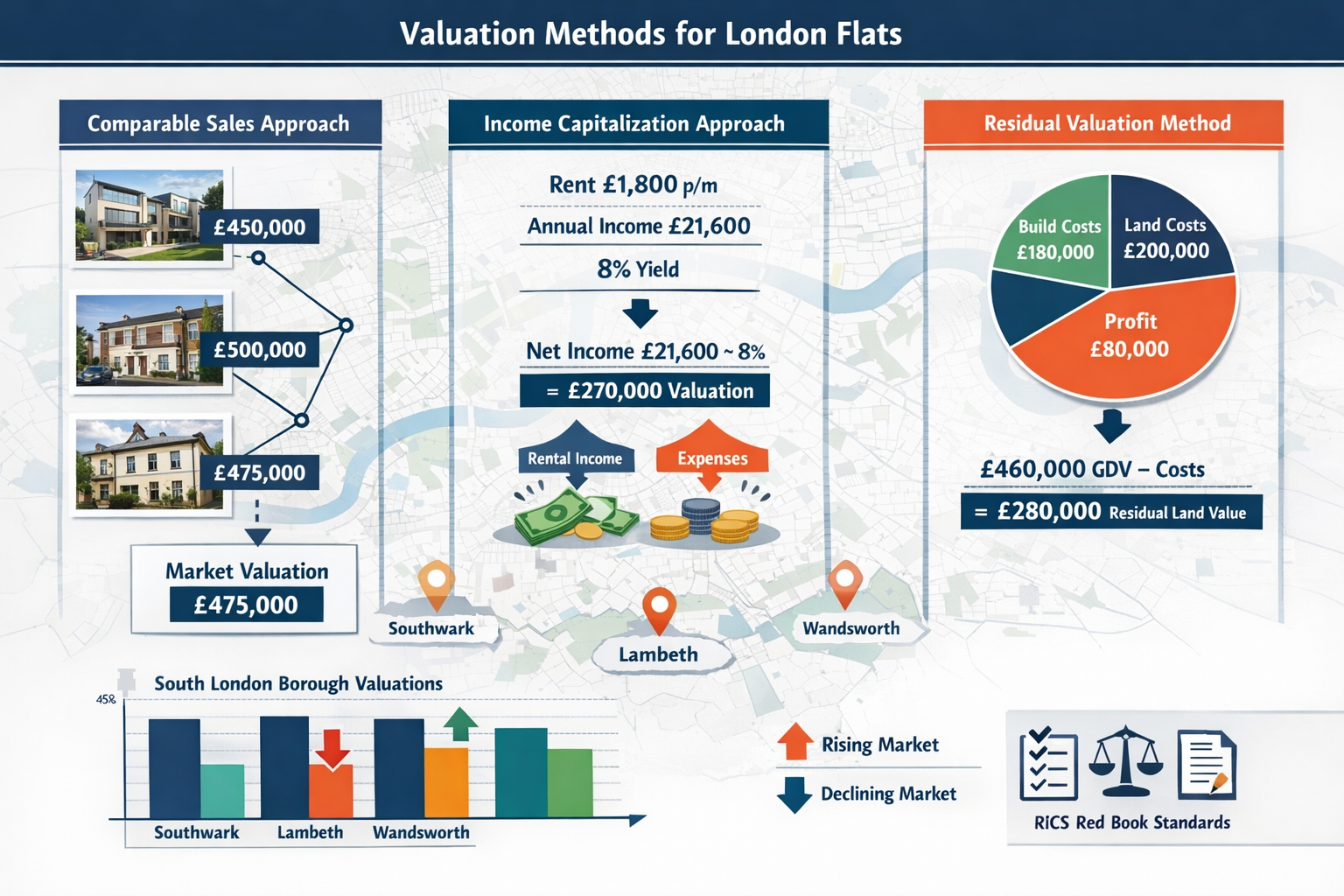
The comparative method remains the foundation of residential flat valuations, but RICS surveyors in 2026 apply sophisticated adjustments to account for market instability. This approach involves identifying similar properties recently sold and adjusting their prices to reflect differences with the subject property.
Key adjustment factors for London flats include:
| Adjustment Category | Typical Range | 2026 Considerations |
|---|---|---|
| Location premium | ±5-15% | Transport links, school catchments, regeneration zones |
| Condition variance | ±3-10% | Modernization standards, maintenance quality |
| Size differential | £500-800/sqm | Price per square metre varies significantly by borough |
| Lease length | ±2-20% | Leases under 80 years face exponential value reduction |
| EPC rating | -2.3% to +2.9% | A-rated properties command measurable premiums[2] |
| Building safety | -10% to -30% | Cladding issues create severe valuation penalties |
RICS surveyors now employ time-adjusted comparables that account for market movement between the comparable sale date and valuation date. In a stabilizing but volatile market, a property sold six months ago may require 2-5% adjustment to reflect current conditions.
The methods of valuation employed must be transparent and defensible, particularly when valuations inform mortgage lending decisions or Help to Buy schemes.
Income Capitalization Approach for Investment Flats
For buy-to-let properties and investment portfolios, the income capitalization method provides crucial valuation insight during periods of market uncertainty. This approach calculates property value based on rental income potential and market yield expectations.
Formula: Property Value = Net Annual Income ÷ Capitalization Rate
In 2026, RICS surveyors apply this method with particular attention to:
Rental market realities: London rental yields vary dramatically by location and property type. Prime Central London flats may yield 2.5-3.5%, while outer London boroughs achieve 4-6% gross yields. Surveyors must use current market rents rather than aspirational figures, especially in areas experiencing tenant affordability pressures.
Capitalization rate selection: The cap rate (yield) reflects market risk perception. Buildings with cladding issues or uncertain safety compliance may require cap rates 1-2 percentage points higher than comparable safe buildings, directly reducing valuation.
Operating expense deductions: Professional valuations account for service charges, ground rent, maintenance reserves, and void periods. London flats in managed blocks often have service charges of £2,000-5,000+ annually that significantly impact net income calculations.
Example calculation:
- Annual rental income: £24,000
- Service charge: £3,000
- Ground rent: £500
- Maintenance reserve: £1,000
- Net annual income: £19,500
- Market cap rate: 4.5%
- Indicated value: £19,500 ÷ 0.045 = £433,333
This method proves particularly valuable when comparable sales data is limited or unreliable due to market volatility. For properties requiring specialized assessment, commercial valuation expertise may be necessary.

Residual Valuation for Properties Requiring Remediation
The residual method has gained prominence in 2026 for valuing London flats requiring significant remediation work, particularly cladding replacement or fire safety upgrades. This approach calculates current value by subtracting remediation costs from the property's potential value once work is completed.
Formula: Current Value = Completed Value – (Remediation Costs + Professional Fees + Finance Costs + Developer Profit)
RICS surveyors applying this method must carefully assess:
- Completed value: What would the property be worth with all safety issues resolved?
- Remediation scope: Detailed cost estimates for cladding replacement, fire stopping, compartmentation improvements
- Funding certainty: Whether Building Safety Fund or developer contributions will cover costs
- Timeline impact: Extended remediation periods affect both costs and marketability
This technique requires collaboration between valuers and building surveyors who can accurately assess defect severity and remediation requirements. Properties identified through RICS specialist defect surveys often require this valuation approach.
Environmental, Social and Governance (ESG) Factors in 2026 Valuations
Energy Performance as a Central Value Driver
RICS released a groundbreaking framework in 2026 establishing Environmental, Social and Governance (ESG) factors as central drivers of residential property value rather than peripheral considerations[2]. This represents a fundamental shift in valuation methodology.
Quantified energy premium data from analysis of 6.8 million housing transactions (2014-2024) reveals:
- EPC A-rated properties: +2.9% price premium per square metre versus EPC D
- EPC B-rated properties: -2.3% discount versus EPC D
- EPC C-rated properties: -1.2% discount versus EPC D
- EPC E-G properties: Increasingly difficult to mortgage and sell[2]
These differentials have accelerated in 2026 as buyers recognize long-term energy cost implications and anticipate stricter rental property regulations. London flats with poor energy performance face compound valuation challenges:
- Reduced buyer pool as mortgage lenders restrict lending on low-EPC properties
- Higher running costs deterring purchasers amid cost-of-living pressures
- Future regulatory risk with potential rental restrictions on EPC E-G properties
- Remediation costs to improve ratings can exceed £10,000-30,000 for typical flats
RICS surveyors now routinely incorporate energy performance adjustments into comparative valuations, treating EPC ratings as equivalent in importance to location, size, and condition factors.
Building Safety and Social Governance Considerations
The "Social" and "Governance" components of ESG valuation increasingly focus on building safety, resident welfare, and management quality. For London flats, this encompasses:
Fire safety compliance: Properties with documented fire risk assessments, compliant escape routes, and proper compartmentation receive valuation premiums over buildings with outstanding safety concerns.
Management quality: Well-managed blocks with transparent service charge accounting, proactive maintenance, and resident engagement command higher values than poorly managed equivalents.
Accessibility and inclusivity: Buildings with lifts, accessible entrances, and adaptable design features appeal to broader demographics, supporting stronger valuations.
Community amenities: Shared facilities, green spaces, and resident services contribute to social value that RICS surveyors increasingly quantify in valuation adjustments.
For comprehensive property assessments incorporating these factors, RICS building surveys provide the detailed analysis necessary for accurate valuations.
Practical Application: Conducting RICS Valuations for London Flats in 2026
The Valuation Process and Timeline
Understanding the practical mechanics of RICS valuations helps property owners, buyers, and professionals navigate the process efficiently. Based on current 2026 practices:
Step 1: Instruction and Fee Agreement (Day 1)
- Valuation purpose clarified (mortgage, Help to Buy, probate, tax)
- Property details and constraints discussed
- Fee quoted based on property value: £200-£275 (under £250k), £275-£350 (£250k-£400k), £350-£400+ (over £400k)[1]
- Additional fees for buildings over 11 metres or with known defects
Step 2: Desktop Research (Days 1-3)
- Land Registry title examination
- Lease review (length, ground rent, restrictions)
- EPC certificate analysis
- Building Safety Register checks
- Comparable sales research
- Local market trend analysis
Step 3: On-Site Inspection (Days 3-7)
- Physical inspection lasting 45-90 minutes[1]
- Structural condition assessment
- Building services evaluation (heating, electrics, plumbing)
- Fire safety and building compliance observations
- Photographic documentation
- Measurement verification
- Neighborhood and location appraisal
Step 4: Valuation Analysis (Days 7-10)
- Comparable sales adjustment calculations
- Income approach modeling (if applicable)
- ESG factor quantification
- Risk assessment and market conditions review
- Final valuation figure determination
Step 5: Report Preparation (Days 10-14)
- Detailed valuation report with supporting evidence
- Methodology explanation and assumptions stated
- Market commentary and risk factors highlighted
- RICS Red Book compliance certification
- Report delivery to client or lender
For specialized valuations such as probate valuation or ATED valuation, additional considerations may extend timelines.
Cost Considerations and Value Optimization
Valuation costs for London flats in 2026 reflect property complexity and value:
- Standard valuations: £200-£400+ based on property value tiers[1]
- Buildings over 11 metres: Additional £100-£200 for safety assessment review
- Cladding-affected properties: Potential £150-£300 premium for enhanced due diligence
- Leasehold complexities: Additional fees for lease extension calculations or enfranchisement valuations
Maximizing valuation outcomes requires strategic preparation:
🏠 Pre-valuation improvements: Addressing obvious defects, ensuring EPC currency, gathering building safety documentation
📋 Documentation readiness: Lease, service charge accounts, building insurance, safety certificates, planning permissions for alterations
🔍 Comparable evidence: Providing recent sales data for similar properties can help surveyors identify appropriate benchmarks
⚡ Energy efficiency: Even modest EPC improvements (C to B) can yield measurable valuation benefits
🏗️ Building safety clarity: Obtaining clear statements from freeholders regarding cladding status and remediation plans removes valuation uncertainty
For properties with specific defects requiring remediation cost assessment, a specific defect report provides the detailed analysis necessary for residual valuation calculations.
Regional Variations Within London's Southern Markets
Borough-Level Valuation Dynamics
London's diverse boroughs experience distinct market dynamics that require localized valuation approaches:
Inner London premium zones (Westminster, Kensington & Chelsea, Camden): Properties maintain resilience despite high-value market pressures. International buyer interest provides price support, but affordability constraints limit first-time buyer activity. Valuations require careful comparable selection from genuinely equivalent micro-locations.
Regeneration hotspots (Southwark, Lewisham, Barking & Dagenham): Infrastructure investment and development activity create rapid value appreciation. Surveyors must distinguish between speculative pricing and sustainable value growth, often applying cautious adjustment factors.
Established family areas (Richmond, Kingston, Bromley): Mid-market stability with strong fundamentals. These areas show early signs of 2026 recovery with realistic pricing attracting renewed buyer interest[3]. Valuations benefit from robust comparable data.
Affordability-focused boroughs (Croydon, Bexley, Havering): Lower-priced flats experience strongest demand as buyers stretch budgets. Valuation challenges include limited comparable sales and rapid price movement requiring time adjustments.
Engaging local chartered surveyors with specific borough expertise ensures valuations reflect nuanced market conditions.
Leasehold Considerations Specific to London Flats
Leasehold tenure introduces unique valuation complexities requiring specialized RICS techniques:
Lease length impact: Properties with leases below 80 years face exponential value reduction. RICS surveyors apply established graphs (Parthenia tables) showing typical value loss:
- 90+ years: Minimal impact (0-2% reduction)
- 80-90 years: Modest impact (2-5% reduction)
- 70-80 years: Moderate impact (5-10% reduction)
- 60-70 years: Significant impact (10-20% reduction)
- Below 60 years: Severe impact (20%+ reduction)
Ground rent considerations: Onerous ground rents (doubling clauses, high fixed amounts) create valuation penalties as they reduce affordability and mortgage availability. RICS guidance requires explicit adjustment for ground rents exceeding 0.1% of property value.
Service charge analysis: High or unpredictable service charges directly impact investment value through income capitalization calculations. Surveyors review 3-5 years of accounts to identify trends.
Lease extension potential: Valuations may reference potential value with extended lease, particularly for properties approaching the 80-year threshold where statutory extension rights become more expensive.
For properties requiring lease extension analysis, specialized freehold valuation or collective enfranchisement expertise provides accurate calculations.
Future-Proofing Valuations: Emerging Trends for 2026-2027
Technology Integration in Valuation Practice
RICS-accredited surveyors increasingly leverage technology tools while maintaining professional judgment primacy:
Automated Valuation Models (AVMs): Desktop algorithms provide initial value estimates but require professional verification. RICS standards mandate physical inspections for formal valuations, though AVMs inform preliminary assessments and comparable selection.
Digital inspection tools: Laser measurement devices, thermal imaging cameras, and moisture meters enhance inspection accuracy. Detailed photographic documentation supports remote review and quality assurance.
Data analytics platforms: Sophisticated databases tracking sales, rentals, and market trends enable more precise comparable selection and adjustment calculations. Integration of EPC data, building safety registers, and planning information streamlines research.
Virtual viewing capabilities: While not replacing physical inspections, virtual tours and drone imagery supplement traditional methods, particularly for initial assessments or follow-up reviews.
These technologies enhance efficiency and accuracy but cannot replace the professional judgment, local knowledge, and regulatory expertise that RICS-qualified surveyors provide.
Anticipating Regulatory Evolution
The regulatory landscape continues evolving with implications for future valuations:
Minimum Energy Efficiency Standards (MEES): Potential extension to owner-occupied properties would create significant valuation impacts for low-EPC flats. Surveyors must consider regulatory risk in long-term value assessments.
Building Safety Act implementation: Ongoing regulatory development may introduce additional compliance requirements affecting valuation methodologies and costs.
Leasehold reform: Proposed legislation simplifying lease extensions and enfranchisement could alter traditional valuation approaches for leasehold flats.
Climate resilience requirements: Emerging focus on flood risk, overheating, and climate adaptation may introduce new valuation adjustment factors.
RICS professionals stay current through continuous professional development, ensuring valuation techniques evolve alongside regulatory frameworks.
Conclusion
Valuation Adjustments for Stabilizing Southern Markets: RICS Techniques for London Flats in 2026 represent sophisticated professional practice responding to unprecedented market complexity. The convergence of affordability pressures, regulatory transformation, building safety concerns, and environmental performance requirements demands enhanced valuation methodologies that go far beyond simple comparable sales analysis.
RICS-qualified surveyors now integrate multiple valuation approaches—comparative, income-based, and residual methods—calibrated to Southern England's unique market conditions. The quantified impact of ESG factors, particularly the 2.9% premium for A-rated energy performance[2], establishes environmental compliance as a central value driver rather than peripheral consideration.
For property owners, buyers, and professionals navigating London's flat market in 2026, several actionable steps optimize outcomes:
✅ Engage RICS-qualified professionals early to understand valuation factors specific to your property and location
✅ Prioritize building safety compliance by obtaining clear documentation regarding cladding status, fire safety, and Building Safety Act registration
✅ Invest strategically in energy performance improvements that deliver measurable valuation premiums and long-term cost savings
✅ Maintain comprehensive documentation including lease details, service charge accounts, building insurance, and alteration permissions
✅ Monitor local market trends through RICS survey data and borough-specific comparable sales to understand realistic value expectations
✅ Consider lease length implications proactively, particularly for properties approaching the critical 80-year threshold
✅ Seek specialist advice for complex situations involving remediation requirements, leasehold disputes, or tax-driven valuations
The encouraging signs of market stabilization identified in the January 2026 RICS survey[3] suggest opportunities for well-informed participants. Properties priced realistically based on professional RICS valuations attract renewed buyer interest, while overvalued stock continues languishing. This environment rewards those who embrace transparent, evidence-based valuation approaches that account for the full spectrum of factors affecting London flat values in 2026.
Whether you're purchasing, selling, refinancing, or managing London residential property, understanding and applying RICS valuation techniques provides the foundation for confident decision-making in stabilizing Southern markets. The investment in professional valuation expertise delivers clarity, supports successful transactions, and protects long-term financial interests in one of the world's most dynamic property markets.
References
[1] Rics Help To Buy Valuation London Cost Process Timescales 2026 Guide – https://winfieldssurveyors.london/rics-help-to-buy-valuation-london-cost-process-timescales-2026-guide/
[2] Future Property Valuation Influence Esg Criteria Residential Buildings – https://www.rics.org/news-insights/future-property-valuation-influence-esg-criteria-residential-buildings
[3] Uk Residential Market Survey January 2026 – https://www.rics.org/content/dam/ricsglobal/documents/market-surveys/uk-residential-market-survey/UK-Residential-Market-Survey_January-2026.pdf
[4] Post Budget 2026 Valuation Challenges Surveyor Strategies For High Value Properties Over 2 Million – https://nottinghillsurveyors.com/blog/post-budget-2026-valuation-challenges-surveyor-strategies-for-high-value-properties-over-2-million