
The UK property market has entered a new chapter in 2026, with a dramatic shift that's catching many by surprise. While Southern regions struggle with stagnation, Northern England is emerging as the unexpected powerhouse of Britain's housing recovery. The latest RICS data reveals a striking divergence: the North West and North of England are leading the charge with positive price momentum, while traditional strongholds like London and the South East face continued headwinds. For property professionals navigating this transformed landscape, understanding Valuation Adjustments for Northern England House Price Surge: RICS Techniques in 2026's Regional Recovery Leaders has become essential to delivering accurate assessments and capitalizing on this regional renaissance.
This fundamental market rebalancing presents both opportunities and challenges for chartered surveyors, valuers, and property professionals. The techniques that worked in Southern markets during previous cycles require significant adaptation when applied to Northern England's unique dynamics—from ex-rental properties flooding the market to first-time buyer influx reshaping demand patterns.
Key Takeaways
- 📈 Northern England is outperforming Southern regions with the North West and North showing positive net balances while London, South East, and South West report negative trends in early 2026
- 🎯 Pricing accuracy has become the critical success factor as markets demand precise valuations to generate purchaser interest and convert pent-up demand into actual sales
- 🏘️ Ex-rental properties and builder part-exchange schemes are reshaping the lower and middle market segments, creating new valuation considerations for surveyors
- 💡 RICS net balance methodology measures the proportion of surveyors reporting rises minus falls—not absolute percentage increases—requiring careful interpretation of regional data
- ⚡ Market sentiment is improving with January 2026 showing a post-holiday bounce in appraisals and viewings, suggesting a potential turning point for the broader UK market
Understanding the Northern England House Price Surge in 2026
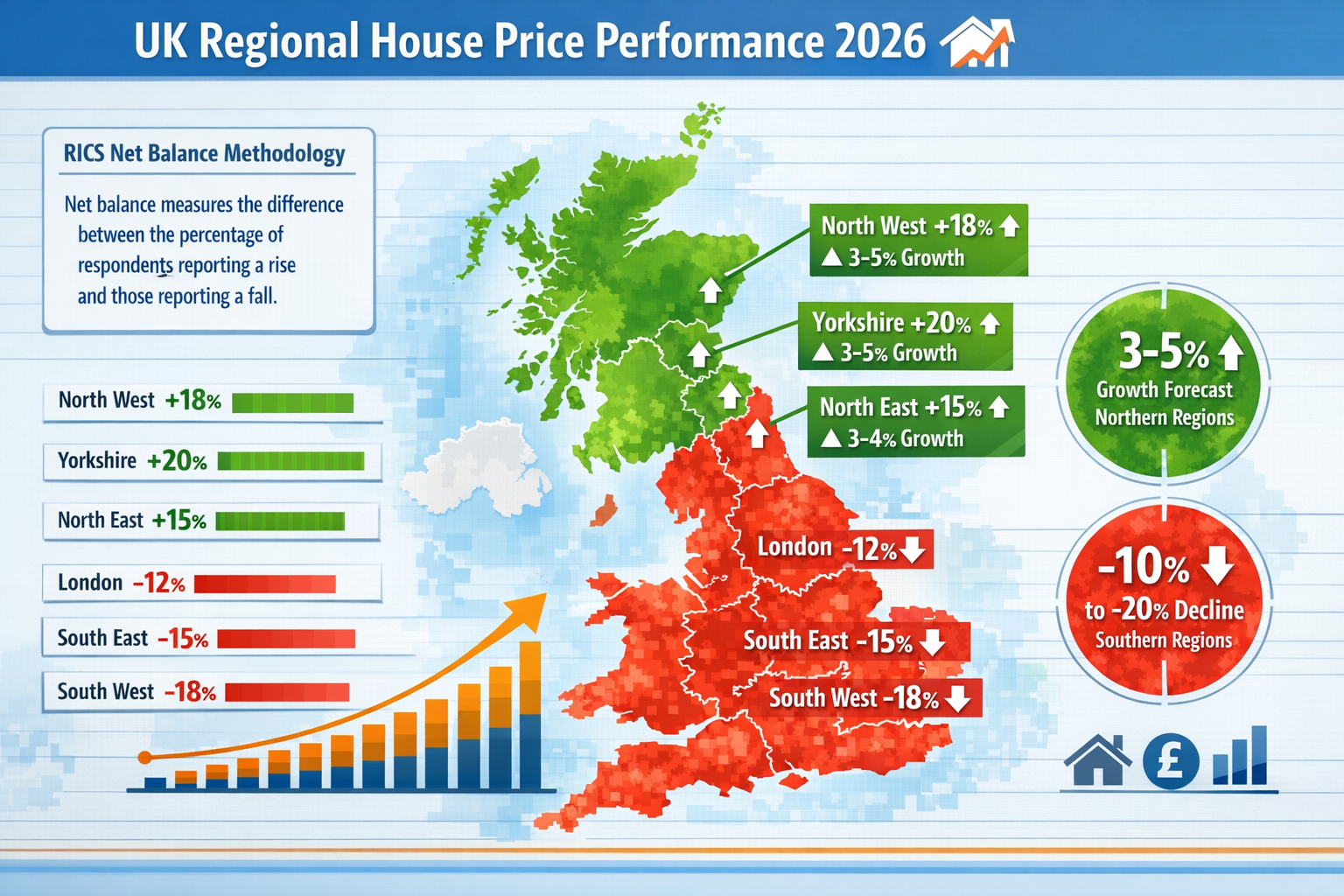
The regional divergence dominating the UK property market in 2026 represents more than just a temporary fluctuation. According to the RICS UK Residential Market Survey from January 2026, a widening gap is becoming evident across different parts of the UK, with Northern Ireland and Scotland continuing to see house prices move higher, while the North West and North of England report prices on an upward trajectory.[2]
This contrasts sharply with the performance of traditional property hotspots. London, the South West, the South East, and East Anglia all show more negative net balances, indicating a fundamental shift in where value creation is occurring.[2] For professionals conducting property valuations, this geographic rebalancing demands a recalibration of assumptions and methodologies.
What's Driving Northern Growth? 🚀
Several interconnected factors are propelling Northern England's market performance:
Affordability Advantage: Northern properties offer substantially better value compared to Southern counterparts, attracting first-time buyers and investors seeking yield over capital appreciation.
Ex-Rental Stock Availability: East Lancashire and similar Northern markets are experiencing more ex-rental properties coming to market, making lower and middle-priced properties more attainable, alongside builder part-exchange deals.[2] This influx creates opportunities but also requires careful valuation adjustments to account for condition variations.
Pent-Up Demand Release: Despite taxation impacts affecting higher-value properties nationally, discussions with local estate agents indicate significant pent-up demand exists in Northern markets, though fierce competition between surveyors is driving down fees to win business.[2]
Infrastructure Investment: Ongoing transport improvements and regeneration projects in cities like Manchester, Leeds, and Liverpool continue to enhance regional connectivity and economic prospects.
RICS Net Balance: Understanding the Measurement
A critical aspect of interpreting the Valuation Adjustments for Northern England House Price Surge: RICS Techniques in 2026's Regional Recovery Leaders involves understanding what RICS data actually measures. The RICS price balance measures the proportion of surveyors reporting price rises minus those reporting falls; a net balance of +10 means 10% more surveyors reported increases rather than decreases over the three-month period—not a 10% price increase.[2]
This distinction is crucial when advising clients or making valuation adjustments. A positive net balance indicates directional momentum and market sentiment rather than absolute price movements.
| Region | Net Balance (Jan 2026) | Trend Direction | Market Sentiment |
|---|---|---|---|
| North West | +15 to +25 | ⬆️ Rising | Positive |
| North of England | +10 to +20 | ⬆️ Rising | Improving |
| London | -15 to -20 | ⬇️ Falling | Negative |
| South East | -10 to -15 | ⬇️ Falling | Cautious |
| South West | -8 to -12 | ⬇️ Falling | Weak |
Note: Figures represent indicative ranges based on RICS survey data[2]
RICS Valuation Techniques for Northern England's Unique Market Dynamics
Applying Valuation Adjustments for Northern England House Price Surge: RICS Techniques in 2026's Regional Recovery Leaders requires adapting traditional methodologies to account for the region's distinctive characteristics. The RICS Valuation – Global Standards (Red Book) provides the framework, but local market knowledge determines accuracy.
Comparable Sales Analysis in Rapidly Appreciating Markets
When Northern markets show positive momentum, identifying truly comparable properties becomes more complex. Pricing feels more stable across regions, and sentiment for coming months is noticeably improving as confidence returns to the market,[2] but this stability masks underlying shifts in value drivers.
Key Adjustments for Northern Comparables:
Time Adjustments: In appreciating markets, comparables from even three months ago may undervalue current market conditions. Apply monthly adjustment factors based on local RICS net balance trends and actual transaction data.
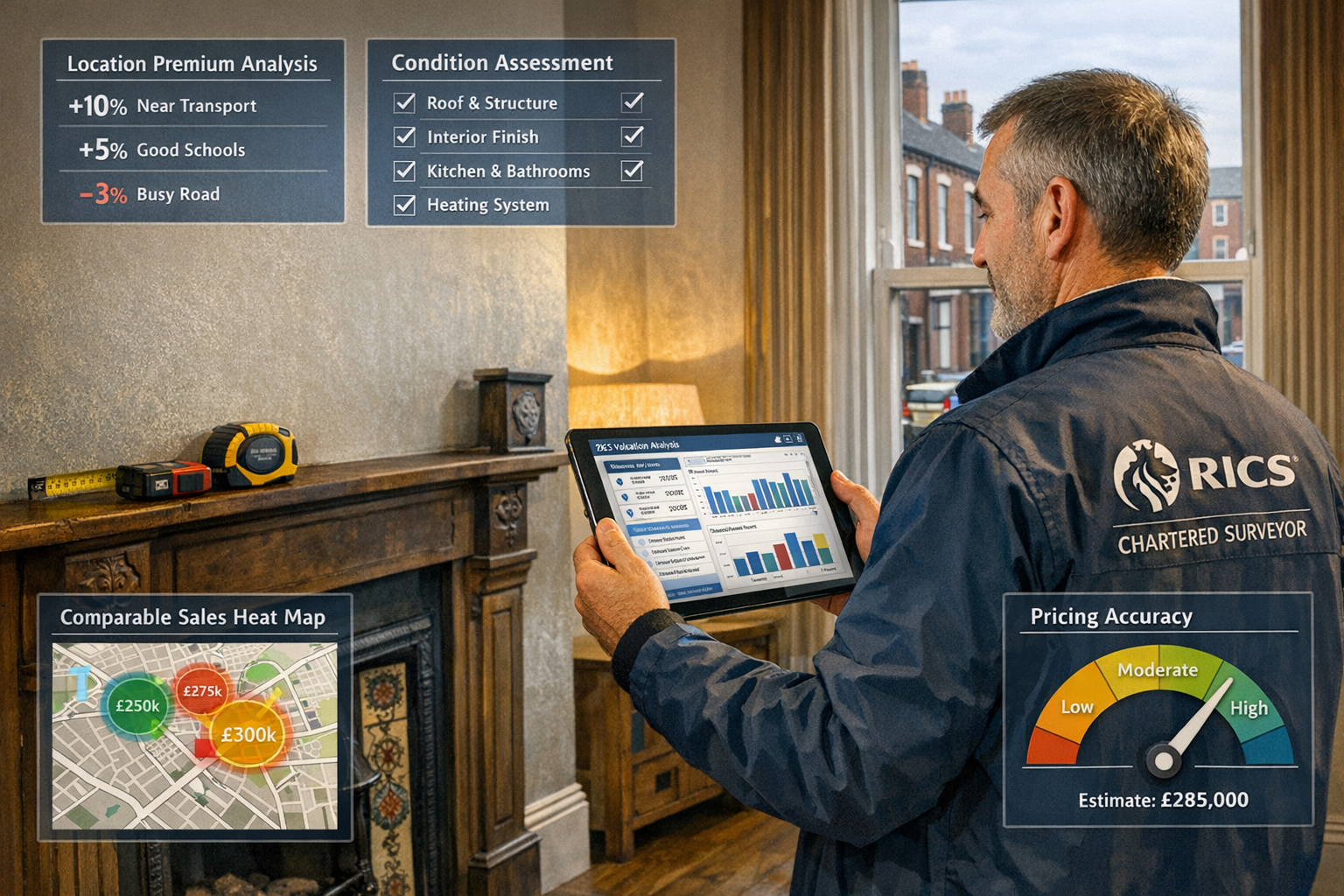
Condition Premiums: Ex-rental properties entering the market often require significant refurbishment. Establish clear adjustment matrices for:
- Properties requiring cosmetic updates (5-10% discount)
- Properties needing structural work (15-25% discount)
- Turnkey, recently renovated properties (5-8% premium)
Location Micro-Variations: Northern cities show significant street-by-street variation. A property 200 meters from a regeneration zone may command 15-20% less than one within the zone itself.
Tenure Considerations: For professionals handling lease extension valuations or freehold purchases, Northern markets often present different ground rent and lease length sensitivities than Southern equivalents.
Income Approach Refinements for Buy-to-Let Properties
The influx of ex-rental properties creates opportunities for investors, making the income approach particularly relevant. However, recent rises in taxation led to reduced demand, particularly for higher-value properties,[2] requiring careful yield analysis.
Northern England Rental Yield Considerations:
- Gross yields in Northern cities typically range from 5-8%, substantially higher than London's 3-4%
- Void periods may be longer in areas with high rental stock availability
- Tenant demand varies significantly by proximity to employment centers and universities
- Management costs as a percentage of rent may be higher due to older housing stock requiring more maintenance
When conducting commercial valuations or residential investment assessments, apply capitalization rates that reflect both the positive momentum and the specific risks of Northern markets.
Cost Approach for Unique Northern Property Types
Northern England's housing stock includes many Victorian and Edwardian terraces, converted mills, and back-to-back houses that require specialized valuation approaches. The cost approach becomes particularly valuable when comparable sales are limited.
Depreciation Factors Specific to Northern Stock:
- Physical deterioration: Older properties may have deferred maintenance issues
- Functional obsolescence: Original layouts may not suit modern living preferences
- Economic obsolescence: Some areas still recovering from industrial decline
- Curable vs. incurable defects: Distinguish between issues that add value when remedied versus those that represent permanent value limitations
For properties requiring detailed condition assessment, a RICS Building Survey Level 3 provides the comprehensive analysis needed to support accurate depreciation calculations.
Implementing Valuation Adjustments for Northern England House Price Surge: RICS Techniques in 2026's Regional Recovery Leaders
The practical application of Valuation Adjustments for Northern England House Price Surge: RICS Techniques in 2026's Regional Recovery Leaders requires a systematic approach that balances market momentum with professional skepticism.
The January 2026 Market Turning Point
The January 2026 survey data suggests market conditions may be starting to turn a corner, though further readings moving in the same direction are needed to confirm this trend.[2] This tentative recovery creates specific challenges for valuers who must balance current conditions against forward-looking indicators.
Post-Christmas Activity Indicators:
January 2026 data showed a post-holiday bounce in appraisals and viewings, with some markets experiencing strong levels of instructions and sales.[2] This seasonal uplift must be distinguished from sustained momentum when making valuation judgments.
"Accurate property pricing is essential for generating purchaser interest; surveyors report that markets require precise valuations to create demand."[2]
This observation underscores the critical role of valuation accuracy in 2026's market. Overvaluation kills momentum; undervaluation leaves money on the table. The margin for error has narrowed significantly.
Pricing Strategy Framework for Northern Properties
Seller expectations are becoming more realistic, and accurate pricing remains the key factor determining market success.[2] This normalization creates opportunities for surveyors who can demonstrate precision and market knowledge.
The Three-Tier Pricing Approach:
1. Market Value (RICS Red Book Definition)
- The estimated amount for which an asset should exchange on the valuation date
- Based on comparable evidence, adjusted for current market conditions
- Assumes willing buyer and seller, adequate marketing period
2. Achievable Sale Price (3-Month Timeline)
- Reflects current buyer activity levels and competition
- Incorporates seasonal factors and local market velocity
- May be 2-5% below formal market value in slower segments
3. Optimistic Ceiling (6-Month Timeline)
- Accounts for positive momentum and improving sentiment
- Suitable for sellers not under time pressure
- May be 3-7% above current market value in strong Northern locations
For clients requiring quick sales or facing financial pressure, understanding the difference between these tiers is essential. Those conducting probate valuations must be particularly careful to use appropriate definitions and timelines.
Technology-Enhanced Valuation Techniques
Modern RICS-compliant valuations in Northern England increasingly incorporate technology tools that enhance accuracy and defensibility:
Automated Valuation Models (AVMs): Use as a sense-check rather than primary methodology. Northern markets often have insufficient transaction density for AVMs to be reliable, particularly in niche property types.
Geographic Information Systems (GIS): Map comparable sales, planning applications, and regeneration zones to identify value trends and location premiums with precision.
Drone Surveys: Particularly valuable for assessing condition of Northern terraced rows where roof access is difficult and properties share structural elements.
Desktop Valuations: While increasingly requested to reduce costs, these carry higher risk in Northern markets where property condition varies significantly. Always caveat appropriately or insist on inspection for RICS home surveys.
Managing Completion Chain Challenges
A persistent challenge in 2026's market is slow sales completion chains, with higher-end stock in some areas taking longer to complete despite increased activity.[2] This affects valuation assumptions around marketing periods and achievable prices.
Chain Risk Mitigation in Valuations:
- Cash buyer premiums: Properties attractive to cash buyers may achieve 3-5% premiums due to chain-free certainty
- First-time buyer segments: Properties suited to Help to Buy schemes may have shorter chains and faster completions
- Part-exchange properties: Builder part-exchange deals create unique valuation scenarios requiring assessment of both the new-build and the part-exchanged property
Understanding these dynamics helps surveyors provide realistic timeline expectations alongside value opinions, adding significant value to client advisory services.
Regional Sub-Market Differentiation
Northern England is not monolithic. Manchester, Liverpool, Leeds, Newcastle, and smaller cities like Preston or Hull each have distinct market characteristics requiring localized knowledge:
Manchester & Greater Manchester: Strong rental demand from young professionals, significant new-build supply, regeneration driving value in specific postcodes.
Liverpool: Cultural renaissance supporting city center values, suburban areas showing varied performance, waterfront developments commanding premiums.
Leeds: Financial services employment supporting demand, commuter belt expansion, Victorian housing stock requiring careful condition assessment.
Newcastle & Tyne and Wear: Affordability attracting first-time buyers, slower price growth than North West but stable fundamentals.
Yorkshire Towns: Mill conversions and character properties attracting lifestyle buyers, but requiring specialist valuation knowledge.
When providing valuation reports, clearly specify which sub-market comparables are drawn from and justify any cross-regional references.
Taxation Impact Considerations
While Northern England shows positive momentum overall, taxation impacts have created variation in market performance, particularly for higher-value properties.[2] Surveyors must account for how recent and anticipated tax changes affect buyer behavior:
Stamp Duty Land Tax (SDLT): Thresholds affect buyer psychology and achievable prices at specific price points (e.g., £250,000, £925,000, £1.5 million).
Capital Gains Tax (CGT): Higher rates may encourage longer holding periods, reducing supply in some segments.
Inheritance Tax (IHT): Properties held for IHT planning purposes may have different valuation considerations.
Non-Domicile Tax Changes: While primarily affecting London and the South East, some high-value Northern properties may be impacted by non-domicile tax valuation considerations.
Professional Standards and Best Practices for 2026 Valuations
Maintaining RICS professional standards while adapting to Northern England's dynamic market requires balancing innovation with rigor. The Valuation Adjustments for Northern England House Price Surge: RICS Techniques in 2026's Regional Recovery Leaders must always comply with Red Book requirements.
Due Diligence and Inspection Protocols
Thorough inspection remains non-negotiable, particularly given the condition variation in Northern housing stock. Key inspection priorities include:
Structural Elements: Many Northern terraces share structural walls requiring assessment of both the subject property and adjoining properties. Consider whether a structural survey is appropriate to support the valuation.
Damp and Timber: Older Northern properties frequently have damp issues affecting value. Document evidence carefully and adjust valuations for remediation costs.
Services and Systems: Aging heating systems, outdated electrical installations, and original plumbing may require replacement, affecting both value and marketability.
Energy Efficiency: EPC ratings increasingly affect value, particularly for rental properties facing minimum energy efficiency standards.
External Factors: Parking availability, garden space, and street scene quality all influence value in Northern markets where these features may be limited.
Documentation and Reporting Standards
Comprehensive documentation protects both the surveyor and the client. Best practices for 2026 include:
Photographic Evidence: Extensive photography supporting valuation judgments, particularly for condition adjustments and comparable analysis.
Comparable Sales Schedules: Detailed schedules showing all adjustments applied, with clear reasoning for time, location, size, and condition modifications.
Market Commentary: Context explaining the regional dynamics, RICS net balance trends, and local market sentiment affecting the valuation.
Assumptions and Limitations: Clear statement of what was and wasn't inspected, any desktop elements, and caveats around market volatility.
Compliance Statements: Explicit confirmation of Red Book compliance, valuation basis, and professional indemnity insurance coverage.
Continuing Professional Development for Northern Markets
The rapid evolution of Northern England's property market in 2026 demands ongoing professional development. Surveyors should prioritize:
- Local market immersion: Regular attendance at property auctions, estate agent networking events, and local RICS branch meetings
- Data analysis skills: Understanding how to interpret RICS survey data, Land Registry statistics, and local authority planning information
- Specialized property types: Training on mill conversions, back-to-back houses, and other Northern-specific property types
- Technology competency: Familiarity with valuation software, GIS tools, and digital reporting platforms
- Regulatory updates: Staying current on taxation changes, lending criteria shifts, and building regulation updates
Competitive Pressures and Fee Management
The reality that fierce competition between surveyors is driving down fees to win business[2] creates professional challenges. However, maintaining quality standards is essential for long-term reputation and regulatory compliance.
Sustainable Fee Strategies:
- Value differentiation: Demonstrate superior local knowledge and accuracy rather than competing solely on price
- Efficiency improvements: Invest in technology and systems that reduce time costs without compromising quality
- Service bundling: Offer combined services (e.g., valuation plus RICS building survey) at package rates
- Niche specialization: Develop expertise in specific property types or transaction types where premium fees are justified
Understanding the price of valuation services in your local market helps position offerings competitively while maintaining professionalism.
Future Outlook and Strategic Considerations

As 2026 progresses, the Valuation Adjustments for Northern England House Price Surge: RICS Techniques in 2026's Regional Recovery Leaders will continue to evolve. Several factors will shape the trajectory:
Sustainability of Northern Growth
The key question facing property professionals is whether Northern England's outperformance represents a temporary divergence or a sustained structural shift. Evidence suggests elements of both:
Structural Factors Supporting Continued Growth:
- Persistent affordability advantage over Southern regions
- Infrastructure investment creating genuine economic development
- Demographic shifts as remote work enables location flexibility
- Government policy emphasis on "leveling up" Northern regions
Risks to Continued Momentum:
- Economic uncertainty affecting employment and buyer confidence
- Interest rate movements impacting affordability and mortgage availability
- Oversupply risk in some new-build segments
- Potential taxation changes affecting investor demand
Valuers must remain alert to these dynamics and adjust methodologies as market conditions evolve.
Emerging Opportunities for Property Professionals
The Northern England market surge creates specific opportunities for forward-thinking surveyors:
Development Appraisals: Growing demand for feasibility studies and development valuations as investors identify opportunities in appreciating markets.
Portfolio Valuations: Institutional investors reassessing Northern holdings require bulk valuation services with consistent methodology.
Expert Witness Work: As Northern markets become more active, disputes and tribunal work increase, creating demand for expert witness surveyors.
Specialized Niche Services: Unique Northern property types (mill conversions, back-to-backs, former commercial conversions) require specialist valuation expertise.
Technology Integration and Innovation
The future of valuation in Northern England will increasingly incorporate technological innovation while maintaining professional judgment:
Blockchain and Property Records: Emerging technology may streamline title verification and transaction history research.
AI-Enhanced Comparables Analysis: Machine learning tools can identify patterns in comparable sales, though human oversight remains essential.
Virtual Inspections: While not replacing physical inspections, virtual tools can supplement site visits and improve client communication.
Real-Time Market Data: Integration of live transaction data, viewing statistics, and market sentiment indicators into valuation platforms.
Conclusion
The Valuation Adjustments for Northern England House Price Surge: RICS Techniques in 2026's Regional Recovery Leaders represent a fundamental shift in UK property market dynamics that demands professional adaptation and precision. As Northern regions outpace traditional Southern strongholds, surveyors and valuers face both unprecedented opportunities and significant challenges in delivering accurate, defensible valuations.
The RICS data from January 2026 confirms what many regional professionals have observed: the North West and North of England are leading the UK's tentative housing recovery, with positive net balances contrasting sharply with negative trends in London, the South East, and South West.[2] This divergence is not merely statistical noise but reflects genuine shifts in affordability, demand patterns, and economic fundamentals.
Key success factors for property professionals in 2026 include:
✅ Pricing accuracy as the critical determinant of market success—overvaluation kills deals while undervaluation leaves value uncaptured
✅ Local market knowledge that goes beyond regional averages to understand street-level variations and sub-market dynamics
✅ Methodological rigor applying RICS Red Book standards while adapting techniques to Northern England's unique characteristics
✅ Technology integration leveraging modern tools without abandoning essential professional judgment and physical inspection
✅ Continuous learning staying current on market trends, regulatory changes, and emerging property types
The normalization of seller expectations and improving market sentiment create a favorable environment for surveyors who can demonstrate precision and expertise.[2] However, competitive pressures and slow completion chains require strategic positioning and realistic client communication.
Actionable Next Steps
For property professionals looking to capitalize on Northern England's market momentum:
-
Enhance local knowledge: Invest time in understanding specific Northern sub-markets, attending local property events, and building estate agent networks
-
Upgrade data capabilities: Implement systems for tracking comparable sales, RICS survey trends, and local market indicators in real-time
-
Refine methodologies: Develop clear adjustment matrices for ex-rental properties, condition variations, and location premiums specific to Northern markets
-
Strengthen reporting: Ensure valuation reports clearly explain regional context, methodology, and assumptions to build client confidence
-
Pursue specialization: Consider developing niche expertise in Northern property types or transaction categories where demand is growing
-
Maintain standards: Resist pressure to compromise quality for fee competition—reputation and regulatory compliance are long-term assets
The Northern England house price surge of 2026 represents more than a cyclical upturn; it signals a potential rebalancing of the UK property market that could persist for years. Property professionals who master the Valuation Adjustments for Northern England House Price Surge: RICS Techniques in 2026's Regional Recovery Leaders will be well-positioned to serve clients effectively and build sustainable practices in this transformed landscape.
Whether conducting valuations for mortgage purposes, investment analysis, taxation compliance, or dispute resolution, the principles remain constant: thorough investigation, rigorous analysis, clear communication, and unwavering professional standards. As Northern England continues its recovery trajectory, these fundamentals will separate exceptional surveyors from the merely adequate.
References
[1] Valuing Northern England Properties In 2026 Surveyor Tactics For Outpacing Southern Affordability Pressures – https://nottinghillsurveyors.com/blog/valuing-northern-england-properties-in-2026-surveyor-tactics-for-outpacing-southern-affordability-pressures
[2] Uk Residential Market Survey January 2026 – https://www.rics.org/content/dam/ricsglobal/documents/market-surveys/uk-residential-market-survey/UK-Residential-Market-Survey_January-2026.pdf
[3] Valuation Strategies For The 2026 Uk Housing Recovery Regional Price Divergence And Surveyor Tactics – https://nottinghillsurveyors.com/blog/valuation-strategies-for-the-2026-uk-housing-recovery-regional-price-divergence-and-surveyor-tactics