New buyer enquiries plummeted to -39% net balance in March 2026—a 10-point monthly deterioration that marks the weakest reading since summer 2023[1]. This dramatic collapse in market activity didn't emerge from domestic policy shifts or seasonal trends. Instead, the Royal Institution of Chartered Surveyors (RICS) March 2026 survey reveals how Valuation Adjustments for Geopolitical Uncertainty in Spring 2026: RICS Survey Insights for Buyer Sentiment Risks have become the defining challenge for property professionals navigating unprecedented market volatility triggered by Middle East conflict escalation and surging energy costs.
The convergence of geopolitical instability, inflationary pressures, and deteriorating buyer confidence has forced chartered surveyors to fundamentally recalibrate their valuation methodologies. With near-term house price expectations crashing 24 points in a single month to -43% net balance, understanding how to quantify and adjust for sentiment-driven risks has never been more critical for accurate property assessments.
Key Takeaways
- 📉 Buyer enquiries collapsed to -39% net balance in March 2026, representing a 10-point monthly decline and the weakest demand reading since summer 2023
- 🌍 Geopolitical escalation in the Middle East directly triggered market uncertainty, with oil price surges pushing UK inflation higher and dampening buyer confidence
- 💷 Near-term price expectations plunged 24 points to -43% net balance, forcing surveyors to implement substantial downward valuation adjustments
- 📊 12-month outlook deteriorated from +33% to +2% net balance over two months, signaling fundamental shifts in long-term property value projections
- 🔧 RICS-accredited surveyors are implementing specific adjustment protocols to account for heightened transaction risk, extended marketing periods, and sentiment volatility
Understanding the March 2026 RICS Survey Results and Market Context
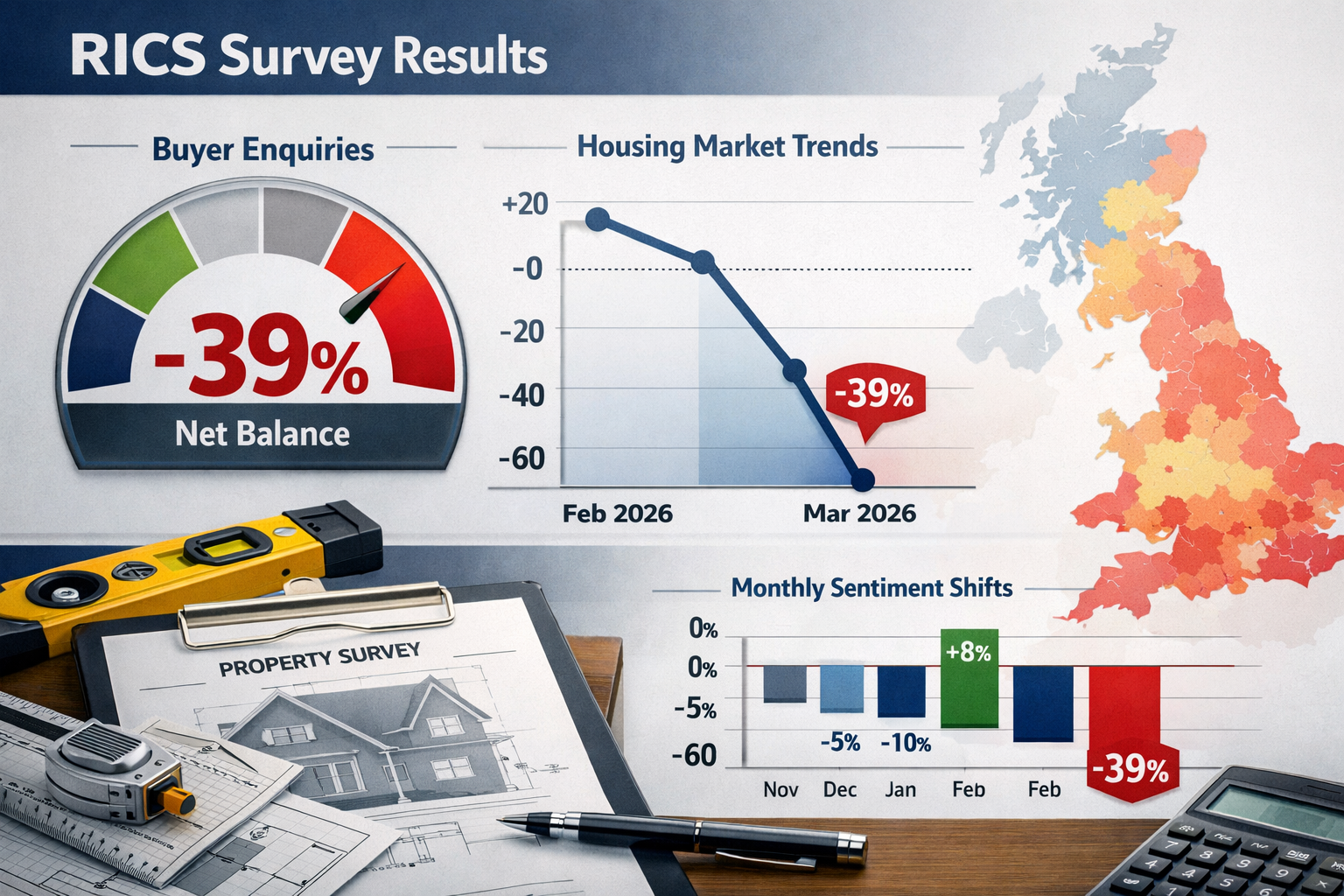
The RICS UK Residential Market Survey for March 2026 documents an extraordinary deterioration in market fundamentals that extends far beyond typical cyclical corrections. The data reveals multiple simultaneous pressure points converging to create exceptional valuation complexity.
Buyer Demand Collapse: The Numbers Behind the Crisis
The -39% net balance for new buyer enquiries represents more than statistical noise—it reflects a fundamental withdrawal of market participants[1]. To contextualize this figure, net balance calculations measure the difference between surveyors reporting increases versus decreases. A -39% reading means that 39% more respondents observed declining enquiries than rising ones, indicating widespread demand contraction across UK regions.
This 10-point monthly deterioration from February's already-weak -29% reading demonstrates accelerating momentum in the wrong direction[1]. The speed of decline matters as much as the absolute level, as rapid sentiment shifts create valuation uncertainty that static methodologies cannot adequately capture.
Sales Expectations: Near-Term Pessimism Intensifies
Near-term sales expectations experienced an even more dramatic reversal, plunging from a neutral -4% net balance in February to -33% in March 2026[1]. This 29-point monthly swing represents one of the sharpest single-month deteriorations in forward-looking sentiment recorded in recent survey history.
The distinction between current activity and forward expectations proves particularly significant for valuation professionals. While current transaction volumes provide observable data points, expectations influence pricing negotiations, marketing strategies, and ultimately achievable sale prices. When surveyors collectively anticipate further contraction, this pessimism becomes self-reinforcing through conservative buyer offers and vendor pricing adjustments.
House Price Outlook: From Optimism to Stagnation
Perhaps most striking for valuation adjustments, the 12-month house price expectations collapsed from +43% in January to +2% in March 2026—a 41-point reversal in just two months[1]. This represents a complete evaporation of the price optimism that characterized early 2026, replaced by expectations of essentially flat nominal values over the coming year.
The near-term picture appears even more challenging, with three-month price expectations at -43% net balance, down 24 points from February's -19% reading[1]. This suggests surveyors anticipate immediate downward pressure on achievable prices before any potential stabilization later in the year.
The Geopolitical Trigger: Middle East Conflict and Energy Shocks
RICS respondents consistently identified geopolitical escalation in the Middle East and rising oil prices as primary drivers of renewed market uncertainty in their February 2026 responses[3]. By March, these concerns had materialized into measurable economic impacts.
The U.S.-Iran conflict escalated in late February 2026, shifting from theoretical risk to real supply disruption[2]. This triggered broad risk-off movements across financial markets, with the S&P 500 declining -4.3% in the first quarter of 2026[2]. More directly relevant to UK property markets, U.S. gasoline prices rose approximately $0.60 per gallon within two weeks of the conflict's onset[2].
Bloomberg Economics estimated March 2026 CPI at 3.4% year-over-year, up from 2.4% in February—a full percentage point monthly acceleration driven substantially by energy cost increases[2]. This inflationary shock directly impacts mortgage affordability and buyer purchasing power, creating immediate downward pressure on property demand.
Valuation Adjustments for Geopolitical Uncertainty in Spring 2026: Practical Surveyor Approaches
The unique challenge facing chartered surveyors in spring 2026 centers on quantifying risks that traditional comparable-based methodologies struggle to capture. When market sentiment shifts rapidly due to external geopolitical factors, recent transaction evidence quickly becomes outdated, and forward-looking adjustments become essential.
Identifying Sentiment-Driven Valuation Risk Factors
Professional surveyors conducting RICS building surveys must now explicitly account for several sentiment-related risk factors:
🔸 Transaction Volume Risk: With buyer enquiries at -39% net balance, the probability of achieving a sale within typical marketing periods has declined substantially. This affects not just market value assessments but also forced sale valuations and auction reserve pricing.
🔸 Price Negotiation Leverage: Weak demand fundamentals shift negotiating power decisively toward buyers, who can credibly threaten to withdraw from transactions. Surveyors must adjust comparable evidence downward to reflect this dynamic, particularly for properties requiring any remedial work identified during surveys.
🔸 Marketing Period Extensions: Properties that might have sold within 8-12 weeks in normal conditions may now require 16-24 weeks or longer. Extended marketing creates additional holding costs for vendors and increases the risk of further price deterioration during the sales process.
🔸 Mortgage Valuation Conservatism: Lenders' internal valuers typically adopt more conservative stances during periods of market uncertainty. This can create a gap between asking prices and mortgage offers, forcing transaction price reductions even when buyers remain willing at higher levels.
Quantifying Downward Adjustments: The Spring 2026 Framework
Professional valuation reports prepared in spring 2026 increasingly incorporate explicit geopolitical risk adjustments. While precise percentages vary by property type, location, and price segment, several frameworks have emerged:
Sentiment Discount Factor: Many RICS-accredited surveyors now apply a 3-7% sentiment discount to comparable evidence from Q4 2025 and Q1 2026 when preparing current valuations. This adjustment reflects the observable deterioration in buyer willingness to transact at previously achievable price levels.
Liquidity Adjustment: For properties in segments experiencing particularly weak demand (such as higher-value homes above £1 million), additional 2-4% liquidity discounts account for extended marketing requirements and reduced buyer competition.
Inflation-Adjusted Affordability: With mortgage rates remaining elevated due to persistent inflation concerns, affordability-constrained segments require explicit adjustments. Surveyors calculate maximum sustainable prices based on typical income multiples and current lending rates, then adjust valuations downward where market evidence exceeds these thresholds.
Regional Variation in Adjustment Magnitude
The impact of geopolitical uncertainty varies significantly across UK regions. Chartered surveyors in West London and other prime markets report more pronounced buyer hesitancy, as international purchasers—particularly sensitive to geopolitical risk—withdraw from the market. Conversely, chartered surveyors in Surrey and chartered surveyors in Sussex note that domestic buyer demand in commuter locations shows relatively greater resilience.
This regional divergence requires location-specific adjustment factors rather than uniform national discounts. Properties in areas with higher proportions of international buyers or luxury segments warrant larger sentiment adjustments than entry-level homes in regions with strong local employment.
RICS Survey Insights for Buyer Sentiment Risks: Implications for Different Valuation Types

Different valuation purposes require distinct approaches to incorporating geopolitical uncertainty and buyer sentiment risks. The spring 2026 market conditions create particular challenges across several common valuation scenarios.
Mortgage Lending Valuations: Conservative Approaches Dominate
Lenders commissioning valuations for mortgage purposes prioritize downside protection, making them particularly sensitive to sentiment deterioration. The March 2026 RICS survey data provides direct evidence that justifies conservative valuation stances.
When conducting Red Book valuations for lending purposes, chartered surveyors must explicitly consider the -43% net balance for near-term price expectations[1]. This doesn't translate to a 43% valuation reduction, but it does warrant substantial caution in selecting comparable evidence and applying adjustments.
Many lenders have internally tightened their loan-to-value ratios in response to market uncertainty, effectively requiring larger deposits even when surveyors provide valuations at asking prices. This creates a practical ceiling on achievable transaction prices regardless of theoretical market values.
Purchase Valuations: Protecting Buyer Interests
Buyers commissioning independent valuations before purchase face particularly acute risks in the spring 2026 market. With near-term price expectations deeply negative, purchasing at current asking prices creates substantial risk of immediate equity loss if market conditions continue deteriorating.
Professional surveyors conducting purchase valuations must balance several competing considerations:
- Comparable Evidence Timing: Recent transactions may have completed based on agreements reached weeks or months earlier, when sentiment was stronger. Adjusting for this timing lag becomes essential.
- Vendor Motivation Assessment: Properties that have been marketed for extended periods may achieve prices below recent comparables as vendors become increasingly motivated to complete sales.
- Future Marketability: Buyers should understand not just current value but also likely saleability if they need to sell within 1-2 years—a critical consideration when 12-month price expectations sit at just +2% net balance[1].
Commercial Property Valuations: Amplified Uncertainty
While the RICS March 2026 survey focuses on residential markets, commercial property valuations face even greater complexity from geopolitical uncertainty. Commercial building surveys must account for tenant business confidence, which deteriorates sharply during geopolitical crises.
Retail and hospitality properties prove particularly vulnerable, as consumer spending typically contracts when energy costs surge and economic uncertainty rises. Office valuations must consider whether corporate tenants will maintain space commitments or seek downsizing opportunities during economic stress.
Investment valuations for commercial properties require explicit risk premium adjustments in discount rate selection, often adding 50-100 basis points to reflect heightened uncertainty about future rental income and capital values.
Specialized Valuation Scenarios
Several specialized valuation types face unique challenges in the spring 2026 environment:
Help to Buy Valuations: Properties purchased under government equity loan schemes require periodic revaluations. Current market weakness creates tension between homeowners hoping for low valuations (to minimize equity loan repayment) and government interests in recovering appropriate equity shares.
Reinstatement Cost Valuations: Insurance purposes require assessment of rebuilding costs, which have increased due to construction material inflation even as market values stagnate. This creates growing gaps between reinstatement costs and market values, particularly for older properties.
Collective Enfranchisement: Leaseholders seeking to purchase freeholds must negotiate based on valuations of landlord interests. Market uncertainty creates disputes over appropriate capitalization rates and growth assumptions in these calculations.
Central Bank Responses and Their Valuation Implications
Understanding monetary policy responses to geopolitical shocks proves essential for medium-term valuation outlooks. The Federal Reserve held the federal funds rate unchanged at 3.50%-3.75% at its March 17-18, 2026 meeting, with the FOMC explicitly acknowledging that Middle East developments create uncertainty for the U.S. economy[2].
More significantly for forward-looking valuations, the Federal Reserve revised 2026 PCE inflation projections upward to 2.7%—a 0.3 percentage-point increase representing the largest single-year upward revision in recent memory[2]. This suggests borrowing costs will remain elevated longer than previously anticipated, maintaining pressure on property affordability throughout 2026.
The Bank of England faces similar constraints, with energy-driven inflation limiting its ability to reduce rates despite weakening property market conditions. This creates a challenging environment where traditional monetary policy responses to housing market weakness remain unavailable due to inflation concerns.
Interest Rate Expectations and Mortgage Pricing
Mortgage market pricing reflects these central bank constraints. Fixed-rate mortgage products have repriced upward since late February 2026, with five-year fixed rates rising 20-30 basis points as lenders anticipate sustained higher base rates.
For valuation purposes, this means affordability constraints will likely tighten further rather than ease over coming months. Surveyors must incorporate these expectations when assessing sustainable price levels, particularly for properties at the upper end of typical buyer affordability ranges.
Practical Guidance for Property Stakeholders
Different market participants require tailored strategies for navigating Valuation Adjustments for Geopolitical Uncertainty in Spring 2026: RICS Survey Insights for Buyer Sentiment Risks.
For Property Buyers
✅ Commission Independent Valuations: Don't rely solely on mortgage valuations, which protect lender interests rather than buyer interests. Independent RICS building surveys with valuation components provide unbiased market assessments.
✅ Negotiate Aggressively: With buyer enquiries at -39% net balance, vendors face limited alternatives. Well-evidenced offers 5-10% below asking prices are increasingly accepted in spring 2026.
✅ Factor Future Marketability: Consider not just current value but also likely saleability if circumstances require selling within 1-2 years. Properties with unique features or narrow buyer appeal carry additional risk in weak markets.
✅ Secure Rate Certainty: Lock in fixed-rate mortgages to protect against further rate increases if inflation remains elevated. Variable rate products carry substantial risk in the current environment.
For Property Vendors
✅ Price Realistically from Outset: Properties that linger on the market for months become stigmatized, often achieving lower final prices than properties priced correctly initially. Commission professional valuations that incorporate current sentiment data.
✅ Consider Timing Flexibility: If not forced to sell immediately, waiting 6-12 months may allow market conditions to stabilize. However, this strategy carries risk if conditions deteriorate further.
✅ Highlight Positive Features: In weak markets, properties must actively compete for limited buyer attention. Professional photography, comprehensive information packs, and addressing obvious defects before marketing become more important.
✅ Remain Negotiation-Ready: Expect buyers to conduct thorough due diligence and negotiate based on survey findings. Building flexibility into initial pricing creates room for negotiation without derailing transactions.
For Property Investors
✅ Reassess Return Requirements: With capital growth expectations near zero for 12 months, investment cases must rely primarily on rental yields. Ensure gross yields exceed 5-6% to provide adequate returns after costs.
✅ Stress-Test Assumptions: Model scenarios where property values decline 5-10% and rental demand softens. Ensure investment structures can withstand adverse conditions without forced sales.
✅ Focus on Resilient Sectors: Residential properties in areas with strong employment and limited new supply show greater resilience than speculative developments or secondary locations.
✅ Maintain Liquidity Reserves: Avoid over-leveraging portfolios. Maintain cash reserves to cover void periods and unexpected maintenance without requiring emergency refinancing in unfavorable conditions.
For Chartered Surveyors and Valuation Professionals
✅ Document Uncertainty Explicitly: Valuation reports should clearly articulate the heightened uncertainty environment, referencing RICS survey data and geopolitical factors. This protects professional liability while informing clients appropriately.
✅ Widen Valuation Ranges: Consider providing valuation ranges rather than point estimates when uncertainty is elevated. A range of ±5% acknowledges market volatility while still providing useful guidance.
✅ Update Comparable Adjustments: Review adjustment factors monthly during periods of rapid sentiment change. Adjustments appropriate in January 2026 may be insufficient by March given the speed of deterioration.
✅ Engage in Continuous Professional Development: Understanding geopolitical risk factors, inflation dynamics, and monetary policy requires knowledge beyond traditional surveying expertise. Investment in economic literacy pays dividends in valuation accuracy.
✅ Communicate Proactively with Clients: Explain the rationale behind adjustments and assumptions. Clients who understand the reasoning behind conservative valuations are more likely to accept recommendations and less likely to dispute professional opinions.
Understanding Survey Duration and Timing Considerations
Market volatility creates particular challenges around survey timing. Those wondering how long a homebuyers survey takes should recognize that in spring 2026, the gap between survey completion and transaction completion may span several weeks or months—during which market conditions can shift substantially.
This timing gap creates risk that valuations become outdated before transactions complete. Some surveyors now include explicit validity periods in valuation reports, noting that opinions are based on market conditions as of the inspection date and may require updating if completion is delayed beyond 8-12 weeks.
Looking Forward: Market Trajectory Scenarios
The RICS March 2026 survey data supports several potential market trajectory scenarios over the remainder of 2026:
Scenario 1: Stabilization by Summer (Probability: 35%)
If geopolitical tensions ease and oil prices retreat from current levels, inflation pressures may moderate faster than central banks currently anticipate. This could enable modest interest rate reductions in Q3-Q4 2026, supporting market stabilization.
Under this scenario, house prices experience modest declines of 2-4% peak-to-trough before stabilizing in late 2026. Transaction volumes remain subdued but improve from March lows. Valuation adjustments can gradually moderate as sentiment stabilizes.
Scenario 2: Extended Weakness (Probability: 45%)
If inflation remains elevated due to sustained energy costs or secondary effects, interest rates stay higher for longer. Buyer affordability constraints persist, maintaining downward pressure on prices and transaction volumes.
This scenario sees house prices decline 5-8% peak-to-trough over 12-18 months, with particularly sharp corrections in higher-value segments and regions dependent on international buyers. Valuation adjustments remain substantial throughout 2026 and into early 2027.
Scenario 3: Severe Correction (Probability: 20%)
If geopolitical conditions deteriorate further—such as broader Middle East conflict or additional supply disruptions—inflation could accelerate beyond current projections. This might force emergency interest rate increases despite housing market weakness.
Under this adverse scenario, house prices decline 10-15% from recent peaks, with transaction volumes falling to levels last seen during the 2008-09 financial crisis. Valuation becomes exceptionally challenging as comparable evidence becomes scarce and sentiment-driven discounts widen substantially.
Conclusion
The Valuation Adjustments for Geopolitical Uncertainty in Spring 2026: RICS Survey Insights for Buyer Sentiment Risks represent a defining challenge for property professionals navigating unprecedented market conditions. The March 2026 RICS survey data—showing buyer enquiries at -39% net balance, near-term price expectations at -43%, and 12-month outlooks collapsing from +43% to +2% in just two months—provides unambiguous evidence that geopolitical shocks have fundamentally altered market dynamics[1].
Chartered surveyors must now incorporate explicit sentiment-driven adjustments into valuation methodologies, typically ranging from 3-7% for general market conditions with additional liquidity discounts for specific property types and locations. These adjustments reflect observable market realities: extended marketing periods, reduced buyer competition, enhanced negotiating leverage for purchasers, and conservative mortgage lending practices.
The geopolitical trigger—Middle East conflict escalation and resulting energy price surges—has created inflationary pressures that constrain central bank responses, ensuring borrowing costs remain elevated despite housing market weakness[2]. This creates a challenging environment where traditional policy support for property markets remains unavailable, extending the likely duration of current market stress.
Actionable Next Steps
For immediate property transactions: Commission comprehensive RICS building surveys that explicitly incorporate current market sentiment data and geopolitical risk factors. Don't rely on valuations completed more than 8-12 weeks ago, as market conditions have shifted substantially.
For investment decisions: Reassess return requirements and stress-test assumptions against scenarios of 5-10% price declines and extended weak conditions. Ensure investment structures maintain adequate liquidity without forced sales.
For professional surveyors: Document uncertainty explicitly in valuation reports, reference RICS survey data to support adjustments, and consider providing valuation ranges rather than point estimates during periods of heightened volatility. Understanding surveyor pricing and ensuring adequate time for thorough analysis becomes more important when market conditions change rapidly.
The spring 2026 market environment demands heightened vigilance, conservative assumptions, and explicit acknowledgment of uncertainty. Property stakeholders who adapt their strategies to these realities will navigate current challenges more successfully than those who assume rapid return to previous market conditions. The RICS survey data provides clear evidence that market fundamentals have shifted substantially—and valuation practices must evolve accordingly.
References
[1] Uk Residential Market Survey March 2026 – https://www.rics.org/content/dam/ricsglobal/documents/market-surveys/uk-residential-market-survey/UK-Residential-Market-Survey-March-2026.pdf
[2] April 2026 Economic And Market Update Geopolitics At The Forefront – https://www.crestwoodadvisors.com/april-2026-economic-and-market-update-geopolitics-at-the-foreground/
[3] Valuation Challenges In Weak Buyer Demand Rics February 2026 Survey Analysis And Surveyor Strategies – https://nottinghillsurveyors.com/blog/valuation-challenges-in-weak-buyer-demand-rics-february-2026-survey-analysis-and-surveyor-strategies