The property market in 2026 presents a unique challenge that's testing even the most experienced surveyors: buyer confidence is soaring while actual transactions remain stubbornly flat. Recent RICS data reveals a striking disconnect—12-month outlook sentiment stands at a robust +35%, yet near-term sales expectations hover at a cautious +4%[1]. This paradox of rising confidence and subdued transactions creates a complex environment where Valuation Accuracy When Market Sentiment Outpaces Activity: Surveyor Strategies for 2026's Paradox of Rising Confidence and Subdued Transactions becomes the defining professional challenge.
For chartered surveyors and property professionals, this mismatch between what buyers feel and what they actually do demands a fundamental recalibration of valuation methodologies. Traditional approaches that rely heavily on transaction comparables struggle when market activity doesn't reflect underlying sentiment, creating potential valuation gaps that can impact everything from mortgage lending to property valuations and investment decisions.

Key Takeaways
- 📊 Sentiment-Activity Gap: 2026 shows a 31-point spread between long-term confidence (+35%) and near-term transaction expectations (+4%), requiring surveyors to weight sentiment data carefully
- 🎯 Dual Valuation Framework: Successful surveyors now employ both sentiment-adjusted and transaction-based methodologies to capture the full market picture
- 📉 Real vs. Nominal Divergence: With 2-2.2% nominal price growth but declining real values, inflation adjustments are critical for accurate valuations[1][2]
- 🔍 Enhanced Due Diligence: Surveyors must analyze regional variations, as high-migration states show inventory rises but buyer resistance despite positive sentiment[3]
- ⚡ Technology Integration: Advanced data analytics and sentiment tracking tools have become essential for bridging the confidence-activity divide in 2026
Understanding the 2026 Market Paradox: When Confidence Doesn't Equal Transactions
The current property market presents what economists call a "sentiment-activity divergence"—a situation where market participants express optimism about future conditions while simultaneously holding back from actual transactions. This phenomenon isn't entirely new, but its magnitude in 2026 is unprecedented.
The Numbers Behind the Paradox
Leading housing economists tracking the 2026 market have identified several key indicators that define this unusual environment[1]:
| Market Indicator | 2026 Forecast | Implication for Valuations |
|---|---|---|
| Nominal Home Price Growth | 2.0-2.2% | Positive headline figures |
| Real Price Growth (Inflation-Adjusted) | Negative | Declining purchasing power |
| 12-Month Sentiment Outlook | +35% | Strong future confidence |
| Near-Term Sales Expectations | +4% | Immediate caution |
| Inventory Levels | Rising | Increased supply pressure |
This data reveals a market where buyers believe conditions will improve but aren't yet willing to commit to purchases. In states like Florida and Texas, inventory is rising and prices are softening, yet "buyers aren't biting"[3]. This creates a valuation challenge: which signal should surveyors prioritize?
Why the Disconnect Exists
Several factors contribute to this sentiment-activity gap in 2026:
- Interest Rate Uncertainty: While there's stronger consensus on where interest rates are heading[8], buyers remain cautious about timing their purchases
- Affordability Concerns: Despite positive sentiment, actual affordability constraints keep transaction volumes subdued[4]
- Economic Transition Period: The market is caught between pandemic-era volatility and a new normal, creating hesitation despite optimism
- Regional Variations: Different markets experience this paradox to varying degrees, with high-migration areas showing particularly strong disconnects[3]
For surveyors conducting Red Book valuations, this environment demands careful consideration of which data points most accurately reflect underlying property values.
Valuation Accuracy When Market Sentiment Outpaces Activity: Core Challenges for Surveyors

When market sentiment diverges from actual transaction activity, surveyors face several critical challenges that can compromise valuation accuracy if not properly addressed.
The Comparable Sales Dilemma
Traditional valuation methods rely heavily on recent comparable sales—but what happens when transaction volumes are suppressed despite positive market sentiment? This creates several issues:
Limited Recent Data: Fewer transactions mean fewer comparables, potentially forcing surveyors to rely on older data that may not reflect current sentiment-driven value perceptions[9].
Selection Bias: The transactions that do occur may not be representative. Motivated sellers accepting lower prices or cash buyers capitalizing on others' hesitation can skew the comparable pool.
Geographic Gaps: Some micro-markets may have virtually no recent transactions, requiring surveyors to extrapolate from broader regional data—a process that introduces additional uncertainty.
"In markets where sentiment is strong but transactions are weak, surveyors must question whether the few sales that occur truly represent market value or merely reflect the circumstances of unusually motivated parties." — Valuation Advisory Survey 2026[9]
Sentiment Data Integration Challenges
While sentiment indicators provide valuable market intelligence, integrating them into formal valuations presents methodological challenges:
- Quantification Difficulty: Converting qualitative sentiment (+35% outlook confidence) into quantifiable value adjustments requires robust frameworks
- Temporal Mismatch: Sentiment reflects future expectations, while valuations typically assess current market value
- Survey Limitations: Sentiment surveys capture opinions, not binding commitments—optimistic respondents may still delay purchases
- Regional Granularity: National or regional sentiment data may not accurately reflect local market conditions
For valuation factors analysis, surveyors must determine appropriate weighting between hard transaction data and softer sentiment indicators.
The Inflation Adjustment Imperative
The 2026 market's divergence between nominal and real price growth adds another layer of complexity. With nominal growth forecast at 2-2.2% but real prices declining[1][2], surveyors must carefully consider:
Valuation Purpose Matters: Different valuation purposes require different approaches to inflation adjustment:
- Mortgage lending valuations typically focus on nominal values
- Investment analysis requires real value assessment
- Divorce valuations may need both perspectives for equitable settlements
Time Horizon Considerations: Short-term valuations may reasonably use nominal figures, while longer-term assessments (such as ATED valuations) should account for real value trajectories.
Regional Market Variations
The sentiment-activity paradox manifests differently across regions, creating challenges for surveyors working across multiple markets. Research shows that high-migration states are experiencing particularly pronounced disconnects, with rising inventory and softening prices despite positive sentiment[3].
Urban vs. Suburban Dynamics: City centers and suburban markets often show different sentiment-activity relationships, requiring location-specific valuation adjustments.
Economic Drivers: Local employment trends, infrastructure development, and demographic shifts create micro-market variations that national sentiment data cannot capture.
Surveyor Strategies for 2026's Paradox: Practical Approaches to Maintain Valuation Accuracy
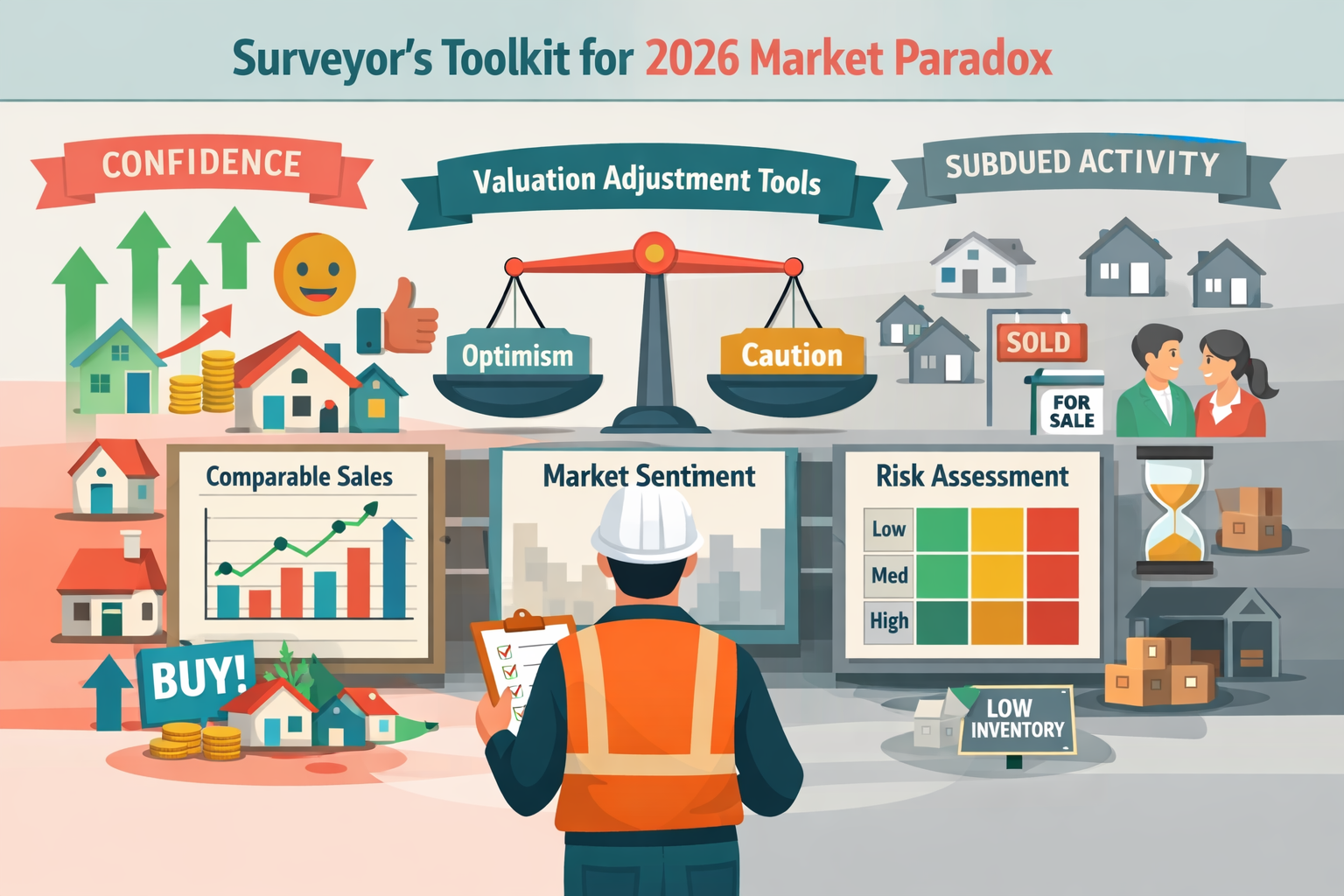
Professional surveyors are developing innovative strategies to maintain valuation accuracy despite the sentiment-activity disconnect. These approaches combine traditional methodology with enhanced analytical frameworks specifically designed for 2026's unique market conditions.
Strategy 1: Dual-Track Valuation Methodology
Leading surveyors now employ a dual-track approach that generates both sentiment-adjusted and transaction-based valuations, then reconciles them through professional judgment:
Transaction-Based Track: Uses traditional comparable sales methodology, with adjustments for:
- Time-on-market trends indicating buyer hesitation
- Price reduction patterns suggesting initial overpricing
- Days-to-sale metrics reflecting transaction velocity
- Cash vs. financed transaction ratios
Sentiment-Adjusted Track: Incorporates forward-looking indicators:
- Regional sentiment survey data weighted by reliability
- Interest rate trajectory expectations and their historical impact on values
- Inventory trend analysis and absorption rate projections
- Economic confidence indicators specific to property markets
Reconciliation Process: The surveyor then applies professional judgment to weight these tracks based on:
- Purpose of valuation (lending, investment, taxation, etc.)
- Client risk tolerance and decision timeframe
- Local market characteristics and historical sentiment-activity relationships
- Strength and consistency of available data in each track
This approach ensures valuations reflect both current market reality (transactions) and emerging value trends (sentiment).
Strategy 2: Enhanced Comparable Selection Criteria
When transaction volumes are suppressed, the quality of comparable selection becomes even more critical. Surveyors are implementing stricter criteria:
✅ Motivation Screening: Actively investigate and adjust for seller motivation, excluding distressed sales or unusually motivated transactions when appropriate
✅ Financing Analysis: Document financing terms for each comparable, as cash purchases may not reflect typical buyer constraints
✅ Time-on-Market Weighting: Give greater weight to properties that sold within typical market timeframes, potentially discounting outliers
✅ Condition Parity: In low-transaction environments, ensure comparables closely match subject property condition to minimize adjustment uncertainty
✅ Expanded Search Parameters: When local comparables are insufficient, develop robust adjustment frameworks for slightly more distant or different properties
This enhanced selection process, combined with thorough documentation in the valuation report, provides greater defensibility.
Strategy 3: Sentiment Data Quantification Frameworks
To systematically integrate sentiment data, progressive surveyors are developing quantification frameworks:
Sentiment-to-Value Translation Model:
- Establish historical correlation between sentiment indices and subsequent price movements in the specific market
- Apply regression analysis to determine predictive value of current sentiment levels
- Calculate confidence intervals to reflect uncertainty in sentiment-based adjustments
- Document assumptions and limitations transparently
Weighted Confidence Scoring: Assign reliability scores to different sentiment sources:
- RICS member surveys: High reliability (professional respondents with market knowledge)
- Consumer confidence surveys: Moderate reliability (broad but less property-specific)
- Online sentiment tracking: Lower reliability (potential selection bias)
Temporal Decay Factors: Apply diminishing weight to sentiment indicators as the valuation date moves further from survey dates, recognizing that sentiment can shift rapidly.
Strategy 4: Scenario-Based Valuation Ranges
Rather than providing single-point valuations in uncertain markets, many surveyors now present scenario-based ranges that acknowledge the sentiment-activity paradox:
Conservative Scenario: Based primarily on recent transaction evidence, assuming sentiment doesn't translate to near-term activity—appropriate for risk-averse lending decisions.
Moderate Scenario: Balanced weighting of transaction and sentiment data, representing the most likely value—suitable for most valuation purposes.
Optimistic Scenario: Incorporates stronger sentiment weighting, assuming confidence translates to activity within the forecast period—useful for investment analysis and strategic planning.
This approach provides clients with a fuller picture of market uncertainty while maintaining professional standards. It's particularly valuable for commercial building surveys and investment properties where stakeholders need to understand value risk.
Strategy 5: Technology-Enhanced Market Intelligence
Surveyors are increasingly leveraging technology to bridge the sentiment-activity gap:
🔧 Real-Time Data Platforms: Subscription services providing daily updates on listings, price changes, and transaction activity
🔧 Sentiment Tracking Tools: Automated monitoring of online property searches, inquiry volumes, and viewing requests as leading indicators
🔧 Predictive Analytics: Machine learning models that identify when sentiment-activity gaps are likely to close based on historical patterns
🔧 Geographic Information Systems (GIS): Mapping tools that visualize sentiment and transaction patterns across micro-markets
🔧 Comparable Database Expansion: Access to broader transaction databases that provide sufficient comparables even in low-volume periods
These technological tools don't replace professional judgment but significantly enhance the data foundation upon which valuations rest.
Strategy 6: Enhanced Client Communication and Education
Perhaps the most important strategy is improved communication about valuation uncertainty:
Transparent Methodology Disclosure: Clearly explain how sentiment and transaction data were weighted and why.
Market Context Briefings: Provide clients with context about the sentiment-activity paradox and its implications for value certainty.
Assumption Documentation: Explicitly state assumptions about when and whether sentiment will translate to activity.
Update Triggers: Identify specific market changes that would warrant valuation updates, such as interest rate movements or transaction volume shifts.
Risk Flagging: Highlight specific risks related to the current market paradox that might affect value stability.
This educational approach helps clients make informed decisions while protecting surveyors from unrealistic expectations about valuation precision in uncertain markets.
Regional Considerations: Applying Strategies Across Different Markets
The sentiment-activity paradox manifests differently across regions, requiring surveyors to adapt strategies to local conditions. Understanding these variations is essential for accurate valuations.
High-Migration Markets: The Florida and Texas Example
States experiencing significant population inflows show particularly pronounced disconnects. Despite strong migration-driven demand sentiment, these markets are seeing rising inventory and buyer resistance[3]. For surveyors working in these areas:
- Inventory Absorption Analysis: Calculate how long current inventory would take to clear at various transaction velocity scenarios
- Migration Trend Sustainability: Assess whether inbound migration patterns are stable or potentially reversing
- Price Expectation Gaps: Identify and quantify differences between seller pricing expectations (often based on recent peak prices) and buyer willingness to pay
Urban Core vs. Suburban Markets
Different property types and locations experience the paradox differently:
Urban Centers: Often show stronger sentiment recovery but slower transaction recovery due to lingering remote work impacts and lifestyle preference shifts.
Suburban Areas: May show more balanced sentiment-activity relationships as they've already absorbed pandemic-era demand shifts.
Rural Markets: Typically show less pronounced paradoxes due to thinner markets where sentiment has less impact on pricing.
Surveyors must adjust their weighting of sentiment data based on these location-specific dynamics.
Considerations for Specialized Valuations
Certain valuation types require particular attention to the sentiment-activity paradox:
Collective Enfranchisement Valuations: Must consider how market uncertainty affects both freehold value and leaseholder participation rates.
Help to Buy Valuations: Require careful assessment of first-time buyer sentiment versus actual purchasing capacity in constrained transaction environments.
Shared Ownership Properties: Need analysis of how sentiment affects both initial share purchases and staircasing activity.
Professional Standards and Regulatory Considerations
Maintaining valuation accuracy during the 2026 paradox requires strict adherence to professional standards while exercising appropriate judgment.
RICS Red Book Compliance
The RICS Valuation – Global Standards (Red Book) provides the framework for professional valuations, but surveyors must interpret these standards appropriately for unusual market conditions:
Basis of Value: Clearly identify whether Market Value, Investment Value, or another basis is most appropriate given the sentiment-activity disconnect.
Assumptions and Special Assumptions: Document any assumptions about sentiment translating (or not translating) to transactions within specific timeframes.
Departures: In some cases, the unusual market conditions may warrant departures from standard methodology, which must be clearly disclosed and justified.
Uncertainty Clauses: Consider whether material uncertainty clauses are appropriate when sentiment-activity gaps create unusual valuation challenges.
Professional Indemnity Considerations
The sentiment-activity paradox creates potential professional liability exposures that surveyors must manage:
- Documentation Standards: Maintain exceptionally thorough working papers showing how sentiment and transaction data were analyzed and weighted
- Assumption Clarity: Ensure all assumptions about market behavior are explicitly stated and reasonable
- Update Provisions: Consider including provisions for valuation updates if market conditions change materially
- Scope Limitations: Clearly define valuation scope and any limitations imposed by data availability or market uncertainty
Looking Ahead: When Will the Paradox Resolve?
Understanding potential resolution scenarios helps surveyors make informed judgments about sentiment weighting and valuation approaches.
Scenario 1: Sentiment Translates to Activity
If the +35% confidence outlook materializes into actual transactions over the next 6-12 months, current sentiment-adjusted valuations will prove prescient. Triggers that might catalyze this translation include:
- Interest rate stabilization or reduction providing financing certainty
- Pent-up demand releasing as buyers conclude "waiting" has no further benefit
- Inventory pressures forcing price adjustments that attract sidelined buyers
- Economic improvements increasing buyer purchasing power
Scenario 2: Sentiment Deflates to Match Activity
Alternatively, if subdued transaction levels persist, sentiment may gradually decline to match reality. This could occur if:
- Economic headwinds emerge that weren't anticipated in sentiment surveys
- Interest rates remain elevated longer than expected
- Affordability constraints prove more binding than sentiment suggests
- External shocks (geopolitical, economic) dampen confidence
Scenario 3: Gradual Convergence
Most likely, sentiment and activity will gradually converge through a combination of modest sentiment decline and modest activity increase, creating a "soft landing" scenario where:
- Transaction volumes slowly increase as buyers adjust to new normal pricing
- Sentiment moderates as overly optimistic expectations temper
- Regional variations persist, with some markets resolving faster than others
Surveyors should monitor leading indicators to identify which scenario is emerging in their specific markets.
Conclusion: Navigating Valuation Accuracy in 2026's Unique Market
The 2026 property market's paradox of rising confidence and subdued transactions represents one of the most challenging valuation environments in recent memory. Valuation Accuracy When Market Sentiment Outpaces Activity: Surveyor Strategies for 2026's Paradox of Rising Confidence and Subdued Transactions requires a fundamental evolution in how professional surveyors approach their work.
The strategies outlined—dual-track methodologies, enhanced comparable selection, sentiment quantification frameworks, scenario-based ranges, technology integration, and improved client communication—provide a comprehensive toolkit for maintaining valuation accuracy despite market uncertainty. These approaches don't eliminate the challenges posed by the sentiment-activity gap, but they provide structured frameworks for navigating them professionally and defensibly.
Key Success Factors
Surveyors who successfully navigate this paradox share several characteristics:
✨ Methodological Flexibility: Willingness to adapt traditional approaches while maintaining professional standards
✨ Data Sophistication: Investment in technology and data sources that provide comprehensive market intelligence
✨ Transparent Communication: Clear explanation of uncertainty and methodology to clients and stakeholders
✨ Continuous Monitoring: Regular reassessment of market conditions and adjustment of approaches as the paradox evolves
✨ Professional Development: Ongoing education about emerging valuation techniques for unusual market conditions
Actionable Next Steps
For surveyors looking to enhance their practice in light of 2026's market paradox:
- Audit Current Methodology: Review existing valuation approaches to identify where sentiment-activity gaps might compromise accuracy
- Develop Quantification Frameworks: Create systematic approaches for weighting sentiment data in your specific markets
- Enhance Technology Stack: Invest in data platforms and analytics tools that provide real-time market intelligence
- Strengthen Documentation: Upgrade working paper templates to explicitly address sentiment-activity considerations
- Client Education Program: Develop briefing materials that explain market paradox implications to clients
- Peer Consultation: Engage with other professionals to share insights about how the paradox manifests in different markets
- Monitor Resolution Indicators: Track leading indicators that signal whether sentiment is translating to activity
The property market will eventually resolve this paradox—sentiment and activity will converge one way or another. Until then, surveyors who implement robust strategies for addressing the disconnect will provide the most accurate, defensible valuations while protecting both their clients and their professional reputations.
For those seeking professional valuation services that account for current market complexities, choosing the right surveyor with experience navigating unusual market conditions is essential. The investment in sophisticated valuation approaches pays dividends in accuracy, defensibility, and client confidence—particularly important when market signals point in different directions.
References
[1] 2026 Real Estate Outlook What Leading Housing Economists Are Watching – https://www.nar.realtor/magazine/real-estate-news/2026-real-estate-outlook-what-leading-housing-economists-are-watching
[2] 2026 National Housing Forecast – https://www.realtor.com/research/2026-national-housing-forecast/
[3] 2026 Property Market Trends – https://www.cotality.com/insights/articles/2026-property-market-trends
[4] 2026 Real Estate Market Trends – https://www.buildium.com/blog/2026-real-estate-market-trends/
[8] Real Estate Market Sentiment Survey – https://www.seyfarth.com/real-estate-market-sentiment-survey.html
[9] 2026 Valuation Advisory North American Market Survey – https://www.nmrk.com/insights/market-report/2026-valuation-advisory-north-american-market-survey