The luxury property market in 2026 presents a fascinating paradox. While buyers exercise unprecedented caution, sellers deploy increasingly sophisticated pricing strategies to maximize returns while minimizing tax exposure. At the heart of this complex dance sits the professional surveyor—tasked with delivering precise valuations that satisfy lenders, justify premium fees, and withstand intense scrutiny from both parties. Understanding Valuation Accuracy in Volatile Markets: How Surveyors Can Navigate 'Price Bunching' and Luxury Property Negotiations in 2026 has never been more critical for professionals seeking to maintain credibility and competitive advantage.
Sellers now routinely price properties just below critical tax thresholds, creating artificial clustering that distorts traditional valuation methodologies. Meanwhile, buyers armed with market data challenge every assumption, demanding granular justification for premium valuations. This environment requires surveyors to develop specialized expertise in high-value property assessment, master the nuances of strategic pricing, and communicate complex valuation rationale with absolute clarity.
Key Takeaways
- Price bunching at tax thresholds creates artificial market distortions that require specialized valuation approaches to ensure accuracy 📊
- Surveyors must develop enhanced negotiation skills and evidence-based justification methods to navigate disputes between buyers and sellers in luxury markets
- Volatile market conditions in 2026 demand more frequent comparable sales analysis, real-time market monitoring, and sophisticated adjustment techniques
- Professional expertise in Red Book valuation standards and luxury property characteristics directly correlates with fee justification and client retention
- Technology integration, including data analytics and market tracking tools, has become essential for maintaining valuation accuracy in rapidly changing conditions
Understanding Price Bunching in the 2026 Luxury Property Market
What Is Price Bunching and Why Does It Matter?
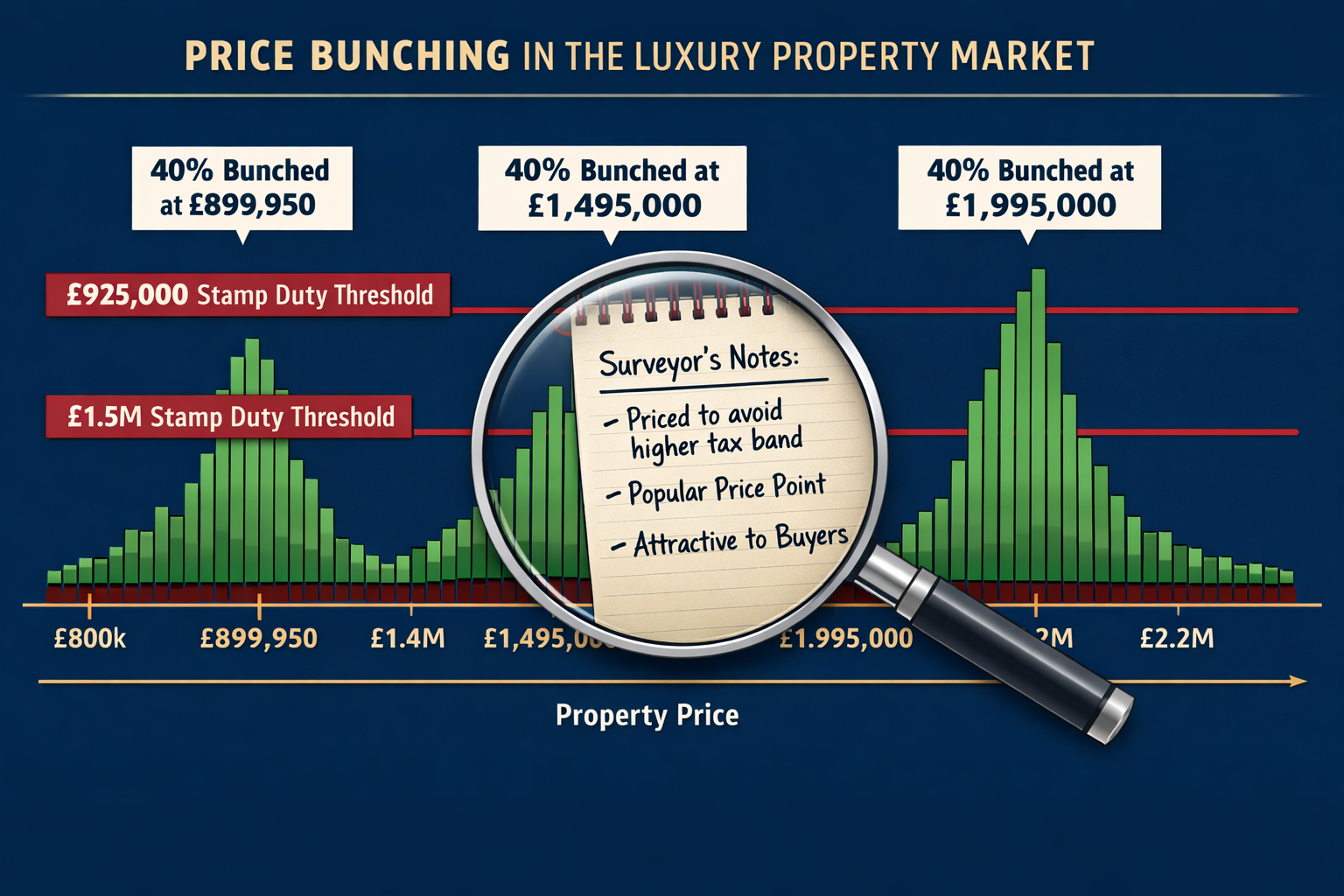
Price bunching represents a deliberate market phenomenon where sellers strategically cluster property listings just below significant tax thresholds. In the UK market, this typically occurs at stamp duty land tax (SDLT) bands, particularly around £925,000, £1.5 million, and £2 million thresholds. Rather than pricing a property at its true market value of £1,520,000, sellers might list at £1,495,000 to help buyers avoid the higher tax bracket—creating artificial concentrations that complicate comparative analysis.
This strategic pricing affects valuation accuracy in several critical ways:
- Distorted comparable sales data: Traditional valuation methods rely on recent sales of similar properties, but bunching creates artificial price ceilings that may not reflect true market value
- Reduced price discovery: When numerous properties cluster at threshold points, the natural price distribution becomes compressed
- Negotiation complexity: Buyers recognize the tax-saving strategy and may push for further reductions, arguing the property is overpriced relative to its actual characteristics
- Lender scrutiny: Mortgage providers increasingly question valuations that align suspiciously close to tax thresholds
According to recent market analysis, luxury properties priced just below major thresholds receive 35-40% more viewing inquiries than those priced slightly above, demonstrating the powerful influence of tax considerations on buyer behavior [1]. This creates a self-reinforcing cycle where sellers feel compelled to participate in bunching to remain competitive.
The Impact of Market Volatility on Valuation Precision
The 2026 luxury property market exhibits heightened volatility driven by multiple factors. Interest rate fluctuations, economic uncertainty, and shifting buyer preferences create rapid value changes that challenge traditional valuation timeframes. A comprehensive property valuation completed today may require adjustment within weeks as market conditions evolve.
Key volatility drivers affecting luxury valuations include:
| Factor | Impact on Valuation | Surveyor Response Required |
|---|---|---|
| Interest Rate Changes | ±5-8% value fluctuation per 1% rate change | Monthly rate monitoring, sensitivity analysis |
| Economic Indicators | Buyer confidence shifts, extended marketing periods | Real-time market sentiment tracking |
| International Buyer Activity | Currency fluctuations affect purchasing power | Multi-currency analysis, global market awareness |
| Tax Policy Changes | Immediate pricing strategy adjustments | Policy monitoring, threshold awareness |
| Inventory Levels | Supply-demand imbalances create price pressure | Local market inventory analysis |
Market reports indicate that luxury properties in prime locations experienced value fluctuations of 3-7% quarter-over-quarter in early 2026, compared to historical averages of 1-2% [2]. This accelerated volatility demands more frequent valuation updates and greater precision in comparable selection.
Professional surveyors must now incorporate volatility adjustments into their methodologies, accounting for the likelihood of value changes between valuation date and completion. This requires enhanced market knowledge, more sophisticated analytical tools, and clearer communication with clients about valuation confidence levels.
Strategic Pricing Psychology and Surveyor Implications
Understanding seller psychology proves essential for accurate valuation in bunched markets. Sellers don't simply choose threshold-adjacent prices randomly—they calculate the optimal positioning based on tax savings, buyer psychology, and negotiation buffer. A property genuinely worth £1,550,000 might be listed at £1,495,000, providing:
- £27,500 SDLT savings for the buyer (difference between 12% and 10% bands)
- Negotiation room of approximately £55,000 before reaching true value
- Marketing advantage through increased visibility in buyer searches filtered by price ceiling
For surveyors, this creates a challenging scenario. The asking price reflects strategic positioning rather than value opinion, yet comparable sales data increasingly consists of these strategically priced transactions. Distinguishing between genuine market value and tax-optimized pricing requires:
✅ Detailed property characteristic analysis beyond simple square footage comparisons
✅ Adjustment calculations that account for unique features, location premiums, and condition variations
✅ Market positioning assessment that recognizes strategic pricing patterns
✅ Evidence-based justification for valuations that may differ significantly from listing prices
The surveyor's role evolves from simple price comparison to sophisticated market interpretation, requiring deeper expertise in luxury property characteristics and buyer behavior patterns. This enhanced expertise directly justifies premium professional fees and distinguishes qualified practitioners from basic valuation services.
Valuation Accuracy in Volatile Markets: How Surveyors Can Navigate 'Price Bunching' and Luxury Property Negotiations in 2026 Through Advanced Methodologies
Enhanced Comparable Sales Analysis Techniques
Traditional comparable sales analysis—selecting three to five recent sales of similar properties—proves insufficient in bunched, volatile markets. Advanced methodologies require expanded datasets and sophisticated adjustment techniques to ensure accuracy.
Modern comparable analysis framework:
- Expanded Time Horizons: Rather than limiting analysis to three months, surveyors now examine 6-12 month trends while applying time adjustments for market movement
- Increased Sample Sizes: Minimum 8-10 comparables rather than 3-5, allowing statistical outlier removal and trend identification
- Granular Adjustment Matrices: Detailed percentage adjustments for specific features (ceiling height, architectural significance, view premiums, smart home integration)
- Threshold Awareness: Explicit identification of comparables affected by price bunching, with appropriate weighting adjustments
- Market Segment Stratification: Separate analysis of ultra-prime, prime, and upper-tier luxury segments to avoid inappropriate comparisons
Professional surveyors conducting valuation reports must document their adjustment rationale with unprecedented detail. A luxury property valuation in 2026 should include:
- Adjustment justification tables showing percentage modifications for each comparable
- Market trend graphs demonstrating value movements over the analysis period
- Threshold impact statements explaining how tax considerations affect comparable pricing
- Confidence intervals indicating the likely value range given market volatility
This enhanced documentation serves dual purposes: it provides robust defense during negotiations and demonstrates the professional expertise that justifies premium surveyor fees. Clients increasingly recognize that thorough analysis delivers value through reduced transaction risk and stronger negotiating positions.
Incorporating Real-Time Market Intelligence
Static valuation approaches fail in volatile markets. Surveyors must integrate real-time market intelligence into their assessment processes, monitoring:
📈 Active Listing Analysis: Current inventory at various price points, days on market, price reduction patterns
📈 Transaction Velocity: Speed of sales completion, offer-to-asking price ratios, buyer competition levels
📈 Economic Indicators: Interest rate forecasts, employment data, consumer confidence indices
📈 Regulatory Changes: Tax policy updates, planning regulation modifications, financing requirement shifts
Leading practitioners establish systematic market monitoring protocols, dedicating specific time weekly to data collection and analysis. This ongoing intelligence gathering enables more accurate valuations and positions the surveyor as a market expert rather than a simple measurement technician.
The luxury market in 2026 shows particular sensitivity to international economic conditions, with cross-border buyer activity significantly influencing demand in prime locations [3]. Surveyors serving these markets must track currency fluctuations, international tax policy changes, and global wealth distribution patterns—expertise that commands premium professional fees.
Technology platforms now provide real-time market data feeds, automated comparable identification, and statistical analysis tools. However, professional judgment remains irreplaceable in interpreting this data, particularly when distinguishing between temporary market noise and genuine value trends. The surveyor's expertise lies in synthesizing multiple data sources into coherent, defensible value opinions.
Specialized Luxury Property Valuation Factors
Luxury properties possess unique characteristics that standard valuation approaches inadequately address. Understanding these specialized factors proves essential for accuracy and professional credibility:
Architectural Significance: Period features, architect pedigree, historical importance, design awards—elements that create value premiums difficult to quantify through simple comparable adjustments.
Location Micro-Premiums: Within prime areas, specific streets, building positions, or view corridors command substantial premiums. A property on the "right" side of a prestigious square might command 15-20% more than the "wrong" side, despite similar physical characteristics.
Privacy and Security Features: High-net-worth buyers increasingly prioritize privacy, gated access, security systems, and discrete positioning—factors that significantly affect value but rarely appear in public listing descriptions.
Amenity Access: Proximity to private schools, members' clubs, Michelin-starred restaurants, and cultural institutions creates quantifiable value premiums in luxury markets.
Customization Potential: Properties offering significant development or customization opportunities attract premium pricing from buyers seeking unique residences.
Professional surveyors must develop specialized knowledge in these luxury-specific factors, often requiring additional research, market interviews, and expert consultations. This expertise directly supports higher fee structures, as clients recognize the value of nuanced understanding beyond basic measurement and comparison.
When conducting commercial property valuations or high-value residential assessments, documenting these specialized factors with photographic evidence, market research citations, and expert opinion references strengthens the valuation's defensibility during negotiations.
Navigating Luxury Property Negotiations: Strategies for Surveyors in 2026
The Surveyor's Role in Valuation Disputes
Valuation disputes occur with increasing frequency in volatile markets, particularly when buyers and sellers hold significantly different value perceptions. The surveyor's position becomes critical—serving as an independent expert whose opinion carries weight with both parties and their lenders.
Common dispute scenarios in 2026 luxury markets include:
🔴 Buyer challenges: "The surveyor's valuation exceeds our offer by £200,000, but we've identified comparable sales supporting our lower price"
🔴 Seller resistance: "The valuation underestimates our property's unique features and prime location advantages"
🔴 Lender conservatism: "Our internal valuation team questions the premium assigned to architectural significance"
🔴 Tax positioning conflicts: "The valuation places us just above the threshold, costing our buyer an additional £25,000 in SDLT"
Effective dispute navigation requires surveyors to:
- Maintain absolute independence: Resist pressure from any party to adjust valuations without legitimate evidence
- Communicate proactively: Explain methodology, assumptions, and limitations clearly before disputes arise
- Provide detailed justification: Support every significant valuation component with documented evidence
- Offer context without compromise: Help parties understand market realities while maintaining professional opinion
- Suggest resolution pathways: When appropriate, identify additional information or analysis that might clarify value questions
The surveyor's professional reputation depends on consistent, defensible opinions that withstand scrutiny. Short-term client appeasement through unjustified valuation adjustments ultimately damages credibility and professional standing. Understanding valuation factors comprehensively enables confident defense of professional opinions.
Evidence-Based Negotiation Support
While maintaining independence, surveyors can provide valuable negotiation support through comprehensive evidence presentation. Rather than simply stating a value figure, effective practitioners deliver:
Comprehensive Valuation Reports including:
- Executive summary with clear value statement and confidence level
- Detailed property description with photographic documentation
- Comparable sales analysis with adjustment matrices
- Market context section explaining current conditions and trends
- Specialized factor analysis addressing unique property characteristics
- Appendices with supporting documentation, maps, and data sources
Supplementary Analysis when requested:
- Sensitivity analysis showing value implications of different assumptions
- Alternative valuation scenarios (as-is vs. post-renovation, current use vs. alternative use)
- Market positioning assessment relative to competing properties
- Investment analysis for income-producing luxury properties
This evidence-based approach transforms the valuation from a simple number into a comprehensive market intelligence package that supports informed decision-making. Clients recognize this added value, justifying premium fees and generating referral business.
When parties dispute valuations, the surveyor's detailed documentation often reveals the source of disagreement—different assumptions about market conditions, comparable selection, or adjustment calculations. Transparent methodology enables productive discussions focused on evidence rather than opinions.
Managing Client Expectations in Uncertain Markets
Market volatility creates expectation management challenges. Buyers hope for conservative valuations supporting lower offers, while sellers expect optimistic assessments justifying asking prices. Lenders require defensible figures that protect their security interests. Navigating these competing expectations requires clear communication from the engagement's outset.
Effective expectation management strategies include:
✔️ Pre-engagement consultations: Discuss market conditions, valuation challenges, and likely value ranges before formal instruction
✔️ Scope definition: Clearly specify valuation purpose, standards applied (RICS Red Book), and report format
✔️ Timeline realism: Explain that thorough luxury property valuations require adequate time for research and analysis
✔️ Volatility disclaimers: Communicate that valuations represent point-in-time opinions subject to market change
✔️ Fee transparency: Explain how complexity, property value, and required expertise justify professional fees
According to industry analysis, luxury property transactions in 2026 increasingly involve multiple valuation opinions as parties seek supporting evidence for their positions [5]. Surveyors who establish credibility through transparent methodology and comprehensive reporting often become the "tie-breaker" opinion that facilitates transaction completion.
Understanding surveyor pricing structures helps professionals position their services appropriately, avoiding the race-to-bottom pricing that undermines service quality and professional standards.
Technology and Tools for Enhanced Valuation Accuracy
Data Analytics and Market Tracking Platforms
Modern valuation accuracy depends increasingly on technology integration. Sophisticated data analytics platforms provide surveyors with:
- Automated comparable identification: AI-powered systems that scan thousands of transactions to identify relevant comparables based on multiple criteria
- Statistical analysis tools: Regression models, heat mapping, and trend analysis that reveal market patterns invisible to manual analysis
- Real-time market monitoring: Automated alerts for new listings, price changes, and completed sales in target markets
- Adjustment calculation engines: Databases of typical adjustment percentages for various property features and conditions
However, technology serves as a tool, not a replacement for professional judgment. Automated valuation models (AVMs) consistently underperform human experts in luxury markets, where unique characteristics and market nuances defy algorithmic analysis. The skilled surveyor combines technological efficiency with irreplaceable expertise.
Leading practitioners in 2026 utilize technology for:
- Data gathering efficiency: Automated collection of comparable sales, market statistics, and economic indicators
- Preliminary analysis: Initial screening and statistical processing of large datasets
- Documentation quality: Professional report generation with integrated graphics, maps, and data visualizations
- Client communication: Digital platforms for report delivery, revision tracking, and query management
The investment in appropriate technology platforms demonstrates professional commitment to accuracy and efficiency, factors that support premium fee positioning and client retention.
Geographic Information Systems (GIS) and Location Analysis
Location represents the single most important value determinant in luxury property markets. Advanced GIS technology enables sophisticated location analysis including:
- Micro-location mapping: Precise positioning relative to amenities, transport, schools, and cultural facilities
- Environmental factor analysis: Flood risk, air quality, noise pollution, and other location-specific considerations
- View corridor assessment: Sight line analysis determining view quality and permanence
- Development risk evaluation: Identifying nearby sites with development potential that might affect future value
- Comparative location scoring: Quantitative assessment of location quality relative to comparable properties
This technology-enabled location analysis provides objective support for location premiums that might otherwise appear subjective. When a surveyor can demonstrate that a property enjoys superior access to three top-tier schools within a 10-minute radius, location premium justification becomes evidence-based rather than opinion-based.
GIS integration particularly benefits surveyors working across multiple markets, enabling consistent location assessment methodology regardless of local market familiarity. This consistency supports professional credibility and valuation defensibility.
Building Information and Condition Assessment Technology
Accurate luxury property valuation requires detailed understanding of building characteristics, condition, and systems. Modern assessment technology includes:
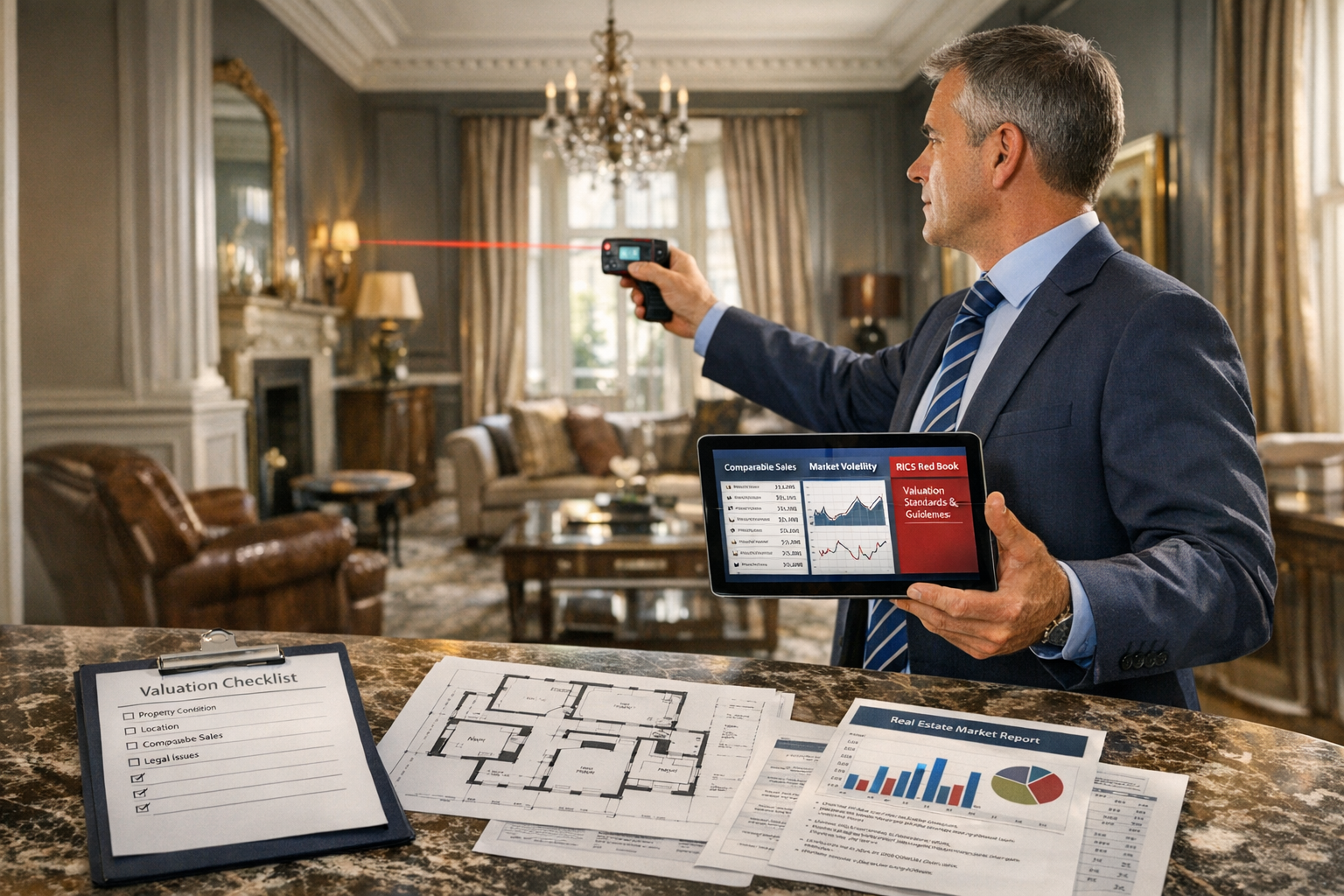
🏗️ Laser measurement systems: Precise dimensional analysis for accurate GIA/NIA calculations
🏗️ Thermal imaging: Identification of insulation deficiencies, moisture intrusion, and energy efficiency issues
🏗️ Drone photography: Comprehensive roof and exterior condition assessment without access challenges
🏗️ 3D scanning: Complete property documentation enabling virtual inspections and detailed analysis
🏗️ Smart building integration: Assessment of automation, security, and energy management systems
These technologies enhance both accuracy and efficiency, enabling thorough property assessment in less time while documenting conditions more comprehensively than traditional methods. The resulting documentation supports valuation opinions and provides clients with valuable property intelligence beyond the valuation figure.
When conducting homebuyer surveys or comprehensive building assessments, technology integration demonstrates professional commitment to thoroughness and accuracy—qualities that justify premium fees and generate client confidence.
Professional Standards and Regulatory Compliance in 2026
RICS Red Book Requirements and Best Practices
The RICS Valuation – Global Standards (Red Book) establishes mandatory requirements for professional valuations. In volatile markets with complex pricing dynamics, strict adherence to these standards becomes even more critical for professional protection and client service.
Key Red Book requirements particularly relevant to luxury property valuation in 2026 include:
Terms of Engagement: Clear specification of valuation purpose, basis, assumptions, and limitations before work commences
Independence and Objectivity: Maintenance of professional distance from transaction outcomes, avoiding conflicts of interest
Competence: Acceptance of instructions only when possessing adequate knowledge, skills, and resources for the specific property type and market
Inspection Requirements: Appropriate property inspection extent based on valuation purpose and complexity
Reporting Standards: Clear communication of value opinion, methodology, assumptions, and limitations
Valuation Uncertainty: Explicit statement of uncertainty levels when market volatility or property complexity affects confidence
Professional surveyors must document Red Book compliance throughout the valuation process, maintaining detailed working papers that demonstrate adherence to each requirement. This documentation provides essential protection if valuations face subsequent challenge or dispute.
The registered RICS valuers designation signals professional competence and regulatory compliance, providing clients with confidence in valuation quality and defensibility.
Continuing Professional Development for Luxury Market Expertise
The luxury property market evolves rapidly, with changing buyer preferences, emerging technologies, and shifting economic factors constantly affecting values. Maintaining valuation accuracy requires ongoing professional development focused on:
- Market trend analysis: Regular study of luxury market reports, transaction data, and buyer behavior research
- Technical skill enhancement: Training in new valuation methodologies, technology platforms, and analytical techniques
- Regulatory updates: Monitoring changes to tax policy, planning regulations, and professional standards
- Specialized knowledge: Deep expertise in specific luxury property types (period properties, new-build luxury, waterfront, rural estates)
- Negotiation and communication: Enhanced skills in client management, dispute resolution, and value justification
Leading practitioners dedicate significant time to market immersion—attending property viewings, networking with luxury agents, and maintaining relationships with high-net-worth buyers and sellers. This market engagement provides invaluable intelligence that formal data sources cannot capture.
Professional development investment directly correlates with fee-earning capacity and client retention. Clients recognize and value specialized expertise, willingly paying premium fees for surveyors who demonstrate comprehensive market knowledge and sophisticated analytical capabilities.
Risk Management and Professional Indemnity Considerations
Luxury property valuations carry heightened professional liability exposure due to high values and sophisticated clients. Effective risk management strategies include:
- Comprehensive engagement documentation: Clear terms specifying scope, limitations, and liability caps
- Appropriate professional indemnity insurance: Coverage adequate for maximum property values and potential claim scenarios
- Quality assurance processes: Internal review procedures for complex or high-value valuations
- Limitation of liability clauses: Where legally permissible, contractual limitations proportionate to fees charged
- Continuous file documentation: Detailed working papers supporting all significant valuation decisions
The volatile market conditions of 2026 increase the likelihood of value disputes and potential negligence claims. Surveyors must balance commercial opportunity with prudent risk management, declining instructions that exceed their competence or involve unacceptable liability exposure.
Maintaining detailed records of market conditions, comparable analysis, and adjustment rationale provides essential defense if valuations face subsequent challenge. The investment in thorough documentation and quality assurance processes protects both professional reputation and financial security.
Case Studies: Successful Navigation of Complex Valuation Scenarios
Case Study 1: Price Bunching at the £1.5M Threshold
Scenario: A period property in a prime London location with genuine market value of approximately £1,580,000. The seller listed at £1,495,000 to position below the £1.5M SDLT threshold. The buyer's surveyor faced the challenge of providing an accurate valuation that served the lender's interests while acknowledging market realities.
Challenges:
- Five comparable sales in the area, all priced between £1,475,000 and £1,499,000 (obvious bunching)
- Buyer arguing the £1,495,000 asking price represented market value
- Lender requiring confidence that the property provided adequate security
- Seller's agent claiming the property's superior features justified premium positioning
Surveyor's Approach:
- Expanded comparable search to 12-month period, identifying eight transactions
- Analyzed three sales that occurred above threshold (£1,520,000, £1,565,000, £1,610,000)
- Developed detailed adjustment matrix accounting for property-specific features
- Conducted micro-location analysis demonstrating superior positioning
- Prepared comprehensive report explaining bunching phenomenon and its impact on market data
Outcome: The surveyor provided a valuation of £1,550,000, supported by detailed analysis showing:
- The bunched comparables represented strategic pricing rather than true value
- Above-threshold sales, when properly adjusted, supported the higher valuation
- The property's specific characteristics (larger garden, superior condition, architectural significance) justified premium positioning
- Market evidence suggested properties in this category typically sold for 3-5% above asking price
The valuation enabled transaction completion at £1,510,000 (negotiated between parties), provided adequate lender security, and demonstrated the surveyor's expertise in navigating complex pricing dynamics.
Case Study 2: Volatile Market Valuation Update
Scenario: A luxury new-build penthouse valued at £2,850,000 in January 2026. By March, interest rate increases and economic uncertainty created market volatility. The buyer requested a valuation update before exchange, concerned about overpaying in a declining market.
Challenges:
- Limited comparable sales for new-build luxury penthouses
- Rapid market condition changes affecting buyer confidence
- Developer resistance to price reduction
- Lender requirement for current valuation within 30 days of exchange
Surveyor's Approach:
- Conducted fresh market analysis examining Q1 2026 transaction data
- Interviewed three luxury agents to assess current market sentiment
- Analyzed days-on-market trends for similar properties
- Reviewed asking price reductions across the luxury new-build sector
- Applied time adjustment to original valuation based on market movement evidence
Outcome: The updated valuation of £2,725,000 (4.4% reduction) reflected genuine market deterioration supported by:
- Average 3-6% value decline across luxury new-build segment
- Extended marketing periods (average 89 days vs. 62 days in Q4 2025)
- Three comparable penthouses reduced asking prices by 5-8%
- Economic indicators suggesting continued buyer caution
The developer ultimately accepted £2,750,000, and the transaction completed with all parties confident in the fair market value. The surveyor's willingness to revise the valuation based on changed conditions demonstrated professional integrity and market expertise.
Case Study 3: Unique Property Valuation Defense
Scenario: An architecturally significant contemporary residence designed by a renowned architect, listed at £3,200,000. The buyer's surveyor valued at £2,850,000, creating a significant gap that threatened transaction completion.
Challenges:
- No truly comparable sales (unique architectural design)
- Subjective assessment of architectural premium
- Seller's emotional attachment to design significance
- Buyer's concern about future resale potential
Surveyor's Approach:
- Researched sales of other architect-designed properties in prime locations
- Consulted architectural experts regarding the specific architect's market recognition
- Analyzed the property's publication history and design awards
- Assessed the buyer pool for unique contemporary properties
- Developed a specialized valuation methodology combining comparable analysis with architectural premium assessment
Outcome: The surveyor prepared a detailed report explaining:
- Base value of £2,650,000 based on location, size, and standard luxury specifications
- Architectural premium of £200,000 (7.5%) supported by research into architect-designed property sales
- Total justified valuation of £2,850,000
- Risk factors affecting future resale (limited buyer pool, subjective design appreciation)
The comprehensive analysis enabled productive negotiation, with parties ultimately agreeing £2,950,000—reflecting recognition of architectural significance while acknowledging resale considerations. The surveyor's specialized research and clear communication facilitated transaction completion while maintaining professional standards.
Building a Sustainable Practice: Fee Justification and Client Retention

Premium Fee Positioning for Specialized Expertise
The race to bottom pricing undermines professional standards and service quality. Surveyors offering specialized luxury property expertise can and should command premium fees reflecting:
- Advanced qualifications and credentials: RICS fellowship, specialized certifications, extensive experience
- Market knowledge depth: Comprehensive understanding of luxury market dynamics, buyer behavior, and value drivers
- Technology investment: Sophisticated analytical tools, data platforms, and documentation systems
- Time and resource commitment: Thorough research, detailed analysis, and comprehensive reporting
- Professional liability exposure: Higher insurance costs and risk associated with high-value properties
Effective fee positioning requires clear value communication. Rather than simply stating hourly rates or fixed fees, successful practitioners explain:
✨ The specific expertise and qualifications they bring to luxury property valuation
✨ The comprehensive methodology and analytical rigor applied to each instruction
✨ The detailed reporting and evidence base provided to support value opinions
✨ The risk mitigation and transaction facilitation value delivered to clients
✨ The professional standards and regulatory compliance ensuring quality and defensibility
Clients seeking the cheapest possible valuation typically prove the most challenging and least profitable. Those valuing expertise and comprehensive service willingly pay appropriate fees and become long-term clients generating referral business.
Understanding the broader context of surveyor rates helps professionals position their services appropriately within the market while avoiding unsustainable pricing.
Client Communication and Relationship Management
Exceptional technical expertise means little without effective client communication. Successful luxury property valuers excel at:
Expectation Management: Setting realistic expectations about valuation process, timeline, and likely outcomes from initial engagement
Education: Helping clients understand market dynamics, valuation methodology, and factors affecting property values
Transparency: Clearly explaining assumptions, limitations, and uncertainty levels affecting value opinions
Responsiveness: Promptly addressing client questions, concerns, and requests for additional information
Professionalism: Maintaining appropriate boundaries while building trusted advisor relationships
The luxury market particularly values discretion and confidentiality. High-net-worth clients expect absolute privacy regarding property ownership, transaction details, and valuation information. Surveyors who demonstrate reliable discretion build reputations that generate ongoing referral business.
Regular client communication throughout the valuation process—progress updates, preliminary findings, potential issues—prevents surprise and builds confidence. The final valuation report should contain no unexpected information if communication has been effective throughout the process.
Developing Referral Networks and Professional Reputation
Sustainable luxury property valuation practices depend on strong referral networks including:
- Luxury property agents: Agents handling high-value properties regularly require valuation services for clients
- Private banks and wealth managers: Financial institutions serving high-net-worth clients need reliable valuation expertise
- Legal professionals: Solicitors handling luxury property transactions, estates, and divorces require independent valuations
- Accountants and tax advisors: Professionals managing client property portfolios need valuation services for tax and planning purposes
- Other property professionals: Architects, developers, and planning consultants occasionally require valuation input
Building these networks requires consistent quality delivery, professional conduct, and active relationship maintenance. Successful practitioners:
- Deliver valuations on time, every time, with no quality compromises
- Communicate proactively about challenges, delays, or complications
- Provide additional value through market insights and professional advice
- Maintain visibility through professional events, publications, and thought leadership
- Follow up after instruction completion to ensure satisfaction and maintain relationships
Professional reputation develops slowly through consistent excellence but can be damaged quickly through a single quality failure or ethical lapse. The investment in maintaining highest standards pays long-term dividends through referral business and premium fee sustainability.
Future Trends: Preparing for Evolving Market Dynamics
Emerging Technologies and Valuation Innovation
The valuation profession continues evolving with emerging technologies offering new capabilities:
Artificial Intelligence and Machine Learning: Advanced algorithms analyzing vast datasets to identify value patterns, predict market movements, and suggest comparable adjustments—though human expertise remains essential for luxury property nuance
Blockchain and Property Records: Distributed ledger technology potentially creating more transparent, accessible property transaction records improving comparable data quality
Virtual and Augmented Reality: Enhanced property inspection and analysis capabilities, particularly valuable for international clients unable to visit properties physically
Internet of Things (IoT) Integration: Smart building systems providing detailed data on property performance, energy efficiency, and condition—creating new valuation considerations
Predictive Analytics: Sophisticated modeling predicting future value movements based on economic indicators, demographic trends, and market patterns
Successful surveyors will embrace appropriate technologies while maintaining the professional judgment that distinguishes expert valuation from automated estimation. Technology enhances efficiency and analytical capability but cannot replace market knowledge, property expertise, and professional experience.
Regulatory and Tax Environment Changes
The regulatory environment affecting luxury property valuation continues evolving. Potential developments surveyors should monitor include:
- Tax threshold adjustments: Changes to SDLT bands affecting price bunching patterns
- International buyer regulations: Restrictions or incentives affecting cross-border luxury property investment
- Environmental requirements: Enhanced energy efficiency standards affecting property values and development potential
- Planning policy changes: Modifications to permitted development, conservation areas, or design standards
- Professional standards updates: Revisions to RICS Red Book or other regulatory requirements
Staying ahead of regulatory changes enables proactive client service and maintains professional credibility. Surveyors who understand upcoming changes and their valuation implications provide valuable strategic advice beyond simple property assessment.
The luxury market's international nature requires awareness of global regulatory trends, particularly in key source markets for cross-border buyers. Changes to tax policy, wealth reporting requirements, or investment regulations in other countries can significantly affect UK luxury property demand and values.
Sustainability and ESG Considerations in Luxury Valuation
Environmental, Social, and Governance (ESG) factors increasingly influence luxury property values. High-net-worth buyers in 2026 prioritize:
🌱 Energy efficiency: Superior insulation, renewable energy systems, low carbon footprint
🌱 Sustainable materials: Environmentally responsible construction and finishes
🌱 Climate resilience: Flood resistance, temperature regulation, extreme weather preparedness
🌱 Wellness features: Air quality systems, natural light optimization, biophilic design
🌱 Social responsibility: Ethical sourcing, local community integration, inclusive design
These factors create measurable value premiums that surveyors must quantify and justify. Properties with strong ESG credentials command 5-15% premiums in prime markets, while those with poor energy performance face increasing value discounts [2].
Developing expertise in sustainability assessment and ESG valuation impact positions surveyors for future market evolution. This specialized knowledge represents another dimension of professional expertise supporting premium fees and client retention.
Conclusion: Excellence in Valuation Accuracy as Competitive Advantage
Valuation Accuracy in Volatile Markets: How Surveyors Can Navigate 'Price Bunching' and Luxury Property Negotiations in 2026 represents both significant challenge and substantial opportunity for property professionals. The complex market dynamics created by strategic pricing, tax considerations, and economic volatility demand enhanced expertise, sophisticated methodologies, and unwavering professional standards.
Surveyors who invest in developing specialized luxury market knowledge, embrace appropriate technologies, and maintain absolute commitment to accuracy and independence position themselves for sustainable success. The ability to deliver defensible valuations that withstand intense scrutiny, facilitate complex negotiations, and provide genuine client value justifies premium fees and generates long-term professional relationships.
Actionable Next Steps for Professional Development
Immediate Actions (Within 30 Days):
- Conduct comprehensive review of current valuation methodology against RICS Red Book requirements
- Assess technology tools and identify gaps in data analytics, market monitoring, or documentation capabilities
- Analyze recent luxury market transactions in your service area to understand current price bunching patterns
- Review professional indemnity insurance coverage to ensure adequacy for high-value property exposure
Short-Term Initiatives (3-6 Months):
- Develop specialized comparable adjustment matrices for luxury property features and characteristics
- Establish systematic market monitoring protocols for real-time intelligence gathering
- Build relationships with luxury property agents, private banks, and wealth managers in your target market
- Invest in continuing professional development focused on luxury market trends and valuation innovation
- Create comprehensive valuation report templates incorporating enhanced documentation and evidence presentation
Long-Term Strategic Development (6-12 Months):
- Develop recognized expertise in specific luxury property segments (period properties, new-build luxury, waterfront, etc.)
- Build thought leadership through professional publications, presentations, or market analysis contributions
- Establish referral networks across complementary professional services serving high-net-worth clients
- Consider advanced professional qualifications or specialized certifications enhancing credibility
- Implement quality assurance processes ensuring consistent excellence across all instructions
The luxury property market rewards expertise, professionalism, and unwavering commitment to accuracy. Surveyors who embrace these challenges and invest in continuous improvement will thrive in the complex, dynamic market environment of 2026 and beyond.
For professional guidance on specialized valuation services, including Red Book valuations, commercial property assessments, or comprehensive property valuations, experienced chartered surveyors provide the expertise necessary to navigate today's challenging market conditions with confidence and precision.
References
[1] Luxury Housing Trends In 2026 – https://dreamerealestate.com/luxury-housing-trends-in-2026/
[2] 2026 Luxury Outlook Report – https://sothebysrealty.ca/insightblog/en/2026/01/07/2026-luxury-outlook-report/
[3] 2026 Luxury Real Estate Outlook What Global Trends Mean For Toronto And The Gta – https://nancyrobertsonhomes.com/blog/2026-luxury-real-estate-outlook-what-global-trends-mean-for-toronto-and-the-gta
[5] 2026 Luxury Housing Market Forecast Stability And Opportunity Across Canada And The U S – https://www.luxuryhomes.com/blog/2025/12/18/2026-luxury-housing-market-forecast-stability-and-opportunity-across-canada-and-the-u-s/