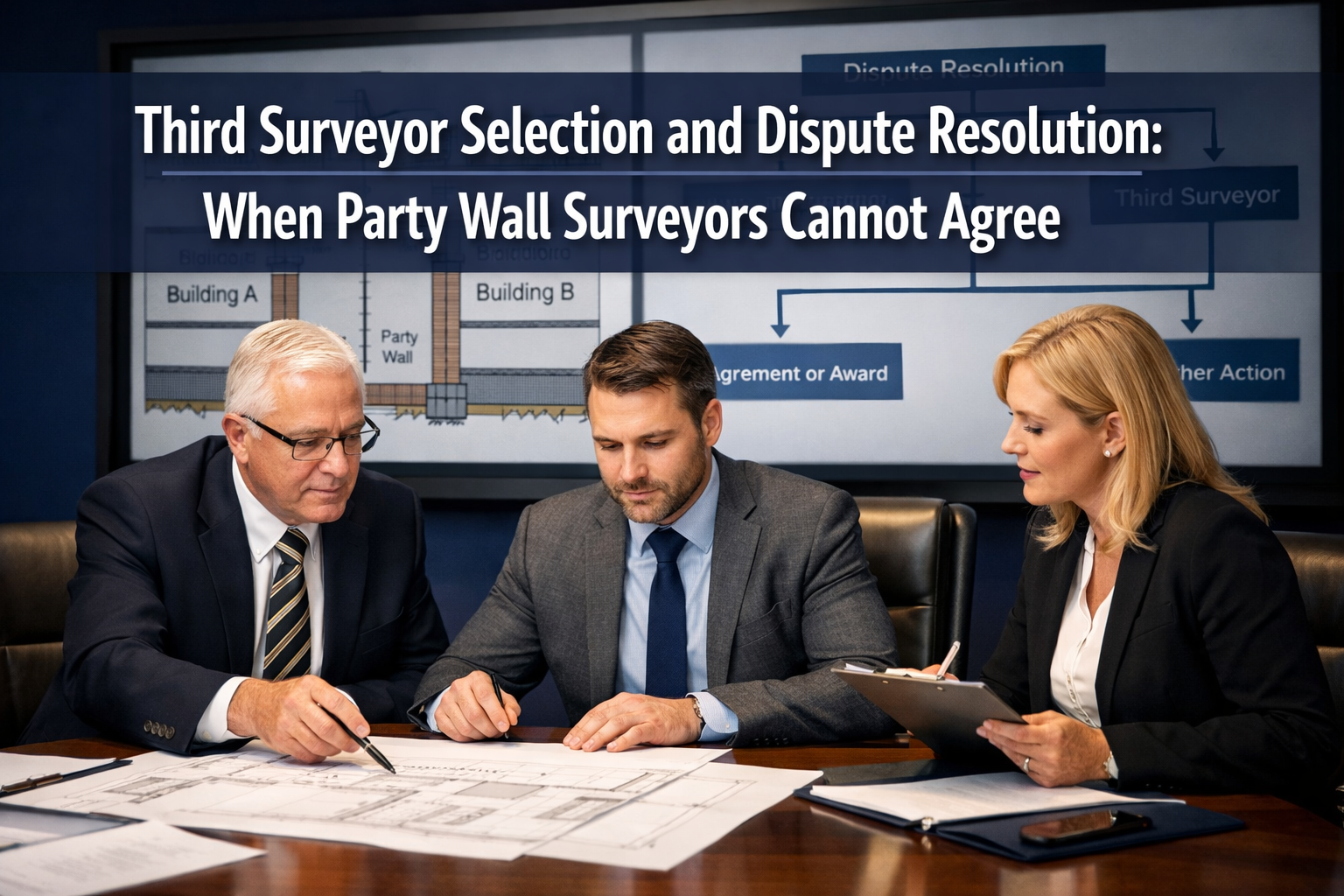
When construction work affects shared property boundaries, disagreements between appointed surveyors can bring projects to a standstill. In 2026, with property development continuing across the UK, understanding the third surveyor selection and dispute resolution process has never been more critical for building owners and their neighbours. The Party Wall etc. Act 1996 provides a structured pathway for resolving these impasses, but many property owners remain unaware of how this statutory safety mechanism operates until they face costly delays.
The process of third surveyor selection and dispute resolution when party wall surveyors cannot agree represents a crucial safeguard within party wall procedures. When the two appointed surveyors reach a deadlock over any aspect of the proposed works or the terms of the Party Wall Award, the Act mandates a clear escalation pathway that protects both parties while ensuring projects can move forward[1].
Key Takeaways
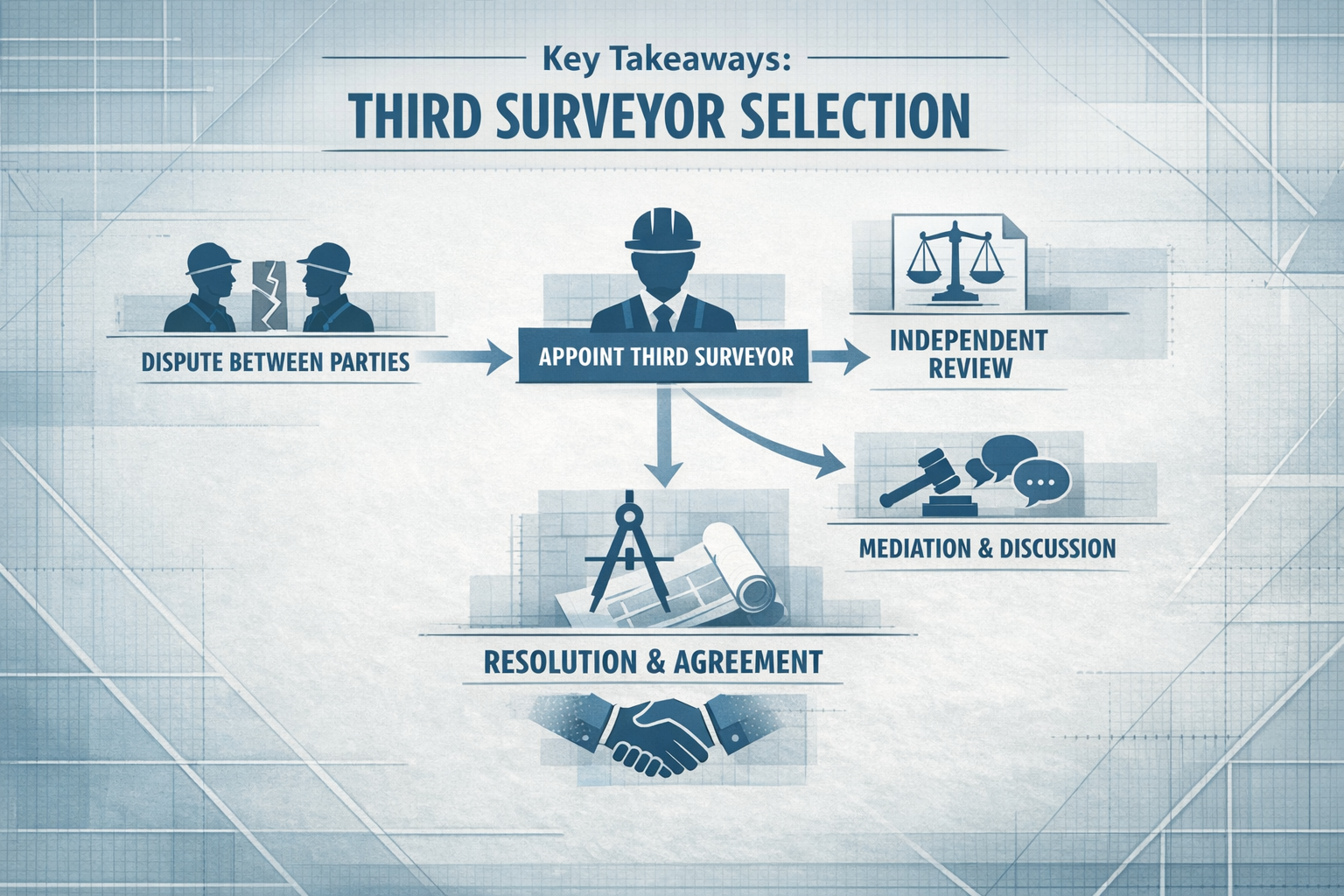
- Third surveyor appointment becomes mandatory when two appointed surveyors cannot agree on any matter under the Party Wall etc. Act 1996, triggering a statutory dispute resolution mechanism[1]
- The two surveyors jointly select the third surveyor—not the property owners—ensuring neutrality and professional expertise in the selection process[1]
- Early selection is legally required under Section 10(1)(b), which specifies surveyors should choose a third surveyor "forthwith" (immediately) after their own appointments[3]
- Third surveyor determinations are final and binding on all parties, with limited appeal options available only within a strict 14-day window[1]
- 99% of cases resolve through negotiation between the two appointed surveyors without requiring appointing officer intervention, demonstrating the effectiveness of collaborative problem-solving[3]
Understanding the Statutory Framework for Third Surveyor Selection
The Party Wall etc. Act 1996 establishes a comprehensive dispute resolution hierarchy designed to prevent construction deadlocks. This framework recognizes that even experienced professionals may occasionally reach genuine disagreements about technical matters, compensation levels, or protective measures required for neighbouring properties.
When Third Surveyor Appointment Becomes Necessary
A third surveyor must be appointed when the two initial surveyors—one representing the building owner and one representing the adjoining owner—cannot reach agreement on any matter under dispute or cannot agree on the final Party Wall Award terms[1]. This disagreement might involve:
- Scope of works and their potential impact on the adjoining property
- Compensation amounts for inconvenience or temporary loss of facilities
- Protective measures required during construction
- Schedule of condition interpretations or requirements
- Access arrangements for inspections during and after works
- Cost apportionment between the parties
The need for a third surveyor arises specifically when negotiations reach an impasse, triggering a statutory requirement embedded in Section 10 of the Act[1]. This isn't a failure of the system but rather an acknowledgment that complex construction scenarios sometimes require an independent expert determination.
The Legal Distinction: Selection vs. Appointment
The Party Wall etc. Act 1996 uses precise terminology that reflects the collaborative nature of this process. The legislation uses the term "select" ten times when referring to third surveyors, never "appoint," reflecting a nuanced legal distinction that emphasizes the choice-making process between the two appointed surveyors[2].
This language distinction matters because it reinforces that:
✅ The two surveyors must work together to identify a suitable third surveyor
✅ Neither property owner can influence the third surveyor choice directly
✅ Professional judgment guides the selection rather than party preferences
✅ Collaborative problem-solving remains the priority even during disputes
Understanding when a situation requires third surveyor intervention helps property owners recognize that this mechanism protects their interests while maintaining project momentum. For more background on party wall procedures, review our comprehensive party wall guidance.
The Third Surveyor Selection Process: Best Practices for Collaborative Problem-Solving
The process of selecting a third surveyor requires careful negotiation between the two appointed surveyors. While the Act provides statutory guidance, professional practice has developed effective protocols that minimize delays and ensure appropriate expertise.
Immediate Selection Requirements Under Section 10(1)(b)
Section 10(1)(b) of the Party Wall etc. Act 1996 specifies that the two surveyors should select the third surveyor "forthwith" (immediately) after their own appointments are confirmed, ideally before disagreements emerge[3]. This proactive approach offers several advantages:
Early Selection Benefits:
| Benefit | Impact |
|---|---|
| Reduced Delays | Third surveyor already identified when disputes arise |
| Cost Efficiency | Avoids rushed selection under pressure |
| Professional Relationships | Establishes communication channels early |
| Psychological Effect | Encourages cooperative negotiation knowing third surveyor awaits |
| Statutory Compliance | Fulfills legal requirement for immediate selection |
Despite this clear statutory requirement, many surveyors fail to prioritize early third surveyor selection[2]. This oversight can create unnecessary complications when disputes subsequently develop and parties must scramble to identify an appropriate candidate.
The Nomination and Negotiation Process
The selection process typically follows a structured negotiation pattern that has evolved through professional practice. The building owner's surveyor usually initiates the process by suggesting three potential candidates, and the adjoining owner's surveyor then either selects one, requests additional names, or makes counter-suggestions until agreement is reached[3].
Standard Selection Protocol:
- 🔍 Initial Proposals – Building owner's surveyor suggests 3 qualified candidates with brief CVs
- 📋 Review Period – Adjoining owner's surveyor evaluates candidates (typically 5-7 days)
- 💬 Feedback Exchange – Discussion of any concerns or preference for alternative candidates
- 🔄 Counter-Proposals – Additional names suggested if initial candidates unsuitable
- ✅ Agreement Reached – Formal written appointment of selected third surveyor
- 📞 Notification – Third surveyor informed and confirms availability
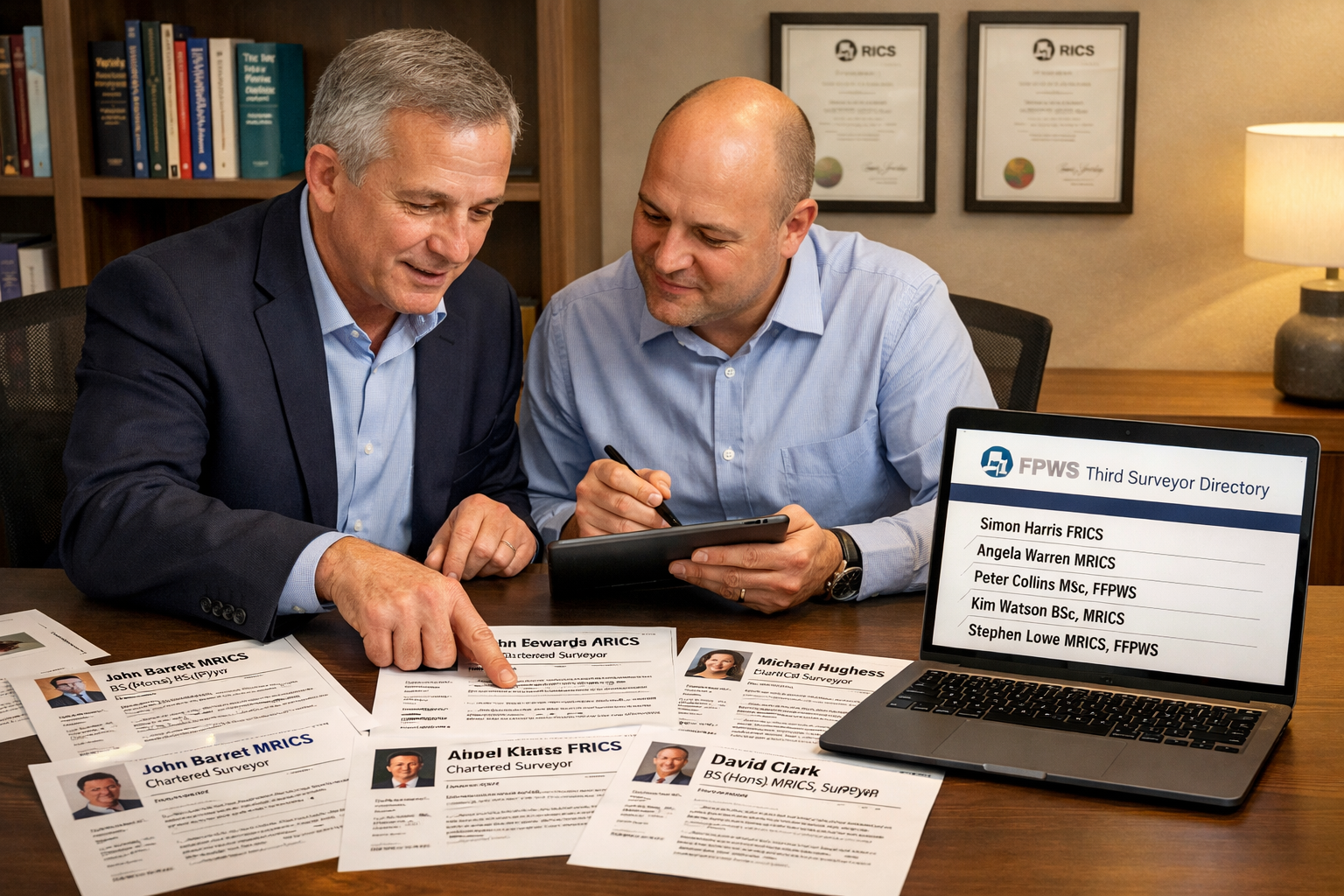
Professional lists of competent third surveyors who have received specialized training are maintained by the Faculty of Party Wall Surveyors (FPWS) and the Department for Communities and Local Government[2]. These directories help ensure qualified candidates are readily available.
"The two appointed surveyors must collectively nominate and appoint the third surveyor—owners cannot influence this choice directly. This ensures neutrality and professional expertise guide the selection."
Essential Qualifications for Third Surveyors
The third surveyor must be a neutral, experienced specialist Party Wall Surveyor who is not chosen by either the building owner or the adjoining owner[1]. Key qualification criteria include:
Professional Requirements:
- ✔️ RICS membership or equivalent professional qualification
- ✔️ Extensive party wall experience with demonstrated expertise
- ✔️ Third surveyor training through recognized professional bodies
- ✔️ No conflicts of interest with either party or their surveyors
- ✔️ Availability to review matters promptly
- ✔️ Professional indemnity insurance appropriate to the role
- ✔️ Reputation for impartiality among party wall professionals
The selection of an appropriately qualified third surveyor significantly impacts the quality and acceptance of their eventual determination. Both appointed surveyors should prioritize expertise and neutrality over convenience or familiarity.
For property owners concerned about party wall costs, understanding that early third surveyor selection can actually reduce expenses by preventing protracted disputes provides important reassurance.
Third Surveyor Selection and Dispute Resolution: Roles, Powers, and Determination Process
Once appointed, the third surveyor assumes specific statutory powers and responsibilities that differ significantly from those of the two appointed surveyors. Understanding these distinctions helps all parties appreciate the limited but crucial role this professional plays.
Limited Scope: Ruling on Specific Points of Disagreement
The third surveyor's role is strictly limited to ruling on the specific point of disagreement submitted by the two appointed surveyors[1]. This focused mandate means:
What Third Surveyors Do:
- 📌 Review the specific disputed matter referred by the two surveyors
- 📌 Consider written submissions from both appointed surveyors
- 📌 Apply professional judgment to technical or valuation questions
- 📌 Issue a written determination on the specific point of dispute
- 📌 Determine fee responsibility for their involvement
What Third Surveyors Do Not Do:
- ❌ Conduct independent site inspections (unless specifically required)
- ❌ Rewrite entire Party Wall Awards
- ❌ Mediate between property owners directly
- ❌ Make determinations beyond the specific referred dispute
- ❌ Overturn matters already agreed between the two surveyors
This limited scope ensures efficiency and prevents the third surveyor from becoming an alternative route for dissatisfied parties to relitigate matters already resolved. When disputes arise about party wall loft conversions or other common works, this focused approach maintains project momentum.
The Determination Process and Timeline
When the two surveyors formally refer a dispute to the third surveyor, a structured process unfolds:
Typical Third Surveyor Determination Timeline:
- Referral (Day 0) – Both surveyors submit written statements outlining their positions
- Document Review (Days 1-7) – Third surveyor reviews submissions and supporting evidence
- Clarification Requests (Days 8-14) – Third surveyor may request additional information
- Determination Drafting (Days 15-21) – Third surveyor prepares written decision with reasoning
- Determination Issued (Day 21-28) – Formal written determination served on both surveyors
- Implementation (Day 28+) – Appointed surveyors incorporate determination into final Award
The determination is final and legally binding on all parties and the two appointed surveyors, allowing the final Party Wall Award to be issued[1]. This finality provides certainty and prevents endless cycles of disagreement.
Fee Allocation and Financial Accountability
One of the most significant aspects of third surveyor involvement concerns fee responsibility. The third surveyor determines who pays for their services, typically apportioning costs to the party whose surveyor's position or instructions led to the unnecessary escalation and requirement of their involvement[1].
This creates a powerful financial incentive for surveyors to resolve disputes cooperatively[1]. Scenarios for fee allocation include:
Fee Responsibility Outcomes:
| Scenario | Typical Fee Allocation |
|---|---|
| Building owner's surveyor took unreasonable position | Building owner pays 100% |
| Adjoining owner's surveyor made unreasonable demands | Adjoining owner pays 100% |
| Genuine technical disagreement requiring expert view | Split 50/50 between parties |
| One surveyor failed to provide adequate information | That party's client pays 100% |
| Dispute arose from owner interference with surveyor | That owner pays 100% |
Third surveyor fees typically range from £1,500 to £5,000 depending on complexity, though particularly technical disputes may exceed this range. This financial risk encourages both appointed surveyors to exhaust collaborative problem-solving before escalating matters.
Property owners should understand that having no party wall agreement can lead to far more expensive disputes than properly managed procedures with professional surveyors.
Escalation Mechanisms: When Third Surveyor Selection and Dispute Resolution Fails
While the vast majority of cases resolve through the standard third surveyor selection process, the Act provides additional escalation mechanisms for exceptional circumstances where even this collaborative approach breaks down.

The Appointing Officer: Local Authority Intervention
If the two surveyors cannot even agree on selecting a third surveyor, Section 10(8) of the Act transfers the task to the local authority's appointing officer—typically the head of Building Control[2][3]. This intervention occurs when:
- The two surveyors have exchanged approximately 12 candidate names without agreement
- Negotiations have clearly reached deadlock with no prospect of resolution
- Either surveyor formally requests appointing officer intervention
- Unreasonable behavior by one surveyor prevents selection
The appointing officer then selects an appropriate third surveyor from qualified professionals, and this selection is binding on both parties. The appointing officer's involvement is rare in practice, occurring in less than 1% of cases[3], as most surveyors recognize that reaching this stage reflects poorly on their professional judgment.
Secretary of State Appointment: The Ultimate Fallback
When the local authority is itself a party to the dispute, the Secretary of State selects the third surveyor instead of the appointing officer[3]. This scenario is exceptionally rare, typically arising only when:
- 🏛️ Local authority is the building owner or adjoining owner
- 🏛️ Potential conflict of interest prevents local authority involvement
- 🏛️ Major infrastructure projects involve government entities
This ultimate fallback ensures that even in the most unusual circumstances, the statutory dispute resolution mechanism cannot be circumvented.
The 99% Success Rate: Why Collaborative Resolution Works
In approximately 99% of cases, the two surveyors successfully select a third surveyor through their standard negotiation process, avoiding the need for appointing officer intervention[3]. This remarkably high success rate reflects several factors:
Why Surveyors Cooperate on Third Surveyor Selection:
✅ Professional reputation matters in the close-knit party wall community
✅ Future working relationships depend on demonstrated reasonableness
✅ Financial incentives discourage unreasonable positions
✅ Statutory obligations create clear expectations for cooperation
✅ Client interests are best served by efficient resolution
✅ Professional standards enforced by RICS and FPWS
This success rate demonstrates that the statutory framework effectively encourages collaborative problem-solving even when substantive disagreements arise. Property owners should take comfort that escalation to appointing officers or courts remains genuinely exceptional.
For those concerned about party wall notice procedures, understanding that professional surveyors resolve disputes efficiently provides important reassurance.
Appeals, Legal Remedies, and the County Court Option
While third surveyor determinations are designed to be final, the Act does provide limited appeal mechanisms for parties who believe a determination is fundamentally flawed.
The 14-Day Appeal Window and High Barriers
A party may lodge an appeal with the County Court under Section 10(17) of the Act, but only within 14 days of the determination being served[1]. This extremely tight timeframe requires:
⏰ Immediate legal advice upon receiving an unfavorable determination
⏰ Rapid evidence gathering to support appeal grounds
⏰ Swift court filing to meet the statutory deadline
⏰ Substantial financial commitment to litigation costs
Appeals are rare, highly technical, and very expensive, creating a strong deterrent effect[1]. Courts will only intervene in exceptional circumstances, such as:
- Procedural irregularities that denied natural justice
- Jurisdictional errors where the third surveyor exceeded their authority
- Manifest errors of law in applying the Party Wall Act
- Bias or conflict of interest affecting the determination
Courts will not overturn determinations simply because a party disagrees with the professional judgment exercised or believes a different conclusion was more appropriate.
Irrevocable Appointments and the No-Rescission Rule
Once appointed in writing, surveyors cannot be dismissed by either party. The legislation explicitly states that "All appointments and selections made under this section shall not be rescinded by either party"[2]. This permanence ensures:
🔒 Surveyor independence from client pressure
🔒 Continuity throughout the party wall process
🔒 Professional judgment protected from interference
🔒 Finality of the dispute resolution mechanism
Property owners occasionally become frustrated with their appointed surveyor's approach and seek to replace them. The no-rescission rule prevents this, emphasizing the importance of careful surveyor selection at the outset.
Cost Implications of Escalation
The financial consequences of escalating disputes beyond the third surveyor determination can be severe:
Comparative Cost Analysis:
| Resolution Level | Typical Cost Range | Timeframe |
|---|---|---|
| Two surveyors agree | £1,000-£3,000 total | 4-8 weeks |
| Third surveyor determination | £3,000-£8,000 total | 8-12 weeks |
| County Court appeal | £15,000-£50,000+ | 6-18 months |
These escalating costs create strong incentives for parties to accept third surveyor determinations rather than pursue appeals. For most residential party wall matters, the cost of litigation quickly exceeds the value in dispute.
Understanding the complete party wall process and FAQs helps property owners appreciate why the third surveyor mechanism represents an efficient alternative to court proceedings.
Best Practices for Avoiding Third Surveyor Escalation
While the third surveyor mechanism provides essential protection, the most successful party wall procedures avoid reaching this stage altogether. Both property owners and their appointed surveyors can take proactive steps to maximize collaborative resolution.
Selecting the Right Surveyors Initially
The foundation of successful party wall procedures lies in appointing experienced, professional surveyors from the outset. Key selection criteria include:
Essential Surveyor Qualities:
- 🎓 RICS qualification and party wall specialization
- 🎓 Local knowledge of construction practices and property values
- 🎓 Communication skills for explaining technical matters clearly
- 🎓 Negotiation experience in resolving disputes cooperatively
- 🎓 Professional reputation among peers
- 🎓 Reasonable fee structures that don't incentivize conflict
Property owners should avoid appointing friends, relatives, or general practitioners without party wall expertise, as these choices frequently lead to disputes requiring third surveyor intervention.
Early Communication and Relationship Building
When appointed surveyors establish positive working relationships early in the process, they create foundations for collaborative problem-solving:
Relationship-Building Strategies:
- Initial joint meeting to discuss the works and establish protocols
- Agreed timetable for inspections, correspondence, and decision-making
- Direct communication rather than routing everything through owners
- Professional courtesy in all interactions
- Transparent reasoning when disagreements arise
- Early third surveyor selection as required by Section 10(1)(b)
These practices significantly reduce the likelihood that minor disagreements escalate into formal disputes requiring third surveyor determination.
Documentation and Transparency
Clear documentation throughout the party wall process helps prevent misunderstandings that might otherwise require third surveyor intervention:
📄 Detailed schedules of condition agreed before works commence
📄 Written records of all site visits and observations
📄 Transparent cost estimates with clear assumptions
📄 Regular progress updates to both owners
📄 Prompt responses to correspondence and queries
When surveyors maintain comprehensive records, they can often resolve apparent disputes by referring back to agreed documentation rather than escalating matters.
Property owners undertaking works that require excavation near a neighbour particularly benefit from thorough documentation practices.
Recognizing When Third Surveyor Input Adds Value
Paradoxically, sometimes the most collaborative approach involves early recognition that a genuine technical disagreement requires third surveyor determination rather than protracted negotiation. Indicators that third surveyor input would be valuable include:
- ✔️ Technical complexity beyond either surveyor's specific expertise
- ✔️ Valuation disagreements exceeding £5,000-£10,000
- ✔️ Precedent-setting issues with implications for future works
- ✔️ Genuine professional disagreement where both positions have merit
- ✔️ Deadlock after reasonable negotiation attempts
In these scenarios, prompt referral to the third surveyor may actually reduce overall costs and delays compared to extended negotiations that ultimately prove fruitless.
Conclusion
Third surveyor selection and dispute resolution when party wall surveyors cannot agree represents a crucial safeguard within the Party Wall etc. Act 1996, providing a structured pathway for resolving impasses while maintaining project momentum. The statutory framework balances professional autonomy with accountability, creating powerful incentives for collaborative problem-solving while ensuring that genuine disputes can be resolved efficiently.
The key principles that property owners should understand include:
🔑 Early third surveyor selection fulfills statutory requirements and prevents delays when disputes arise
🔑 The two appointed surveyors jointly select the third surveyor, ensuring professional expertise and neutrality
🔑 Third surveyor determinations are final and binding, with limited appeal options
🔑 Fee allocation creates accountability, discouraging unreasonable positions
🔑 99% of cases resolve through negotiation without requiring appointing officer intervention
Actionable Next Steps
For building owners planning works affecting party walls in 2026:
- Appoint an experienced party wall surveyor with demonstrated expertise in collaborative dispute resolution
- Ensure your surveyor selects a third surveyor immediately after appointment, as required by Section 10(1)(b)
- Maintain open communication with your surveyor about the progress of negotiations
- Understand that third surveyor involvement may actually reduce costs compared to protracted disputes
- Focus on the long-term relationship with your neighbours rather than winning individual points
For adjoining owners responding to party wall notices:
- Appoint your own surveyor rather than relying on the building owner's surveyor alone
- Choose a professional with negotiation skills and a reputation for reasonableness
- Trust the statutory framework to protect your interests through the third surveyor mechanism if needed
- Recognize that most disputes resolve through professional negotiation without formal determinations
The third surveyor mechanism demonstrates the Party Wall etc. Act 1996's sophisticated approach to balancing property rights with construction needs. By understanding this process and working with experienced professionals, property owners can navigate party wall procedures efficiently while maintaining positive neighbourly relationships.
For expert guidance on party wall matters and access to experienced surveyors who prioritize collaborative problem-solving, consult with specialists who understand both the technical requirements and the interpersonal dynamics that lead to successful outcomes. The statutory framework provides the structure, but professional expertise and goodwill create the results that benefit all parties.
References
[1] Appointing The Third Surveyor When Disagreements Arise And Why This Costly Step Is Necessary – https://www.partywallslimited.com/blog/appointing-the-third-surveyor-when-disagreements-arise-and-why-this-costly-step-is-necessary
[2] Party Wall Disputes The Third Surveyor – https://www.isurv.com/info/390/features_archive/11143/party_wall_disputes_the_third_surveyor
[3] Role Of The Third Surveyor In Party Wall Matters – https://taylor-mitchell.co.uk/blog/role-of-the-third-surveyor-in-party-wall-matters/
[4] If You Cant Agree – https://www.gov.uk/party-walls-building-works/if-you-cant-agree
[5] Party Wall Agreement – https://hoa.org.uk/advice/guides-for-homeowners/i-am-improving/party-wall-agreement/
[6] The Unique Role Of A Party Wall Surveyor – https://dwfgroup.com/en/news-and-insights/insights/2017/4/the-unique-role-of-a-party-wall-surveyor
[7] Party Wall Surveys Amid 2026 Construction Boom Handling Disputes In High Demand Uk Housing Markets – https://nottinghillsurveyors.com/blog/party-wall-surveys-amid-2026-construction-boom-handling-disputes-in-high-demand-uk-housing-markets