The surveying profession stands at a critical crossroads in 2026. With anticipated homebuying reforms driving unprecedented demand and a predicted volume surge across both lending and property surveys, the industry faces a pressing question: Do we have enough qualified surveyors to meet the challenge? The answer requires immediate action on talent pipeline strategies for surveyors: building capacity for 2026's volume surge and homebuying reforms has become the sector's most urgent priority.
The Royal Institution of Chartered Surveyors (RICS) recognizes this challenge and is implementing transformative initiatives to strengthen graduate pathways, enhance continuing professional development (CPD), and deploy digital tools that support both existing members and attract new talent [1]. For surveying firms, the time to act is now—building a robust talent pipeline isn't just about filling vacancies; it's about ensuring the profession can deliver quality RICS home surveys and specialized services when the market demands them most.

Key Takeaways
- 📈 Volume surge expected: The surveying sector anticipates significant increases in survey demand throughout 2026 due to homebuying reforms and market recovery
- 🎓 RICS pathway improvements: New clearer graduate pathways and enhanced digital CPD platforms are being developed to accelerate qualification timelines
- ⏱️ Time-to-hire matters: Without strategic talent pipelines, firms face average position fill times of 42 days, creating service delivery bottlenecks during peak demand
- 🔧 Skills-based hiring works: Organizations implementing structured candidate profiles and multi-channel sourcing see measurably better quality-of-hire outcomes
- 💡 Technology enables visibility: Integrated ATS-CRM systems and real-time pipeline analytics help firms identify sourcing bottlenecks and maintain recruitment agility
Understanding the 2026 Surveying Landscape and Demand Drivers
The Perfect Storm: Reform, Recovery, and Renewed Demand
The surveying sector in 2026 is experiencing what industry experts call a "perfect storm" of positive market conditions. Homebuying reforms designed to streamline property transactions are creating additional touchpoints where professional surveying services become essential [1]. Simultaneously, market recovery from previous economic headwinds means more properties are changing hands, and lenders are increasing their requirements for comprehensive property assessments.
This convergence creates unprecedented demand for qualified surveyors capable of delivering everything from standard homebuyer surveys to specialized RICS Building Surveys Level 3 inspections. The challenge? The talent pool hasn't grown proportionally to meet this surge.
Capacity Constraints Across the Profession
Current capacity constraints manifest in several critical areas:
- Geographic coverage gaps: Certain regions face acute surveyor shortages, extending wait times for property buyers
- Specialization shortfalls: Demand for specialist defect surveys and commercial building surveys often exceeds available qualified professionals
- Turnaround time pressures: Buyers increasingly ask "how long does a homebuyers survey take?" and expect faster service delivery
- Quality maintenance concerns: Rushing to meet volume demands risks compromising the thoroughness that defines professional surveying
These constraints underscore why talent pipeline strategies for surveyors: building capacity for 2026's volume surge and homebuying reforms must address both immediate hiring needs and long-term workforce development.
RICS Initiatives: Strengthening the Foundation for Talent Pipeline Strategies
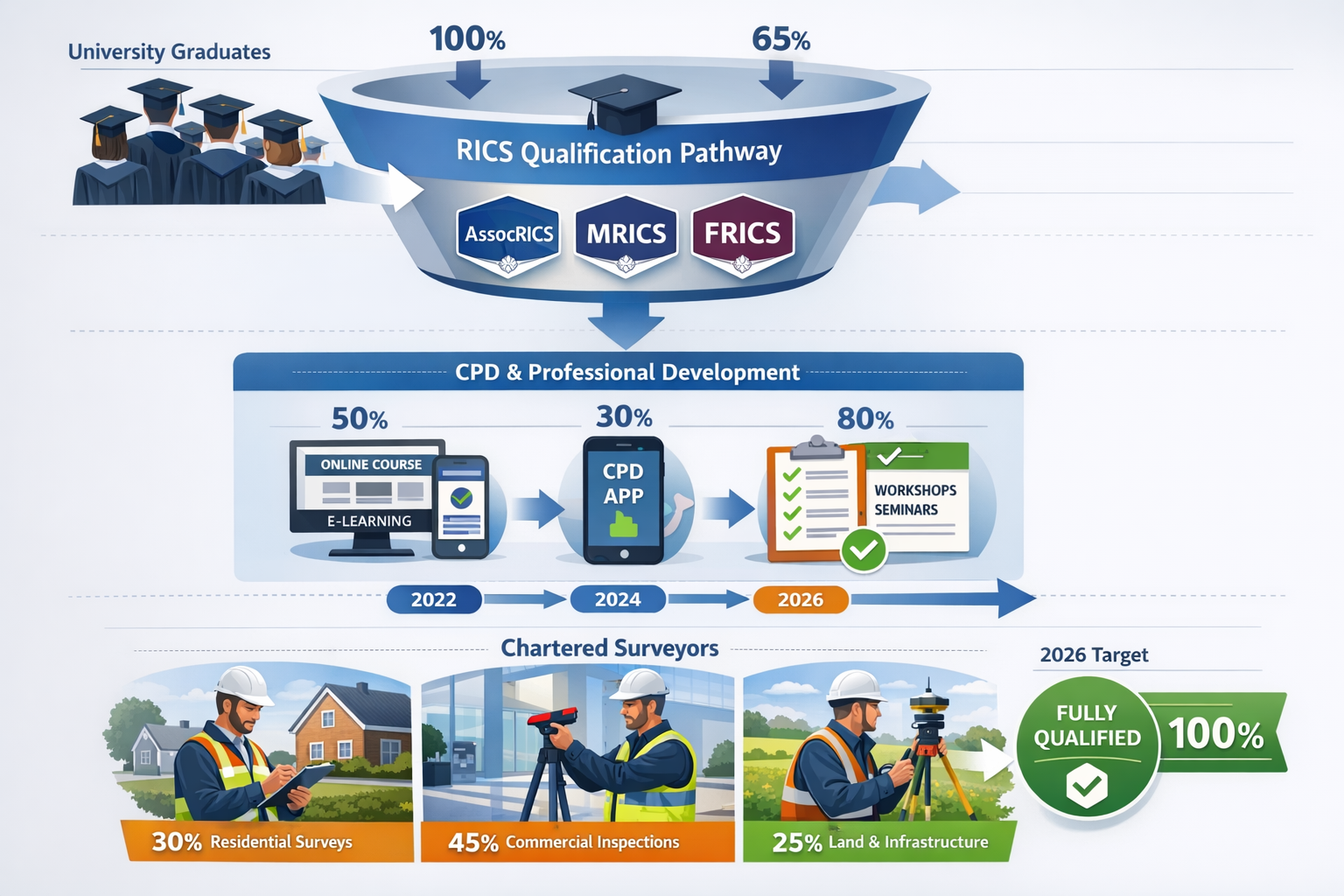
Clearer Graduate Pathways to Qualification
One of the most significant barriers to building surveying capacity has been the complexity and perceived opacity of qualification pathways. RICS is directly addressing this challenge by developing clearer, more structured routes for graduates entering the profession [1].
These improved pathways include:
✅ Streamlined Assessment of Professional Competence (APC): Simplified competency frameworks that help candidates understand exactly what's required
✅ Enhanced mentorship structures: Better matching between experienced chartered surveyors and trainees
✅ Modular learning approaches: Flexible qualification routes that accommodate diverse educational backgrounds
✅ Transparent timeline expectations: Clear guidance on realistic timeframes from graduate entry to chartered status
For firms implementing talent pipeline strategies for surveyors: building capacity for 2026's volume surge and homebuying reforms, these clearer pathways mean faster time-to-productivity for new hires and more predictable workforce planning.
Enhanced Digital CPD Platforms and Member Support
Professional development doesn't end at qualification—maintaining and expanding expertise throughout a surveyor's career is equally critical. RICS has invested significantly in enhanced digital CPD platforms featuring [1]:
- Interactive learning modules: Covering emerging topics like sustainability assessments, modern construction methods, and digital surveying technologies
- Mobile-first accessibility: The new RICS member app enables learning on-the-go, fitting professional development around busy survey schedules
- Personalized learning pathways: AI-driven recommendations based on individual practice areas and career goals
- Peer collaboration features: Virtual communities where surveyors share insights and solve complex problems collectively
These digital enhancements serve dual purposes: they retain existing talent by demonstrating investment in their development while simultaneously attracting tech-savvy graduates who expect modern, flexible learning environments.
Attracting the Next Generation of Surveying Professionals
The surveying profession must compete with numerous other career paths for top graduate talent. RICS's initiatives specifically target next-generation attraction through:
🎯 University partnerships: Strengthened relationships with built environment programs to introduce surveying careers earlier
🎯 Apprenticeship expansion: Alternative entry routes that combine earning with learning
🎯 Diversity initiatives: Targeted outreach to underrepresented groups to broaden the talent pool
🎯 Career visibility campaigns: Showcasing the variety, impact, and earning potential within surveying careers
Research indicates that 43% of companies plan to replace roles with AI in the coming years, with entry-level positions particularly vulnerable [4]. However, surveying's hands-on, judgment-intensive nature makes it more resistant to automation—a compelling message for graduates seeking career stability alongside professional challenge.
Building Your Firm's Talent Pipeline: Practical Strategies and Implementation
Multi-Channel Sourcing: Casting a Wider Net
Relying on a single recruitment channel is a recipe for talent scarcity. Organizations developing robust talent pipeline strategies for surveyors: building capacity for 2026's volume surge and homebuying reforms should implement diverse candidate sourcing channels [3]:
| Sourcing Channel | Best For | Implementation Tips |
|---|---|---|
| University partnerships | Graduate recruitment | Establish internship programs; sponsor student projects; offer guest lectures |
| Professional networks | Experienced hires | Active participation in RICS regional events; LinkedIn engagement |
| Employee referrals | Cultural fit candidates | Incentivize referrals with bonuses; make process simple |
| Industry job boards | Passive candidates | Maintain compelling employer brand; highlight unique benefits |
| Social media recruiting | Younger demographics | Showcase day-in-the-life content; highlight career progression |
| Recruitment agencies | Specialized roles | Partner with agencies specializing in built environment professions |
Multi-channel sourcing doesn't mean pursuing all channels equally—it means strategically selecting and optimizing the channels most likely to reach your target candidate profiles.
Structured Candidate Profiles: Reducing Bias and Improving Match Quality
Skills-based hiring is becoming increasingly operational, with research showing direct correlation to better quality-of-hire outcomes [5]. For surveying firms, this means moving beyond generic job descriptions to create detailed candidate blueprints that document [2]:
- Technical capabilities: Specific survey types, software proficiency, measurement techniques
- Experience type: Residential vs. commercial; new construction vs. heritage properties
- Industry exposure: Sectors served (residential conveyancing, insurance claims, legal disputes)
- Cultural alignment indicators: Work style preferences, communication approaches, professional values
These structured profiles improve consistency across recruiters and reduce subjective screening that can introduce unconscious bias. When implemented properly, they expand your effective talent pool by identifying candidates who might be overlooked by traditional credential-focused screening.
Technology Integration: Gaining Pipeline Visibility
Without visibility into your talent pipeline, you're essentially recruiting blind. Modern ATS-CRM integration provides the real-time dashboards and analytics tools necessary to understand [2]:
📊 Pipeline depth by role segment: How many qualified candidates exist for each surveyor specialization
📊 Readiness categorization: Which candidates are immediately available vs. require notice periods
📊 Conversion ratios: Where candidates drop out of your recruitment process
📊 Sourcing effectiveness: Which channels deliver the highest quality candidates
📊 Time-to-hire metrics: Average duration from first contact to offer acceptance
This visibility enables proactive pipeline management rather than reactive scrambling when positions open. For example, if your analytics reveal that choosing the right property survey specialists take 60+ days to hire, you can begin sourcing before the need becomes urgent.
Recruitment and Training Checklists for Surveying Firms
Recruitment Readiness Checklist
Use this checklist to ensure your firm is positioned to attract and secure top surveying talent in 2026's competitive market:
Employer Brand & Value Proposition
- Clearly articulated career progression pathways documented and shared publicly
- Competitive compensation benchmarked against regional and national surveying salary data
- Unique benefits highlighted (flexible working, CPD funding, specialized training opportunities)
- Employee testimonials and success stories featured on website and social media
- Thought leadership content demonstrating expertise and industry engagement
Sourcing Infrastructure
- Active relationships with at least 3 university built environment programs
- Employee referral program with clear incentives and simple submission process
- Professional networking presence at RICS events and regional surveying associations
- Social media recruitment strategy with regular content showcasing firm culture
- Partnership with specialized recruitment agencies for hard-to-fill roles
Selection Process
- Structured candidate profiles developed for each surveyor role type
- Skills-based assessment methods that evaluate practical surveying competencies
- Interview panels trained on unconscious bias and consistent evaluation criteria
- Realistic job previews that accurately represent day-to-day surveying work
- Streamlined decision-making process to reduce time from interview to offer
Technology & Analytics
- Applicant Tracking System (ATS) implemented with pipeline reporting capabilities
- Integration between ATS and CRM for passive candidate relationship management
- Real-time dashboard access for hiring managers showing pipeline status
- Quarterly pipeline health reviews examining conversion rates and sourcing effectiveness
- Candidate experience feedback mechanisms to identify process improvements
Training and Development Checklist
Once talent is secured, effective onboarding and development ensure retention and productivity:
Onboarding Program
- Structured 90-day onboarding plan with clear milestones and competency checkpoints
- Assigned mentor from experienced chartered surveyor pool
- Shadowing opportunities across different survey types and property categories
- Technical training on firm-specific software, reporting templates, and quality standards
- Introduction to firm's approach to different types of surveys
APC Support (for trainees)
- Dedicated APC counselor assigned with regular review meetings scheduled
- Structured experience logging system with feedback loops
- Mock assessment opportunities before final APC submission
- Study leave provision for APC preparation
- Financial support for RICS membership and assessment fees
Continuing Professional Development
- Individual CPD plans aligned with both firm needs and personal career goals
- Access to RICS digital learning platforms and new member app
- Budget allocation for external training courses and professional conferences
- Internal knowledge-sharing sessions where surveyors present on specialized topics
- Cross-training opportunities to develop breadth across survey specializations
Career Progression Framework
- Clear criteria for advancement from trainee to qualified to senior surveyor roles
- Specialization pathways identified (e.g., heritage buildings, commercial, expert witness)
- Leadership development opportunities for surveyors interested in management
- Regular career conversations (minimum annually) to discuss aspirations and development
- Succession planning for key roles to create internal advancement opportunities
Workforce Planning: Staying Ahead of Demand Fluctuations
Quarterly Workforce Audits
Talent pipeline strategies for surveyors: building capacity for 2026's volume surge and homebuying reforms require ongoing attention, not one-time initiatives. Quarterly workforce audits help organizations maintain strategic agility by identifying [3]:
🔍 Current skills gaps: Which survey specializations lack sufficient capacity
🔍 Upcoming retirements: Senior surveyors approaching retirement age
🔍 Expansion-supporting roles: Positions needed to support business growth plans
🔍 Utilization patterns: Whether current staff are over- or under-deployed
🔍 Training effectiveness: Whether development programs are producing desired competencies
These regular audits transform workforce planning from reactive firefighting to proactive capacity building. When combined with market intelligence about homebuying trends and regulatory changes, they enable firms to build capacity before demand peaks rather than scrambling to catch up afterward.
Addressing the Leadership Pipeline Crisis
While immediate focus naturally centers on filling surveyor positions, firms must also consider long-term leadership development. Research warns that aggressive entry-level hiring cuts to leverage AI could create a leadership pipeline crisis within 5-10 years [4].
For surveying firms, this means:
- Protecting graduate intake: Maintaining consistent graduate hiring even during slower periods to ensure future leadership bench strength
- Developing internal talent: Creating clear pathways from surveyor to senior surveyor to director roles
- Mentorship formalization: Ensuring knowledge transfer from experienced professionals to emerging talent
- Leadership training: Providing management and business development skills alongside technical surveying expertise
The surveyors who enter the profession in 2026 will be leading firms in 2036—investing in their development today is investing in the profession's future.
Leveraging Technology Without Losing the Human Element
Digital Tools Enhancing Surveyor Productivity
Technology plays a dual role in talent pipeline strategies: it makes existing surveyors more productive while also attracting tech-savvy talent. In 2026, leading surveying firms are deploying:
- Digital survey platforms: Tablet-based inspection tools that streamline data collection and report generation
- Drone technology: For roof surveys and large property assessments, reducing time and safety risks
- AI-assisted defect detection: Machine learning tools that flag potential issues for surveyor review
- Virtual collaboration tools: Enabling remote consultation and multi-surveyor input on complex cases
- Automated scheduling systems: Optimizing surveyor routes and maximizing billable time
These technologies don't replace professional judgment—they amplify surveyor capacity by handling routine tasks and enabling focus on the complex analysis that defines quality surveying work.
Maintaining Professional Standards in High-Volume Environments
As firms scale capacity to meet 2026's volume surge, maintaining the professional standards that define quality surveying becomes paramount. Key safeguards include:
✓ Quality assurance protocols: Regular peer review of reports before client delivery
✓ Standardized methodologies: Consistent approaches to common survey scenarios
✓ Adequate time allocation: Resisting pressure to compromise inspection thoroughness for speed
✓ Continuing competence verification: Regular skills assessments to identify training needs
✓ Client feedback integration: Systematic collection and response to service quality indicators
The surveying profession's reputation depends on consistent quality delivery—talent pipeline strategies must build capacity without compromising the standards that create client trust and professional pride.
Regional Considerations and Geographic Capacity Building
Addressing Regional Surveyor Shortages
Surveyor availability varies significantly by region, with some areas experiencing acute shortages while others maintain adequate capacity. Firms implementing talent pipeline strategies for surveyors: building capacity for 2026's volume surge and homebuying reforms should consider:
High-Demand Regions Requiring Focus:
- Rapidly growing suburban areas with new housing development
- Regions with aging housing stock requiring specialist heritage expertise
- Areas with limited surveying competition creating service gaps
- Locations experiencing post-pandemic population influx
Regional Capacity-Building Approaches:
- Remote surveying models: Enabling surveyors to serve multiple regions with strategic travel
- Regional recruitment partnerships: Collaborating with local universities and technical colleges
- Incentive programs: Offering relocation support or regional bonuses for hard-to-staff areas
- Flexible working arrangements: Allowing surveyors to balance regional travel with work-from-home days
Understanding regional variations in surveying demand enables more strategic talent deployment and recruitment targeting.
Measuring Success: KPIs for Talent Pipeline Effectiveness
Key Performance Indicators to Track
Effective talent pipeline strategies require measurement. Essential KPIs include:
| Metric | Target Benchmark | Why It Matters |
|---|---|---|
| Time-to-hire | <42 days | Industry average; shorter indicates pipeline strength [3] |
| Quality-of-hire | >4.0/5.0 manager rating | Validates selection process effectiveness |
| Pipeline depth | 3:1 ratio qualified candidates to open roles | Ensures choice and reduces hiring urgency |
| Offer acceptance rate | >85% | Indicates competitive positioning and candidate experience |
| New hire retention (12-month) | >90% | Validates fit and onboarding effectiveness |
| APC pass rate (first attempt) | >80% | Demonstrates training program quality |
| Internal promotion rate | >60% of senior roles | Shows career development effectiveness |
| Cost-per-hire | Benchmarked to industry | Ensures recruitment efficiency |
Regular review of these metrics enables continuous improvement in talent acquisition and development processes.
Adjusting Strategies Based on Data
Data without action provides no value. Establish quarterly strategy reviews where recruitment and training leaders:
- Analyze KPI trends and identify concerning patterns
- Gather qualitative feedback from recent hires and hiring managers
- Benchmark performance against industry standards and competitors
- Identify specific process improvements or resource reallocations
- Set targeted goals for the next quarter with clear accountability
This data-driven approach ensures talent pipeline strategies evolve with changing market conditions and organizational needs.
Preparing for the Future: Beyond 2026

Building Sustainable Talent Ecosystems
While 2026's volume surge creates immediate urgency, sustainable talent pipeline strategies look beyond short-term capacity challenges to build long-term talent ecosystems that can flex with market cycles.
This includes:
🌱 Educational partnerships: Multi-year commitments to university programs that create consistent graduate pipelines
🌱 Industry collaboration: Sharing best practices with other surveying firms to strengthen the profession collectively
🌱 Policy engagement: Contributing to RICS policy development that shapes qualification pathways
🌱 Community presence: Building surveying profession awareness through school engagement and career events
🌱 Knowledge preservation: Documenting expertise from retiring surveyors before institutional knowledge is lost
These ecosystem-building activities create resilient talent pipelines that serve the profession through both boom and quieter periods.
Embracing Workforce Flexibility
The nature of work continues evolving, and surveying firms must adapt their talent strategies accordingly. Workforce flexibility in 2026 includes:
- Hybrid working models: Balancing field work requirements with flexible report writing and administrative work
- Portfolio careers: Engaging experienced surveyors on project or part-time bases post-retirement
- Skills-based project teams: Assembling specialized teams for complex assignments rather than rigid departmental structures
- Continuous learning culture: Normalizing ongoing skill development as career-long expectation
- Diverse employment models: Combining permanent staff with contractors and interim specialists strategically [6]
Organizations that embrace this flexibility attract broader talent pools and maintain capacity more effectively through demand fluctuations.
Conclusion: Taking Action on Talent Pipeline Strategies
The surveying profession faces a defining moment in 2026. The anticipated volume surge driven by homebuying reforms and market recovery creates both tremendous opportunity and significant capacity risk. Talent pipeline strategies for surveyors: building capacity for 2026's volume surge and homebuying reforms are not optional—they are essential for firms that intend to thrive in this evolving landscape.
RICS's initiatives around clearer graduate pathways, enhanced CPD platforms, and digital member support provide the foundational infrastructure the profession needs. Individual firms must now build upon this foundation with strategic recruitment, structured training programs, and workforce planning that anticipates rather than reacts to demand.
Actionable Next Steps for Surveying Firms
Immediate Actions (This Quarter):
- Conduct a comprehensive workforce audit identifying current capacity gaps and upcoming retirements
- Implement structured candidate profiles for your most critical surveyor roles
- Establish relationships with at least two university built environment programs for graduate pipeline development
- Review and enhance your firm's online presence to attract passive candidates
- Ensure all trainees have assigned APC mentors and clear development plans
Medium-Term Initiatives (Next 6 Months):
- Deploy ATS technology with pipeline analytics and reporting capabilities
- Develop multi-channel sourcing strategy targeting diverse candidate pools
- Create formalized onboarding program with 90-day competency milestones
- Establish quarterly workforce planning reviews with senior leadership
- Invest in digital surveying tools that enhance productivity and attract tech-savvy talent
Long-Term Strategic Priorities (12+ Months):
- Build internal leadership development pathways from surveyor to director level
- Establish firm reputation as employer of choice through thought leadership and industry engagement
- Create flexible workforce models incorporating permanent staff, contractors, and portfolio professionals
- Develop specialized expertise in high-demand survey types to differentiate firm capabilities
- Contribute to profession-wide talent development through RICS engagement and industry collaboration
The firms that act decisively on these strategies will not only meet 2026's volume surge—they will position themselves as industry leaders with the capacity, expertise, and reputation to thrive for decades to come. The talent pipeline you build today determines the surveying services you can deliver tomorrow.
References
[1] Surveying In 2026 Reform Recovery And Renewed Demand – https://www.lrg.co.uk/news-and-insights/surveying-in-2026-reform-recovery-and-renewed-demand/
[2] Develop Strong Hiring Pipeline – https://v3staffing.in/blog/develop-strong-hiring-pipeline
[3] Talent Acquisition Strategy – https://www.paycor.com/resource-center/articles/talent-acquisition-strategy/
[4] Korn Ferry Research Unveils Top Talent Acquisition Trends Shaping 2026 – https://www.kornferry.com/about-us/press/korn-ferry-research-unveils-top-talent-acquisition-trends-shaping-2026
[5] Talent Acquisition And Recruitment Trends To Prepare For In 2026 – https://rival-hr.com/talent-acquisition-and-recruitment-trends-to-prepare-for-in-2026/
[6] 2026 Talent Lens Survey The State Of Interim Talent – https://www.heidrick.com/en/perspectives/on-demand-talent/2026-talent-lens-survey_the-state-of-interim-talent