The surveying profession stands at a critical crossroads in 2026. While demand for surveying services surges across construction, infrastructure, and property sectors, firms face an unprecedented challenge: there simply aren't enough qualified surveyors to meet market needs. The Talent Pipeline Crisis in Surveying: How Firms Can Attract and Retain the Next Generation Amid 2026 Sector Growth has become the defining issue for industry leaders, threatening to constrain business expansion and compromise service quality.
This crisis isn't driven solely by retirements or technological disruption. Rather, it stems from a near-total collapse of career awareness among younger generations, eroded mentorship structures, and uncompetitive career pathways that push talented professionals toward faster-entry alternatives.[1] With 72% of global employers reporting hiring difficulties and 28% specifically citing a lack of qualified candidates, the surveying sector must act decisively to rebuild its talent pipeline.[3][5]
Key Takeaways
- The surveying profession faces a demographic bottleneck with experienced professionals nearing retirement, isolated early-career surveyors, and a troubling vacuum in mid-level positions that threatens knowledge transfer and operational capacity.[1]
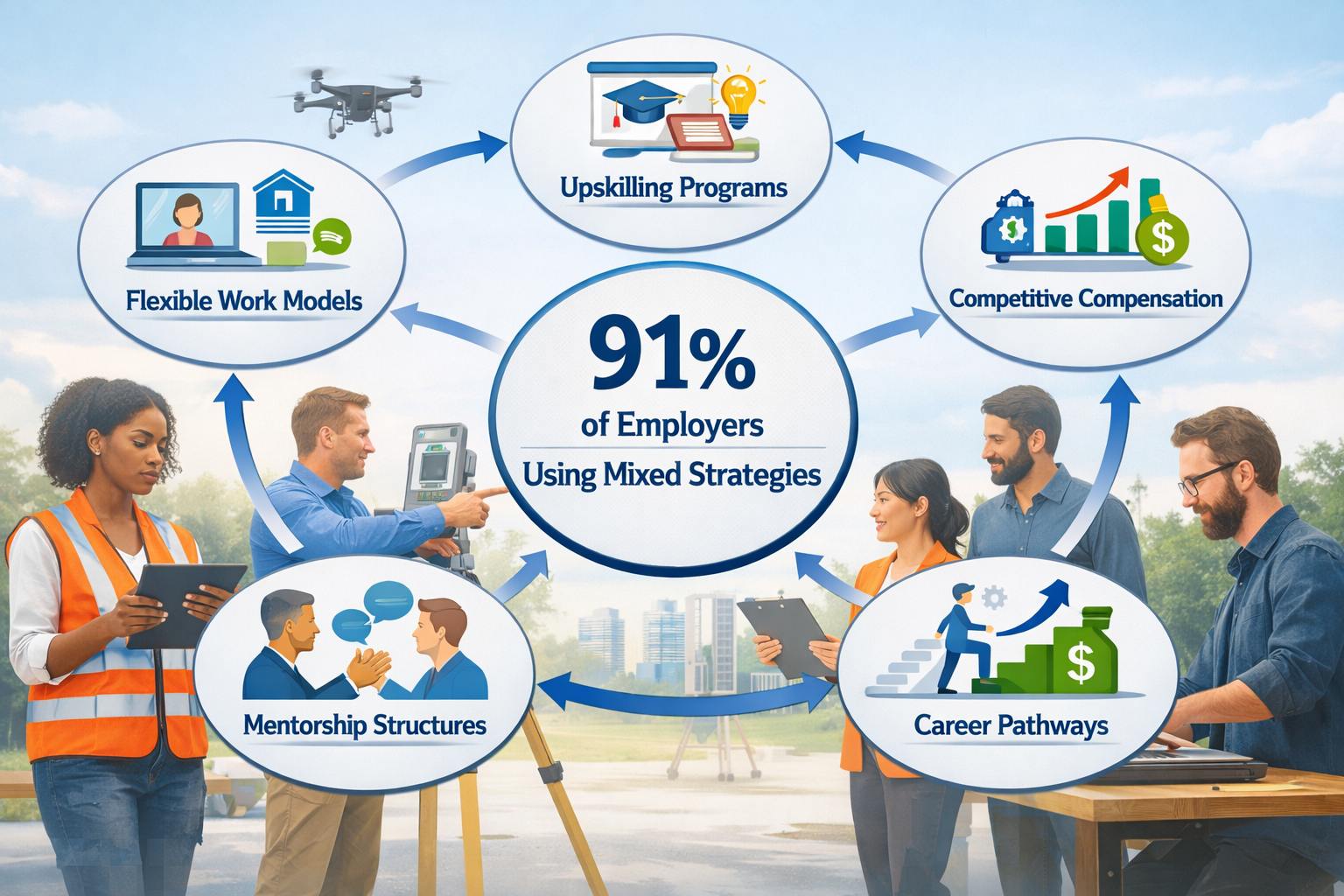
- 91% of employers are deploying mixed recruitment strategies including upskilling programs (27%), flexible schedules (20%), location flexibility (18%), and wage increases (19%) to address talent shortages.[3]
- Long licensure pathways make surveying uncompetitive against tech careers and adjacent industries, requiring firms to modernize training approaches and create clearer progression routes.
- RICS is enhancing qualification pathways and CPD platforms to support talent development, providing firms with structured frameworks to attract and retain the next generation.
- Mentorship structures have eroded significantly, with young surveyors reporting insufficient guidance, undermining the apprenticeship traditions that historically sustained professional development.[1]
Understanding the Talent Pipeline Crisis in Surveying: How Firms Can Attract and Retain the Next Generation Amid 2026 Sector Growth
The Demographic Bottleneck Threatening the Profession
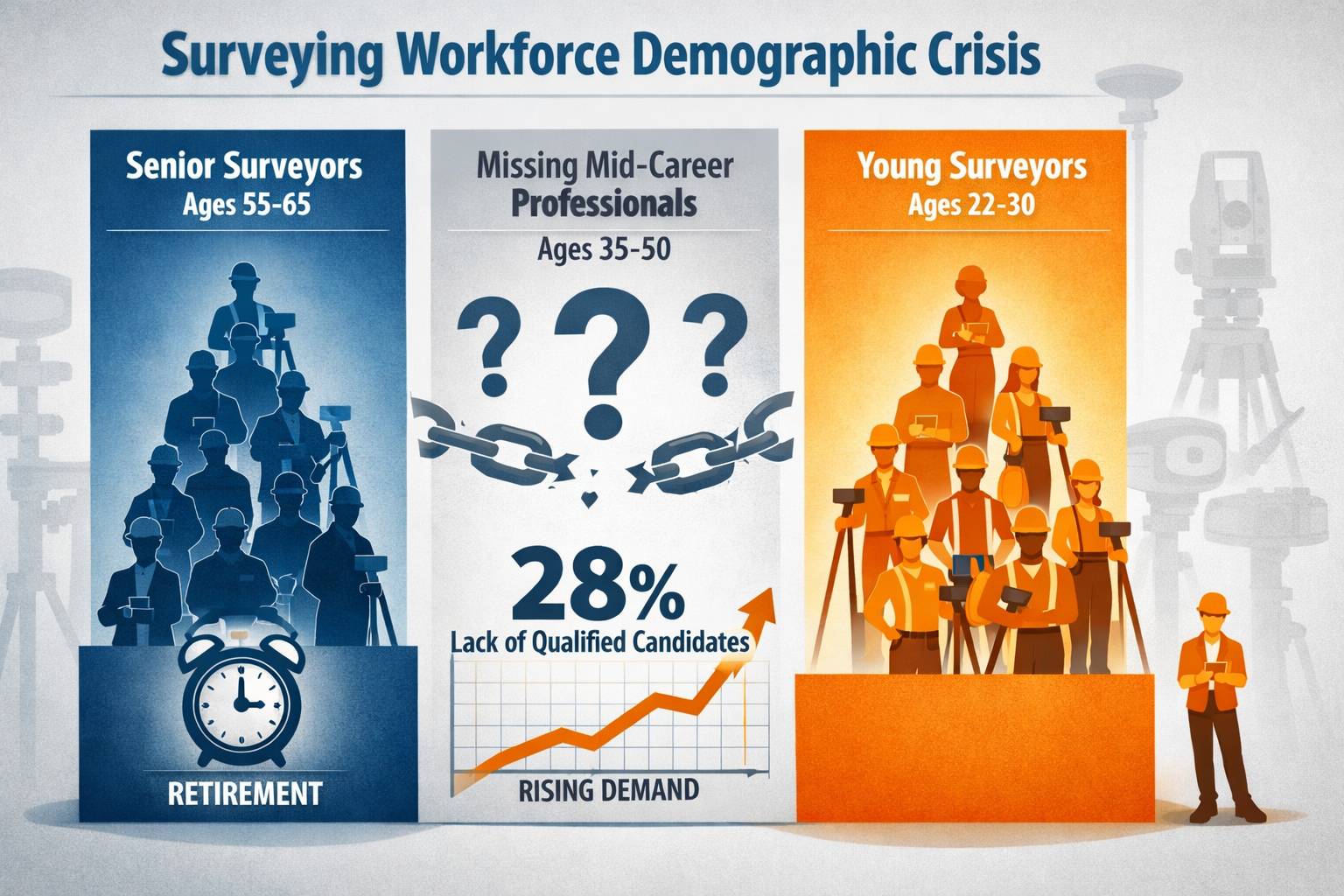
The surveying industry faces a troubling demographic reality that threatens its operational foundation. On one end, experienced surveyors approach retirement age, carrying decades of specialized knowledge about different types of survey comparison and complex property assessments. On the other end, isolated early-career professionals struggle to gain traction without adequate mentorship or structured advancement paths.[1]
The most concerning gap exists in the middle ranks—the 35-50 age group that should form the profession's operational backbone. This demographic vacuum creates several cascading problems:
📊 Knowledge Transfer Breakdown: Without mid-career professionals to bridge generations, critical expertise fails to pass from retiring surveyors to newcomers.
⚠️ Operational Capacity Constraints: Firms lack the experienced professionals needed to handle complex projects like RICS commercial building surveys while simultaneously mentoring junior staff.
🔄 Career Progression Uncertainty: Early-career surveyors see no clear pathway forward, contributing to burnout and attrition to adjacent industries.
Why Young Talent Overlooks Surveying Careers
The profession's invisibility crisis represents perhaps its greatest challenge. Unlike engineering, architecture, or construction management, surveying lacks presence in career guidance programs, university recruitment fairs, and popular media. Young people simply don't know the profession exists or understand its critical role in the built environment.[1]
When they do encounter surveying, several factors make it uncompetitive:
| Challenge | Impact on Recruitment | Competing Alternative |
|---|---|---|
| Long licensure path (4-6 years education + field time + exams) | Delays earning potential and career advancement | Tech careers with 12-week bootcamps |
| Limited flexibility in traditional firm structures | Fails to meet work-life expectations | Remote-first GIS positions |
| Unclear prestige despite high liability | Underappreciation relative to responsibility | Construction management with visible project outcomes |
| Insufficient starting compensation during training period | Financial strain during extended qualification | Adjacent industries offering competitive entry salaries |
The construction sector broadly faces similar pressures, with 66% of California contractors citing demand for skilled labor as a persistent challenge heading into 2026.[2][4] However, surveying's specialized nature and extended qualification requirements amplify these difficulties.
The Erosion of Mentorship and Apprenticeship Models
Historically, surveying relied on robust apprenticeship traditions where experienced professionals invested significant time developing junior talent. This model created both technical competency and professional culture, ensuring knowledge transfer across generations.
That system has largely collapsed. Young surveyors report encountering impatience or silence when seeking guidance, with senior professionals too stretched by workload demands to provide adequate mentorship.[1] This erosion creates a vicious cycle:
- ❌ New surveyors struggle without guidance
- ❌ Mistakes increase due to insufficient training
- ❌ Senior staff become more reluctant to delegate
- ❌ Junior professionals feel undervalued and leave
- ❌ Remaining staff face even greater workload pressure
Many early-career professionals burn out due to underappreciation, facing substantial liability burdens without corresponding prestige or structured advancement paths. They increasingly migrate toward adjacent industries like GIS technology, construction project management, or tech startups that offer faster recognition and career progression.[1]
Strategies to Address the Talent Pipeline Crisis in Surveying: How Firms Can Attract and Retain the Next Generation Amid 2026 Sector Growth
Building Visibility and Career Awareness Programs
Firms cannot recruit talent that doesn't know they exist. Proactive visibility initiatives must become standard practice:
🎓 University Partnerships: Establish relationships with geography, engineering, and construction management programs. Offer guest lectures, site visits, and summer internships that expose students to surveying careers before they commit to alternative paths.
🏫 Secondary School Outreach: Partner with STEM education programs to introduce surveying concepts at earlier ages. Demonstrate how surveying combines technology, outdoor work, problem-solving, and tangible impact on communities.
💼 Industry Ambassador Programs: Deploy young surveyors as career ambassadors who can authentically speak to their peers about the profession's opportunities and challenges.
📱 Digital Presence: Maintain active social media showcasing diverse surveying work—from drone surveys to boundary surveys—that counters misconceptions about the profession being outdated or monotonous.
RICS is actively working to inspire the next generation of surveyors through enhanced visibility programs and clearer communication about career opportunities.[7] Firms should leverage these industry-wide initiatives while developing their own local recruitment brands.
Modernizing Qualification Pathways and Training Programs
The long, unclear path to professional licensure remains a critical barrier. While maintaining professional standards, firms can make qualification more accessible and competitive:
Accelerated Training Models: Develop structured programs that combine academic learning with paid field experience, allowing candidates to earn while they learn rather than accumulating debt during extended unpaid training periods.
Competency-Based Progression: Implement clear milestone systems where trainees understand exactly what skills and experiences they need to advance, with regular feedback and recognition for achievements.
Technology Integration: Embrace modern surveying technology—GPS, laser scanning, photogrammetry, GIS platforms—in training programs to attract tech-savvy candidates and demonstrate the profession's innovation.
Flexible Learning Formats: Offer evening classes, online modules, and blended learning that accommodates candidates with family responsibilities or those transitioning from other careers.
RICS's enhanced CPD platforms provide excellent frameworks for continuous professional development, helping firms structure ongoing learning beyond initial qualification.[7] Organizations should integrate these resources into comprehensive career development programs.
Implementing Competitive Compensation and Benefits Strategies
With 19% of employers increasing wages to address talent shortages, surveying firms must ensure their compensation packages remain competitive.[3] However, money alone won't solve the crisis—total rewards packages must address broader lifestyle expectations:
💰 Competitive Starting Salaries: Research shows that 45% of California construction firms face pressure from rising wages and employee benefits.[2][4] Surveying firms must match or exceed adjacent industries during the critical training period when candidates evaluate long-term career commitment.
📈 Clear Earning Progression: Publish transparent salary bands tied to qualification milestones, demonstrating how compensation grows with expertise and credentials.
🏠 Flexible Work Arrangements: With 20% of employers offering schedule flexibility and 18% providing location flexibility, surveying firms must adapt traditional field-office models.[3] Consider:
- Compressed work weeks (four 10-hour days)
- Flexible start/end times around field work requirements
- Remote options for report writing, analysis, and administrative tasks
- Hybrid models that balance field presence with work-life balance
🎯 Comprehensive Benefits: Beyond salary, offer robust packages including professional development funding, equipment allowances, health benefits, retirement contributions, and paid time for continuing education.
Understanding surveyor pricing and rates helps firms structure compensation that reflects true market value while maintaining profitability.
Rebuilding Mentorship and Professional Development Structures
Addressing the mentorship erosion requires intentional systems, not informal arrangements that fail under workload pressure:
Formal Mentorship Programs: Assign every new hire a dedicated mentor with protected time allocation for guidance activities. Recognize mentorship contributions in performance reviews and compensation decisions.
Structured Onboarding: Develop comprehensive 90-day onboarding programs that systematically introduce new surveyors to firm procedures, client expectations, and technical standards through a mix of shadowing, supervised practice, and independent work with review.
Peer Learning Communities: Create cohorts of early-career professionals who progress together, sharing challenges and solutions while building professional networks that sustain careers long-term.
Knowledge Management Systems: Document processes, best practices, and lessons learned in accessible digital formats that supplement personal mentorship and preserve institutional knowledge as senior professionals retire.
Reverse Mentorship: Pair tech-savvy junior surveyors with senior professionals to share knowledge about new technologies, creating mutual value that strengthens intergenerational relationships.
The apprenticeship model that historically sustained surveying can be revitalized through intentional structure and resource allocation, transforming it from an informal tradition into a competitive advantage for talent retention.
Leveraging Technology to Enhance Career Appeal
Modern surveying technology offers powerful recruitment advantages when properly showcased:
🚁 Advanced Equipment: Highlight work with drones, laser scanners, and GPS systems that appeal to tech-oriented candidates and demonstrate the profession's innovation trajectory.
💻 Digital Workflows: Implement cloud-based collaboration platforms, mobile data collection apps, and automated reporting systems that improve efficiency while attracting candidates comfortable with digital tools.
📊 Data Analytics: Emphasize how modern surveying increasingly involves data analysis, visualization, and strategic insights—skills that appeal to candidates interested in both fieldwork and analytical challenges.
🌐 Specialized Services: Develop expertise in emerging areas like stock condition surveys, subsidence surveys, and structural surveys that demonstrate diverse career pathways within the profession.
Technology adoption shouldn't just improve operations—it should become a core element of recruitment messaging that positions surveying as a forward-looking profession rather than a legacy industry.
Retention Strategies: Keeping Talent Once You've Attracted It
Addressing the Retention Challenge
Attracting talent represents only half the battle. With 27% of talent acquisition leaders citing retention as a major challenge, firms must create environments where surveyors want to build long-term careers.[5] Skilled professionals increasingly command multiple job offers, making retention as critical as recruitment.
Early-Career Retention: The first two years prove most vulnerable, when new surveyors evaluate whether their career choice meets expectations. Firms should:
- Provide regular feedback and recognition for contributions
- Offer varied project exposure to prevent monotony
- Create clear short-term goals that build toward long-term qualification
- Address concerns proactively before frustration leads to departure
Mid-Career Retention: As surveyors gain experience, retention strategies must evolve:
- Offer leadership opportunities and project management roles
- Support specialization in areas of interest (commercial, residential, expert witness work)
- Provide pathways to partnership or equity participation
- Recognize expertise through titles, compensation, and autonomy
Work-Life Balance: Burnout drives attrition across all career stages. Sustainable workload management, reasonable overtime expectations, and genuine flexibility prevent the exhaustion that pushes talented surveyors toward less demanding alternatives.
Creating Advancement Pathways and Career Diversity
The lack of structured advancement paths contributes significantly to early-career burnout.[1] Firms should develop clear career frameworks with multiple progression routes:
Technical Track: For surveyors who prefer hands-on work over management, create senior technical roles with compensation and prestige equivalent to management positions.
Management Track: Develop project managers, team leaders, and department heads who oversee operations while maintaining technical involvement.
Specialist Track: Support deep expertise in specific survey types—from commercial property surveys to expert witness services—that command premium fees and professional recognition.
Entrepreneurial Track: Encourage intrapreneurship where ambitious surveyors develop new service lines or regional offices within the firm structure, satisfying entrepreneurial drive without losing talent to startup ventures.
Building Positive Firm Culture and Professional Community
Culture significantly influences retention, particularly among younger professionals who prioritize workplace environment alongside compensation:
🤝 Collaborative Environment: Foster teamwork over competition, where surveyors support each other's success rather than hoarding knowledge or undermining colleagues.
🎯 Purpose and Impact: Regularly connect daily work to meaningful outcomes—how surveys protect buyers, enable construction projects, resolve disputes, and shape communities.
🏆 Recognition Programs: Celebrate achievements publicly, from qualification milestones to exceptional client feedback to innovative problem-solving.
🌱 Professional Growth: Demonstrate genuine investment in employee development through training budgets, conference attendance, professional memberships, and continuing education support.
📣 Voice and Input: Create channels where surveyors at all levels contribute to firm decisions, processes, and strategic direction, fostering ownership and engagement.
Firms with strong cultures become talent magnets in competitive markets, attracting referrals from satisfied employees and building reputations as employers of choice.
Industry-Wide Initiatives and Collaborative Solutions
RICS's Role in Addressing the Pipeline Crisis
The Royal Institution of Chartered Surveyors recognizes the urgency of the talent pipeline crisis and has implemented several initiatives to support the profession:
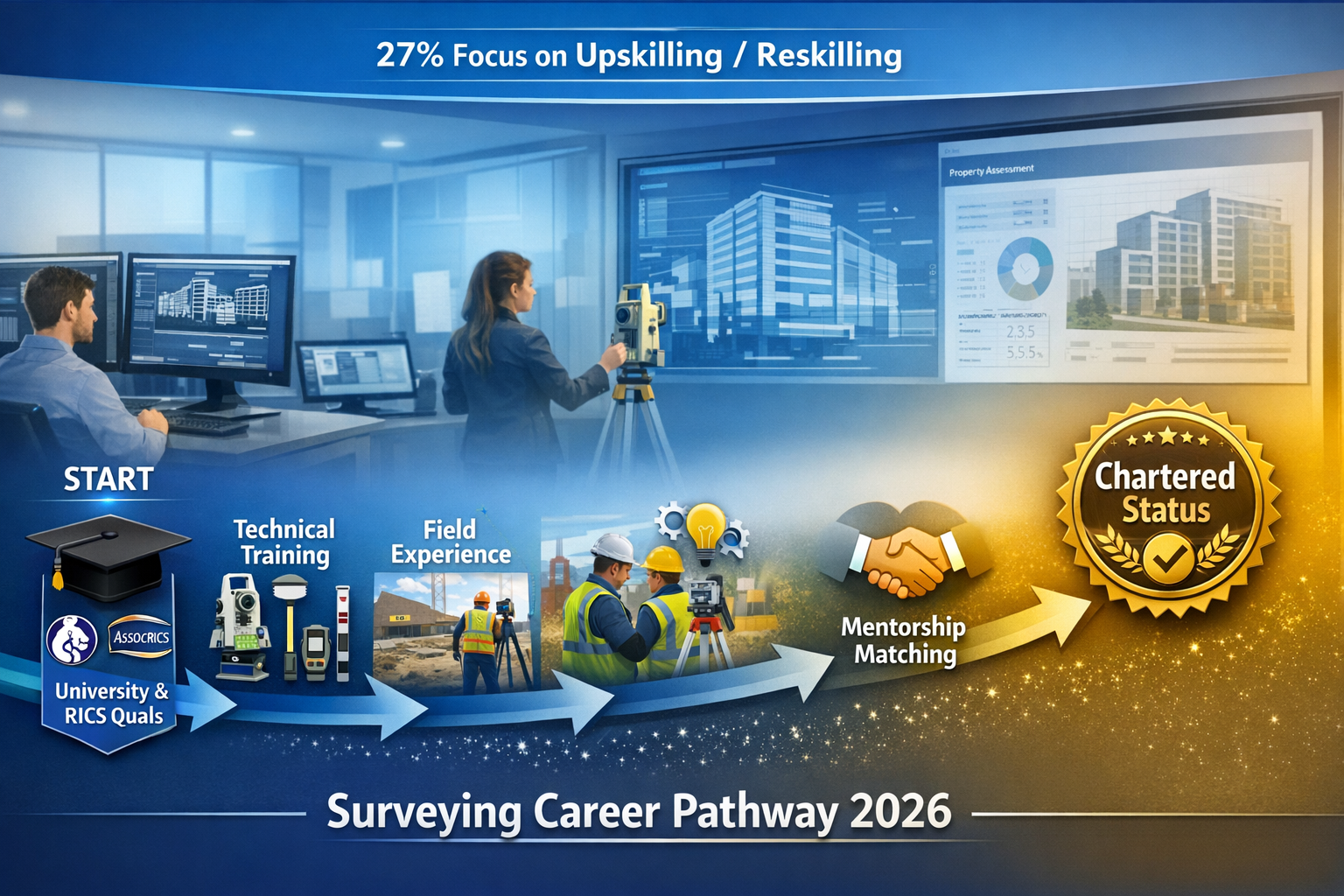
Enhanced Qualification Pathways: RICS is working to streamline and clarify the route to chartered status, making requirements more transparent and accessible while maintaining professional standards.[7]
Improved CPD Platforms: Digital learning resources and continuing professional development tools help firms provide structured training without requiring extensive internal curriculum development.
Career Promotion Initiatives: Industry-wide campaigns to raise surveying's profile among students and career changers, complementing firm-level recruitment efforts.[7]
Standards and Best Practices: Published guidance on training, mentorship, and professional development that firms can adopt to improve talent development programs.
Individual firms should actively engage with RICS initiatives, leveraging industry-wide resources to supplement their internal programs and contributing feedback to shape future support.
Cross-Sector Learning from Construction and Related Industries
The broader construction sector faces similar talent challenges, offering valuable lessons:
Apprenticeship Revival: Construction firms are reinvesting in formal apprenticeship programs with government support, providing models surveying can adapt.
Diversity Initiatives: Targeted recruitment of underrepresented groups—women, minorities, career changers—expands the talent pool beyond traditional sources.
Technology Partnerships: Collaborations with equipment manufacturers and software providers create training programs that benefit both parties while developing candidate skills.
Industry Associations: Collective action through professional bodies amplifies individual firm efforts, creating sector-wide visibility and advocacy.
With 66% of California contractors prioritizing workforce pipeline development, surveying firms should explore collaborative initiatives that share costs and amplify impact.[2][4]
Government and Educational Institution Partnerships
Solving the talent pipeline crisis requires ecosystem-level collaboration:
Educational Curriculum Development: Work with universities and technical colleges to develop surveying programs that align with modern practice requirements and industry needs.
Funding and Incentives: Advocate for apprenticeship grants, student loan forgiveness for surveying careers, and tax incentives for firms investing in training.
Career Guidance Integration: Ensure surveying appears in school career counseling resources, vocational guidance programs, and STEM initiatives.
Licensing Reform: Where appropriate, work with regulatory bodies to modernize licensing requirements that create unnecessary barriers without enhancing professional competency.
These partnerships create sustainable pipeline development rather than temporary recruitment fixes, addressing root causes of the talent shortage.
Measuring Success and Adjusting Strategies
Key Performance Indicators for Talent Pipeline Health
Firms addressing the talent pipeline crisis should track specific metrics to evaluate progress:
📊 Recruitment Metrics:
- Applications per open position
- Quality of candidate pool (relevant qualifications, experience)
- Time-to-hire for surveying roles
- Acceptance rate of job offers
- Cost-per-hire compared to industry benchmarks
📈 Development Metrics:
- Qualification progression rates (candidates advancing toward chartered status)
- Training completion rates
- Mentorship program participation and satisfaction
- Internal promotion rates versus external hiring
🔄 Retention Metrics:
- Voluntary turnover rate by career stage
- Average tenure by role level
- Exit interview themes and patterns
- Employee satisfaction scores
- Internal referral rates
💼 Business Impact Metrics:
- Revenue per surveyor
- Project delivery capacity
- Client satisfaction trends
- Ability to pursue new opportunities without capacity constraints
Regular measurement enables data-driven adjustments to recruitment and retention strategies, ensuring resources focus on highest-impact activities.
Adapting to Evolving Talent Market Conditions
The talent landscape continues shifting. ManpowerGroup's 2026 survey shows modest relief from 2025's peak shortage (72% versus 74%), but challenges remain substantial across all sectors.[3] Surveying firms must maintain flexibility:
Continuous Market Research: Monitor compensation trends, competitor practices, and candidate expectations through regular surveys and industry benchmarking.
Pilot Programs: Test new approaches on small scales before full implementation—flexible work trials, revised training formats, alternative qualification pathways.
Feedback Loops: Regularly solicit input from current employees, recent hires, and even candidates who declined offers to understand what works and what needs improvement.
Strategic Patience: Rebuilding a talent pipeline takes years, not months. Maintain commitment to long-term strategies while making tactical adjustments based on results.
The firms that successfully navigate the Talent Pipeline Crisis in Surveying: How Firms Can Attract and Retain the Next Generation Amid 2026 Sector Growth will be those that treat talent development as a strategic priority rather than an administrative function.
Conclusion
The Talent Pipeline Crisis in Surveying: How Firms Can Attract and Retain the Next Generation Amid 2026 Sector Growth represents the defining challenge for the profession. With 72% of employers facing hiring difficulties and surveying experiencing a near-total collapse of career awareness among younger generations, the path forward requires decisive action across multiple fronts.[3][1]
The demographic bottleneck—experienced professionals nearing retirement, isolated early-career surveyors, and a troubling vacuum in mid-level positions—threatens both operational capacity and knowledge transfer. Long licensure pathways, eroded mentorship structures, and insufficient career visibility make surveying uncompetitive against faster-entry alternatives in technology and adjacent industries.
However, solutions exist. Firms that build visibility through university partnerships and digital presence, modernize qualification pathways with structured training programs, implement competitive total rewards packages including flexible work arrangements, rebuild intentional mentorship systems, and leverage technology to enhance career appeal will position themselves as employers of choice in competitive markets.
RICS's enhanced qualification pathways and CPD platforms provide valuable frameworks, while cross-sector learning from construction and collaborative partnerships with educational institutions create ecosystem-level support. Success requires treating talent development as a strategic priority, measuring progress through specific KPIs, and maintaining long-term commitment despite short-term challenges.
Actionable Next Steps
For Firm Leaders:
- ✅ Audit current recruitment and retention practices against the strategies outlined above
- ✅ Allocate dedicated budget and leadership attention to talent pipeline development
- ✅ Engage with RICS initiatives and industry partnerships to leverage collective resources
- ✅ Implement at least three new strategies within the next quarter
- ✅ Establish measurement systems to track progress and guide adjustments
For Individual Surveyors:
- ✅ Volunteer as a mentor or career ambassador to support the next generation
- ✅ Share your surveying career on social media to increase profession visibility
- ✅ Provide feedback to your firm on retention and development opportunities
- ✅ Engage with local universities to introduce students to surveying careers
For the Industry:
- ✅ Collaborate on sector-wide visibility campaigns
- ✅ Share best practices for training and retention across firms
- ✅ Advocate for educational partnerships and government support
- ✅ Modernize professional standards to balance accessibility with competency
The surveying profession has weathered challenges before. By addressing the talent pipeline crisis with urgency, creativity, and sustained commitment, firms can ensure the next generation of surveyors is ready to meet 2026's growing demand and beyond. Those who act decisively today will secure competitive advantage tomorrow, while those who delay risk being unable to capitalize on sector growth opportunities.
For firms seeking to understand how professional surveying services create value, explore our resources on choosing the right property survey and local chartered surveyors. The future of surveying depends on building the talent pipeline today.
References
[1] Vanishing Lines Confronting The Surveying Workforce Shortage – https://landsurveyorsunited.com/articles/vanishing-lines-confronting-the-surveying-workforce-shortage
[2] Agc Of California Survey Reveals Industry Outlook For 2026 – https://www.agc-ca.org/about/agc-blog/agc-of-california-survey-reveals-industry-outlook-for-2026/
[3] 2026 Talent Shortage Survey Key Findings – https://recruitingheadlines.com/2026-talent-shortage-survey-key-findings/
[4] Agc Of California Survey Shows Contractors Cautiously Optimistic Heading Into 2026 – https://www.californiaconstructionnews.com/2026/02/23/agc-of-california-survey-shows-contractors-cautiously-optimistic-heading-into-2026/
[5] Hiring Statistics – https://goodtime.io/blog/talent-operations/hiring-statistics/
[7] Inspire Next Generation Surveyors – https://ww3.rics.org/uk/en/modus/business-and-skills/better-business/inspire-next-generation-surveyors.html