
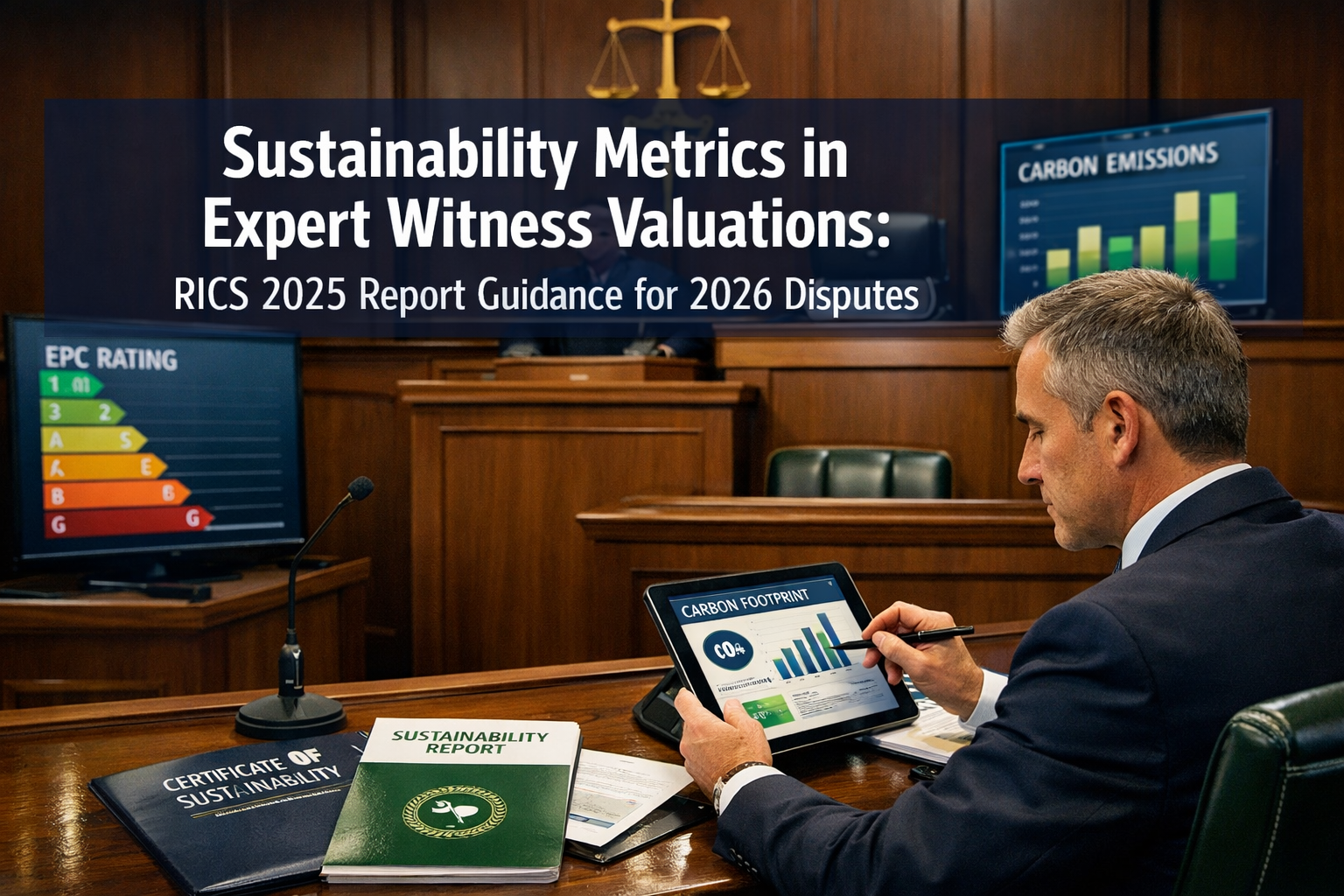
Over 60% of property professionals admit they conduct carbon calculations and climate resilience assessments in less than half of their projects—or not at all.[3] This stark reality from the RICS 2025 Sustainability Report reveals a critical gap that could undermine expert witness testimony in 2026 property disputes. As courts increasingly scrutinize environmental performance in valuation cases, understanding how to integrate Sustainability Metrics in Expert Witness Valuations: RICS 2025 Report Guidance for 2026 Disputes has become essential for defending professional opinions under cross-examination.
The intersection of sustainability metrics and expert witness work represents a fundamental shift in property valuation litigation. With RICS publishing updated guidance on both expert witness standards and ESG integration, professionals must now demonstrate competency in environmental factors alongside traditional valuation methods. This comprehensive guide explores how to apply the RICS 2025 framework to defend valuations in contentious proceedings, focusing on energy ratings, carbon footprints, and climate resilience assessments.
Key Takeaways
- 60% of professionals fail to regularly conduct carbon calculations, creating vulnerability in expert witness testimony that opposing counsel can exploit in 2026 disputes[3]
- RICS has published updated global standards on ESG in commercial property valuation, establishing mandatory frameworks for reflecting environmental factors in expert opinions[2]
- Energy Performance Certificate (EPC) ratings now directly impact market value, requiring expert witnesses to quantify sustainability metrics in valuation adjustments
- The Sustainable Building Index declined from +41 to +30 between 2024 and 2025, indicating market volatility that experts must address in dispute scenarios[5]
- Awaab's Law takes effect in October 2025, introducing new regulatory considerations that expert witnesses must incorporate into their guidance[2]
Understanding the RICS 2025 Framework for Sustainability Metrics in Expert Witness Valuations
The RICS 2025 Sustainability Report and accompanying guidance documents establish a comprehensive framework for integrating environmental, social, and governance (ESG) factors into property valuations. For expert witnesses, this framework provides both a defense mechanism and a professional standard that courts expect experts to follow.
The Core Components of RICS Sustainability Guidance
RICS has developed a practical framework for reflecting sustainability factors in valuation advice worldwide.[2] This framework encompasses several critical dimensions:
Carbon Footprint Assessment 🌍
Expert witnesses must now demonstrate competency in calculating operational and embodied carbon within properties. The framework requires quantification of:
- Annual carbon emissions (kgCO2e/m²)
- Embodied carbon in building materials
- Predicted carbon reduction pathways
- Alignment with net-zero targets
Energy Performance Metrics ⚡
Energy ratings have transitioned from supplementary information to primary valuation drivers. Registered RICS valuers must now incorporate:
- Current EPC ratings and their market impact
- Cost-to-upgrade analysis for improved ratings
- Regulatory compliance timelines (MEES requirements)
- Energy efficiency investment returns
Climate Resilience Assessment 🏗️
The 2025 guidance emphasizes physical climate risks, requiring experts to evaluate:
- Flood risk exposure and mitigation measures
- Overheating vulnerability in changing climate
- Extreme weather resilience features
- Adaptation costs and value implications
Regulatory Context for 2026 Disputes
The regulatory landscape has evolved significantly, creating new considerations for expert witness work. RICS launched a public consultation on the 5th edition of "Surveyors acting as expert witnesses" to ensure standards meet current industry needs.[2] This consultation addresses emerging issues including:
"Members must ensure they understand their responsibilities as expert witnesses and possess the skills, knowledge, and relevant experience in their field to undertake the role effectively."[1]
For 2026 disputes, expert witnesses must navigate:
- Awaab's Law compliance (effective October 2025) impacting residential property standards[2]
- Enhanced MEES regulations requiring higher EPC thresholds for commercial lettings
- Mandatory carbon reporting in certain property transactions
- Biodiversity net gain requirements affecting development valuations
The RICS Practice Alert published in April 2025 specifically addresses expert witness services provision in high-volume litigation, particularly housing disrepair claims.[1] This guidance emphasizes the need for robust sustainability metric integration in all valuation opinions.
Applying Sustainability Metrics in Expert Witness Valuations: RICS 2025 Report Guidance for 2026 Disputes
Translating RICS sustainability guidance into defensible expert witness testimony requires a structured methodology. The 2025 framework provides specific tools and approaches that experts can deploy in contentious scenarios.
Quantifying Value Adjustments for Energy Performance
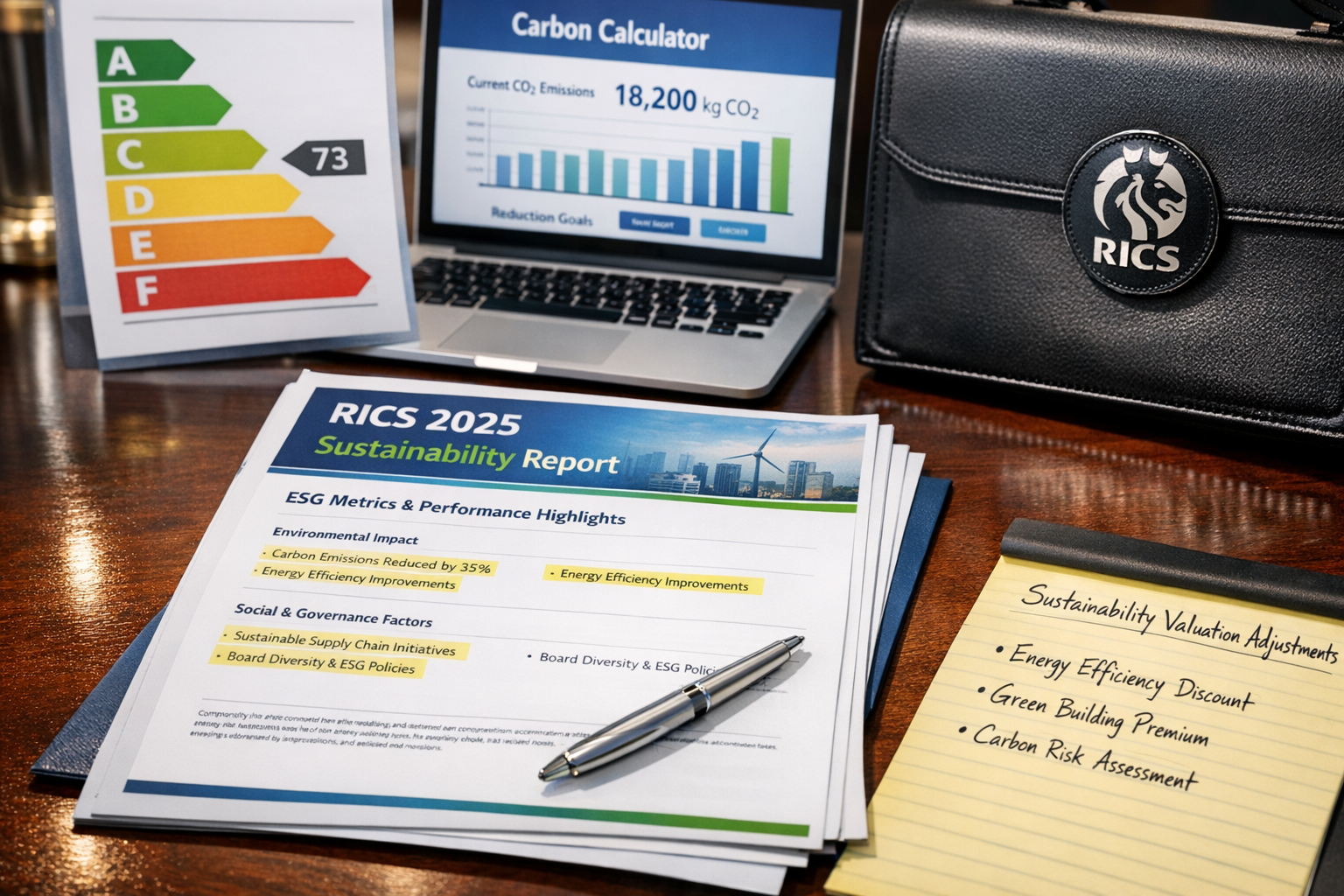
The most common challenge in 2026 disputes involves quantifying how sustainability metrics affect property value. The RICS framework recommends a tiered approach:
Tier 1: Direct Market Evidence
Expert witnesses should prioritize comparable evidence showing price differentials based on EPC ratings. Research from the 2025 Sustainability Report indicates that green building demand has slowed, with the Sustainable Building Index declining to +30 from +41 in 2024.[5] This market shift requires experts to:
- Analyze recent transactions with similar sustainability profiles
- Adjust for temporal changes in green building premiums
- Document market sentiment shifts toward sustainability features
- Quantify buyer willingness-to-pay for improved ratings
Tier 2: Cost-to-Upgrade Analysis
When direct comparables are insufficient, experts can calculate value impacts through upgrade cost analysis:
| EPC Rating | Typical Upgrade Cost | Payback Period | Value Impact Range |
|---|---|---|---|
| G to E | £15,000-£35,000 | 15-25 years | -10% to -15% |
| E to C | £8,000-£18,000 | 8-15 years | -5% to -8% |
| C to A | £25,000-£50,000 | 12-20 years | +3% to +8% |
These figures should be adjusted for property type, location, and market conditions specific to the dispute context.
Tier 3: Income Capitalization Adjustments
For commercial property valuations, sustainability metrics affect both rental income and yield rates. Expert witnesses should demonstrate:
- Rental premiums/discounts: Green-certified buildings typically command 3-8% rental premiums, though the 2025 report suggests this premium is compressing[5]
- Yield compression: Sustainable buildings may attract 25-50 basis points yield compression due to lower risk profiles
- Void period adjustments: Properties with poor EPC ratings face extended letting periods, increasing holding costs
- Obsolescence risk: Buildings failing to meet future regulatory standards face accelerated depreciation
Defending Carbon Calculation Methodologies
The RICS 2025 Sustainability Report reveals that only 40% of professionals regularly track waste reduction and data-sharing,[3] creating potential vulnerabilities when experts present carbon calculations in court. To defend carbon methodologies effectively:
Establish Clear Calculation Boundaries 📊
Expert witnesses must define whether calculations include:
- Operational carbon only (Scope 1 and 2 emissions)
- Embodied carbon in existing structure
- Whole-life carbon including future renovations
- Tenant vs. landlord-controlled emissions
Use Recognized Standards
Reference established frameworks such as:
- RICS Whole Life Carbon Assessment guidance
- UKGBC Net Zero Carbon Buildings Framework
- ISO 14064 for greenhouse gas accounting
- LETI (London Energy Transformation Initiative) targets
Document Assumptions and Limitations
Courts expect transparency about calculation limitations. Expert reports should explicitly state:
- Data sources and quality (actual vs. modeled consumption)
- Assumptions about occupancy patterns and usage
- Benchmark comparisons used for validation
- Uncertainty ranges in final calculations
Integrating Climate Resilience into Valuation Opinions
Climate resilience has emerged as a critical factor in 2026 disputes, particularly for properties with long investment horizons. The RICS framework recommends government policy measures to mandate carbon assessment reporting and drive investments in green buildings.[3]
Physical Risk Assessment Framework
Expert witnesses should evaluate climate risks across multiple dimensions:
Flood Risk 💧
- Current Environment Agency flood zone classification
- Future flood risk projections (2050, 2080 scenarios)
- Existing flood defense infrastructure and maintenance
- Insurance availability and premium impacts
- Mitigation measures and their costs
Overheating Risk 🌡️
- Building orientation and thermal mass
- Glazing ratios and solar gain potential
- Cooling system adequacy for future climate
- Adaptation costs for overheating prevention
- Health and productivity impacts for occupants
Extreme Weather Resilience
- Structural capacity for increased wind loads
- Drainage adequacy for intense rainfall events
- Material durability under climate stress
- Maintenance cost escalation projections
For valuation reports, these assessments should translate into specific value adjustments or risk disclosures that opposing experts cannot easily dismiss.
Sustainability Metrics in Expert Witness Valuations: RICS 2025 Report Guidance for 2026 Disputes – Practical Application Strategies
Moving from theory to courtroom application requires expert witnesses to develop robust processes that withstand cross-examination. The RICS 2025 guidance provides a foundation, but practical implementation demands additional strategies.
Building a Defensible Expert Report Structure
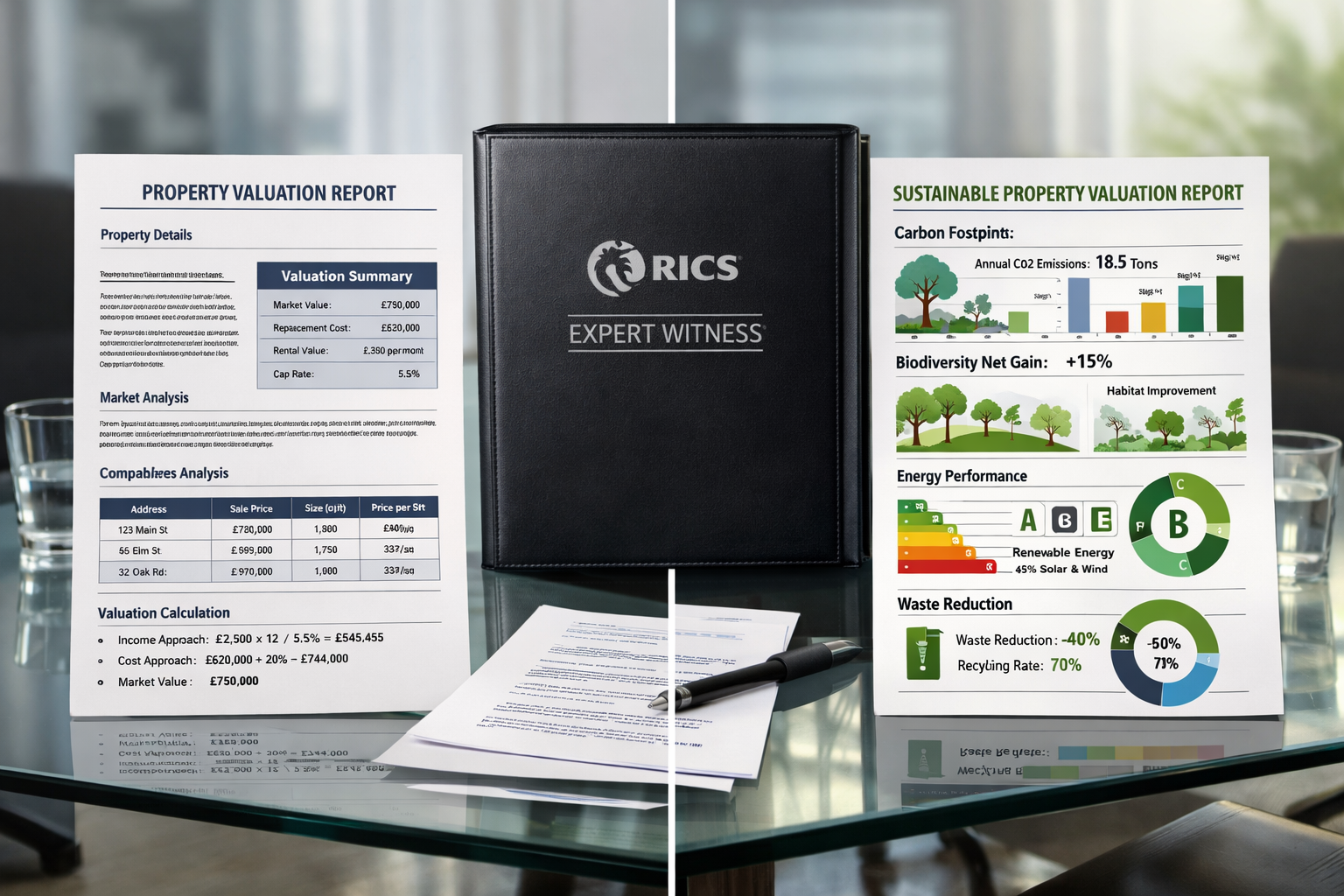
The structure of an expert witness report incorporating sustainability metrics should follow this enhanced framework:
Section 1: Instructions and Context
- Clearly define the valuation purpose and dispute context
- Identify specific sustainability issues in contention
- Establish the regulatory and market context (2026 standards)
- Confirm compliance with RICS expert witness standards[2]
Section 2: Property Description with Sustainability Profile
Traditional property descriptions must now include:
- Current EPC rating with detailed breakdown
- Renewable energy installations and capacity
- Building fabric performance metrics (U-values, air tightness)
- Water efficiency measures and ratings
- Sustainable transport accessibility
- Biodiversity features and green infrastructure
Section 3: Market Analysis with Sustainability Context
Expert witnesses must demonstrate awareness of market trends identified in the 2025 Sustainability Report, including the slowdown in green building demand.[5] This section should address:
- Market sentiment shifts: How has buyer/tenant appetite for sustainability changed?
- Regulatory trajectory: What future requirements will affect the property?
- Competitive positioning: How does the subject property compare to market alternatives?
- Investment risk profile: What sustainability-related risks affect value?
Section 4: Valuation Methodology with Sustainability Integration
This critical section must demonstrate how sustainability metrics influenced the valuation conclusion. Using methods of valuation recognized by RICS, experts should:
For Comparable Method:
- Present comparable evidence with sustainability characteristics
- Quantify adjustments for EPC rating differences
- Explain green building premium/discount application
- Address market evidence quality and reliability
For Investment Method:
- Adjust rental values for energy performance
- Modify yields to reflect sustainability risk
- Account for capital expenditure requirements
- Project future regulatory compliance costs
For Residual Method:
- Include sustainability requirements in build costs
- Factor in green building certification expenses
- Adjust developer's profit for sustainability risk
- Incorporate biodiversity net gain obligations
Section 5: Sustainability-Specific Value Adjustments
Create a transparent adjustment schedule:
Base Market Value (sustainability-neutral): £X
Adjustments:
+ EPC Rating Premium (A vs. C): +£Y
- Deferred MEES Compliance Costs: -£Z
+ Climate Resilience Features: +£W
- Carbon Reduction Capex (NPV): -£V
= Net Sustainability-Adjusted Value: £X+Y-Z+W-V
Responding to Common Challenges in Cross-Examination
Expert witnesses face predictable challenges when presenting sustainability metrics in 2026 disputes. Preparation for these scenarios strengthens testimony:
Challenge 1: "Sustainability metrics are too uncertain to quantify"
Effective Response Strategy:
- Acknowledge uncertainty ranges but emphasize market reality
- Reference the 60% of professionals who fail to conduct assessments as evidence of industry-wide challenge, not individual incompetence[3]
- Present sensitivity analysis showing value ranges under different scenarios
- Cite regulatory trajectory as reducing uncertainty over time
- Compare to other accepted valuation uncertainties (market conditions, planning risk)
Challenge 2: "The market doesn't actually pay for these features"
Effective Response Strategy:
- Present transaction evidence showing sustainability premiums/discounts
- Distinguish between current market behavior and rational buyer expectations
- Reference the RICS framework as establishing professional standards regardless of market maturity[2]
- Explain regulatory drivers forcing market recognition (MEES, net-zero targets)
- Address the Sustainable Building Index decline with context about market cycles[5]
Challenge 3: "Your carbon calculations are speculative"
Effective Response Strategy:
- Provide detailed methodology documentation
- Reference recognized standards (RICS Whole Life Carbon Assessment)
- Present validation through benchmark comparisons
- Acknowledge data limitations explicitly in report
- Explain that 40% tracking rate industry-wide doesn't invalidate proper methodology[3]
Leveraging RICS Guidance as Professional Defense
The updated RICS standards provide powerful defense mechanisms for expert witnesses. When challenged on sustainability metric integration, experts can reference:
Professional Obligation Framework
RICS members acting as expert witnesses must possess "the skills, knowledge, and relevant experience in their field to undertake the role effectively."[1] This includes understanding sustainability factors affecting property value in 2026.
Global Standards Adoption
RICS has published updated global standards on ESG and sustainability in commercial property valuation,[2] establishing that sustainability integration is not optional but mandatory for competent valuation practice.
Regulatory Awareness Requirements
The RICS guidance specifically notes that expert witnesses should be aware of evolving legislation like Awaab's Law.[2] Failure to incorporate such factors could constitute professional negligence.
Documentation and Evidence Standards
Expert witnesses must maintain rigorous documentation standards for sustainability assessments:
Essential Documentation Checklist ✅
- EPC certificates (current and historical)
- Energy consumption data (actual meter readings preferred)
- Carbon calculation worksheets with assumptions
- Climate risk assessment reports
- Comparable transaction evidence with sustainability features
- Regulatory compliance timeline analysis
- Cost estimates for sustainability improvements
- Market research on green building premiums
- Professional development records (CPD in sustainability)
For RICS building surveys, this documentation forms the foundation of defensible expert opinions.
Collaborative Approaches and Expert Conferencing
In complex 2026 disputes, courts may direct expert conferencing on sustainability issues. The RICS framework supports collaborative approaches where experts:
Establish Common Ground
- Agree on applicable regulatory standards
- Confirm calculation methodologies
- Align on market evidence interpretation
- Identify areas of genuine disagreement
Narrow Dispute Issues
- Quantify value impact ranges for specific factors
- Separate factual disputes from opinion differences
- Propose sensitivity analyses for uncertain variables
- Recommend additional evidence that could resolve disputes
Present Joint Statements
- Clearly delineate agreed facts and methodologies
- Explain remaining areas of professional disagreement
- Provide context for different valuation conclusions
- Assist the court in understanding technical issues
This collaborative approach, encouraged by RICS expert witness guidance,[2] often leads to more efficient dispute resolution while maintaining professional integrity.
Future-Proofing Expert Witness Practice for Post-2026 Sustainability Requirements
The regulatory and market landscape will continue evolving beyond 2026. Expert witnesses must anticipate future developments to provide forward-looking valuation advice.
Emerging Regulatory Trends
Enhanced MEES Requirements
Current projections suggest commercial MEES thresholds will tighten from EPC 'E' to 'C' by 2027-2028, with potential progression to 'B' by 2030. Expert witnesses should:
- Model value impacts of progressive regulatory tightening
- Calculate stranded asset risk for non-compliant properties
- Assess feasibility and cost of compliance pathways
- Evaluate exemption eligibility and implications
Mandatory Carbon Reporting
The RICS 2025 Sustainability Report recommends government policy measures to mandate carbon assessment reporting.[3] Experts should prepare for:
- Standardized carbon disclosure requirements
- Integration with transaction processes
- Third-party verification protocols
- Penalty frameworks for non-compliance
Biodiversity Net Gain Integration
Environmental net gain requirements will increasingly affect property valuations, requiring experts to:
- Quantify biodiversity unit requirements
- Value on-site vs. off-site provision options
- Assess long-term management obligations
- Incorporate into development appraisals
Professional Development Imperatives
Given that 60% of professionals conduct carbon calculations in less than half of their projects,[3] expert witnesses must differentiate themselves through enhanced competency:
Essential CPD Areas for 2026 and Beyond:
- Building physics and energy modeling
- Carbon accounting methodologies
- Climate science and adaptation strategies
- Green building certification schemes (BREEAM, LEED, WELL)
- Sustainable finance and green lending
- Environmental legislation and case law
- ESG risk assessment frameworks
For chartered surveyors acting as expert witnesses, this specialized knowledge becomes a competitive advantage and professional necessity.
Technology Integration
Advanced technology tools enhance the credibility and defensibility of sustainability assessments:
Energy Modeling Software
- Dynamic thermal modeling for overheating risk
- Daylight and solar gain analysis
- HVAC system optimization studies
- Renewable energy generation forecasting
Carbon Calculation Platforms
- Whole-life carbon assessment tools
- Embodied carbon databases
- Scenario modeling for decarbonization pathways
- Benchmarking against industry standards
Climate Risk Analytics
- Flood risk mapping with future projections
- Heat stress vulnerability assessment
- Extreme weather impact modeling
- Physical risk scoring systems
Expert witnesses who leverage these tools provide more robust, data-driven opinions that withstand scrutiny in 2026 disputes.
Conclusion
The integration of Sustainability Metrics in Expert Witness Valuations: RICS 2025 Report Guidance for 2026 Disputes represents a fundamental evolution in property valuation practice. With 60% of professionals failing to regularly conduct carbon calculations and climate resilience assessments,[3] expert witnesses who master this integration gain significant competitive advantage while fulfilling professional obligations.
The RICS 2025 framework provides clear guidance: sustainability factors are no longer supplementary considerations but core components of competent valuation practice. The updated global standards on ESG in commercial property valuation[2] establish mandatory frameworks that courts will expect expert witnesses to follow in 2026 disputes.
Key Implementation Steps
For Expert Witnesses Preparing for 2026 Disputes:
- Audit Current Competency – Assess your knowledge gaps in sustainability metrics and develop targeted CPD plans
- Update Report Templates – Integrate sustainability sections into standard expert witness report structures
- Build Evidence Libraries – Compile market evidence of sustainability premiums/discounts and comparable transactions
- Establish Calculation Protocols – Adopt recognized carbon calculation and climate risk assessment methodologies
- Document Methodologies – Create transparent, defensible processes for sustainability metric integration
- Engage with RICS Guidance – Review the 2025 Sustainability Report and expert witness standards thoroughly
- Develop Technology Capabilities – Invest in energy modeling and carbon calculation tools
The Competitive Advantage
As the Sustainable Building Index declined from +41 to +30 between 2024 and 2025,[5] market volatility in green building valuations creates both challenges and opportunities. Expert witnesses who can navigate this complexity with confidence, backed by robust RICS-compliant methodologies, will be sought after for high-value disputes.
The regulatory trajectory is clear: Awaab's Law, enhanced MEES requirements, and mandatory carbon reporting will make sustainability competency non-negotiable for expert witnesses.[2] Those who develop this expertise now will be positioned as authorities in their field, while those who delay risk professional obsolescence.
Taking Action
Begin your preparation today by:
- Reviewing the RICS 2025 Sustainability Report in detail to understand current market trends and professional expectations
- Consulting with registered RICS valuers who specialize in sustainability-integrated valuations
- Attending specialized CPD courses on carbon calculation, climate risk assessment, and ESG valuation methodologies
- Engaging with the RICS expert witness consultation to contribute to evolving professional standards
- Developing case studies from current instructions that demonstrate sustainability metric integration
For complex disputes requiring expert witness services with sustainability expertise, professional guidance ensures compliance with RICS 2025 standards while delivering defensible valuation opinions. The integration of environmental metrics into expert witness work is no longer emerging practice—it is the professional standard for 2026 and beyond.
The convergence of regulatory pressure, market evolution, and professional standards creates an imperative for expert witnesses: master sustainability metrics or risk professional credibility in the courtroom. The RICS 2025 framework provides the roadmap—implementation is now the challenge facing every valuation professional engaged in contentious work.
References
[1] Srb Risk Outlook Report 2025 – https://www.rics.org/content/dam/ricsglobal/documents/about-rics/SRB-risk-outlook-report-2025.pdf
[2] Rics Launches Global Consultation On Updated Expert Witness Standard – https://www.rics.org/news-insights/rics-launches-global-consultation-on-updated-expert-witness-standard
[3] Sustainability Report 2025 – https://www.rics.org/news-insights/current-topics-campaigns/sustainability/sustainability-report-2025
[5] Rics Publishes Sustainability Report 2025 On Green Building Market Trends – https://www.lexisnexis.co.uk/legal/news/rics-publishes-sustainability-report-2025-on-green-building-market-trends