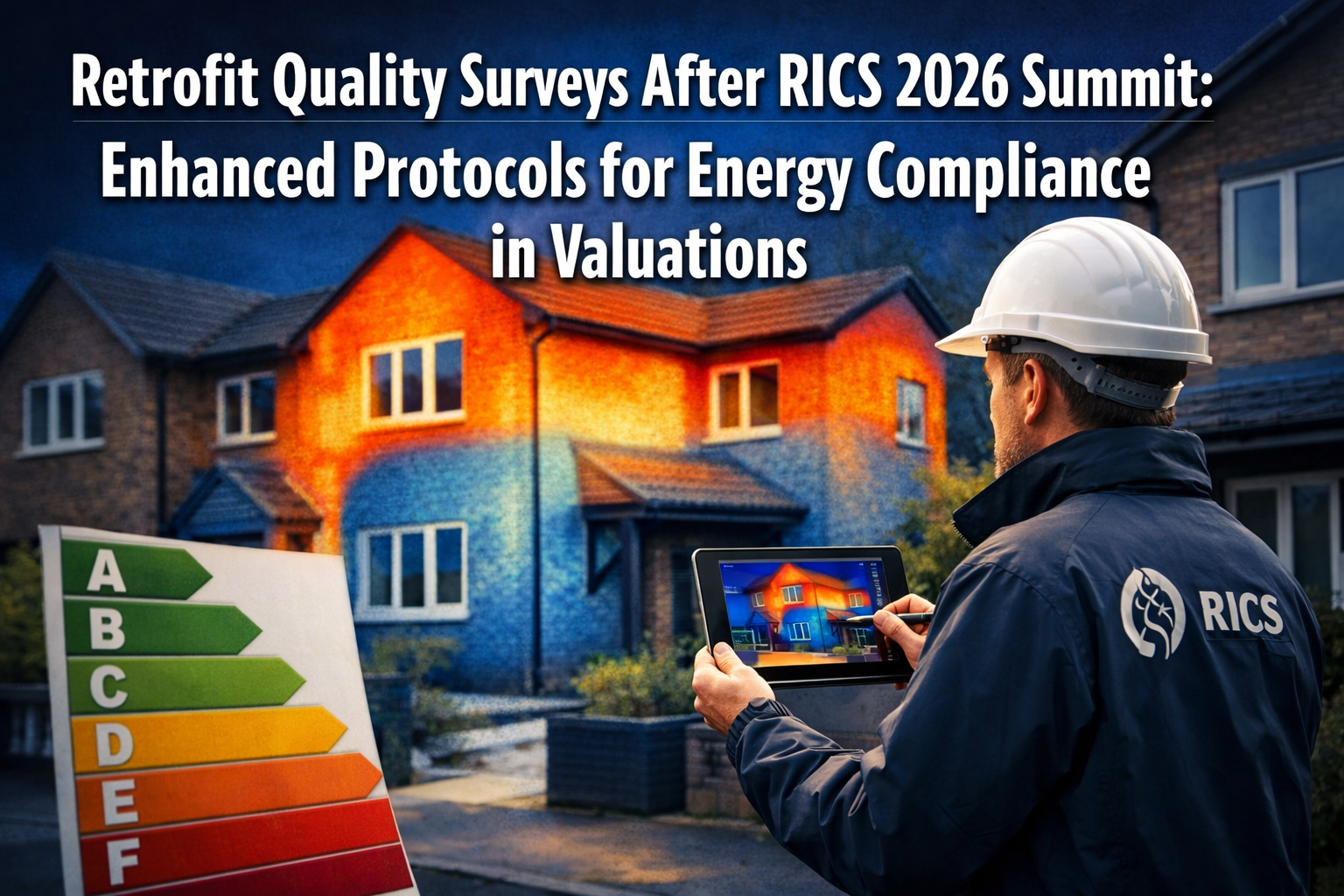

The property surveying landscape is undergoing a seismic shift in 2026. Following the groundbreaking RICS Retrofit Summit held in January, Retrofit Quality Surveys After RICS 2026 Summit: Enhanced Protocols for Energy Compliance in Valuations have emerged as the new gold standard for assessing property worth in an energy-conscious market. With a staggering 92% of current retrofit installations requiring immediate remediation [1], the need for rigorous survey protocols has never been more critical.
The Summit brought together industry leaders, government officials, and technical experts to address the quality crisis plaguing the UK's retrofit sector. Their collective insights are reshaping how chartered surveyors evaluate properties, particularly those undergoing or requiring energy efficiency improvements.
Key Takeaways
- 98% of current retrofit installations have significant issues requiring remediation or presenting immediate safety risks, highlighting the urgent need for enhanced survey protocols [1]
- £15 billion government investment over five years will upgrade 5 million homes, creating unprecedented demand for qualified retrofit surveyors [2]
- New RICS professional pathway (AssocRICS) specifically for residential retrofit surveying addresses critical competency gaps in the industry [2]
- Short training courses deemed inadequate – industry leaders rejected 3-5 day courses as wholly insufficient for critical retrofit assessment roles [1]
- Enhanced protocols require site visits, independent assessment, and data-driven monitoring to ensure quality and protect property values [1]
Understanding the Quality Crisis That Drove Enhanced Protocols
The Shocking Reality of Current Retrofit Standards
The National Audit Office's findings presented at the Summit revealed an alarming truth: 92% of installations under ECO4 and GBIS schemes have major issues requiring immediate remediation, with a further 6% presenting immediate health and safety risks [1]. These statistics represent more than just numbers—they reflect thousands of homeowners whose properties have been devalued rather than improved through poorly executed retrofit work.
This quality crisis has profound implications for property valuations. When RICS building surveys uncover substandard retrofit installations, properties can lose significant market value. Buyers increasingly demand evidence of proper energy compliance, and poorly executed work creates both financial and legal liabilities.
Why Traditional Survey Methods Fall Short
Traditional property surveys weren't designed to assess the complex interplay of building physics, ventilation requirements, and thermal performance that modern retrofits demand. A standard RICS home survey might identify visible defects but miss critical issues such as:
- Interstitial condensation caused by improperly installed insulation
- Ventilation inadequacy leading to moisture accumulation
- Thermal bridging that negates energy efficiency improvements
- Non-compliant installations that void insurance coverage
The Summit emphasized that these technical complexities require specialized training and assessment protocols that go far beyond conventional surveying practices.
Retrofit Quality Surveys After RICS 2026 Summit: The New Professional Standards
The RICS Residential Retrofit Surveying Pathway
In direct response to identified competency gaps, RICS launched a new professional membership pathway for residential retrofit surveying (AssocRICS) developed in collaboration with The Retrofit Academy [2]. This groundbreaking qualification represents a fundamental shift in how the profession approaches energy compliance in valuations.
The pathway requires comprehensive training in:
| Competency Area | Requirements | Impact on Valuations |
|---|---|---|
| PAS 2035:2023 Standards | Full understanding of retrofit assessment methodology | Ensures compliance with national retrofit standards |
| Building Physics | Thermal performance, moisture dynamics, ventilation | Identifies risks that affect long-term property value |
| Energy Modeling | Software proficiency for performance prediction | Provides accurate energy efficiency projections |
| Quality Assurance | Site inspection protocols, testing procedures | Verifies installation quality before valuation |
| Historic Buildings | Specialized approaches for traditional construction | Protects heritage value while improving efficiency |
Rejecting Inadequate Training Standards
Summit panelists unanimously rejected the current practice of 3-day and 5-day training courses for Domestic Energy Assessors and Retrofit Assessors as wholly insufficient [1]. Dr Sarah Price, Technical Author of PAS 2035:2023, emphasized that such critical roles cannot be properly prepared through abbreviated training programs.
This stance has significant implications for property valuations. Surveyors conducting commercial building surveys or residential assessments must now demonstrate comprehensive competency rather than merely completing short courses.
The £15 Billion Warm Homes Plan: Creating New Valuation Frameworks
Three-Pillar Structure and Surveyor Roles
Launched immediately after the Summit on January 21, 2026, the UK government's Warm Homes Plan commits £15 billion over 5 years to upgrade 5 million homes [2]. This massive investment creates three distinct frameworks that require enhanced survey protocols:
Pillar 1: Targeted Support for Low-Income Households 🏠
Surveyors must conduct comprehensive whole-house assessments to identify appropriate interventions while ensuring value-for-money in publicly funded projects. These assessments require understanding of fuel poverty metrics and cost-benefit analysis.
Pillar 2: Universal Offer for Investing Households 💰
Properties where owners can contribute financially require detailed energy compliance valuations that justify investment returns. Surveyors must accurately project energy savings and property value uplift.
Pillar 3: Stronger Protections for Renters 📋
Enhanced survey protocols ensure landlord compliance with minimum energy efficiency standards while protecting tenant interests. This includes pre- and post-installation verification.
Scaling to Meet National Targets
The Climate Change Committee mandates that residential retrofits must increase to 500,000 per year from 2025 and one million per year by 2030 to meet net-zero targets [3]. This exponential scaling requires:
- Standardized assessment protocols that ensure consistency across thousands of properties
- Digital reporting systems that capture data for outcome monitoring
- Quality assurance frameworks that catch problems before they affect property values
- Independent verification separate from installation interests
Enhanced Protocols for Energy Compliance in Valuations: Practical Implementation
Site Inspection and Coordination Requirements
Summit attendees emphasized that Retrofit Coordinators must visit every site [1], establishing a critical principle: remote or desktop assessments are inadequate for retrofit quality assurance. This requirement fundamentally changes how valuers approach energy compliance.
RICS President Nick Maclean OBE RD FRICS stated that successful retrofit "requires a relentless focus on standards, skills and professionalism" [2]. This philosophy translates into specific site inspection protocols:
✅ Pre-Installation Assessment
- Detailed building fabric survey including hidden defects
- Moisture and ventilation baseline measurements
- Thermal imaging to identify existing performance issues
- Heritage impact assessment for traditional buildings
✅ During Installation Monitoring
- Regular site visits to verify specification compliance
- Photographic documentation of installation stages
- Testing of interim milestones (air-tightness, insulation continuity)
- Coordination between multiple trades
✅ Post-Installation Verification
- Comprehensive testing against design specifications
- Energy performance validation
- Occupant guidance and handover procedures
- 12-month post-occupancy evaluation
Data-Driven Outcome Monitoring
Richard Ellis, Director of Sustainability at The Peabody Trust, emphasized that "data is king" in ensuring retrofit success and accountability [1]. Enhanced protocols now require:
Performance Metrics Collection 📊
- Actual energy consumption before and after retrofit
- Indoor environmental quality measurements (temperature, humidity, CO2)
- Occupant satisfaction and comfort assessments
- Cost-benefit analysis of implemented measures
Digital Documentation Standards
Modern building surveys must include digital records that enable:
- Longitudinal performance tracking
- Comparison against predicted outcomes
- Early identification of underperforming installations
- Evidence-based valuation adjustments
Independent Assessment and Conflict of Interest Management
Dr Sarah Price recommended that professionals must act independently of vested interests [1]. This principle addresses a fundamental flaw in current retrofit delivery where assessors, coordinators, and installers often have financial relationships that compromise objectivity.
Enhanced protocols require:
🔍 Separation of Roles
- Independent surveyors not affiliated with installation companies
- Clear disclosure of any financial relationships
- Third-party verification of critical installations
- Consumer protection through unbiased assessment
🔍 Professional Indemnity Requirements
- Enhanced insurance coverage for retrofit assessments
- Clear liability frameworks for quality failures
- Professional standards enforcement mechanisms
- Consumer redress pathways
Historic Building Considerations in Retrofit Quality Surveys
Specialized Protocols for Traditional Construction
Alan Gardner, Head of Historic Building Climate Change Adaptation at Historic England, called for development of a skilled workforce with controls ensuring quality is built into the system [1]. Traditional buildings require fundamentally different retrofit approaches than modern construction.
Enhanced protocols for historic properties include:
Breathability Assessment 🏛️
Traditional buildings rely on moisture permeability through lime mortars and porous materials. Surveyors must evaluate how proposed retrofits affect this critical characteristic to avoid trapped moisture and decay.
Heritage Value Protection
Commercial property surveyors and residential specialists must balance energy improvements against architectural significance, ensuring retrofits enhance rather than diminish property value.
Reversibility Principles
Where possible, retrofit interventions should be reversible, allowing future adaptation without permanent alteration to historic fabric.
RICS Residential Retrofit Standard: The Foundation for Enhanced Valuations
March 2024 Standard and Consumer Guidance
RICS launched its first residential retrofit standard setting key rules for professionals in March 2024 [3], providing the foundation upon which post-Summit protocols build. This standard, developed by the RICS Residential Professional Property Group Panel (RPPGP), establishes minimum competencies and ethical requirements.
The accompanying consumer guide helps property owners understand:
- What to expect from professional retrofit assessments
- How energy efficiency improvements affect property values
- Questions to ask surveyors and installers
- Red flags indicating substandard work
Integration with PAS 2035:2023
Enhanced protocols require seamless integration between RICS professional standards and PAS 2035:2023 retrofit assessment methodology. Surveyors must demonstrate competency in both frameworks to provide comprehensive valuations that account for:
- Compliance with national retrofit standards
- Professional surveying ethics and methodologies
- Building regulations and planning requirements
- Insurance and warranty implications
Quality Control Mechanisms in Enhanced Protocols
Testing and Measurement Requirements
Dr Sarah Price's recommendations for better quality control and more testing and measurement [1] translate into specific requirements for retrofit quality surveys:
Mandatory Testing Protocols 🔬
- Air-tightness testing before and after installation
- Thermal imaging verification of insulation continuity
- Moisture content monitoring in affected building elements
- Ventilation performance measurement
- Sound insulation testing where party walls are affected
Performance Verification
Enhanced protocols require actual measurement rather than assumed performance, ensuring valuations reflect genuine energy efficiency improvements rather than theoretical projections.
Robust Monitoring Systems
Historic England's recommendation for robust monitoring to identify issues when they occur [1] establishes ongoing quality assurance as a core component of enhanced protocols. This includes:
12-Month Post-Occupancy Evaluation
- Energy consumption verification against predictions
- Building performance monitoring for defects
- Occupant feedback on comfort and functionality
- Remediation of identified issues
Long-Term Performance Tracking
Digital systems enable continuous monitoring that informs future valuations and identifies systemic issues requiring industry-wide correction.
Impact on Property Valuations and Market Dynamics
Energy Efficiency as a Value Driver
Enhanced protocols fundamentally change how energy compliance affects property valuations. Properties with verified, high-quality retrofit installations command premium prices, while those with substandard work face significant value reductions.
Market Differentiation 💷
- Properties with comprehensive retrofit quality documentation sell faster
- Verified energy performance reduces buyer uncertainty
- Quality assurance certificates become essential marketing tools
- Poor retrofits create legal liabilities that depress values
Buyer Expectations in 2026
Today's property buyers increasingly demand evidence of energy compliance. Enhanced protocols provide the documentation framework that supports informed purchasing decisions:
- Transparent Performance Data: Actual energy consumption rather than theoretical ratings
- Quality Assurance Certification: Independent verification of installation standards
- Warranty Protection: Clear liability frameworks for defects
- Future-Proofing: Compliance with evolving energy regulations
Implementing Enhanced Protocols: Practical Steps for Surveyors
Professional Development Requirements
Surveyors seeking to conduct retrofit quality assessments must:
- Complete RICS AssocRICS Residential Retrofit Pathway or equivalent comprehensive training
- Gain PAS 2035:2023 competency through recognized training providers
- Develop building physics expertise including thermal modeling and moisture analysis
- Acquire specialized equipment for testing and measurement
- Establish professional indemnity coverage appropriate for retrofit assessment risks
Technology Integration
Modern retrofit quality surveys require sophisticated technology:
Essential Equipment 📱
- Thermal imaging cameras with calibrated accuracy
- Moisture meters for invasive and non-invasive measurement
- Air-tightness testing equipment (blower door)
- Indoor environmental quality monitors
- Digital documentation systems for comprehensive reporting
Software Capabilities
- Energy modeling platforms
- Building information management systems
- Digital reporting with photographic evidence
- Data analytics for performance tracking
Challenges and Opportunities in the Enhanced Protocol Era
Addressing the Skills Gap
The rapid scaling required to meet national targets creates significant workforce challenges. The rejection of short training courses means longer, more comprehensive education pathways that may initially constrain surveyor availability.
However, this challenge creates opportunities for surveyors who invest in proper training to differentiate themselves in a growing market with premium fee potential.
Balancing Rigor with Affordability
Enhanced protocols necessarily increase assessment costs. The industry must balance thoroughness with affordability to avoid creating barriers to retrofit uptake.
Solutions include:
- Tiered assessment levels appropriate to project scale and complexity
- Digital efficiencies that reduce time requirements
- Standardized reporting templates that streamline documentation
- Government support for assessment costs in low-income programs
Future Developments: Beyond the 2026 Summit
Ongoing Refinement of PAS 2035
Dr Sarah Price's recommendation for refinement of PAS 2035 [1] signals that standards will continue evolving based on real-world experience. Surveyors must commit to continuous professional development to maintain competency.
Integration with Building Safety Regulations
Enhanced retrofit protocols increasingly intersect with broader building safety frameworks established post-Grenfell. Surveyors must understand how energy efficiency improvements interact with fire safety, structural integrity, and other critical building performance aspects.
Climate Adaptation Considerations
As climate change accelerates, retrofit quality surveys must increasingly address overheating risk, flood resilience, and extreme weather adaptation alongside energy efficiency. This expanding scope requires surveyors to develop multidisciplinary expertise.
Conclusion
Retrofit Quality Surveys After RICS 2026 Summit: Enhanced Protocols for Energy Compliance in Valuations represent a fundamental transformation in how the property profession approaches energy efficiency. The Summit's revelations about the 98% failure rate in current installations [1] have catalyzed urgent action to establish rigorous standards that protect property values and homeowner interests.
The new RICS AssocRICS pathway, combined with the £15 billion Warm Homes Plan and mandatory site inspection requirements, creates a comprehensive framework for quality assurance. Surveyors who embrace these enhanced protocols position themselves at the forefront of a rapidly expanding market while contributing to the UK's net-zero objectives.
Actionable Next Steps
For Property Surveyors:
- Begin the RICS AssocRICS Residential Retrofit Surveying pathway immediately
- Invest in thermal imaging and testing equipment to meet enhanced protocol requirements
- Develop relationships with independent testing laboratories for verification services
- Implement digital documentation systems that support data-driven outcome monitoring
For Property Owners:
- Engage only RICS-qualified surveyors for retrofit assessments
- Demand comprehensive quality assurance documentation before accepting installations
- Insist on independent verification separate from installer interests
- Maintain digital records of all retrofit work to support future valuations
For Industry Stakeholders:
- Support the development of standardized assessment frameworks
- Invest in training infrastructure that meets rigorous competency requirements
- Establish data-sharing platforms that enable outcome monitoring
- Advocate for consumer protection mechanisms that ensure quality
The enhanced protocols emerging from the RICS 2026 Summit aren't merely technical requirements—they represent a commitment to professionalism, quality, and consumer protection that will define the retrofit sector for decades to come. Success requires embracing these standards not as burdens but as opportunities to deliver genuine value in an energy-conscious property market.
References
[1] Quality In Retrofit Summit 2026 – https://retrofitacademy.org/quality-in-retrofit-summit-2026/
[2] Retrofit Leaders Meet Rics Hq Discuss Importance Transformative Projects – https://www.rics.org/news-insights/retrofit-leaders-meet-rics-hq-discuss-importance-transformative-projects
[3] Rics Launches Residential Retrofit And Improving Energy In Your Home Guide – https://www.rics.org/news-insights/rics-launches-residential-retrofit-and-improving-energy-in-your-home-guide