

The UK rental market in 2026 presents a unique challenge for property surveyors. With tenant demand edging higher and landlord instructions remaining firmly negative, the traditional valuation frameworks require urgent recalibration. Rental Market Valuations in 2026: How Surveyors Should Price Properties with Rising Tenant Demand and Constrained Supply demands a sophisticated understanding of supply-demand imbalances, regional variations, and evolving market dynamics that directly impact property values and rental yields.
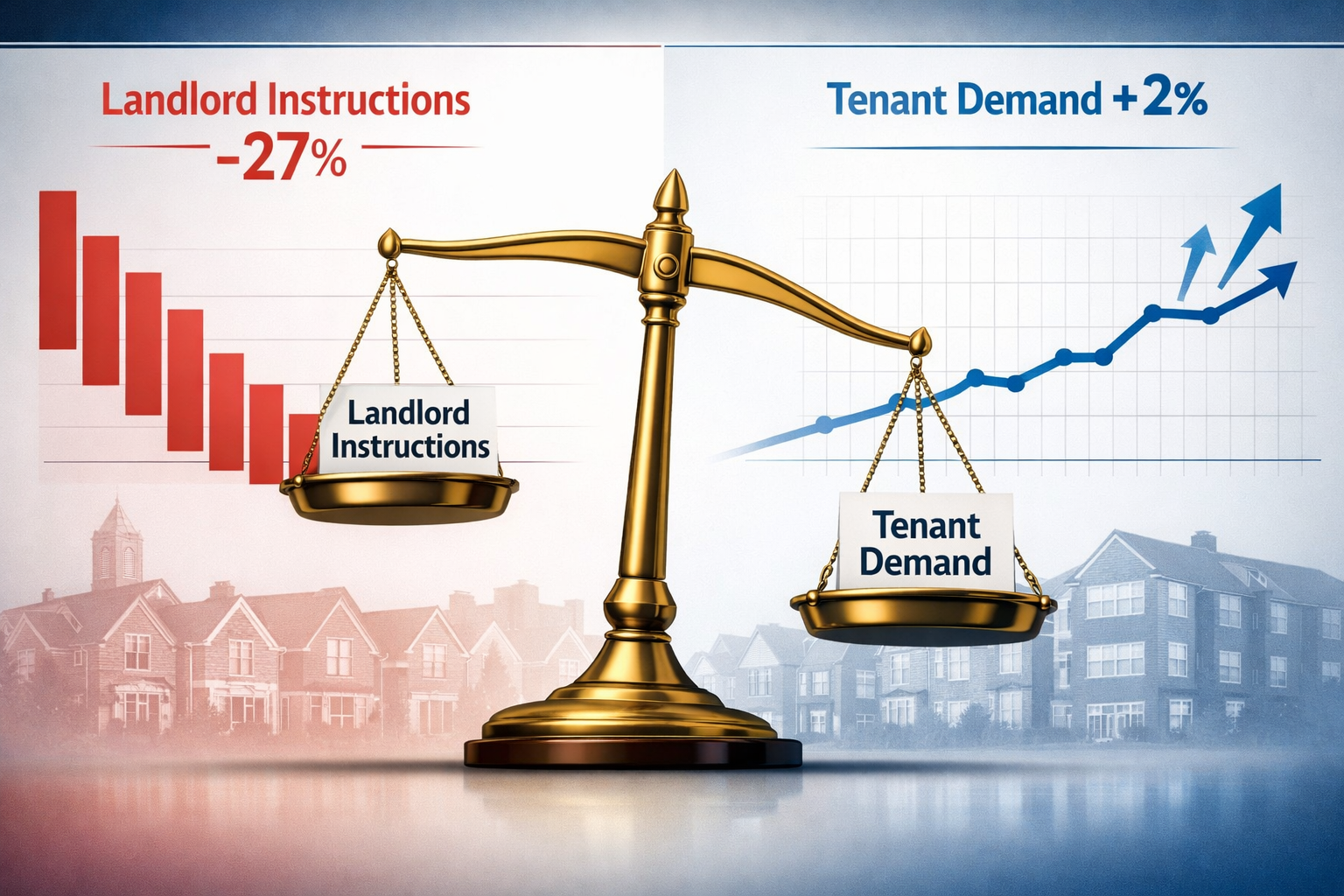
Recent data reveals a stark reality: landlord rental instructions sit at a net balance of -27%, signaling a persistent shortage of rental stock [3]. Meanwhile, tenant demand maintains a positive net balance of +2%, creating the fundamental imbalance that's reshaping how surveyors must approach property valuations. This supply constraint, combined with average UK rents reaching £1,367 monthly in January 2026—up 3.5% year-on-year [1]—requires surveyors to adopt more nuanced pricing strategies that account for local market pressures, property characteristics, and forward-looking rental growth expectations.

Key Takeaways
- Supply shortage drives valuations: Landlord instructions at -27% net balance create sustained upward pressure on rental valuations across most UK regions [3]
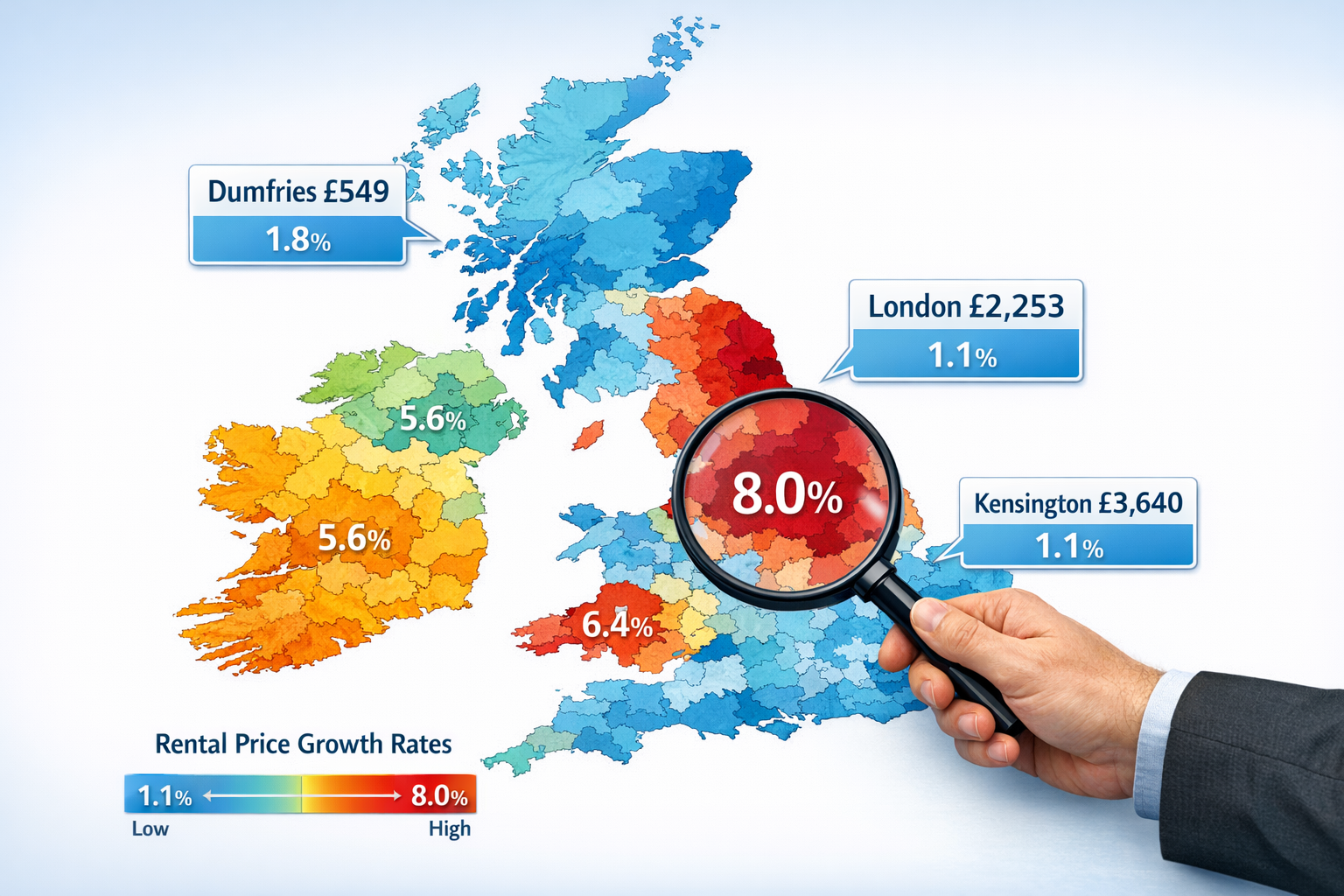
- Regional variation is extreme: Rental growth ranges from 1.1% in London to 8.0% in North East England, requiring localized valuation approaches [1]
- Property type matters significantly: Detached properties command £1,563 monthly versus £1,334 for flats, impacting investment valuations [1]
- Forward expectations remain positive: 20% of surveyors expect rents to rise in the next three months despite economic uncertainty [3]
- Long-term growth projections: Five-year forecasts predict 12% rental income growth alongside 22.2% property value increases [6]
Understanding the Supply-Demand Imbalance Affecting Rental Market Valuations in 2026
The fundamental driver of Rental Market Valuations in 2026: How Surveyors Should Price Properties with Rising Tenant Demand and Constrained Supply lies in the persistent mismatch between available rental properties and tenant requirements. The -27% net balance for landlord instructions represents one of the most significant supply constraints in recent years [3]. This metric indicates that far more surveyors are reporting decreases in landlord instructions than increases—a trend that shows no signs of reversing.
The Landlord Exodus and Its Impact on Valuations
Several factors contribute to the ongoing supply shortage:
- Regulatory pressures: Increased compliance requirements and energy efficiency standards discourage some landlords from maintaining rental portfolios
- Tax changes: Section 24 mortgage interest relief restrictions continue to affect buy-to-let profitability
- Market uncertainty: Economic volatility and interest rate fluctuations make some investors cautious about property investments
- Exit strategies: Older landlords selling properties to realize capital gains rather than passing portfolios to next generation
For surveyors conducting rent reviews or property valuations, this supply constraint must factor into pricing decisions. Properties in areas with severe supply shortages command premium valuations, as landlords can be more selective with tenants and maintain higher rental yields.
Tenant Demand Patterns in 2026
While landlord supply contracts, tenant demand remains resilient at a +2% net balance [3]. This steady demand stems from:
- Affordability barriers to homeownership: High mortgage rates and deposit requirements keep many would-be buyers in the rental market
- Demographic shifts: Younger professionals delaying homeownership in favor of flexibility
- Urban migration: Continued movement toward employment centers and major cities
- Lifestyle preferences: Growing acceptance of long-term renting among certain demographics
The combination of stable demand and constrained supply creates a seller's market for rental properties. Surveyors must recognize that traditional yield calculations may undervalue properties in supply-constrained areas, as future rental growth potential becomes a critical valuation component.
Surveyor Expectations and Market Sentiment
Looking ahead, 20% of surveyors expect rental prices to rise over the next three months [3], reflecting ongoing confidence in rental market strength despite broader economic uncertainty. However, this optimism varies significantly by region and property type, requiring surveyors to apply localized knowledge rather than national averages when pricing properties.
For those seeking professional guidance on valuation methods, understanding these market dynamics becomes essential to accurate property assessment.
Regional Variations in Rental Market Valuations: A Surveyor's Guide to Local Pricing
One of the most critical aspects of Rental Market Valuations in 2026: How Surveyors Should Price Properties with Rising Tenant Demand and Constrained Supply involves recognizing that national averages mask dramatic regional differences. Surveyors who rely on UK-wide statistics risk significantly mispricing properties in their local markets.
Extreme Regional Rental Growth Disparities
The January 2026 data reveals striking variations across UK regions [1]:
| Region | Average Monthly Rent | Year-on-Year Growth |
|---|---|---|
| North East England | £721 | 8.0% 📈 |
| Wales | £826 | 5.8% |
| Northern Ireland | £875 | 5.6% |
| England (average) | £1,423 | 3.5% |
| Scotland | £1,021 | 2.6% |
| London | £2,253 | 1.1% 📉 |
This data demonstrates that surveyors in the North East should apply significantly different valuation multiples than those working in London. The 8.0% annual growth in the North East suggests strong rental yield potential and justifies higher capital valuations relative to current rental income. Conversely, London's modest 1.1% growth—despite commanding the highest absolute rents—indicates market maturation and potential oversupply in certain segments.
London's Cooling Rental Market
Perhaps most surprising for 2026 is London's rental market sentiment shift. The 12-month price expectations in London fell dramatically to +7% in February from +56% in January [3]. This sharp decline suggests surveyors should exercise caution when valuing London rental properties, particularly in premium segments where supply may be catching up with demand.
However, London's average rent of £2,253 monthly still represents a substantial premium over other regions [1]. Areas like Kensington and Chelsea command £3,640 monthly—more than six times the lowest-priced area (Dumfries and Galloway at £549). For chartered surveyors in London and surrounding areas, this premium pricing requires careful justification based on location-specific factors rather than broader market trends.
Micro-Market Analysis Within Regions
Beyond regional averages, surveyors must consider micro-market variations within cities and counties. Factors influencing local rental valuations include:
- Transport connectivity: Properties near major transport hubs command 15-25% premiums
- School catchment areas: Family homes in desirable school districts see sustained demand
- Employment centers: Proximity to major employers and business districts drives rental values
- Amenity access: Walkability scores and local services significantly impact tenant preferences
- Development pipelines: Planned infrastructure improvements affect future valuation potential
For surveyors working in specific locations such as Surrey or Hertfordshire, understanding these local nuances becomes essential to accurate property pricing.
Property Type and Configuration Impact
Beyond geography, property characteristics significantly influence rental valuations. January 2026 data shows clear differentiation by property type [1]:
- Detached properties: £1,563 monthly average
- Semi-detached: £1,342 monthly average
- Terraced: £1,289 monthly average
- Flats and maisonettes: £1,334 monthly average
Bedroom count also drives substantial variation:
- One bedroom: £1,109 monthly
- Two bedrooms: £1,276 monthly
- Three bedrooms: £1,482 monthly
- Four+ bedrooms: £2,037 monthly
These differentials must inform surveyor valuations, particularly when assessing investment potential. A four-bedroom detached property in a supply-constrained market may justify premium pricing based on limited comparable stock and strong tenant demand from families.
Practical Valuation Frameworks for Surveyors in Supply-Constrained Markets
With the market context established, surveyors need practical methodologies for Rental Market Valuations in 2026: How Surveyors Should Price Properties with Rising Tenant Demand and Constrained Supply. Traditional approaches require adaptation to account for current market dynamics.
Adjusted Yield Calculations
Standard rental yield calculations (annual rent ÷ property value × 100) provide baseline metrics, but surveyors must adjust these for:
1. Supply Constraint Premium: Properties in areas with negative landlord instruction balances may justify 0.5-1.0% yield compression (higher valuations relative to current rent) based on anticipated rental growth.
2. Regional Growth Differentials: Apply forward-looking adjustments based on regional growth rates. A property in the North East with 8.0% annual rental growth deserves different valuation treatment than a comparable London property with 1.1% growth.
3. Tenant Demand Strength: Areas with positive tenant demand balances support more aggressive rental growth assumptions in valuation models.
Example calculation:
- Current monthly rent: £1,400
- Annual rent: £16,800
- Standard yield expectation: 5.0%
- Base valuation: £336,000
- Supply constraint adjustment: +0.75% yield compression
- Adjusted valuation: £357,447
This 6.4% valuation increase reflects the property's position in a supply-constrained market with strong rental growth prospects.
Comparable Property Analysis with Market Adjustments
When conducting comparable property analysis, surveyors should:
✅ Prioritize recent transactions: Use sales within the last 3-6 months to reflect current market conditions
✅ Apply time adjustments: Account for quarterly rental growth when using older comparables
✅ Weight by similarity: Give greater emphasis to properties matching type, size, and location characteristics
✅ Adjust for supply dynamics: Properties sold in areas with improving supply may require downward adjustments
✅ Consider tenant quality: Properties with established, long-term tenants justify premium valuations
For comprehensive property assessment, surveyors might also recommend a homebuyer survey to identify any structural issues that could affect rental valuations.

Long-Term Investment Valuation Models
For institutional investors and buy-to-let portfolios, surveyors should incorporate longer-term projections. Five-year forecasts suggest [6]:
- Rental income growth: 12% cumulative increase
- Property value appreciation: 22.2% cumulative increase
- Net yield impact: Improving returns as rental growth outpaces operating cost increases
These projections support higher current valuations for properties with strong fundamentals in supply-constrained markets. Surveyors should model scenarios including:
- Base case: Moderate rental growth aligned with regional averages
- Optimistic case: Sustained supply constraints driving above-average growth
- Conservative case: Economic headwinds moderating rental appreciation
Accounting for Property Condition and Improvement Potential
Property condition significantly impacts rental valuations. Surveyors should assess:
- Energy efficiency ratings: Properties with EPC ratings below C face regulatory risks and tenant preference challenges
- Modernization requirements: Outdated kitchens, bathrooms, and systems reduce rental potential
- Maintenance standards: Well-maintained properties command premium rents and lower void periods
- Improvement opportunities: Properties with extension or conversion potential offer additional value
For properties requiring detailed condition assessment, a RICS Building Survey Level 3 provides comprehensive analysis of structural integrity and maintenance requirements.
Incorporating Macroeconomic Factors
While supply-demand fundamentals drive rental valuations, surveyors must also consider broader economic context:
Interest rate environment: Higher mortgage rates affect buy-to-let investor returns and property valuations. Current rates influence the discount rates applied to future rental income streams.
Inflation expectations: Rental growth typically correlates with inflation, but recent years show divergence. Surveyors should assess whether current rental growth is sustainable or represents catch-up from previous years.
Economic uncertainty: The February 2026 RICS survey shows near-term price expectations turned cautious at -18% net balance, driven by concerns over inflation and global instability [3]. This suggests surveyors should apply conservative assumptions for short-term valuations while maintaining confidence in longer-term fundamentals.
Employment trends: Local employment growth and wage inflation directly impact tenant affordability and rental demand sustainability.
Specialized Valuation Scenarios
Certain property types require specialized valuation approaches:
Shared ownership properties: These require understanding of both rental and ownership components. Surveyors should consult guidance on valuing shared ownership properties to properly assess market value.
Leasehold properties: Remaining lease terms significantly impact valuations. Properties with short leases may require lease extension valuations to determine optimal pricing.
Portfolio valuations: Bulk property assessments for institutional investors require different methodologies than single-property valuations, with greater emphasis on geographic diversification and aggregate yield metrics.
Development potential: Properties with planning permission or development potential command premiums beyond pure rental yield calculations.
Documentation and Reporting Best Practices
Professional surveyors should document valuation decisions comprehensively:
📋 Market context: Include regional rental growth data, supply-demand metrics, and local market conditions
📋 Comparable evidence: Present at least 3-5 comparable properties with adjustment explanations
📋 Methodology transparency: Clearly explain yield calculations, adjustment factors, and assumptions
📋 Risk assessment: Identify factors that could affect future rental income or property values
📋 Sensitivity analysis: Show how valuations change under different market scenarios
This documentation protects surveyors professionally and provides clients with clear rationale for pricing decisions. Understanding surveyor pricing helps clients appreciate the value of thorough professional assessment.
Technology and Data Tools for Modern Valuations
Forward-thinking surveyors leverage technology to enhance valuation accuracy:
- Rental data platforms: Real-time rental listing data provides current market pricing
- Transaction databases: Access to completed rental agreements and property sales
- Mapping tools: Geographic information systems (GIS) for micro-market analysis
- Predictive analytics: Machine learning models identifying rental growth trends
- Automated valuation models (AVMs): Supplementary tools for initial assessments (not replacements for professional judgment)
However, technology should augment rather than replace professional surveyor expertise. The nuanced understanding of local markets, property condition, and qualitative factors remains essential to accurate valuations.
Future Outlook: Preparing for Evolving Rental Market Conditions
Looking beyond 2026, surveyors must prepare for potential market shifts that could affect Rental Market Valuations in 2026: How Surveyors Should Price Properties with Rising Tenant Demand and Constrained Supply.
Anticipated Market Developments
Moderated growth expectations: Industry forecasts predict 2.6% rental growth for 2026 [4], suggesting more moderate appreciation than recent years. This aligns with earlier predictions of around 2.5%, indicating a stabilizing market rather than continued acceleration.
Supply response potential: If rental yields remain attractive, new landlord entrants or returning investors could gradually ease supply constraints. Surveyors should monitor landlord instruction trends for early signs of supply recovery.
Regulatory changes: Ongoing government policy discussions around rental market regulation, tenant protections, and landlord obligations could significantly impact property valuations. Surveyors must stay informed of legislative developments.
Economic recovery trajectory: The path of interest rates, inflation, and economic growth will fundamentally shape rental market dynamics through 2026 and beyond.
Adapting Valuation Practices
Successful surveyors will:
🔍 Maintain market intelligence: Regular review of RICS surveys, ONS data, and local market reports
🔍 Build regional expertise: Deep knowledge of specific geographic markets rather than generalized national approaches
🔍 Develop scenario planning: Multiple valuation scenarios accounting for different market outcomes
🔍 Enhance client communication: Clear explanation of assumptions and market context behind valuations
🔍 Pursue continuous education: Professional development in emerging valuation methodologies and market analysis techniques
Risk Considerations for Clients
Surveyors should advise clients on key risks affecting rental property valuations:
⚠️ Regulatory risk: Potential changes to landlord-tenant legislation affecting returns
⚠️ Market cycle risk: Current supply constraints may eventually reverse, moderating rental growth
⚠️ Interest rate risk: Rising borrowing costs affecting buy-to-let investment returns
⚠️ Property-specific risk: Condition issues, lease terms, or location factors affecting individual properties
⚠️ Economic risk: Broader economic downturns impacting tenant affordability and demand
Comprehensive risk assessment ensures clients make informed decisions based on realistic expectations rather than extrapolating current favorable conditions indefinitely.
Conclusion
Rental Market Valuations in 2026: How Surveyors Should Price Properties with Rising Tenant Demand and Constrained Supply requires a sophisticated, multi-faceted approach that goes beyond traditional valuation methodologies. The fundamental supply-demand imbalance—characterized by landlord instructions at -27% net balance and tenant demand at +2%—creates sustained upward pressure on rental values across most UK markets [3].
However, surveyors must resist the temptation to apply blanket assumptions across all properties and regions. The extreme variation in rental growth—from 1.1% in London to 8.0% in North East England—demands localized expertise and careful comparable analysis [1]. Property type, configuration, condition, and micro-market positioning all significantly impact appropriate valuation levels.
The practical frameworks outlined in this article—adjusted yield calculations, enhanced comparable analysis, long-term investment modeling, and comprehensive risk assessment—provide surveyors with tools to navigate this complex market environment. By incorporating both quantitative data and qualitative market intelligence, surveyors can deliver valuations that accurately reflect current conditions while accounting for future market evolution.
Actionable Next Steps for Surveyors
- Review regional data monthly: Monitor RICS surveys and ONS rental statistics to track market trends
- Build local comparable databases: Maintain detailed records of rental transactions in your service areas
- Develop client education materials: Create resources explaining current market dynamics and valuation approaches
- Enhance professional networks: Connect with other surveyors to share market intelligence and best practices
- Invest in technology tools: Adopt data platforms and analytics tools to supplement professional judgment
- Pursue specialized training: Seek CPD opportunities focused on rental market analysis and investment property valuation
As the rental market continues evolving through 2026 and beyond, surveyors who combine rigorous methodology with deep market understanding will deliver the most accurate and valuable property assessments. The supply-constrained environment presents both opportunities and challenges—success depends on recognizing the nuances that distinguish exceptional valuation work from generic approaches.
For professional surveyor services across the UK, including comprehensive property valuations and rental market assessments, experienced chartered surveyors provide the expertise necessary to navigate these complex market conditions with confidence.
References
[1] February2026 – https://www.ons.gov.uk/economy/inflationandpriceindices/bulletins/privaterentandhousepricesuk/february2026
[3] Uk Residential Survey February 2026 – https://www.rics.org/news-insights/uk-residential-survey-february-2026
[4] 2026 Predictions For Landlords – https://www.simplybusiness.co.uk/knowledge/rental/2026-predictions-for-landlords/
[6] Buy To Let Valuation Surge 2026 Survey Strategies For Institutional Investors In A Recovering Market – https://nottinghillsurveyors.com/blog/buy-to-let-valuation-surge-2026-survey-strategies-for-institutional-investors-in-a-recovering-market