
{"cover":"Professional landscape format (1536x1024) hero image with bold text overlay 'Regional Divergence in Property Valuations: North-South Price Gaps in 2026' in extra large 72pt white sans-serif font with dark shadow and semi-transparent navy overlay box, positioned in upper third. Background shows split-screen composition: left side displays modern Northern England terraced houses with upward trending green price graph overlay, right side shows London Victorian properties with flat orange trend line. Color scheme: navy blue, white, green and orange accents. Magazine cover aesthetic, editorial quality, high contrast, professional surveying theme with subtle map of UK in background.","content":["Landscape format (1536x1024) detailed infographic showing UK map with color-coded regional property price growth percentages for 2026. Northern regions (Scotland, Northern Ireland, North West) highlighted in vibrant green with +6-7% growth labels, London and South East in muted orange with +1-2% labels. Professional surveyor with tablet overlaid on left side examining digital property data. Clean modern design with data visualization elements, bar charts comparing regional performance, RICS logo subtly placed, professional color palette of navy, green, orange and white, editorial quality illustration style.","Landscape format (1536x1024) close-up scene of professional chartered surveyor conducting detailed building inspection inside period property. Surveyor wearing hard hat using thermal imaging camera and moisture meter on Victorian-era wall showing potential damp issues. Split-screen effect showing Northern property on left (solid condition, minimal defects) versus Southern property on right (heritage features requiring specialist assessment). Technical equipment visible: laser measure, tablet with survey software, clipboard with RICS forms. Warm natural lighting, professional documentary photography style, emphasis on regional building condition differences.","Landscape format (1536x1024) modern office setting showing surveyor team analyzing regional valuation data on large wall-mounted screens displaying interactive UK property market dashboard. Multiple monitors show comparative market analysis tools, GeoConnect platform interface, regional price heat maps, and valuation adjustment calculators. Professional team discussing strategy with documents spread on conference table. Technology-focused composition with tablets, digital tools, and data visualization prominent. Clean corporate aesthetic, bright natural lighting, contemporary workspace, emphasis on tech-driven valuation methodology, professional photography style with depth of field."]}
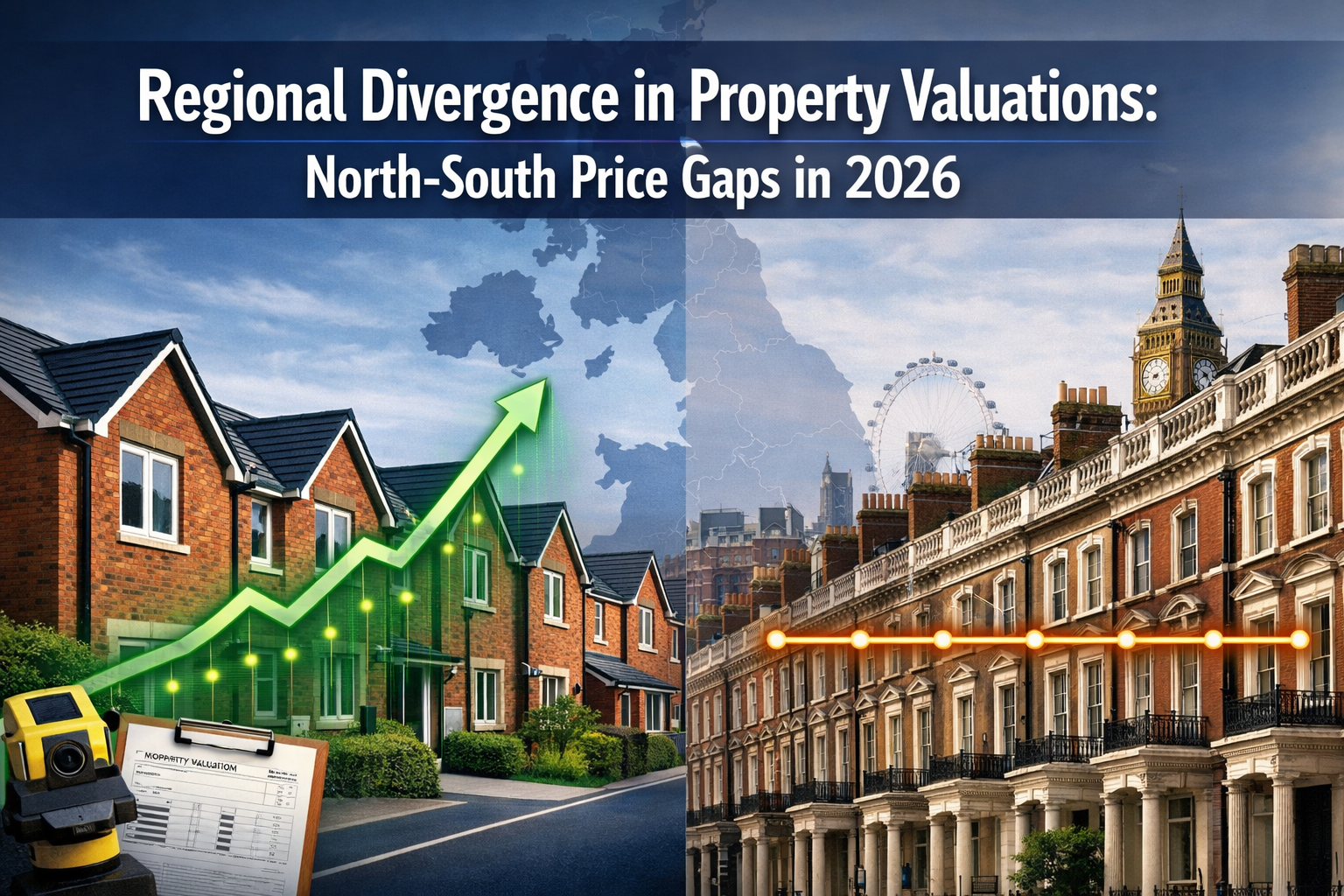
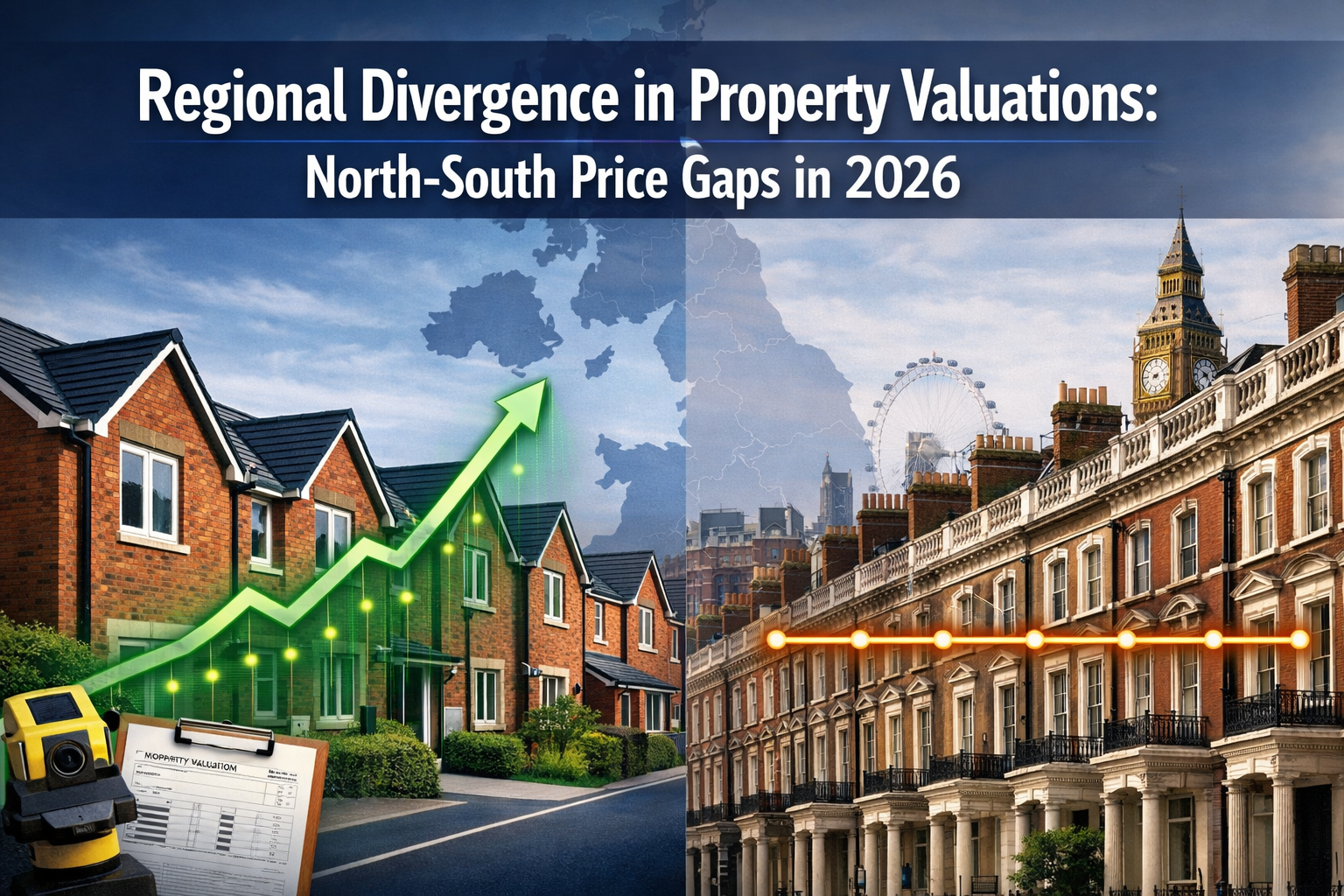
The UK property market in 2026 presents a fascinating paradox: while Scotland, Northern Ireland, and the North West experience robust price growth of 6-7%, London and the South East struggle with minimal appreciation. This Regional Divergence in Property Valuations: Surveyor Techniques for North-South Price Gaps in 2026's Recovering Market demands that chartered surveyors fundamentally rethink their approach to property assessment, valuation methodologies, and building survey priorities. As the market transitions from cooling to recovery, understanding these geographical disparities isn't just academic—it's essential for accurate valuations and informed property decisions.
The traditional assumption that London and the South East would always outperform has been shattered. Northern regions are now the growth engines, creating unique challenges for surveyors who must adapt their techniques to reflect these divergent market dynamics. This shift affects everything from choosing the right property survey to determining accurate valuations across different regions.
Key Takeaways
- 🏘️ Northern regions (Scotland, Northern Ireland, North West) are experiencing 6-7% price growth in 2026, significantly outpacing London and the South East
- 📊 Surveyor techniques must adapt regionally, with Northern properties requiring growth-focused valuations while Southern properties need heritage and stability assessments
- 🔧 Building survey priorities differ by region—Northern surveys emphasize investment potential while Southern surveys focus on structural integrity and conservation
- 💻 Technology-driven tools like GeoConnect are creating more consistent valuation decisions across fragmented regional markets
- 📈 The cooling-then-recovering market pattern of 2026 requires surveyors to balance current conditions with future growth trajectories differently across regions
Understanding the North-South Property Price Divide in 2026
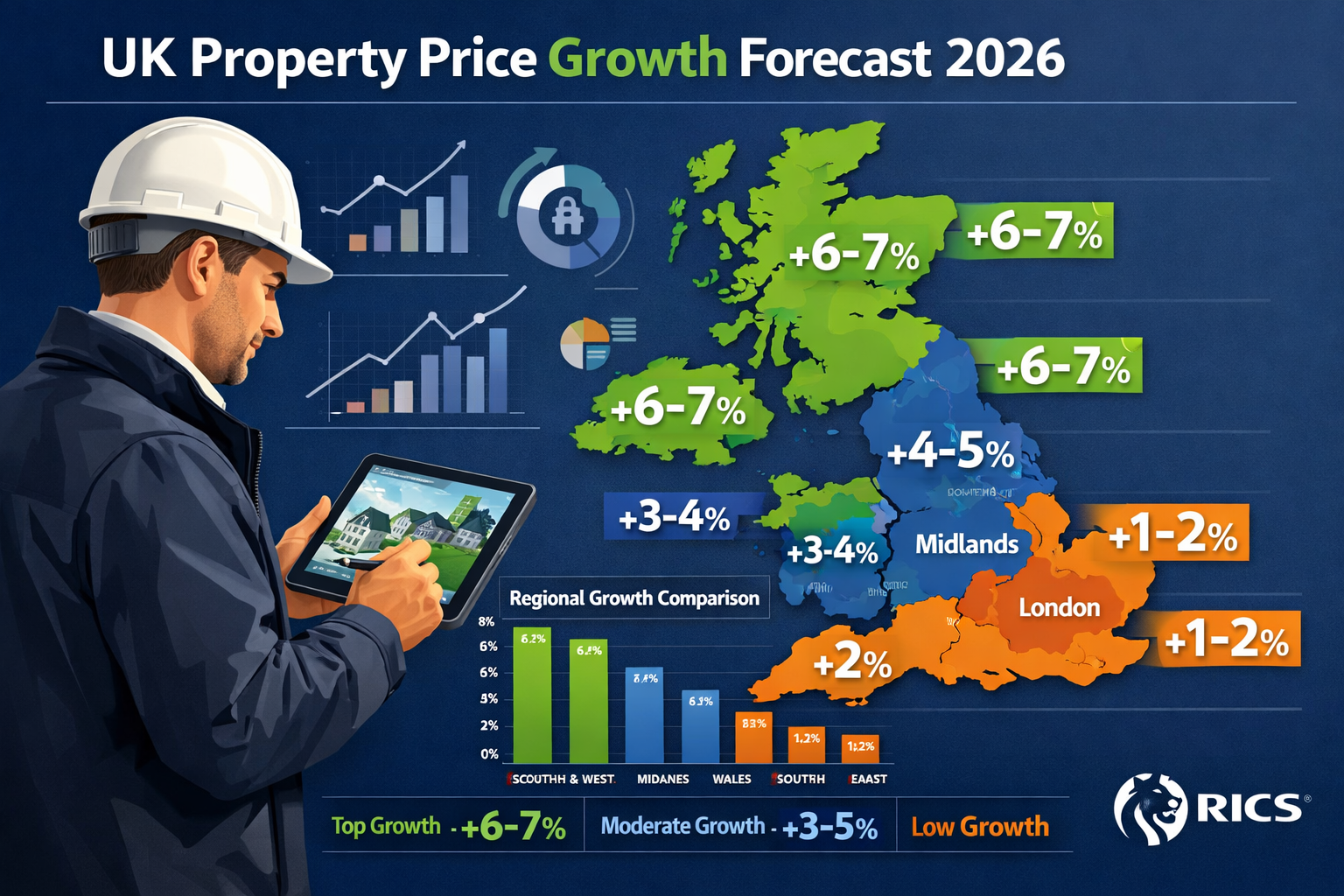
The geographical split in UK property performance has reached unprecedented levels in 2026. While chartered surveyors in North West London and South East London grapple with stagnant markets, their counterparts in Manchester, Liverpool, and Edinburgh are witnessing a property boom.
The Numbers Behind Regional Divergence
According to RICS valuation methods, Northern England is projected to experience price surges of 6-7% throughout 2026 [1]. This stands in stark contrast to London and the South East, where price appreciation remains subdued at 1-2%. Several factors drive this divergence:
Economic Factors:
- Affordability ratios in Northern regions remain attractive to first-time buyers
- Remote work flexibility continues to reduce London's premium positioning
- Regional investment initiatives stimulate Northern property demand
- Cost of living pressures push buyers toward more affordable regions
Market Dynamics:
- Southern markets face affordability ceilings limiting further growth
- Northern markets benefit from catch-up growth after years of underperformance
- Stamp duty thresholds impact high-value Southern properties disproportionately
- Post-Budget 2026 policies create distinct challenges for properties over £2 million [3]
Cooling-Then-Recovering Market Characteristics
The 2026 market exhibits a unique "cooling-then-recovering" pattern that impacts regional valuations differently [2]. This pattern means:
| Market Phase | Northern Regions | Southern Regions |
|---|---|---|
| Cooling Period (Q1-Q2) | Minimal impact, prices stabilize | Significant correction, 3-5% decline |
| Recovery Phase (Q3-Q4) | Strong rebound, 6-7% annual growth | Modest recovery, 1-2% growth |
| Buyer Sentiment | Optimistic, investment-focused | Cautious, value-seeking |
| Survey Priorities | Growth potential assessment | Structural integrity focus |
This divergence creates a fundamental challenge for surveyors: one-size-fits-all valuation approaches no longer work. A property in Hampstead requires entirely different assessment criteria than a comparable property in Leeds or Glasgow.
Why Regional Expertise Matters More Than Ever
The fragmentation of the UK property market means that local chartered surveyors with specific regional knowledge provide significantly more accurate valuations than generalist approaches. Understanding local market nuances—from planning restrictions to infrastructure developments—becomes critical when markets move in opposite directions.
Surveyor Techniques for Valuing Properties in High-Growth Northern Markets
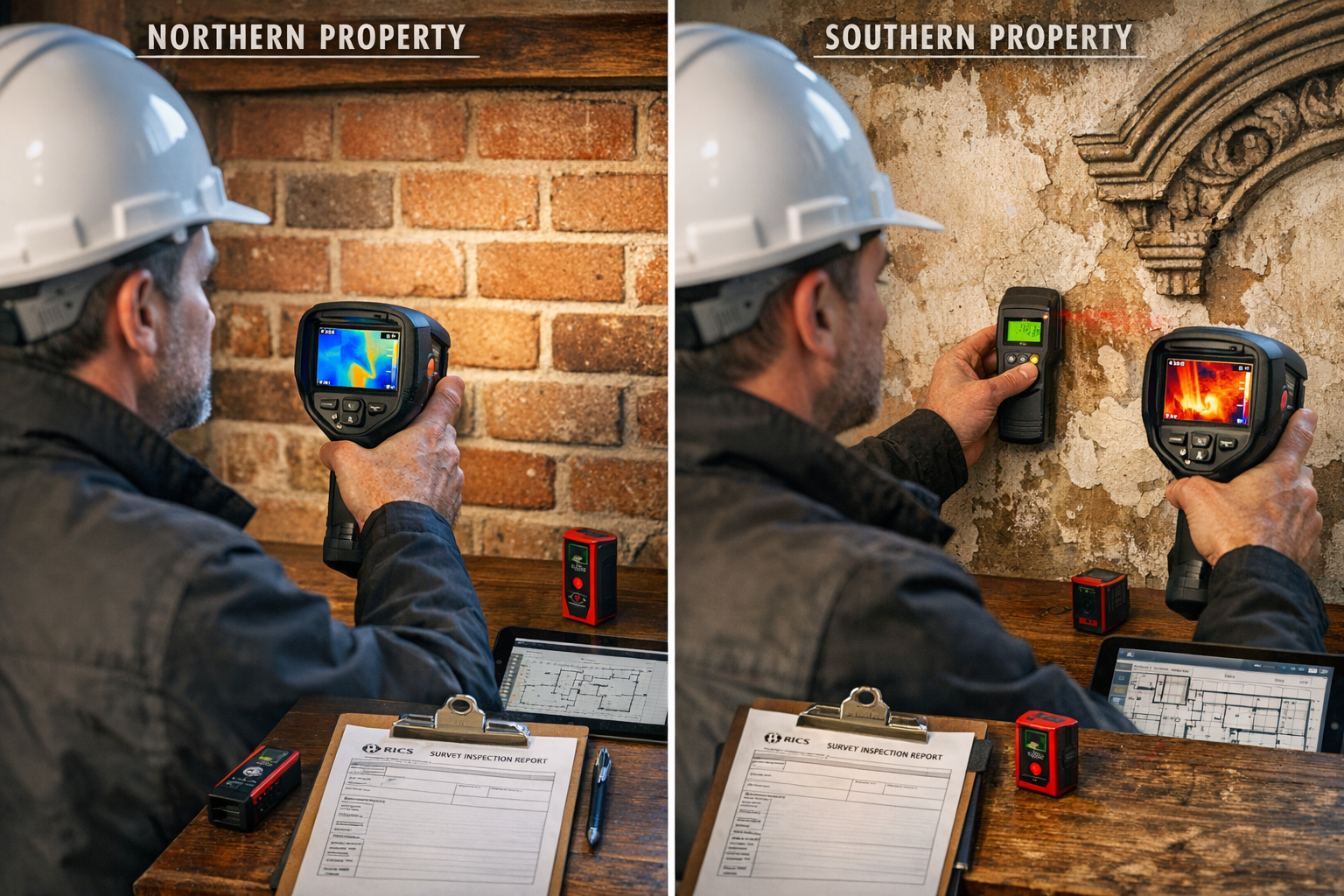
When conducting valuations in Scotland, Northern Ireland, and the North West, surveyors must adapt their methodologies to account for rapid price appreciation and strong buyer demand. The Regional Divergence in Property Valuations: Surveyor Techniques for North-South Price Gaps in 2026's Recovering Market requires specific technical adjustments in high-growth areas.
Adjusted Comparable Analysis for Rising Markets
Traditional comparable analysis assumes relatively stable market conditions. In rapidly appreciating markets, this approach can undervalue properties. Surveyors should:
Time-Adjust Comparables:
- Apply monthly appreciation factors (typically 0.5-0.6% monthly in Northern markets)
- Weight recent sales more heavily than older transactions
- Consider pending sales and asking prices as forward indicators
- Account for seasonal variations in local markets
Expand Comparable Search Radius:
- Cast wider geographical nets when local comparables are limited
- Adjust for micro-location differences more precisely
- Consider properties in similar growth corridors
- Weight quality of comparable over proximity in fast-moving markets
Growth Trajectory Valuation Methodology
For properties in high-growth regions, surveyors should incorporate forward-looking valuation components:
✅ Investment Potential Assessment: Evaluate rental yield potential and capital appreciation prospects
✅ Infrastructure Impact Analysis: Consider upcoming transport, commercial, or regeneration projects
✅ Demographic Trend Evaluation: Assess population growth, employment trends, and migration patterns
✅ Supply Constraint Analysis: Evaluate planning restrictions and development pipeline limitations
This approach aligns with how buyers in Northern markets are making decisions—they're purchasing based on future value, not just current condition.
Building Survey Priorities in Growth Markets
When conducting homebuyer surveys or structural surveys in high-growth Northern regions, priorities shift:
Emphasize Improvement Potential:
- Identify value-add renovation opportunities
- Assess feasibility of extensions or conversions
- Evaluate planning permission prospects
- Consider modern buyer preferences (home offices, outdoor space)
Streamlined Defect Assessment:
- Focus on major structural issues that impact value
- Provide cost-benefit analysis for repairs versus market appreciation
- Differentiate between urgent repairs and cosmetic improvements
- Consider whether defects are priced into the market
Market Context Integration:
- Include local market performance data in reports
- Provide comparative growth analysis
- Highlight features particularly valued in the local market
- Reference recent comparable transactions with growth adjustments
Technology-Enabled Consistency
The shift toward technology tools aims to create more consistent valuation decisions across different property types and regions [4]. Surveyors in Northern markets should leverage:
- GeoConnect platforms for comprehensive property understanding before site visits
- Automated valuation models (AVMs) as cross-reference points
- Digital comparable databases with real-time market data
- Thermal imaging and drone surveys for efficient property assessment
These tools help maintain professional standards even when market conditions create pressure for rapid turnaround times.
Adapting Survey Approaches for Stable Southern Markets
While Northern markets boom, London and the South East require different surveyor techniques that reflect market maturity, heritage property considerations, and price stability. Understanding these Regional Divergence in Property Valuations: Surveyor Techniques for North-South Price Gaps in 2026's Recovering Market nuances ensures accurate assessments in slower-growth areas.
Conservative Valuation Approaches
In markets experiencing minimal appreciation, surveyors must adopt more conservative methodologies:
Strict Comparable Standards:
- Use tighter time windows for comparable sales (3-6 months maximum)
- Require closer geographical proximity for valid comparables
- Apply downward adjustments for market softening
- Scrutinize asking prices versus achieved prices more carefully
Risk-Adjusted Valuations:
- Consider downside scenarios in market commentary
- Highlight properties with extended marketing periods
- Note price reductions in comparable analysis
- Provide range valuations rather than single-point estimates
Heritage and Conservation Considerations
Southern markets, particularly areas like Battersea, Chiswick, and Putney, contain significant proportions of period and listed properties requiring specialized assessment:
Period Property Expertise:
- Understanding traditional construction methods and materials
- Identifying appropriate versus inappropriate alterations
- Assessing conservation area restrictions
- Evaluating listed building implications on value
Specialist Survey Requirements:
- Damp surveys for older properties with solid walls
- Roof surveys for period properties with original coverings
- Structural assessments for properties with movement or settlement
- Different types of survey comparison to match property age and condition
High-Value Property Challenges
Post-Budget 2026 has created distinct valuation challenges for properties over £2 million, requiring specialized RICS surveyor strategies [3]. These challenges include:
Enhanced Due Diligence:
- More detailed RICS Building Surveys Level 3 for premium properties
- Specialist reports for unique features (pools, home cinemas, wine cellars)
- Environmental assessments and energy efficiency evaluations
- Commercial valuation techniques for mixed-use properties
Market Liquidity Considerations:
- Longer marketing periods for high-value properties
- Smaller buyer pool affecting comparable availability
- International buyer sentiment and currency fluctuations
- Tax implications affecting net buyer demand
Building Survey Focus in Stable Markets
When conducting surveys in Southern regions, emphasis shifts toward:
🏛️ Structural Integrity: Detailed assessment of building condition and longevity
🔍 Hidden Defects: Thorough investigation of concealed problems that impact value
💰 Maintenance Costs: Comprehensive evaluation of ongoing ownership expenses
📋 Regulatory Compliance: Building regulations, fire safety, and EPC requirements
This approach recognizes that buyers in stable markets are more focused on avoiding problems than capturing growth, making thorough defect identification paramount.
Leasehold Considerations
Southern markets have higher proportions of leasehold properties, requiring additional expertise:
- Lease extension valuations for properties with diminishing terms
- Ground rent and service charge analysis
- Building insurance and major works provisions
- Freeholder relationship and management quality assessment
Technology and Data-Driven Regional Valuation Strategies

The fragmentation of UK property markets in 2026 has accelerated the adoption of technology-driven valuation tools. These innovations help surveyors maintain consistency and accuracy despite divergent regional conditions.
Digital Platforms for Regional Market Intelligence
Modern surveyors leverage sophisticated platforms to understand regional market dynamics:
GeoConnect and Market Analysis Tools:
- Real-time comparable data across multiple regions
- Heat mapping of price growth patterns
- Predictive analytics for market trajectory forecasting
- Automated valuation models providing baseline estimates
These tools create more consistent decisions across different property types and regions [4], addressing the challenge of market fragmentation.
Data Integration for Accurate Valuations
Effective regional valuation requires integrating multiple data sources:
| Data Type | Northern Markets | Southern Markets |
|---|---|---|
| Transaction Data | Recent sales with growth adjustments | Conservative comparable analysis |
| Economic Indicators | Employment growth, wage inflation | Cost of living, affordability ratios |
| Planning Data | Development pipeline, regeneration | Conservation restrictions, density limits |
| Demographic Trends | Migration patterns, age profiles | Population stability, household formation |
Remote Assessment Technologies
The rise of remote and hybrid survey techniques enables efficient regional coverage:
- Drone surveys for roof and exterior assessment
- Thermal imaging for identifying defects remotely
- Video survey consultations for initial property assessments
- Digital measurement tools for accurate floor plans
These technologies are particularly valuable when surveyors need to cover multiple regions or provide quick turnaround times in competitive markets.
Standardization Versus Localization
The challenge for modern surveying practices is balancing standardized methodologies with local market expertise:
Standardization Benefits:
✅ Consistent quality across regions
✅ Comparable reporting formats
✅ Professional standards compliance
✅ Technology integration efficiency
Localization Requirements:
✅ Regional market knowledge
✅ Local construction techniques understanding
✅ Area-specific risk factors
✅ Community and neighborhood insights
The most effective approach combines standardized processes with local expertise—using technology for data gathering and analysis while applying human judgment for regional context and interpretation.
Continuous Professional Development
Given rapid market changes, surveyors must engage in ongoing education:
- Regional market trend analysis and forecasting
- Technology tool proficiency and updates
- RICS valuation standard revisions
- Economic indicator interpretation skills
- Local planning policy changes
Professional bodies and firms should invest in regional specialization programs that develop deep expertise in specific market areas rather than attempting superficial coverage of all regions.
Practical Applications: Case Studies and Regional Examples
Understanding theoretical approaches is valuable, but practical application demonstrates how Regional Divergence in Property Valuations: Surveyor Techniques for North-South Price Gaps in 2026's Recovering Market works in real scenarios.
Case Study 1: Victorian Terrace Valuation Comparison
Property Type: 3-bedroom Victorian terrace, similar condition
Location A: Manchester (North West)
Location B: Bromley (South East London)
Manchester Approach:
- Applied 6% annual growth adjustment to comparables from 6 months prior
- Emphasized garden size and home office potential (high local demand)
- Noted nearby infrastructure improvements (tram extension)
- Recommended cosmetic improvements to maximize appreciation
- Valuation: £285,000 (up from £268,000 six months earlier)
Bromley Approach:
- Used strict 3-month comparable window due to market stability
- Detailed assessment of period features and conservation compliance
- Highlighted maintenance requirements for aging roof
- Conservative growth projection of 1-2% annually
- Valuation: £475,000 (stable from £472,000 six months earlier)
Case Study 2: New-Build Apartment Assessment
Property Type: 2-bedroom apartment in modern development
Location A: Edinburgh
Location B: East London
Edinburgh Approach:
- Focused on rental yield potential (5.2% gross yield)
- Assessed developer reputation and build quality
- Considered proximity to employment centers and universities
- Evaluated service charge reasonableness
- Growth trajectory: Strong demand from relocating professionals
East London Approach:
- Scrutinized leasehold terms and ground rent provisions
- Detailed schedule of condition for new-build defects
- Assessed building safety compliance post-regulation changes
- Conservative yield assessment (3.8% gross yield)
- Market context: Oversupply in certain submarkets affecting values
Regional Survey Pricing Variations
Surveyor pricing varies regionally based on market conditions, property values, and local competition:
Northern Markets:
- Level 2 Homebuyer Survey: £400-£550
- Level 3 Building Survey: £650-£900
- Faster turnaround times due to competitive demand
Southern Markets:
- Level 2 Homebuyer Survey: £550-£750
- Level 3 Building Survey: £900-£1,500
- More detailed reports reflecting higher property values
Strategic Recommendations for Property Buyers and Investors
Given the significant regional divergence in 2026's property market, buyers and investors should adjust their strategies accordingly.
For Northern Market Buyers
Prioritize Speed and Decisiveness:
- Properties in high-growth areas move quickly
- Obtain pre-approved surveys where possible
- Consider homebuyer surveys for faster turnaround
- Don't let minor defects derail purchases in appreciating markets
Focus on Growth Indicators:
- Transport infrastructure improvements
- Employment center proximity
- School catchment areas
- Regeneration zones and planning applications
Investment-Oriented Approach:
- Calculate rental yields alongside capital appreciation
- Consider properties with improvement potential
- Evaluate buy-to-let opportunities in student or professional areas
- Monitor local market velocity and days-on-market trends
For Southern Market Buyers
Emphasize Due Diligence:
- Invest in comprehensive RICS Building Surveys for older properties
- Obtain specialist reports for specific concerns (damp surveys, structural assessments)
- Negotiate based on survey findings—sellers more flexible in stable markets
- Consider longer-term value rather than short-term appreciation
Heritage and Quality Focus:
- Period features and original details command premiums
- Conservation area properties retain value better
- Quality of location outweighs size in premium areas
- School catchments and transport links remain critical
Leasehold Awareness:
- Scrutinize lease terms, ground rents, and service charges
- Consider lease extension costs for properties under 80 years
- Evaluate building management quality and major works provisions
- Understand freeholder relationships and right-to-manage options
For Property Investors
Regional Diversification:
- Balance Northern growth exposure with Southern stability
- Consider portfolio approach across multiple regions
- Monitor regional economic indicators and employment trends
- Adjust allocation based on market cycle positioning
Survey Strategy Optimization:
- Use appropriate survey levels for investment goals
- Consider specific defect reports for targeted assessments
- Build relationships with regional surveyors for repeat business
- Leverage technology for efficient portfolio management
Future Outlook: Regional Market Trajectories Beyond 2026
While 2026 presents clear North-South divergence, understanding potential future scenarios helps inform long-term strategies.
Potential Market Convergence Factors
Several factors could reduce regional disparities over time:
Economic Rebalancing:
- Government leveling-up initiatives bearing fruit
- Regional productivity improvements
- Infrastructure investment narrowing connectivity gaps
- Remote work patterns stabilizing
Affordability Corrections:
- Northern markets reaching affordability ceilings
- Southern markets becoming more attractive on relative value
- First-time buyer dynamics shifting
- Stamp duty threshold adjustments
Persistent Divergence Scenarios
Alternatively, regional differences might deepen:
Structural Economic Shifts:
- Continued London premium erosion
- Regional cities establishing distinct identities
- Climate and environmental factors influencing location choices
- Demographic changes reinforcing regional preferences
Surveyor Adaptation Requirements
Regardless of future scenarios, surveyors must remain adaptable:
🔄 Continuous market monitoring and trend analysis
📚 Ongoing professional development in regional specializations
💻 Technology adoption for efficiency and consistency
🤝 Network building with regional specialists and experts
📊 Data-driven decision making supplemented by local knowledge
Conclusion
The Regional Divergence in Property Valuations: Surveyor Techniques for North-South Price Gaps in 2026's Recovering Market represents a fundamental shift in UK property dynamics that demands sophisticated, region-specific surveyor approaches. With Northern regions experiencing 6-7% growth while Southern markets remain subdued, the one-size-fits-all valuation methodology has become obsolete.
Chartered surveyors must now master dual competencies: standardized professional practices that ensure quality and consistency, combined with deep regional expertise that captures local market nuances. Technology platforms like GeoConnect provide the data infrastructure, but human judgment and local knowledge remain irreplaceable for accurate valuations.
For Northern markets, surveyors should emphasize growth trajectory analysis, investment potential assessment, and forward-looking valuation components. In Southern markets, the focus shifts to conservative comparable analysis, heritage property expertise, and detailed defect identification. Both approaches require professional rigor, but the priorities and methodologies differ significantly.
Actionable Next Steps
For Property Buyers:
- Engage local chartered surveyors with specific regional expertise
- Choose the right property survey level based on market conditions and property type
- Request regional market context in survey reports
- Adjust negotiation strategies based on local market velocity
For Property Professionals:
- Invest in regional market intelligence and data platforms
- Develop specialized expertise in key growth or stability markets
- Adopt technology tools while maintaining local knowledge
- Provide clients with regional context alongside technical assessments
For Investors:
- Diversify across regions to balance growth and stability
- Build relationships with regional surveyor networks
- Monitor economic indicators and infrastructure developments
- Adjust portfolio allocation based on market cycle positioning
The 2026 property market demonstrates that geography matters more than ever. Success requires understanding not just properties, but the distinct regional markets in which they exist. By adapting surveyor techniques to reflect North-South price gaps, professionals can provide accurate valuations that serve clients effectively in this fragmented, recovering market.
References
[1] Building Surveys In A Cooling Then Recovering Market How 2026 Price Stability Changes What Buyers Should Prioritise – https://nottinghillsurveyors.com/blog/building-surveys-in-a-cooling-then-recovering-market-how-2026-price-stability-changes-what-buyers-should-prioritise
[2] Building Squares A Cooling Then Recovering Market How 2026 Price Stability Changes What Buyers Should Prioritise – https://nottinghillsurveyors.com/blog/building-squares-a-cooling-then-recovering-market-how-2026-price-stability-changes-what-buyers-should-prioritise
[3] Post Budget 2026 Valuation Challenges Surveyor Strategies For High Value Properties Over 2 Million – https://nottinghillsurveyors.com/blog/post-budget-2026-valuation-challenges-surveyor-strategies-for-high-value-properties-over-2-million
[4] 2026 Forecasts Technology And Surveying – https://mortgagesoup.co.uk/2026-forecasts-technology-and-surveying/