
Landlords who fail to register on the new Private Rented Sector Database in 2026 will lose the legal right to serve Section 8 eviction notices—a regulatory shift that fundamentally changes how party wall surveyors must verify landlord credentials before issuing awards. With penalties reaching £30,000 for false information and the database launch scheduled for late 2026, the intersection of property registration requirements and party wall procedures demands immediate strategic attention from surveyors managing adjoining owner disputes.
Understanding Private Rented Sector Database Registration and Party Wall Implications: Surveyor Strategies for Landlord Compliance Under Renters' Rights Act 2026 has become essential for property professionals navigating the evolving regulatory landscape. The Renters' Rights Act 2026 creates unprecedented administrative touchpoints where surveyors must document landlord compliance status within party wall awards, particularly when building owners propose works affecting tenanted properties.
Key Takeaways
- Mandatory registration requirement: All private landlords must register themselves and each rental property on the PRS Database before advertising or letting properties from late 2026, with unregistered landlords unable to serve valid possession notices[1]
- Surveyor verification obligations: Party wall surveyors must confirm landlord registration status when building owners are landlords, documenting compliance in awards to prevent future eviction procedure challenges
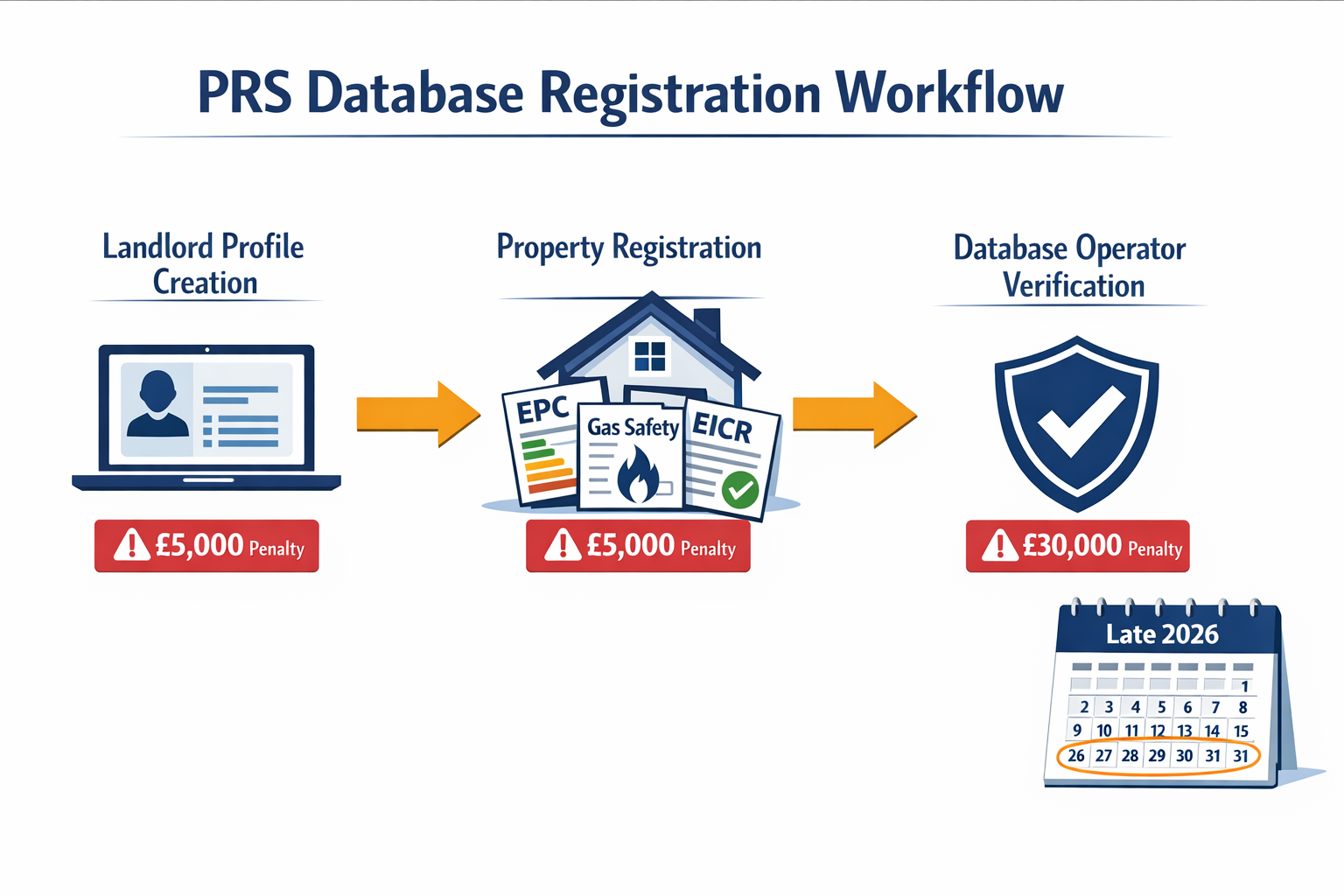
- Graduated penalty structure: Non-compliance penalties range from £5,000 for failure to register to £30,000 for providing false information, with criminal prosecution possible for persistent breaches[1][4]
- Tenant enforcement powers: Tenants can search the database to verify landlord legitimacy and apply for rent repayment orders covering up to 24 months of rent paid while landlords were unregistered[1]
- Phase 1 implementation timeline: Section 21 abolition takes effect May 1, 2026, with the PRS Database launching in autumn 2026 and full compliance required during the 2027 transition period[1][3]
Understanding the Private Rented Sector Database Under the Renters' Rights Act 2026
The Private Rented Sector Database represents the most comprehensive landlord registration system ever implemented in England. Unlike previous voluntary schemes, this mandatory database creates a centralized repository of landlord and property information accessible to tenants, local councils, and enforcement authorities.
Scope and Registration Requirements
The database applies to all private landlord types operating in England, including[1]:
- Individual landlords with single or multiple properties
- Limited companies and corporate landlords
- Partnership structures
- New landlords before their first tenancy advertisement
Required registration information includes[1][2][4]:
| Category | Information Required |
|---|---|
| Landlord Details | Full contact information for all joint landlords |
| Property Information | Complete address, property type, bedroom count |
| Occupancy Data | Number of households, residents, furnished status |
| Compliance Certificates | Gas safety, electrical safety, EPC ratings |
| Legal Records | Deposit protection details, Section 8 notice history |
The database operator—an independent body appointed by the Secretary of State—will verify submitted information, issue unique registration numbers, and maintain public access portals for tenant searches[1].
Timeline and Implementation Phases
The rollout follows a structured timeline aligned with broader Renters' Rights Act provisions:
Phase 1 (May 1, 2026): Section 21 "no fault" evictions abolished; all assured shorthold tenancies automatically convert to periodic tenancies; landlords must provide written tenant rights information using government-prescribed forms[3]
Phase 2 (Late 2026): PRS Database launches with registration portal open to all landlords; new landlords must register before advertising properties[1][2]
Phase 3 (2027): Existing landlords complete registration during transition period; letting agents required to verify registration before marketing or managing properties[1]
Penalty Structure and Enforcement Mechanisms
The graduated penalty scheme creates significant financial consequences for non-compliance:
Civil Penalties[1][4]:
- 💷 £5,000 for failure to register or renew registration
- 💷 £2,500 for failing to update details within required timeframes
- 💷 £30,000 for providing false information or continuing to let after registration revocation
Alternative sources indicate penalties may reach £7,000 for first breaches and £40,000 for repeated violations[2][4], though final amounts await confirmation in secondary legislation.
Beyond financial penalties, criminal prosecution remains possible for persistent breaches, marking a significant escalation in enforcement powers compared to previous landlord regulation frameworks[4].
Party Wall Implications of Private Rented Sector Database Registration and Surveyor Responsibilities
The intersection of PRS Database requirements and party wall procedures creates new compliance verification obligations for surveyors managing adjoining owner disputes. When building owners who are also landlords propose works affecting party structures, surveyors must now consider registration status as part of their professional duties.

Why Registration Status Matters for Party Wall Awards
The critical link between database registration and party wall procedures stems from eviction notice requirements. Landlords must be registered to serve valid possession notices under most Section 8 grounds[1][2]. This creates scenarios where:
- A landlord-building owner serves party wall notices for proposed works
- The adjoining owner (a tenant) disputes the works or resulting damage
- The landlord-building owner later attempts eviction citing the dispute as grounds
- The eviction fails because the landlord was unregistered during the party wall process
Surveyors who fail to verify and document landlord registration status may inadvertently contribute to future legal complications when landlords attempt possession proceedings.
Surveyor Verification Strategies
Professional party wall surveyors should implement these verification protocols:
Pre-Award Verification:
- Request PRS Database registration numbers from building owners who disclose landlord status
- Verify registration through the public database search portal
- Document registration status and number in preliminary correspondence
Award Documentation:
- Include landlord registration numbers in party wall awards when building owners are registered landlords
- Add specific clauses confirming registration status at the time of award issuance
- Note any registration verification attempts and responses
Schedule of Condition Integration:
- Reference landlord registration in schedule of condition reports for tenanted properties
- Document whether adjoining owner (tenant) has verified landlord registration
- Photograph any visible compliance certificates during property inspections
Special Considerations for Loft Conversions and Major Works
Loft conversions and substantial renovations in tenanted properties present heightened compliance risks. When landlords undertake significant works requiring party wall procedures, surveyors should:
✅ Confirm works comply with tenancy agreement terms regarding major alterations
✅ Verify landlord has provided tenants with required rights information under Phase 1 provisions[3]
✅ Document registration status before works commence to establish compliance timeline
✅ Consider whether works may affect habitability and trigger additional landlord obligations
The abolition of Section 21 notices from May 1, 2026, means landlords cannot use "no fault" evictions to remove tenants who object to party wall works[3]. This increases the importance of proper consent procedures and thorough documentation.
Tenant Rights and Surveyor Neutrality
Surveyors appointed under the Party Wall Act must maintain impartiality while acknowledging tenant rights under the Renters' Rights Act 2026. When the adjoining owner is a tenant:
- Tenants can independently verify landlord registration through database searches[1]
- Tenants may apply for rent repayment orders if they discover their landlord is unregistered[1]
- Surveyors should not provide legal advice about tenant remedies but may reference database availability
Professional surveyors should familiarize themselves with the guidance for party wall awards to ensure documentation meets both traditional party wall requirements and new compliance verification standards.
Practical Compliance Strategies for Private Rented Sector Database Registration and Party Wall Implications
Surveyors must develop systematic approaches to integrate PRS Database verification into existing party wall workflows without compromising professional standards or creating unnecessary delays.
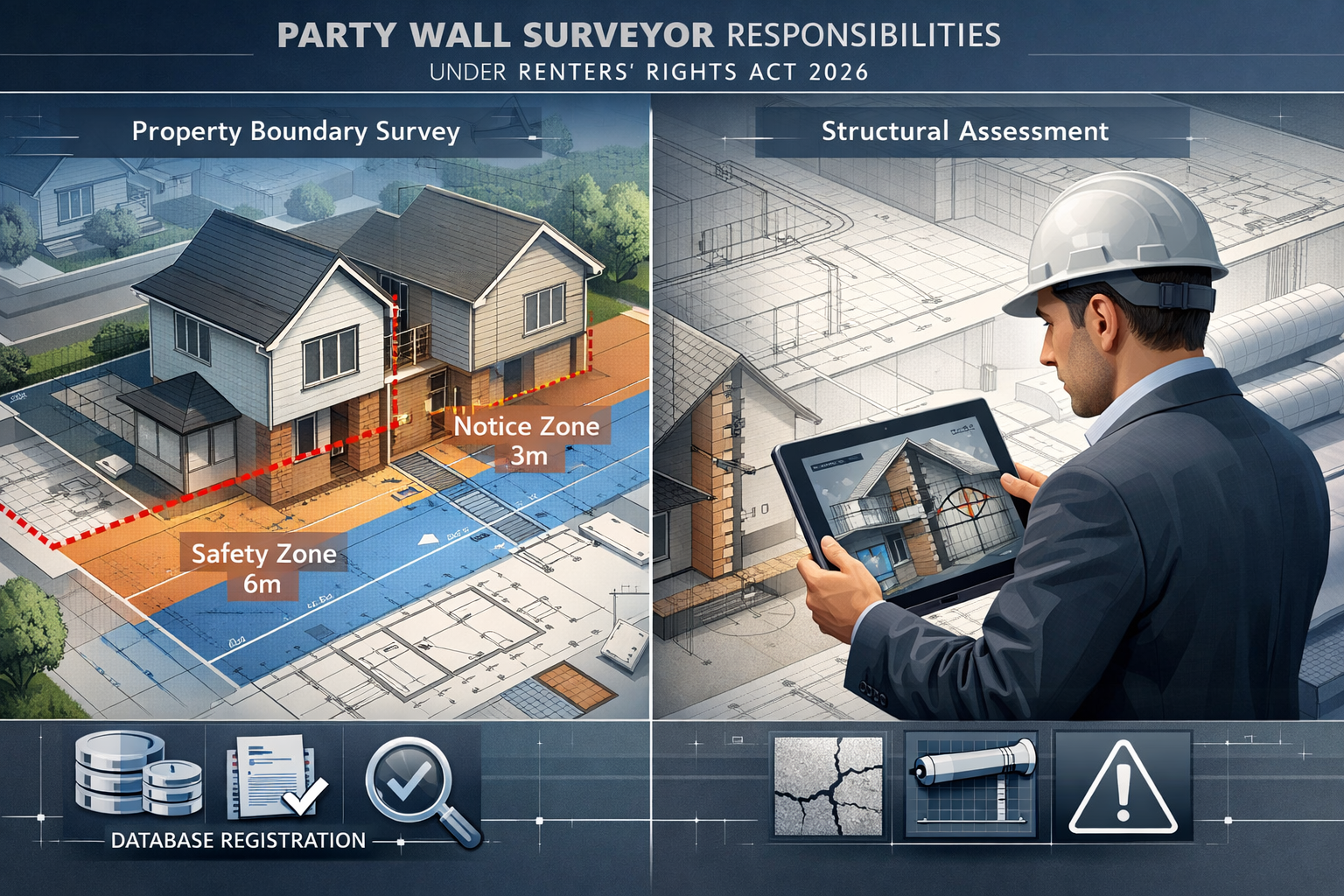
Developing Standardized Verification Procedures
Initial Appointment Stage:
When appointed as agreed surveyor or building owner's surveyor, include registration verification in standard information requests:
"If you are a landlord of the property subject to the proposed works, please provide your PRS Database registration number as required under the Renters' Rights Act 2026. This information will be documented in the party wall award to ensure compliance with current regulations."
This language normalizes the request while explaining its regulatory basis.
Documentation Templates:
Modify standard party wall award templates to include:
LANDLORD COMPLIANCE VERIFICATION
Building Owner Registration Status: [Registered/Not Applicable]
PRS Database Registration Number: [Number or N/A]
Verification Date: [Date]
Verification Method: [Database search/Building owner declaration]
For leasehold properties, additional clauses may address both landlord registration and freeholder notification requirements.
Managing Non-Compliant Situations
When building owners who are landlords refuse to provide registration information or appear unregistered, surveyors face professional dilemmas. Consider these approaches:
Option 1: Documentation Without Judgment
Record the refusal or non-compliance in award documentation without making determinations about legal consequences. Include language such as:
"The Building Owner declined to provide PRS Database registration information. Surveyors make no determination regarding compliance with the Renters' Rights Act 2026, which is a matter between the Building Owner and relevant enforcement authorities."
Option 2: Conditional Recommendations
When registration status may affect the feasibility of proposed works (particularly if tenant cooperation is required), include conditional recommendations:
"If the Building Owner is subject to PRS Database registration requirements, completion of registration before commencing works may facilitate smoother execution and reduce potential tenant objections."
Option 3: Professional Withdrawal
In extreme cases where a building owner requests assistance in circumventing registration requirements or explicitly plans non-compliant activities, surveyors may need to withdraw from appointments to protect professional standing.
Coordination with Letting Agents and Property Managers
Many landlords operate through letting agents who will be required to verify registration before marketing or managing properties from 2027[1]. Surveyors can leverage these relationships:
- Request letting agent confirmation of landlord registration status
- Coordinate inspection schedules with property managers familiar with tenant rights
- Obtain compliance certificate copies through agent channels rather than direct landlord requests
This approach distributes verification burden across the property management ecosystem while ensuring thorough documentation.
Technology Integration and Database Access
The PRS Database will provide public search functionality for tenant verification[1]. Surveyors should:
🔍 Bookmark the official database portal once launched
🔍 Develop standard search protocols for verification
🔍 Maintain records of search results with timestamps
🔍 Consider subscription services that may offer bulk verification for surveyors managing multiple appointments
Integration with existing surveying software and project management tools can streamline compliance checks across multiple party wall appointments.
Fee Considerations and Client Communication
Registration verification adds administrative burden to party wall appointments. Surveyors should:
- Review fee structures to account for additional compliance verification work
- Communicate verification requirements clearly in appointment terms
- Consider whether registration delays may extend overall appointment timelines
- Include compliance verification as a distinct service element in engagement letters
Transparent communication about these new requirements helps manage client expectations while ensuring appropriate compensation for expanded professional duties.
Regional Variations and Local Authority Enforcement
While the PRS Database applies nationally across England, local authority enforcement approaches may vary. Surveyors operating across multiple regions should:
- Monitor local council enforcement priorities and penalty application patterns
- Develop relationships with local authority private sector housing teams
- Attend regional property professional forums discussing implementation experiences
- Consider whether specific local areas have supplementary landlord registration schemes that interact with the national database
For surveyors working in areas with established practices, such as chartered surveyors in London or chartered surveyors in Essex, understanding regional enforcement patterns becomes particularly valuable.
Training and Professional Development
The convergence of landlord regulation and party wall practice requires ongoing professional education:
📚 Attend RICS webinars and guidance updates on Renters' Rights Act implications
📚 Review government-published information sheets and secondary legislation[5]
📚 Participate in party wall surveyor forums discussing compliance strategies
📚 Consider specialist training in residential landlord regulation
📚 Develop relationships with legal professionals specializing in landlord-tenant law
Surveyors who position themselves as compliance-aware professionals may gain competitive advantages as landlords seek advisors who understand the full regulatory landscape.
Risk Management and Professional Indemnity
Professional indemnity insurers may develop specific requirements or exclusions related to landlord compliance verification. Surveyors should:
- Notify insurers about expanded compliance verification activities
- Confirm coverage extends to advice or documentation regarding registration status
- Maintain detailed records of all verification attempts and communications
- Consider whether additional coverage is warranted given increased regulatory complexity
Documentation thoroughness becomes even more critical when surveyors operate at the intersection of multiple regulatory frameworks.
Conclusion
The introduction of Private Rented Sector Database Registration and Party Wall Implications: Surveyor Strategies for Landlord Compliance Under Renters' Rights Act 2026 fundamentally reshapes professional responsibilities for party wall surveyors. With mandatory registration launching in late 2026 and full compliance required by 2027, surveyors must immediately develop verification protocols that document landlord registration status within party wall awards.
The linkage between database registration and Section 8 eviction notice validity creates direct consequences for party wall procedures involving tenanted properties. Landlords who fail to register face penalties up to £30,000 and lose the ability to regain possession through legal proceedings[1][4]—complications that can arise from party wall disputes when registration status remains unverified.
Immediate action steps for party wall surveyors:
- Revise documentation templates to include landlord registration verification sections in party wall awards
- Develop standard information requests that normalize registration number collection during initial appointments
- Bookmark the PRS Database portal once launched in late 2026 for verification searches
- Review professional indemnity coverage to confirm protection extends to compliance verification activities
- Establish relationships with local authority enforcement teams to understand regional implementation approaches
- Attend professional development programs focused on Renters' Rights Act implications for property professionals
The convergence of landlord regulation and party wall practice demands proactive adaptation rather than reactive compliance. Surveyors who integrate registration verification into standard workflows position themselves as comprehensive compliance advisors while protecting clients from future legal complications.
As the regulatory landscape continues evolving, party wall surveyors must balance traditional impartiality with new documentation requirements. By treating registration verification as a factual matter—similar to verifying property ownership or lease terms—surveyors can fulfill expanded professional duties without compromising the neutral stance essential to party wall practice.
For complex situations involving party wall disputes in tenanted properties, consider consulting specialists who understand both party wall procedures and landlord compliance requirements. The intersection of these regulatory frameworks will only grow more significant as enforcement mechanisms mature and case law develops around the Renters' Rights Act 2026.
References
[1] Private Rented Sector Database – https://www.augustapp.com/blog/private-rented-sector-database
[2] The Private Rented Sector Database Explained – https://www.tlc-farnham.co.uk/blogs/the-private-rented-sector-database-explained
[3] Renters Rights Act Update Tenancy Information And New Assured Tenancy Forms – https://connections.nortonrosefulbright.com/post/102mo8v/renters-rights-act-update-tenancy-information-and-new-assured-tenancy-forms
[4] Private Rented Sector Database – https://hmorley.co.uk/private-rented-sector-database/
[5] The Renters Rights Act Information Sheet 2026 – https://www.gov.uk/government/publications/the-renters-rights-act-information-sheet-2026