The property industry faces a costly challenge: 32% of all repair maintenance costs come from emergency issues—the most expensive category for property operators[1]. Imagine knowing exactly when a roof will need replacement, predicting plumbing failures before they flood apartments, or accurately budgeting for structural repairs five years in advance. In 2026, this isn't science fiction—it's the reality of Predictive Analytics in Surveys: Forecasting Property Maintenance Costs Using AI-Enhanced Defect Detection.
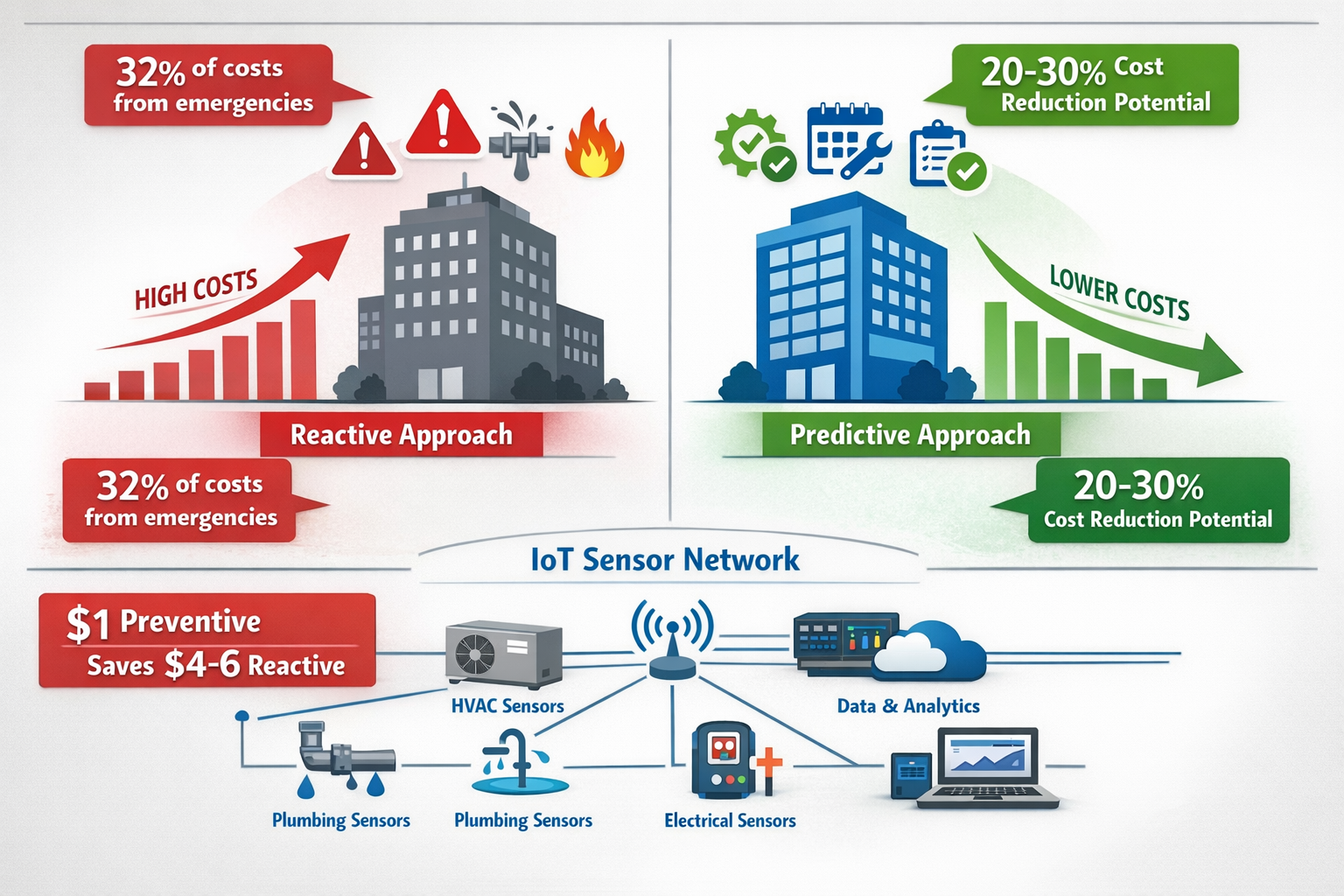
Modern digital tools like laser scanning, thermal imaging, and AI-powered analysis are transforming traditional property surveys into sophisticated forecasting systems. These technologies enable buyers to budget accurately for long-term repair needs, help insurers refine premium calculations based on actual risk data, and allow property managers to shift from reactive firefighting to strategic planning. The financial impact is substantial: every $1 spent on preventive maintenance saves $4-6 in reactive maintenance costs[4], while predictive approaches can reduce overall maintenance expenses by 20-30%[4].
Key Takeaways
- 🎯 Emergency repairs cost significantly more: 32% of maintenance budgets go to emergency issues, making prediction crucial for cost control[1]
- 💰 Proven ROI from predictive approaches: Every $1 invested in preventive maintenance saves $4-6 in reactive repairs, with predictive analytics reducing costs by 20-30%[4]
- 🔬 AI-enhanced surveys detect invisible defects: Modern laser scanning and thermal imaging combined with AI analysis identify problems before they become emergencies
- 📊 Data-driven forecasting replaces guesswork: Historical work orders, sensor data, and AI pattern recognition create accurate multi-year maintenance budgets
- ⚡ Optimal maintenance mix for 2026: Industry leaders allocate 70-80% to preventive maintenance, 10-15% to predictive maintenance, and only 10-20% to reactive repairs[4]
Understanding Predictive Analytics in Property Surveys
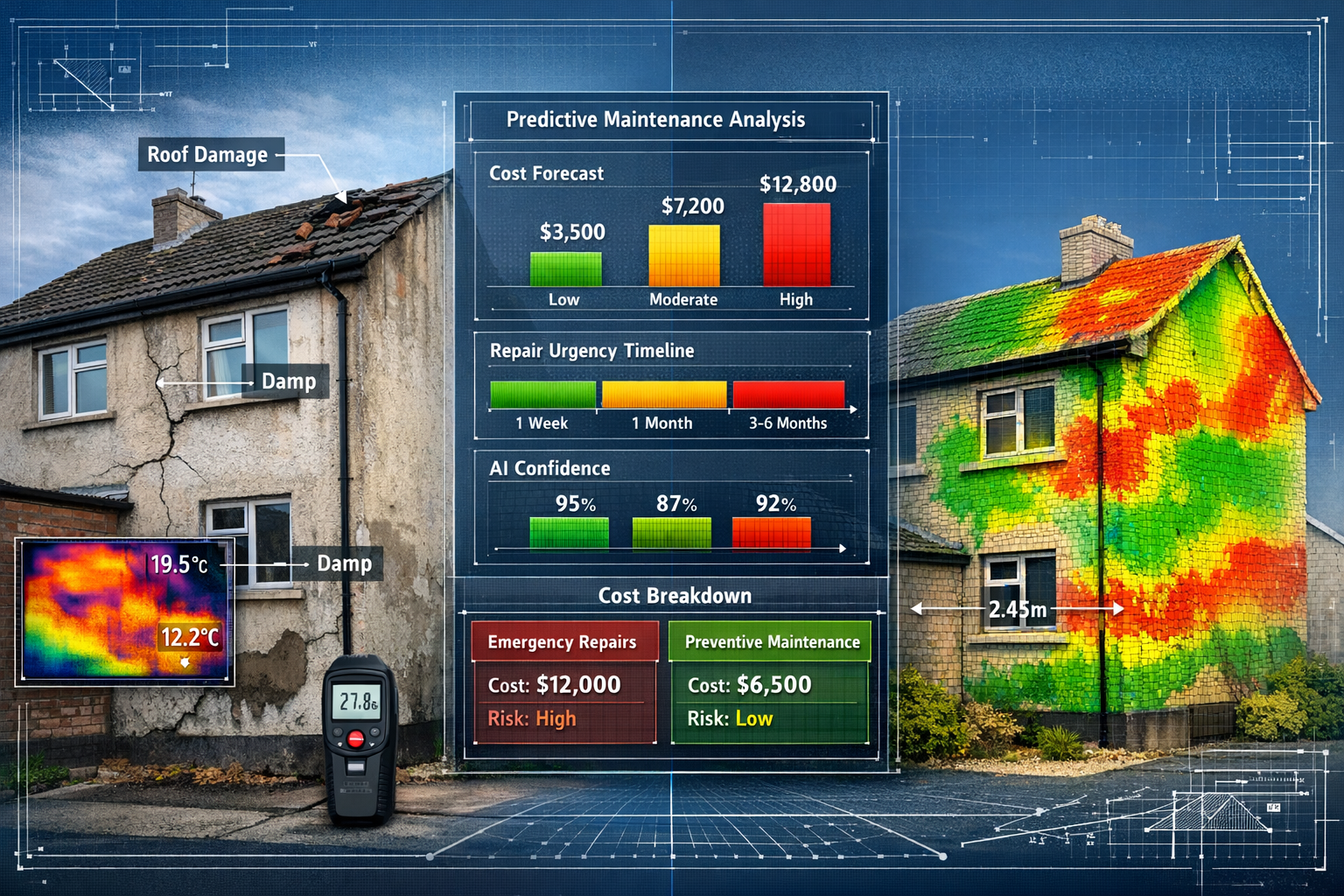
Predictive analytics represents a fundamental shift from traditional "inspect and report" surveying to "inspect, analyze, and forecast" methodology. This approach combines multiple data sources—physical inspection findings, historical maintenance records, environmental conditions, and building characteristics—to create probabilistic models of future maintenance needs.
The Evolution from Traditional to Predictive Surveys
Traditional building surveys focus on identifying current defects and assessing present condition. While valuable, they provide limited insight into when problems will worsen or how much future repairs will cost. Predictive analytics transforms this snapshot into a motion picture.
The key difference lies in data integration. Modern predictive surveys leverage:
- Physical inspection data from comprehensive RICS specialist defect surveys
- Historical maintenance records showing repair patterns and failure rates
- Environmental monitoring through IoT sensors tracking moisture, temperature, and structural movement
- AI pattern recognition identifying correlations invisible to human observers
- Comparative portfolio data benchmarking against similar properties
How AI Enhances Defect Detection
Artificial intelligence doesn't replace professional surveyors—it amplifies their capabilities. AI excels at processing vast datasets to identify patterns that predict future failures. For example, AI tools now detect unusual operational patterns such as water usage anomalies that signal leaks, triggering maintenance before escalation and preventing costly damage[2].
Machine learning algorithms analyze thousands of variables simultaneously:
| Traditional Detection | AI-Enhanced Detection |
|---|---|
| Visual inspection of visible cracks | Thermal imaging analysis revealing hidden moisture pathways |
| Manual measurement of settlement | Laser scanning creating millimeter-accurate 3D models tracking movement over time |
| Subjective assessment of deterioration rate | Algorithmic prediction based on material type, age, exposure, and historical degradation patterns |
| Single-point-in-time evaluation | Continuous monitoring and trend analysis |
More than one-third of maintenance professionals now report extensive use of sensors, with additional professionals testing IoT and IIoT devices[5], creating the data foundation for predictive analytics.
The Data Sources Powering Property Predictions
Unlike industrial predictive maintenance that relies primarily on equipment sensors, property-based predictions utilize operational data already being collected[1]:
- Work order text and descriptions revealing recurring issues
- Resident-reported symptoms providing early warning signals
- Historical job durations indicating problem complexity
- Technician logs and notes capturing contextual details
- Cost patterns and trends showing escalation trajectories
- Repeat issue tracking identifying chronic problem areas
This rich data ecosystem, when processed through AI algorithms, reveals predictive insights that would remain hidden in traditional analysis. A specific defect report combined with historical data can forecast not just current repair costs, but future maintenance trajectories.
Forecasting Property Maintenance Costs with AI-Enhanced Detection
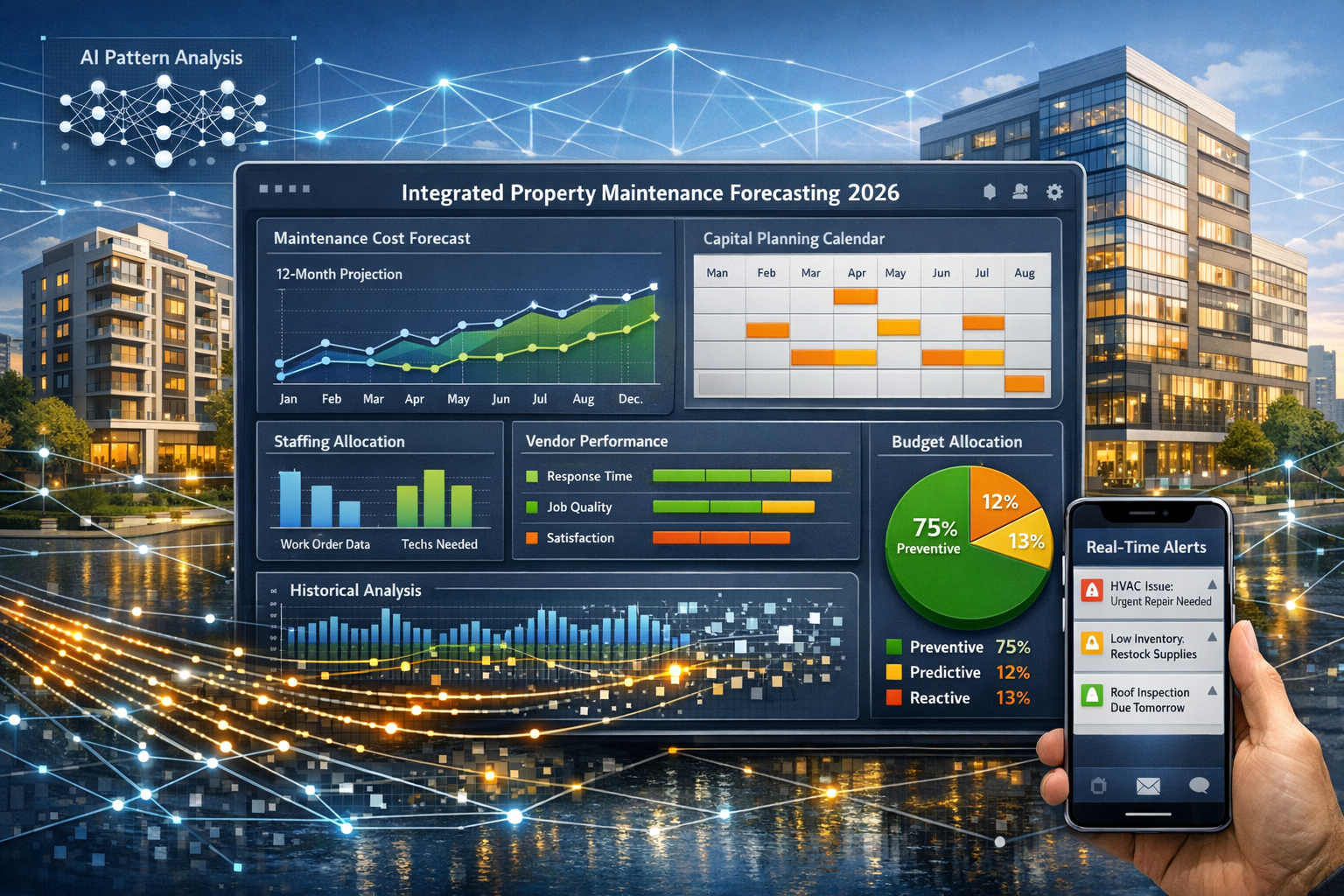
The financial benefits of accurate maintenance forecasting extend far beyond simple budgeting. In 2026, forecasting capabilities now extend across operations to rent pricing strategy, vacancy prediction, capital planning, staffing decisions, and vendor management[3].
The Cost-Benefit Foundation
The economic case for predictive maintenance is compelling. Industry research demonstrates that predictive maintenance can reduce maintenance costs up to 25% and increase uptime by 10-20%[5]. For property portfolios, this translates directly to improved net operating income and asset value.
Consider the cost structure of reactive versus predictive approaches:
Reactive Maintenance Costs:
- Emergency service premiums (after-hours rates)
- Expedited material procurement
- Tenant disruption and potential vacancy
- Collateral damage from delayed response
- Lost rental income during repairs
Predictive Maintenance Savings:
- Scheduled repairs at standard rates
- Bulk material purchasing discounts
- Minimal tenant disruption
- Prevention of secondary damage
- Maintained occupancy and revenue
Annual maintenance spending across rental portfolios ranges from $0.90 to $1.27 per square foot[1]—a variation indicating substantial differences in operational efficiency and predictive capability. Properties at the lower end typically employ sophisticated forecasting, while those at the higher end often operate reactively.
Implementing Optimal Maintenance Budget Allocation
Industry guidance for 2026 recommends a strategic mix: 70-80% preventive maintenance, 10-15% predictive maintenance, and 10-20% reactive maintenance[4]. This allocation maximizes the $4-6 return on every preventive dollar while maintaining flexibility for unexpected issues.
Preventive Maintenance (70-80%):
- Scheduled inspections and servicing
- Regular component replacements before failure
- Routine cleaning and adjustments
- Compliance-driven maintenance
Predictive Maintenance (10-15%):
- Condition monitoring systems
- AI-enhanced defect analysis
- Predictive sensor networks
- Data analytics and forecasting tools
Reactive Maintenance (10-20%):
- True emergency responses
- Unpredictable failures
- Tenant-caused damage
- Force majeure events
This allocation requires accurate forecasting to execute effectively. Dilapidation surveys combined with predictive analytics help property managers transition from reactive to strategic maintenance planning.
Calculating Long-Term Repair Costs
AI-enhanced defect detection transforms cost estimation from educated guessing to data-driven forecasting. The process involves:
1. Defect Severity Classification
Modern surveys categorize defects not just by current condition but by deterioration trajectory. A minor crack might be classified as high-priority if AI analysis predicts rapid expansion based on material properties, environmental exposure, and historical patterns.
2. Time-to-Failure Prediction
Machine learning algorithms analyze similar defects across thousands of properties to estimate when intervention becomes necessary. This transforms "needs repair eventually" into "requires attention within 18-24 months."
3. Cost Escalation Modeling
Predictive systems forecast how repair costs increase with delay. A £2,000 roof repair today might become a £15,000 replacement in three years—information crucial for capital planning and reinstatement cost valuation.
4. Probability-Weighted Budgeting
Rather than binary predictions, AI provides probability distributions. A maintenance forecast might indicate: "70% probability of HVAC replacement needed in years 3-5, estimated cost £8,000-12,000; 30% probability of extended service life with enhanced maintenance."
Real-World Applications for Buyers and Insurers
For Property Buyers:
Predictive analytics transforms the purchase decision. Instead of receiving a static survey report, buyers access dynamic forecasting showing:
- Year-by-year maintenance cost projections
- Capital expenditure timeline (roof, boiler, windows)
- Total cost of ownership over 5, 10, and 20 years
- Risk-adjusted budgets accounting for uncertainty
This enables accurate financial planning and informed negotiation. A property with £50,000 in predicted maintenance over five years might justify a purchase price reduction or influence financing decisions.
For Insurance Companies:
Insurers increasingly use predictive analytics to refine premium calculations based on actual risk data rather than broad categorizations. Properties with:
- Comprehensive predictive maintenance programs
- IoT monitoring systems
- Strong historical maintenance records
- Low predicted failure probability
…qualify for reduced premiums reflecting their genuinely lower risk profile. Conversely, properties with deferred maintenance and high predicted failure rates face premium increases or coverage limitations.
Overcoming Adoption Challenges
Despite proven benefits, adoption remains constrained by costs and internal skills gaps at many facilities[5]. The barriers include:
Initial Investment Requirements:
- Laser scanning equipment and software
- IoT sensor networks
- AI analytics platforms
- Staff training and development
Skills and Expertise Gaps:
- Data analysis capabilities
- AI system interpretation
- Integration with existing workflows
- Change management
Data Quality Concerns:
- Incomplete historical records
- Inconsistent documentation
- Legacy system integration
- Data standardization needs
Successful implementation typically follows a phased approach: starting with pilot projects on high-value assets, demonstrating ROI, then scaling across portfolios. Many organizations partner with specialized commercial property surveyors who provide predictive analytics capabilities without requiring in-house expertise development.
Advanced Technologies Enabling Predictive Property Analytics
The technological foundation of Predictive Analytics in Surveys: Forecasting Property Maintenance Costs Using AI-Enhanced Defect Detection combines multiple cutting-edge tools, each contributing unique capabilities to the forecasting ecosystem.
Laser Scanning and 3D Modeling
Laser scanning technology has revolutionized property surveying by creating millimeter-accurate 3D models of entire buildings. These digital twins serve as the baseline for predictive analytics:
Capabilities:
- Captures millions of measurement points in minutes
- Creates permanent digital record for comparison over time
- Identifies structural movement invisible to visual inspection
- Enables virtual inspections reducing access requirements
- Integrates with AI analysis for automated defect detection
Predictive Applications:
By comparing laser scans taken months or years apart, AI algorithms detect subtle structural movements indicating foundation settlement, wall deflection, or roof sagging. The rate of change becomes the predictive variable—a wall moving 2mm annually requires different intervention timing than one moving 0.2mm annually.
Drone surveys equipped with laser scanning capabilities access difficult areas like tall buildings and complex rooflines, capturing comprehensive data without scaffolding or access equipment costs.
Thermal Imaging and Moisture Detection
Thermal imaging cameras reveal temperature differentials indicating:
- Hidden moisture intrusion and leak pathways
- Insulation deficiencies and thermal bridging
- HVAC system inefficiencies
- Electrical hotspots predicting failure
- Air infiltration routes
When combined with AI pattern recognition, thermal imaging transforms from diagnostic tool to predictive system. Machine learning algorithms trained on thousands of thermal images can distinguish between:
- Acute moisture events requiring immediate response
- Chronic moisture patterns indicating systemic issues
- Seasonal variations requiring no intervention
- Progressive deterioration requiring scheduled repair
This capability proves particularly valuable for subsidence surveys where moisture patterns often precede visible structural movement.
IoT Sensors and Continuous Monitoring
The Internet of Things (IoT) enables continuous condition monitoring rather than periodic inspections. Strategic sensor placement tracks:
Environmental Conditions:
- Temperature and humidity levels
- Moisture content in walls and floors
- Air quality and ventilation effectiveness
- Light exposure and UV degradation
Structural Performance:
- Movement and settlement patterns
- Vibration and stress levels
- Load distribution changes
- Crack width progression
Building Systems:
- HVAC performance and efficiency
- Plumbing pressure and flow rates
- Electrical consumption patterns
- Energy usage anomalies
This continuous data stream feeds AI algorithms that establish normal operating baselines and flag deviations. A gradual increase in water consumption might indicate a developing leak; rising HVAC energy usage could signal declining efficiency requiring service.
AI Pattern Recognition and Machine Learning
The true power of predictive analytics emerges when AI processes multiple data streams simultaneously. Machine learning algorithms excel at identifying complex patterns:
Correlation Detection:
AI identifies relationships between variables that humans might miss. For example, the combination of building age, roof orientation, local weather patterns, and historical maintenance might predict roof failure with 85% accuracy 18 months in advance.
Anomaly Identification:
By establishing normal operational patterns, AI flags unusual behaviors requiring investigation. This prevents the gradual normalization of declining performance—the "boiling frog" syndrome where slow deterioration goes unnoticed.
Predictive Model Refinement:
Machine learning systems improve accuracy over time. Each maintenance event provides feedback: was the prediction accurate? Did intervention occur at the optimal time? Were costs within projected ranges? The system learns from outcomes, continuously refining its forecasting models.
Natural Language Processing:
Advanced AI systems analyze unstructured text from work orders, tenant complaints, and technician notes. Natural language processing extracts meaningful patterns from descriptions like "slow drain in kitchen" or "intermittent heating" that might indicate developing problems.
Integration with Traditional Survey Expertise
Technology enhances but doesn't replace professional judgment. The most effective predictive systems combine AI capabilities with surveyor expertise:
Surveyors provide:
- Contextual understanding of building construction
- Assessment of repair quality and workmanship
- Evaluation of regulatory compliance issues
- Professional judgment on intervention timing
- Client communication and recommendation development
AI provides:
- Pattern recognition across vast datasets
- Quantitative failure probability calculations
- Cost trend analysis and forecasting
- Continuous monitoring and alerting
- Objective, data-driven risk assessment
A comprehensive RICS home survey enhanced with predictive analytics delivers both professional insight and data-driven forecasting, creating actionable intelligence for property decisions.
Specialized Applications Across Property Types
Different property types benefit from tailored predictive approaches:
Residential Properties:
Focus on major systems (roof, HVAC, plumbing) with predictive models based on age, usage patterns, and maintenance history. Homebuyer surveys increasingly include 5-10 year maintenance forecasts.
Commercial Buildings:
Emphasize business continuity and tenant satisfaction. Predictive analytics prevent disruptions that could trigger lease breaks or vacancy. Commercial building surveys with predictive components support investment decisions and asset management.
Multi-Family Portfolios:
Aggregate data across properties to identify systemic issues and optimize maintenance scheduling. Portfolio-level analytics reveal whether problems are property-specific or indicate broader construction or maintenance deficiencies.
Historic Buildings:
Combine traditional conservation expertise with modern monitoring to preserve heritage assets while predicting maintenance needs. Sensors track environmental conditions affecting historic materials, while AI models predict deterioration rates under different conservation scenarios.
Practical Implementation Strategies
Implementing Predictive Analytics in Surveys: Forecasting Property Maintenance Costs Using AI-Enhanced Defect Detection requires strategic planning and phased execution. Organizations achieving full adoption of condition-based maintenance are estimated to save 2.1 million hours of downtime and $233 billion annually[9] at the Fortune 500 level—benefits that scale proportionally for smaller portfolios.
Step 1: Establish Data Foundation
Audit Existing Data:
Begin by inventorying available information:
- Historical maintenance records and work orders
- Previous survey reports and inspections
- Utility consumption data
- Tenant complaint logs
- Vendor invoices and repair documentation
Standardize Documentation:
Create consistent formats for capturing future data:
- Structured work order fields (problem type, location, materials, labor hours, costs)
- Photographic documentation requirements
- Defect classification taxonomies
- Maintenance outcome tracking
Digitize Legacy Records:
Convert paper records to searchable digital formats. Even incomplete historical data provides valuable training material for AI algorithms.
Step 2: Deploy Strategic Monitoring
Prioritize High-Value Assets:
Focus initial sensor deployment on:
- Critical building systems (HVAC, electrical, plumbing)
- High-cost components (roofs, structural elements)
- Problem-prone areas identified in surveys
- Assets affecting multiple tenants or operations
Select Appropriate Technologies:
Match monitoring tools to specific needs:
- Moisture sensors for areas prone to water damage
- Thermal cameras for periodic comprehensive scans
- Vibration monitors for structural elements
- Energy meters for HVAC and electrical systems
Establish Baseline Conditions:
Conduct comprehensive initial surveys using laser scanning and other technologies to create reference points for future comparison.
Step 3: Implement AI Analytics Platform
Choose Scalable Solutions:
Select analytics platforms that:
- Integrate with existing property management systems
- Accept multiple data input types (sensors, work orders, surveys)
- Provide user-friendly visualization and reporting
- Offer mobile access for field teams
- Scale from pilot projects to full portfolio deployment
Configure Predictive Models:
Work with vendors or data scientists to:
- Train algorithms on historical data
- Establish normal operating parameters
- Define alert thresholds and escalation protocols
- Create cost forecasting models
- Develop reporting templates for stakeholders
Validate Predictions:
Test system accuracy through pilot programs, comparing predictions against actual outcomes and refining models based on results.
Step 4: Integrate with Maintenance Workflows
Shift to Condition-Based Scheduling:
Replace calendar-based maintenance with condition-triggered interventions:
- Monitor actual equipment performance rather than assuming degradation
- Schedule repairs based on predicted failure timelines
- Optimize intervention timing for cost and disruption minimization
Develop Response Protocols:
Create clear procedures for different alert levels:
- Green alerts: Schedule routine inspection within normal workflow
- Yellow alerts: Plan intervention within 3-6 months
- Orange alerts: Prioritize repair within 30-90 days
- Red alerts: Immediate emergency response required
Empower Maintenance Teams:
Provide field staff with:
- Mobile access to predictive analytics dashboards
- Historical context for current issues
- Recommended intervention approaches
- Feedback mechanisms to improve system accuracy
Step 5: Optimize Budget Allocation
Create Multi-Year Capital Plans:
Use predictive forecasts to develop rolling 5-10 year maintenance budgets:
- Identify major component replacement timelines
- Smooth expenditures to avoid budget spikes
- Prioritize interventions by ROI and risk
- Build contingency reserves for uncertainty
Track Performance Metrics:
Monitor key indicators:
- Emergency repair percentage (target: below 20%)
- Preventive vs. reactive spending ratio (target: 70-80% preventive)
- Cost per square foot (benchmark against portfolio average)
- Prediction accuracy rates
- Maintenance-related tenant satisfaction scores
Demonstrate ROI:
Document savings from:
- Avoided emergency premiums
- Extended asset life through timely intervention
- Reduced collateral damage
- Improved energy efficiency
- Enhanced property values
Step 6: Leverage for Strategic Advantage
Enhance Property Valuations:
Provide predictive maintenance data to support:
- Higher valuations due to lower operational risk
- Reduced insurance premiums
- Faster sales through buyer confidence
- Better financing terms from lenders
Support Investment Decisions:
Use forecasting to:
- Evaluate acquisition opportunities with accurate cost projections
- Prioritize capital improvements by predicted ROI
- Optimize hold vs. sell decisions
- Support disposition pricing strategies
Improve Tenant Relations:
Demonstrate proactive management through:
- Reduced maintenance disruptions
- Faster response to developing issues
- Transparent communication about planned improvements
- Enhanced property reliability and comfort
Addressing Common Implementation Challenges
Challenge: High Initial Costs
Solution: Phase implementation starting with highest-value assets. Calculate ROI based on avoided emergency repairs—often achieving payback within 12-24 months.
Challenge: Staff Resistance
Solution: Involve maintenance teams early, emphasizing how technology makes their jobs easier rather than replacing them. Provide comprehensive training and celebrate early wins.
Challenge: Data Quality Issues
Solution: Accept that initial predictions may have lower accuracy. System performance improves as data quality and quantity increase. Focus on continuous improvement rather than perfection.
Challenge: Integration Complexity
Solution: Work with vendors offering pre-built integrations with common property management systems. Consider cloud-based platforms that minimize IT infrastructure requirements.
Challenge: Interpretation Difficulties
Solution: Partner with experienced chartered surveyors who understand both traditional building pathology and modern predictive analytics, bridging the gap between data and actionable recommendations.
Future Trends and Emerging Capabilities
The field of predictive property analytics continues evolving rapidly. Several emerging trends will shape capabilities through 2026 and beyond:
Expanded AI Capabilities
Computer Vision Advances:
Next-generation AI will analyze photographs and videos to identify defects automatically. Surveyors will capture images with smartphones, with AI flagging potential issues, measuring crack widths, and comparing against previous inspections.
Predictive Accuracy Improvements:
As datasets grow and algorithms improve, prediction confidence intervals will narrow. Current systems might forecast "roof replacement needed in 3-7 years"; future systems will predict "roof replacement needed in month 47-51 with 90% confidence."
Automated Report Generation:
AI will synthesize survey data, sensor readings, and historical patterns into comprehensive reports requiring only professional review rather than manual drafting.
Integration with Smart Building Systems
Unified Building Intelligence:
Predictive maintenance will integrate seamlessly with:
- Energy management systems
- Security and access control
- Space utilization analytics
- Indoor environmental quality monitoring
This convergence creates holistic building intelligence platforms optimizing performance across all dimensions simultaneously.
Blockchain for Maintenance Verification
Immutable Maintenance Records:
Blockchain technology will create tamper-proof maintenance histories, increasing buyer confidence and supporting property valuations. Every repair, inspection, and upgrade will be permanently recorded with cryptographic verification.
Climate Adaptation Planning
Weather Pattern Integration:
Predictive models will incorporate climate change projections, forecasting how changing weather patterns affect maintenance needs:
- Increased storm damage probability
- Heat stress on HVAC systems
- Moisture pattern shifts affecting building envelopes
- Freeze-thaw cycle changes impacting foundations
Regulatory and Insurance Evolution
Mandatory Predictive Maintenance:
Some jurisdictions may require predictive maintenance programs for certain property types, particularly high-occupancy buildings where system failures pose safety risks.
Insurance Premium Optimization:
Insurers will increasingly offer significant premium reductions for properties with comprehensive predictive maintenance programs, recognizing the substantially lower risk profile.
ESG Reporting Requirements:
Environmental, Social, and Governance (ESG) frameworks will incorporate maintenance efficiency metrics, with predictive approaches demonstrating responsible asset stewardship and sustainability.
Conclusion
Predictive Analytics in Surveys: Forecasting Property Maintenance Costs Using AI-Enhanced Defect Detection represents far more than technological innovation—it fundamentally transforms property ownership, management, and investment from reactive uncertainty to strategic foresight. The financial case is compelling: with 32% of maintenance costs stemming from expensive emergencies[1] and predictive approaches reducing total maintenance expenses by 20-30%[4], the ROI justifies investment across property types and portfolio sizes.
The convergence of laser scanning, thermal imaging, IoT sensors, and AI analytics creates unprecedented visibility into property condition and future maintenance needs. Buyers gain accurate long-term cost projections enabling informed purchase decisions. Insurers access real risk data supporting fair, precise premium calculations. Property managers transition from firefighting to strategic planning, optimizing the maintenance mix toward the industry-recommended 70-80% preventive, 10-15% predictive, and 10-20% reactive allocation[4].
Actionable Next Steps
For Property Buyers:
- Request predictive maintenance forecasts as part of your building survey
- Compare long-term cost projections across potential purchases
- Use forecasts to negotiate purchase prices and plan renovation budgets
- Share predictive data with insurers to secure optimal premium rates
For Property Owners and Managers:
- Audit existing maintenance data to establish your baseline
- Conduct comprehensive surveys with specialist defect analysis on high-value assets
- Deploy strategic IoT monitoring on critical building systems
- Partner with surveyors and analytics providers to implement pilot predictive programs
- Track emergency repair percentages and work toward the 10-20% target
For Insurance Professionals:
- Develop premium adjustment frameworks rewarding predictive maintenance programs
- Request maintenance forecasts and monitoring data during underwriting
- Partner with property analytics providers to access real-time risk data
- Create incentive programs encouraging policyholder adoption of predictive approaches
For Industry Professionals:
- Invest in training on AI-enhanced survey technologies
- Develop partnerships with analytics platform providers
- Build case studies demonstrating ROI from predictive approaches
- Educate clients on the value proposition beyond traditional surveys
The property industry stands at an inflection point. Those who embrace predictive analytics gain substantial competitive advantages: lower operating costs, higher asset values, better tenant satisfaction, and superior investment returns. Those who delay adoption face increasing disadvantages as the performance gap widens.
The technology exists. The ROI is proven. The question is no longer whether to implement Predictive Analytics in Surveys: Forecasting Property Maintenance Costs Using AI-Enhanced Defect Detection, but how quickly your organization will capture the benefits. Every emergency repair that could have been prevented, every budget surprise that could have been forecasted, and every maintenance dollar that could have been optimized represents lost value waiting to be reclaimed through predictive approaches.
The future of property maintenance isn't reactive—it's predictive. The future isn't uncertain—it's forecasted. And that future is available today for those ready to embrace it. 🏗️📊
References
[1] Predictive Maintenance Solves Problems – https://lula.life/articles/predictive-maintenance-solves-problems
[2] Top Ways Ai Is Changing The Property Management Industry In 2026 – https://www.northpointam.com/blog/top-ways-ai-is-changing-the-property-management-industry-in-2026
[3] Data Driven Decision Making Property Managers – https://bfpminc.com/data-driven-decision-making-property-managers/
[4] Property Maintenance Guide Complete Checklist And Cost Breakdown 2026 – https://www.oxmaint.com/blog/post/property-maintenance-guide-complete-checklist-and-cost-breakdown-2026
[5] Maintenance Stats Trends And Insights – https://www.getmaintainx.com/blog/maintenance-stats-trends-and-insights
[9] 25 Maintenance Stats 2026 Predictive 150007286 – https://www.aol.com/finance/25-maintenance-stats-2026-predictive-150007286.html