Shopping centres across the UK are experiencing an unexpected renaissance in 2026. After years of decline, these retail hubs are emerging as undervalued assets ripe for transformation. As property developers and retail investors recognize this opportunity, expansion projects are accelerating—bringing party wall surveys to the forefront of successful retail revitalisation strategies. Party Wall Surveys for Retail Revitalisation: Securing Agreements in 2026 Shopping Centre Expansion Plays have become essential tools for navigating the complex legal and structural requirements of high street expansions.
The commercial real estate landscape is shifting dramatically. While some sectors face headwinds, retail properties—particularly shopping centres—are attracting renewed investment [4]. This revival demands careful planning, especially when expansion work affects shared walls between retail units. Understanding party wall procedures can mean the difference between a smooth project launch and costly delays that derail revitalisation efforts.
Key Takeaways
- 🏢 Shopping centres rank as undervalued assets in 2026, creating expansion opportunities that require expert party wall survey management
- ⏰ Notice timelines are critical: Building owners must serve party wall notices at least two months before commencing work on shared retail walls
- 💷 Cost allocation follows strict protocols: Understanding who pays for surveys, awards, and remedial work prevents disputes during retail expansion
- 📋 Schedule of condition surveys protect all parties: Pre-work documentation of adjoining retail units safeguards against unfounded damage claims
- ⚖️ Professional surveyor involvement reduces conflicts: Independent party wall surveyors facilitate agreements between expanding retailers and their neighbours
Understanding Party Wall Requirements in Shopping Centre Expansions
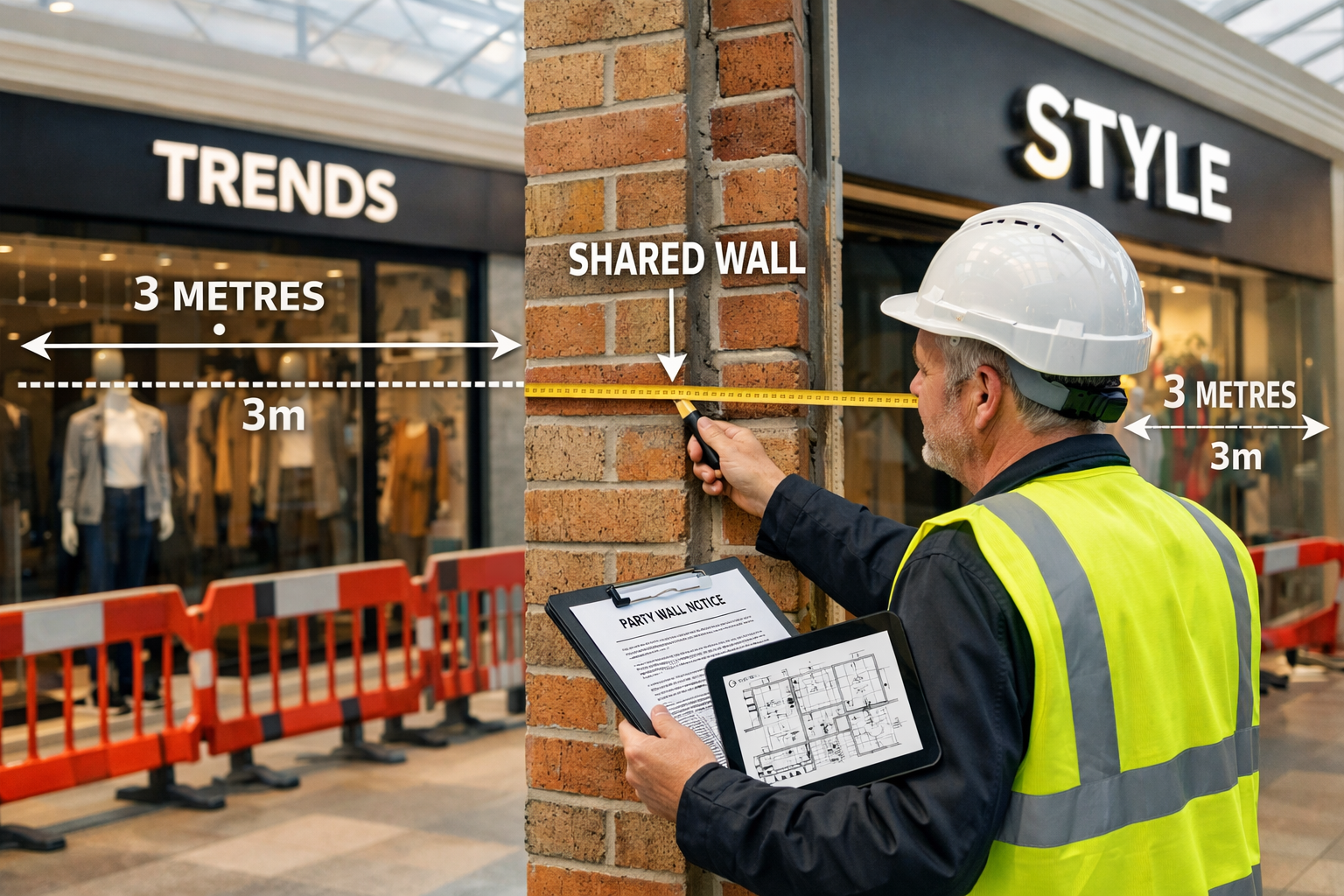
Shopping centre expansion projects typically involve multiple retail units sharing common walls, floors, and structural elements. The Party Wall etc. Act 1996 governs these situations in England and Wales, establishing clear procedures for building owners undertaking work that affects shared structures.
What Triggers Party Wall Requirements?
Several common retail expansion scenarios activate party wall obligations:
- Structural alterations to shared walls between retail units
- Excavation work within three metres of neighbouring properties
- Foundation work that goes deeper than adjacent retail unit foundations
- New wall construction on or astride the boundary line
- Cutting into party walls for new openings or services
When planning shopping centre revitalisation, developers must identify all work falling under the Act. Missing even one affected party can halt construction and create legal complications. For excavation projects, notice for excavation near a neighbour becomes particularly important when expanding retail footprints.
The Three-Meter Rule in Retail Settings
The three-meter rule holds special significance in shopping centre environments. When excavation occurs within three metres of an adjoining building and extends below its foundation level, specific notice requirements apply. In densely packed retail developments, this rule often affects multiple neighbouring units simultaneously.
Example scenario: A department store planning basement expansion for additional retail space must serve notices to all adjoining units if excavation falls within the three-meter zone and reaches below their foundation depths.
Party Wall Surveys for Retail Revitalisation: Notice Timelines and Service Requirements
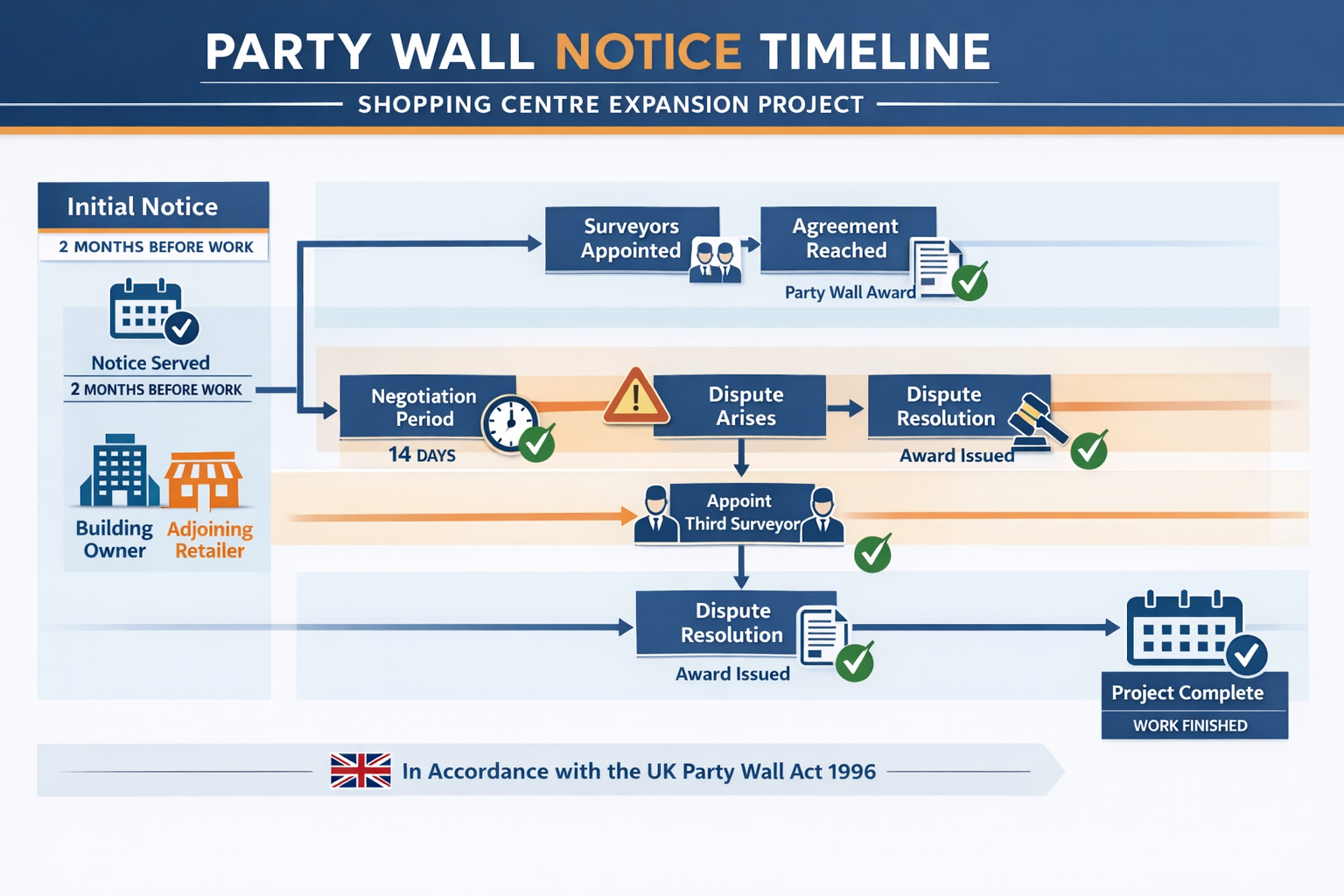
Timing distinguishes successful retail expansion projects from those plagued by delays. The Party Wall Act establishes strict notice periods that building owners must observe.
Critical Notice Periods
| Work Type | Notice Period | Key Requirements |
|---|---|---|
| Work directly on party wall | 2 months | Line of Junction Notice or Party Structure Notice |
| New wall on boundary line | 1 month | Line of Junction Notice |
| Excavation within 3-6 metres | 1 month | Notice of Adjacent Excavation |
| Excavation within 3 metres | 1 month | Notice of Adjacent Excavation |
These timelines represent minimum requirements. Smart developers build additional buffer time into project schedules, accounting for potential disputes or surveyor appointment delays.
Serving Notices in Multi-Tenant Shopping Centres
Shopping centres present unique challenges for notice service. Building owners must identify:
- Freeholders of adjoining retail units
- Long leaseholders with sufficient lease terms
- Occupying tenants in certain circumstances
- Managing agents representing multiple owners
Failure to serve all required parties constitutes a breach of the Act. In 2026's competitive retail environment, such oversights can derail time-sensitive expansion projects designed to capture market opportunities [3].
What Happens After Notice Service?
Once building owners serve proper notices, adjoining owners have three response options:
- Consent in writing within 14 days (rare in commercial settings)
- Dissent or fail to respond within 14 days (triggers surveyor appointment)
- Request modifications to the proposed work
Most commercial retail scenarios proceed to surveyor appointment. This isn't necessarily adversarial—professional surveyors facilitate agreements protecting both parties' interests. Without proper consent for party wall work, projects cannot legally commence.
Securing Agreements: The Party Wall Award Process
The party wall award forms the legal foundation for retail expansion work affecting shared structures. This document, prepared by appointed surveyors, details exactly what work can proceed and under what conditions.
Appointing Party Wall Surveyors
Three surveyor appointment scenarios exist:
Agreed Surveyor Approach 🤝
Both parties appoint a single surveyor to act impartially. This streamlined approach works well when relationships between retail neighbours are cooperative and the work is relatively straightforward.
Two Surveyor Approach ⚖️
Each party appoints their own surveyor. These two professionals then work together to produce the award. This remains the most common approach in commercial retail settings, providing balanced representation.
Third Surveyor Appointment 🎯
The two appointed surveyors select a third surveyor to resolve any disputes between them. This surveyor's decision becomes binding.
What the Party Wall Award Contains
A comprehensive party wall award for shopping centre expansion includes:
- Detailed description of the proposed work
- Time and manner of work execution
- Access arrangements for surveyors and contractors
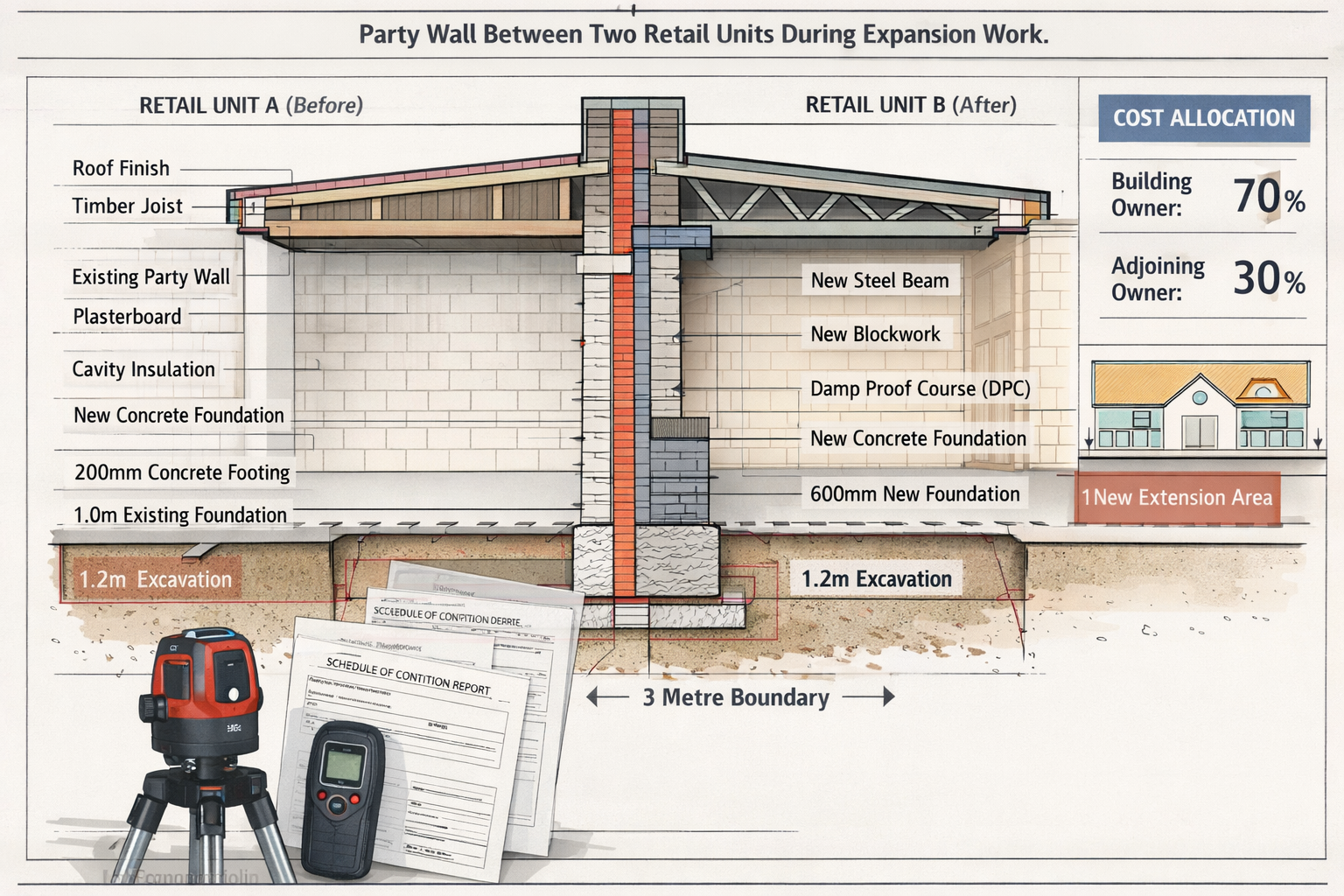
- Schedule of condition documenting pre-work state of adjoining properties
- Cost allocation between building and adjoining owners
- Dispute resolution procedures
- Completion timeline and notification requirements
The schedule of condition deserves special attention. This photographic and written record of the adjoining retail unit's condition before work commences protects all parties. Learn more about schedule of condition party wall documentation best practices.
Cost Allocation in Commercial Retail Settings
Understanding who pays for what prevents disputes that delay projects:
| Cost Item | Typically Paid By | Notes |
|---|---|---|
| Building owner's surveyor | Building owner | Always |
| Adjoining owner's surveyor | Building owner | In most cases |
| Third surveyor (if needed) | Building owner | Usually |
| Schedule of condition survey | Building owner | Pre-work documentation |
| Remedial work for damage | Building owner | If work causes damage |
| Betterment improvements | Adjoining owner | If they benefit from work |
The building owner—the party initiating retail expansion—bears most costs. This reflects the principle that those benefiting from development should fund associated procedures. However, if adjoining owners request improvements beyond what's necessary (such as upgraded finishes), they may contribute to those enhancements.
Managing Disputes and Damage Claims During Retail Expansion
Even with proper procedures, disputes can arise during shopping centre expansion projects. The 2026 construction environment shows mixed trends, with some sectors experiencing heightened activity that increases pressure on party wall processes [3].
Common Dispute Triggers
Timing Conflicts ⏱️
Retail operations run on tight schedules, especially during peak shopping seasons. Expansion work that disrupts trading can create friction between neighbours. Awards should specify work hours that minimize impact on adjoining retail operations.
Access Disagreements 🚪
Surveyors and contractors need access to adjoining properties for inspections and certain work types. Retail tenants may resist access during trading hours, requiring careful negotiation and scheduling.
Damage Claims 🔨
Construction vibration, dust, or structural movement can affect neighbouring retail units. When damage to property in party wall situations occurs, the pre-work schedule of condition becomes invaluable evidence.
Preventing Disputes Through Professional Management
Smart developers employ several strategies to minimize conflicts:
- Early engagement with all affected parties before formal notices
- Clear communication about project timelines and potential impacts
- Professional monitoring throughout construction phases
- Rapid response to concerns raised by adjoining owners
- Comprehensive insurance covering party wall work
The consequences of no party wall agreement can be severe. Courts can issue injunctions stopping work entirely, creating costly delays that undermine retail revitalisation business cases.
Resolution Mechanisms
When disputes arise despite preventive measures, several resolution paths exist:
- Surveyor negotiation: The appointed surveyors work to find mutually acceptable solutions
- Third surveyor determination: Binding decision from the impartial third surveyor
- Appeal to county court: Within 14 days of award service, though this is expensive and time-consuming
- Mediation: Increasingly popular alternative to formal legal proceedings
Party Wall Surveys for Retail Revitalisation: Strategic Implementation in 2026
The current retail landscape presents unique opportunities for shopping centre expansion. Commercial real estate outlooks for 2026 show retail properties gaining attention as undervalued assets with revitalisation potential [4]. Successful developers integrate party wall procedures into broader project strategies.
Aligning Party Wall Timelines with Retail Calendars
Retail operates on predictable cycles. Smart expansion planning accounts for:
- Peak trading periods (November-December, back-to-school)
- Quiet seasons ideal for disruptive work
- Lease renewal dates affecting tenant cooperation
- Marketing campaign launches requiring completed spaces
Building party wall notice periods into project timelines ensures work can commence during optimal windows. A two-month notice period served in September positions work to begin in November—potentially problematic for retail neighbours during peak season. Better planning might target notice service in January for March commencement, completing work before summer trading.
Multi-Phase Expansion Strategies
Large shopping centre revitalisation projects often proceed in phases. This approach offers party wall advantages:
Phase 1: Expansion of anchor tenant spaces with minimal party wall complications
Phase 2: Work affecting multiple shared walls, leveraging relationships built in Phase 1
Phase 3: Final connections and finishing work with established procedures
Each phase requires separate party wall notices and awards, but the learning curve flattens as all parties become familiar with processes.
Technology Integration in 2026 Party Wall Surveys
Modern party wall surveys leverage technology unavailable in earlier years:
- 3D laser scanning for precise schedule of condition documentation
- Drone surveys for roof and upper-level assessments
- Digital collaboration platforms for surveyor communication
- Vibration monitoring systems providing real-time data during construction
- Photogrammetry creating detailed visual records
These tools enhance accuracy while reducing survey time, helping keep retail expansion projects on schedule. For complex structural assessments, structural surveys provide comprehensive analysis beyond basic party wall requirements.
Case Study Applications: High Street Shopping Centre Scenarios
Scenario 1: Department Store Basement Expansion
A major department store plans basement expansion to add 2,000 square metres of retail space. The work requires:
- Excavation to 4 metres depth
- Underpinning of the existing party wall
- New structural supports affecting adjoining units
Party wall implications:
- Six adjoining retail units require notices
- Three-meter rule triggers additional requirements
- Schedule of condition must document all six properties
- Phased work minimizes disruption to neighbours
- Vibration monitoring protects against damage claims
Timeline: Notice served in March, work commences in May, completion by September before peak season.
Scenario 2: Food Court Reconfiguration
A shopping centre plans food court expansion, removing walls between three existing units to create a unified dining space.
Party wall implications:
- Work directly affects party walls requiring removal
- Structural alterations need detailed engineering
- Adjoining retail units concerned about noise and odours
- Award specifies enhanced ventilation and soundproofing
- Access needed for beam installation affecting upper floors
Timeline: Notice served in January, agreement reached in March, work during April-May quiet period.
Scenario 3: Vertical Expansion Adding Retail Levels
A two-storey shopping centre adds a third retail level, requiring structural work to existing party walls and foundations.
Party wall implications:
- All ground and first-floor tenants affected
- Foundation strengthening triggers excavation notices
- Comprehensive structural surveys required
- Temporary access arrangements during construction
- Long-term monitoring for settlement issues
Timeline: 18-month project with rolling party wall awards for different phases.
Cost-Benefit Analysis: Professional Party Wall Management
Developers sometimes question whether professional party wall survey costs justify the investment. The 2026 retail environment, with its focus on efficient capital deployment, demands clear cost-benefit analysis.
Direct Costs of Party Wall Compliance
Typical fee ranges for shopping centre projects:
- Party wall surveyor fees: £1,500-£5,000 per adjoining owner
- Schedule of condition surveys: £800-£2,500 per property
- Monitoring during construction: £500-£2,000
- Award preparation and administration: £1,000-£3,000
For a project affecting six adjoining retail units, total party wall costs might range from £15,000-£45,000.
Costs of Non-Compliance
Compare professional management costs against potential non-compliance consequences:
- Injunction halting work: £50,000-£500,000+ in delays and legal fees
- Damage claims without schedule of condition: £10,000-£100,000+ per property
- Relationship breakdown with retail neighbours: Immeasurable long-term impact
- Reputation damage in commercial property market: Lost future opportunities
The cost-benefit calculation overwhelmingly favours professional party wall management. In 2026's competitive retail environment, developers cannot afford the delays and disputes that arise from inadequate party wall procedures.
Selecting the Right Party Wall Surveyor for Retail Projects
Not all party wall surveyors possess equal expertise in commercial retail settings. Shopping centre expansion demands specialists understanding both party wall law and retail operational requirements.
Essential Qualifications and Experience
Look for surveyors with:
✅ RICS membership (Royal Institution of Chartered Surveyors)
✅ Specific party wall accreditation (Faculty of Party Wall Surveyors membership)
✅ Commercial retail experience with shopping centre projects
✅ Local market knowledge of the specific retail area
✅ Professional indemnity insurance adequate for project scale
Questions to Ask Prospective Surveyors
Before appointing a party wall surveyor, developers should ask:
- How many shopping centre expansion projects have you managed?
- What is your typical timeline from notice to award?
- How do you handle disputes between commercial parties?
- What technology do you use for schedule of condition documentation?
- Can you provide references from similar retail projects?
- How do you minimize disruption to ongoing retail operations?
The right surveyor becomes a project partner, not just a regulatory requirement. Their expertise in navigating party wall complexities can accelerate timelines and prevent costly complications.
Future-Proofing Retail Expansion: Beyond 2026
While this article focuses on 2026 shopping centre expansion plays, successful developers think beyond immediate projects. Party wall agreements create precedents affecting future development potential.
Building Positive Neighbour Relations
Today's adjoining owner may become tomorrow's development partner. Professional, respectful party wall procedures build goodwill that facilitates future projects. Retail neighbours who experience smooth, well-managed expansion work are more likely to consent quickly to subsequent projects.
Documentation for Future Reference
Comprehensive party wall awards and schedules of condition become valuable property records. Future owners, tenants, and developers benefit from:
- Clear structural documentation of previous work
- Established precedents for similar future projects
- Relationship history with adjoining properties
- Baseline condition records for future comparisons
Sustainability and Party Wall Considerations
The 2026 retail revitalisation trend increasingly incorporates sustainability goals. Party wall work offers opportunities for:
- Improved insulation in shared walls (see insulation in a party wall considerations)
- Energy efficiency upgrades benefiting multiple units
- Shared infrastructure for renewable energy systems
- Waste reduction through coordinated construction
Awards can specify sustainable construction methods and materials, aligning party wall compliance with broader environmental objectives.
Conclusion
Party Wall Surveys for Retail Revitalisation: Securing Agreements in 2026 Shopping Centre Expansion Plays represent far more than regulatory compliance—they form the foundation for successful retail transformation projects. As shopping centres emerge as undervalued assets with significant revitalisation potential, professional party wall management separates successful developers from those facing costly delays and disputes.
The key principles bear repeating:
🎯 Start early: Integrate party wall timelines into project planning from day one
📋 Document thoroughly: Comprehensive schedules of condition protect all parties
🤝 Communicate clearly: Transparency with adjoining owners prevents misunderstandings
⚖️ Engage professionals: Experienced party wall surveyors navigate complexities efficiently
💷 Budget appropriately: Party wall costs represent insurance against far larger problems
Actionable Next Steps
For developers planning shopping centre expansion in 2026:
- Conduct preliminary party wall assessment identifying all potentially affected properties
- Engage qualified party wall surveyors with commercial retail experience
- Develop comprehensive project timeline incorporating notice periods and agreement processes
- Budget for full party wall compliance including surveys, awards, and monitoring
- Establish communication protocols with all adjoining owners and tenants
- Implement technology solutions for documentation and monitoring
- Build contingency time into schedules for potential disputes or delays
The retail revitalisation opportunity of 2026 rewards those who combine vision with professional execution. Party wall surveys, properly managed, transform potential obstacles into structured processes that protect investments and relationships alike. Shopping centres poised for expansion can proceed confidently, knowing that thorough party wall procedures provide the legal and structural foundation for successful transformation.
The high street's revival depends on developers who understand that great retail experiences require more than attractive designs and compelling tenant mixes—they demand professional management of every technical and legal requirement. Party wall surveys exemplify this principle, turning complex shared-structure challenges into manageable, predictable processes that keep revitalisation projects on track and on budget.
References
[1] Nahb Expects Remodeling Growth 2026 – https://www.nahb.org/news-and-economics/press-releases/2026/02/nahb-expects-remodeling-growth-2026
[2] Spotlight New York Citys Office Market – https://comptroller.nyc.gov/reports/spotlight-new-york-citys-office-market/
[3] 2026 Construction Outlook Mixed Trends – https://dailyreporter.com/2026/01/14/2026-construction-outlook-mixed-trends/
[4] Commercial Real Estate Outlook – https://www.deloitte.com/us/en/insights/industry/financial-services/commercial-real-estate-outlook.html
[5] Fewer Americans Plan Renovations In 2026 But Professional Led Projects And Spending Increase – https://civicscience.com/fewer-americans-plan-renovations-in-2026-but-professional-led-projects-and-spending-increase/
[6] How Builders Are Approaching Current Housing Landscape – https://hbsdealer.com/how-builders-are-approaching-current-housing-landscape
[7] Party Wall Surveys Amid 2026 Construction Boom Handling Disputes In High Demand Uk Housing Markets – https://nottinghillsurveyors.com/blog/party-wall-surveys-amid-2026-construction-boom-handling-disputes-in-high-demand-uk-housing-markets