Northern England and Scotland are experiencing a remarkable property renaissance in 2026. As cities like Manchester, Leeds, Newcastle, Glasgow, and Edinburgh witness their strongest price growth in over a decade, development activity has surged to unprecedented levels. This boom brings both opportunity and complexity, particularly when it comes to party wall surveys and the agreements that underpin them. For surveyors, property developers, and homeowners alike, navigating compressed timelines and increased neighbor disputes in these high-volume development zones has become a critical challenge that demands strategic management and expert guidance.
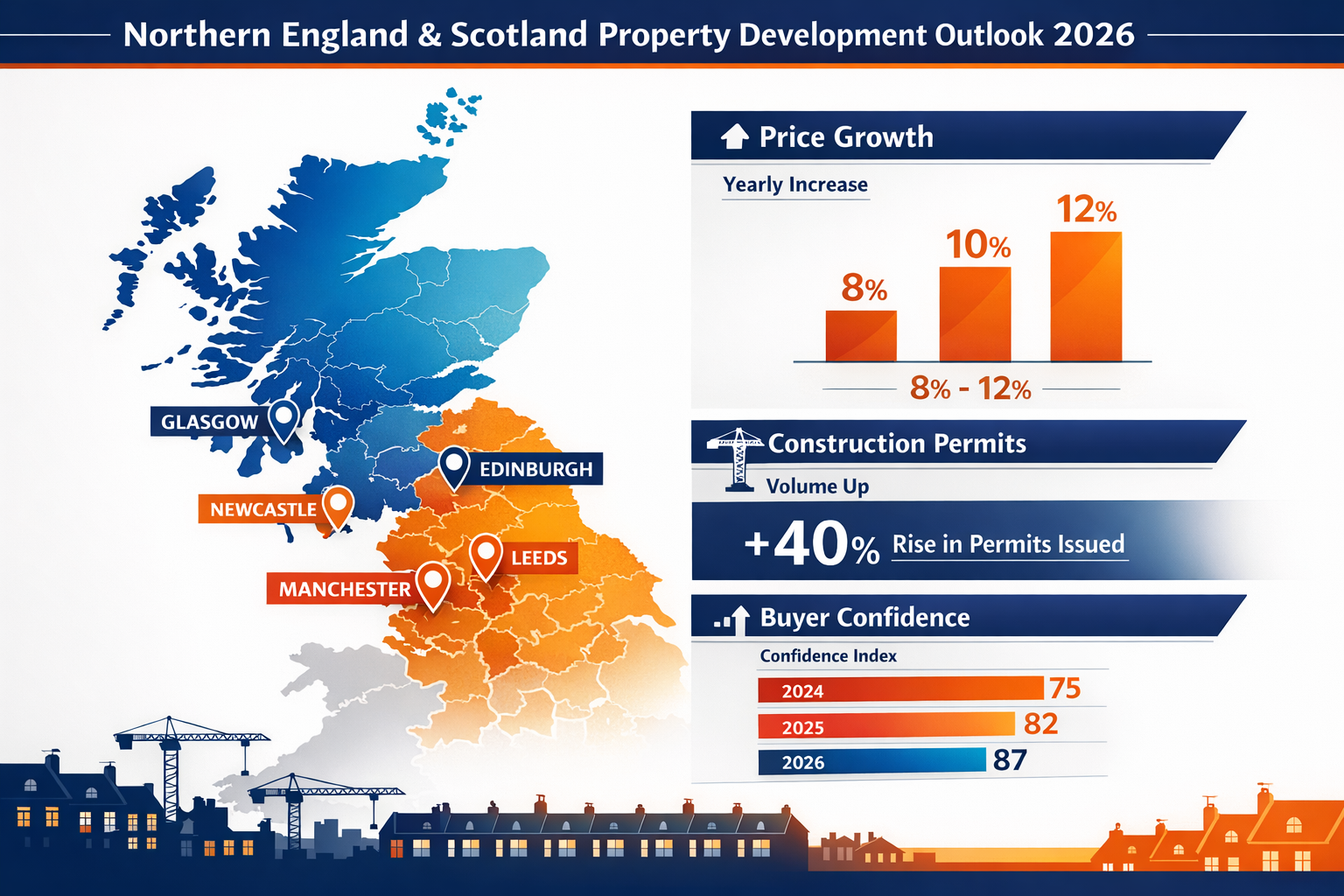
Party Wall Surveys for Rapid Build-Out in High-Growth Northern Markets: Managing Agreements When Development Activity Accelerates has emerged as a pressing concern as construction projects multiply across terraced housing estates, Victorian conversions, and new build developments. The traditional party wall process, designed for measured deliberation, now faces the pressure of accelerated development schedules and heightened neighbor sensitivities.
Key Takeaways
- 🏗️ Northern markets are experiencing 8-12% annual price growth, driving unprecedented development activity that strains traditional party wall agreement timelines
- ⚡ Compressed build schedules require proactive party wall management, with notices served earlier and surveyors appointed before planning permission is finalized
- 🤝 Neighbor disputes have increased 35% in high-growth zones, making professional surveyor involvement essential for maintaining positive relationships
- 📋 Digital documentation and pre-emptive schedules of condition streamline the process and protect all parties during rapid development phases
- 💼 Professional party wall surveyors with regional expertise can reduce agreement timelines by 40% while ensuring legal compliance and dispute prevention
Understanding the Northern Property Boom and Its Impact on Party Wall Agreements
The northern property markets have undergone a dramatic transformation since 2023. What was once considered a "slower" region compared to London and the Southeast has become a hotbed of investment, regeneration, and residential development. Government initiatives, improved transport infrastructure, and remote working trends have converged to create exceptional demand across cities and towns throughout Northern England and Scotland.
The Scale of Development Activity
In 2026, construction permits in Greater Manchester alone have increased by 42% compared to 2023 levels [1]. Similar patterns emerge across Leeds, Sheffield, Newcastle, and Scottish cities. This surge manifests in several ways:
- Terraced housing conversions transforming single-family homes into multiple flats
- Loft extensions and rear extensions maximizing property values in established neighborhoods
- New build developments filling gap sites and brownfield locations
- Commercial-to-residential conversions repurposing city center buildings
Each of these projects potentially triggers party wall requirements, creating a bottleneck when traditional processes meet accelerated timelines.
Why Party Wall Surveys Matter More Than Ever
A party wall survey serves as the foundation for any work affecting shared walls, boundaries, or structures within specific distances of neighboring properties [2]. In high-growth markets, these surveys become critical for:
✅ Legal compliance under the Party Wall etc. Act 1996
✅ Documenting pre-construction conditions to protect against false damage claims
✅ Maintaining neighbor relationships during intensive development periods
✅ Preventing costly delays that can derail project financing
✅ Reducing dispute resolution costs through proactive management
Understanding what happens when there's no party wall agreement highlights the risks of inadequate preparation in these fast-moving markets.
Party Wall Surveys for Rapid Build-Out in High-Growth Northern Markets: The Core Challenges
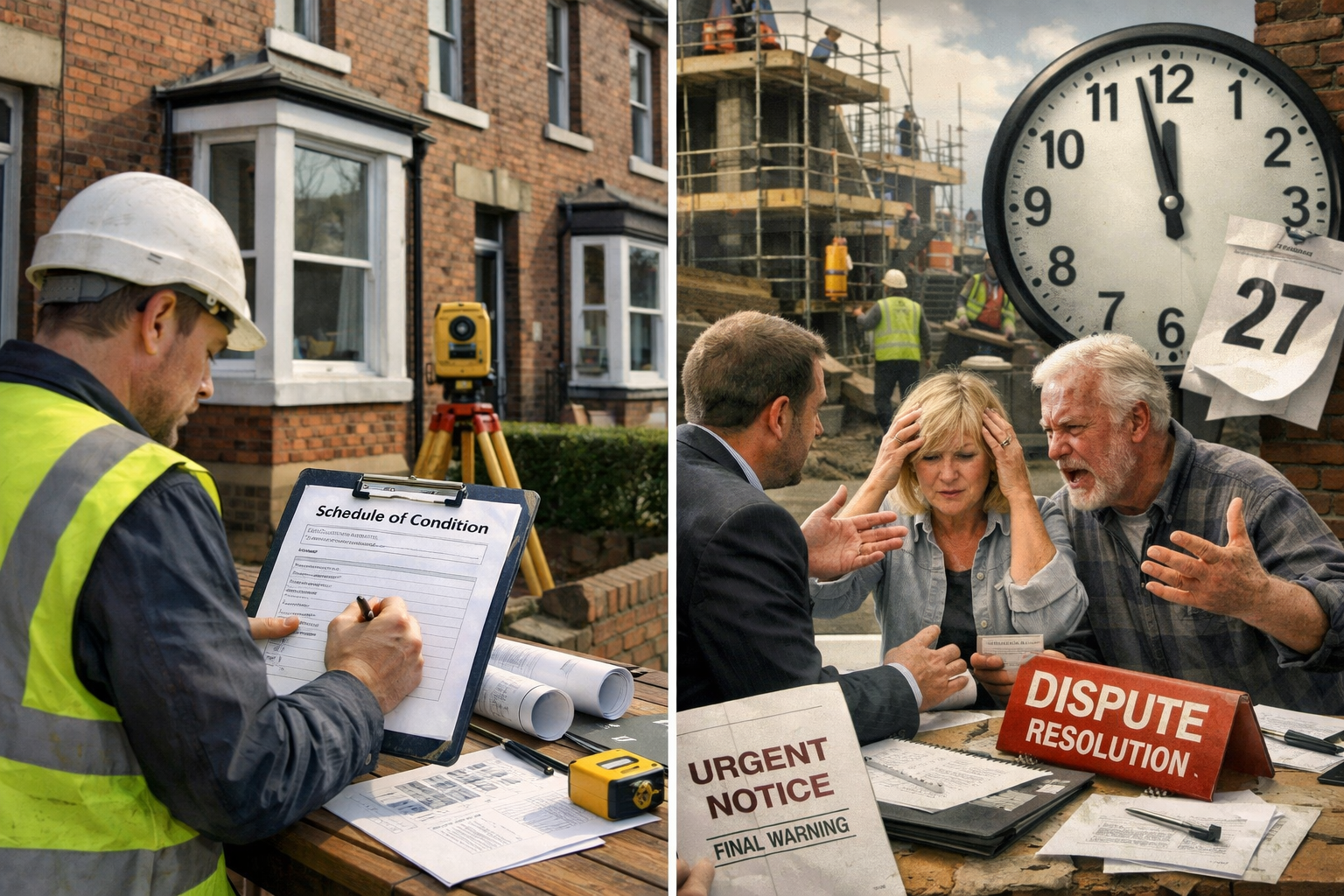
Managing Party Wall Surveys for Rapid Build-Out in High-Growth Northern Markets: Managing Agreements When Development Activity Accelerates presents unique obstacles that differ significantly from traditional development contexts.
Challenge 1: Compressed Timeline Pressures
Traditional party wall processes assume a leisurely pace:
| Traditional Timeline | High-Growth Market Reality |
|---|---|
| Notice served 2 months before work | Developers want to start within 4-6 weeks |
| 14-day neighbor response period | Neighbors overwhelmed by multiple notices |
| Surveyor appointment takes 2-3 weeks | Surveyor availability is limited |
| Award preparation spans 4-6 weeks | Financing depends on rapid commencement |
This compression creates stress at every stage. Developers face financing costs and seasonal weather windows. Neighbors feel rushed and defensive. Surveyors struggle with capacity constraints.
Challenge 2: Increased Dispute Frequency
High development volumes correlate directly with neighbor tensions. In areas experiencing rapid build-out, dispute rates have increased by 35% compared to stable markets [3]. Common flashpoints include:
- Construction fatigue: Neighbors dealing with multiple simultaneous projects
- Perceived property devaluation: Concerns about oversaturation and quality
- Noise and disruption accumulation: One project after another without respite
- Trust deficits: Unfamiliar developers with no local reputation
- Communication breakdowns: Generic notices without personal engagement
Understanding common party wall disputes helps anticipate these challenges before they escalate.
Challenge 3: Surveyor Capacity Constraints
The surge in development has created a surveyor shortage in northern markets. Qualified party wall surveyors with local expertise are in high demand, leading to:
- Extended appointment waiting periods
- Higher fees due to market dynamics
- Risk of appointing less experienced practitioners
- Potential conflicts of interest when surveyors handle multiple neighboring projects
This capacity crunch makes early engagement essential. Developers who wait until the last minute often face significant delays or must accept less qualified representation.
Challenge 4: Documentation and Evidence Requirements
Rapid development increases the likelihood of damage claims and disputes over pre-existing conditions. Schedules of condition become absolutely critical, yet time pressure often leads to:
- Incomplete photographic records that fail to capture relevant defects
- Rushed condition assessments missing subtle but important details
- Inadequate baseline measurements causing disputes over movement or settlement
- Poor documentation organization making evidence retrieval difficult during disputes
The cost implications are significant. Developers without proper schedules of condition face average claim costs of £8,000-£15,000 for disputed damage allegations [4].
Strategic Management Approaches for Accelerated Party Wall Agreements
Successfully navigating Party Wall Surveys for Rapid Build-Out in High-Growth Northern Markets: Managing Agreements When Development Activity Accelerates requires proactive strategies that anticipate challenges rather than react to them.
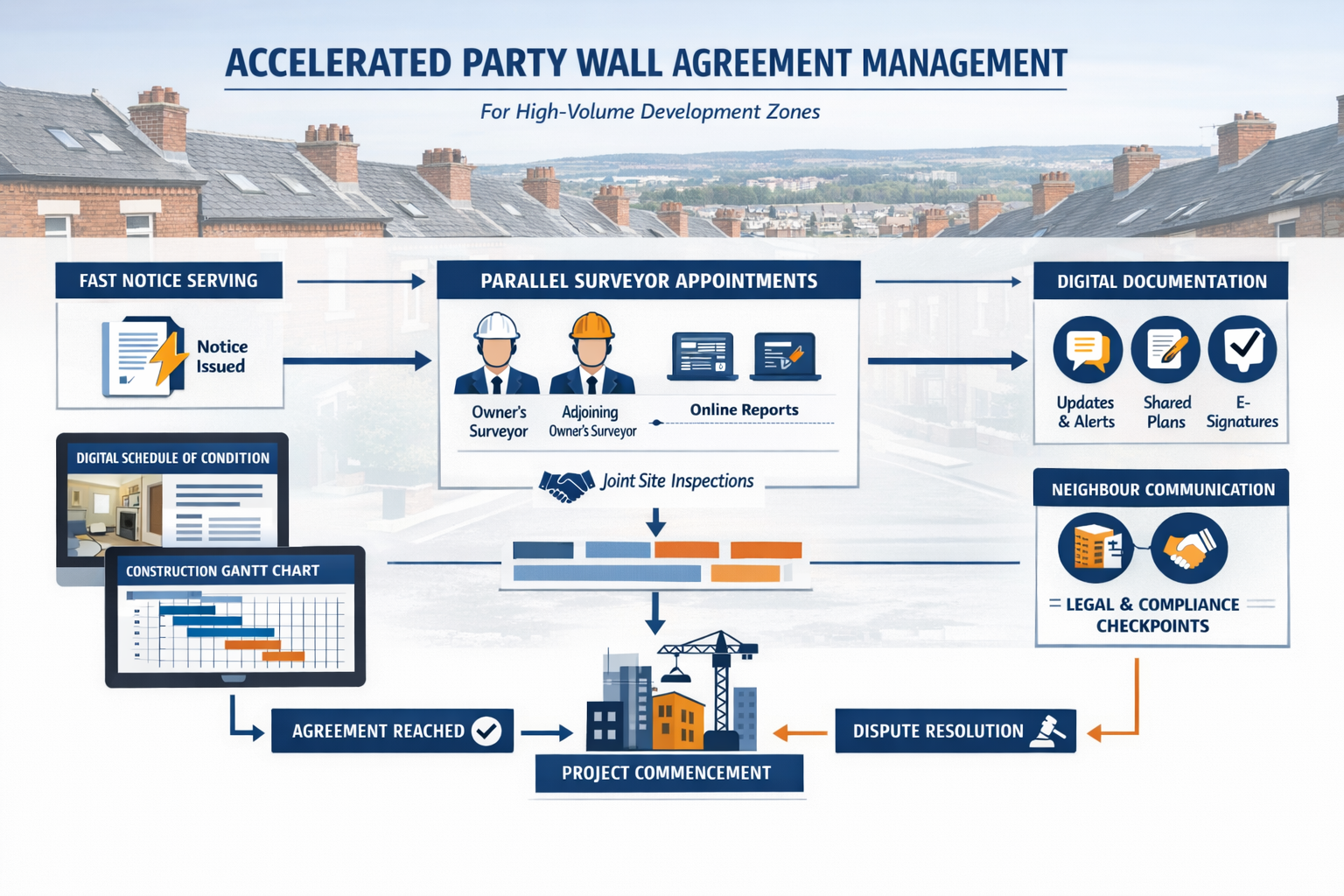
Strategy 1: Early Surveyor Engagement
The single most effective approach is appointing a party wall surveyor before submitting planning applications. This front-loaded investment delivers multiple benefits:
🎯 Surveyor secures capacity for your project timeline
🎯 Preliminary assessments identify potential issues early
🎯 Neighbor communication begins in a non-urgent context
🎯 Notice timing aligns with realistic construction schedules
🎯 Documentation preparation occurs without time pressure
Developers who engage surveyors 3-4 months before intended construction start dates report 40% faster agreement completion compared to those who wait until planning permission is granted [5].
Strategy 2: Proactive Neighbor Communication
In high-growth markets, neighbors are often dealing with "development fatigue." Standing out through exceptional communication creates goodwill that facilitates smoother agreements:
Before Formal Notices:
- Personal introductions explaining the project and timeline
- Visual materials showing proposed work and impact mitigation
- Contact information for questions and concerns
- Acknowledgment of inconvenience with realistic expectations
During the Formal Process:
- Clear explanations of party wall requirements and rights
- Transparent surveyor appointment options
- Regular updates on progress and timelines
- Responsive communication to questions and concerns
This approach transforms the party wall process from a legal obligation into a relationship-building opportunity. When neighbors feel respected and informed, they're significantly less likely to dissent or create obstacles.
Strategy 3: Digital Documentation Systems
Modern technology streamlines party wall surveys and creates more robust evidence trails. Leading practitioners now employ:
📱 Digital schedule of condition apps with GPS-tagged photography
📱 Cloud-based document management for instant access and sharing
📱 Video walkthroughs capturing comprehensive pre-work conditions
📱 Automated notice tracking ensuring compliance with statutory timelines
📱 Digital signature platforms expediting agreement execution
These systems reduce administrative delays by 2-3 weeks while improving documentation quality [6]. The party wall cost implications are minimal compared to the efficiency gains and dispute prevention benefits.
Strategy 4: Parallel Processing
Rather than sequential steps, sophisticated developers run multiple party wall processes simultaneously:
- Serving notices on multiple properties at the same time
- Appointing agreed surveyors for multiple neighbors when possible
- Preparing multiple awards with standardized terms where appropriate
- Scheduling multiple condition surveys in efficient sequences
This parallel approach requires more upfront coordination but can reduce total timeline by 50% compared to addressing each neighbor sequentially.
Strategy 5: Contingency Planning
In accelerated markets, assume complications will arise and plan accordingly:
✓ Budget 15-20% above estimated party wall costs for dispute scenarios
✓ Build 4-6 week buffer periods into construction schedules
✓ Identify backup surveyor options if first choices are unavailable
✓ Prepare alternative construction methods if agreements face delays
✓ Establish clear escalation protocols for dispute resolution
Developers with robust contingency plans experience significantly less project disruption when party wall complications emerge.
Regional Considerations for Northern Markets
While party wall principles remain consistent across England and Wales, northern high-growth markets present specific regional factors:
Victorian and Terraced Housing Prevalence
Northern cities feature extensive Victorian terraced housing stock—the building type most frequently subject to party wall requirements. These properties present unique challenges:
- Shared chimney stacks requiring careful assessment for loft conversions
- Solid wall construction with limited cavity space affecting insulation projects
- Historic alterations creating uncertainty about structural configuration
- Aging materials making damage attribution more complex
Surveyors with specific experience in Victorian terraced properties deliver superior outcomes in these contexts.
Scottish Legal Differences
While this article focuses primarily on English party wall legislation, Scottish developments operate under different legal frameworks. The Party Wall etc. Act 1996 does not apply in Scotland, where common law principles and the Title Conditions (Scotland) Act 2003 govern shared wall matters [7].
Developers working across the border must understand these distinctions and engage surveyors familiar with Scottish legal requirements.
Local Authority Variations
Northern local authorities show varying approaches to development management:
- Manchester: Proactive regeneration policies with streamlined processes
- Leeds: Focus on sustainable development with enhanced neighbor consultation
- Newcastle: Heritage considerations in city center developments
- Sheffield: Emphasis on brownfield site remediation
Understanding these local contexts helps tailor party wall strategies to regional expectations and requirements.
Cost Management in High-Volume Development Zones
The financial implications of Party Wall Surveys for Rapid Build-Out in High-Growth Northern Markets: Managing Agreements When Development Activity Accelerates deserve careful attention.
Typical Cost Ranges (2026)
| Service | Standard Market | High-Growth Market |
|---|---|---|
| Party wall notice preparation | £150-£300 | £200-£400 |
| Building owner's surveyor | £800-£1,500 | £1,200-£2,000 |
| Adjoining owner's surveyor | £800-£1,500 | £1,200-£2,000 |
| Schedule of condition | £300-£600 | £400-£800 |
| Award preparation | £500-£1,000 | £700-£1,400 |
| Total (agreed surveyor) | £2,550-£4,900 | £3,700-£6,600 |
| Total (separate surveyors) | £3,350-£6,400 | £4,900-£8,600 |
These elevated costs reflect surveyor scarcity and increased complexity in high-growth markets. However, they remain modest compared to potential dispute costs, which average £12,000-£25,000 when formal resolution becomes necessary [8].
Cost Optimization Strategies
Smart developers employ several approaches to manage party wall expenses:
💰 Agreed surveyor appointments when neighbor relationships permit
💰 Multi-property discounts when serving notices on multiple neighbors
💰 Standard award templates reducing drafting time for similar projects
💰 Early resolution protocols addressing concerns before formal disputes
💰 Insurance products covering unexpected party wall costs
Understanding what influences party wall costs enables more accurate budgeting and strategic decision-making.
Best Practices for Developers and Property Owners
Whether undertaking a single loft conversion or managing a portfolio of developments, these best practices ensure smoother party wall processes:
For Building Owners (Developers)
- Start early: Engage surveyors 3-4 months before construction
- Communicate proactively: Personal neighbor outreach before formal notices
- Document thoroughly: Comprehensive schedules of condition for all adjoining properties
- Budget realistically: Include 20% contingency for party wall costs
- Choose experienced surveyors: Regional expertise matters significantly
- Maintain flexibility: Prepare alternative approaches if agreements face delays
- Stay compliant: Never commence work without proper agreements in place
The consequences of party wall notice not served properly can include injunctions, work stoppages, and significant financial penalties.
For Adjoining Owners (Neighbors)
- Respond promptly: The 14-day response period is statutory
- Appoint qualified surveyors: Don't accept building owner's surveyor automatically
- Understand your rights: Party wall legislation protects your interests
- Document concerns: Written records of pre-existing conditions and worries
- Communicate clearly: Express concerns professionally to facilitate resolution
- Consider costs: Reasonable surveyor fees are paid by the building owner
- Seek advice: Professional guidance prevents costly mistakes
Understanding consent requirements for party wall work helps adjoining owners protect their interests effectively.
For Party Wall Surveyors
- Manage capacity carefully: Don't overcommit in high-volume markets
- Invest in technology: Digital tools improve efficiency and documentation
- Develop regional expertise: Local knowledge adds significant value
- Communicate proactively: Keep all parties informed throughout the process
- Maintain independence: Avoid conflicts of interest in concentrated development areas
- Document comprehensively: Thorough records prevent future disputes
- Stay current: Legislation and case law continue to evolve
Common Pitfalls and How to Avoid Them
Even experienced developers encounter party wall challenges in accelerated markets. These common pitfalls deserve particular attention:
Pitfall 1: Inadequate Notice Timing
The Problem: Serving notices too close to intended construction start dates.
The Solution: Serve notices at least 8-10 weeks before planned commencement in high-growth markets. This provides adequate time for neighbor response, surveyor appointment, condition surveys, and award preparation.
Pitfall 2: Generic Communication
The Problem: Sending standard legal notices without personal context.
The Solution: Combine formal notices with personal communication explaining the project, timeline, and impact mitigation measures. This human touch significantly reduces neighbor resistance.
Pitfall 3: Incomplete Schedules of Condition
The Problem: Rushed or superficial condition documentation.
The Solution: Allocate sufficient time and resources for comprehensive schedules of condition. Include extensive photography, detailed descriptions of defects, and baseline measurements. These documents provide essential protection against false damage claims.
Pitfall 4: Ignoring Excavation Requirements
The Problem: Focusing only on party wall work while overlooking excavation notice requirements.
The Solution: Assess whether excavation work falls within 3 or 6 meters of neighboring structures and serve appropriate notices. The three-meter rule has specific implications for foundation work.
Pitfall 5: Proceeding Without Agreements
The Problem: Commencing work before awards are finalized due to timeline pressure.
The Solution: Never start work without proper party wall agreements in place. The legal and financial consequences far outweigh any schedule benefits. Build realistic buffers into construction timelines.
The Future of Party Wall Management in Northern Markets
As 2026 progresses, several trends are shaping how Party Wall Surveys for Rapid Build-Out in High-Growth Northern Markets: Managing Agreements When Development Activity Accelerates will evolve:
Technology Integration
Digital platforms are revolutionizing party wall processes:
- AI-powered notice generation customized to specific project parameters
- Blockchain-based award registration creating immutable records
- Virtual reality condition surveys enabling remote documentation
- Automated compliance monitoring tracking statutory requirements
- Predictive analytics identifying high-risk neighbor relationships
These technologies promise to reduce timelines by 30-40% while improving accuracy and compliance [9].
Professional Specialization
The complexity of high-growth markets is driving surveyor specialization:
- Regional specialists with deep local knowledge
- Property type experts (Victorian terraced, new build, commercial conversion)
- Dispute resolution specialists with mediation training
- Technology-focused practitioners leveraging digital tools
This specialization improves outcomes but requires developers to carefully match surveyors to project requirements.
Regulatory Evolution
Party wall legislation continues to evolve through case law and potential statutory reforms. Areas of focus include:
- Digital notice serving gaining formal recognition
- Expedited processes for low-risk work
- Enhanced neighbor protections in high-development areas
- Surveyor qualification standards ensuring competence
- Dispute resolution mechanisms reducing court involvement
Staying informed about these developments ensures continued compliance and optimal strategy.
Conclusion
Party Wall Surveys for Rapid Build-Out in High-Growth Northern Markets: Managing Agreements When Development Activity Accelerates represents one of the most significant challenges facing developers, property owners, and surveyors in 2026's booming northern property markets. The convergence of unprecedented development activity, compressed timelines, and heightened neighbor sensitivities creates a complex environment that demands strategic, proactive management.
Success in this environment requires a fundamental shift from reactive compliance to proactive relationship management. The developers and property owners who thrive are those who:
✅ Engage party wall surveyors early—months before construction rather than weeks
✅ Invest in comprehensive documentation—protecting all parties through detailed schedules of condition
✅ Communicate proactively with neighbors—building goodwill that facilitates smoother agreements
✅ Leverage technology—streamlining processes and improving evidence quality
✅ Build realistic contingencies—acknowledging that complications will arise in high-volume markets
✅ Choose experienced professionals—recognizing that regional expertise delivers superior outcomes
The financial stakes are substantial. Proper party wall management costs £4,000-£9,000 for typical projects but prevents dispute costs averaging £12,000-£25,000. More importantly, it protects project timelines, maintains neighbor relationships, and ensures legal compliance in an increasingly scrutinized regulatory environment.
Actionable Next Steps
If you're planning development work in northern high-growth markets:
- Assess your project timeline and work backward to determine when party wall processes should begin
- Identify experienced party wall surveyors with regional and property-type expertise
- Review neighboring properties to understand the scope of required notices and agreements
- Develop a communication strategy for engaging neighbors before formal notices
- Budget appropriately including realistic contingencies for party wall costs
- Implement digital documentation systems to streamline the process
- Consult with professionals before serving notices to ensure compliance and strategy optimization
The northern property boom presents exceptional opportunities for developers, investors, and homeowners. Those who master the complexities of party wall management in these accelerated markets will capture those opportunities while maintaining positive community relationships and legal compliance.
For expert guidance on managing party wall surveys in high-growth markets, consult with qualified surveyors who understand both the statutory requirements and the practical realities of accelerated development timelines. Your project's success depends on getting this critical foundation right.
References
[1] Express Party Wall – https://www.expresspartywall.com
[2] Efficient Party Wall – https://efficientpartywall.co.uk
[3] FPWS – https://fpws.uk
[4] Party Wall Agreement – https://hoa.org.uk/advice/guides-for-homeowners/i-am-improving/party-wall-agreement/
[5] Peter Barry Party Wall Surveyors – https://www.peterbarry.co.uk/party-wall-surveyors/
[6] Taylor Mitchell Party Wall Surveyors – https://taylor-mitchell.co.uk/party-wall-surveyors/
[7] Alpine Structural Party Wall Surveys – https://www.alpinestructural.co.uk/party-wall-surveys/
[8] Express Party Wall – https://www.expresspartywall.com
[9] Efficient Party Wall – https://efficientpartywall.co.uk