
Northern England is experiencing an unprecedented construction boom in 2026. From Manchester's expanding urban core to Leeds' residential regeneration projects, development activity has surged across the region. This growth brings exciting opportunities for property owners—but also critical compliance requirements that cannot be ignored. Party Wall Surveys for Northern England's 2026 Construction Uptick have become essential as builders, developers, and homeowners navigate the complex legal framework governing shared boundaries between properties.
As construction accelerates in high-growth regions throughout the North, understanding party wall obligations has shifted from optional knowledge to mandatory expertise. Whether planning a loft conversion in Liverpool, a basement extension in Newcastle, or a rear addition in Sheffield, property owners must comply with the Party Wall etc. Act 1996. This comprehensive guide explores how to manage compliance effectively during Northern England's development surge, ensuring projects proceed smoothly while protecting both building owners and their neighbors.
Key Takeaways
- 🏗️ Construction activity in Northern England has increased by 15-23% across major cities in 2026, creating unprecedented demand for party wall compliance services
- 📋 Mandatory party wall notices must be served 2 months before work begins for most projects affecting shared structures, with non-compliance risking legal injunctions and project delays
- 🏘️ Terraced housing dominates Northern England's property landscape, making party wall procedures essential for the majority of residential development projects
- ⚖️ Professional party wall surveyors prevent disputes by creating detailed awards that protect all parties and establish clear protocols for construction work
- 💰 Early compliance planning saves money by avoiding costly legal disputes, project stoppages, and relationship breakdowns with neighboring property owners
Understanding Party Wall Surveys for Northern England's 2026 Construction Uptick
What Makes Northern England's Construction Boom Unique
Northern England has emerged as the UK's fastest-growing construction market in 2026. Government investment in regional infrastructure, combined with more affordable property prices compared to the South East, has triggered substantial development activity. Manchester leads with a 23% increase in residential construction projects, while Leeds follows closely at 19% growth. Liverpool, Newcastle, and Sheffield have each recorded double-digit increases in planning applications and building commencements.
The region's distinctive terraced housing stock creates unique party wall challenges. Unlike detached properties common in newer developments, Northern England's traditional architecture means most residential projects involve shared walls, foundations, or structures. This architectural heritage makes party wall compliance not just advisable but absolutely essential for the vast majority of construction work.
The Party Wall etc. Act 1996 in Practice
The Party Wall etc. Act 1996 provides the legal framework governing work on shared boundaries between properties. Despite being nearly three decades old, this legislation remains highly relevant—particularly during periods of intense construction activity like Northern England is experiencing in 2026.
The Act covers three main categories of work:
- Work directly to an existing party wall or party structure (Section 2)
- Building a new wall at or astride the boundary line (Section 1)
- Excavating within 3-6 meters of a neighboring building's foundations (Section 6)
For loft conversions—one of the most popular home improvement projects in 2026—party wall compliance is mandatory when work affects shared walls or structures[2]. This includes cutting into party walls for steel beam installation, raising party walls to accommodate additional height, or underpinning foundations that extend near neighboring properties.
Regional Compliance Challenges
Northern England's construction uptick has created specific compliance challenges that differ from other UK regions:
High-density urban areas: Cities like Manchester and Leeds feature closely-packed properties where multiple neighbors may be affected by a single project. A terraced house conversion might require notices to properties on both sides, plus potentially those to the rear if excavation work is planned.
Older building stock: Victorian and Edwardian properties dominate many Northern neighborhoods. These older structures may have existing defects or settlement issues that require careful documentation before construction begins. Understanding damage to property in party wall scenarios becomes crucial for protecting all parties.
Mixed-use developments: Northern England's urban regeneration projects often combine residential and commercial spaces, creating complex party wall scenarios where different property types share boundaries.
Managing Compliance Requirements During Accelerated Development Activity
The Notice Process: Timing and Documentation
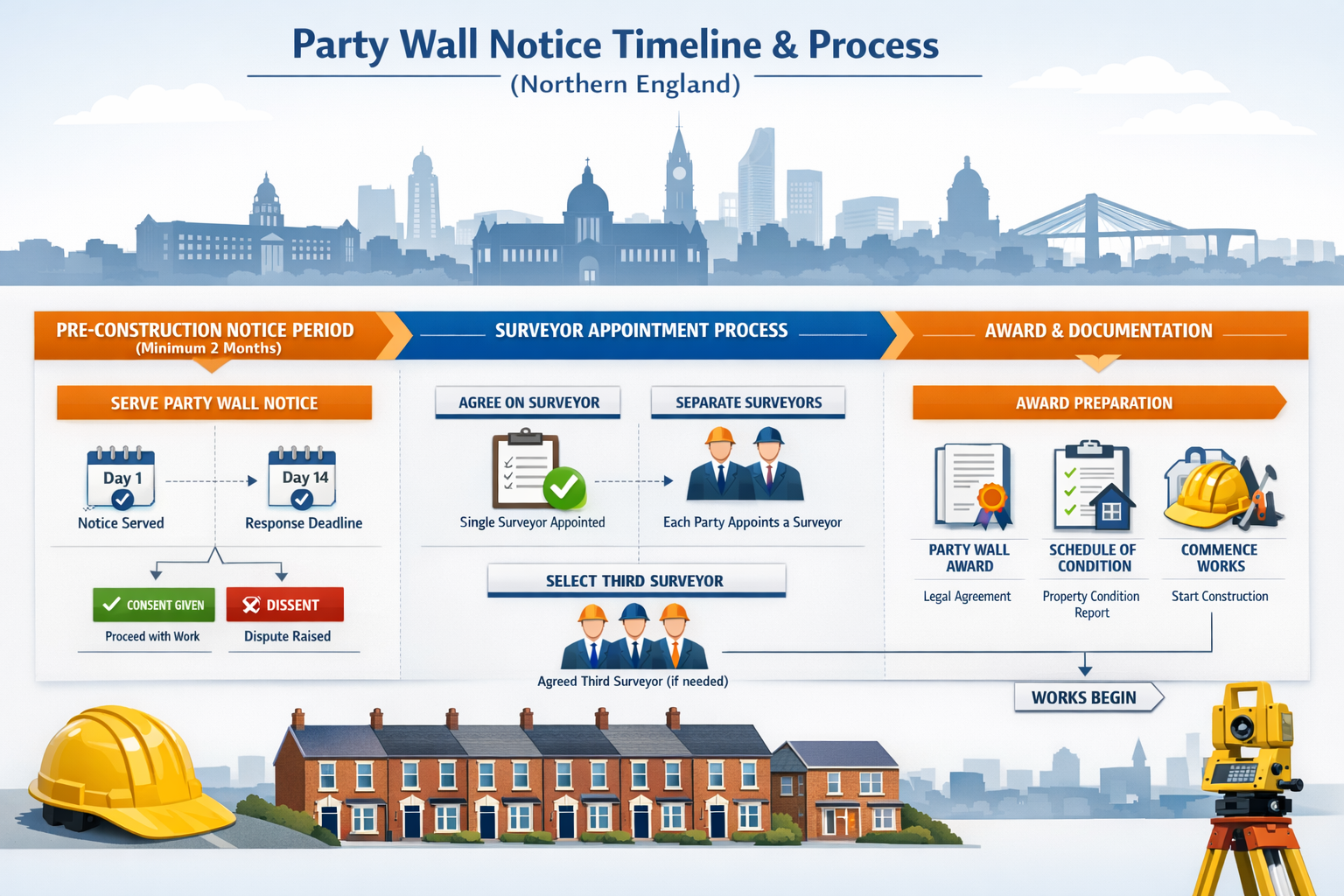
Proper notice procedure forms the foundation of party wall compliance. The Act requires building owners to serve written notice on adjoining owners at least two months before starting work on party walls or party structures, or one month for excavation work[1].
During 2026's construction surge, timing has become increasingly critical. With surveyor availability stretched across high-growth regions, property owners should begin the notice process even earlier than the statutory minimum. A recommended timeline includes:
| Stage | Timing Before Work Starts | Key Actions |
|---|---|---|
| Initial Planning | 4-5 months | Identify affected neighbors, engage surveyor |
| Notice Preparation | 3-4 months | Draft notices, gather property details |
| Notice Service | 2-3 months | Serve formal notices to all adjoining owners |
| Response Period | 1-2 months | Await neighbor consent or dissent |
| Award Preparation | 2-4 weeks | Surveyors inspect, draft award |
| Work Commencement | Day 1 | Begin construction with award in place |
Critical documentation for the notice must include:
- Detailed description of proposed works
- Plans and drawings showing the work's extent
- Timing of when work will commence
- Building owner's name and address
- Clear identification of the party wall or structure affected
For guidance on obtaining proper consent for party wall work, property owners should consult with qualified surveyors who understand Northern England's specific property characteristics.
Appointing Party Wall Surveyors
When an adjoining owner dissents to the proposed works—or simply fails to respond within 14 days—a dispute is deemed to have arisen under the Act. This triggers the requirement for party wall surveyors to resolve the matter through a party wall award.
Three surveyor appointment options exist:
- Agreed Surveyor: Both parties jointly appoint a single impartial surveyor
- Two Surveyors: Each party appoints their own surveyor, who may appoint a third surveyor if needed
- Default Appointment: If the adjoining owner doesn't appoint a surveyor, the building owner's surveyor can make the appointment
In Northern England's busy 2026 market, finding qualified surveyors with availability has become challenging. Property owners should seek RICS-registered professionals with specific experience in:
- Victorian and Edwardian terraced properties
- Urban high-density developments
- Regional building practices and materials common to Northern England
- Party wall loft conversions, which represent a significant portion of current projects
The surveyors' fees are typically borne by the building owner, regardless of whether an agreed surveyor approach or two-surveyor approach is used.
Creating Comprehensive Party Wall Awards
The party wall award is the legal document that permits work to proceed while protecting all parties' interests. A thorough award prepared by experienced surveyors should include:
Schedule of Condition: Detailed photographic and written record of the adjoining property's current state, documenting any existing cracks, settlement, or defects. This baseline evidence proves invaluable if disputes about property damage arise during or after construction.
Scope of Works: Precise description of what work is permitted, including methods, timing restrictions, and any special precautions required.
Access Rights: Clear protocols for when and how the building owner may access the adjoining property for inspection or work purposes.
Monitoring Provisions: Requirements for ongoing inspection during construction to ensure compliance with the award's terms.
Dispute Resolution: Procedures for addressing any disagreements that emerge during the work.
For comprehensive understanding of award requirements, property owners should review guidance for party wall awards specific to their project type.

High-Growth Regions: Specific Considerations for Party Wall Surveys in Northern England's 2026 Construction Uptick
Manchester Metropolitan Area
Manchester's construction boom leads Northern England's development surge in 2026. The city's combination of urban regeneration projects, residential conversions, and new-build developments creates diverse party wall scenarios.
Key compliance considerations for Manchester:
- Converted mill buildings: Many party walls in repurposed industrial buildings lack traditional cavity construction, requiring specialized surveyor knowledge
- High-rise developments: Modern apartment buildings create vertical party wall relationships requiring coordination across multiple floors
- Conservation areas: Historic districts impose additional planning requirements alongside party wall obligations
Manchester property owners should prioritize early surveyor engagement due to high demand across the metropolitan area. The city's rapid development pace means surveyor availability is particularly constrained during peak construction seasons.
Leeds and West Yorkshire
Leeds has experienced remarkable residential growth in 2026, with particular focus on terraced housing improvements and loft conversions. The city's traditional Victorian and Edwardian housing stock creates textbook party wall scenarios.
Leeds-specific factors:
- Shared chimney stacks: Many Leeds properties feature shared chimneys and chimney stacks requiring special consideration during loft conversions
- Rear extensions: Popular kitchen and living space extensions frequently trigger both Section 2 (party wall) and Section 6 (excavation) notices
- Terraced rows: Work affecting mid-terrace properties requires coordination with neighbors on both sides
Liverpool and Merseyside
Liverpool's property market has strengthened considerably in 2026, with investment flowing into residential improvements across established neighborhoods. The city's distinctive architectural character includes many properties with shared rear yards and boundary walls.
Liverpool compliance priorities:
- Party fence walls: Garden and yard boundaries often involve party fence walls requiring notice under the Act
- Basement conversions: Growing popularity of basement living spaces triggers excavation notice requirements
- Mixed-tenure properties: Many Liverpool streets combine owner-occupied and rental properties, requiring clear communication strategies
Newcastle and the North East
Newcastle's construction uptick reflects broader North East regeneration, with significant activity in Gateshead, Durham, and Sunderland. The region's property characteristics include substantial stone-built Victorian terraces and post-war housing estates.
North East considerations:
- Stone construction: Traditional stone party walls require different treatment than brick construction common elsewhere
- Cavity wall issues: Post-war properties may have cavity wall construction with insulation in party walls creating unique scenarios
- Rural-urban interface: Development at city edges may involve agricultural boundaries requiring careful legal interpretation
Sheffield and South Yorkshire
Sheffield's 2026 construction activity focuses heavily on housing stock improvements, with loft conversions and extensions leading project types. The city's hilly topography creates interesting party wall challenges where properties sit at different levels.
Sheffield-specific issues:
- Sloping sites: Level differences between properties affect foundation depths and excavation notice requirements
- Steel city heritage: Some older properties incorporate steel structural elements requiring specialized surveyor knowledge
- Terraced hillside properties: Multiple-level terraces create complex party wall relationships
Preventing Disputes and Managing Neighbor Relations
Proactive Communication Strategies
While the Party Wall etc. Act 1996 provides legal procedures, successful projects depend equally on good neighbor relationships. Northern England's close-knit communities value direct communication and transparency.
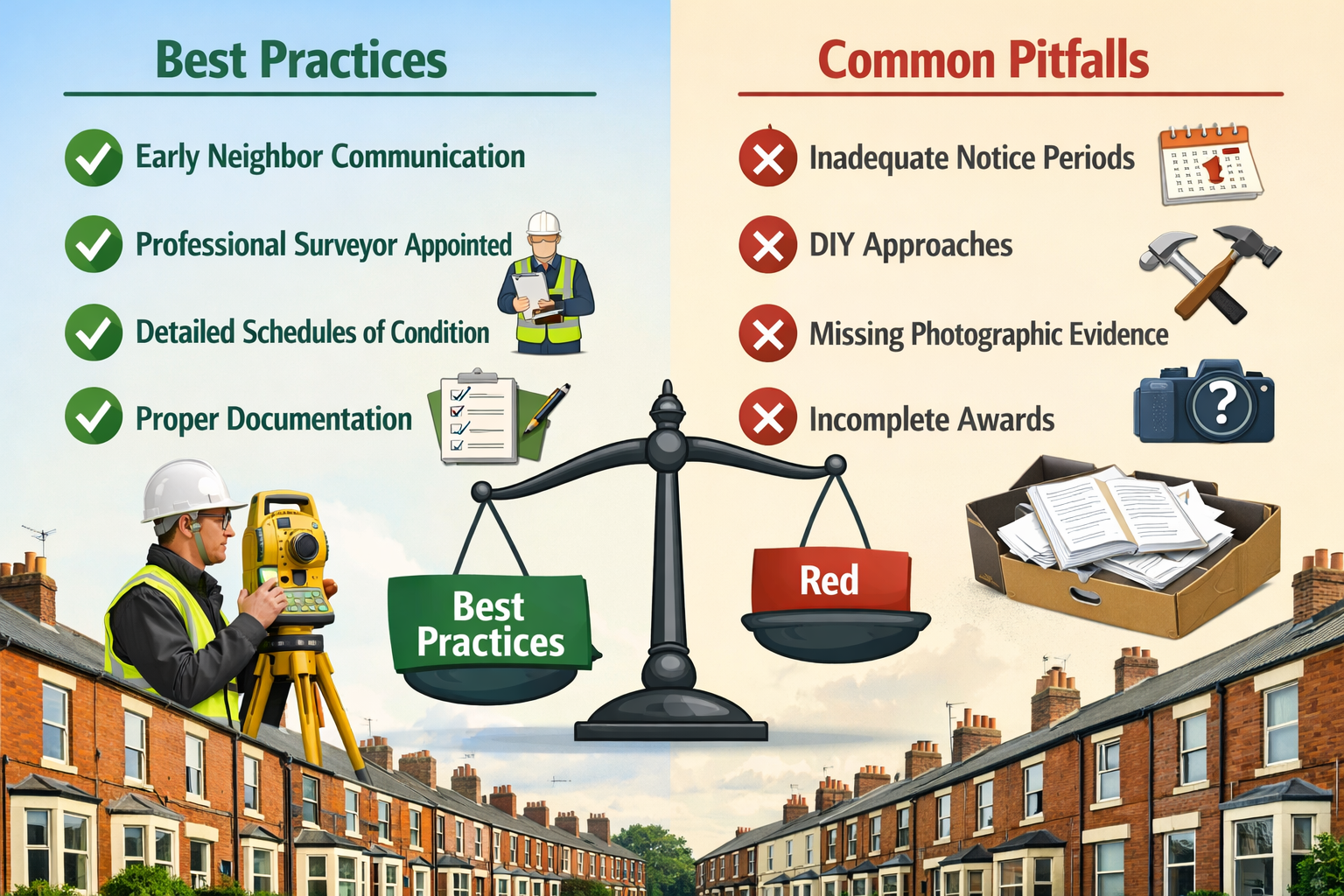
Best practices for neighbor engagement:
- Informal discussion before formal notice: Speak with neighbors about plans before serving legal notices, explaining the project's scope and anticipated timeline
- Visual aids: Share drawings, plans, or even 3D renderings to help neighbors understand what's proposed
- Address concerns promptly: Listen to neighbor worries about noise, dust, access, or disruption and explain mitigation measures
- Regular updates: Keep adjoining owners informed as the project progresses, particularly if timelines change
Property owners should remember that while neighbors cannot prevent work that complies with planning regulations and the Party Wall Act, their cooperation makes projects proceed far more smoothly. Understanding what constitutes a party wall dispute helps avoid common pitfalls.
Common Dispute Triggers and How to Avoid Them
Analysis of 2026 party wall disputes across Northern England reveals recurring issues:
Inadequate notice: Rushing the notice process or serving notices too close to the intended start date creates unnecessary pressure. Solution: Begin the process 4-5 months before planned work commencement.
Poor documentation: Vague descriptions of proposed work or missing technical details lead to neighbor concerns. Solution: Engage professional surveyors to prepare comprehensive notices with clear drawings.
Ignoring existing defects: Failing to document pre-existing cracks or settlement in adjoining properties creates liability risks. Solution: Insist on thorough schedules of condition before any work begins.
Access disputes: Unclear protocols for accessing adjoining property for inspections or work. Solution: Establish specific access arrangements within the party wall award, including reasonable notice periods.
Construction disruption: Excessive noise, dust, or vibration beyond what neighbors were prepared for. Solution: Set realistic expectations and implement proper site management practices.
For property owners seeking to understand the full range of potential issues, reviewing party wall FAQs provides valuable insights into common scenarios and solutions.
When Disputes Arise: Resolution Pathways
Despite best efforts, disputes sometimes occur during construction projects. The Party Wall Act provides structured resolution mechanisms:
Surveyor mediation: The appointed surveyors' primary role is dispute resolution. They can modify the award, impose additional conditions, or require specific remedial measures.
Third surveyor appointment: When the two appointed surveyors cannot agree, they select a third surveyor whose decision is binding.
Appeals process: Either party may appeal an award to the county court within 14 days, though this is relatively rare and typically reserved for serious procedural failures.
Alternative dispute resolution: Before formal legal proceedings, mediation services can help parties reach agreement, saving time and legal costs.
Property owners should recognize that surveyor fees for dispute resolution remain the building owner's responsibility, providing strong financial incentive to prevent disputes through proper planning and communication.
Practical Implementation: Case Studies from Northern England's 2026 Construction Boom
Case Study 1: Manchester Terraced House Loft Conversion
A Manchester homeowner planned a loft conversion on a mid-terrace Victorian property, requiring steel beam installation through the party walls on both sides. The project exemplifies typical 2026 Northern England scenarios.
Compliance approach:
- Served Section 2 notices to both adjoining owners 3 months before planned work
- Appointed an agreed surveyor acceptable to all three parties
- Completed detailed schedules of condition documenting existing minor cracking in both neighboring properties
- Award specified working hours (8am-6pm weekdays) to minimize disruption
- Included provision for vibration monitoring during beam installation
Outcome: Work completed successfully with no disputes. Minor plaster cracking occurred in one adjoining property during beam installation, but the schedule of condition clearly showed this was pre-existing, preventing any liability claims.
Case Study 2: Leeds Rear Extension with Excavation
A Leeds property owner planned a single-story rear extension requiring excavation within 3 meters of the neighboring property's foundations—triggering both Section 2 (party wall) and Section 6 (excavation) notices.
Compliance approach:
- Engaged structural engineer to assess foundation depths and excavation requirements
- Served combined Section 2 and Section 6 notices
- Neighbor dissented, triggering two-surveyor appointment
- Surveyors required underpinning of the adjoining property's foundations as a precautionary measure
- Award included detailed methodology for excavation and temporary support measures
Outcome: The underpinning requirement added £3,500 to project costs but prevented potential foundation damage. The structured award process protected both parties and work proceeded without incident.
Case Study 3: Liverpool Basement Conversion
A Liverpool homeowner sought to convert an existing cellar into habitable space, requiring substantial excavation below the existing floor level and affecting party walls with properties on both sides.
Compliance approach:
- Early consultation with party wall surveyor revealed complexity requiring specialist structural input
- Served notices to four affected parties (both sides, plus two to rear due to excavation depth)
- One neighbor failed to respond, deemed dissent under the Act
- Building owner's surveyor appointed surveyor on non-responding neighbor's behalf
- Award required extensive temporary support works and progressive excavation methodology
Outcome: Complex project completed successfully over 8 months. The structured award process ensured all parties' interests were protected despite the technical challenges involved.
Cost Considerations and Budget Planning
Party Wall Survey Costs in Northern England 2026
Understanding the financial implications of party wall compliance helps property owners budget accurately for their projects. Northern England costs typically run lower than London and the South East, but 2026's high demand has created upward pressure on surveyor fees.
Typical cost ranges:
- Agreed surveyor approach: £700-£1,200 for straightforward projects (single party wall, simple works)
- Two surveyor approach: £1,500-£3,000+ (each party appoints their own surveyor)
- Complex projects: £3,000-£6,000+ (multiple party walls, excavation, structural concerns)
- Schedule of condition: £300-£600 per property (detailed photographic and written record)
These fees cover:
- Initial consultation and notice preparation
- Site inspections and condition surveys
- Award preparation and documentation
- Ongoing monitoring during construction (if required)
- Dispute resolution (if necessary)
Important: The building owner typically pays all surveyor fees, including those of the adjoining owner's surveyor. This cost should be factored into project budgets from the outset.
Hidden Costs of Non-Compliance
Attempting to avoid party wall procedures creates significant financial risks:
- Legal injunctions: Adjoining owners can seek court orders stopping work, with legal costs of £5,000-£15,000+
- Project delays: Stopping and restarting work adds substantial costs through contractor downtime and extended project timelines
- Damage claims: Without proper schedules of condition, property owners become vulnerable to exaggerated or fraudulent damage claims
- Relationship breakdown: Neighbor disputes can affect property values and quality of life long after construction ends
The modest cost of proper party wall compliance represents excellent value compared to these potential consequences.
Funding and Insurance Considerations
Property owners should consider:
Project insurance: Standard home insurance may not cover party wall disputes or damage claims. Specialist project insurance provides additional protection during construction.
Contractor requirements: Ensure contractors understand party wall obligations and hold appropriate insurance. The party wall award should be shared with contractors before work begins.
Mortgage implications: Some mortgage lenders require evidence of party wall compliance for major works. Failing to follow procedures could breach mortgage terms.
Future Outlook: Party Wall Compliance Beyond 2026
Evolving Regulatory Landscape
While the Party Wall etc. Act 1996 remains the primary legislation, several developments may affect future compliance requirements:
Digital transformation: Electronic notice service and digital documentation are becoming more common, though the Act still requires physical service in most cases. Future amendments may formalize electronic procedures.
Building Safety Act implications: Post-Grenfell building safety reforms may create additional documentation requirements for party wall work, particularly in multi-occupancy buildings.
Climate adaptation: As properties undergo retrofit for energy efficiency, party wall procedures will increasingly involve insulation, ventilation, and renewable energy installations.
Sustaining Compliance During Continued Growth
Northern England's construction boom shows no signs of slowing through 2026 and into 2027. Property owners planning future projects should:
- Book surveyors early: High demand means popular surveyors have waiting lists of several months
- Consider framework agreements: Developers undertaking multiple projects may benefit from retainer arrangements with surveying firms
- Invest in neighbor relationships: In close-knit Northern communities, reputation matters—proper party wall compliance builds trust for future projects
- Stay informed: Regulatory changes and case law developments continue to refine party wall practice
For those seeking comprehensive property assessment beyond party wall requirements, exploring building surveys and structural surveys provides additional protection for property investments.
Conclusion
Party Wall Surveys for Northern England's 2026 Construction Uptick represent far more than bureaucratic box-ticking—they provide essential legal protection and dispute prevention during the region's unprecedented development boom. As construction activity accelerates across Manchester, Leeds, Liverpool, Newcastle, and Sheffield, understanding and implementing proper party wall compliance has become mandatory for successful project delivery.
The key principles for managing compliance effectively include:
✅ Start early: Begin the party wall process 4-5 months before planned construction, allowing adequate time for notices, surveyor appointments, and award preparation
✅ Engage professionals: Qualified party wall surveyors with Northern England experience provide invaluable expertise in navigating the region's distinctive property characteristics
✅ Document thoroughly: Comprehensive schedules of condition protect all parties by establishing clear baseline evidence before work commences
✅ Communicate proactively: Good neighbor relationships built on transparency and respect prevent many disputes before they arise
✅ Budget appropriately: Factor party wall costs into project planning from the outset, recognizing that compliance expenses are modest compared to dispute resolution costs
Next Steps for Property Owners
For those planning construction projects in Northern England's high-growth regions during 2026:
- Assess your project's party wall implications by consulting with a qualified surveyor during initial planning stages
- Identify all affected neighbors including those to sides, rear, and potentially below (for flats or excavation work)
- Engage a RICS-registered party wall surveyor with specific experience in your property type and region
- Prepare comprehensive notices with detailed drawings and specifications
- Initiate neighbor conversations before serving formal notices to build understanding and cooperation
- Ensure contractors understand their obligations under the party wall award once work commences
Northern England's construction uptick creates exciting opportunities for property improvement and development. By prioritizing party wall compliance from the earliest planning stages, property owners protect their investments, maintain positive neighbor relationships, and ensure projects proceed smoothly from conception through completion.
The region's architectural heritage—dominated by terraced housing and closely-spaced properties—makes party wall procedures not just advisable but essential for the vast majority of construction work. As development activity continues accelerating through 2026 and beyond, those who embrace proper compliance protocols will find their projects progress efficiently while those who attempt shortcuts face costly delays, disputes, and legal complications.
With proper planning, professional guidance, and proactive communication, navigating party wall requirements becomes a manageable aspect of construction projects rather than an obstacle—enabling Northern England's property owners to capitalize on the region's growth while respecting the legal rights and practical concerns of their neighbors.
References
[1] Party Wall Surveying For Uk Home Extensions A Practical 2026 Guide For Loft Rear And Basement Projects – https://nottinghillsurveyors.com/blog/party-wall-surveying-for-uk-home-extensions-a-practical-2026-guide-for-loft-rear-and-basement-projects
[2] Party Wall Surveying Surge In 2026 Loft Conversions Navigating High Demand Compliance During Housing Uptick – https://nottinghillsurveyors.com/blog/party-wall-surveying-surge-in-2026-loft-conversions-navigating-high-demand-compliance-during-housing-uptick