
The UK's artificial intelligence revolution is transforming the landscape—literally. As 2026 unfolds, data centre developments are sprouting across the nation at unprecedented rates, driven by government initiatives, AI Growth Zones, and streamlined planning reforms. Yet amid this technological gold rush, one critical legal requirement remains unchanged: the Party Wall etc. Act 1996. Understanding Party Wall Surveys for Data Centre Developments: RICS Protocols Amid UK AI Infrastructure Boom has become essential for developers, surveyors, and neighbouring property owners navigating these complex, high-stakes projects.
The convergence of rapid infrastructure expansion and stringent party wall legislation creates unique challenges. Data centres require substantial excavation, foundation work, and structural modifications—activities that frequently trigger party wall procedures. With the government targeting 12-month consent timelines for major projects and establishing AI Growth Zones nationwide, chartered surveyors face mounting pressure to deliver compliant, efficient party wall surveys that keep developments on track [4].
Key Takeaways
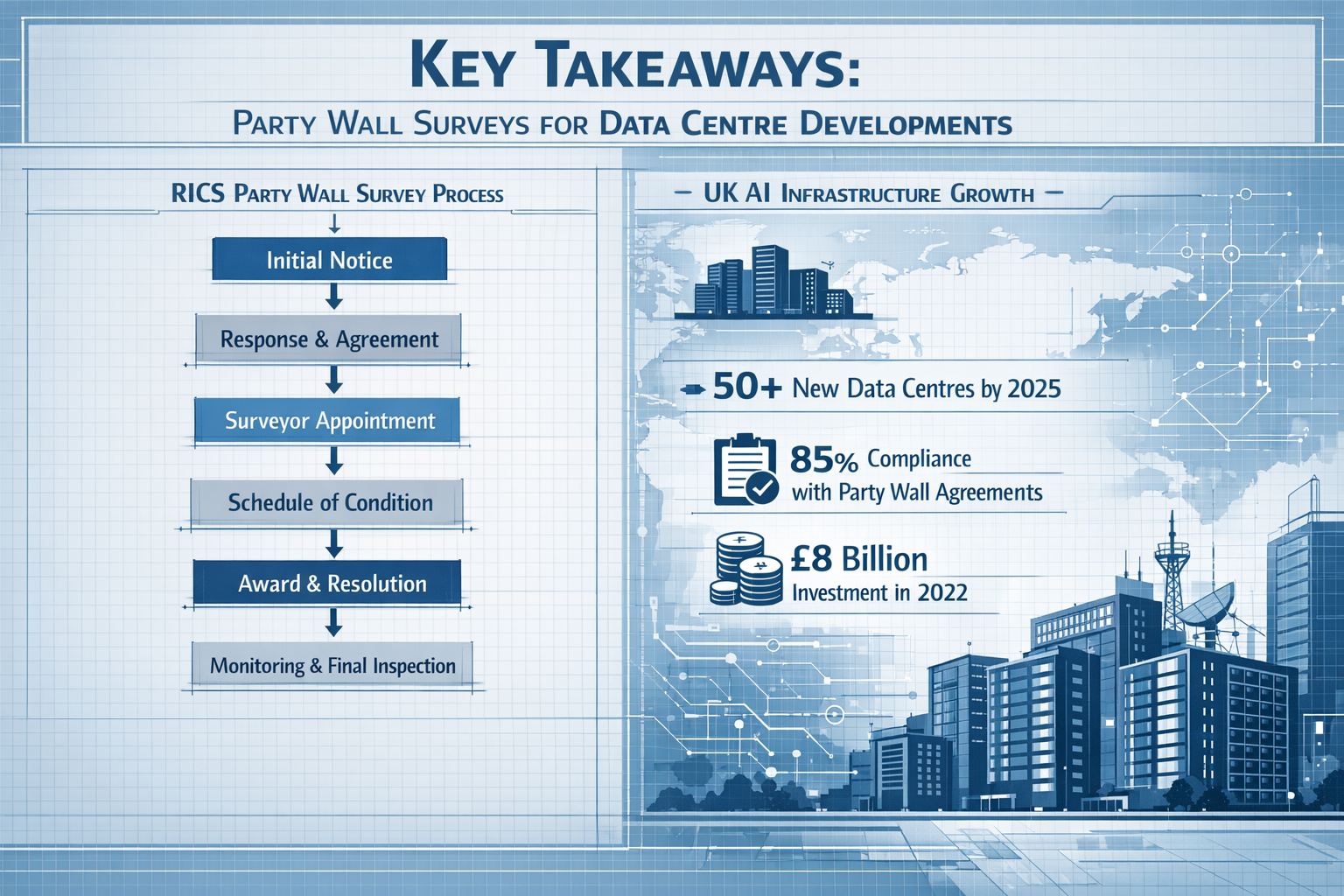
- RICS protocols provide authoritative guidance for party wall surveys in data centre developments, with specialized expertise from leading practitioners shaping 2026 best practices
- Section 2 notices require minimum 2-month advance notification for work on existing party walls, while excavation activities trigger additional formal procedures critical to data centre construction timelines
- Government reforms including AI Growth Zones and NPPF updates are accelerating data centre approvals, creating unprecedented demand for expert party wall surveyors
- Regional AI hubs outside London are experiencing significant data centre expansion, requiring surveyors to navigate party wall matters in diverse property contexts
- Professional surveyor involvement from project inception prevents costly disputes and ensures compliance with both Party Wall Act requirements and RICS standards
Understanding Party Wall Surveys for Data Centre Developments 🏗️
What Makes Data Centre Party Wall Surveys Unique?
Data centre developments present distinctive challenges that set them apart from conventional construction projects. These facilities demand massive structural loads to support server equipment, extensive excavation for cooling systems, and vibration-sensitive foundations—all factors that significantly impact party wall considerations.
The scale of modern data centres means they frequently occupy sites adjacent to existing commercial or industrial properties. This proximity necessitates rigorous party wall procedures to protect neighbouring structures from potential damage during construction. According to comprehensive guidance on party wall matters, these surveys must address:
- Deep excavation requirements for cooling infrastructure and cable routing
- Structural loading from heavy equipment affecting shared foundations
- Vibration management during piling and foundation work
- Access arrangements for ongoing maintenance and emergency repairs
- Thermal and acoustic insulation considerations at shared boundaries
The 2026 investment surge in data centre construction has prompted RICS experts to develop specialized protocols addressing these unique requirements [2].
The Party Wall etc. Act 1996: Core Requirements
The Party Wall etc. Act 1996 establishes three primary notice categories relevant to data centre developments:
Section 1: New Building on the Line of Junction
When constructing a new data centre directly on or astride the boundary line with an adjacent property, developers must serve notice. This scenario commonly arises in industrial estates where maximizing site coverage is essential.
Section 2: Work to Existing Party Walls
Modifications to existing shared walls—including cutting into, underpinning, or strengthening party structures—require minimum 2-month advance notice [3]. Data centre projects frequently trigger Section 2 requirements when adapting existing industrial buildings.
Section 6: Excavation and Construction
Perhaps most relevant to data centre developments, Section 6 governs excavation within three or six metres of neighbouring structures, depending on depth. Given the substantial foundation and cooling system requirements, virtually all new data centre builds trigger Section 6 procedures.
Understanding consent requirements for party wall work ensures developers initiate proper notification procedures before commencing construction.
RICS Standards and Professional Protocols
The Royal Institution of Chartered Surveyors (RICS) provides the authoritative framework for party wall surveying in the UK. Michael Cooper, Director at Cooper's Building Surveyors and RICS Fellow, serves as co-chair of the RICS boundaries and party wall panel and chairs the working group responsible for developing RICS party wall guides [1]. This leadership ensures protocols remain current with evolving construction practices.
RICS guidance emphasizes several critical principles for data centre party wall surveys:
| RICS Protocol Element | Application to Data Centres |
|---|---|
| Pre-construction condition surveys | Comprehensive documentation of adjacent properties before excavation |
| Structural monitoring | Real-time vibration and settlement tracking during foundation work |
| Professional independence | Appointed surveyors must act impartially despite being selected by parties |
| Award preparation | Detailed specifications for protective measures and construction methods |
| Dispute resolution | Structured procedures when neighbouring owners object to proposed works |
Irene Moore, Partner at Fetto Moore & Co with over 18 years of specialist experience in the Party Wall etc. Act 1996, contributed to the Fourth Edition of "The Party Wall Act Explained"—widely regarded as essential reading for surveyors navigating complex projects [1]. Her expertise reflects the sophisticated understanding required for high-stakes data centre developments.
Navigating Party Wall Surveys for Data Centre Developments: RICS Protocols in Practice
The Surveyor's Role in High-Stakes Projects
James Audsley, Chief Operating Officer at Hollis with over 20 years of industry experience, brings particular specialization in party wall and neighbourly matters [1]. His expertise exemplifies the professional calibre required for data centre projects where construction values often exceed £50 million and timeline delays carry substantial financial penalties.
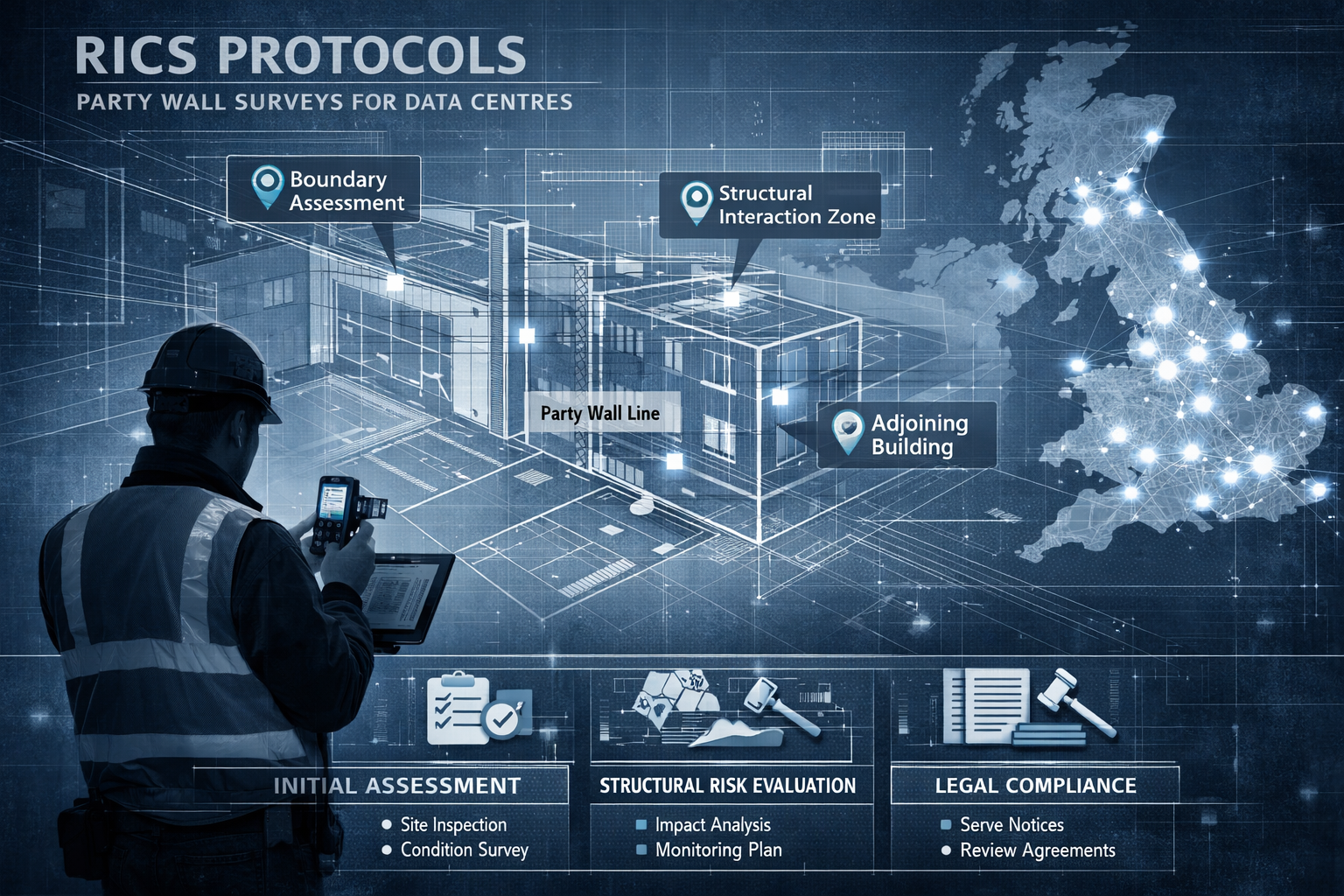
Chartered surveyors fulfilling party wall appointments in data centre developments typically undertake these responsibilities:
Initial Assessment and Notice Preparation
Surveyors conduct comprehensive site analysis to identify all party wall triggers, prepare accurate notice documentation, and ensure service complies with statutory requirements. For data centres, this includes detailed excavation plans showing proximity to neighbouring foundations.
Condition Surveys and Documentation
Before construction commences, surveyors prepare meticulous photographic and written records of adjacent properties. This baseline documentation proves essential if damage to property claims arise during or after construction.
Award Negotiation and Preparation
When neighbouring owners consent to proposed works, surveyors prepare party wall awards specifying construction methods, protective measures, working hours, and dispute resolution procedures. These legally binding documents provide certainty for all parties.
Construction Monitoring
Throughout the build phase, surveyors conduct regular inspections, review structural monitoring data, and ensure contractors comply with award specifications. For data centres, this often includes vibration monitoring during piling operations.
Case Study: Regional AI Hub Development
While London attracts significant attention, emerging AI hubs in Manchester, Birmingham, and Edinburgh are experiencing substantial data centre expansion. A 2026 project in the Manchester area illustrates typical party wall challenges [2].
Project Profile:
- 45,000 sq ft data centre facility
- Adjacent to operational logistics warehouse
- Excavation to 4.5 metres for cooling infrastructure
- Existing party wall requiring strengthening
Party Wall Survey Challenges:
The development team engaged RICS chartered surveyors to navigate complex party wall procedures. Key issues included:
- Excavation Proximity: Foundation works extended within three metres of the warehouse structure, triggering Section 6 requirements
- Structural Reinforcement: The existing party wall required underpinning to support additional loading, necessitating Section 2 notices
- Operational Continuity: The warehouse operator required 24/7 access, constraining construction scheduling
- Vibration Sensitivity: Storage racking systems in the warehouse required strict vibration limits during piling
Resolution Approach:
Appointed surveyors prepared comprehensive awards specifying:
- Real-time vibration monitoring with automatic work cessation thresholds
- Phased excavation methodology minimizing disturbance
- Temporary propping arrangements for party wall strengthening
- Weekly liaison meetings between construction teams and warehouse management
The project completed on schedule with zero substantiated damage claims—demonstrating how professional surveyor involvement prevents disputes and maintains project momentum.
Notice Timelines and Critical Deadlines ⏰
Understanding statutory notice periods is crucial for data centre developers working within aggressive construction schedules. The Party Wall etc. Act 1996 establishes minimum notification requirements:
Section 2 Notices (Work to Existing Party Walls)
- Minimum notice period: 2 months before work commences [3]
- Response deadline: Neighbouring owners have 14 days to consent or dissent
- Award preparation: If dissent occurs, surveyors must be appointed and awards prepared before work begins
Section 6 Notices (Excavation)
- Minimum notice period: 1 month before excavation commences
- Response deadline: 14 days for neighbouring owner response
- Immediate appointment: Surveyors should be engaged promptly if consent is not forthcoming
For data centre projects targeting the government's 12-month consent timeline for major infrastructure [4], these statutory periods must be integrated into critical path planning. Experienced surveyors recommend serving notices during the planning application phase to avoid delays between approval and construction commencement.
Developers should also consider that party wall costs typically include fees for both the building owner's surveyor and the adjoining owner's surveyor, plus potential award preparation expenses.
The 2026 UK AI Infrastructure Boom and Planning Reforms
Government Initiatives Driving Data Centre Growth 📈
The UK government has implemented sweeping reforms to accelerate data centre development in support of artificial intelligence infrastructure. These policy changes directly impact the volume and urgency of party wall surveys required across the sector.
National Planning Policy Framework (NPPF) Updates
The government updated the NPPF to bolster data centre construction by requiring local planning authorities to identify suitable locations for data centres and introducing a new grey belt policy avenue for development [4]. This proactive approach ensures land availability in strategic locations.
AI Growth Zones
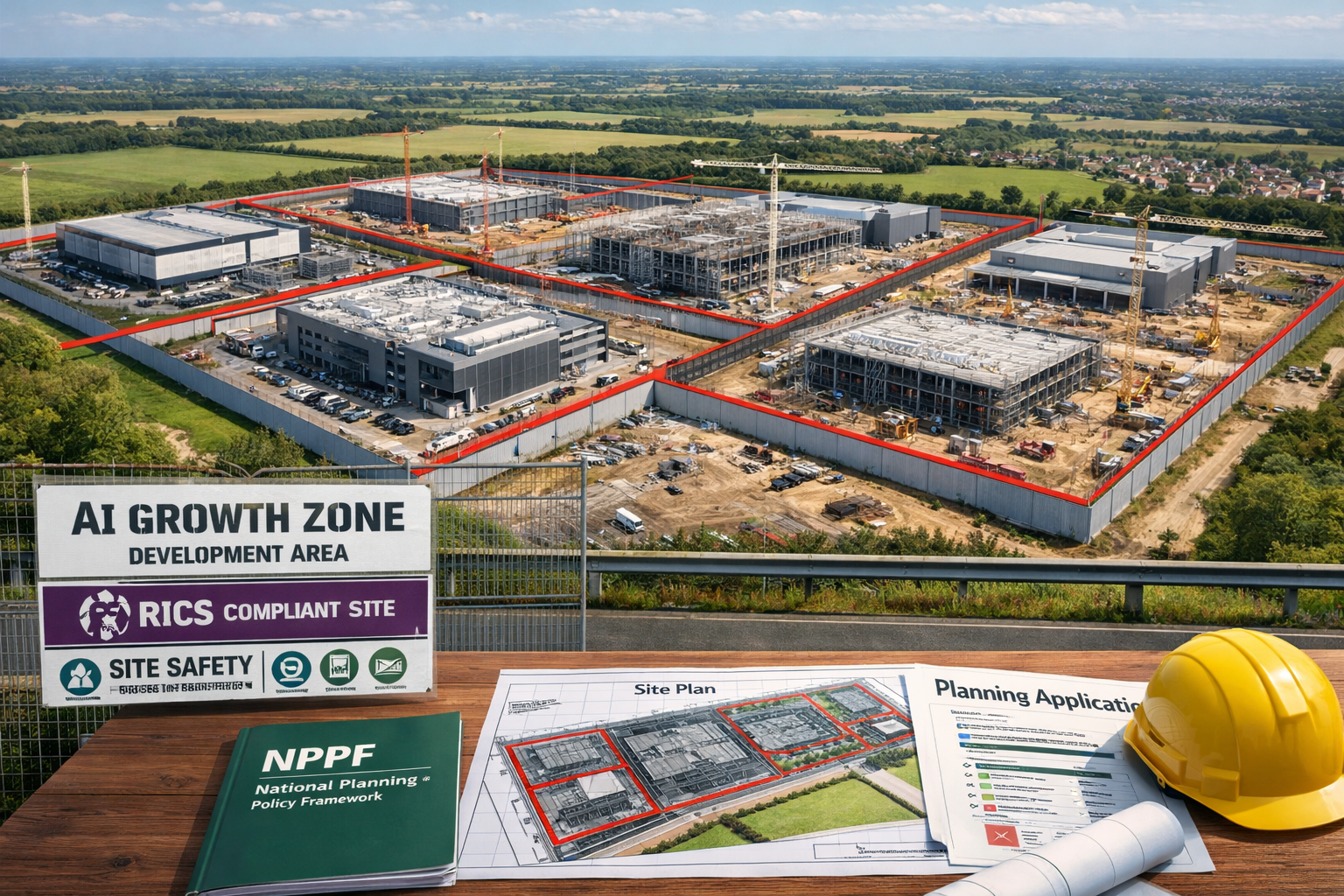
Draft Policy E1 requires development plans to allocate sites for data centres and take into account AI Growth Zones—geographic areas with strategic approaches to encourage data centre construction. This initiative reflects the Government's AI Opportunities Action Plan, with concrete designs issued in November 2025 [4].
These designated zones create clusters of data centre development, increasing the likelihood of multiple adjacent facilities sharing party walls and requiring coordinated surveyor involvement.
Streamlined Consenting Timelines
Perhaps most significantly, the government is exploring ways to cut consent timelines to 12 months for larger data centre projects under the Nationally Significant Infrastructure Project regime [4]. This acceleration places intense pressure on party wall procedures to proceed efficiently without compromising legal compliance or neighbouring owner protections.
Infrastructure Support Measures
Beyond planning reforms, the government has committed to:
- Reducing electricity costs for data centre operators
- Accelerating grid connection times to support rapid deployment
- Providing strategic site identification through local authority coordination
These measures collectively create an environment where data centre developments can proceed rapidly—provided party wall and other legal requirements are managed professionally from project inception.
Regional Distribution Beyond London 🗺️
While London and the South East maintain significant data centre presence, the 2026 boom extends across the UK. Emerging hubs include:
Northern Powerhouse Locations
- Manchester and surrounding areas
- Leeds and West Yorkshire
- Newcastle upon Tyne
Midlands Expansion
- Birmingham and Solihull
- Nottingham
- Leicester
Scottish Developments
- Edinburgh
- Glasgow
- Aberdeen (leveraging renewable energy access)
This geographic distribution means chartered surveyors across the UK require expertise in party wall procedures for data centre developments. Regional variations in property types—from converted industrial buildings to purpose-built facilities—demand adaptable surveying approaches.
For surveyors seeking to develop expertise in this growing sector, RICS commercial building surveys provide foundational knowledge applicable to data centre assessments.
Best Practices for Party Wall Surveys in Data Centre Developments
Early Engagement and Project Planning
The most successful data centre developments integrate party wall considerations from the earliest planning stages. Proactive surveyor engagement offers multiple advantages:
Risk Identification
Early site analysis identifies potential party wall complications before land acquisition or design finalization. This foresight allows developers to:
- Adjust site layouts to minimize party wall impacts
- Budget accurately for surveyor fees and potential compensation
- Establish realistic construction timelines incorporating statutory notice periods
Stakeholder Communication
Engaging neighbouring property owners early—even before formal notices—builds goodwill and facilitates smoother negotiations. Surveyors can explain proposed works, address concerns, and establish communication channels that prevent misunderstandings escalating into disputes.
Design Optimization
Structural engineers can modify foundation designs, excavation methodologies, and construction sequencing to reduce party wall impacts when surveyors are involved during the design phase.
Comprehensive Condition Surveys
Given the high-value nature of data centre projects and potential for significant structural work, condition surveys must be exceptionally thorough. Best practice includes:
Photographic Documentation
- High-resolution images of all elevations
- Detailed close-ups of existing defects
- Time-stamped and georeferenced photographs
- Video walkthroughs of interior spaces
Structural Assessment
- Crack monitoring and measurement
- Foundation exposure and assessment where accessible
- Structural loading capacity evaluation
- Identification of pre-existing movement or settlement
Services Documentation
- Location of utilities crossing party boundaries
- Drainage systems potentially affected by excavation
- Electrical and telecommunications infrastructure
Professional surveyors often commission structural surveys to supplement party wall condition assessments, particularly for older industrial buildings adjacent to new data centre sites.
Managing Disputes and Objections ⚖️
Despite best efforts, neighbouring owners sometimes object to proposed works or dispute aspects of party wall awards. RICS protocols provide structured dispute resolution mechanisms:
Third Surveyor Appointment
When the building owner's surveyor and adjoining owner's surveyor cannot reach agreement, they jointly appoint a third surveyor whose decision is binding. Selecting an experienced third surveyor with data centre expertise can expedite resolution.
Alternative Dispute Resolution
Before formal dispute procedures, mediation or expert determination may resolve disagreements more quickly and cost-effectively. This approach is particularly valuable when construction timelines are critical.
Award Variation Procedures
Circumstances may change during construction, requiring award modifications. Established procedures for varying awards prevent delays when unexpected conditions arise.
Understanding what constitutes a party wall dispute helps developers and surveyors recognize potential issues early and implement appropriate resolution strategies.
Technology and Monitoring Solutions 💻
Modern data centre party wall surveys leverage advanced technology for enhanced accuracy and real-time monitoring:
Vibration Monitoring Systems
Automated sensors track vibration levels during piling and excavation, providing instant alerts if thresholds are exceeded. This technology protects sensitive adjacent operations while documenting compliance with award specifications.
3D Laser Scanning
Pre-construction laser scanning creates precise digital models of adjacent structures, enabling accurate comparison with post-construction conditions and objective assessment of any movement or damage.
Structural Monitoring
Crack gauges, tiltmeters, and settlement monitoring points provide continuous data throughout construction, allowing early intervention if unexpected movement occurs.
Digital Documentation Platforms
Cloud-based systems enable real-time sharing of inspection reports, monitoring data, and photographic evidence between all parties, improving transparency and communication.
Regulatory Compliance and Professional Standards
Beyond Party Wall Act compliance, data centre developments must satisfy multiple regulatory requirements:
Building Regulations
Party wall works must comply with Building Regulations, particularly regarding fire resistance, structural integrity, and sound insulation. Surveyors coordinate with building control to ensure awards specify compliant construction methods.
CDM Regulations
Construction (Design and Management) Regulations require health and safety considerations throughout the project lifecycle. Party wall awards should address safe working methods, particularly for excavation and underpinning operations.
Environmental Considerations
Data centres' cooling and power requirements may impact drainage, groundwater, and noise levels affecting neighbouring properties. Party wall surveyors coordinate with environmental consultants to address these concerns comprehensively.
Engaging local chartered surveyors with knowledge of regional planning authorities and building control practices ensures developments navigate all regulatory requirements efficiently.
Future Outlook: Party Wall Surveys for Data Centre Developments
Emerging Trends in 2026 and Beyond
The intersection of AI infrastructure expansion and party wall legislation continues evolving. Several trends are shaping the future landscape:
Increased Surveyor Specialization
As data centre developments become more prevalent, surveyors are developing niche expertise in this sector. Professional bodies including RICS are likely to introduce specialized training and accreditation for data centre party wall work.
Standardized Protocols
Industry collaboration between developers, surveyors, and government agencies may produce standardized party wall protocols specifically for data centre projects, reducing negotiation time and establishing consistent best practices.
Enhanced Monitoring Technology
Artificial intelligence and IoT sensors will enable more sophisticated structural monitoring, providing predictive analytics that identify potential issues before damage occurs.
Sustainability Integration
As data centres face increasing pressure to demonstrate environmental responsibility, party wall surveys will incorporate sustainability assessments, including thermal efficiency of shared walls and renewable energy infrastructure implications.
Professional Development Opportunities 📚
For chartered surveyors, the data centre boom presents significant professional opportunities. The RICS Building Surveying Conference 2026 features leading party wall experts sharing insights from recent projects [1], providing valuable continuing professional development.
Surveyors seeking to enter this specialized field should:
- Pursue RICS party wall training and accreditation
- Develop understanding of data centre technical requirements
- Build relationships with data centre developers and operators
- Stay current with planning policy reforms and AI Growth Zone designations
- Participate in professional networks and knowledge-sharing forums
The convergence of technological infrastructure demands and traditional property law creates a unique professional niche where expertise commands premium fees and offers intellectually stimulating challenges.
Conclusion
Party Wall Surveys for Data Centre Developments: RICS Protocols Amid UK AI Infrastructure Boom represents a critical intersection of traditional property law and cutting-edge technological infrastructure. As 2026 unfolds, the government's ambitious AI Growth Zones, streamlined planning processes, and 12-month consent timelines are accelerating data centre construction across the UK—from London to emerging regional hubs in Manchester, Birmingham, and Edinburgh.
The Party Wall etc. Act 1996 remains unchanged, requiring developers to navigate statutory notice periods, surveyor appointments, and award preparations regardless of project urgency. RICS protocols, shaped by leading experts including Michael Cooper, Irene Moore, and James Audsley, provide authoritative guidance ensuring these high-stakes developments proceed compliantly while protecting neighbouring property owners.
Key Success Factors 🎯
Successful party wall management in data centre developments requires:
- Early surveyor engagement during planning and design phases
- Comprehensive condition surveys documenting pre-construction property status
- Professional expertise from RICS chartered surveyors with data centre experience
- Advanced monitoring technology tracking vibration, settlement, and structural movement
- Proactive communication with neighbouring owners and stakeholders
- Integrated timeline planning accommodating statutory notice periods within aggressive construction schedules
Actionable Next Steps
For Data Centre Developers:
- Engage RICS chartered surveyors during site selection and feasibility stages
- Integrate party wall notice periods into critical path planning
- Budget appropriately for professional surveyor fees and potential compensation
- Establish communication protocols with neighbouring property owners
- Implement comprehensive monitoring systems from construction commencement
For Property Owners Adjacent to Proposed Data Centres:
- Understand your rights under the Party Wall etc. Act 1996
- Appoint an experienced RICS surveyor if you receive party wall notices
- Document your property's current condition independently
- Engage constructively with developers while protecting your interests
- Seek professional advice before consenting to or disputing proposed works
For Chartered Surveyors:
- Pursue specialized training in data centre party wall procedures
- Develop technical understanding of data centre construction requirements
- Build professional networks within the AI infrastructure sector
- Stay current with NPPF reforms and AI Growth Zone developments
- Attend industry conferences and continuing professional development events
The UK's AI infrastructure boom presents unprecedented opportunities and challenges. By combining RICS professional standards with specialized data centre expertise, chartered surveyors play an indispensable role in delivering the technological infrastructure underpinning the nation's digital future—while ensuring traditional property protections remain robust and effective.
For comprehensive guidance on party wall matters and professional surveying services, explore our party wall resources and connect with experienced RICS chartered surveyors who understand the unique demands of data centre developments in 2026's dynamic infrastructure landscape.
References
[1] Rics Building Surveying Conference – https://www.rics.org/training-events/conferences/rics-building-surveying-conference
[2] Party Wall Surveys For Data Centre Expansions In The Uk Ai Boom Rics Guidance And Case Studies From 2026 Projects – https://nottinghillsurveyors.com/blog/party-wall-surveys-for-data-centre-expansions-in-the-uk-ai-boom-rics-guidance-and-case-studies-from-2026-projects
[3] Party Wall Surveys For Data Centre Expansions Navigating Agreements In The 2026 Investment Surge – https://nottinghillsurveyors.com/blog/party-wall-surveys-for-data-centre-expansions-navigating-agreements-in-the-2026-investment-surge
[4] 102mh6w What Does The New Nppf Mean For Data Centres – https://www.charlesrussellspeechlys.com/en/insights/quick-reads/102mh6w-what-does-the-new-nppf-mean-for-data-centres/