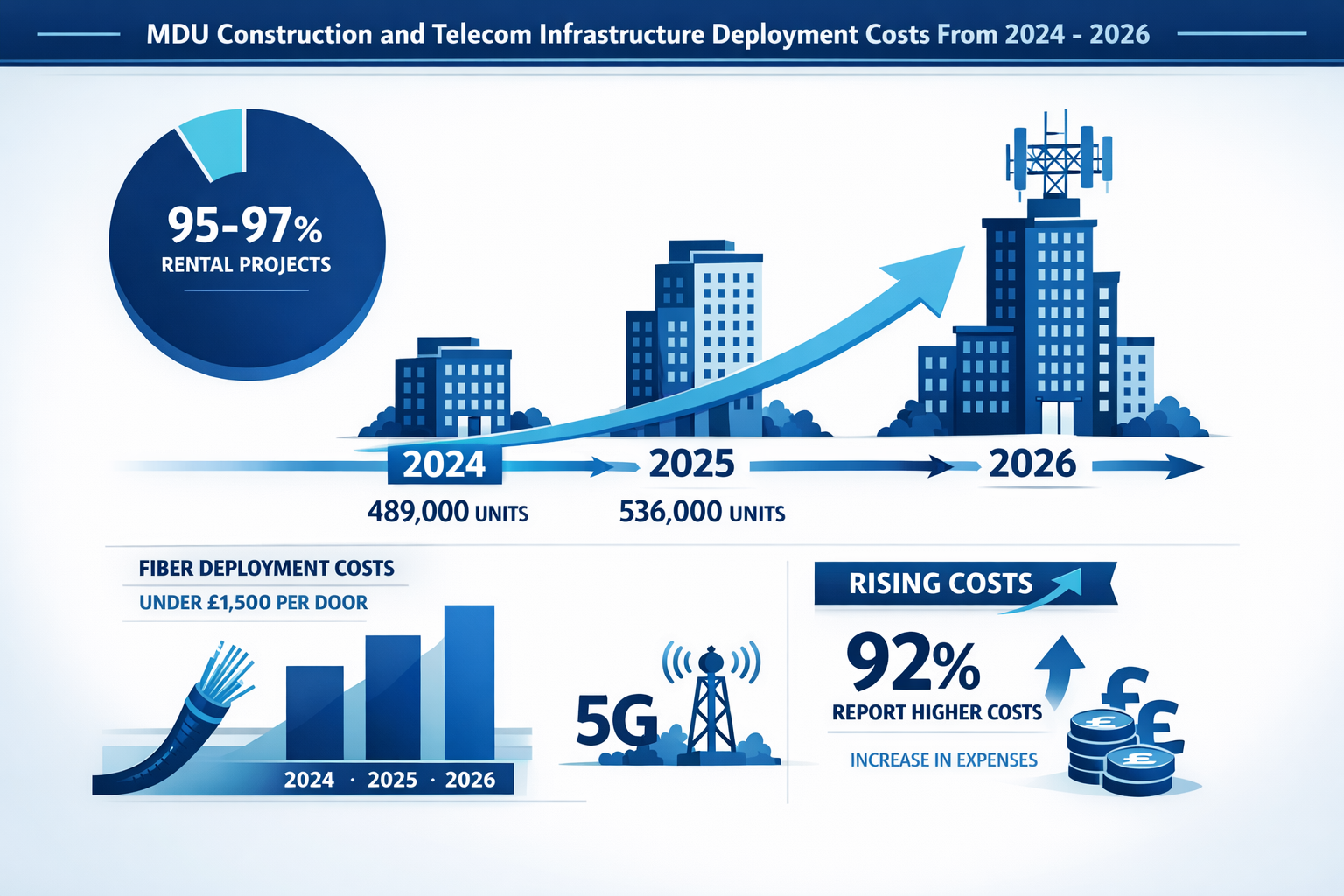
Multi-dwelling unit (MDU) construction surged nearly 10 percent from 489,000 units in 2024 to an estimated 536,000 in 2025, with 38 percent of all new dwelling units now located in large apartment buildings[1]. This construction boom coincides with an unprecedented demand for digital infrastructure—5G networks, fiber-optic broadband, and advanced connectivity systems—that rivals the recent push for EV charging stations. As Party Wall Surveys for 5G and Fibre in Multi-Occupancy: Beyond EV Chargers to 2026 Connectivity Booms becomes a critical concern, property owners, developers, and surveyors must navigate complex structural and legal requirements to accommodate this digital transformation.
The installation of telecommunications infrastructure in multi-occupancy buildings presents unique challenges under the Party Wall Act 1996. Unlike standalone properties, residential blocks require careful coordination between multiple stakeholders, rigorous structural assessments, and RICS-compliant documentation to prevent disputes and ensure building integrity. With 95-97 percent of new MDU construction designated for rental apartments[1], landlords and property managers face mounting pressure to deliver high-speed connectivity while maintaining compliance with party wall legislation.

Key Takeaways
- MDU construction growth has accelerated dramatically, with 536,000 units built in 2025, creating unprecedented demand for telecom infrastructure in shared-wall properties
- RICS-compliant party wall procedures are essential when installing 5G equipment and fiber cables through or adjacent to party walls in multi-occupancy buildings
- Deployment costs are rising, with 92 percent of industry respondents reporting higher fiber installation costs in 2025 and 88 percent expecting further increases in 2026[3][5]
- Proper party wall notices must address structural loading, fire safety, cable routing, and long-term maintenance access for telecommunications equipment
- Professional surveyor involvement reduces dispute risks and ensures installations meet both Party Wall Act requirements and modern connectivity standards
Understanding Party Wall Requirements for Telecommunications Infrastructure
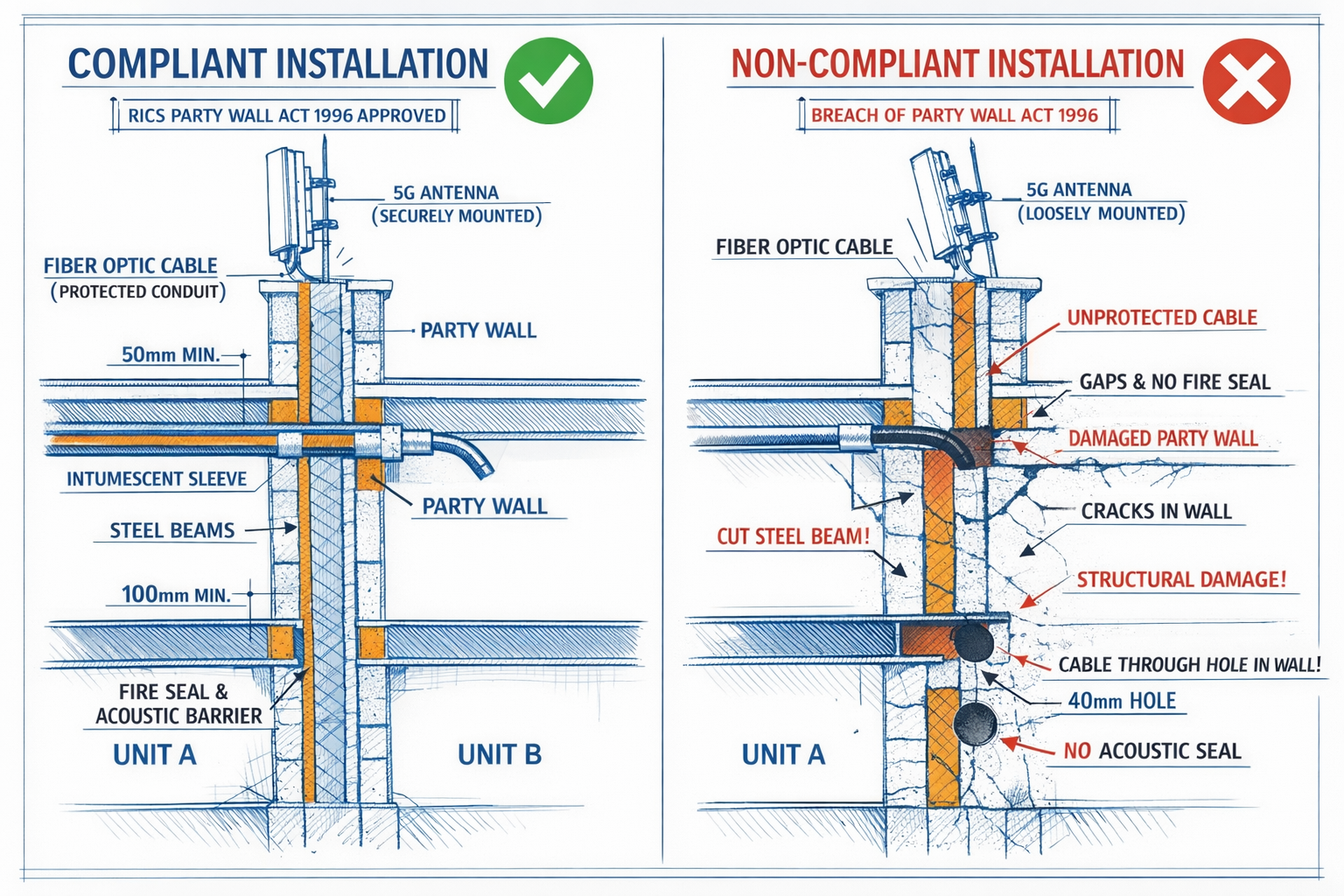
The Party Wall Act 1996 governs work affecting shared walls, boundary structures, and excavations near neighbouring properties throughout England and Wales. When installing 5G and fibre infrastructure in multi-occupancy buildings, property owners must serve appropriate notices before commencing work that involves:
- Cutting into party walls to route fiber-optic cables or install cable management systems
- Attaching equipment such as distribution panels, antenna mounts, or junction boxes to shared structures
- Adding structural loads from telecommunications equipment that may affect wall integrity
- Creating penetrations for cable entry/exit points between units or common areas
Types of Party Wall Notices for Telecom Installations
Different installation scenarios require specific notice types under the Act:
Party Structure Notice (Section 2): Required when cutting into, altering, or attaching equipment directly to a party wall. This applies to most fiber cable installations that penetrate shared walls between residential units.
Line of Junction Notice (Section 1): Necessary when building new structures along property boundaries, such as external equipment cabinets or antenna support structures that straddle the boundary line.
Notice of Adjacent Excavation (Section 6): Applicable when installing underground fiber conduits or telecommunications infrastructure within three meters of a neighbouring building's foundation. Understanding what is the three meter rule helps determine when this notice applies.
Notice Periods and Response Requirements
Property owners must provide at least two months' notice for party structure work and one month's notice for line of junction work. Affected neighbours have 14 days to respond with:
- Consent to the proposed work
- Dissent, triggering the party wall award process
- No response, which constitutes deemed dissent after 14 days
When disputes arise, both parties must appoint surveyors (or agree on a single agreed surveyor) to prepare a party wall award documenting the work scope, protective measures, and condition schedules.
The 2026 Connectivity Boom: Market Drivers and Cost Implications
The telecommunications infrastructure landscape has transformed dramatically as digital connectivity becomes as essential as electricity and water. The convergence of multiple technology trends creates what industry experts call the "2026 connectivity boom"—a period of intensive infrastructure deployment across residential properties.
Rising Deployment Costs Across the Industry
While fiber deployment costs in MDUs remain relatively affordable—typically under $1,500 per apartment door and often below $1,000 in new construction near existing fiber lines[1]—the broader industry faces significant cost pressures. Survey data reveals that 92 percent of respondents reported higher deployment costs in 2025, with nearly one-third citing "significantly" higher expenses[3][5]. Looking ahead, 88 percent expect costs to increase again in 2026, driven primarily by:
- Labour shortages in specialized telecommunications installation trades
- Materials cost inflation affecting fiber cables, conduits, and mounting hardware
- Compliance requirements including enhanced fire-stopping and structural certification
- Supply chain disruptions impacting equipment availability and lead times
These cost pressures make proper planning and party wall compliance even more critical. Avoiding disputes and installation delays through professional surveyor involvement can offset rising material and labour costs. Understanding typical party wall survey costs helps property owners budget appropriately for compliant installations.
5G Infrastructure Deployment Patterns
The wireless industry built approximately 900-1,200 new macro towers in 2025[2], but the real growth occurs in distributed antenna systems (DAS) and small cell networks within buildings. Multi-occupancy properties increasingly require:
- In-building 5G small cells mounted on party walls and common area structures
- Distributed antenna systems with cable runs through multiple units
- Equipment rooms housing power supplies, signal processors, and distribution equipment
- Rooftop installations requiring structural assessments and potential party wall implications
Each installation type presents unique party wall considerations, particularly regarding structural loading, electromagnetic compatibility, and long-term maintenance access.
Fiber-to-the-Premises (FTTP) Acceleration
Government broadband initiatives and consumer demand drive aggressive fiber deployment schedules. Property managers report installation requests for:
- Gigabit-capable fiber to individual units
- Redundant fiber pathways for business-grade reliability
- Future-proofed conduit systems accommodating multiple service providers
- Common area networking supporting smart building systems
The rental-dominated MDU market (95-97 percent of new construction[1]) creates particular challenges, as landlords must balance tenant connectivity demands against capital expenditure constraints and party wall compliance obligations.
RICS-Compliant Structural Assessments for Telecom Installations
Professional chartered surveyors play a crucial role in ensuring telecommunications infrastructure installations meet both Party Wall Act requirements and structural safety standards. The Royal Institution of Chartered Surveyors (RICS) provides guidance frameworks that surveyors follow when assessing telecom-related party wall work.
Pre-Installation Structural Surveys
Before serving party wall notices, property owners should commission comprehensive structural assessments covering:
Load-Bearing Capacity Analysis: Evaluating whether party walls can support additional equipment weight from fiber distribution panels, 5G antenna arrays, or cable management systems. This assessment considers existing structural loads, wall construction materials, and foundation adequacy.
Cable Routing Feasibility: Identifying optimal pathways for fiber cables that minimize structural impact while maintaining fire compartmentation. Surveyors assess whether existing service voids, risers, or conduits can accommodate new cables without compromising building integrity.
Fire Safety Compliance: Ensuring cable penetrations through party walls maintain required fire resistance ratings. This involves specifying appropriate fire-stopping materials and installation methods that preserve the wall's fire barrier function.
Electromagnetic Compatibility: Assessing potential interference between telecommunications equipment and existing building systems, particularly relevant for 5G installations near sensitive equipment.
Professional structural surveys provide the technical foundation for party wall notices and subsequent awards, documenting baseline conditions and identifying potential risks.
Schedule of Condition Documentation
RICS guidance emphasizes thorough photographic and written documentation of party wall conditions before telecom installation work begins. Comprehensive schedules should capture:
- Existing cracks, defects, or deterioration in party walls and adjacent structures
- Current cable installations and service penetrations
- Decorative finishes on both sides of party walls
- Structural elements potentially affected by new installations
This documentation protects all parties by establishing clear baseline conditions, making it possible to distinguish pre-existing issues from installation-related damage. When party wall disputes arise, detailed schedules provide objective evidence for resolution.
Ongoing Monitoring Requirements
Complex telecommunications installations may require monitoring surveys to track structural response during and after installation. This proves particularly important when:
- Installing heavy equipment on party walls with questionable load capacity
- Routing extensive cable bundles through older masonry structures
- Working near properties with existing structural concerns or subsidence history
- Conducting work in buildings with non-standard construction methods
Monitoring surveys establish measurement protocols and trigger thresholds for intervention if unexpected movement or damage occurs.
Addressing Common Party Wall Complications in MDU Telecom Projects
Multi-occupancy telecommunications installations frequently encounter specific complications that require careful management and professional surveyor expertise.
Multiple Adjoining Owners
Unlike single-family properties, MDU projects may require serving party wall notices to dozens or even hundreds of adjoining owners. This creates logistical challenges including:
- Coordinating response timelines from multiple parties with varying levels of understanding
- Managing dissenting owners who may have different concerns or objections
- Appointment of multiple surveyors when different owners choose different representatives
- Reconciling conflicting requirements in the resulting party wall award
Professional project management and clear communication strategies prove essential for navigating these multi-party scenarios effectively.
Access Rights and Long-Term Maintenance
Telecommunications infrastructure requires ongoing maintenance, upgrades, and occasional repairs throughout its operational lifetime. Party wall awards should explicitly address:
- Routine maintenance access rights and notification procedures
- Emergency repair protocols for service-affecting failures
- Equipment upgrade pathways as technology evolves
- Decommissioning responsibilities when systems reach end-of-life
Failing to establish clear access rights during initial installation can lead to future disputes when maintenance becomes necessary. Understanding potential obstructions in party walls helps anticipate access challenges.
Leaseholder vs. Freeholder Responsibilities
In leasehold properties, the division of responsibilities between leaseholders and freeholders adds complexity to party wall procedures. Key considerations include:
- Who serves the notice: Typically the party undertaking the work, but lease terms may specify freeholder involvement
- Cost allocation: Whether installation costs fall to individual leaseholders, the freeholder, or telecommunications providers
- Consent requirements: Some leases require freeholder permission before leaseholders can consent to party wall work
- Service charge implications: How ongoing maintenance costs integrate with building service charges
Reviewing lease terms before commencing party wall procedures prevents procedural errors that could invalidate notices or awards.
Dealing with Non-Responsive Neighbours
In large MDUs, some adjoining owners inevitably fail to respond to party wall notices within the statutory 14-day period. When this occurs, deemed dissent triggers the party wall award process automatically. Strategies for managing non-responsive neighbours include:
- Multiple contact methods: Serving notices via recorded delivery, hand delivery, and electronic communication where permitted
- Clear, accessible language: Avoiding technical jargon that might confuse recipients unfamiliar with party wall procedures
- Proactive surveyor appointment: Moving quickly to appoint surveyors once deemed dissent occurs
- Transparent communication: Keeping all parties informed throughout the process
The consequences of proceeding without a party wall agreement can include injunctions, work stoppages, and liability for resulting damage.
Best Practices for Telecom Infrastructure Party Wall Projects
Property owners, developers, and telecommunications providers can maximize project success by following established best practices for party wall compliance in MDU connectivity projects.
Early Surveyor Engagement
Engaging qualified chartered surveyors during project planning—before serving party wall notices—provides significant advantages:
- Accurate scope definition that identifies all party wall implications early
- Realistic timeline development accounting for notice periods and potential disputes
- Cost estimation including surveyor fees, protective measures, and contingency allowances
- Risk identification highlighting potential complications before they become problems
Early surveyor involvement often reduces overall project costs by preventing expensive delays and disputes.
Comprehensive Technical Specifications
Party wall notices and awards should include detailed technical specifications for telecommunications installations, covering:
Cable Types and Routing: Specifying fiber cable specifications, protective conduits, and exact routing pathways through party structures. This prevents ambiguity about approved work scope.
Mounting Methods: Documenting approved fixings, brackets, and attachment methods that preserve party wall integrity while supporting equipment loads.
Fire-Stopping Details: Specifying approved fire-stopping products, installation methods, and certification requirements for cable penetrations.
Protective Measures: Outlining dust control, vibration limits, noise restrictions, and working hours to minimize disruption to adjoining owners.
Quality Standards: Referencing relevant British Standards, telecommunications industry standards, and manufacturer specifications.
Stakeholder Communication Strategies
Successful MDU telecommunications projects require clear communication with multiple stakeholder groups:
Adjoining Owners: Providing plain-language explanations of proposed work, expected benefits, potential disruptions, and party wall procedures. Offering Q&A sessions or information meetings can prevent misunderstandings.
Building Managers: Coordinating installation schedules with building operations, resident activities, and other concurrent projects.
Telecommunications Contractors: Ensuring installation teams understand party wall award requirements and work within approved parameters.
Regulatory Bodies: Maintaining compliance with building control, planning requirements, and telecommunications regulations alongside party wall obligations.
Documentation and Record-Keeping
Maintaining comprehensive project documentation proves invaluable if disputes arise or future work becomes necessary:
- Complete notice records including service dates, delivery confirmations, and responses
- Photographic evidence of pre-work conditions, installation progress, and completed work
- Correspondence files documenting all communications with adjoining owners and surveyors
- As-built drawings showing actual cable routes, equipment locations, and structural modifications
- Certification documents confirming fire-stopping, electrical safety, and structural adequacy
Digital documentation systems with cloud backup ensure records remain accessible throughout the infrastructure's operational lifetime.
Future-Proofing Multi-Occupancy Buildings for Evolving Connectivity Demands
As telecommunications technology continues evolving rapidly, forward-thinking property owners and developers incorporate flexibility into party wall agreements and infrastructure designs.
Anticipating Technology Evolution
Current 5G and fiber installations represent snapshots of 2026 technology, but connectivity demands will continue growing. Party wall awards should consider:
- Upgrade pathways allowing future equipment replacements without requiring new party wall procedures
- Capacity margins in cable routes and equipment spaces accommodating additional services
- Modular designs enabling incremental expansion as tenant demands increase
- Technology-neutral language avoiding specifications that become obsolete quickly
Building in flexibility during initial installations reduces future party wall complications and associated costs.
Sustainable Infrastructure Approaches
Environmental considerations increasingly influence telecommunications infrastructure decisions. Sustainable approaches include:
- Energy-efficient equipment reducing ongoing operational costs and environmental impact
- Shared infrastructure allowing multiple service providers to use common cable routes and equipment spaces
- Recyclable materials in cable management systems and mounting hardware
- Minimal structural intervention preserving building fabric and reducing waste
These approaches align with broader sustainability goals while potentially reducing party wall survey costs through simplified installations.
Regulatory Horizon Scanning
The regulatory landscape governing telecommunications infrastructure continues evolving. Property owners should monitor:
- Building Regulations updates affecting fire safety, structural requirements, and accessibility
- Telecommunications legislation potentially streamlining deployment procedures or imposing new obligations
- Planning policy changes affecting equipment visibility, antenna siting, and infrastructure sharing
- Party Wall Act interpretations through case law and professional guidance updates
Staying informed about regulatory developments helps property owners maintain compliance and anticipate future requirements.
Conclusion: Navigating the Connectivity Infrastructure Challenge
The convergence of surging MDU construction, accelerating telecommunications deployment, and rising infrastructure costs creates a complex environment for property owners and developers in 2026. Successfully navigating Party Wall Surveys for 5G and Fibre in Multi-Occupancy: Beyond EV Chargers to 2026 Connectivity Booms requires professional expertise, careful planning, and rigorous compliance with Party Wall Act requirements.
The statistics tell a compelling story: 536,000 MDU units built in 2025[1], 92 percent of deployers facing higher costs[3][5], and 88 percent expecting further increases in 2026[3][5]. Against this backdrop, proper party wall procedures become not just legal obligations but strategic necessities for project success.
Actionable Next Steps
Property owners planning telecommunications infrastructure installations in multi-occupancy buildings should:
- Engage qualified chartered surveyors early in project planning to assess party wall implications and structural requirements
- Commission comprehensive structural surveys documenting baseline conditions and identifying potential complications
- Develop detailed technical specifications for installations that satisfy both party wall requirements and connectivity objectives
- Serve appropriate party wall notices with sufficient lead time to accommodate statutory response periods and potential disputes
- Establish clear communication channels with all stakeholders including adjoining owners, building managers, and contractors
- Document thoroughly throughout the project lifecycle to protect all parties' interests
- Plan for long-term access and maintenance requirements in party wall awards
The digital infrastructure demands of modern residential properties show no signs of slowing. By combining professional surveyor expertise with proactive party wall compliance, property owners can deliver the connectivity residents demand while protecting structural integrity and maintaining positive neighbour relationships. The 2026 connectivity boom presents both challenges and opportunities—success depends on navigating party wall requirements with the same sophistication applied to the technology itself.
For property owners facing telecommunications infrastructure projects in multi-occupancy buildings, professional guidance from experienced chartered surveyors provides the foundation for compliant, successful installations that meet both legal requirements and connectivity objectives.
References
[1] Good News For Deployers New Mdu Construction Is Strong – https://bbcmag.com/good-news-for-deployers-new-mdu-construction-is-strong/
[2] A 6000 Macro Tower Build Could Kick Off The Next U S Rural Infrastructure Cycle – https://wirelessestimator.com/articles/2026/a-6000-macro-tower-build-could-kick-off-the-next-u-s-rural-infrastructure-cycle/
[3] Broadband Bytes January 2026 Issue 2 – https://uclswiftna.com/broadband-bytes-january-2026-issue-2/
[4] 2026 Predictions How Wireless Experts See In Building Connectivity Evolving – https://wia.org/2026-predictions-how-wireless-experts-see-in-building-connectivity-evolving/
[5] Us Fibre Industry Sees Rising Build Costs In 2026 – https://www.telecoms.com/fibre/us-fibre-industry-sees-rising-build-costs-in-2026