

The United Kingdom stands at the threshold of an unprecedented retrofit revolution in 2026. With an estimated 25 million homes requiring energy improvements to meet evolving Energy Performance Certificate (EPC) standards[3], property owners and developers face a complex landscape where energy efficiency goals intersect with legal obligations under the Party Wall Act 1996. As homeowners rush to upgrade insulation, install heat pumps, and improve thermal performance, many overlook a critical compliance requirement: party wall surveys and agreements.
Understanding Party Wall Surveys for 2026 Retrofit Boom: Compliance Checklists Amid EPC Mandates and Quality Summit Insights has never been more essential. The convergence of mandatory EPC upgrades, heightened construction activity, and stricter enforcement of party wall legislation creates a perfect storm of potential disputes. Professional surveyors now integrate thermal imaging technology, compliance assessments, and detailed retrofit cost projections into their building surveys[4], offering property owners comprehensive strategies to navigate this challenging environment.
This article leverages insights from recent retrofit quality summits and EPC requirement updates to outline strategic party wall notice approaches that prevent disputes while facilitating essential energy upgrade projects.
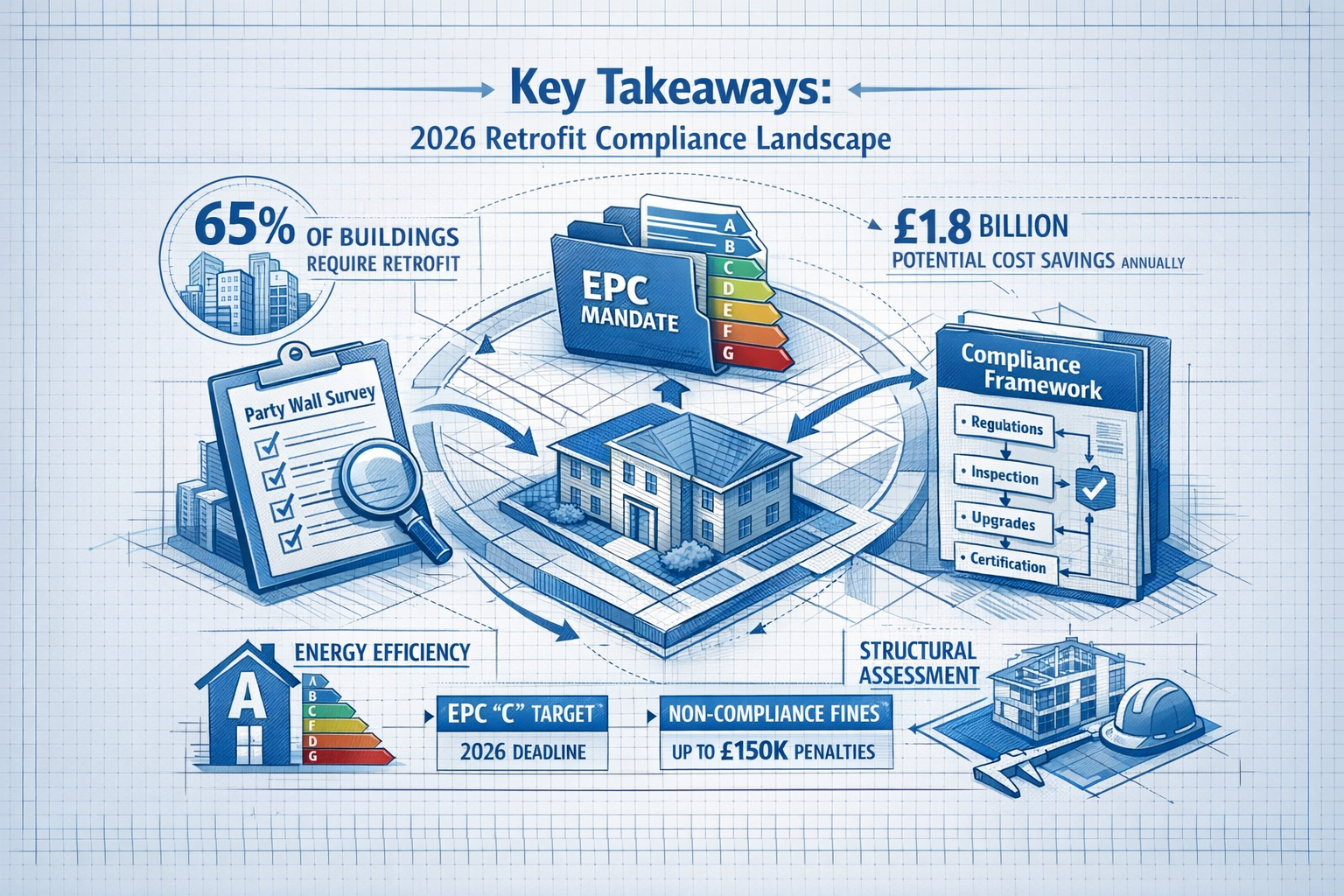
Key Takeaways
✅ Notice Requirements Are Non-Negotiable: Building along boundaries, excavating near neighbouring properties, or altering party structures during retrofit work requires formal party wall agreements—failure to serve proper notices can halt projects and trigger costly disputes.
✅ Integration Saves Time and Money: Modern surveyors combine party wall assessments with thermal surveys and EPC evaluations, providing comprehensive compliance checklists that address both legal obligations and energy performance goals in a single process.
✅ Early Engagement Prevents Delays: Serving party wall notices two months before commencing retrofit work allows sufficient time for neighbour consent, surveyor appointments, and award preparation—critical for meeting 2026 EPC deadlines.
✅ Documentation Protects All Parties: Detailed schedules of condition completed before retrofit work begins establish baseline property status, preventing unfounded damage claims and facilitating smooth dispute resolution.
✅ Professional Guidance Is Essential: With party wall awards costing approximately £1,000 and surveyors charging £150-£200 per hour[1], investing in expert advice early prevents exponentially higher costs from project delays, legal disputes, and compliance failures.
Understanding the 2026 Retrofit Landscape and Party Wall Implications
The Scale of the Retrofit Challenge
The retrofit imperative facing UK property owners in 2026 represents the largest coordinated residential improvement programme in modern history. RICS standards effective from October 31, 2024, establish comprehensive frameworks for energy efficiency improvements[3], creating both opportunities and obligations for millions of homeowners. This massive undertaking particularly affects properties built before modern insulation standards, including the vast majority of terraced houses, semi-detached properties, and converted flats where party walls are prevalent.
The 2026 construction boom[2] intensifies scrutiny on party wall agreements as neighbours simultaneously pursue retrofit projects. This creates unique challenges: multiple concurrent works affecting shared structures, competing timelines for EPC compliance, and heightened sensitivity to disruption as entire streets undergo transformation.
What Constitutes Party Wall Work in Retrofit Projects
Not all retrofit improvements trigger party wall obligations, but many common energy efficiency measures do. Understanding which works require formal agreements prevents costly mistakes and project delays.
Works requiring party wall agreements include:
- 🏗️ External wall insulation (EWI) that builds up to or along the boundary line
- 🔨 Cavity wall insulation involving drilling or injection near party walls
- 🏠 Loft conversions affecting shared roof structures or party walls
- ⚡ Structural alterations to install heat pumps or ventilation systems on party walls
- 🔧 Excavation work for ground source heat pumps within specified distances of neighbouring foundations
- 🧱 Underpinning or foundation work related to basement insulation projects
Conversely, minor works not requiring party wall agreements include internal plastering, electrical work, installing shelving, or purely cosmetic improvements that don't affect the structural integrity or load-bearing capacity of party walls[1].
For property owners planning insulation in a party wall, understanding these distinctions prevents compliance failures that could derail entire retrofit programmes.
EPC Mandates Driving Retrofit Activity
Energy Performance Certificate requirements continue tightening across residential and commercial sectors. Rental properties face minimum EPC rating requirements, while homeowners increasingly pursue upgrades to reduce energy costs and enhance property values. These mandates create urgency that sometimes leads to rushed decision-making regarding party wall compliance.
The integration of EPC assessments with party wall surveys offers a strategic advantage. Professional surveyors now provide comprehensive evaluations that identify both energy efficiency opportunities and party wall obligations simultaneously[4], enabling property owners to plan holistic improvement programmes that address all regulatory requirements efficiently.
Party Wall Surveys for 2026 Retrofit Boom: Strategic Notice Procedures and Compliance Frameworks
The Three Types of Party Wall Notices
The Party Wall Act 1996 establishes three distinct notice categories, each applicable to different retrofit scenarios. Understanding which notice applies to specific works forms the foundation of compliance.
Section 1 Notices cover new building work along or astride the boundary line. For retrofit projects, this typically applies when external wall insulation extends to the property boundary or when constructing new structures to house heat pump equipment.
Section 2 Notices address works to existing party walls, including cutting into walls for insulation, installing new damp-proof courses, or raising party walls for loft conversions. This represents the most common notice type for retrofit projects affecting terraced and semi-detached properties.
Section 6 Notices (excavation notices) apply when digging within specified distances of neighbouring buildings. The critical thresholds are:
- Within 3 meters of a neighbour's structure and deeper than its foundations
- Within 6 meters and below a 45-degree plane from the bottom of neighbouring foundations
Ground source heat pump installations frequently trigger Section 6 requirements. Property owners should review notice for excavation near a neighbour guidance and understand what is the three meter rule to ensure compliance.
Timeline Requirements and Strategic Planning
Two-month minimum notice periods apply for most party wall works, though one-month notice suffices for certain excavation scenarios. This timeline requirement has profound implications for retrofit projects targeting 2026 EPC compliance deadlines.
Strategic planning sequence:
- Initial Assessment (Month 1): Engage surveyor to evaluate retrofit options and identify party wall implications
- Notice Preparation (Month 2): Draft and serve appropriate notices with detailed work descriptions
- Response Period (Months 3-4): Allow neighbours 14 days to consent or dissent; appoint surveyors if disputed
- Award Preparation (Months 4-5): Surveyors inspect properties, prepare schedules of condition, draft awards
- Work Commencement (Month 6+): Begin retrofit work only after award finalisation or neighbour consent
This timeline demonstrates why early engagement with party wall procedures proves essential. Property owners who delay notice service until immediately before planned work often face months of unexpected delays, potentially missing critical EPC compliance deadlines or losing contractor availability during peak retrofit season.
The Schedule of Condition: Your Protection Against Disputes
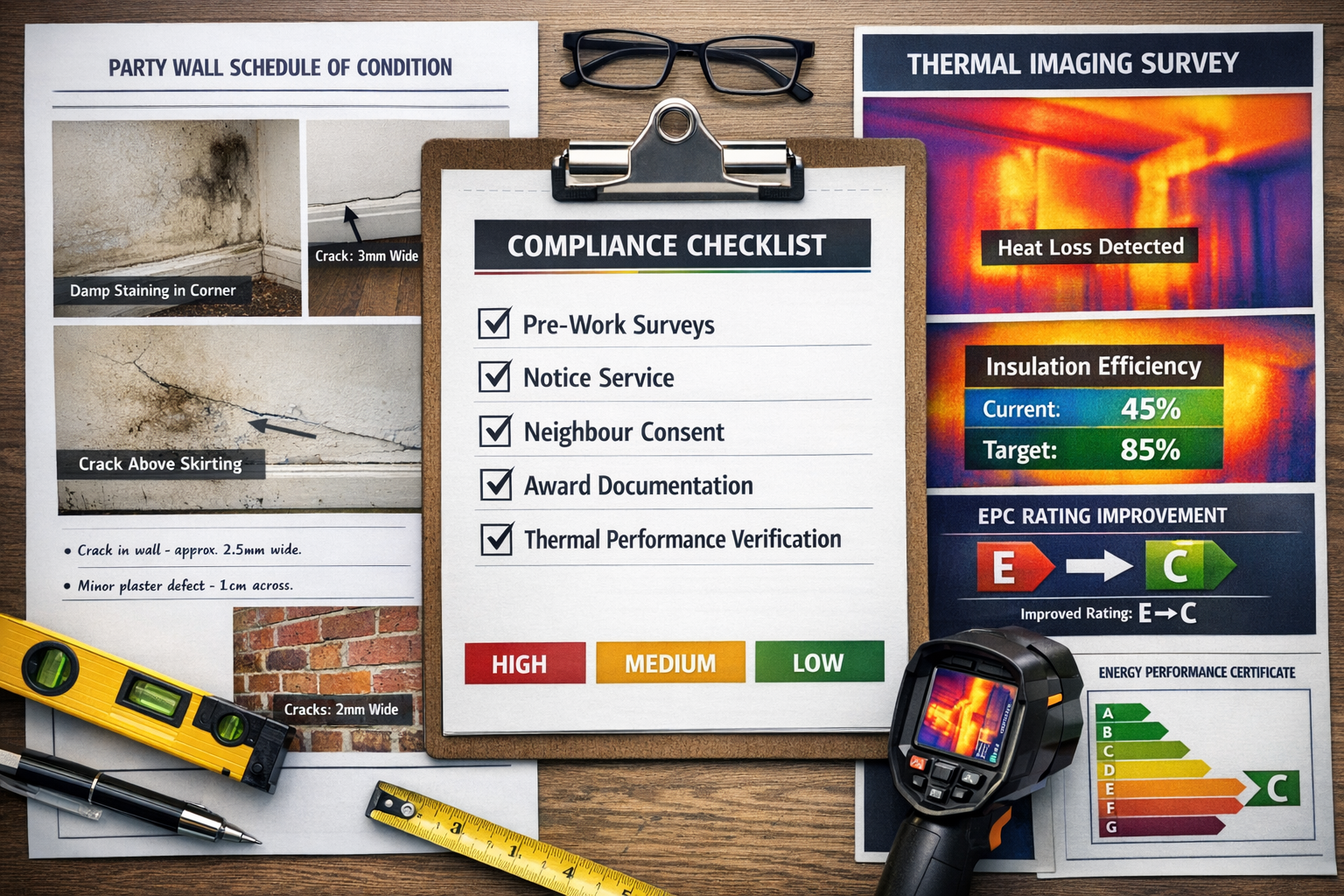
A comprehensive schedule of condition represents the single most valuable dispute prevention tool in retrofit projects. This detailed photographic and written record documents the existing state of neighbouring properties before work commences, establishing an objective baseline for assessing any subsequent damage claims.
Professional schedules of condition include:
- 📸 Extensive photography of all rooms, focusing on areas near party walls
- 📝 Detailed written descriptions of existing defects, cracks, and imperfections
- 📏 Measurements and annotations of notable features
- 🔍 Assessment of structural condition and existing damage
- 📋 Documentation of finishes, decorations, and fixtures
For retrofit projects, surveyors increasingly incorporate thermal imaging into schedules of condition, documenting pre-work thermal performance and identifying existing insulation deficiencies[4]. This dual-purpose approach serves both party wall compliance and retrofit planning objectives.
Property owners should review schedule of condition party wall best practices to understand what comprehensive documentation entails. For leasehold properties undergoing retrofit, schedule of condition leasehold requirements may impose additional documentation obligations.
Compliance Checklists for Retrofit Projects: Integrating Party Wall and EPC Requirements
Pre-Project Planning Checklist
Before commencing any retrofit work affecting party walls, property owners should complete this comprehensive compliance verification:
Legal and Regulatory Compliance:
- ✅ Identify all works potentially affecting party walls or neighbouring properties
- ✅ Determine which Party Wall Act notice types apply to planned works
- ✅ Review planning permission requirements for external alterations
- ✅ Verify building regulations compliance for proposed improvements
- ✅ Confirm EPC rating targets and improvement pathways
- ✅ Check for conservation area or listed building restrictions
Party Wall Procedure Initiation:
- ✅ Engage qualified party wall surveyor for initial assessment
- ✅ Prepare detailed work descriptions for notices
- ✅ Identify all affected neighbours requiring notice service
- ✅ Draft and serve appropriate notices minimum two months before planned start
- ✅ Maintain proof of notice service (recorded delivery recommended)
- ✅ Prepare for potential surveyor appointment if neighbours dissent
Technical Assessment:
- ✅ Commission structural surveys to assess existing conditions
- ✅ Conduct thermal imaging surveys to identify insulation opportunities
- ✅ Evaluate party wall structural capacity for additional loads (EWI, equipment)
- ✅ Assess foundation depths for excavation work planning
- ✅ Review damp surveys results before insulation installation
- ✅ Verify compatibility of retrofit measures with existing construction
Understanding party wall cost implications helps property owners budget appropriately. With party wall awards typically costing approximately £1,000 and hourly surveyor rates ranging £150-£200[1], these expenses represent a modest investment compared to potential dispute costs or project delays.
During-Work Monitoring and Documentation
Active project management during retrofit work prevents many common party wall disputes. Establishing clear protocols and maintaining meticulous records protects all parties.
Ongoing Compliance Measures:
| Activity | Frequency | Responsibility | Documentation |
|---|---|---|---|
| Neighbour communication | Weekly minimum | Building owner | Written updates, meeting notes |
| Site condition monitoring | Daily | Contractor | Photo logs, incident reports |
| Vibration monitoring | Continuous for sensitive work | Specialist consultant | Automated data logs |
| Structural movement checks | Weekly during active work | Party wall surveyor | Crack monitoring reports |
| Schedule of condition updates | After each work phase | Party wall surveyor | Photographic evidence |
| Compliance verification | Before each new work phase | Building control | Inspection certificates |
Critical intervention triggers requiring immediate surveyor notification include:
- 🚨 Discovery of unexpected structural conditions
- 🚨 Visible new cracks in party walls or neighbouring properties
- 🚨 Neighbour complaints about vibration, noise, or damage
- 🚨 Deviations from approved work descriptions in party wall award
- 🚨 Access issues or boundary disputes
- 🚨 Evidence of pre-existing undisclosed defects
Property owners facing challenges should consult what is a party wall dispute guidance and understand resolution pathways before situations escalate.
Post-Completion Verification and EPC Certification
The final phase of retrofit projects requires careful attention to both party wall obligations and EPC certification requirements.
Post-Work Party Wall Obligations:
- ✅ Conduct final joint inspection with party wall surveyor
- ✅ Compare final conditions against original schedule of condition
- ✅ Address any identified damage promptly and professionally
- ✅ Obtain neighbour sign-off on completed works
- ✅ Retain all documentation for minimum seven years
- ✅ Update property records with party wall award details
EPC Certification Process:
- ✅ Schedule post-retrofit EPC assessment
- ✅ Provide assessor with documentation of all improvements
- ✅ Verify thermal performance meets design specifications
- ✅ Address any performance gaps identified during assessment
- ✅ Obtain updated EPC certificate showing improved rating
- ✅ Update property marketing materials and legal documentation
The integration of party wall compliance with EPC improvement objectives creates efficiency gains. Surveyors conducting building surveys increasingly provide comprehensive reports addressing both aspects simultaneously, reducing overall assessment costs and streamlining project planning.
Quality Summit Insights: Best Practices from Industry Leaders
Emerging Standards for Retrofit Party Wall Surveys
Recent industry quality summits have established evolving best practices for party wall surveys in the retrofit context. These standards reflect growing recognition that traditional party wall procedures require adaptation for energy efficiency projects.
Key quality standards emerging from 2026 summits:
Enhanced Documentation Requirements: Retrofit-focused party wall surveys now routinely include thermal imaging alongside traditional photographic schedules of condition. This dual documentation serves multiple purposes: establishing baseline thermal performance, identifying hidden structural issues that might affect retrofit work, and providing comprehensive pre-work records.
Integrated Compliance Assessment: Leading surveyors provide unified reports addressing party wall obligations, building regulations compliance, planning requirements, and EPC improvement pathways. This holistic approach prevents the fragmented decision-making that often leads to compliance failures or suboptimal retrofit outcomes.
Technology Integration: Professional surveyors increasingly employ advanced tools including:
- 📱 Digital documentation platforms for real-time sharing with all parties
- 🌡️ Thermal imaging cameras identifying heat loss and structural anomalies
- 📊 3D scanning for precise dimensional records
- 🔔 Vibration monitoring equipment for sensitive works
- 💻 Cloud-based project management systems ensuring transparency
Proactive Dispute Prevention: Rather than reactive dispute resolution, quality-focused surveyors emphasise preventive strategies including pre-work neighbour meetings, clear communication protocols, and detailed work scheduling that minimises disruption.
Common Retrofit Scenarios and Party Wall Solutions
Industry experience from the early phases of the 2026 retrofit boom reveals recurring scenarios where strategic party wall management prevents disputes.
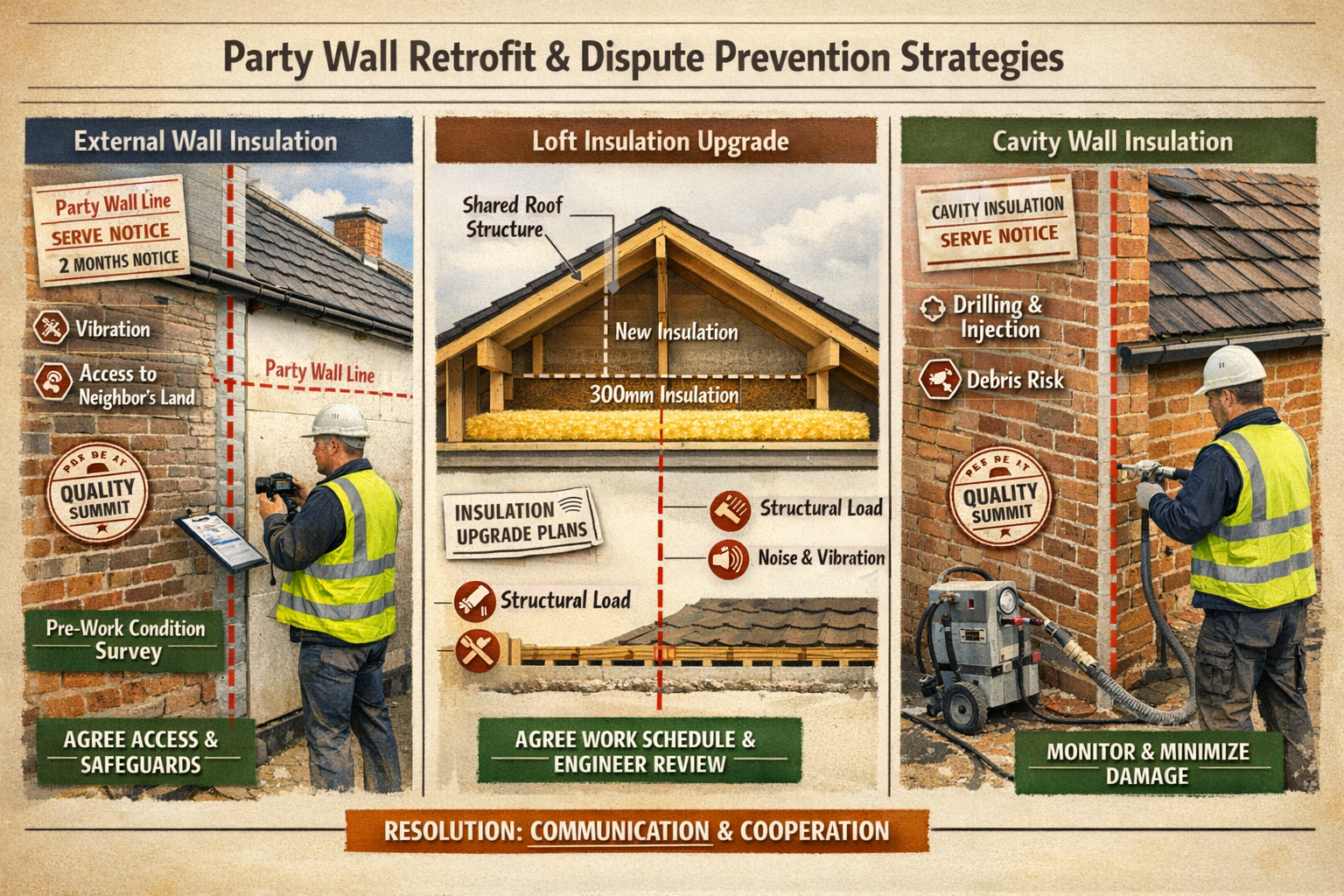
Scenario 1: External Wall Insulation on Terraced Properties
Challenge: EWI systems build up to or beyond property boundaries, potentially encroaching on neighbouring land or affecting shared structures.
Solution: Early engagement with neighbours, detailed boundary surveys, and party wall awards that explicitly address insulation thickness, fixing methods, and aesthetic coordination. Many successful projects involve coordinated improvements where multiple neighbours simultaneously install EWI, sharing costs and minimising individual disruption.
Scenario 2: Loft Conversions Affecting Shared Roof Structures
Challenge: Insulating and converting loft spaces often requires modifications to party walls extending into roof spaces, plus potential structural alterations affecting shared chimneys and shared chimney stacks.
Solution: Comprehensive structural assessments before notice service, clear specification of all works affecting shared elements, and schedules of condition extending to roof spaces and chimney structures. Surveyors recommend explicit provisions for noise insulation between converted spaces to prevent post-completion disputes.
Scenario 3: Ground Source Heat Pump Excavations
Challenge: Excavating for ground source heat pump loops frequently triggers Section 6 notice requirements, with potential foundation stability implications.
Solution: Professional foundation surveys establishing neighbouring foundation depths before notice service, detailed excavation plans showing compliance with safe distance requirements, and continuous monitoring during excavation work. Successful projects include contingency provisions for unexpected ground conditions.
Scenario 4: Cavity Wall Insulation Near Party Walls
Challenge: Drilling and injection processes for cavity wall insulation can affect party wall stability and create vibration concerns.
Solution: Pre-work structural assessment confirming cavity wall construction suitability, detailed drilling plans avoiding party wall ties and structural elements, and vibration monitoring during injection. Awards should specify acceptable working hours and noise mitigation measures.
Dispute Resolution Pathways and Preventive Strategies
Despite best planning efforts, disputes occasionally arise during retrofit projects. Understanding resolution pathways and preventive strategies minimises project impact.
Primary Prevention Strategies:
🤝 Early Neighbour Engagement: Informal discussions before formal notice service often identify concerns that can be addressed in project planning, preventing formal disputes.
📋 Detailed Work Specifications: Vague notice descriptions invite disputes. Comprehensive specifications including methods, timing, access requirements, and protective measures reduce misunderstandings.
💰 Fair Cost Allocation: Transparent discussion of cost responsibilities prevents disputes. While building owners bear party wall procedure costs, clear communication about who pays for what prevents resentment.
🕐 Realistic Timelines: Rushed projects generate disputes. Building adequate time buffers into retrofit schedules accommodates party wall procedures without deadline pressure.
Formal Resolution Pathways:
When disputes arise despite preventive efforts, the Party Wall Act provides structured resolution mechanisms:
- Agreed Surveyor Appointment: Both parties jointly appoint a single surveyor (fastest, most economical option)
- Separate Surveyors: Each party appoints their own surveyor, who then jointly prepare the award
- Third Surveyor: If appointed surveyors disagree, they select a third surveyor for final determination
Property owners should understand that party wall notice not served scenarios create significant vulnerabilities, potentially allowing neighbours to seek injunctions halting work. Retrospective notice service, while possible, dramatically increases dispute risk and costs.
For complex situations, consulting party wall FAQs provides clarity on common concerns and procedural requirements.
Financial Considerations: Budgeting for Party Wall Compliance in Retrofit Projects
Direct Party Wall Costs
Understanding the financial implications of party wall compliance enables accurate retrofit budgeting. Costs vary based on project complexity, property type, and whether disputes arise.
Typical Cost Components:
Surveyor Fees: Professional party wall surveyors charge £150-£200 per hour[1], with total fees depending on project complexity. Simple party wall awards for straightforward retrofit work typically cost around £1,000[1], while complex projects involving multiple properties or disputed matters can cost significantly more.
Notice Preparation: While property owners can technically prepare and serve notices themselves, professional preparation ensures compliance and reduces dispute risk. Solicitors or surveyors typically charge £200-£500 for notice preparation services.
Schedule of Condition: Comprehensive photographic and written schedules cost £300-£800 depending on property size and documentation extent. Retrofit-focused schedules incorporating thermal imaging may command premium fees but provide enhanced value.
Award Preparation: When neighbours dissent and appoint surveyors, the building owner typically pays both surveyors' fees. Total award costs for disputed matters range £2,000-£5,000 for standard residential projects, potentially higher for complex situations.
Monitoring and Inspections: Ongoing surveyor involvement during construction adds £500-£2,000 depending on project duration and complexity.
Indirect Costs of Non-Compliance
The financial consequences of party wall non-compliance dwarf direct compliance costs:
Project Delays: Neighbours discovering unpermitted party wall work can seek injunctions halting construction. Resulting delays cost contractors' standing time, extended equipment hire, and potentially missed EPC compliance deadlines triggering rental income loss or sale complications.
Retrospective Compliance: Serving notices after work commences dramatically increases dispute likelihood. Neighbours understandably feel disrespected, making cooperation difficult and expensive surveyor appointments more likely.
Damage Claims: Without proper schedules of condition, defending against damage allegations becomes extremely difficult. Unfounded claims can cost thousands in unnecessary repairs or legal fees.
Legal Costs: Disputed party wall matters occasionally escalate to legal proceedings, with costs potentially reaching tens of thousands of pounds.
Property Value Impact: Unresolved party wall disputes create title defects that complicate sales, potentially reducing property values or making properties unsaleable.
Cost-Benefit Analysis: Professional Guidance Value
Engaging professional surveyors early in retrofit planning delivers substantial value beyond mere compliance:
Integrated Planning Efficiency: Surveyors conducting comprehensive assessments addressing party wall obligations, structural capacity, thermal performance, and EPC improvement pathways eliminate duplicative inspections and provide cohesive improvement strategies.
Dispute Prevention: Professional notice preparation, neighbour liaison, and detailed work specifications prevent the majority of potential disputes, saving thousands in resolution costs.
Project Optimisation: Experienced surveyors identify opportunities for coordinated improvements with neighbours, potentially sharing costs and achieving better outcomes than isolated projects.
Insurance and Warranty Protection: Proper party wall compliance often represents a condition for building insurance coverage and retrofit warranty validity. Non-compliance can void protection worth far more than surveyor fees.
Time Savings: Professional management of party wall procedures frees property owners to focus on core retrofit decisions rather than navigating complex legal requirements.
For property owners evaluating whether professional guidance justifies the investment, the calculus is straightforward: £1,000-£2,000 in surveyor fees prevents £10,000-£50,000+ in potential dispute costs, delays, and complications.
Regional Variations and Local Authority Considerations
Party Wall Compliance Across UK Jurisdictions
While the Party Wall Act 1996 applies throughout England and Wales, Scotland operates under different legal frameworks. Property owners must understand jurisdictional variations when planning retrofit projects.
England and Wales: The Party Wall Act 1996 provides comprehensive statutory framework. Compliance is mandatory, with established procedures and surveyor appointment mechanisms.
Scotland: No equivalent statutory party wall legislation exists. Property owners rely on common law principles and the Land Reform (Scotland) Act 2003 for boundary and access matters. Retrofit projects affecting shared structures require negotiated agreements rather than statutory notices.
Northern Ireland: The Party Walls Act (Northern Ireland) 1926 provides older statutory framework with some procedural differences from the 1996 Act.
Local Authority Building Control Integration
Local authority building control departments increasingly coordinate party wall compliance verification with building regulations approval for retrofit projects. This integration creates both opportunities and obligations.
Enhanced Scrutiny: Building control officers now routinely ask whether party wall procedures have been followed for works affecting shared structures. Failure to demonstrate compliance can delay or prevent building regulations approval.
Coordinated Inspections: Some progressive local authorities coordinate building control inspections with party wall surveyor visits, reducing overall inspection burden and ensuring consistent documentation.
EPC Compliance Verification: Building control departments verify that completed retrofit work achieves intended EPC improvements, creating accountability for proper installation of insulation and energy efficiency measures.
Property owners should engage with local building control early in retrofit planning to understand specific requirements and coordination opportunities in their jurisdiction.
Technology and Innovation in Party Wall Surveys for Retrofit Projects
Digital Documentation and Communication Platforms
The 2026 retrofit boom accelerates adoption of digital technologies in party wall procedures, improving transparency, efficiency, and dispute prevention.
Cloud-Based Project Management: Leading surveyors employ platforms that provide all parties (building owners, neighbours, surveyors, contractors) real-time access to:
- Notice documentation and service records
- Schedules of condition with searchable photo libraries
- Work progress updates and milestone completions
- Communication logs ensuring transparency
- Document version control preventing confusion
Digital Notice Service: While traditional recorded delivery remains legally valid, some surveyors supplement physical notice service with digital delivery providing instant confirmation and creating comprehensive audit trails.
Mobile Documentation Apps: Surveyors increasingly use tablet-based applications for on-site documentation, enabling:
- Immediate photo upload with GPS tagging and timestamps
- Voice-to-text note capture for efficient reporting
- Real-time sharing with clients and neighbours
- Offline functionality for properties with poor connectivity
- Automated report generation reducing turnaround times
Advanced Assessment Technologies
Retrofit-focused party wall surveys leverage technologies that traditional assessments rarely employed:
Thermal Imaging Integration: Infrared cameras identify:
- Heat loss through party walls indicating insulation opportunities
- Moisture intrusion suggesting hidden structural issues
- Thermal bridging requiring attention during retrofit
- Pre-existing conditions that might affect retrofit performance
3D Laser Scanning: Precise dimensional capture provides:
- Accurate records of existing conditions for dispute resolution
- Foundation depth verification for excavation planning
- Structural movement detection through repeat scanning
- Integration with Building Information Modeling (BIM) for complex projects
Vibration Monitoring Equipment: Sensitive works like excavation or drilling benefit from continuous vibration monitoring that:
- Provides objective evidence of compliance with safe working limits
- Alerts contractors to excessive vibration requiring procedure adjustment
- Creates defensible records if neighbours allege damage from vibration
- Demonstrates professional approach reducing neighbour concerns
Moisture Meters and Structural Sensors: Advanced diagnostic equipment identifies hidden conditions that might affect retrofit work or party wall stability, preventing mid-project surprises that trigger disputes.
Future Outlook: Party Wall Compliance Beyond 2026
Evolving Regulatory Landscape
The retrofit imperative driving party wall activity in 2026 represents just the beginning of a multi-decade transformation of UK housing stock. Future regulatory developments will likely intensify compliance requirements:
Stricter EPC Mandates: Anticipated tightening of minimum EPC standards for rental and sale properties will drive additional retrofit waves, maintaining high party wall survey demand throughout the 2020s and 2030s.
Retrofit Quality Standards: RICS and other professional bodies continue developing enhanced standards for retrofit work[3], potentially incorporating party wall compliance verification into quality assurance frameworks.
Digital Notice Systems: Government initiatives toward digital property records may eventually enable electronic party wall notice service and award registration, improving transparency and reducing disputes.
Climate Resilience Requirements: Future regulations addressing flood resilience, overheating prevention, and climate adaptation may trigger additional party wall works as properties undergo comprehensive environmental upgrades.
Professional Development and Specialisation
The intersection of party wall law and retrofit technology creates demand for specialised professional expertise:
Retrofit-Focused Surveyors: Professionals combining party wall expertise with deep understanding of insulation technologies, heat pump installations, and EPC assessment increasingly command premium fees for integrated services.
Thermal Survey Specialists: Surveyors certified in thermography and building physics provide enhanced value in retrofit contexts, identifying opportunities and risks that traditional assessments miss.
Dispute Resolution Expertise: As retrofit activity generates party wall disputes, specialists in mediation and alternative dispute resolution find growing opportunities preventing costly formal proceedings.
Property owners planning significant retrofit work should seek surveyors with demonstrable expertise in both party wall procedures and energy efficiency technologies, ensuring comprehensive guidance addressing all project dimensions.
Practical Action Plan: Implementing Party Wall Compliance in Your Retrofit Project
Immediate Steps for Property Owners
Property owners planning retrofit work in 2026 should take these immediate actions to ensure party wall compliance:
Week 1-2: Initial Assessment
- Document all planned retrofit improvements
- Review property boundaries and identify shared structures
- Research choosing the right property survey options
- Obtain preliminary quotes from party wall surveyors
- Schedule initial consultation with qualified surveyor
Week 3-4: Professional Engagement
- Appoint party wall surveyor for comprehensive assessment
- Commission thermal survey if not included in party wall assessment
- Obtain detailed party wall cost estimate including all procedures
- Review surveyor recommendations for notice requirements
- Prepare preliminary project timeline incorporating party wall procedures
Month 2: Notice Preparation and Service
- Finalise detailed work descriptions for notices
- Prepare required notice documents (surveyor-assisted recommended)
- Identify all neighbours requiring notice service
- Serve notices via recorded delivery with proof of service
- Provide neighbours with surveyor contact information for questions
Month 3-4: Response Period and Award Preparation
- Track neighbour responses (consent or dissent)
- Facilitate surveyor appointments for dissenting neighbours
- Schedule schedule of condition inspections
- Cooperate with surveyor information requests
- Review draft party wall award before finalisation
Month 5+: Work Commencement and Monitoring
- Ensure contractors understand party wall award requirements
- Implement communication protocols with neighbours
- Maintain work logs and photographic documentation
- Schedule periodic surveyor monitoring visits
- Address any concerns promptly and professionally
Checklist for Contractor Selection
Choosing contractors experienced with party wall compliance reduces risk substantially:
✅ Request evidence of previous party wall projects completed successfully
✅ Verify contractor understanding of party wall award conditions
✅ Confirm insurance coverage adequate for party wall works
✅ Review contractor communication protocols with neighbours
✅ Assess contractor willingness to coordinate with party wall surveyor
✅ Obtain detailed work schedules showing compliance with award timing requirements
✅ Verify contractor commitment to protective measures specified in award
✅ Confirm contractor maintains detailed work logs and photographic records
Contractors dismissive of party wall requirements or resistant to surveyor oversight represent significant risk. Professional contractors welcome party wall procedures as protection for all parties and evidence of project professionalism.
Long-Term Compliance Management
Party wall obligations extend beyond project completion:
Documentation Retention: Maintain comprehensive records including notices, awards, schedules of condition, correspondence, and completion certificates for minimum seven years. These documents prove invaluable for future work, property sales, or dispute resolution.
Property Information Updates: Update property information forms and legal documentation to reflect party wall awards, ensuring future owners understand historical works and obligations.
Relationship Maintenance: Preserve positive neighbour relationships established through professional party wall procedures. These relationships facilitate future projects and create supportive community environments.
Periodic Reviews: Before undertaking future works, review historical party wall awards to understand any ongoing obligations or restrictions affecting subsequent projects.
Conclusion
Party Wall Surveys for 2026 Retrofit Boom: Compliance Checklists Amid EPC Mandates and Quality Summit Insights represent essential knowledge for property owners navigating the convergence of energy efficiency mandates and legal compliance obligations. The unprecedented scale of retrofit activity—affecting an estimated 25 million UK homes requiring energy improvements[3]—creates both opportunities and risks that demand professional management.
The key insights from recent quality summits emphasise integration: combining party wall assessments with thermal surveys, EPC evaluations, and structural assessments delivers efficiency gains that reduce costs while ensuring comprehensive compliance. Professional surveyors charging £150-£200 per hour and delivering party wall awards for approximately £1,000[1] provide exceptional value compared to the potentially catastrophic costs of non-compliance.
Critical success factors for retrofit projects include:
🎯 Early engagement with party wall procedures, serving notices minimum two months before planned work commencement
🎯 Professional guidance from surveyors experienced in both party wall law and retrofit technologies
🎯 Comprehensive documentation including detailed schedules of condition protecting all parties
🎯 Proactive communication with neighbours preventing misunderstandings that escalate into disputes
🎯 Technology integration leveraging thermal imaging, digital documentation, and monitoring equipment
🎯 Realistic budgeting recognising party wall compliance as essential investment, not optional expense
The 2026 retrofit boom represents a transformational opportunity to improve UK housing stock energy performance while creating healthier, more comfortable homes. Success requires navigating complex regulatory frameworks where party wall compliance intersects with EPC mandates, building regulations, and planning requirements. Property owners who approach this challenge strategically—engaging qualified professionals, following established procedures, and maintaining transparent communication—will achieve their retrofit goals efficiently while preserving positive neighbour relationships and protecting property values.
Next Steps
Property owners planning retrofit work should take immediate action:
- Schedule consultations with party wall surveyors experienced in retrofit projects
- Review comprehensive guides including consent for party wall work requirements
- Develop integrated project plans addressing party wall, EPC, and building regulations compliance
- Engage neighbours early in informal discussions before formal notice service
- Budget appropriately for professional guidance recognising its value in preventing costly disputes
The convergence of retrofit imperatives and party wall obligations creates complexity, but professional guidance and systematic approaches transform this challenge into manageable, predictable processes. Property owners who invest in proper compliance procedures will complete their 2026 retrofit projects successfully, achieving energy efficiency goals while maintaining positive community relationships and protecting their property investments.
The future of UK housing depends on successful navigation of this retrofit transformation. Party wall compliance represents not an obstacle but an essential framework ensuring improvements benefit all parties while protecting individual rights. By embracing professional standards, leveraging quality summit insights, and following comprehensive compliance checklists, property owners contribute to both individual property enhancement and broader societal goals of energy efficiency and carbon reduction.
References
[1] Party Wall Agreement – https://hoa.org.uk/advice/guides-for-homeowners/i-am-improving/party-wall-agreement/
[2] Party Wall Surveys Amid 2026 Construction Boom Handling Disputes In High Demand Uk Housing Markets – https://nottinghillsurveyors.com/blog/party-wall-surveys-amid-2026-construction-boom-handling-disputes-in-high-demand-uk-housing-markets
[3] Retrofit – https://www.rics.org/profession-standards/rics-standards-and-guidance/sector-standards/real-estate-standards/retrofit
[4] Building Surveys For Energy Performance Certificates In 2026 Navigating Epc Upgrades And Retrofit Mandates For Uk Buyers – https://nottinghillsurveyors.com/blog/building-surveys-for-energy-performance-certificates-in-2026-navigating-epc-upgrades-and-retrofit-mandates-for-uk-buyers
[5] Passivhaus Retrofit In The Uk 2nd Edition V1.4 260121 – https://passivhaus.uk/wp-content/uploads/2026/01/Passivhaus-Retrofit-in-the-UK-2nd-edition-v1.4-260121.pdf