
{"cover":"Professional landscape format (1536x1024) hero image featuring bold text overlay 'Party Wall Surveys for 2026 Healthcare Expansions: RICS Compliance Amid NHS Infrastructure Push' in extra large 72pt white sans-serif font with dark shadow and semi-transparent navy overlay box, positioned in upper third. Background shows modern NHS hospital building under construction with scaffolding, adjacent residential properties, and surveyor with hard hat examining shared boundary wall with clipboard and laser measuring device. Foreground includes architectural plans and RICS compliance documents. Color scheme: NHS blue, white, construction orange accents. High contrast, magazine cover quality, editorial style with professional depth of field.","content":["Landscape format (1536x1024) detailed illustration showing cross-section diagram of party wall between NHS clinic extension and neighboring residential property. Technical drawing style with labeled elements including foundations, wall structure, excavation zones, and three-meter rule measurement annotations. Surveyor figures on both sides of wall conducting assessments. Overlay text 'Party Wall Act 1996 Requirements' in professional typography. Color-coded zones showing building owner and adjoining owner responsibilities. RICS logo watermark. Clean architectural blueprint aesthetic with modern infographic elements, measurement callouts, and compliance checkmarks.","Landscape format (1536x1024) professional photograph of chartered surveyor in business attire and hard hat standing at construction site boundary between NHS hospital expansion and neighboring properties, holding official Party Wall Notice documents and Award paperwork. Background shows construction equipment, scaffolding on healthcare facility, and residential buildings. Foreground displays sample notice templates, dispute resolution flowchart, and timeline calendar marked with key dates. Text overlay 'Navigating Party Wall Awards for Healthcare Projects' in bold sans-serif. Documentary photography style with natural lighting, professional composition, depth showing both properties clearly.","Landscape format (1536x1024) infographic-style image showing dispute resolution process flowchart for NHS healthcare expansion projects. Central pathway with branching decision points, icons representing surveyor appointments, agreed surveyor selection, and award issuance. Side panels show template excerpts for Line of Junction Notice, Notice of Adjacent Excavation, and Award documentation. Professional color scheme with NHS blue, legal document beige, and resolution green. Statistics overlay showing 2026 healthcare construction volume. Modern corporate infographic aesthetic with clear hierarchy, professional icons, and step-by-step visual progression from initial notice through final award."]}
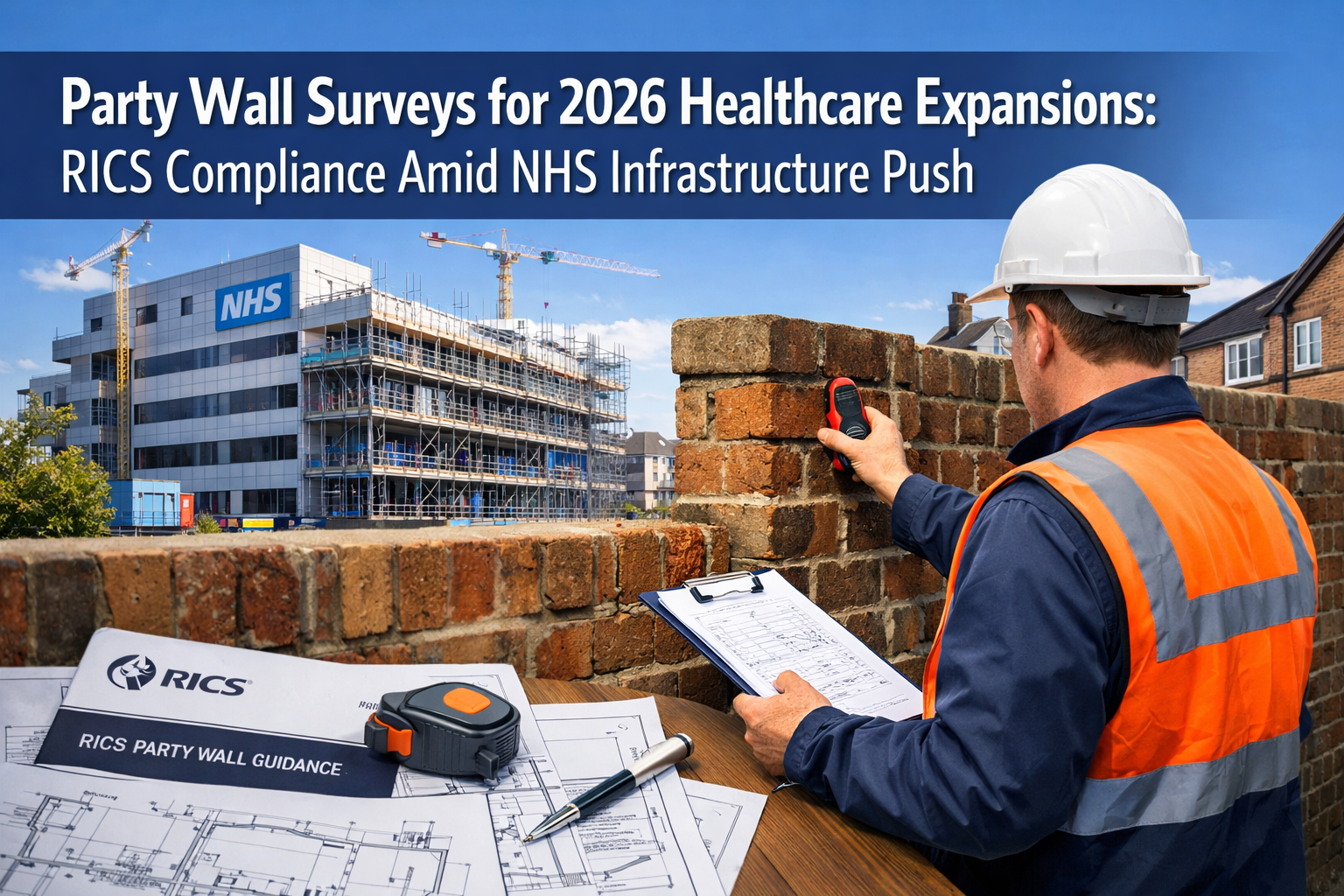
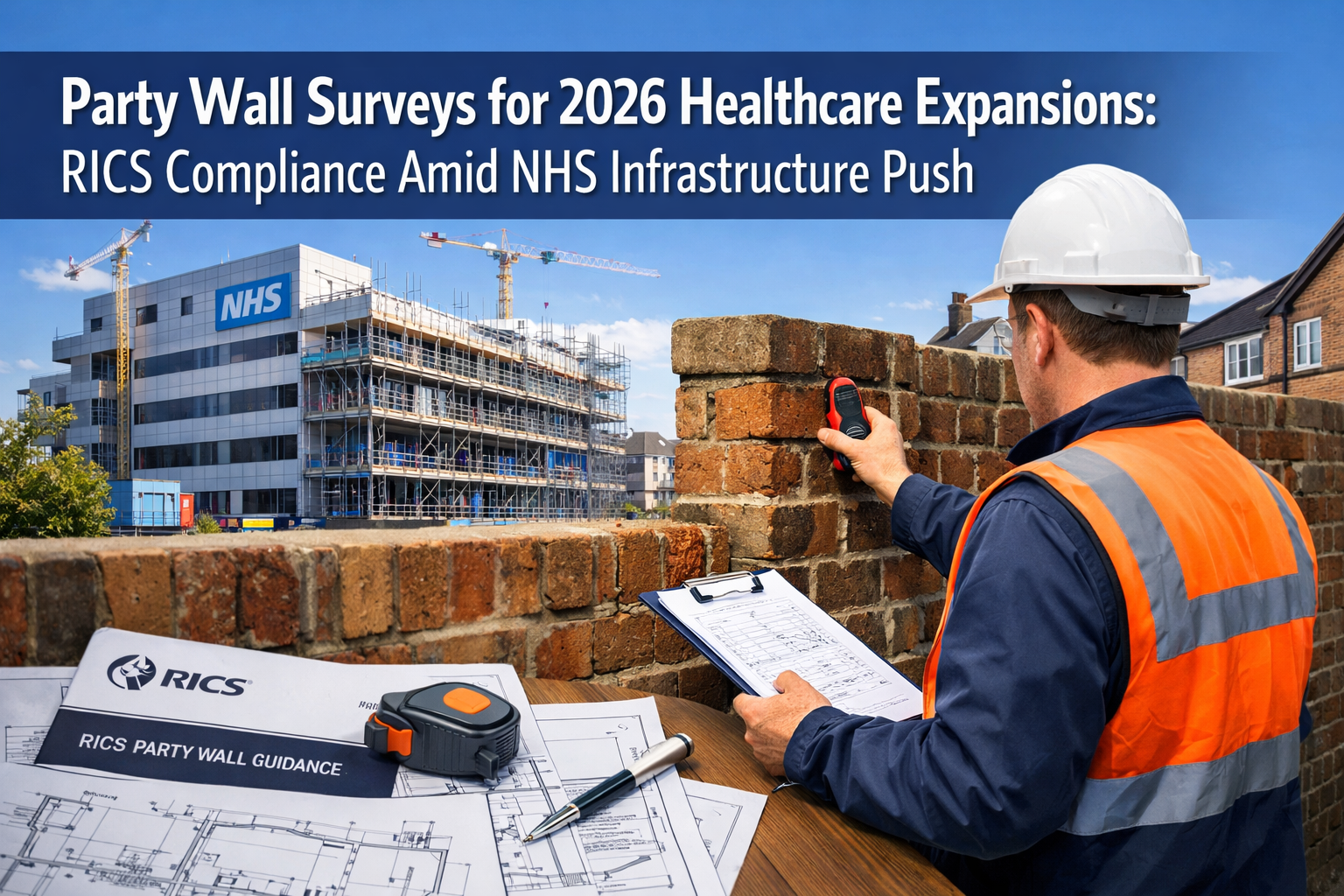
The NHS is experiencing one of its most ambitious infrastructure pushes in decades. As 2026 unfolds, healthcare facilities across the UK are expanding, modernizing, and adapting to meet growing patient demands. But behind every hospital extension, clinic upgrade, and medical center expansion lies a critical legal requirement that can make or break project timelines: party wall surveys and compliance. Understanding Party Wall Surveys for 2026 Healthcare Expansions: RICS Compliance Amid NHS Infrastructure Push has become essential for NHS trusts, private healthcare providers, and the chartered surveyors who guide these complex projects through regulatory waters.
The convergence of unprecedented NHS capital investment [1] and stringent Royal Institution of Chartered Surveyors (RICS) standards creates unique challenges. Healthcare construction projects must navigate not only medical facility regulations but also the Party Wall etc. Act 1996, which governs building work affecting shared boundaries with neighboring properties. This article explores the surveyor's critical role in securing Party Wall Awards, managing neighbor disputes, and ensuring RICS compliance for healthcare expansions in 2026.
Key Takeaways
- NHS infrastructure investment in 2026 is driving significant healthcare facility expansions, creating increased demand for compliant party wall procedures [1][2]
- RICS-accredited surveyors play essential roles in navigating party wall requirements, serving as building owner surveyors, adjoining owner surveyors, or agreed surveyors
- Party Wall Awards must be secured before construction begins on NHS projects affecting shared boundaries, with specific notice periods and documentation requirements
- Template notices and structured dispute resolution strategies help healthcare projects avoid costly delays and maintain positive community relations
- High-stakes healthcare projects require specialized expertise in balancing clinical operational needs with legal party wall obligations
Understanding Party Wall Requirements for Healthcare Facility Expansions
The Legal Framework Governing NHS Construction Projects
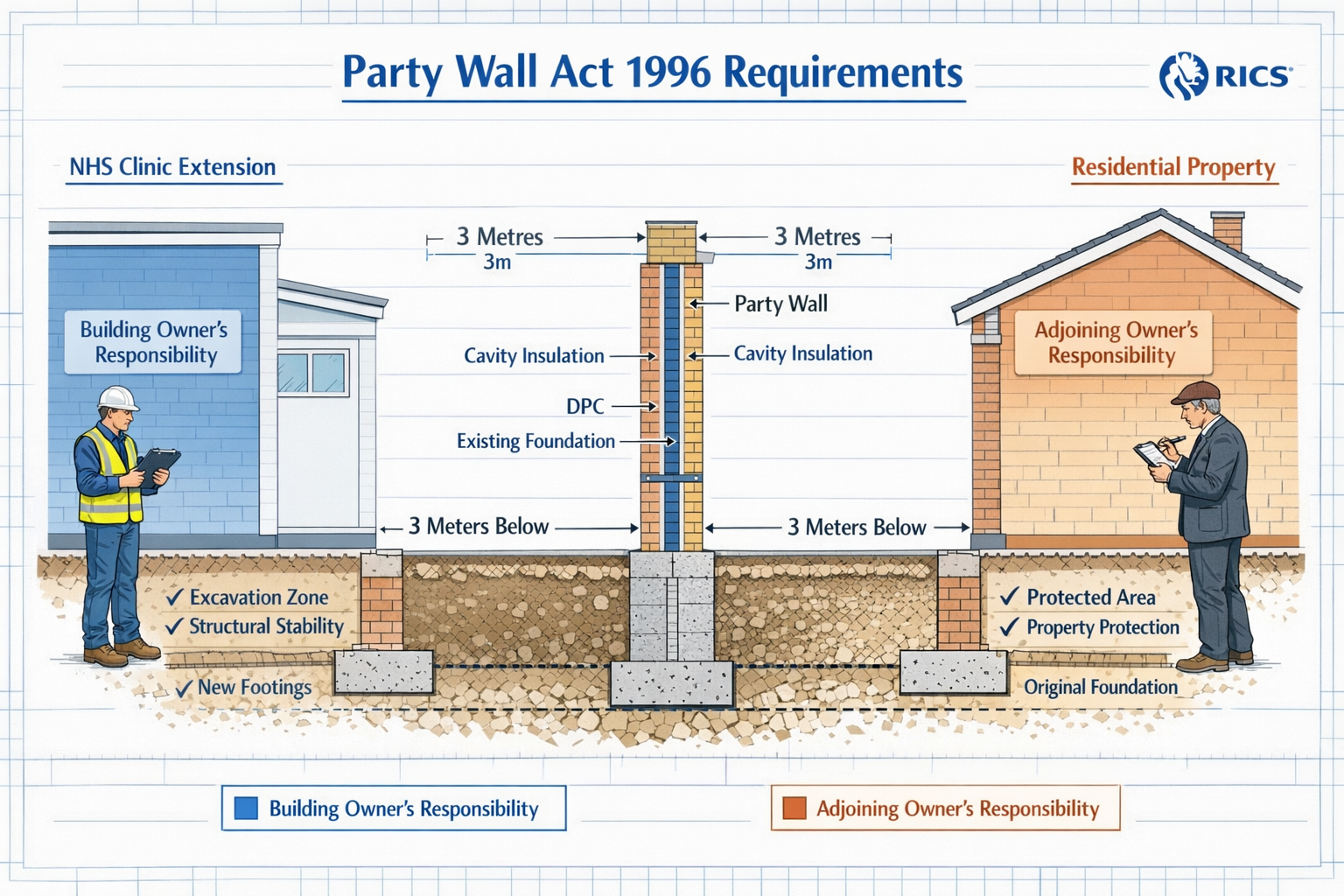
The Party Wall etc. Act 1996 applies to all building owners in England and Wales, including NHS trusts and private healthcare operators. When a healthcare facility plans construction work that affects a shared wall, boundary, or involves excavation near neighboring properties, the Act mandates specific procedures.
Three primary scenarios trigger party wall requirements:
- Building on or at a party wall – Extensions or structural alterations to existing healthcare buildings that share walls with adjacent properties
- Building at a boundary – New construction within three meters of a neighbor's structure where foundations will be deeper than existing buildings
- Excavation work – Digging within three or six meters of neighboring buildings, depending on depth
For NHS projects, these scenarios frequently arise when:
- 🏥 Expanding emergency departments into areas adjacent to residential or commercial properties
- 🔬 Adding laboratory or diagnostic imaging wings to existing hospital structures
- 🚑 Constructing multi-story car parks near property boundaries
- 💉 Modernizing primary care facilities in dense urban environments
Understanding what is the three meter rule becomes particularly important for healthcare expansions, as many NHS sites operate in space-constrained urban locations where neighboring properties sit close to planned construction zones.
RICS Standards for Healthcare Construction Surveys
The Royal Institution of Chartered Surveyors establishes professional standards that govern how party wall surveyors conduct their work. For healthcare projects in 2026, RICS compliance ensures:
Professional competency requirements:
- Surveyors must demonstrate expertise in both party wall legislation and healthcare facility construction
- Continuing professional development (CPD) in medical building regulations and infection control considerations
- Understanding of NHS operational requirements and clinical service continuity
Documentation standards:
- Comprehensive condition surveys of adjoining properties before construction begins
- Detailed photographic and written records that establish baseline property conditions
- Professional indemnity insurance adequate for high-value healthcare projects
Ethical obligations:
- Impartiality when serving as agreed surveyors
- Transparent communication with all parties
- Adherence to RICS guidance notes on party wall procedures
The RICS commercial building survey framework provides the foundation for assessing both the healthcare facility and neighboring properties, ensuring that all structural implications are properly evaluated before work commences.
The Surveyor's Role in Securing Party Wall Awards for Hospital Extensions
Building Owner Surveyors: Representing NHS Trusts
When an NHS trust or healthcare provider initiates an expansion project, they typically appoint a building owner surveyor to represent their interests throughout the party wall process. This role carries significant responsibilities in high-stakes healthcare projects.
Primary duties include:
| Responsibility | Description | Healthcare-Specific Considerations |
|---|---|---|
| Notice Preparation | Drafting and serving legally compliant party wall notices | Must account for NHS operational timelines and clinical service impacts |
| Schedule of Condition | Documenting pre-construction state of adjoining properties | Extra scrutiny given potential vibration-sensitive medical equipment nearby |
| Award Drafting | Preparing the Party Wall Award document | Including provisions for emergency access and infection control protocols |
| Dispute Resolution | Managing disagreements with adjoining owners | Balancing community relations with urgent healthcare infrastructure needs |
| Construction Monitoring | Overseeing compliance with Award terms during building | Coordinating with NHS operational managers to minimize service disruption |
Building owner surveyors must understand the urgency driving many 2026 healthcare expansions. The NHS Medium Term Planning Framework emphasizes infrastructure development as critical to service delivery [2], creating pressure to expedite party wall procedures without compromising legal compliance.
For complex projects, building owner surveyors often coordinate with structural survey specialists to assess potential impacts on neighboring structures and develop appropriate protective measures.
Adjoining Owner Surveyors: Protecting Neighbor Interests
Property owners adjacent to NHS expansion sites have the right to appoint their own surveyor—the adjoining owner surveyor—to protect their interests. This role becomes particularly important when healthcare construction may impact residential properties, commercial buildings, or other sensitive uses.
Key functions include:
- Independent assessment of the building owner's proposals and their potential impacts
- Negotiation of Award terms that adequately protect the adjoining owner's property
- Monitoring construction activities to ensure compliance with agreed protections
- Damage claim evaluation if construction causes harm to the adjoining property
Adjoining owner surveyors must balance legitimate concerns about construction impacts with recognition of the public benefit provided by NHS infrastructure improvements. This requires diplomatic skill and technical expertise.
Agreed Surveyors: Impartial Facilitation
When both parties consent, a single agreed surveyor can serve both the building owner and adjoining owner. This approach can streamline the process and reduce costs, making it attractive for straightforward healthcare expansion projects.
Advantages of the agreed surveyor approach:
✅ Cost efficiency – Single surveyor fee rather than two separate appointments
✅ Faster timelines – Reduced coordination complexity
✅ Simplified communication – One point of contact for all parties
✅ Reduced formality – Less adversarial atmosphere
When agreed surveyors work best:
- Straightforward extensions with minimal structural impact
- Cooperative relationships between healthcare facility and neighbors
- Projects where adjoining owners trust the building owner's intentions
- Situations where both parties want to minimize costs and delays
However, for controversial or complex NHS projects—such as major hospital expansions in residential areas—separate surveyors often provide better protection for all parties' interests. Understanding party wall FAQs helps both building owners and adjoining owners make informed decisions about surveyor appointments.
Party Wall Notices for 2026 Healthcare Projects: Templates and Timelines
Types of Notices Required for NHS Construction
The Party Wall etc. Act 1996 requires specific notices depending on the nature of construction work. Healthcare expansion projects must serve the appropriate notice type with adequate lead time.
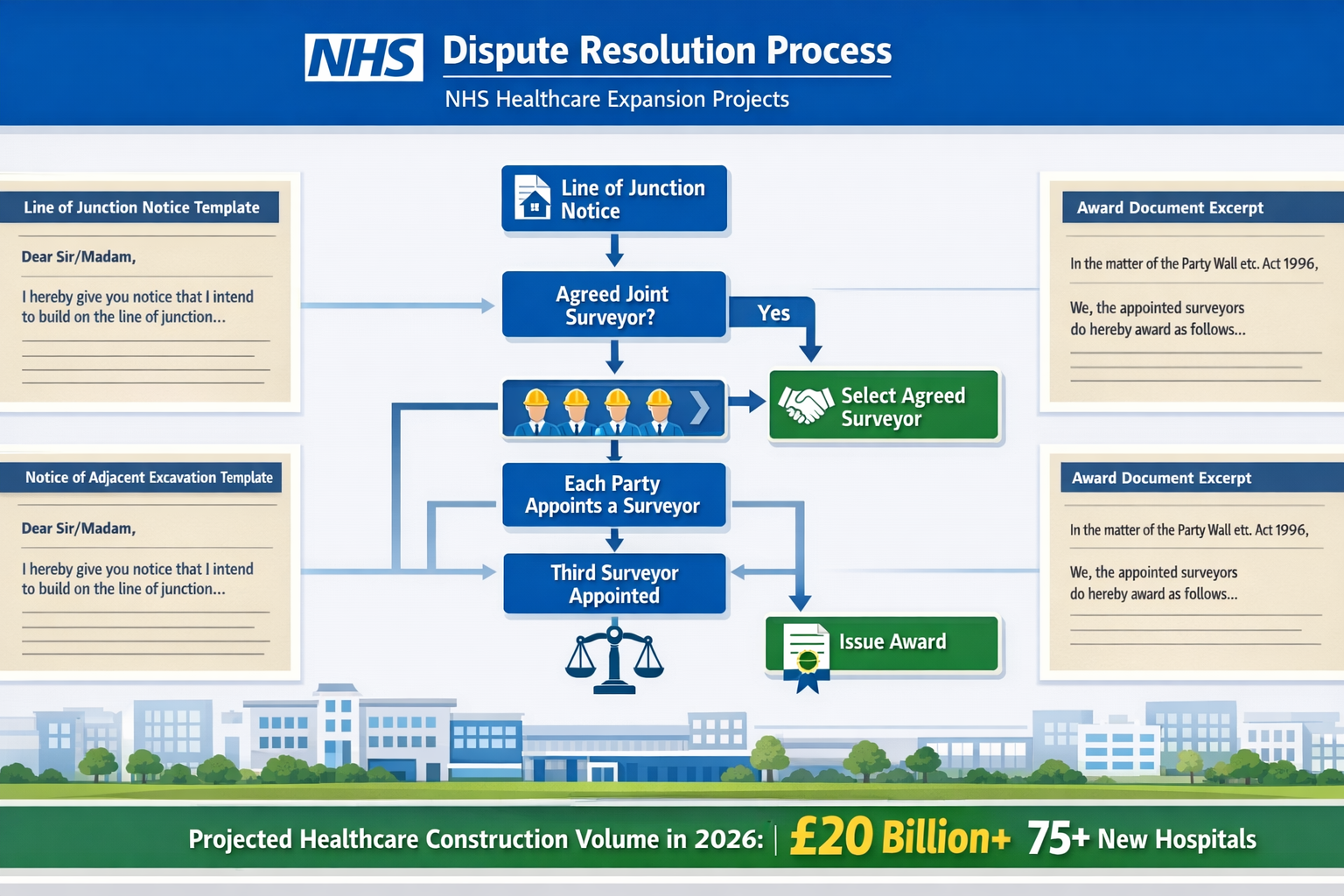
Line of Junction Notice (Section 1)
Used when building a new wall directly on the boundary line between properties. For NHS projects, this might apply when:
- Constructing a new clinic wing along a property boundary
- Building connecting corridors between existing healthcare structures
- Erecting security fencing or boundary structures
Required notice period: At least one month before work begins
Notice of Adjacent Excavation and Construction (Section 6)
Required when excavation or construction occurs within specified distances of neighboring buildings:
- Three meters when new foundations will be deeper than neighboring foundations
- Six meters when excavation will cut a line at 45 degrees from the bottom of neighboring foundations
This notice type frequently applies to NHS projects involving:
- Multi-story additions requiring deep foundations
- Underground parking or service tunnels
- Basement extensions for medical equipment or storage
Required notice period: At least one month before work begins
Party Structure Notice (Section 2)
Necessary when work directly affects an existing party wall, party fence wall, or party structure. Healthcare applications include:
- Cutting into a shared wall to create doorways or service penetrations
- Raising the height of a shared wall for vertical expansion
- Underpinning a party wall to support additional floors
Required notice period: At least two months before work begins
Essential Elements of Compliant Party Wall Notices
A legally valid party wall notice must contain specific information. Healthcare projects should ensure notices include:
Template: Core Notice Requirements
PARTY WALL NOTICE
[Type of Notice - Section X of Party Wall etc. Act 1996]

Building Owner: [NHS Trust/Healthcare Provider Name]
Building Owner Address: [Healthcare Facility Address]

Adjoining Owner: [Neighbor Name]
Adjoining Owner Address: [Neighboring Property Address]

Description of Proposed Works:
[Detailed description of healthcare expansion project, including:
- Nature of construction (extension, excavation, structural work)
- Dimensions and specifications
- Expected start date
- Estimated duration]

Plans and Drawings:
[Reference to attached architectural plans showing:
- Existing structures
- Proposed construction
- Party wall/boundary locations
- Foundation depths and excavation zones]

Notice Served: [Date]
Proposed Commencement Date: [Date - minimum 1-2 months from service]

Building Owner Signature: _________________
Date: _________________
Critical details for healthcare projects:
🏗️ Operational context – Explain how the expansion supports patient care without disclosing confidential medical information
📐 Technical specifications – Include sufficient detail for adjoining owners to understand potential impacts
📅 Realistic timelines – Account for NHS procurement processes and clinical service planning
📋 Supporting documentation – Attach architectural drawings, foundation details, and construction methodology
Notice Service Methods and Proof of Delivery
Proper service of party wall notices is essential. Invalid service can delay healthcare projects by months. Acceptable methods include:
Recommended service approaches:
- Hand delivery with signed acknowledgment receipt
- Recorded delivery post providing tracking and delivery confirmation
- Email if the adjoining owner has agreed to electronic communication in writing
- Standard post (least recommended due to lack of proof)
For NHS projects affecting multiple neighboring properties, surveyors should maintain a comprehensive notice tracking system:
| Adjoining Owner | Property Address | Notice Type | Service Date | Service Method | Response Deadline | Status |
|---|---|---|---|---|---|---|
| [Name] | [Address] | Section 6 | [Date] | Recorded Delivery | [Date + 14 days] | Awaiting Response |
Responding to Party Wall Notices: The 14-Day Window
After receiving a party wall notice, adjoining owners have 14 days to respond. Their options include:
Option 1: Consent to the Works
Written agreement that work may proceed as described. This does not waive rights to compensation for damage, but allows work to begin without a formal Award.
Option 2: Dissent or Non-Response
Either explicit dissent or failure to respond within 14 days triggers the "dispute" process, requiring surveyor appointments and a Party Wall Award.
Option 3: Counter-Notice
For Section 1 notices, adjoining owners may serve a counter-notice requesting that the building owner build the wall wholly on the building owner's land, or as a party fence wall.
For healthcare projects, dissent should not be viewed negatively. The "dispute" mechanism is simply the formal process for creating a Party Wall Award that protects all parties. Many adjoining owners dissent specifically to ensure proper protections are in place, not to obstruct NHS infrastructure development.
Understanding potential party wall disputes helps NHS trusts prepare appropriate responses and maintain positive community relations throughout the expansion process.
Navigating Neighbor Disputes in High-Stakes NHS Infrastructure Projects
Common Sources of Conflict in Healthcare Expansions
Healthcare construction projects can generate significant concern among neighboring property owners. Understanding common dispute triggers allows surveyors to address issues proactively.
Typical concerns from adjoining owners:
🔊 Noise and disruption – Construction activities affecting residential quality of life or commercial operations
🏚️ Structural damage risk – Fears about vibration, excavation, or foundation work causing cracks or settlement
🌳 Loss of light and privacy – Multi-story healthcare additions blocking sunlight or creating overlooking
🚗 Access and parking – Construction vehicles and equipment disrupting neighborhood access
⏰ Duration uncertainty – Lack of clarity about how long disruption will continue
💷 Property value impacts – Concerns about devaluation from proximity to expanded healthcare facilities
For NHS projects, additional sensitivities may include:
- Infection control concerns – Neighbors worried about healthcare-associated pathogens
- Emergency vehicle noise – Increased ambulance traffic to expanded facilities
- Clinical waste management – Perceptions about waste handling near residential areas
- 24/7 operations – Lighting and activity from round-the-clock healthcare services
Dispute Resolution Strategies for Healthcare Projects
Effective dispute resolution requires a combination of technical expertise, legal knowledge, and diplomatic communication skills. Chartered surveyors employ several strategies to resolve conflicts while keeping NHS projects on schedule.
Strategy 1: Pre-Notice Consultation
Before formally serving party wall notices, proactive NHS trusts engage neighbors through:
- Community meetings explaining the healthcare need driving expansion
- Visual presentations showing how the project will look and function
- Question and answer sessions addressing concerns before formal processes begin
- Advance notice of upcoming party wall procedures and timelines
This approach builds goodwill and often prevents formal disputes from arising.
Strategy 2: Comprehensive Schedule of Condition
A detailed schedule of condition documenting the pre-construction state of adjoining properties provides:
- Baseline evidence for assessing any construction-related damage
- Reassurance to neighbors that their property condition is thoroughly recorded
- Clear reference point for resolving damage claims fairly
For healthcare projects, schedules should include:
- Photographic documentation of all elevations, rooms, and existing defects
- Detailed written descriptions of structural condition
- Records of any vibration-sensitive equipment or features
- Documentation of existing cracks, settlement, or structural issues
Strategy 3: Protective Measures and Monitoring
Party Wall Awards for NHS projects should specify appropriate protective measures:
| Risk Factor | Protective Measure | Monitoring Approach |
|---|---|---|
| Excavation settlement | Underpinning or foundation support | Settlement monitoring pegs, regular surveys |
| Vibration damage | Vibration limits, equipment restrictions | Continuous vibration monitoring equipment |
| Dust and debris | Protective sheeting, regular cleaning | Visual inspections, air quality monitoring |
| Structural movement | Crack monitoring, movement joints | Crack width gauges, photographic tracking |
Strategy 4: Transparent Communication Throughout Construction
Ongoing communication prevents minor issues from escalating:
- Regular updates to adjoining owners about construction progress
- Advance notice of particularly disruptive activities
- Responsive contact person for addressing concerns quickly
- Periodic condition inspections with adjoining owners present
For guidance on managing formal Awards, review party wall award guidance.
When Disputes Escalate: Third Surveyor Appointments
If the building owner's surveyor and adjoining owner's surveyor cannot agree on Award terms, either party may request appointment of a third surveyor to resolve the disagreement.
Third surveyor selection process:
- The two surveyors attempt to agree on a third surveyor appointment
- If they cannot agree within 10 days, either surveyor may request the appointing officer (typically the local authority) to select a third surveyor
- The third surveyor reviews the dispute and issues a binding determination
Implications for NHS projects:
- ⏱️ Timeline delays – Third surveyor processes can add several weeks to project schedules
- 💰 Additional costs – Third surveyor fees are typically shared between parties
- 📋 Formal procedures – More documentation and formal submissions required
- ⚖️ Binding decisions – Third surveyor determinations are legally enforceable
To avoid third surveyor involvement, experienced healthcare project surveyors emphasize compromise and creative problem-solving that addresses legitimate concerns while allowing essential NHS infrastructure to proceed.
RICS Compliance Standards for Party Wall Surveys for 2026 Healthcare Expansions

Professional Practice Standards
RICS members conducting party wall surveys for healthcare expansions must adhere to rigorous professional standards that ensure competent, ethical service delivery.
Key RICS requirements:
Competence and Expertise
Surveyors must demonstrate:
- Appropriate qualifications and experience in party wall matters
- Understanding of construction techniques relevant to healthcare facilities
- Knowledge of NHS operational requirements and constraints
- Familiarity with infection control and clinical environment considerations
Professional Indemnity Insurance
Given the high value and public importance of NHS projects, surveyors must maintain adequate insurance coverage:
- Minimum coverage levels appropriate to project scale
- Coverage for both negligent advice and breach of duty
- Extended coverage for long-tail claims that may arise years after completion
Conflicts of Interest Management
RICS standards require transparent disclosure and management of potential conflicts:
- Prior relationships with NHS trusts or neighboring property owners
- Financial interests in project outcomes
- Personal relationships that might compromise impartiality
Record Keeping and Documentation
Comprehensive records must be maintained throughout the party wall process:
- All correspondence with building owners and adjoining owners
- Inspection notes and photographic evidence
- Award drafts and final executed documents
- Fee agreements and payment records
Quality Assurance for Healthcare Project Surveys
The high-stakes nature of NHS infrastructure projects demands enhanced quality assurance measures beyond standard party wall procedures.
Enhanced survey protocols for healthcare expansions:
🔍 Detailed condition assessments – More comprehensive than typical residential projects, given potential vibration sensitivity of medical equipment in neighboring buildings
📊 Risk analysis – Formal assessment of construction risks and appropriate mitigation strategies
🏗️ Construction methodology review – Evaluation of proposed building techniques for compatibility with healthcare operational requirements
🤝 Stakeholder coordination – Integration with NHS project managers, clinical directors, and facilities teams
The RICS specialist defect survey framework provides valuable guidance for identifying potential issues before they impact healthcare construction projects.
Continuing Professional Development for Healthcare Surveying
As NHS infrastructure needs evolve, surveyors must maintain current knowledge through ongoing professional development.
Relevant CPD topics for 2026:
- Modern healthcare facility design – Understanding modular construction, infection control requirements, and clinical space standards
- NHS procurement processes – Familiarity with capital planning frameworks and approval hierarchies [2]
- Sustainability requirements – Net-zero carbon targets for new NHS buildings
- Digital construction technologies – BIM (Building Information Modeling) applications in healthcare projects
- Party wall case law updates – Recent legal decisions affecting procedures and obligations
Case Studies: Party Wall Surveys for 2026 Healthcare Expansions in Practice
Urban Primary Care Center Extension
Project Overview:
A London-based NHS primary care center planned a two-story extension to accommodate additional GP consulting rooms and diagnostic services. The facility shared a party wall with a three-story residential building containing six flats.
Party Wall Challenges:
- Existing party wall required cutting for new doorway connections
- Foundation excavation within three meters of residential building
- Resident concerns about construction noise during working hours
- Limited site access requiring use of neighboring property access
Surveyor Solutions:
- Building owner surveyor prepared comprehensive Section 2 and Section 6 notices with detailed construction methodology
- Adjoining owner surveyor appointed by the residential building's freeholder to represent all flat owners
- Schedule of condition documented pre-existing cracks and settlement in residential building
- Party Wall Award specified:
- Restricted working hours (8am-6pm weekdays only)
- Vibration monitoring throughout excavation
- Temporary access rights across residential property for equipment delivery
- Protective hoarding and dust suppression measures
Outcome:
Construction completed on schedule with no damage claims. The primary care center now serves 3,000 additional patients annually, demonstrating the public benefit of effective party wall procedures.
District Hospital Multi-Story Car Park
Project Overview:
An NHS district hospital constructed a five-story car park to address chronic parking shortages affecting patient access and staff recruitment. The site bordered a commercial office building and retail units.
Party Wall Challenges:
- Deep excavation for underground service connections
- Six-meter rule triggered for multiple commercial properties
- Business interruption concerns from retail tenants
- Complex ownership structure with multiple adjoining owners
Surveyor Solutions:
- Systematic notice service to all affected commercial property owners
- Agreed surveyor approach accepted by office building owner to reduce costs
- Separate surveyors appointed for retail units due to business interruption concerns
- Staggered construction phases to minimize simultaneous impacts on multiple neighbors
Party Wall Award provisions:
- Detailed foundation design review by adjoining owner's structural engineer
- Business interruption monitoring and compensation framework
- Regular liaison meetings with commercial tenants
- Accelerated damage claim resolution process
Outcome:
The car park added 450 spaces, significantly improving hospital access. One minor settlement claim was resolved quickly using the Schedule of Condition baseline, preserving positive relationships with commercial neighbors.
Specialist Treatment Center Expansion
Project Overview:
A specialist cancer treatment center expanded its radiotherapy facilities, requiring construction of a heavily shielded basement extension adjacent to residential properties.
Party Wall Challenges:
- Exceptionally deep excavation (8 meters) for radiation shielding
- Vibration-sensitive residential properties with elderly occupants
- Public anxiety about radiation safety
- Complex structural engineering for lead-lined walls
Surveyor Solutions:
- Pre-construction community engagement explaining radiation shielding and safety measures
- Enhanced condition surveys including structural engineer assessments of neighboring foundations
- Continuous monitoring program with real-time vibration alerts
- Liaison officer appointed to maintain daily communication with residents
Party Wall Award innovations:
- Provision for temporary relocation assistance if vibration exceeded thresholds
- Independent structural engineering review of excavation methodology
- Photographic condition updates every two weeks
- Extended warranty period for settlement-related damage claims (5 years vs. standard 1 year)
Outcome:
The complex excavation was completed without structural damage to neighboring properties. The expanded facility now treats 200 additional cancer patients annually, demonstrating how careful party wall management enables critical healthcare infrastructure.
The 2026 NHS Infrastructure Context: Opportunities and Pressures
Government Investment and Healthcare Expansion Priorities
The NHS is experiencing significant capital investment in 2026, creating unprecedented demand for party wall surveying services in the healthcare sector. The NHS 10 Year Health Plan identifies infrastructure modernization as essential to addressing capacity challenges and improving patient outcomes [1].
Key investment areas driving party wall activity:
💉 Primary care expansion – New and enlarged GP surgeries in high-growth urban areas
🏥 Hospital modernization – Emergency department expansions and surgical suite upgrades
🔬 Diagnostic capacity – Imaging centers and pathology laboratory extensions
🧠 Mental health facilities – Community mental health centers and crisis intervention units
👴 Integrated care centers – Multi-service facilities combining primary, community, and social care
The Medium Term Planning Framework emphasizes "delivering change together" through infrastructure that supports integrated care delivery [2]. This policy direction means healthcare facilities are increasingly being co-located with other services, creating more complex party wall scenarios involving multiple building owners and diverse property uses.
Construction Boom Pressures on Party Wall Processes
The broader 2026 construction boom is creating capacity challenges for party wall surveyors [6]. Healthcare projects compete for limited surveyor availability, particularly for RICS-accredited professionals with healthcare facility expertise.
Market pressures affecting NHS projects:
📈 Surveyor availability – High demand across residential and commercial sectors
⏰ Extended timelines – Longer waits for surveyor appointments and Award preparation
💷 Fee inflation – Increased costs for party wall services
📋 Quality variations – Pressure to use less experienced surveyors due to capacity constraints
NHS trusts can mitigate these pressures by:
- Early surveyor engagement – Appointing building owner surveyors during design phases
- Framework agreements – Establishing preferred surveyor panels for multiple projects
- Realistic budgeting – Allocating adequate funds for quality party wall services
- Timeline planning – Building party wall procedures into overall project schedules from the outset
For surveyors, the 2026 healthcare expansion represents significant professional opportunities but also heightened responsibility to maintain quality standards despite market pressures.
Practical Resources: Templates and Checklists for Healthcare Party Wall Projects
Party Wall Notice Template for NHS Extensions
Adapted Section 6 Notice Template:
NOTICE OF ADJACENT EXCAVATION
Party Wall etc. Act 1996, Section 6(5)

TO: [Adjoining Owner Name]
[Adjoining Owner Address]

FROM: [NHS Trust/Healthcare Provider]
[Healthcare Facility Address]

Date of Notice: [Date]

NOTICE IS HEREBY GIVEN that [NHS Trust Name], as Building Owner, intends to carry out excavation and construction work at [Healthcare Facility Address] in connection with [brief project description, e.g., "expansion of emergency department facilities to improve patient care capacity"].

DESCRIPTION OF PROPOSED WORKS:

The works will involve:
- Excavation to a depth of [X] meters for new foundations
- Construction of a [X]-story extension measuring approximately [dimensions]
- [Other relevant work descriptions]

The proposed works fall within [3/6] meters of your building at [Adjoining Owner Address], and the excavation will be to a depth [below/that will cut a line at 45 degrees from] the bottom of the foundations of your building.

PLANS AND SPECIFICATIONS:

Detailed plans and specifications are attached, showing:
- Site location plan
- Foundation design and excavation extent
- Proposed structure elevations
- Construction methodology summary

PROPOSED COMMENCEMENT:

Subject to receiving your consent or preparing a Party Wall Award, works are planned to commence on or after [Date - minimum 1 month from notice date].

YOUR RIGHTS:

You have 14 days from receiving this notice to:
1. Consent to the works in writing, or
2. Serve a counter-notice (if applicable), or
3. Dissent or not respond, which will require appointment of party wall surveyors to prepare a Party Wall Award

If you wish to appoint a surveyor to represent your interests, please notify us within 14 days. If you do not respond within 14 days, a dispute is deemed to have arisen and the surveyor appointment process will proceed.

CONTACT INFORMATION:

For questions about this notice or the proposed works, please contact:
[Project Manager Name]
[Contact Details]

Building Owner Signature: _______________________
Print Name: [Name]
Position: [Title]
Date: _______________________

Attachments:
- Site location plan
- Proposed works drawings
- Foundation details
- Construction methodology statement
Party Wall Award Checklist for Healthcare Projects
Essential Award Components:
✅ Parties Identification
- Building owner (NHS trust/healthcare provider) details
- Adjoining owner(s) details
- Building owner's surveyor details
- Adjoining owner's surveyor details (or agreed surveyor)
✅ Property Descriptions
- Legal descriptions of building owner's property
- Legal descriptions of adjoining owner's property
- Identification of party walls, boundaries, or excavation zones
✅ Works Description
- Detailed description of proposed healthcare expansion
- Reference to architectural and structural drawings
- Construction methodology summary
- Expected duration and phasing
✅ Rights and Permissions
- Right to execute the described works
- Access rights to adjoining property (if required)
- Working hours and restrictions
- Permitted noise and vibration levels
✅ Protective Provisions
- Required protective measures (shoring, underpinning, etc.)
- Monitoring requirements (settlement pegs, crack gauges, etc.)
- Notification procedures for issues arising during construction
- Emergency contact protocols
✅ Schedule of Condition
- Reference to detailed pre-construction condition survey
- Photographic and written documentation of adjoining property
- Baseline for assessing construction-related damage
✅ Damage and Compensation
- Process for reporting potential damage
- Surveyor inspection and assessment procedures
- Compensation determination methodology
- Timeline for damage claim resolution
✅ Fees and Costs
- Surveyor fee arrangements
- Responsibility for Award preparation costs
- Provisions for additional surveyor involvement if needed
✅ Dispute Resolution
- Process for resolving disagreements during construction
- Third surveyor appointment procedures (if applicable)
- Appeal and review mechanisms
✅ Execution
- Signatures of appointed surveyors
- Date of Award
- Service on building owner and adjoining owner(s)
Pre-Construction Checklist for NHS Project Managers
Timeline Planning:
| Milestone | Recommended Timing | Key Actions |
|---|---|---|
| Surveyor Appointment | 4-6 months before construction | Engage RICS-accredited building owner surveyor with healthcare experience |
| Neighbor Identification | 4 months before construction | Identify all properties potentially affected by party wall procedures |
| Notice Preparation | 3-4 months before construction | Prepare compliant notices with detailed project information |
| Notice Service | 2-3 months before construction | Serve notices via recorded delivery with proof of service |
| Response Period | 14 days after notice service | Monitor for consent, dissent, or counter-notices |
| Surveyor Appointments | Within 10 days of dissent | Adjoining owners appoint surveyors or building owner requests appointment |
| Schedule of Condition | 1-2 months before construction | Complete detailed condition surveys of all adjoining properties |
| Award Preparation | 4-8 weeks before construction | Surveyors negotiate and prepare Party Wall Award |
| Award Execution | 2-4 weeks before construction | Surveyors sign and serve Award on parties |
| Construction Commencement | After Award in place | Works may legally proceed |
Budget Considerations:
Typical party wall costs for NHS projects:
- Building owner surveyor fees: £1,500-£5,000+ depending on project complexity
- Adjoining owner surveyor fees: £1,000-£3,000+ per adjoining owner (building owner typically pays)
- Schedule of condition: £500-£2,000 per property
- Monitoring services: £500-£2,000 for duration of construction
- Third surveyor fees (if required): £2,000-£5,000+
For complex multi-phase NHS projects, total party wall costs can reach £50,000-£100,000+. Early budgeting prevents project delays due to inadequate cost provisions.
Future-Proofing Healthcare Expansions: Emerging Considerations for 2026 and Beyond
Sustainability and Net-Zero Construction
NHS England has committed to achieving net-zero carbon emissions, with new healthcare buildings required to meet stringent environmental standards. These sustainability requirements create additional party wall considerations:
Green construction techniques affecting party wall procedures:
🌱 Ground source heat pumps – Deep excavation for geothermal systems triggering six-meter rule
♻️ Recycled and low-carbon materials – Novel construction materials requiring specialized surveyor knowledge
☀️ Solar panel installations – Roof work on party walls requiring Section 2 notices
🌳 Green roofs and walls – Additional structural loads on party walls requiring engineering assessments
Party Wall Awards for sustainable healthcare projects should address:
- Long-term maintenance access for renewable energy systems
- Structural capacity for green infrastructure
- Water management for living walls and green roofs
- Future modification rights as technologies evolve
Digital Technologies and BIM Integration
Building Information Modeling (BIM) is becoming standard for NHS capital projects. Party wall surveyors can leverage digital technologies to improve service delivery:
Digital tools for party wall management:
📐 3D modeling – Visual representations of proposed works helping adjoining owners understand impacts
📊 Digital condition surveys – Tablet-based recording with integrated photography and annotation
📡 Real-time monitoring – IoT sensors providing continuous vibration and movement data
☁️ Cloud collaboration – Shared platforms for document management and communication
For healthcare projects, digital approaches offer particular benefits:
- Infection control – Reduced need for paper document handling
- Stakeholder engagement – Virtual presentations for community consultation
- Audit trails – Comprehensive digital records for compliance demonstration
- Efficiency – Faster Award preparation and distribution
Modular and Off-Site Construction
The NHS is increasingly adopting modular construction techniques to accelerate delivery and improve quality. These approaches create unique party wall scenarios:
Modular construction party wall considerations:
- Reduced excavation – Lighter modular structures may have less foundation impact
- Faster construction – Compressed timelines requiring expedited party wall procedures
- Crane operations – Oversailing of adjoining properties during module installation
- Vibration profiles – Different vibration characteristics than traditional construction
Party Wall Awards for modular healthcare projects should specifically address:
- Temporary crane positions and oversailing permissions
- Module delivery and installation schedules
- Noise from off-site fabrication vs. on-site assembly
- Accelerated damage assessment procedures matching faster construction pace
Conclusion
Party Wall Surveys for 2026 Healthcare Expansions: RICS Compliance Amid NHS Infrastructure Push represents a critical intersection of public health needs, legal requirements, and professional surveying practice. As NHS trusts and healthcare providers respond to unprecedented demand for expanded facilities, proper party wall procedures ensure that essential infrastructure development proceeds legally, ethically, and with appropriate protection for neighboring property owners.
Key success factors for healthcare party wall projects:
🎯 Early engagement – Involving RICS-accredited surveyors during project planning phases
📋 Comprehensive documentation – Detailed notices, schedules of condition, and Awards
🤝 Proactive communication – Building positive relationships with adjoining owners through transparency
⚖️ Balanced advocacy – Representing client interests while respecting neighbors' legitimate concerns
🔍 Quality monitoring – Ongoing oversight ensuring Award compliance throughout construction
The 2026 NHS infrastructure push creates significant opportunities for chartered surveyors while demanding the highest professional standards. Healthcare projects carry unique stakes—delays can impact patient care, and construction must often proceed alongside ongoing clinical operations. Surveyors who understand both party wall legislation and healthcare facility requirements provide invaluable service to the NHS and the communities it serves.
Actionable Next Steps
For NHS Trusts and Healthcare Providers:
- Assess your project pipeline – Identify upcoming expansions that may trigger party wall requirements
- Budget appropriately – Allocate adequate funds for party wall surveyor fees and procedures
- Engage surveyors early – Appoint building owner surveyors during design development, not just before construction
- Plan realistic timelines – Build 3-4 months into project schedules for party wall procedures
- Invest in community relations – Conduct pre-notice consultation to build goodwill with neighbors
For Property Owners Adjacent to Healthcare Facilities:
- Understand your rights – Review party wall guidance to know what protections you're entitled to
- Respond promptly – Take action within 14 days of receiving party wall notices
- Consider surveyor appointment – Engage your own adjoining owner surveyor for complex projects
- Document concerns – Keep records of pre-existing property conditions and construction impacts
- Maintain communication – Work cooperatively with NHS trusts while protecting your interests
For Chartered Surveyors:
- Develop healthcare expertise – Pursue CPD in NHS facility construction and operational requirements
- Maintain RICS compliance – Ensure all party wall work meets current professional standards
- Build NHS relationships – Establish connections with healthcare estates teams and procurement frameworks
- Invest in technology – Adopt digital tools that improve service delivery for complex projects
- Share knowledge – Contribute to professional guidance development for healthcare party wall work
The convergence of NHS infrastructure investment, stringent RICS standards, and complex party wall legislation creates both challenges and opportunities in 2026. With proper planning, professional expertise, and collaborative approaches, healthcare expansions can proceed smoothly while protecting all stakeholders' interests and ultimately improving patient care across the UK.
References
[1] The NHS 10 Year Health Plan Why 2026 Feels Like A Turning Point – https://siliconpractice.co.uk/2026/01/21/the-nhs-10-year-health-plan-why-2026-feels-like-a-turning-point/
[2] Medium Term Planning Framework Delivering Change Together 2026 27 To 2028 29 – https://www.england.nhs.uk/long-read/medium-term-planning-framework-delivering-change-together-2026-27-to-2028-29/
[3] NHS Crisis Evaluating Radical Alternatives – https://www.kingsfund.org.uk/insight-and-analysis/long-reads/nhs-crisis-evaluating-radical-alternatives
[4] Securing The Future Programme Bulletin February 2026 – https://communityhealthpartnerships.co.uk/insight/securing-the-future-programme-bulletin-february-2026/
[5] LMC Update 11 February 2026 – https://cambslmc.org/news/lmc-update-11-february-2026/
[6] Party Wall Surveys Amid 2026 Construction Boom Handling Disputes In High Demand UK Housing Markets – https://nottinghillsurveyors.com/blog/party-wall-surveys-amid-2026-construction-boom-handling-disputes-in-high-demand-uk-housing-markets