{"cover":"Professional landscape format (1536×1024) hero image featuring bold text overlay 'Party Wall Surveys and Neighbour Agreements: Best Practices for Managing Disputes and Compliance in 2026' in extra large 72pt white sans-serif font with dark shadow and semi-transparent navy overlay box, positioned in upper third. Background shows split composition: left side displays modern semi-detached houses with shared party wall visible, right side shows professional surveyor in hard hat examining wall with tablet and measuring equipment. Foreground includes architectural blueprints, legal documents, and RICS compliance checklist. Color scheme: navy blue, white, orange accents for emphasis. High contrast, magazine cover quality, editorial photography style with sharp focus and professional lighting. Photorealistic rendering with depth of field effect.","content":["Detailed landscape format (1536×1024) illustration showing comprehensive party wall survey process workflow diagram. Central image features professional surveyor conducting detailed wall inspection with laser measuring device and camera, documenting cracks and structural conditions. Split-screen composition shows 'before' and 'after' documentation with annotated photographs, schedule of condition reports on clipboard, and digital tablet displaying party wall award document. Include visual elements: magnifying glass highlighting wall defects, measurement annotations, timestamp labels, and checklist items being marked. Background shows cross-section diagram of typical party wall construction with labels. Color palette: professional blues, grays, and white with orange highlighting for key points. Clean, infographic-style aesthetic with technical precision and RICS branding elements visible.","Detailed landscape format (1536×1024) conceptual illustration depicting neighbour dispute resolution pathway and compliance framework for 2026. Center shows two neighboring properties connected by shared party wall with visual timeline overlay showing dispute escalation stages: friendly communication (handshake icon), formal notice service (document icon), surveyor mediation (professional with clipboard), and legal resolution (gavel icon). Include visual elements: Party Wall Notice template, 14-day response calendar, agreed surveyor appointment diagram, and party wall award document. Side panels show compliance checklist with green checkmarks, cost breakdown chart showing £1000 average agreement cost, and hourly rate indicators (£150-£200). Modern flat design style with clear visual hierarchy, professional color scheme of navy, teal, white, and orange accents. Icons and infographic elements clearly labeled.","Detailed landscape format (1536×1024) professional photograph showing best practices documentation and maintenance inspection system for party walls in 2026. Main composition features organized documentation system: physical folders labeled 'Party Wall Records', digital tablet displaying photo log app with before/after comparison images, smartphone showing neighbour communication text thread, and printed schedule of condition report with annotated photographs. Include visual elements: 6-12 month inspection calendar with marked dates, maintenance checklist being completed, measuring tape against wall showing crack monitoring, moisture meter reading display, and contractor invoices organized chronologically. Background shows well-maintained party wall with inspection points marked by orange stickers. Foreground displays professional camera, notepad with detailed notes, and RICS standards guidebook. Clean, organized aesthetic with professional lighting, sharp focus on documentation details, and color scheme of white, gray, navy with orange organizational accents."]
As construction activity surges across the UK in 2026, homeowners and property professionals face an unprecedented rise in party wall disputes. With renovation projects increasing and urban density climbing, understanding Party Wall Surveys and Neighbour Agreements: Best Practices for Managing Disputes and Compliance in 2026 has become essential for protecting both property values and professional reputations. Whether you're a building owner planning an extension, a neighbour concerned about adjacent works, or a surveyor navigating RICS standards, this comprehensive guide provides the critical knowledge needed to manage party wall matters effectively while minimizing liability and maintaining positive neighbour relations.
Key Takeaways
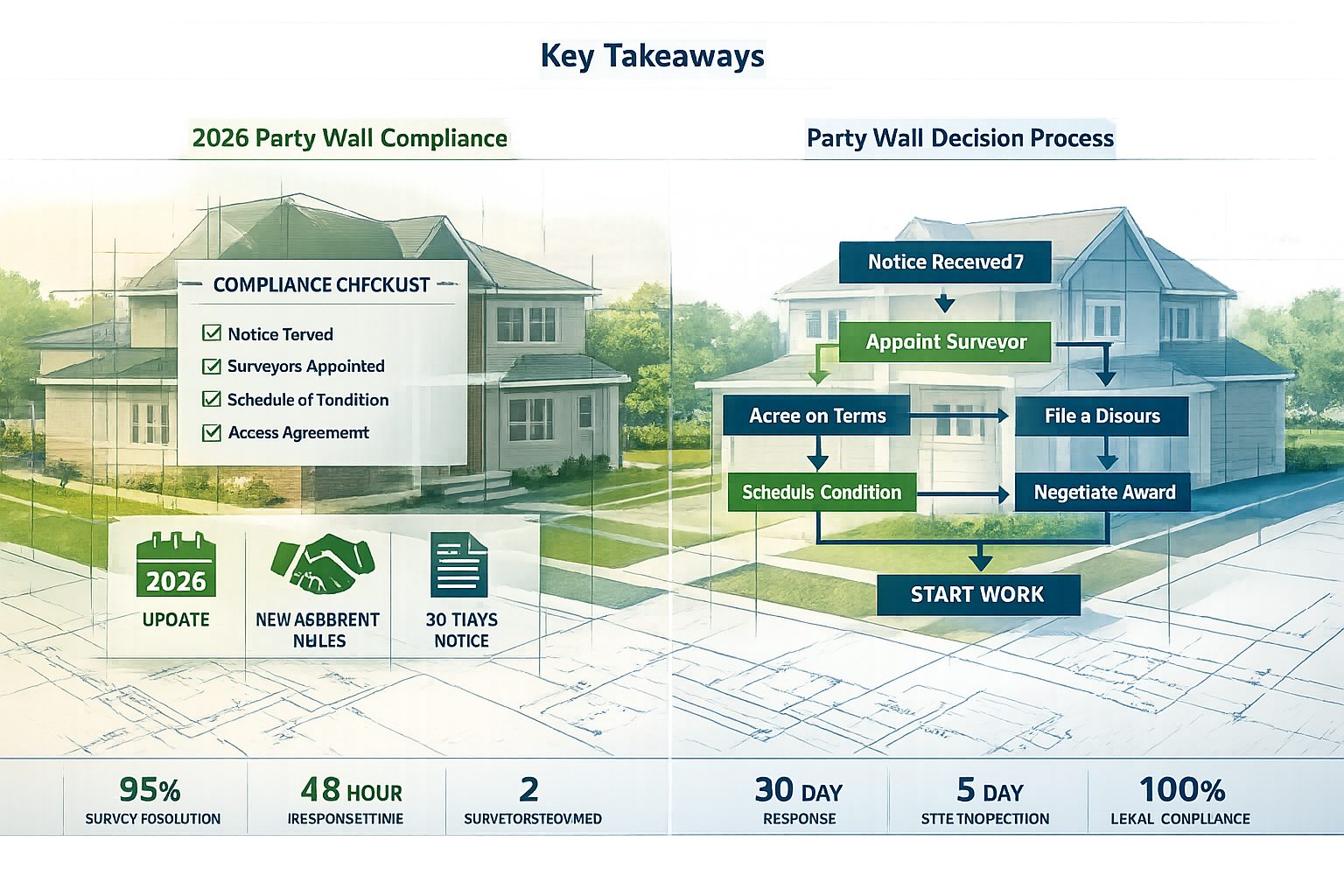
✅ Legal Notice is Mandatory: Before commencing party wall works, property owners must serve written Party Wall Notices to all affected neighbours—verbal agreements hold no legal weight, and the notice requires a 14-day response period.[3]
✅ Professional Costs Are Predictable: The average party wall agreement costs approximately £1,000, with surveyors charging between £150-£200 per hour, though complexity and location significantly impact final expenses.[3]
✅ Documentation Prevents Disputes: Comprehensive schedules of condition with timestamped photographs, detailed work logs, and written neighbour communications serve as critical evidence in resolving disagreements and demonstrating compliance.[2]
✅ Independent Surveyors Ensure Fairness: When both parties appoint surveyors, they must select one agreed, independent professional who is NOT the building owner's existing surveyor, ensuring impartial assessment and award preparation.[3]
✅ 2026 Standards Demand Greater Precision: Updated requirements emphasize clearer documentation, enhanced transparency, improved communication protocols, and stricter compliance measures that protect all parties involved.[6]
Understanding Party Wall Legislation and 2026 Requirements
What Constitutes a Party Wall?
A party wall is a shared wall that separates adjoining properties, most commonly found in semi-detached houses, terraced homes, and apartment buildings.[3] These structures can include walls built along the boundary line between properties, walls that straddle the boundary with equal portions on each side, or garden walls constructed over or along property boundaries.[3]
The Party Wall etc. Act 1996 governs these shared structures throughout England and Wales, establishing clear rights and responsibilities for property owners undertaking building work. Understanding what qualifies as a party wall is the first step in determining whether formal agreements and surveys are necessary.
Common party wall scenarios include:
- 🏠 Shared walls between semi-detached or terraced houses
- 🧱 Boundary walls built astride the property line
- 🏗️ Walls within one property that support structures in neighbouring properties
- 🌳 Garden walls exceeding certain height thresholds along boundaries
When Party Wall Agreements Are Required
Not all work affecting party walls requires formal agreements. Minor activities such as plastering, electrical installations, or attaching kitchen units and shelving typically fall outside the scope of party wall legislation.[3] However, more substantial works demand proper notification and agreement.
Property owners must serve Party Wall Notices when planning:
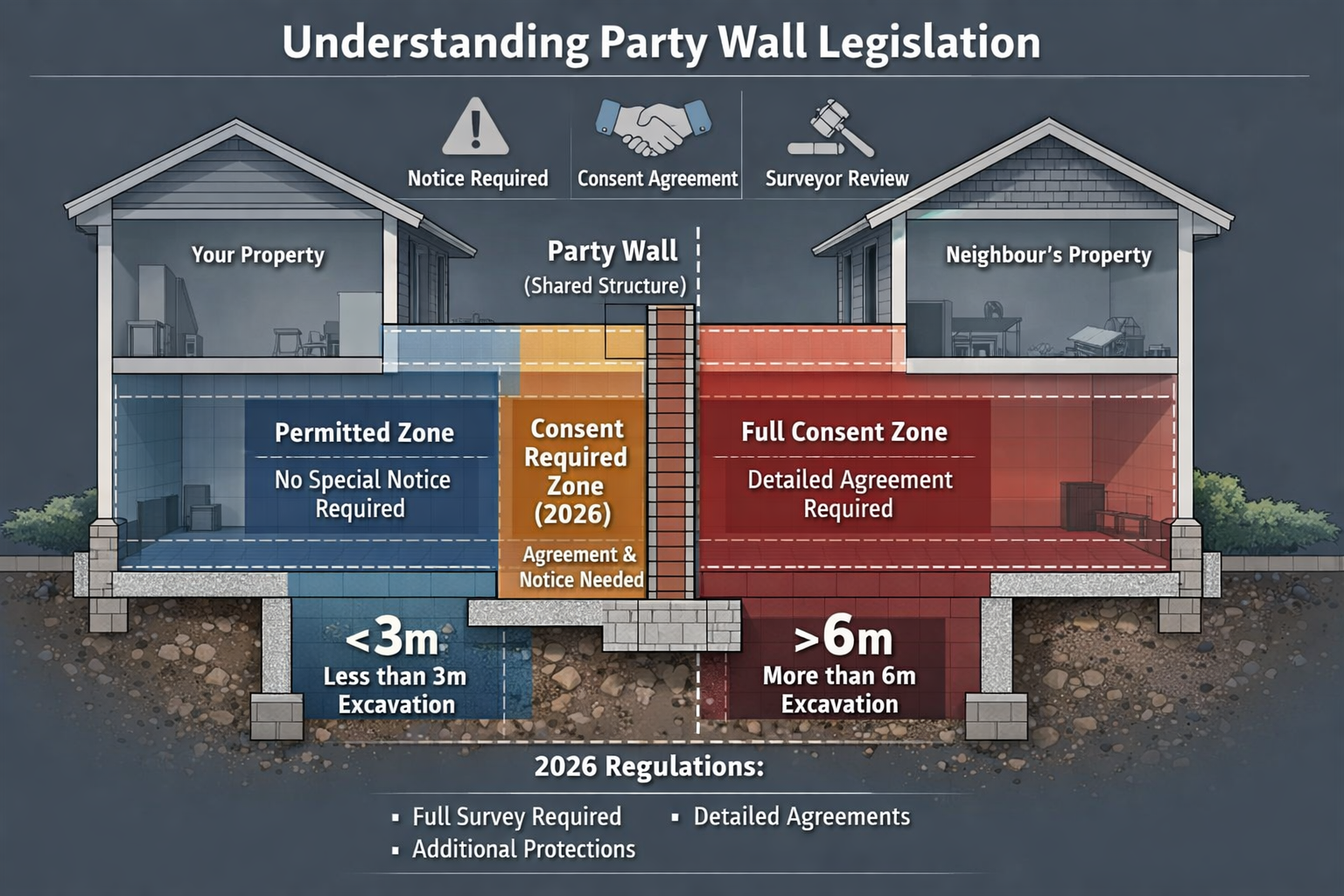
- Building on or adjacent to a party wall (cutting into, underpinning, or raising the wall)
- Excavating within three meters of a neighbouring structure if the work goes deeper than the neighbour's foundations
- Excavating within six meters if the proposed excavation extends below a 45-degree plane from the neighbour's foundation base
Understanding what is the three meter rule helps property owners determine when formal notices become mandatory.
2026 Compliance Standards and RICS Guidelines
The 2026 standards for party wall surveys represent a significant evolution in professional practice. These updated requirements emphasize clearer documentation, greater transparency, improved communication with surveyors, and enhanced precision requirements.[6]
Professional surveyors must now adhere to stricter RICS standards that demand:
- Enhanced photographic documentation with timestamped digital records
- More detailed schedules of condition that capture pre-work property states
- Clearer communication protocols between all parties
- Transparent fee structures disclosed upfront
- Comprehensive party wall awards that leave no ambiguity regarding permitted works
These elevated standards protect both building owners and neighbouring property owners while reducing the likelihood of disputes arising from unclear documentation or inadequate communication. For comprehensive guidance, consult our party wall FAQs resource.
Party Wall Surveys and Neighbour Agreements: Best Practices for the Survey Process
Serving Proper Party Wall Notices
The party wall process begins with serving appropriate written notice to all affected neighbours. This cannot be done verbally—the law requires formal written documentation that clearly outlines the proposed works.[3] Property owners must provide neighbours with a minimum 14-day response period to consider the notice and formulate their response.
Essential elements of a valid Party Wall Notice include:
- Detailed description of the proposed works
- Specific location and extent of work affecting the party wall
- Anticipated start date for the project
- Technical drawings or plans showing the work scope
- Building owner's contact information
- Clear explanation of the neighbour's rights and response options
Failure to serve proper notice can result in significant delays, legal complications, and potentially costly disputes. Understanding the consequences of party wall notice not served helps property owners avoid these pitfalls.
Neighbour Response Options and Implications
Upon receiving a Party Wall Notice, neighbours have three response options, each triggering different procedural requirements:
1. Consent (Written Assent)
When neighbours provide written agreement to the proposed works, no surveyor appointment is required.[3] However, prudent practice still recommends creating dated photographs and written documentation of the wall's current condition. While appointing a surveyor remains optional in consent situations, doing so can minimize future disputes by establishing a clear baseline condition record.
2. Dissent (Formal Disagreement)
If a neighbour dissents or fails to respond within 14 days, the matter automatically proceeds to surveyor appointment. This doesn't necessarily indicate hostility—many neighbours choose this route simply to ensure proper documentation and protection of their property interests.
3. No Response
Silence after 14 days is legally treated as dissent, triggering the surveyor appointment process. This protects neighbours who may be away or unable to respond while ensuring the process moves forward.
Understanding consent for party wall work clarifies how each response option affects timelines and costs.
Appointing Party Wall Surveyors
The surveyor appointment process varies depending on whether neighbours consent or dissent to proposed works.
Single Agreed Surveyor Approach
When both parties agree, they may appoint one independent surveyor who acts impartially for both sides. This surveyor must NOT be the same professional the building owner uses for their construction project—independence is paramount.[3] This approach typically reduces costs while ensuring fair treatment.
Two Surveyors Plus Third Surveyor
Alternatively, each party may appoint their own surveyor. These two professionals then work together to produce the party wall award. If they cannot agree on specific matters, they appoint a third surveyor to resolve the disagreement.
Cost Considerations
Professional party wall surveyors typically charge between £150 and £200 per hour, with a complete party wall award costing approximately £1,000.[3] These fees are generally the building owner's responsibility, including the neighbour's surveyor fees in most cases. For detailed cost breakdowns, review our guide on party wall costs.
Creating Comprehensive Schedules of Condition
The schedule of condition represents one of the most critical documents in the party wall process. This detailed record, prepared by the appointed surveyor(s), documents the pre-work condition of the neighbouring property through photographs, descriptions, and technical assessments.[3]
Essential schedule of condition components include:
| Component | Description | Purpose |
|---|---|---|
| Photographic Evidence | Timestamped, high-resolution images of all relevant areas | Visual baseline for comparison post-work |
| Written Descriptions | Detailed narrative of existing defects, cracks, finishes | Precise documentation of pre-existing conditions |
| Measurements | Crack widths, displacement measurements, level readings | Quantifiable data for future comparison |
| Room-by-Room Assessment | Systematic evaluation of each affected space | Comprehensive coverage preventing omissions |
| External Inspection | Exterior walls, foundations, drainage, landscaping | Complete property assessment |
This documentation proves invaluable when disputes arise regarding whether damage resulted from the building works or existed beforehand. Learn more about creating effective documentation through our schedule of condition party wall guide.
The Party Wall Award Document
The culminating document in the party wall process is the Party Wall Award—a legally binding agreement that details the proposed works, establishes conditions for execution, and sets out each party's rights and obligations.
Key Party Wall Award sections:
- Work Description: Precise details of permitted activities
- Access Rights: When and how the building owner may access neighbouring property
- Working Hours: Permitted times for noisy or disruptive work
- Protective Measures: Required precautions to prevent damage
- Schedule of Condition: Attached baseline documentation
- Dispute Resolution: Procedures for addressing disagreements during works
- Cost Allocation: Who pays for surveys, monitoring, and potential repairs
For comprehensive understanding of award requirements, consult our guidance for party wall award resource.
Party Wall Surveys and Neighbour Agreements: Best Practices for Dispute Resolution
Common Sources of Party Wall Disputes
Despite best intentions and proper procedures, party wall disputes remain common. Understanding typical conflict sources helps property owners and professionals anticipate and prevent problems.
Frequent dispute triggers include:
🔴 Inadequate or Late Notice: Serving notices too close to the work start date or with insufficient detail creates immediate friction and legal complications.
🔴 Damage to Neighbouring Property: Cracks, structural movement, or cosmetic damage resulting from building works represent the most serious dispute category, often requiring expert assessment and costly remediation.
🔴 Excessive Noise and Disruption: Works extending beyond agreed hours or creating unreasonable disturbance strain neighbour relations even when technically compliant.
🔴 Unauthorized Work Scope: Exceeding the approved works described in the Party Wall Award without additional notice and agreement.
🔴 Access Disputes: Disagreements over when, how, and how frequently the building owner may access neighbouring property.
🔴 Cost Disagreements: Conflicts over who pays surveyor fees, monitoring costs, or repair expenses.
Understanding what is a party wall dispute helps parties recognize when professional intervention becomes necessary.
Preventing Disputes Through Proactive Communication
The most effective dispute resolution strategy is prevention through communication. Property owners who invest time in building positive neighbour relationships before commencing work significantly reduce conflict likelihood.
Proactive communication best practices:
-
Pre-Notice Discussion: Informally discuss planned works before serving formal notices, explaining the project scope and anticipated timeline.
-
Visual Aids: Provide drawings, sketches, or 3D renderings that help neighbours visualize the proposed works.
-
Regular Updates: Keep neighbours informed throughout the project, particularly when timelines change or unexpected issues arise.
-
Responsive Attitude: Address neighbour concerns promptly and respectfully, even when not legally required to do so.
-
Written Records: Document all communications, agreements, and commitments in writing to prevent misunderstandings.
-
Professional Intermediaries: Engage surveyors early to facilitate discussions and provide objective technical explanations.
Escalation Procedures When Disputes Arise
When prevention fails and disputes emerge, following a structured escalation process protects all parties while seeking resolution.
Recommended dispute escalation pathway:
Stage 1: Direct Communication
Begin with friendly, non-confrontational conversation. Many disputes result from simple misunderstandings that direct dialogue can resolve. Document these conversations in writing afterward, confirming what was discussed and agreed.
Stage 2: Joint Inspection
Request that both parties (ideally with their respective surveyors) conduct a joint site inspection to examine the concern together. This collaborative approach often reveals solutions that written exchanges miss.
Stage 3: Surveyor-Assisted Mediation
Engage the appointed party wall surveyor(s) to mediate the dispute. These professionals have technical expertise and legal knowledge to propose fair solutions that satisfy both parties while maintaining compliance.
Stage 4: Third Surveyor Appointment
If the appointed surveyors cannot agree, they may appoint a third surveyor whose decision becomes binding. This represents a formal escalation but remains less costly and time-consuming than litigation.
Stage 5: Legal Consultation
When damage is substantial or other resolution methods fail, consult solicitors specializing in property law. This should be a last resort given the costs and relationship damage litigation creates.
For situations where agreements were never established, understand the implications through our guide on no party wall agreement.
Addressing Damage Claims
Damage to neighbouring property represents the most serious party wall dispute category. When structural cracks, cosmetic damage, or other harm occurs, following proper procedures protects all parties' interests.
Damage claim best practices:
✅ Immediate Documentation: Photograph and describe the damage as soon as it's discovered, noting date, time, and circumstances.
✅ Notify All Parties: Inform the building owner, contractor, and appointed surveyor(s) immediately in writing.
✅ Avoid Premature Repairs: Do not repair damage before the surveyor inspects and documents it, as this may prejudice claims.
✅ Reference Schedule of Condition: Compare current damage to the pre-work schedule of condition to establish whether the damage is new or pre-existing.
✅ Obtain Professional Assessment: Engage the party wall surveyor or independent structural engineer to assess cause, severity, and remediation requirements.
✅ Determine Causation: Establish whether the damage resulted from the building works, pre-existing defects, or other causes.
✅ Agree Remediation Scope: Define repair specifications that restore the property to its pre-work condition (or better if required).
Our resource on damage to property in party wall situations provides detailed guidance on managing these complex scenarios.
Maintenance-Related Disputes
Not all party wall disputes arise from new construction—many stem from maintenance neglect on one side of a shared wall. When a neighbour fails to maintain their portion of a party wall, causing damage or deterioration to your property, a different approach is required.
Addressing neighbour maintenance neglect:
-
Document the Problem: Photograph the deterioration, dampness, or structural issues, noting how they affect your property.
-
Friendly Initial Contact: Politely bring the issue to your neighbour's attention—they may be unaware of the problem.
-
Joint Inspection Request: Suggest examining the issue together to ensure both parties understand the scope.
-
Surveyor Engagement: If the neighbour is unresponsive, consider appointing a surveyor to assess the situation and produce a technical report.
-
Formal Written Notice: Send a formal letter (ideally through a solicitor) outlining the problem, required repairs, and reasonable timeline for action.
-
Legal Action: If substantial damage continues and the neighbour refuses to act, legal proceedings may become necessary to compel repairs and recover damages.
Regular maintenance inspections help prevent these disputes. Professional guidance recommends visual inspections every 6 to 12 months, checking for cracks, separation lines, damp, mould, bulging, peeling paint, and pest infestation.[2]
Documentation and Compliance Best Practices for 2026
Creating Comprehensive Work Records
Documentation excellence separates successful party wall projects from those that descend into costly disputes. Property owners and professionals should maintain comprehensive records throughout the entire process.
Essential documentation categories:
📋 Pre-Work Documentation
- Original Party Wall Notices with proof of service
- Neighbour responses (consent, dissent, or lack thereof)
- Surveyor appointment letters
- Complete schedule of condition with photographs
- Party Wall Award document
- Insurance certificates and contractor credentials
📋 During-Work Documentation
- Daily work logs noting activities, personnel, and hours
- Progress photographs showing work stages
- Any variations or changes to the approved scope
- Neighbour communications and complaints
- Incident reports for accidents or damage
- Delivery records and material specifications
📋 Post-Work Documentation
- Completion photographs showing finished work
- Final inspection reports from surveyors
- Neighbour sign-off or final assessment
- Contractor invoices and payment records
- Warranty and guarantee documentation
- "As-built" drawings showing final construction
Maintaining comprehensive logs including dates of work, before/after photographs, contractor invoices, and neighbour communications helps resolve future disagreements and demonstrates due diligence.[2]
Digital Documentation Systems
Modern technology offers powerful tools for managing party wall documentation more effectively than traditional paper-based systems.
Recommended digital documentation approaches:
🔧 Cloud-Based Storage: Platforms like Google Drive, Dropbox, or specialized construction management software provide secure, accessible storage for all party wall documents.
🔧 Photographic Apps: Use apps that automatically timestamp and geotag photographs, creating verifiable evidence of conditions at specific dates and locations.
🔧 Communication Tracking: Email provides automatic timestamps and records, making it superior to phone calls for important communications. Consider using project management platforms that centralize all correspondence.
🔧 Version Control: Maintain clear version histories for documents like Party Wall Awards, ensuring everyone works from the current approved version.
🔧 Backup Systems: Implement redundant backup systems to prevent catastrophic data loss that could undermine legal positions.
Inspection and Monitoring Protocols
Regular inspections during building works help identify problems early when they're easier and less expensive to address.
Inspection frequency recommendations:
| Project Phase | Inspection Frequency | Focus Areas |
|---|---|---|
| Pre-Work | Once (comprehensive) | Complete baseline condition documentation |
| Foundation Work | Weekly or after each major stage | Structural movement, crack development, drainage |
| Structural Work | Weekly | Wall integrity, load distribution, support adequacy |
| Finishing Work | Bi-weekly | Cosmetic damage, vibration effects, access compliance |
| Post-Completion | 1 month and 6 months after | Settlement, delayed damage manifestation |
| Ongoing Maintenance | Every 6-12 months | General condition, emerging defects, weatherproofing[2] |
Appointed surveyors typically conduct these inspections, though building owners may also engage independent monitors for additional protection. The costs of monitoring are generally the building owner's responsibility but provide valuable protection against unfounded damage claims.
Maintaining Compliance with RICS Standards
Professional surveyors must adhere to Royal Institution of Chartered Surveyors (RICS) standards when conducting party wall work. These standards protect all parties and ensure professional accountability.
Key RICS requirements for party wall surveyors include:
✓ Independence and Impartiality: Surveyors must act fairly between parties, even when appointed by one side.
✓ Professional Competence: Only appropriately qualified and experienced surveyors should undertake party wall work.
✓ Clear Fee Structures: Surveyors must provide transparent fee information upfront, avoiding surprise charges.
✓ Timely Service: Awards should be prepared and served within reasonable timeframes to avoid project delays.
✓ Comprehensive Documentation: All aspects of the survey, assessment, and award must be thoroughly documented.
✓ Continuing Professional Development: Surveyors must maintain current knowledge of legislation, case law, and best practices.
The RICS Building Surveying Standards provide detailed guidance on professional conduct and technical requirements.[7]
Record Retention Requirements
How long should party wall documentation be retained? Legal and practical considerations suggest extended retention periods.
Recommended retention periods:
- Party Wall Awards: Permanently (they run with the property)
- Schedules of Condition: Minimum 12 years (statute of limitations for property claims)
- Photographs and Inspection Reports: Minimum 12 years
- Correspondence: Minimum 6 years (general contract law limitation)
- Invoices and Payment Records: Minimum 6 years (tax requirements)
- Insurance Certificates: Duration of coverage plus 12 years
When selling a property, providing party wall documentation to purchasers demonstrates transparency and can prevent future disputes over historic works.
Protecting Professional Practice from Liability
Professional Indemnity Insurance
Surveyors conducting party wall work must maintain adequate professional indemnity insurance (PII) to protect against claims arising from errors, omissions, or professional negligence.
Essential PII considerations:
- Coverage Limits: Ensure policy limits adequately cover potential claim values in your practice area
- Retroactive Coverage: Verify that the policy covers work performed before the current policy period
- Extended Reporting: Consider "run-off" coverage for work performed if you cease practicing
- Exclusions: Understand what scenarios or claim types the policy excludes
- Notification Requirements: Know the procedures and timelines for notifying insurers of potential claims
RICS requires member surveyors to maintain minimum PII levels, but many professionals carry higher limits given the potential costs of party wall disputes.
Risk Management Strategies
Beyond insurance, proactive risk management reduces liability exposure and protects professional reputations.
Effective risk management practices:
🛡️ Detailed Engagement Letters: Clearly define scope of services, fees, timelines, and limitations of liability before commencing work.
🛡️ Conflict Checks: Verify no conflicts of interest exist before accepting appointments, particularly when acting as the agreed surveyor.
🛡️ Technical Review: Have complex or unusual party wall awards reviewed by senior colleagues before issuance.
🛡️ Clear Communication: Explain technical matters in plain language to ensure clients understand their rights, obligations, and options.
🛡️ Limitation of Liability Clauses: Where appropriate and legally enforceable, include reasonable liability limitations in engagement terms.
🛡️ Continuing Education: Stay current on legislation changes, case law developments, and evolving best practices through regular training.
Common Professional Errors to Avoid
Understanding typical mistakes helps surveyors avoid repeating them.
Frequent professional errors include:
❌ Inadequate Schedule of Condition: Superficial or incomplete baseline documentation that fails to capture pre-existing defects
❌ Ambiguous Award Language: Vague descriptions of permitted works that lead to scope disputes
❌ Missed Deadlines: Failing to prepare and serve awards within reasonable timeframes, delaying projects
❌ Insufficient Independence: Appearing biased toward the appointing party rather than maintaining impartiality
❌ Poor Communication: Failing to keep both parties informed of progress, decisions, and requirements
❌ Inadequate Site Knowledge: Preparing awards without sufficient site visits or technical understanding
❌ Scope Creep: Allowing work to exceed the approved scope without proper variation procedures
Handling Complaints and Appeals
Despite best efforts, complaints may arise. Professional handling of these situations protects reputations and limits liability.
Complaint management best practices:
-
Acknowledge Promptly: Respond to complaints quickly, even if a full response requires investigation time.
-
Investigate Thoroughly: Examine the complaint objectively, reviewing all documentation and seeking colleague input if appropriate.
-
Communicate Clearly: Explain your findings and reasoning in accessible language, avoiding defensive tones.
-
Offer Remedies: Where errors occurred, propose fair solutions that address the harm without admitting liability unnecessarily.
-
Document Everything: Maintain complete records of complaints, investigations, and resolutions.
-
Notify Insurers: Inform your PII provider of serious complaints that could develop into claims, following policy notification requirements.
-
Learn and Improve: Analyze complaints for systemic issues in your practice that warrant process improvements.
The Party Wall etc. Act 1996 provides appeal mechanisms through the County Court for parties dissatisfied with surveyor decisions, making thorough and fair initial work essential.
Special Considerations for 2026 Projects
Loft Conversions and Party Walls
Loft conversions represent one of the most common projects triggering party wall requirements, particularly in terraced and semi-detached properties where roof structures and party walls interact.
Party wall considerations for loft conversions:
- Raising Party Walls: Extending party walls upward to accommodate increased height requires formal party wall procedures
- Steel Beam Installation: Inserting structural beams that bear on or pass through party walls needs agreement
- Roof Structure Modifications: Changes affecting shared roof structures or party wall loading
- Staircase Installation: New staircases may affect party wall structures or require underpinning
- Dormer Construction: Dormers can impact party wall heights and structural loads
For comprehensive guidance on these projects, review our party wall loft conversions resource.
Excavation and Foundation Work
The three-meter and six-meter rules govern when excavation work near neighbouring properties requires party wall procedures.
Excavation notice requirements:
- Within 3 meters: Notice required if excavating deeper than the neighbour's foundation base
- Within 6 meters: Notice required if excavation extends below a 45-degree plane from the neighbour's foundation base
- Underpinning: Always requires notice when affecting party walls or nearby structures
These rules protect neighbouring properties from foundation damage, settlement, or structural instability caused by adjacent excavation.
Commercial and Mixed-Use Properties
Party wall procedures in commercial properties or mixed-use developments involve additional complexities compared to residential projects.
Commercial party wall considerations:
- Multiple Stakeholders: Commercial buildings may have multiple tenants, leaseholders, and ownership structures requiring broader notification
- Business Disruption: Commercial neighbours face revenue loss from disruption, making timing and working hours critical
- Structural Complexity: Commercial buildings often have more complex structural systems requiring specialized surveyor expertise
- Higher Values: Greater property values and potential damage costs increase stakes and liability exposure
- Lease Restrictions: Commercial leases may impose additional requirements beyond statutory party wall obligations
Heritage and Listed Buildings
Listed buildings and properties in conservation areas require special consideration when party wall work is contemplated.
Heritage property considerations:
🏛️ Listed Building Consent: Separate from party wall procedures, listed building consent may be required for proposed works
🏛️ Conservation Officer Involvement: Local authority conservation officers may need to approve methods and materials
🏛️ Specialist Surveyors: Heritage property expertise becomes essential for appropriate assessment and award preparation
🏛️ Traditional Materials: Awards may specify traditional materials and methods to preserve historic character
🏛️ Enhanced Documentation: More detailed schedules of condition protect irreplaceable historic fabric
🏛️ Reversibility Requirements: Works may need to be reversible to satisfy conservation principles
Conclusion: Implementing Best Practices for Party Wall Success in 2026
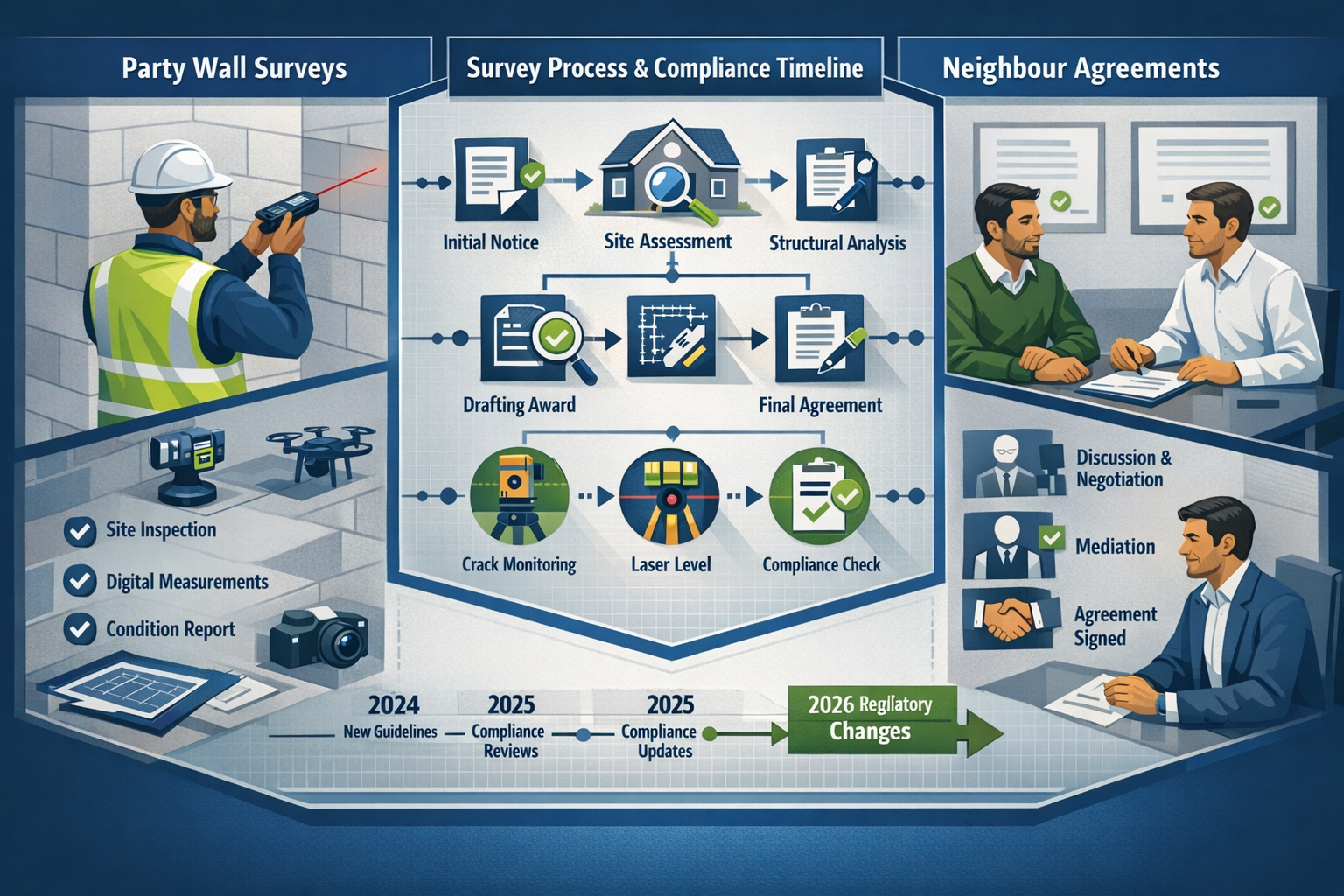
As construction activity continues expanding throughout 2026, mastering Party Wall Surveys and Neighbour Agreements: Best Practices for Managing Disputes and Compliance in 2026 has never been more critical. The elevated standards, enhanced documentation requirements, and increased scrutiny of party wall procedures demand that property owners, neighbours, and professional surveyors approach these matters with diligence, transparency, and commitment to best practices.
Key Success Factors
Successful party wall management in 2026 requires:
✨ Proactive Communication: Engaging neighbours early, explaining proposed works clearly, and maintaining open dialogue throughout projects prevents most disputes before they arise.
✨ Comprehensive Documentation: Detailed schedules of condition, timestamped photographs, written records of all communications, and thorough work logs provide essential protection when disagreements emerge.
✨ Professional Expertise: Engaging qualified, RICS-compliant surveyors ensures proper procedures, fair awards, and defensible positions if disputes escalate.
✨ Regulatory Compliance: Adhering to updated 2026 standards, serving proper notices, respecting response timelines, and following prescribed procedures protects legal positions.
✨ Risk Management: Maintaining adequate insurance, implementing systematic quality controls, and learning from industry experience minimizes liability exposure.
Actionable Next Steps
For building owners planning party wall work:
- Research Requirements Early: Determine whether your project triggers party wall procedures well before your planned start date
- Engage Professional Surveyors: Consult qualified party wall surveyors during project planning, not just when disputes arise
- Budget Appropriately: Include party wall costs (averaging £1,000 plus potential monitoring fees) in your project budget
- Communicate Proactively: Discuss plans with neighbours informally before serving formal notices
- Document Everything: Create comprehensive records from project inception through completion and beyond
For neighbours receiving party wall notices:
- Understand Your Rights: Research party wall legislation or consult a surveyor to understand your options
- Respond Promptly: Provide written responses within the 14-day period, even if consenting
- Consider Surveyor Appointment: Even when inclined to consent, appointing a surveyor provides valuable protection
- Document Baseline Conditions: Photograph your property thoroughly before works commence
- Maintain Communication: Stay engaged throughout the project, raising concerns promptly when they arise
For professional surveyors:
- Update Technical Knowledge: Ensure familiarity with 2026 standards, recent case law, and evolving best practices
- Enhance Documentation Systems: Implement digital tools and systematic processes for comprehensive record-keeping
- Verify Insurance Coverage: Confirm professional indemnity insurance adequately covers party wall work
- Maintain Independence: Rigorously protect impartiality even when appointed by one party
- Invest in CPD: Participate in continuing professional development focused on party wall expertise
The Path Forward
The party wall landscape in 2026 demands higher standards, greater transparency, and more rigorous compliance than ever before. Property owners who view party wall procedures as mere bureaucratic obstacles risk costly disputes, project delays, and damaged neighbour relations. Those who embrace best practices, engage qualified professionals, and prioritize communication and documentation position themselves for successful projects and positive outcomes.
Similarly, surveyors who maintain technical excellence, adhere to RICS standards, and implement robust risk management systems protect their professional reputations while serving clients effectively. The investment in proper party wall procedures—whether measured in time, money, or professional attention—consistently proves worthwhile when compared to the costs of disputes, litigation, and damaged relationships.
By implementing the best practices outlined in this guide, all parties can navigate party wall matters confidently, maintain compliance with evolving standards, and achieve successful project outcomes while preserving the positive neighbour relationships that make communities thrive.
For additional support with party wall matters, professional surveys, or dispute resolution, consult qualified chartered surveyors who specialize in party wall work and maintain current knowledge of 2026 compliance requirements.
References
[1] Party Walls – https://cardinalsurveying.com/party-walls/
[2] Party Wall Maintenance Tips For Keeping Your Property In Compliance – https://www.adamjoseph.co.uk/party-wall-maintenance-tips-for-keeping-your-property-in-compliance
[3] Party Wall Agreement – https://hoa.org.uk/advice/guides-for-homeowners/i-am-improving/party-wall-agreement/
[4] Party Wall Survey Guide – https://strutsurveyors.com/party-wall-survey-guide/
[5] Post Alta Nsps 2026 Standards Implementation Challenges And Success Stories For Property Surveyors – https://nottinghillsurveyors.com/blog/post-alta-nsps-2026-standards-implementation-challenges-and-success-stories-for-property-surveyors
[6] New 2026 Minimum Standard Detail Requirements For Land Title Surveys – https://www.harrisbeachmurtha.com/insights/new-2026-minimum-standard-detail-requirements-for-land-title-surveys/
[7] Building Surveying Standards – https://www.rics.org/profession-standards/rics-standards-and-guidance/sector-standards/building-surveying-standards