Scotland's property market is experiencing unprecedented momentum in 2026, with the nation leading the UK in regional house price growth. This surge has sparked a residential development boom, driving demand for extensions, conversions, and new builds across Edinburgh, Glasgow, Aberdeen, and beyond. As homeowners and developers rush to capitalize on rising property values, party wall surveying has become critically important for ensuring legal compliance and protecting all parties involved in construction projects affecting shared structures.
Understanding Party Wall Surveying for Scotland's 2026 Housing Boom: Compliance and Best Practices Amid Strong Price Growth is essential for property professionals, homeowners, and developers navigating this dynamic market. Unlike England and Wales, Scotland operates under different legal frameworks for party wall matters, making specialized knowledge crucial for successful project delivery.

Key Takeaways
- 🏴 Scotland follows common law principles rather than the Party Wall etc. Act 1996, requiring different notification and dispute resolution approaches
- 📈 Strong price growth in 2026 has increased renovation and extension activity, creating higher demand for party wall surveying services
- ⚖️ Legal compliance requires understanding Scottish building standards, title deeds, and common interest provisions
- 🔍 Professional surveyors play vital roles in documenting conditions, managing neighbour relations, and preventing costly disputes
- 🏗️ Best practices include early engagement, thorough documentation, and clear communication throughout construction projects
Understanding Scotland's Unique Party Wall Legal Framework
How Scottish Law Differs from English Party Wall Legislation
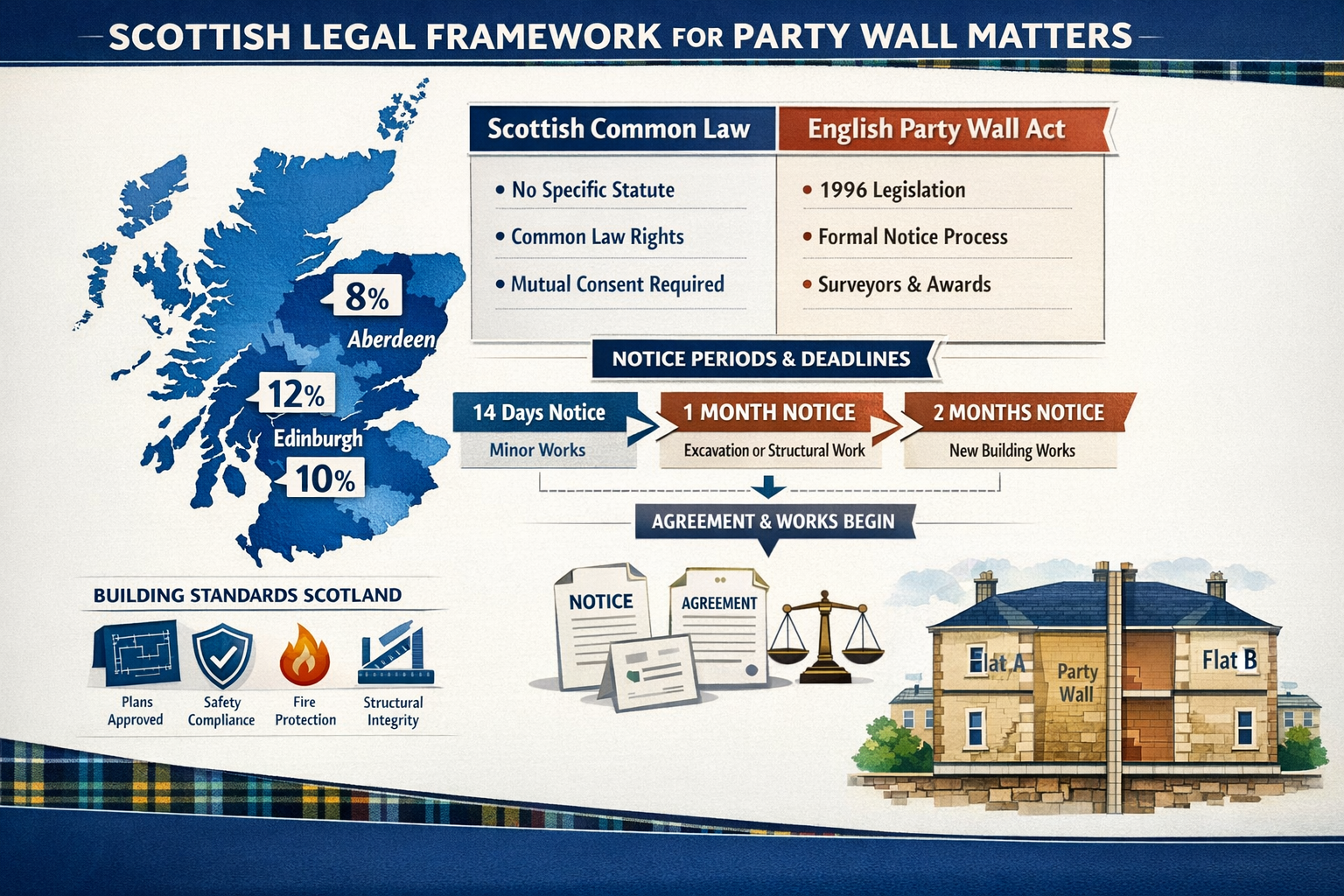
Scotland's approach to party wall matters fundamentally differs from the Party Wall etc. Act 1996 that governs England and Wales. Scottish property law operates under common law principles and the Title Conditions (Scotland) Act 2003, which means there is no statutory party wall procedure requiring formal notices and awards.
Instead, Scottish property owners must navigate:
- Title deed provisions that specify rights and obligations regarding shared walls
- Common interest rules that protect structural elements shared between properties
- Building Standards Scotland requirements for construction work
- Common law duties to avoid causing damage to neighbouring properties
This legal landscape creates both challenges and opportunities. While there's no mandatory notice period, property owners still have legal obligations to their neighbours. Understanding these nuances is critical for Party Wall Surveying for Scotland's 2026 Housing Boom: Compliance and Best Practices Amid Strong Price Growth.
Key Scottish Regulations Affecting Party Wall Work
Several regulatory frameworks govern work affecting party walls in Scotland:
| Regulation | Application | Key Requirements |
|---|---|---|
| Building (Scotland) Regulations 2004 | All construction work | Building warrant required for structural alterations |
| Title Conditions (Scotland) Act 2003 | Property boundaries and shared structures | Compliance with title deed conditions |
| Common Law of Nuisance | Work causing damage or disturbance | Duty of care to neighbours |
| Housing (Scotland) Act 2006 | Tenement properties | Maintenance and repair obligations |
| Tenements (Scotland) Act 2004 | Shared ownership structures | Common property management rules |
Common Interest and Shared Ownership Principles
In Scotland, the concept of common interest provides automatic protection for structural elements, even without explicit title deed provisions. This means:
✅ Owners cannot weaken support structures affecting neighbouring properties
✅ Gable walls and party walls benefit from mutual protection rights
✅ Alterations requiring neighbour consent must be properly documented
✅ Damage caused by construction work creates liability regardless of notices served
For tenement properties (Scotland's traditional multi-storey buildings with shared walls), the Tenements (Scotland) Act 2004 establishes default rules for common property management. These provisions are particularly relevant during the 2026 housing boom, as many tenement conversions and renovations involve party wall considerations.
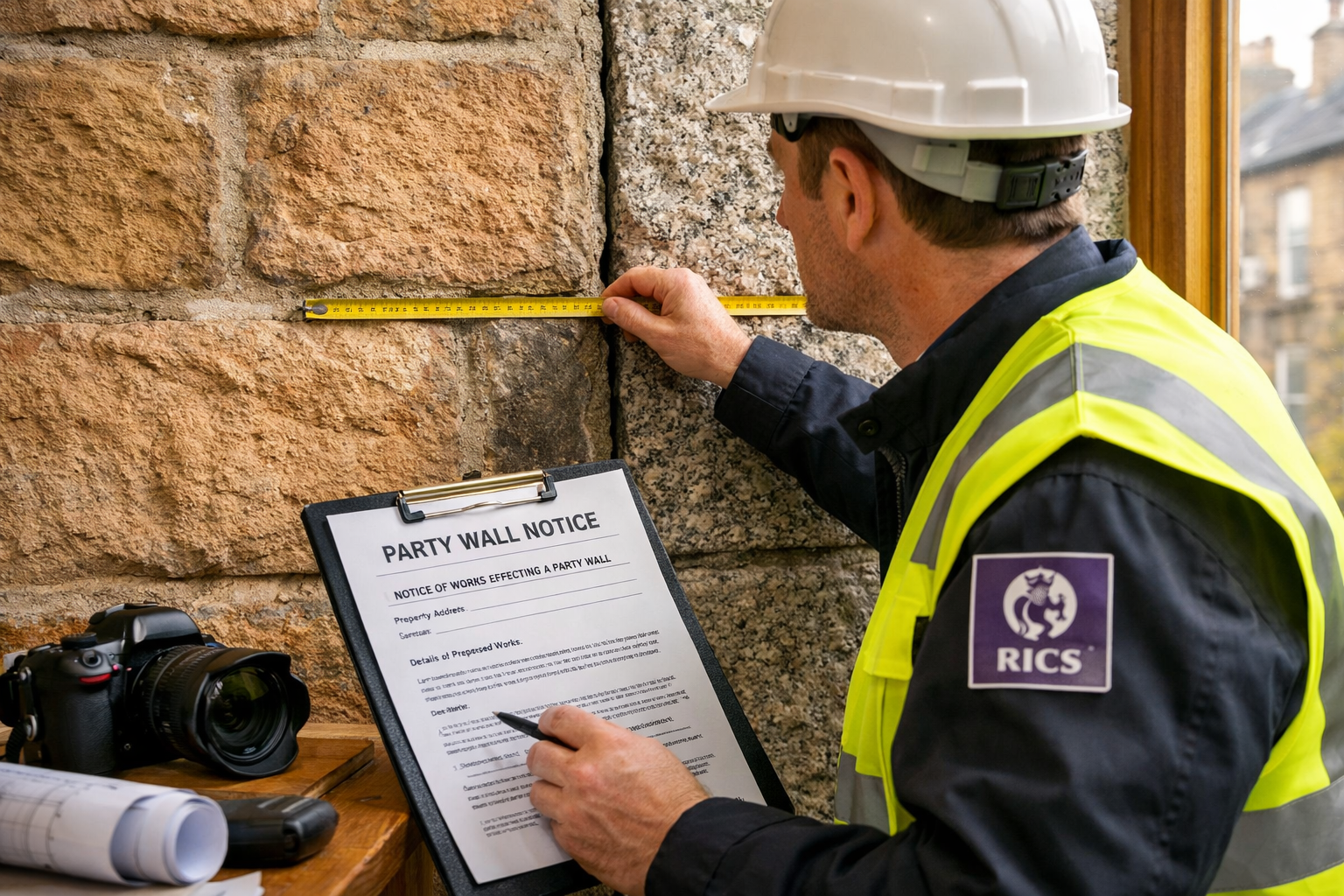
Party Wall Surveying for Scotland's 2026 Housing Boom: Notification Requirements and Compliance
When Notification is Required Under Scottish Law
Although Scotland lacks statutory party wall notice requirements, best practice dictates proactive communication with neighbours before commencing work affecting shared structures. Notification should be provided for:
- Structural alterations to party walls or gable walls
- Foundation work within three metres of neighbouring properties (similar to the three-meter rule applied in England)
- Loft conversions affecting shared roof structures or party walls
- Extensions that may impact structural support or drainage
- Chimney work on shared chimneys and shared chimney stacks
While not legally mandated, written notification demonstrates good faith and helps prevent party wall disputes that could delay projects and increase costs.
Best Practices for Neighbour Communication
Effective communication is the cornerstone of successful party wall management in Scotland's 2026 housing boom. Professional surveyors recommend:
Early Engagement Strategy:
- Initial conversation – Discuss plans informally before formal notification
- Written notice – Provide detailed description of proposed works
- Access arrangements – Negotiate reasonable access for inspections
- Timeline sharing – Communicate realistic project schedules
- Contact information – Provide details for project manager and surveyor
Documentation Requirements:
- Architectural drawings showing party wall impacts
- Structural engineer reports for significant alterations
- Building warrant applications and approvals
- Insurance certificates demonstrating adequate coverage
- Schedule of condition documenting pre-work property status
Obtaining Consent for Party Wall Work
Unlike the statutory consent process in England, Scottish consent for party wall work relies on:
Voluntary Agreements:
Property owners should seek written consent documenting:
- Specific works to be undertaken
- Access rights and limitations
- Protection measures to prevent damage
- Dispute resolution mechanisms
- Cost-sharing arrangements (if applicable)
Title Deed Compliance:
Review property titles to identify any express conditions requiring neighbour consent. Breaching title conditions can result in court interdicts preventing work continuation.
Professional Survey Involvement:
Engaging qualified surveyors provides several advantages:
- Independent assessment of potential impacts
- Professional documentation reducing liability risks
- Mediation support if disagreements arise
- Technical expertise ensuring building standards compliance
The absence of party wall agreements doesn't eliminate legal obligations—it simply shifts responsibility to common law principles and contractual arrangements.
Compliance Challenges During Scotland's 2026 Housing Market Surge
Managing Increased Workload and Project Volume
Scotland's exceptional price growth in 2026 has created unprecedented demand for party wall surveying services. Property values in Edinburgh have increased by double digits, while Glasgow and Aberdeen show similarly strong performance. This boom presents several challenges:
Capacity Constraints:
- Shortage of qualified surveyors familiar with Scottish law
- Extended timelines for survey appointments
- Pressure to expedite assessments without compromising quality
- Increased risk of oversights due to rushed processes
Quality Assurance Measures:
Professional firms must implement robust systems:
- Standardized checklists for Scottish party wall assessments
- Peer review processes for complex cases
- Continuing professional development on Scottish regulations
- Technology integration for efficient documentation
Client Education:
Many homeowners undertaking first-time extensions lack understanding of Scottish party wall requirements. Surveyors must invest time explaining:
- Differences from English party wall procedures
- Importance of neighbour relations
- Potential consequences of party wall notices not served (or not provided in Scottish context)
- Timeline implications for project planning
Common Compliance Pitfalls and How to Avoid Them
Pitfall #1: Assuming English Party Wall Act Applies
❌ Problem: Contractors and homeowners from England applying English procedures in Scotland
✅ Solution: Verify legal framework before commencing work; engage Scottish-qualified surveyors
Pitfall #2: Inadequate Pre-Work Documentation
❌ Problem: Failing to create comprehensive schedules of condition
✅ Solution: Photograph and document all potentially affected areas before work begins
Pitfall #3: Ignoring Title Deed Provisions
❌ Problem: Proceeding without reviewing property titles
✅ Solution: Conduct thorough title searches identifying relevant burdens and conditions
Pitfall #4: Poor Communication with Neighbours
❌ Problem: Starting work without proper notification or discussion
✅ Solution: Implement structured communication protocols with written documentation
Pitfall #5: Insufficient Insurance Coverage
❌ Problem: Inadequate protection against damage claims
✅ Solution: Verify contractors carry appropriate public liability insurance; consider additional cover
Handling Disputes and Disagreements
When conflicts arise despite best efforts, Scottish property owners have several resolution options:
Informal Mediation:
- Direct negotiation between property owners
- Surveyor-facilitated discussions
- Community mediation services
Formal Procedures:
- Sheriff Court actions for interdict or damages
- Arbitration under Scottish Arbitration Code
- Expert determination by independent surveyors
Prevention Strategies:
The best dispute resolution is dispute prevention. Professional surveyors recommend:
🔹 Transparent processes – Share information openly with all parties
🔹 Realistic expectations – Clearly communicate potential disruptions
🔹 Responsive communication – Address concerns promptly
🔹 Professional intermediaries – Use surveyors as neutral facilitators
🔹 Written agreements – Document all arrangements and commitments
For guidance on managing conflicts, property owners can consult resources on party wall disputes adapted for Scottish contexts.
Best Practices for Party Wall Surveyors Operating in Scotland's 2026 Market
Professional Standards and Qualifications
The surge in Scottish construction activity demands highly qualified professionals. Party wall surveyors should possess:
Essential Qualifications:
- RICS (Royal Institution of Chartered Surveyors) membership
- Specific knowledge of Scottish property law
- Building pathology expertise
- Understanding of Scottish building standards
- Professional indemnity insurance
Continuing Professional Development:
Given Scotland's unique legal framework, surveyors must maintain current knowledge through:
- Scottish property law updates
- Building Standards Scotland amendments
- Case law developments affecting party wall matters
- Industry best practice guidance
- Technical construction methods and materials
Conducting Thorough Pre-Work Assessments
Comprehensive assessments form the foundation of successful party wall management. Best practice protocols include:
Site Investigation Checklist:
✓ External inspection of party wall and adjacent structures
✓ Internal examination of potentially affected areas
✓ Identification of existing defects or damage
✓ Assessment of structural condition and stability
✓ Review of previous alterations or repairs
✓ Evaluation of construction methods and materials
✓ Photographic documentation from multiple angles
✓ Measured surveys of critical dimensions
Schedule of Condition Requirements:
A detailed schedule of condition protects all parties by establishing baseline property status. Essential elements include:
- High-resolution photography – Date-stamped images of all relevant areas
- Written descriptions – Detailed narrative of existing conditions
- Defect identification – Documentation of pre-existing issues
- Measurement records – Crack widths, level readings, alignment checks
- Material specifications – Identification of construction types and finishes
This documentation proves invaluable if disputes arise regarding damage attribution. For properties with existing issues, consider specialized structural surveys to establish comprehensive baseline conditions.
Documentation and Record-Keeping Excellence
Professional party wall surveyors must maintain meticulous records throughout projects:
Essential Documentation:
- Initial correspondence – All communications with property owners
- Survey reports – Detailed technical assessments
- Photographic records – Comprehensive visual documentation
- Drawings and plans – Annotated architectural documents
- Consent agreements – Written permissions and arrangements
- Progress reports – Regular updates on work advancement
- Completion certificates – Final condition assessments
- Correspondence logs – Chronological communication records
Digital Systems:
Modern surveying practices leverage technology for efficiency:
- Cloud-based document management systems
- Digital photography with GPS tagging
- 3D scanning for complex structures
- Project management software tracking milestones
- Secure client portals for document sharing
Managing Loft Conversions and Extensions
Loft conversions represent a significant portion of work during Scotland's 2026 housing boom, particularly in cities with limited land availability. These projects frequently involve party wall considerations:
Common Loft Conversion Issues:
- Raising party wall height for headroom
- Installing steel beams bearing on party walls
- Dormer windows affecting shared roof structures
- Staircase installations requiring structural alterations
- Sound insulation between converted spaces
Extension-Specific Considerations:
- Foundation depth and proximity to boundaries
- Drainage connections and soakaway locations
- Structural loading on party walls
- Access requirements during construction
- Temporary works and scaffolding arrangements
Cost Management and Fee Structures
Transparent pricing builds trust and prevents disputes. Scottish party wall surveyors typically charge:
Fee Structures:
- Hourly rates: £100-£200+ depending on experience and complexity
- Fixed fees: £500-£2,000+ for standard residential assessments
- Percentage-based: 0.5-1% of construction costs for major projects
- Disbursements: Additional costs for specialist reports or testing
Cost Factors:
- Property type and size
- Complexity of proposed works
- Number of adjoining owners involved
- Geographic location within Scotland
- Urgency and timeline requirements
- Need for specialist input (structural engineers, etc.)
During the 2026 boom, competitive pricing must balance affordability with quality service delivery. Surveyors should provide clear written quotations outlining scope and exclusions.
Technology and Innovation in Scottish Party Wall Surveying
Digital Tools Enhancing Survey Accuracy
Modern technology has transformed party wall surveying practices:
3D Laser Scanning:
- Precise measurements of complex structures
- Creation of detailed digital twins
- Accurate monitoring of structural movement
- Enhanced documentation for dispute resolution
Drone Photography:
- Safe inspection of high-level elements
- Comprehensive roof and chimney surveys
- Efficient documentation of large properties
- Cost-effective alternative to scaffolding access
Moisture Meters and Thermal Imaging:
- Detection of hidden defects
- Identification of water penetration routes
- Assessment of insulation effectiveness
- Evidence gathering for condition reports
Digital Reporting Platforms:
- Interactive reports with embedded media
- Real-time updates accessible to all parties
- Automated compliance checklists
- Streamlined approval workflows
Data Management During High-Volume Periods
Scotland's 2026 housing boom requires efficient information handling:
Cloud-Based Systems:
- Centralized document repositories
- Multi-user access with permission controls
- Automatic backup and version control
- Integration with accounting and CRM platforms
Mobile Applications:
- On-site data capture and annotation
- Offline functionality for remote locations
- Voice-to-text reporting capabilities
- Instant photo uploads with metadata
Artificial Intelligence Applications:
- Automated defect detection in photographs
- Predictive analysis of structural risks
- Natural language processing for report generation
- Pattern recognition identifying compliance issues
Regional Variations Across Scotland
Edinburgh's Tenement Challenges
Edinburgh's historic tenement buildings present unique party wall considerations:
- Stone construction requiring specialized assessment techniques
- Shared ownership under complex title arrangements
- Conservation area restrictions affecting alteration methods
- Tourism pressure creating demand for short-term rental conversions
Glasgow's Regeneration Projects
Glasgow's ongoing regeneration drives substantial party wall activity:
- Mixed-use developments combining residential and commercial spaces
- Brownfield redevelopment with contamination considerations
- Social housing improvements affecting multiple properties simultaneously
- New build density creating numerous boundary interfaces
Aberdeen's Energy Sector Influence
Aberdeen's economy influences its property market dynamics:
- Cyclical demand linked to oil and gas sector performance
- High-specification properties requiring premium materials
- Granite construction presenting unique technical challenges
- Coastal exposure affecting weathering and maintenance requirements
Future-Proofing Party Wall Practices for Continued Growth
Preparing for Sustained Market Activity
Scotland's strong 2026 performance may continue, requiring strategic planning:
Capacity Building:
- Recruitment and training of additional surveyors
- Development of standardized procedures and templates
- Investment in technology infrastructure
- Strategic partnerships with complementary professionals
Market Positioning:
- Specialization in specific property types or regions
- Thought leadership through publications and presentations
- Client education programs building awareness
- Relationship development with architects and contractors
Sustainability and Environmental Considerations
Modern party wall work increasingly incorporates sustainability:
Energy Efficiency Upgrades:
- Insulation installations affecting party walls
- Air tightness improvements at boundaries
- Renewable energy systems requiring structural modifications
- Ventilation strategies crossing property lines
Heritage Conservation:
- Balancing modernization with character preservation
- Traditional materials and methods for historic properties
- Reversible interventions minimizing permanent alterations
- Documentation standards for listed buildings
Professional Development Priorities
Surveyors must continuously enhance their expertise:
📚 Technical Knowledge:
- Scottish building regulations updates
- Emerging construction technologies
- Sustainable building practices
- Digital surveying methodologies
🤝 Soft Skills:
- Negotiation and mediation techniques
- Client communication and expectation management
- Cultural sensitivity in diverse communities
- Stress management during high-volume periods
⚖️ Legal Awareness:
- Case law developments affecting party walls
- Title deed interpretation skills
- Insurance and liability considerations
- Dispute resolution procedures
For those seeking comprehensive guidance, exploring party wall FAQs provides valuable foundational knowledge, though Scottish-specific adaptations are necessary.
Conclusion: Navigating Success in Scotland's Party Wall Landscape
Party Wall Surveying for Scotland's 2026 Housing Boom: Compliance and Best Practices Amid Strong Price Growth requires specialized knowledge, professional diligence, and adaptive strategies. Scotland's unique legal framework—operating under common law rather than statutory party wall legislation—demands that surveyors, property owners, and developers understand the nuanced differences from English practices.
The exceptional price growth driving Scotland's 2026 housing boom has created unprecedented opportunities alongside significant challenges. Increased renovation activity, loft conversions, and extensions mean more properties than ever require careful party wall management. Success depends on:
✅ Understanding Scottish legal principles governing shared structures and common interest
✅ Implementing proactive communication strategies with neighbours and stakeholders
✅ Maintaining comprehensive documentation throughout project lifecycles
✅ Leveraging technology to enhance accuracy and efficiency
✅ Prioritizing professional development to stay current with evolving practices
Actionable Next Steps
For Property Owners:
- Consult qualified Scottish surveyors before commencing work affecting party walls
- Review title deeds identifying any express conditions or restrictions
- Engage neighbours early with transparent communication about planned projects
- Ensure contractors understand Scottish legal requirements differ from English procedures
- Obtain comprehensive insurance coverage protecting against damage claims
For Surveyors:
- Invest in Scottish property law continuing education and qualifications
- Develop standardized procedures adapted specifically for Scottish contexts
- Implement robust quality assurance systems managing increased workload
- Adopt digital tools enhancing documentation and client communication
- Build strategic networks with complementary professionals across Scotland
For Developers:
- Budget adequate time and resources for proper party wall management
- Engage experienced Scottish surveyors during project planning phases
- Establish clear communication protocols with all affected neighbours
- Maintain flexibility in schedules accommodating potential delays
- Document all agreements and arrangements in writing
Scotland's 2026 housing boom presents remarkable opportunities for those equipped with appropriate knowledge and professional support. By understanding the unique Scottish approach to party wall matters and implementing best practices tailored to this framework, property professionals can navigate this dynamic market successfully while protecting the interests of all parties involved.
The combination of strong price growth, increased construction activity, and Scotland's distinctive legal landscape makes professional party wall surveying more valuable than ever. Those who invest in expertise, maintain rigorous standards, and prioritize collaborative approaches will thrive during this exceptional period of market expansion.
For comprehensive surveying services and expert guidance on party wall matters, consider consulting with qualified professionals who understand both the technical and legal complexities of Scottish property work. The right support makes the difference between smooth project delivery and costly disputes that delay construction and damage neighbour relations.