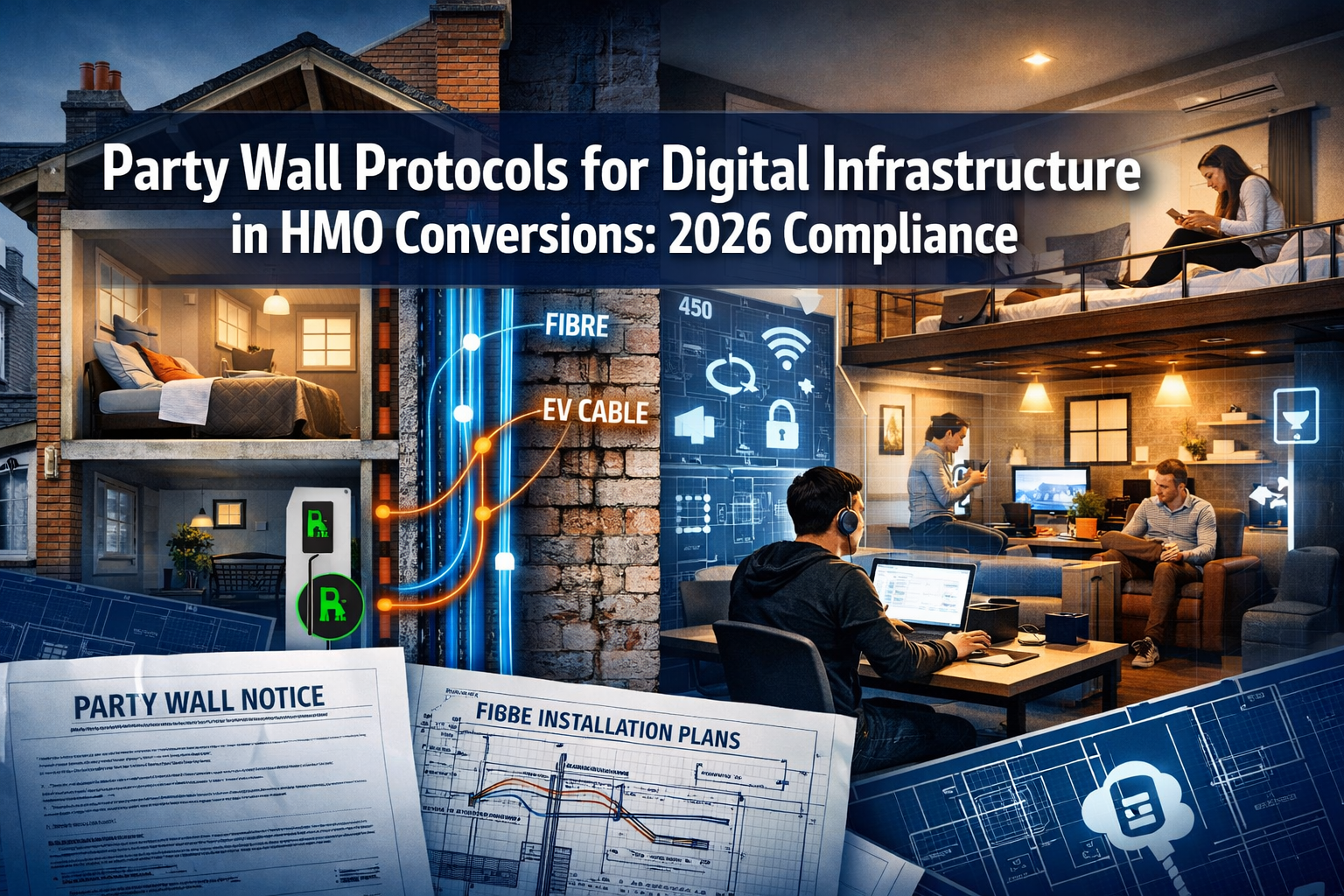

More than 60 council areas across England now restrict HMO conversions through Article 4 directions, while landlords face mounting pressure to install gigabit-capable broadband and EV charging infrastructure under evolving Private Rented Sector (PRS) regulations[3]. Yet the single biggest compliance blind spot remains party wall protocols when threading fiber cables or mounting EV chargers through shared walls—a legal minefield that can trigger disputes, delays, and unexpected costs exceeding £2,400 per property. Understanding Party Wall Protocols for Digital Infrastructure in HMO Conversions: 2026 Compliance for Fibre and EV Amid PRS Reforms has become essential for landlords navigating the intersection of housing standards, digital connectivity mandates, and neighbor relations.
The convergence of HMO licensing expansion, government digital infrastructure reforms, and the Renters' Rights Bill creates unprecedented compliance challenges in 2026. With over 70 councils operating additional licensing schemes for smaller HMOs (3-4 occupants)[3], and the UK government actively consulting on planning rule reforms to accelerate digital infrastructure deployment[1], property owners must master the technical and legal requirements for installing modern connectivity through party walls. This comprehensive guide explains exactly how to navigate party wall notices, award processes, and cost-saving strategies when upgrading HMOs with essential digital infrastructure.
Key Takeaways
- Party wall notices are mandatory when installing fiber ducting or EV charging conduits through shared walls in HMO conversions, with 14-day minimum notice periods required
- Multi-party agreements can reduce costs by 40-60%, saving £800-£2,400 per property when coordinating installations across adjoining HMO units
- Digital infrastructure planning reforms proposed in late 2025 aim to streamline deployment, but party wall obligations remain unchanged under current legislation[1]
- PRS reforms under the Renters' Rights Bill indirectly increase demand for proper digital infrastructure, making compliant party wall procedures critical for competitive HMO properties
- Combined compliance frameworks integrating fire safety, electrical certification, and party wall protocols reduce inspection failures and tenant disputes
Understanding Party Wall Obligations for HMO Digital Infrastructure
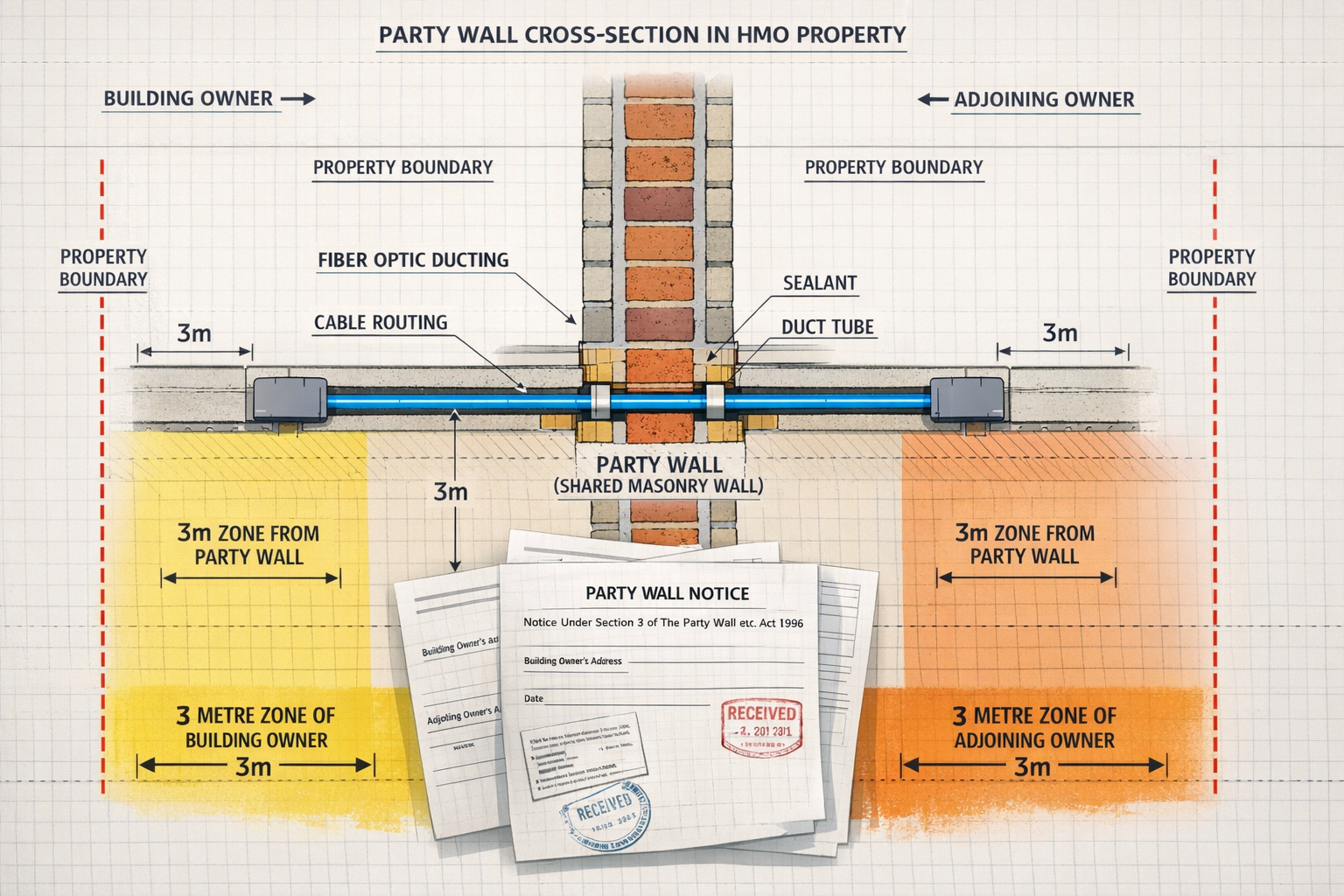
The Party Wall etc. Act 1996 governs all work affecting shared walls between properties, including the installation of digital infrastructure in HMO conversions. When landlords thread fiber optic cables, install EV charging conduits, or mount equipment on party walls, they trigger specific legal obligations that require formal notification and potentially surveyor-led award processes.
What Triggers Party Wall Notices for Digital Infrastructure
Installing fiber broadband or EV charging infrastructure in HMOs typically involves three scenarios that activate party wall requirements:
1. Cutting into Party Walls (Section 2 Work)
Threading fiber ducting through shared masonry walls requires cutting channels or drilling penetrations. This constitutes notifiable work under Section 2 of the Act, requiring two months' written notice to adjoining owners. The notice must specify:
- Exact location and dimensions of proposed penetrations
- Cable routing paths and duct specifications
- Fire-stopping measures and cavity barrier installations
- Anticipated start date and completion timeline
2. Building on or Near Boundary Lines (Section 1 Work)
External EV charging posts or fiber termination boxes mounted within three meters of a boundary line may require party wall notices, particularly if foundations exceed specified depths. Understanding the three-meter rule helps determine when formal notices become necessary.
3. Excavations Affecting Neighboring Foundations (Section 6 Work)
Underground conduit runs for EV charging cables or utility connections near party walls can undermine adjacent foundations. Section 6 work requires one month's notice when excavations fall within specified proximity zones.
The Party Wall Award Process for HMO Upgrades
When adjoining owners dissent to proposed works—or fail to respond within 14 days—the Party Wall Act mandates a formal award process[5]. For HMO conversions involving multiple units and shared infrastructure, this process becomes particularly complex:
Step 1: Formal Notice Delivery
Serve written notices to all affected adjoining owners, including:
- Detailed technical specifications of fiber/EV installations
- Architectural drawings showing cable routes and equipment locations
- Schedule of Condition documentation (pre-work property condition records)
Professional Schedule of Condition surveys protect both parties by establishing baseline property conditions before work commences.
Step 2: Consent or Dissent Response
Adjoining owners have 14 days to respond with either:
- Written consent (allowing work to proceed without further formality)
- Dissent or counter-proposals (triggering surveyor appointment)
- No response (deemed dissent, requiring award process)
Securing consent for party wall work early streamlines HMO conversion timelines and reduces costs significantly.
Step 3: Surveyor Appointment and Award
Upon dissent, parties must appoint either:
- Two surveyors (one for each party, who jointly select a third surveyor)
- One agreed surveyor (acting impartially for both parties—typically 30-40% cheaper)
The surveyor(s) inspect properties, assess proposed works, and issue a Party Wall Award document specifying:
- Permitted scope of digital infrastructure installation
- Working hours and access arrangements
- Cost allocation for surveys and monitoring
- Dispute resolution procedures
💡 Pro Tip: For HMO conversions involving multiple adjoining properties, appointing a single agreed surveyor can reduce total survey costs from £2,400 (three separate surveyors) to £800-£1,200, while maintaining legal compliance.
Digital Infrastructure-Specific Considerations
Modern fiber and EV installations present unique party wall challenges rarely encountered in traditional building work:
Cable Routing and Fire Safety
Fiber optic cables threaded through party walls must maintain fire compartmentation integrity. Party Wall Awards should specify:
- Approved fire-stopping materials (intumescent sealants, cavity barriers)
- Maximum penetration diameters to preserve structural integrity
- Inspection points for Building Control sign-off
Electromagnetic Interference and Cable Separation
EV charging cables carrying high currents must maintain separation distances from communication cables. Awards should address:
- Minimum spacing requirements (typically 300mm for power/data segregation)
- Shielding specifications for EMI-sensitive equipment
- Testing protocols to verify signal integrity post-installation
Ongoing Access and Maintenance Rights
Unlike one-time construction work, digital infrastructure requires periodic maintenance. Party Wall Awards should establish:
- Future access rights for cable upgrades or repairs
- Notice periods for maintenance activities
- Responsibility allocation for damage during servicing
For complex scenarios involving obstructions in party walls, specialized surveyor expertise ensures compliant solutions that satisfy both technical and legal requirements.
EV Charging and Fibre Installation: Technical Compliance Under 2026 Regulations
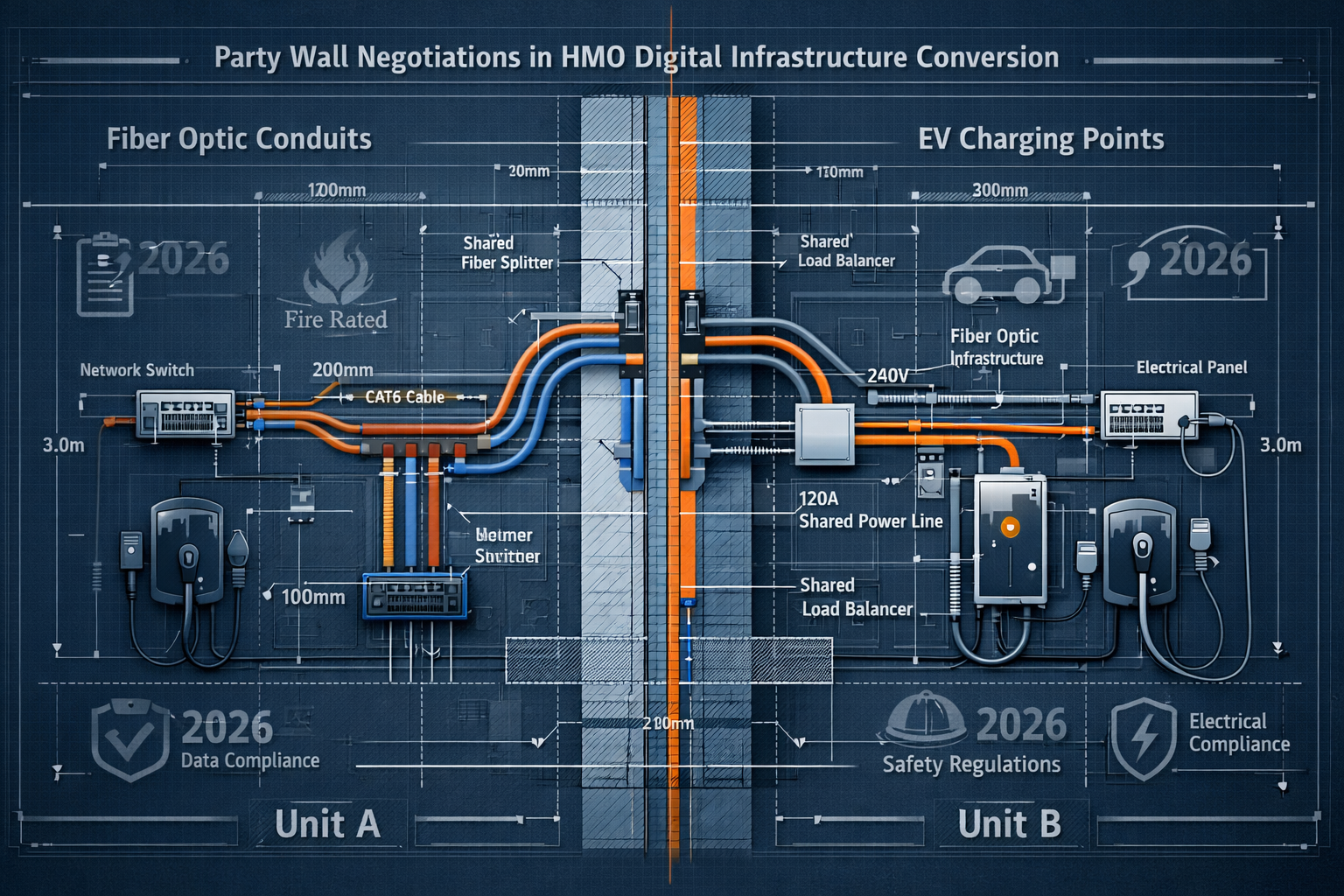
The UK government's December 2025 call for evidence on digital infrastructure planning reforms signals accelerated deployment expectations for 2026 and beyond[1]. Meanwhile, HMO landlords must meet escalating tenant demands for gigabit-capable broadband and electric vehicle charging—both requiring careful party wall management during installation.
Fibre Broadband Requirements for HMOs in 2026
While no statutory minimum broadband speed currently applies to HMOs, market pressures and tenant expectations effectively mandate gigabit-capable connections. The government's digital infrastructure reforms aim to reduce deployment costs and accelerate rollout timelines[1], but party wall obligations remain unchanged.
Installation Methods and Party Wall Implications
External Wall Routing
- Advantages: Minimizes party wall involvement; typically requires only Section 1 notices if within three meters of boundaries
- Disadvantages: Aesthetic concerns; potential planning permission requirements in conservation areas
- Party Wall Cost: £400-£800 for boundary-proximate installations
Internal Ducting Through Party Walls
- Advantages: Cleaner aesthetic; protected cable runs; future-proof for upgrades
- Disadvantages: Requires Section 2 notices; potential structural surveys; fire-stopping obligations
- Party Wall Cost: £800-£1,600 for single-property awards; significantly reduced with multi-party agreements
Riser Installations in Multi-Unit HMOs
- Advantages: Single penetration serves multiple units; economies of scale
- Disadvantages: Complex party wall scenarios involving multiple floors/owners
- Party Wall Cost: £1,200-£2,400 without coordination; £600-£900 with unified approach
EV Charging Infrastructure: Building Regulations and Party Wall Integration
The government's push for electric vehicle adoption creates indirect pressure on HMO landlords to provide charging facilities, particularly for properties with dedicated parking. Installing EV chargers often involves party wall considerations when:
- Mounting equipment on external party walls facing parking areas
- Running supply cables through shared wall cavities
- Installing ground-mounted posts near boundary lines
Electrical Safety and Certification Requirements
All EV charging installations must comply with:
- BS 7671 (18th Edition Wiring Regulations): Ensures proper earthing, RCD protection, and circuit design
- Building Regulations Part P: Requires certification by competent electricians
- IET Code of Practice for EV Charging: Specifies installation standards for residential settings
Party Wall Awards should reference these standards explicitly, ensuring electrical work doesn't compromise structural integrity or create fire risks within shared walls.
Cost-Saving Strategies for Multi-Unit HMO EV Installations
When converting terraced properties or semi-detached houses into HMOs, coordinating EV infrastructure across multiple adjoining units delivers substantial savings:
| Approach | Party Wall Cost | Installation Cost | Total per Unit |
|---|---|---|---|
| Individual installations (4 units) | £800 × 4 = £3,200 | £1,200 × 4 = £4,800 | £2,000 |
| Coordinated multi-party agreement | £1,200 (shared) | £4,000 (bulk discount) | £1,300 |
| Savings per unit | £500 | £200 | £700 |
🎯 Action Item: Approach adjoining HMO landlords before initiating party wall notices to explore coordinated digital infrastructure installations. Shared surveyor appointments and synchronized work schedules reduce costs by 35-45% while maintaining full legal compliance.
Planning Reform Implications for Digital Infrastructure Deployment
The government's consultation on planning rule reforms (response deadline February 26, 2026) specifically targets barriers to digital infrastructure deployment[1]. Proposed changes include:
- Streamlined permitted development rights for fiber installations
- Reduced planning application requirements for telecommunications equipment
- Accelerated approval processes for infrastructure providers
However, these reforms do not supersede Party Wall Act obligations. Even with simplified planning procedures, landlords must still serve proper party wall notices and obtain awards when work affects shared structures. The reforms primarily benefit network operators deploying street-level infrastructure rather than individual property owners managing HMO conversions.
Integrating Fire Safety and Digital Infrastructure Compliance
HMO fire safety regulations create additional complexity when installing digital infrastructure through party walls. Building Regulations Approved Document B requires:
Fire Compartmentation Integrity
- All penetrations through fire-resisting walls must maintain 30-60 minute fire ratings
- Fiber and power cables require approved fire-stopping systems
- Party Wall Awards should specify inspection schedules to verify fire barrier integrity
Escape Route Protection
- Cable routing must not obstruct escape routes or create trip hazards
- Emergency lighting circuits require segregation from data cables
- Smoke detector circuits need protected pathways independent of tenant-accessible systems
Electrical Safety in Multi-Occupancy Settings
- Consumer units serving individual HMO rooms require proper labeling
- EV charging circuits need dedicated RCD protection
- Periodic inspection and testing (EICR) every five years for HMOs
For comprehensive guidance on HMO-specific building regulations, consult party wall FAQs addressing common compliance scenarios.
PRS Reforms and Multi-Party Agreement Strategies for Cost Optimization
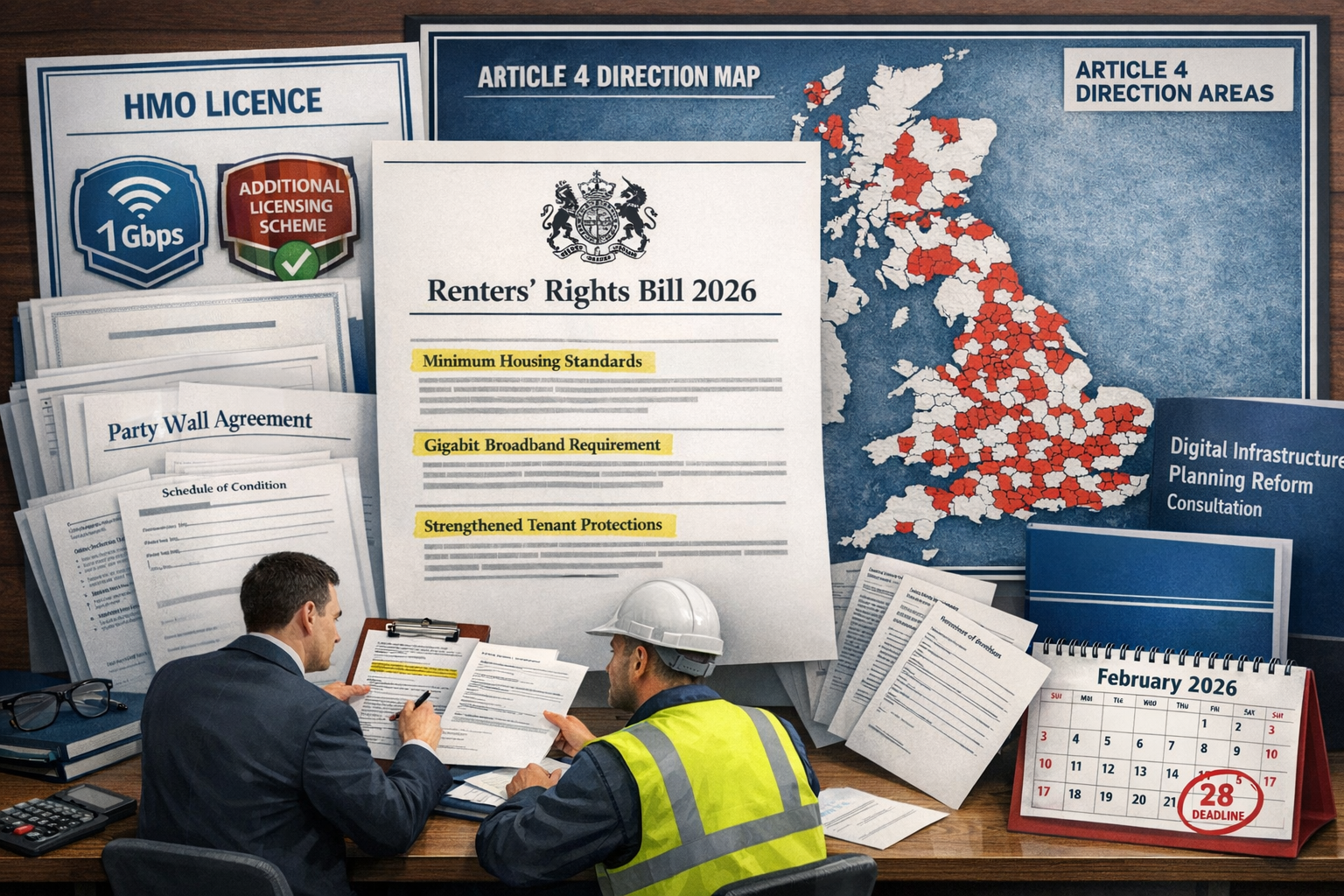
The Renters' Rights Bill progressing through Parliament in 2026 introduces sweeping changes to the Private Rented Sector, indirectly amplifying the importance of proper digital infrastructure in HMO properties. While the Bill doesn't explicitly mandate broadband speeds or EV charging, competitive market pressures and tenant expectations make these amenities increasingly essential for maintaining occupancy rates and rental values.
How PRS Reforms Drive Digital Infrastructure Demand
The Renters' Rights Bill's key provisions create downstream effects on HMO digital infrastructure requirements:
Abolition of Section 21 "No-Fault" Evictions
With landlords unable to reclaim properties without specific grounds, tenant retention becomes paramount. Properties offering superior digital connectivity and modern amenities (including EV charging) command premium rents and reduce void periods.
Enhanced Tenant Rights and Property Standards
Stronger enforcement of Decent Homes Standards and fitness-for-habitation requirements indirectly pressure landlords to provide contemporary infrastructure. While not legally mandated, inadequate broadband or lack of EV charging may constitute "unfitness" arguments in future tribunal cases.
Licensing Scheme Expansion
Over 70 councils now operate additional licensing schemes for smaller HMOs (3-4 occupants)[3][4], with many incorporating digital infrastructure assessments into license conditions. Proactive party wall compliance for fiber and EV installations demonstrates professional management standards that licensing authorities favor.
Multi-Party Agreement Frameworks: Reducing Costs by 40-60%
The most effective cost-reduction strategy for party wall compliance in HMO-dense areas involves coordinated multi-party agreements. When multiple adjoining properties require similar digital infrastructure upgrades, synchronized approaches deliver substantial savings:
Framework 1: Shared Surveyor Appointments
Rather than each property appointing separate surveyors (£800-£1,200 per property), adjoining owners jointly appoint a single agreed surveyor to:
- Conduct simultaneous inspections of all affected properties
- Issue a unified Party Wall Award covering coordinated installations
- Allocate costs proportionally based on work scope
Typical Savings: £500-£800 per property in surveyor fees
Framework 2: Consolidated Installation Contracts
Bulk procurement of fiber installation or EV charging equipment reduces per-unit costs:
- Negotiate volume discounts with approved contractors (15-25% typical savings)
- Schedule consecutive installations minimizing mobilization costs
- Share scaffolding or access equipment across multiple properties
Typical Savings: £300-£600 per property in installation costs
Framework 3: Unified Schedule of Condition Documentation
Commissioning a single surveyor to document pre-work conditions for all affected properties reduces duplication:
- Comprehensive photographic records of party walls and adjacent areas
- Baseline structural assessments identifying pre-existing defects
- Shared documentation reducing individual survey costs by 50%
Typical Savings: £200-£400 per property in condition survey fees
Case Study: Terraced HMO Conversion with Coordinated Digital Infrastructure
Scenario: Four adjoining terraced houses converted to 5-bedroom HMOs requiring fiber broadband and EV charging installations affecting shared party walls.
Individual Approach Costs:
- Party wall surveyor (per property): £800
- Schedule of Condition (per property): £400
- Fiber installation (per property): £1,200
- EV charger installation (per property): £1,500
- Total per property: £3,900
- Total for four properties: £15,600
Coordinated Multi-Party Approach Costs:
- Single agreed surveyor for all properties: £2,000 (£500 per property)
- Unified Schedule of Condition: £800 (£200 per property)
- Bulk fiber installation contract: £4,000 (£1,000 per property)
- Coordinated EV infrastructure: £5,200 (£1,300 per property)
- Total per property: £3,000
- Total for four properties: £12,000
Savings: £900 per property (23% reduction) or £3,600 total
Navigating Dissent and Dispute Resolution in Multi-Party Scenarios
Complex multi-party agreements occasionally face dissent from individual adjoining owners. Effective resolution strategies include:
Early Engagement and Transparency
- Initiate informal discussions 2-3 months before formal notices
- Share technical specifications and cost-benefit analyses
- Demonstrate compliance with all regulatory requirements
Flexible Award Terms
- Offer staggered installation schedules accommodating individual preferences
- Provide alternative cable routing options minimizing specific concerns
- Include comprehensive indemnity clauses protecting adjoining owners
Third-Party Mediation
- Engage professional party wall surveyors with mediation expertise
- Reference established precedents from similar HMO conversions
- Emphasize mutual benefits of coordinated infrastructure upgrades
For properties with complex shared structures like shared chimneys and chimney stacks, specialized surveyor knowledge ensures compliant solutions addressing all parties' concerns.
Licensing Authority Expectations for Digital Infrastructure
HMO licensing applications increasingly scrutinize digital infrastructure provision as part of overall property standards assessments. Licensing authorities evaluate:
Connectivity Standards
- Minimum broadband speeds supporting multiple simultaneous users
- Adequate Wi-Fi coverage throughout all habitable rooms
- Backup connectivity options for business-critical tenant needs
Safety and Certification
- Proper electrical certification for all installations (EICR compliance)
- Fire safety integration for cable penetrations through party walls
- Regular maintenance schedules for digital infrastructure
Documentation and Compliance
- Party Wall Awards demonstrating proper legal procedures
- Building Control completion certificates for notifiable work
- Professional installation records from qualified contractors
Proactive compliance with party wall protocols signals professional management standards that licensing authorities reward with faster application processing and fewer inspection failures.
Future-Proofing HMO Digital Infrastructure Investments
Given the rapid evolution of connectivity standards and vehicle electrification, party wall installations should incorporate future-proofing measures:
Oversized Ducting and Conduits
- Install 50mm+ diameter ducts allowing future cable upgrades
- Include draw cords facilitating replacement without wall re-penetration
- Specify ducting materials resistant to degradation (HDPE, PVC-U)
Modular EV Charging Infrastructure
- Design electrical supplies supporting higher charging capacities (22kW+)
- Include capacity for additional charging points as EV adoption increases
- Specify weatherproof enclosures accommodating future smart charging controllers
Documented Access Rights
- Party Wall Awards should explicitly grant future access for upgrades
- Establish reasonable notice periods for maintenance activities (7-14 days typical)
- Define responsibility allocation for upgrade costs affecting shared infrastructure
These provisions minimize future party wall complications while protecting landlords' infrastructure investments against technological obsolescence.
Conclusion
Mastering Party Wall Protocols for Digital Infrastructure in HMO Conversions: 2026 Compliance for Fibre and EV Amid PRS Reforms represents a critical competency for landlords navigating the intersection of housing regulation, connectivity mandates, and neighbor relations. With over 60 council areas restricting HMO conversions through Article 4 directions[3] and digital infrastructure reforms accelerating deployment expectations[1], proper party wall compliance protects investments while delivering essential modern amenities.
The key to cost-effective compliance lies in coordinated multi-party agreements that reduce surveyor fees by 40-60% while maintaining full legal protection. By engaging adjoining owners early, appointing shared surveyors, and synchronizing installations, landlords transform party wall obligations from regulatory burdens into strategic opportunities for infrastructure optimization.
Actionable Next Steps
✅ Immediate Actions (Next 30 Days):
- Audit existing HMO properties identifying digital infrastructure gaps requiring party wall work
- Identify adjoining properties potentially benefiting from coordinated fiber/EV installations
- Consult qualified party wall surveyors to assess specific notice requirements
- Commission Schedule of Condition surveys documenting current party wall conditions
✅ Short-Term Planning (60-90 Days):
- Initiate informal discussions with adjoining owners exploring multi-party agreements
- Obtain detailed quotations from approved contractors for fiber and EV installations
- Prepare comprehensive party wall notices incorporating technical specifications
- Engage agreed surveyors for properties where coordinated approaches are feasible
✅ Long-Term Strategy (6-12 Months):
- Monitor government digital infrastructure planning reforms for implementation updates[1]
- Review HMO licensing requirements in your council area for evolving digital standards[4]
- Establish maintenance protocols ensuring ongoing compliance with fire safety and electrical regulations
- Document lessons learned creating standardized procedures for future HMO conversions
As PRS reforms reshape the rental landscape and tenant expectations for digital connectivity intensify, landlords who master party wall protocols for infrastructure installations gain competitive advantages through reduced costs, faster deployment, and enhanced property standards. The investment in proper legal compliance today protects against disputes, regulatory penalties, and costly remediation tomorrow—while delivering the modern amenities that attract and retain quality tenants in an increasingly competitive market.
For complex scenarios or properties with unusual party wall configurations, professional guidance from experienced chartered surveyors ensures compliant, cost-effective solutions tailored to your specific circumstances. The convergence of digital infrastructure demands and party wall obligations creates challenges, but also opportunities for forward-thinking landlords who approach compliance strategically rather than reactively.
References
[1] Reforming Planning Rules To Accelerate Deployment Of Digital Infrastructure – https://www.gov.uk/government/calls-for-evidence/reforming-planning-rules-to-accelerate-deployment-of-digital-infrastructure/reforming-planning-rules-to-accelerate-deployment-of-digital-infrastructure
[2] Download – https://www.london.gov.uk/media/107156/download
[3] Hmo Planning Permission In England A Landlord S Checklist 2026 – https://www.excelaarchitecturelondon.co.uk/post/hmo-planning-permission-in-england-a-landlord-s-checklist-2026
[4] Hmo Licensing Changes – https://www.thehmomortgagebroker.co.uk/hmo-licensing-changes/
[5] Office To Multifamily Conversion 2026 – https://www.base-4.com/office-to-multifamily-conversion-2026/
[6] Reforming Planning Rules Accelerate Deployment Digital Infrastructure – https://www.planningresource.co.uk/article/1944151/reforming-planning-rules-accelerate-deployment-digital-infrastructure