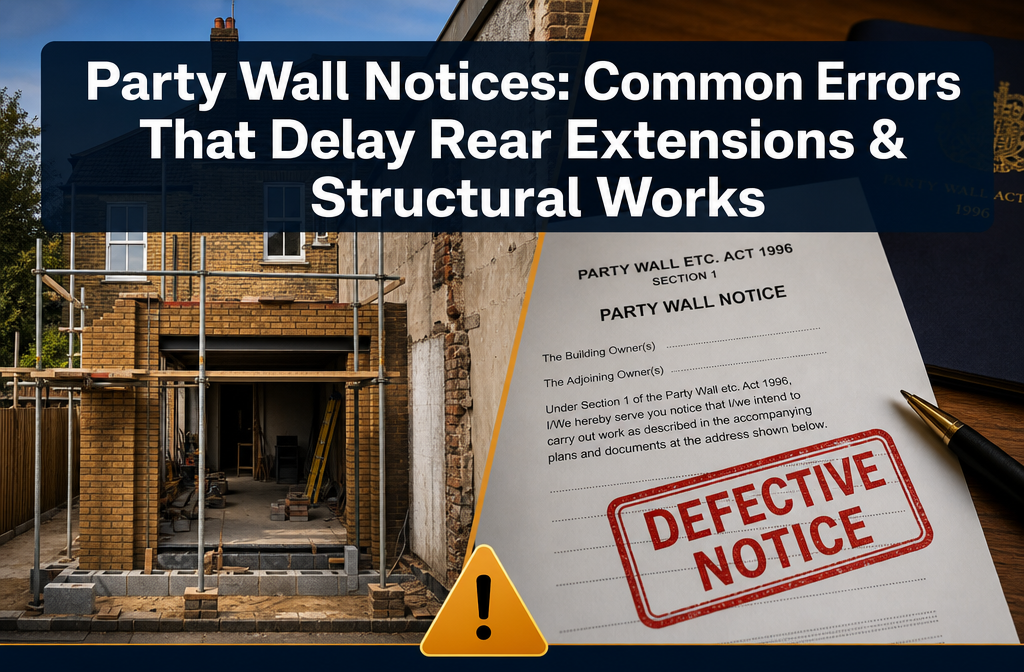

Around one in three party wall disputes arises not from genuine neighbour conflict but from procedural mistakes that could have been avoided entirely [4]. For homeowners planning rear extensions or internal structural remodelling, those mistakes translate directly into programme overruns, abortive costs, and strained relationships with the very neighbours they live beside every day.
Understanding Party Wall Notices for Rear Extensions and Internal Structural Remodelling: Common Errors That Delay Projects is therefore not a bureaucratic exercise — it is a practical risk-management step that protects timelines and budgets from the outset.
Key Takeaways 📋
- The Party Wall etc. Act 1996 still governs all notifiable works; there have been no recent amendments, so delays are almost always caused by process errors, not law changes [7].
- Rear extensions and internal structural works are frequently misidentified as non-notifiable, leading to notices being served too late or not at all [2].
- Invalid notices — wrong form, missing details, or incorrect service — restart the statutory clock and can add weeks to a project.
- Neighbour consent or dissent must be managed within strict timeframes; missing these windows triggers the appointment of surveyors and a formal Party Wall Award.
- Engaging a qualified party wall surveyor early is the single most effective way to avoid the errors covered in this article.
Why Rear Extensions and Internal Works Trigger the Act More Often Than Owners Expect
A common misconception is that the Party Wall etc. Act 1996 only applies when a wall is physically shared with a neighbour. In reality, the Act casts a much wider net [7].
Three Categories of Notifiable Work
| Category | Typical Trigger for Rear Extensions | Notice Required |
|---|---|---|
| Party structure notice | Cutting into, raising, or underpinning a shared wall | Yes — 2 months before works |
| Line of junction notice | Building a new wall on or at the boundary | Yes — 1 month before works |
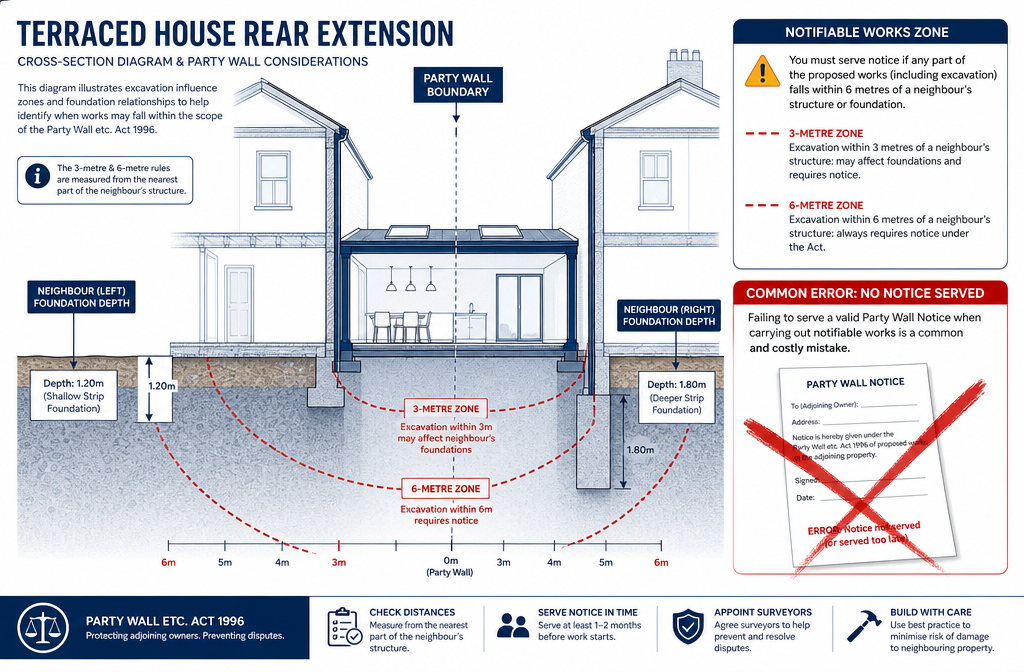
| Three/six metre notice | Excavating within 3m (or 6m for deeper works) of a neighbour's foundations | Yes — 1 month before works |
Rear extensions almost always involve new foundations. When those foundations go deeper than the neighbouring building's foundations, or when the 45-degree influence line from the neighbour's foundations is crossed, a three or six metre notice is required [1]. Many owners assume that because the work sits entirely on their own land, no notice is needed. That assumption is wrong and is one of the most common errors that delay projects [2].
Internal structural remodelling adds another layer of complexity. Works such as:
- 🔩 Steel beam (RSJ) insertions that bear onto a party wall
- 🧱 Chimney breast removals where the breast is on or adjacent to the party wall
- 🚪 Structural openings formed through a party wall
- 🏗️ Load redistribution onto party piers or columns
…all constitute "works to a party structure" under Section 2 of the Act and require a party structure notice [2][4]. Owners who treat these as purely internal matters and proceed without notice expose themselves to injunctions and forced stoppages.
"The Act does not care whether works feel internal or external — it cares whether a party structure is affected."
For a clear overview of how the Act applies to different scenarios, the party wall guidance from Canterbury Surveyors provides a useful starting point.
The Most Common Errors in Party Wall Notices for Rear Extensions and Internal Structural Remodelling
Error 1: Serving Notice Too Late
The Act sets minimum notice periods that are not negotiable:
- Two months before works begin for a party structure notice
- One month before works begin for a line of junction notice or excavation notice [7]
Contractors are often appointed and start dates agreed before a notice is even drafted. By the time the owner realises a notice is needed, there may be only days — not months — before the planned start. The result is a forced delay while the statutory period runs, or a rushed notice that contains errors.
Practical fix: Serve notice at the same time as submitting a planning application, not after planning permission is granted.
Error 2: Using the Wrong Notice Type
There are three distinct notice types under the Act, each with its own prescribed content. Serving a line of junction notice when a party structure notice is required — or vice versa — renders the notice invalid [4]. An invalid notice does not start the statutory clock. The owner must re-serve the correct notice and wait the full period again.
This error is particularly common where a rear extension involves both new foundations near the boundary and works to an existing party wall. Both a three-metre notice and a party structure notice may be required simultaneously [1].
Error 3: Incomplete or Inaccurate Notice Content
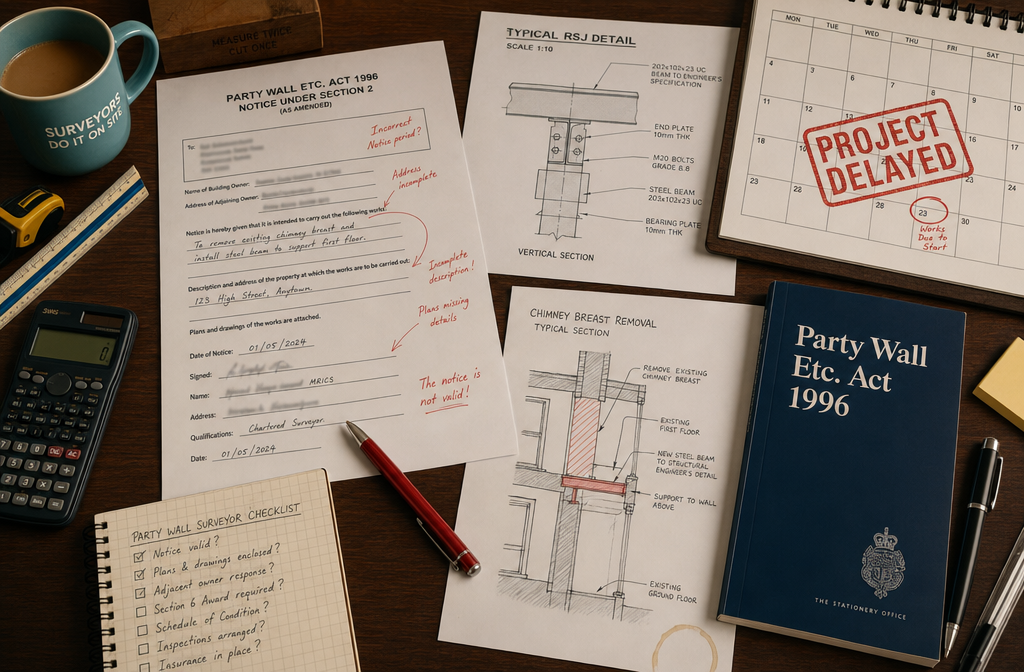
A valid party wall notice must include [7]:
- The building owner's name and address
- The address of the building where works will take place
- A description of the proposed works — sufficiently detailed to allow the neighbour to understand what is planned
- The proposed start date
Notices that describe works vaguely — for example, "rear extension works" without specifying excavation depths, wall heights, or structural interventions — are regularly challenged by adjoining owners or their surveyors. A challenged notice may be deemed invalid, restarting the process entirely.
Where structural beam calculations are involved, including a summary of the structural engineer's scope alongside the notice helps demonstrate the full extent of works. Beam calculations from a structural engineer can provide the technical detail needed to make a notice unambiguous.
Error 4: Serving Notice on the Wrong Person
The notice must be served on every adjoining owner — not just the occupier. Where a property is tenanted, the freeholder and any long leaseholder must each receive a separate notice [4][5]. In blocks of flats, this can mean serving multiple notices for a single project. Missing even one adjoining owner invalidates the process for that property and can halt works if that owner later objects.
Error 5: Mishandling the Response Period
Once a notice is served, the adjoining owner has 14 days to respond [7]. The three possible outcomes are:
- Consent in writing — works can proceed without a formal award
- Dissent and agreement to appoint an agreed surveyor — one surveyor acts for both parties
- Dissent and appointment of separate surveyors — each party appoints their own surveyor, and a third surveyor is selected as referee
If no response is received within 14 days, a deemed dispute arises automatically. Many building owners misinterpret silence as consent and begin works. This is a serious error. A deemed dispute triggers the surveyor appointment process, and works begun without a Party Wall Award in place risk injunction [5].
Understanding how a Party Wall Award is structured helps building owners appreciate why the surveyor process exists and what protections it provides to both sides.
Error 6: Assuming Permitted Development Exempts Works from the Act
Planning permission (or permitted development rights) and the Party Wall etc. Act are entirely separate legal regimes [5]. A rear extension built under permitted development still requires party wall notices if the works are notifiable. This confusion is extremely common and accounts for a significant proportion of mid-project disputes [9].
Error 7: Failing to Commission a Schedule of Condition
Even where a notice is correctly served and consent obtained, the absence of a schedule of condition before works begin leaves the building owner exposed. If a neighbour later claims that cracks or damage were caused by the extension or structural works, there is no baseline record to dispute or confirm the claim.
A schedule of condition report documents the pre-works state of the adjoining property and is one of the most cost-effective risk management tools available.
Error 8: Overlooking Drainage and Foundation Interactions
Rear extensions frequently require drainage diversions or new drainage runs close to the boundary. Where drainage works involve excavation within the notifiable zones, a separate excavation notice may be required in addition to the party structure notice [6]. Failing to identify this interaction is another source of invalid or incomplete notice packages.
A drainage survey prior to design can identify potential conflicts early, allowing the notice package to address all relevant works from the outset.
Avoiding Disputes: Practical Steps Before, During, and After Notice Service

Understanding Party Wall Notices for Rear Extensions and Internal Structural Remodelling: Common Errors That Delay Projects is only half the battle. The other half is building a process that prevents errors from occurring.
Before Serving Notice ✅
- Appoint a party wall surveyor at design stage, not after planning approval
- Confirm which notice types are required for every element of the proposed works
- Obtain structural engineer input early — especially for steel insertions and load-bearing removals
- Identify all adjoining owners, including freeholders and long leaseholders
- Commission a structural survey if the condition of the party wall is uncertain
During the Notice Period ✅
- Keep a dated record of service (recorded delivery or personal service with a witness)
- Diarise the 14-day response deadline and the full statutory notice period
- Do not agree verbal start dates with contractors until the statutory process is complete
- If the neighbour dissents, engage the surveyor appointment process promptly — delays here add further programme risk
After Consent or Award ✅
- Ensure the Party Wall Award or written consent is received before any notifiable works begin
- Brief the contractor on the specific conditions set out in the Award
- Arrange for a post-works inspection if the Award requires one
- Retain all documentation — disputes can arise months after completion
What Does the Party Wall Process Cost?
Cost is often cited as a reason owners try to manage the process themselves. In practice, errors made without professional guidance cost far more than the surveyor fees avoided. Understanding party wall costs upfront allows owners to budget accurately and avoid the false economy of DIY notice service.
When Disputes Arise
Despite best efforts, disputes do occur. When they do, the Act provides a structured resolution mechanism through the surveyor process. Understanding what a party wall dispute involves — and how it is resolved — helps building owners engage constructively rather than escalating conflict.
Conclusion: Avoid the Errors, Protect the Programme
The Party Wall etc. Act 1996 has not changed, but the mistakes made under it remain stubbornly consistent. For anyone planning a rear extension or internal structural remodelling in 2026, the message is straightforward: the errors that delay projects are almost entirely avoidable.
Serve the right notice, to the right people, with the right content, at the right time. Commission a schedule of condition. Engage a qualified party wall surveyor before design is finalised. Do not conflate planning permission with party wall compliance.
Actionable next steps:
- 📋 Identify whether your proposed works are notifiable — seek professional advice if uncertain
- 🗓️ Build the statutory notice periods into your project programme from day one
- 👷 Appoint a party wall surveyor at the same time as your architect or structural engineer
- 📄 Commission a schedule of condition before any works begin
- 📁 Keep all notice documentation, responses, and Awards in a single project file
Taking these steps costs relatively little. Ignoring them can cost weeks of programme time, thousands in abortive fees, and the goodwill of neighbours who will still be living next door long after the extension is complete.
References
[1] Preparing Party Wall Notices Rear Extension – https://www.peterbarry.co.uk/blog/preparing-party-wall-notices-rear-extension/
[2] Are My Works Covered By The Party Wall Act – https://redmondassociates.co.uk/surveying/party-wall/are-my-works-covered-by-the-party-wall-act
[3] Semi Detached Rear Extension – https://resi.co.uk/advice/rear-extensions/semi-detached-rear-extension
[4] Party Wall Agreement – https://hoa.org.uk/advice/guides-for-homeowners/i-am-improving/party-wall-agreement/
[5] Party Wall Agreements What You Need To Know – https://www.fmb.org.uk/find-a-builder/ultimate-guides-to-home-renovation/party-wall-agreements-what-you-need-to-know.html
[6] Party Wall Notice Excavation Still Needed Even If – https://www.reddit.com/r/DIYUK/comments/1riqi9k/party_wall_notice_excavation_still_needed_even_if/
[7] Work Tell Your Neighbour About – https://www.gov.uk/party-walls-building-works/work-tell-your-neighbour-about
[9] Alternative To Party Wall For Rear Extension – https://www.mybuilder.com/questions/v/39802/althernative-to-party-wall-for-rear-extension