

The 2026 housing recovery is transforming neighbourhoods across the UK, particularly in London and the South East. As property values stabilise and homeowner confidence returns, extension projects are surging—and with them, a wave of party wall notices that many property owners are unprepared to navigate. Understanding the Party Wall Implications of the 2026 Housing Recovery: Managing Neighbour Disputes in High-Activity Extension Projects has never been more critical for homeowners planning loft conversions, basement excavations, or side-return extensions in terraced properties.
The surge in home improvement activity means surveyors are reporting unprecedented volumes of party wall work. With approximately 95% of London extension projects requiring formal party wall procedures [2], and timelines stretching 2–4 months before work can legally commence, the cost and complexity of compliance can derail even well-planned projects. This guide provides essential insights into managing these legal requirements efficiently while maintaining positive neighbour relations.
Key Takeaways
- The Party Wall Act 1996 applies to ~95% of London extensions, including loft conversions, basements, and boundary work—compliance is mandatory, not optional [2]
- Budget £1,500–£3,600 per affected neighbour for combined surveyor costs in 2026, with fees ranging £750–£1,800 per surveyor [2]
- Allow 2–4 months minimum from serving notice to starting work; rushed timelines create disputes and delays [2]
- Neighbours cannot veto your project under the Act—dissent triggers a formal Award process but does not stop legally compliant work [2]
- Professional surveyor engagement early in project planning prevents costly disputes and ensures compliant sequencing
Understanding Party Wall Implications in the 2026 Housing Market Context
The 2026 housing recovery presents a unique convergence of factors driving extension activity. With mortgage rates stabilising and property transactions increasing, homeowners are choosing to extend rather than move—particularly in high-value urban areas where terraced and semi-detached properties dominate.
Why 2026 Is Different for Party Wall Activity
Several market dynamics are intensifying party wall implications this year:
📈 Increased Extension Volume: RICS forecasts suggest home improvement spending is up 23% compared to 2024 levels, with loft conversions and basement excavations leading the surge in terraced properties.
🏘️ Terraced Property Concentration: London and South East markets feature predominantly terraced housing stock, meaning virtually every extension project involves at least one shared boundary.
⚖️ Unchanged Legislation: The Party Wall Act 1996 remains the governing framework, unchanged since 1997 [1]. While the law is stable, surveyor fees and dispute rates fluctuate with market activity.
💰 Rising Project Costs: With construction costs elevated, homeowners are more sensitive to unexpected expenses—making early party wall budgeting essential.
What the Party Wall Act Actually Covers
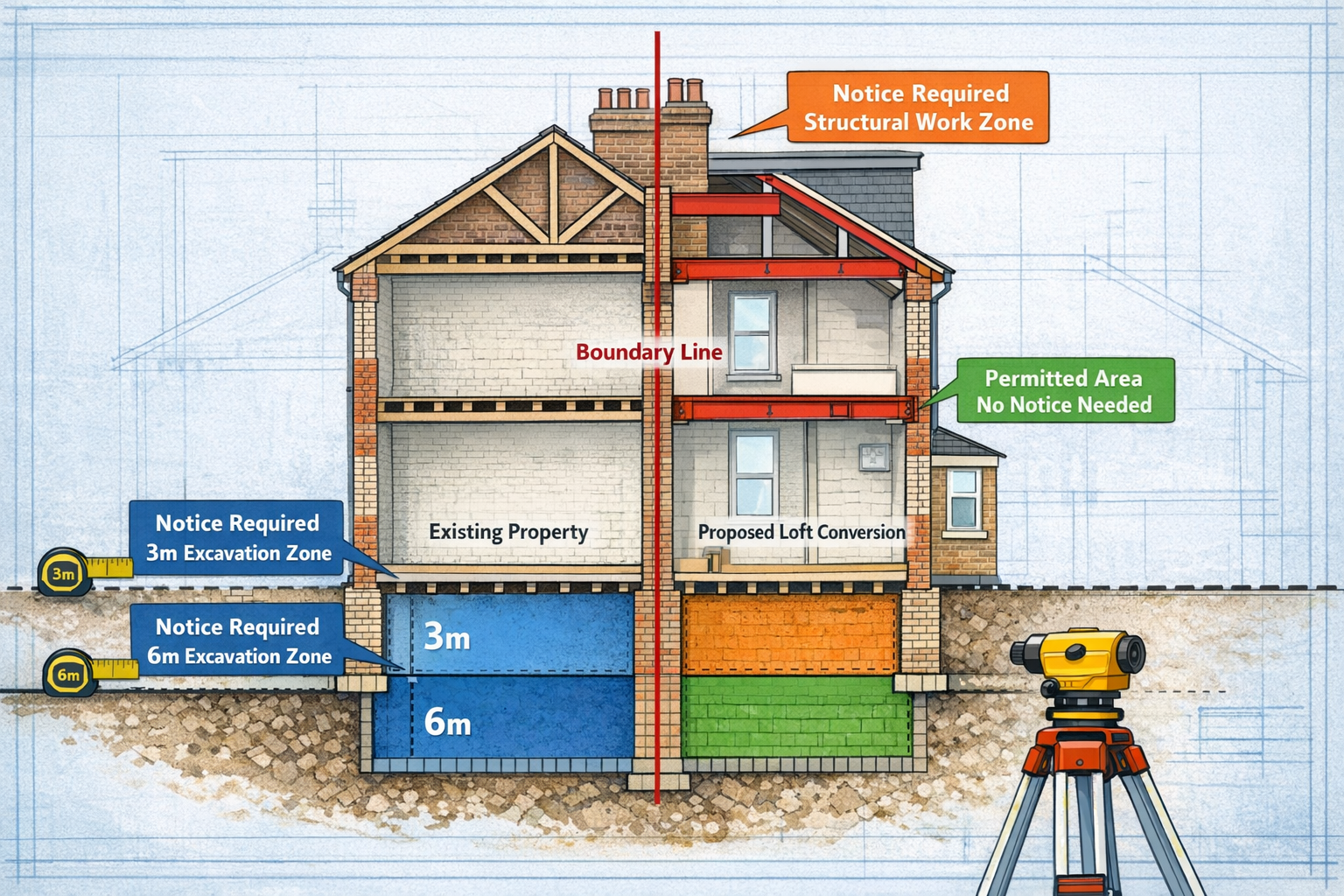
The Party Wall Act establishes rights and obligations when building work affects shared walls, boundaries, or nearby foundations. Three main categories of work trigger notice requirements [1]:
| Work Type | Notice Period | Common Examples |
|---|---|---|
| Work to existing party walls | 1 month | Cutting into wall for beams, raising wall height, inserting damp-proof course |
| Building on/at the boundary | 2 months | New walls on boundary line, side-return extensions |
| Excavation within 3m or 6m | 1 month | Basement excavations, foundation work near neighbours |
Understanding what constitutes a party wall dispute helps homeowners recognise when professional intervention becomes necessary.
The Party Wall Notice Process: Timelines and Procedures for 2026 Projects
Navigating the party wall process efficiently requires understanding the precise sequence of events and realistic timelines. Many homeowners underestimate how long formal procedures take, leading to project delays and contractor scheduling conflicts.
Step-by-Step Notice Process
1. Prepare Detailed Plans (Week 1-2) 🏗️
Before serving any notice, complete architectural drawings showing exactly how work will affect party walls or boundaries. Vague descriptions increase the likelihood of neighbour dissent.
2. Serve Formal Notice (Week 3)
Written notice must include:
- Property owner's details
- Description of proposed work
- Drawings and specifications
- Proposed start date (minimum 1-2 months ahead)
- Statement of rights under the Act
Notices for excavation near a neighbour require specific depth and distance measurements.
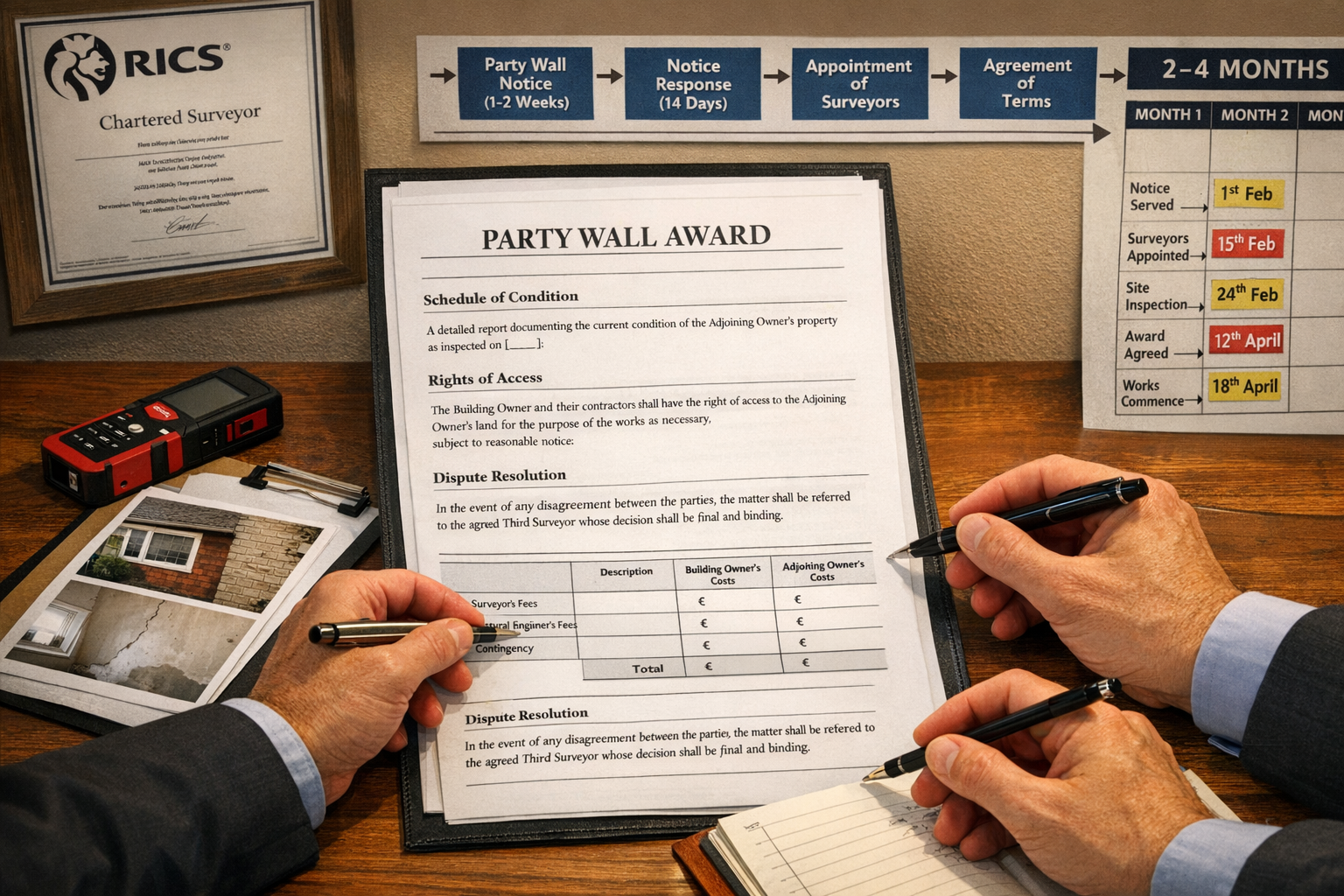
3. Neighbour Response Period (14 Days)
Neighbours have 14 days to consent or dissent. Silence equals dissent under the Act [2]—a crucial point many homeowners miss.
4. Surveyor Appointment (Week 5-6)
If neighbours dissent (or don't respond), both parties appoint surveyors. Alternatively, a single "Agreed Surveyor" can act for both parties with mutual consent, reducing costs.
5. Schedule of Condition Survey (Week 7-8)
Surveyors document the current state of neighbouring properties through photographs and detailed reports. This protects both parties by establishing baseline conditions before work begins.
6. Party Wall Award Preparation (Week 9-12)
Surveyors draft the Award—a legally binding document specifying:
- Scope of permitted work
- Working hours and access rights
- Protective measures required
- Dispute resolution procedures
- Cost allocation
7. Award Served and Work Commences (Week 13+)
Once all parties receive the Award, work can legally begin. The entire process typically requires 2-4 months minimum [2].
Common Timeline Pitfalls
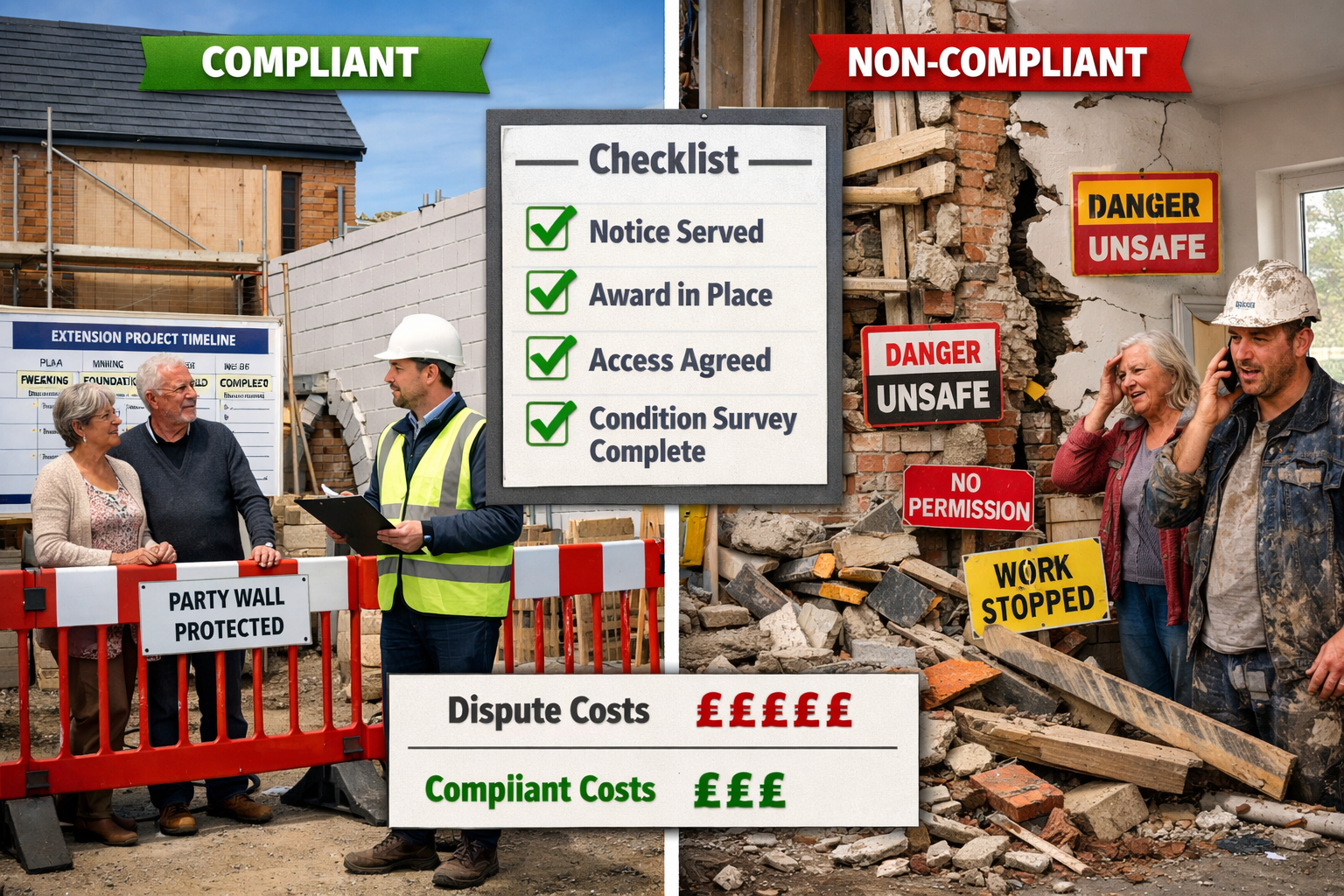
⚠️ Starting work before the Award is finalised exposes building owners to legal action and potential stop-work orders.
⚠️ Underestimating surveyor scheduling during peak construction seasons can add 2-3 weeks to timelines.
⚠️ Incomplete initial notices trigger requests for clarification, resetting the 14-day response clock.
For party wall loft conversions, the complexity increases when work involves raising party walls or cutting into shared structures for steel beam installation.
Managing Neighbour Disputes: Cost Implications and Surveyor Selection in 2026
Financial planning for party wall compliance extends beyond surveyor fees. Understanding the full cost spectrum and selecting the right professionals prevents budget overruns and relationship breakdowns.
2026 Party Wall Cost Breakdown
Current market rates for party wall services in London and the South East show significant variation based on project complexity [2]:
Surveyor Fees Per Neighbour:
- Simple projects (single party wall, straightforward work): £750–£1,200 per surveyor
- Complex projects (multiple walls, excavation, structural changes): £1,200–£1,800 per surveyor
- Total budget per affected neighbour: £1,500–£3,600 (covering both building owner's and neighbour's surveyor)
Additional Costs:
- Schedule of Condition photography: £150–£400
- Award preparation and administration: Included in surveyor fees
- Dispute resolution (if required): £500–£2,000 additional
- Damage rectification (if work causes issues): Variable, covered by Award provisions
For detailed cost planning, review our comprehensive guide on party wall costs.
Choosing the Right Party Wall Surveyor
Qualifications to Verify ✅
- RICS (Royal Institution of Chartered Surveyors) membership
- Specific party wall experience (minimum 5 years)
- Local area knowledge (understands regional construction practices)
- Professional indemnity insurance (minimum £2 million)
Red Flags to Avoid 🚩
- Surveyors who guarantee neighbour consent
- Unusually low fees (often indicate inexperience)
- Dual roles (acting as both project manager and party wall surveyor creates conflicts)
- Lack of formal Award examples or references
The Agreed Surveyor Advantage
When relationships with neighbours are positive, appointing a single Agreed Surveyor offers several benefits:
💰 Cost Savings: One fee instead of two, typically £900–£1,400 total
⏱️ Faster Process: Eliminates coordination between separate surveyors
🤝 Simplified Communication: Single point of contact for all parties
📋 Streamlined Awards: Reduced administrative complexity
However, Agreed Surveyors must maintain strict impartiality. If disputes arise during the process, separate surveyors may still be required.
Compliant Project Sequencing: Integrating Party Wall Requirements Into Extension Planning
Successful project delivery in the 2026 housing recovery requires treating party wall compliance as a critical path item, not an afterthought. Strategic sequencing prevents delays, controls costs, and maintains neighbour goodwill.
Pre-Planning Phase (Months 1-2 Before Notice)
Boundary Verification 📏
Commission a professional boundary survey to confirm exact property lines. Disputes over boundary locations derail party wall processes and create lasting neighbour conflicts.
Design Review for Party Wall Impact
Work with architects to minimise party wall implications:
- Position structural elements to reduce cutting into shared walls
- Consider foundation designs that limit excavation depth near boundaries
- Plan access routes that don't require excessive neighbour cooperation
Neighbour Pre-Consultation 🗣️
Informal discussions before formal notices improve cooperation rates significantly. Share preliminary plans, explain timelines, and address concerns proactively. This isn't legally required but dramatically reduces dissent rates.
Notice and Award Phase (Months 3-5)
Serve Notices Early
Integrate party wall timelines into overall project schedules. Serve notices before finalising contractor agreements to avoid costly delays if disputes arise.
Coordinate Multiple Notices
Projects affecting multiple neighbours or requiring different notice types need careful coordination. A single extension might require:
- Line of Junction notice (2 months) for new boundary wall
- Party Structure notice (1 month) for cutting into existing wall
- Excavation notice (1 month) for foundation work
Stagger these appropriately to avoid timeline conflicts.
Maintain Contractor Flexibility
Brief contractors on potential Award conditions that might affect their work:
- Restricted working hours
- Required protective measures
- Access limitations
- Monitoring requirements
Construction Phase Best Practices
Award Compliance Monitoring ✓
Designate a site manager responsible for:
- Adhering to specified working hours
- Implementing protective measures (hoarding, temporary supports)
- Facilitating surveyor access for monitoring visits
- Documenting compliance photographically
Proactive Damage Prevention
Even with Awards in place, preventing damage protects relationships and budgets:
- Install vibration monitoring for excavation work
- Use protective sheeting on shared walls
- Schedule noisy work during mid-day hours
- Provide neighbours with site manager contact details
Dispute Resolution Protocols
If neighbours raise concerns during construction:
- Document the issue immediately with photos and notes
- Contact the party wall surveyor within 24 hours
- Suspend relevant work pending surveyor assessment
- Implement surveyor recommendations promptly
Understanding potential obstructions in party walls before work begins prevents mid-project complications.
Post-Completion Obligations
Final Inspections
Party wall surveyors typically conduct post-completion inspections comparing final conditions against the Schedule of Condition. Address any identified damage promptly per Award terms.
Documentation Retention
Maintain complete party wall records indefinitely:
- Original notices and responses
- Party Wall Award
- Schedule of Condition reports
- Correspondence with surveyors and neighbours
- Completion inspection reports
These documents prove compliance if future disputes arise or when selling the property.
Risk Mitigation Strategies for High-Activity Extension Markets
The 2026 housing recovery's intensity creates specific risks that proactive homeowners can mitigate through strategic planning and professional engagement.
Managing Multiple Simultaneous Projects
In active markets, neighbours may be conducting their own extensions simultaneously. This creates unique challenges:
Coordination Opportunities 🤝
- Share surveyor costs through Agreed Surveyor arrangements
- Coordinate access requirements to minimise disruption
- Align construction schedules to avoid compounding noise and inconvenience
- Pool resources for temporary works (scaffolding, hoarding)
Conflict Scenarios
- Competing foundation excavations affecting soil stability
- Overlapping working hours creating excessive noise
- Access route conflicts when both properties need deliveries
- Structural interdependencies (one project affecting another's timeline)
Early communication and professional surveyor mediation prevent these scenarios from escalating.
Insurance and Liability Considerations
Building Owner Responsibilities 🏗️
Party Wall Awards don't eliminate liability for damage caused by construction work. Ensure:
- Contractor has adequate public liability insurance (minimum £5 million)
- Your buildings insurance covers party wall-related claims
- Professional indemnity insurance for surveyors and designers is current
- All insurance policies are disclosed to party wall surveyors
Neighbour Protection
The Schedule of Condition provides baseline documentation, but neighbours should:
- Photograph their own properties comprehensively before work begins
- Review their buildings insurance for construction-related damage coverage
- Understand their rights under the Award for damage rectification
- Maintain independent records of any concerns during construction
Regulatory Compliance Beyond Party Walls
Party wall compliance doesn't replace other regulatory requirements:
Planning Permission 📋
Most extensions require planning approval or Permitted Development verification. Party Wall Awards don't grant planning permission—both processes run independently.
Building Regulations
All structural work must comply with current Building Regulations. Party wall surveyors assess compliance with the Party Wall Act only, not broader building standards.
CDM Regulations
Construction Design and Management Regulations 2015 apply to most domestic projects. Ensure principal designers and contractors understand their obligations.
For complex projects, engaging chartered surveyors with multi-disciplinary expertise ensures comprehensive compliance.
Technology and Innovation in Party Wall Management
The 2026 market is seeing increased adoption of technology to streamline party wall processes and reduce dispute risks.
Digital Documentation Systems
Cloud-Based Notice Management ☁️
Modern platforms enable:
- Electronic service of notices with delivery confirmation
- Automated response tracking and deadline monitoring
- Centralised document storage accessible to all parties
- Template libraries ensuring compliant notice wording
Advanced Survey Techniques
Condition Survey Innovation
Traditional photography is being supplemented with:
- 360° photography providing comprehensive baseline documentation
- Laser scanning creating precise 3D models of neighbouring properties
- Thermal imaging identifying pre-existing defects that might be attributed to new work
- Vibration monitoring providing objective data on construction impact
These technologies reduce disputes by providing irrefutable evidence of pre-existing conditions and construction effects.
Dispute Resolution Platforms
Online mediation services are emerging for party wall disputes, offering:
- Video conferencing for surveyor meetings
- Shared document review platforms
- Digital Award execution with electronic signatures
- Transparent cost tracking and allocation
While face-to-face engagement remains important for relationship management, digital tools accelerate administrative processes significantly.
Regional Variations and Local Market Dynamics
Party wall implications vary significantly across UK regions, with 2026 market conditions amplifying these differences.
London and South East Intensity
The highest concentration of party wall activity occurs in:
- Central London: Virtually every project involves party walls; surveyor availability is constrained during peak seasons
- South East London: High proportion of Victorian terraced stock with complex structural interdependencies
- North West London: Active loft conversion market driven by property value growth
For region-specific guidance, consult chartered surveyors in Central London or South East London who understand local market dynamics.
Suburban and Regional Considerations
Outside London, party wall activity is increasing but:
- Surveyor availability may be limited in rural areas
- Fee structures tend toward the lower end of ranges
- Neighbour relationships often involve longer-term acquaintance
- Local building practices may differ from urban norms
Areas like Berkshire and Surrey are experiencing particularly strong extension activity in 2026.
Case Studies: Lessons from 2026 Extension Projects
Case Study 1: Successful Loft Conversion in Terraced Property
Project: Two-storey Victorian terrace, Fulham
Work: Loft conversion with party wall raised 1.2m, steel beam insertion
Neighbours Affected: 2 (both sides)
Approach:
- Informal consultation 6 weeks before formal notices
- Shared visual presentations of finished design
- Single Agreed Surveyor appointed with neighbour consent
- Schedule of Condition completed within 2 weeks
- Award finalised in 8 weeks total
Outcome: Project commenced on schedule, no disputes, total party wall costs £2,400 (both neighbours combined). Positive neighbour relationships maintained throughout.
Key Success Factor: Early engagement and transparency built trust that facilitated Agreed Surveyor arrangement, halving costs and timelines.
Case Study 2: Basement Excavation Dispute Resolution
Project: Semi-detached Edwardian property, Richmond
Work: Single-storey rear basement excavation, 3.5m depth
Neighbours Affected: 1 (attached property)
Challenges:
- Neighbour initially refused consent
- Concerns about foundation stability and property value impact
- Previous relationship tensions over boundary disputes
Resolution Process:
- Separate surveyors appointed (building owner's and neighbour's)
- Detailed structural engineer's report commissioned addressing stability concerns
- Enhanced monitoring regime included in Award (weekly vibration readings)
- Neighbour's surveyor fees (£1,600) paid by building owner per Award
- Additional protective measures specified: underpinning, temporary supports
Outcome: Award finalised after 14 weeks. Work completed without damage. Final inspection confirmed no adverse effects. Relationship improved through professional process.
Key Lesson: Professional surveyor mediation transformed adversarial situation into structured, evidence-based process. Higher upfront costs (£3,800 total) prevented far more expensive litigation.
Case Study 3: Multi-Property Development Coordination
Project: Terrace of 5 properties, Ealing, with 3 simultaneous extensions
Work: Various loft conversions and rear extensions
Complexity: Overlapping party walls, shared access, coordinated timelines
Strategy:
- Residents' association facilitated group consultation
- Single surveyor firm appointed across multiple Awards
- Coordinated Schedule of Condition survey for all properties
- Shared protective measures (scaffolding, hoarding)
- Staggered construction schedules to minimise cumulative disruption
Outcome: Successful completion of all three projects within 18 months. Bulk surveyor fee negotiation reduced individual costs by 30%. Community cohesion strengthened through collaborative approach.
Key Innovation: Treating party wall compliance as community infrastructure rather than individual burden created economies of scale and reduced conflict.
Conclusion
The Party Wall Implications of the 2026 Housing Recovery: Managing Neighbour Disputes in High-Activity Extension Projects represent both a challenge and an opportunity for homeowners navigating today's active property improvement market. With extension volumes at multi-year highs and approximately 95% of London projects requiring formal party wall procedures, understanding the legal framework, realistic timelines, and cost implications is essential for successful project delivery.
Essential Actions for Homeowners
✅ Budget Appropriately: Allocate £1,500–£3,600 per affected neighbour for party wall compliance, and integrate these costs into early project budgets [2].
✅ Plan Timeline Realistically: Allow minimum 2–4 months from notice service to work commencement; rushed schedules create disputes and delays [2].
✅ Engage Professionals Early: Appoint experienced RICS-qualified party wall surveyors during design phases, not after construction contracts are signed.
✅ Communicate Proactively: Informal neighbour consultation before formal notices dramatically improves cooperation rates and reduces dissent.
✅ Document Comprehensively: Maintain complete records of all notices, Awards, surveys, and correspondence for future reference and property sale purposes.
Next Steps for Your Extension Project
-
Assess Party Wall Requirements: Review your project plans against the three categories of work requiring notices (existing party walls, boundary construction, excavation).
-
Commission Boundary Survey: Verify exact property lines before finalising designs to avoid boundary disputes.
-
Obtain Surveyor Quotes: Contact 2-3 RICS-qualified party wall surveyors for fee proposals and availability during your planned timeline.
-
Integrate Compliance into Project Plan: Work with architects and contractors to sequence party wall procedures within overall project schedules.
-
Initiate Neighbour Dialogue: Begin informal discussions about your plans, addressing concerns and building goodwill before formal processes begin.
The 2026 housing recovery offers tremendous opportunities for property enhancement, but success requires navigating party wall implications with professionalism, transparency, and strategic planning. By treating compliance as a project enabler rather than an obstacle, homeowners can deliver ambitious extensions while maintaining positive neighbour relationships and protecting their investments.
For expert guidance on your specific project, consider consulting with experienced party wall specialists who understand the unique dynamics of the current market and can provide tailored advice for your circumstances.
References
[1] Party Wall Agreement – https://hoa.org.uk/advice/guides-for-homeowners/i-am-improving/party-wall-agreement/
[2] Party Wall Agreement London 2026 – https://www.mayfairstudio.co.uk/blog/party-wall-agreement-london-2026