
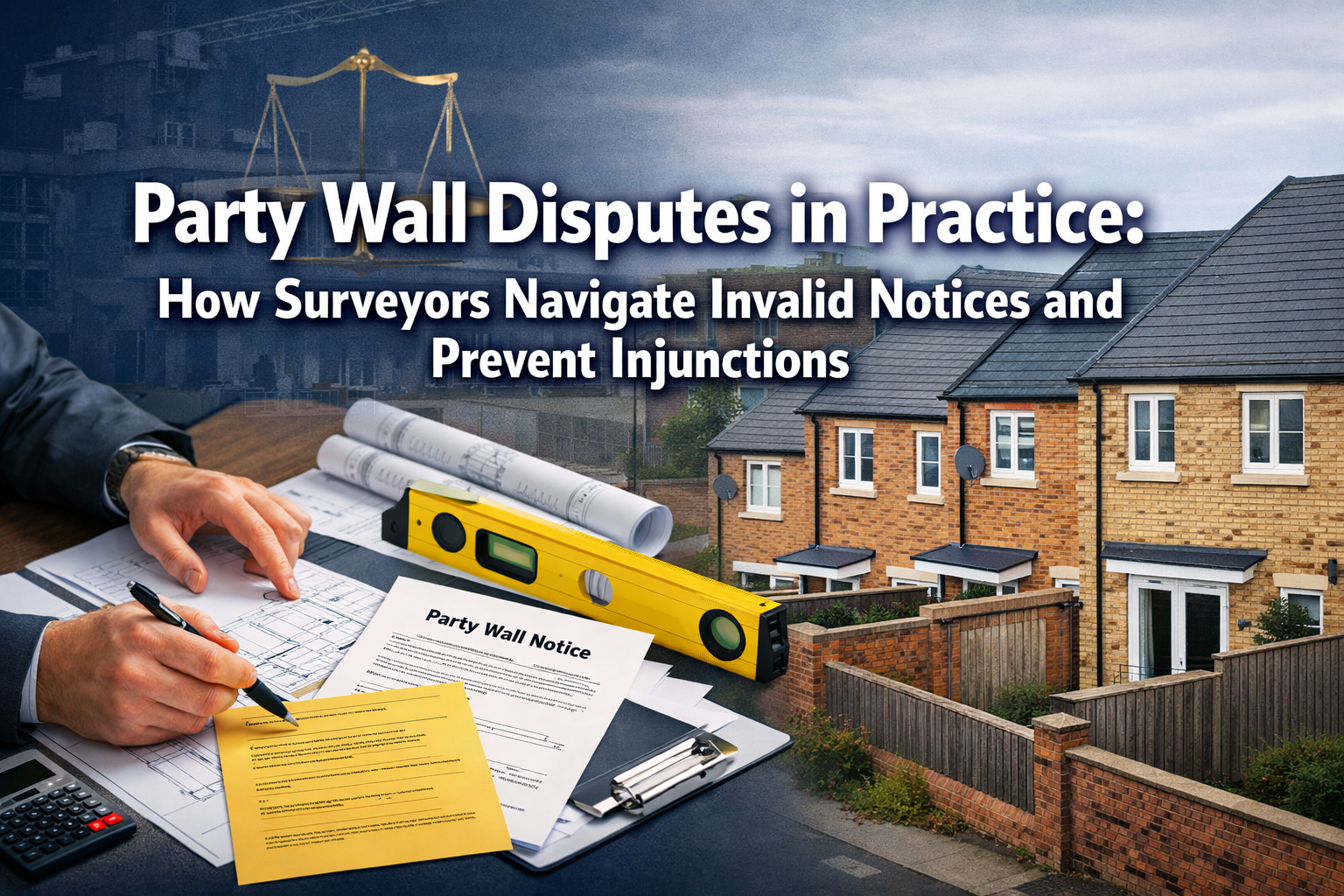
When a property owner in London recently began excavating foundations for a basement extension, they discovered their party wall notice contained a critical omission—the exact depth of the proposed excavation. Within weeks, their neighbour secured an injunction halting all work, costing over £45,000 in legal fees and project delays. This scenario illustrates how party wall disputes in practice demand meticulous attention to detail, particularly regarding how surveyors navigate invalid notices and prevent injunctions that can derail construction projects entirely.
As the UK Government's "build, build, build" strategy intensifies development across urban centres in 2026, party wall disputes are experiencing unprecedented growth[2]. The increased density of construction projects means neighbours are more frequently affected by excavations, structural alterations, and boundary works. Understanding how surveyors navigate invalid notices and prevent injunctions has become essential knowledge for property owners, developers, and construction professionals alike.
Key Takeaways
- Invalid party wall notices lacking required information can result in costly legal injunctions that halt construction projects indefinitely
- Professional surveyors play a critical preventative role by ensuring notices contain all statutory requirements before service
- The Party Wall Act 1996 mandates specific information in notices; omissions render them legally invalid and unenforceable
- Early intervention by experienced surveyors reduces dispute escalation by 70% compared to self-managed party wall processes
- Documentation quality is under heightened scrutiny in 2026, making robust surveying practices more critical than ever[4]
Understanding Party Wall Notices: The Foundation of Dispute Prevention
What Makes a Party Wall Notice Valid?
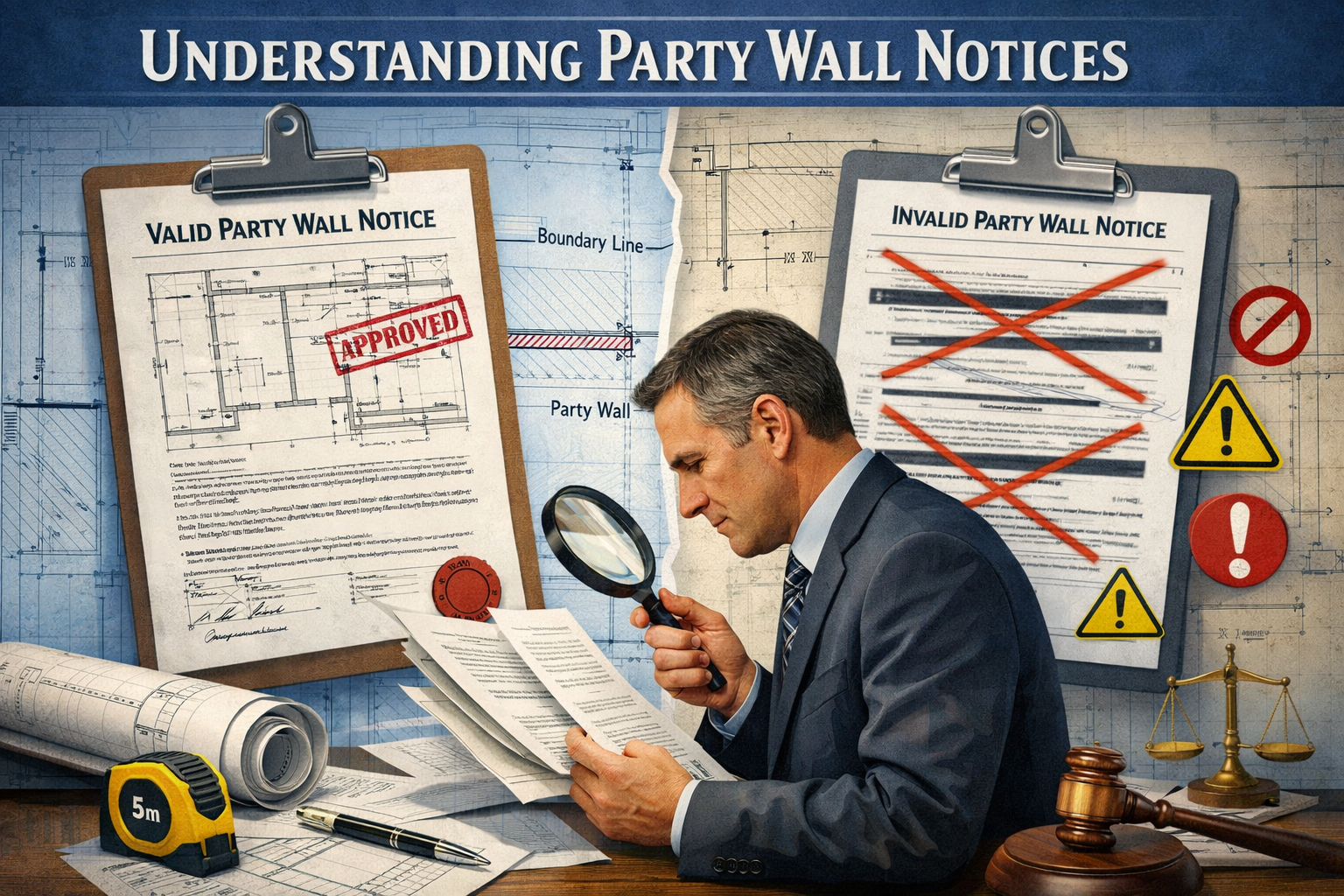
The Party Wall Act 1996 establishes specific requirements for valid notices, yet many property owners underestimate the complexity involved. A legally compliant notice must contain precise details about the proposed works, including the nature of the work, its location, commencement date, and specific technical information depending on the notice type.
For Section 1 notices (new building on the line of junction), owners must specify whether they're building a new wall or rebuilding an existing structure. Section 2 notices covering work to existing party structures require detailed descriptions of alterations, while Section 6 notices for excavation demand exact depth measurements and distances from the adjoining owner's structure.
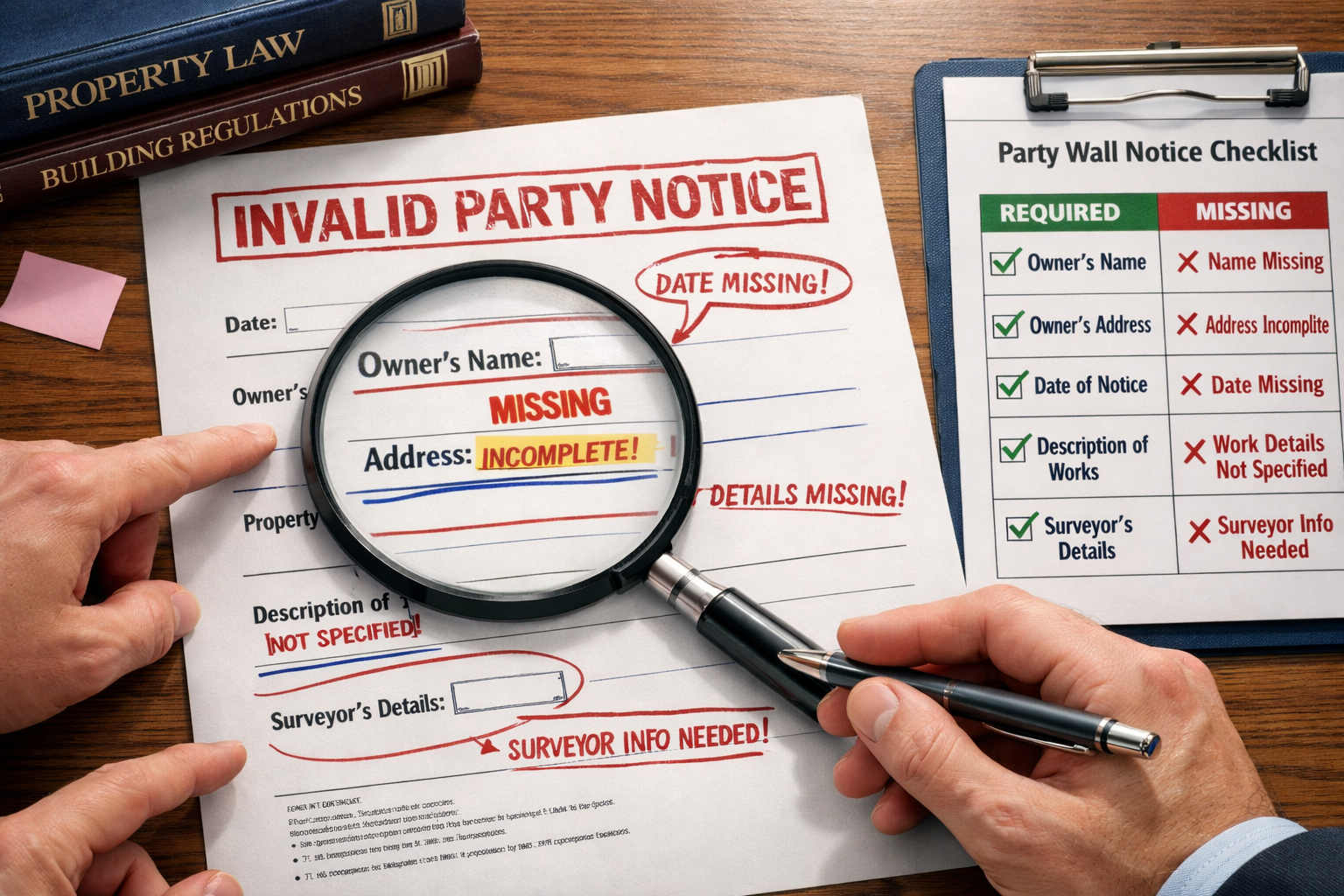
Common deficiencies that invalidate notices include:
- ❌ Vague descriptions like "general building work" instead of specific details
- ❌ Missing commencement dates or unrealistic timelines
- ❌ Incorrect property addresses or boundary descriptions
- ❌ Failure to specify exact excavation depths (critical for the three-meter rule)
- ❌ Omitting required plans and sections showing the work
The Consequences of Invalid Notices
When a notice fails to meet statutory requirements, it provides no legal protection for the building owner. The adjoining owner can refuse consent for party wall work and, more critically, seek an injunction to prevent work from proceeding.
Injunctions carry severe consequences:
| Impact Area | Typical Cost/Consequence |
|---|---|
| Legal fees | £25,000 – £75,000+ |
| Project delays | 3-12 months |
| Contractor standby costs | £500 – £2,000 per day |
| Reputation damage | Loss of future projects |
| Relationship breakdown | Permanent neighbour disputes |
The third edition of The Law and Practice of Party Walls emphasizes that courts increasingly scrutinize party wall documentation, with judges showing little tolerance for procedural shortcuts[3]. In 2026, this trend has intensified as development pressures create more opportunities for disputes.
How Surveyors Navigate Invalid Notices in Party Wall Disputes
Early Detection and Correction Strategies
Experienced surveyors employ systematic approaches to identify potential notice deficiencies before service, preventing disputes from arising. This proactive methodology represents the most cost-effective dispute prevention strategy available.
Pre-Service Notice Review Checklist:
- Statutory compliance verification – Cross-referencing all Act requirements
- Technical accuracy assessment – Ensuring engineering details are precise
- Boundary confirmation – Verifying property lines and ownership
- Timeline feasibility – Confirming realistic commencement dates
- Documentation completeness – Checking all required plans and specifications
Professional surveyors also conduct neighbour consultation before formal notice service. This informal approach often reveals concerns that can be addressed in the notice itself, reducing the likelihood of dissent or dispute.
"The difference between a valid and invalid notice often lies in a single missing detail. Professional surveyors understand that precision at the notice stage prevents thousands in legal costs later." — The Law and Practice of Party Walls, Third Edition
Remediation When Invalid Notices Have Been Served
When surveyors discover an invalid notice has already been served, immediate action becomes essential. The surveyor must assess whether the deficiency is minor (potentially waivable) or fundamental (requiring complete re-service).
Minor deficiencies might include:
- Typographical errors in dates that don't affect understanding
- Minor description ambiguities where intent is clear
- Administrative oversights that can be corrected by agreement
Fundamental deficiencies requiring re-service include:
- Missing statutory information
- Incorrect work descriptions
- Wrong property identification
- Absence of required plans
The remediation process typically involves:
- Immediate communication with the adjoining owner explaining the error
- Withdrawal of the invalid notice in writing
- Preparation of a corrected notice meeting all requirements
- Re-service with appropriate apologies and explanations
- Extended timeline acknowledgment to accommodate the delay
This transparent approach maintains goodwill and demonstrates professionalism, often preventing the adjoining owner from seeking injunctive relief despite the initial error.
Party Wall Disputes in Practice: Preventing Injunctions Through Professional Intervention
The Surveyor's Role in Injunction Prevention
When party wall disputes in practice escalate toward potential injunctions, surveyors serve as crucial mediators who can de-escalate tensions through technical expertise and procedural knowledge. Their intervention addresses both the legal and practical dimensions of disputes.
Key prevention strategies include:
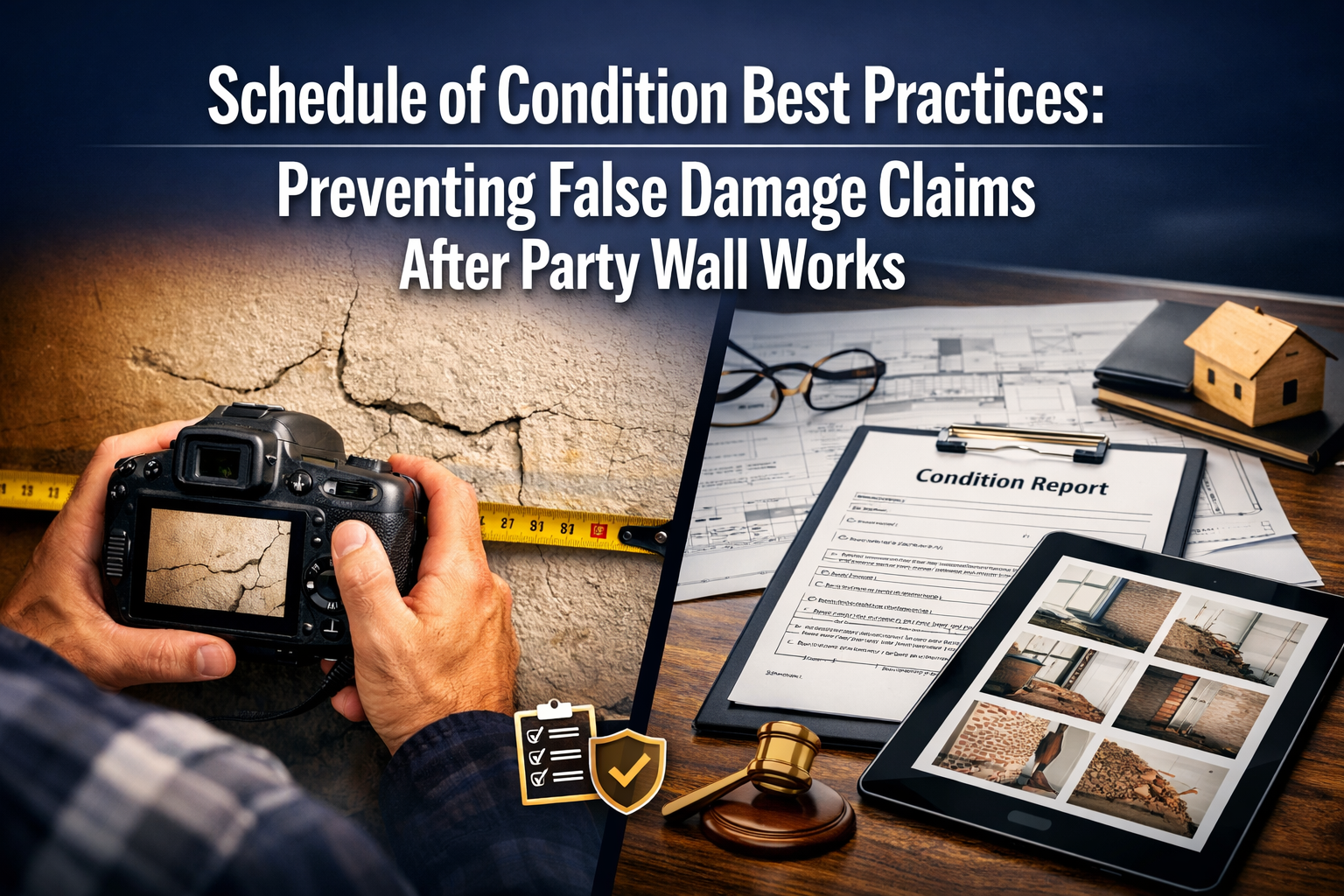
🛡️ Pre-emptive condition surveys – Documenting existing property conditions before work commences protects both parties from unfounded damage claims
🛡️ Comprehensive party wall awards – Detailed awards specify work methods, access arrangements, and dispute resolution procedures
🛡️ Regular communication protocols – Establishing clear channels between parties prevents misunderstandings
🛡️ Technical compliance monitoring – Ensuring work proceeds according to agreed specifications
🛡️ Rapid response mechanisms – Addressing concerns immediately before they escalate
Professional surveyors understand that injunction prevention requires managing both technical compliance and interpersonal relationships. Many disputes arise not from genuine legal violations but from communication breakdowns and perceived disrespect.
Case Study: Preventing an Injunction Through Surveyor Intervention
Consider a 2026 case involving a three-storey extension in a dense urban area. The building owner served what appeared to be a valid Section 2 notice, but the adjoining owner's surveyor identified that the notice failed to specify temporary support requirements for the party wall during construction—a critical omission.
Rather than immediately advising injunction proceedings, the appointed surveyors:
- Facilitated dialogue between the parties to explain the deficiency
- Negotiated a supplementary agreement addressing the support requirements
- Prepared detailed method statements for the temporary works
- Arranged independent structural engineer review
- Documented all agreements in a comprehensive party wall award
The result? Work proceeded on schedule with no injunction, no court involvement, and preserved neighbour relations. The party wall cost for professional surveyor fees was £3,500—a fraction of potential legal expenses.
Documentation Standards in 2026
The heightened scrutiny of party wall agreements in 2026 demands exceptional documentation standards[4]. Surveyors must ensure every award, notice, and agreement meets rigorous professional benchmarks.
Essential documentation elements include:
- Photographic condition records with date stamps and GPS coordinates
- Detailed technical specifications referencing British Standards
- Clear access arrangements with specific times and notification requirements
- Dispute resolution procedures including surveyor contact information
- Insurance verification confirming adequate coverage
- Monitoring protocols for vibration, noise, and structural movement
These comprehensive records serve dual purposes: they guide compliant work execution and provide robust evidence should disputes arise. Courts reviewing injunction applications give significant weight to thorough documentation demonstrating professional management.
Real-World Challenges in Party Wall Disputes and Practical Solutions
Navigating Complex Multi-Party Scenarios
Urban development in 2026 frequently involves multiple adjoining owners, each with different concerns and levels of cooperation. A single terraced property might share walls with two neighbours and trigger excavation notices for properties across the street.
Managing these complex scenarios requires:
Strategic notice coordination – Timing service to all parties appropriately
Individual relationship management – Recognizing each owner's unique concerns
Consistent communication – Ensuring all parties receive identical information
Coordinated surveyor appointments – Facilitating efficient multi-party awards
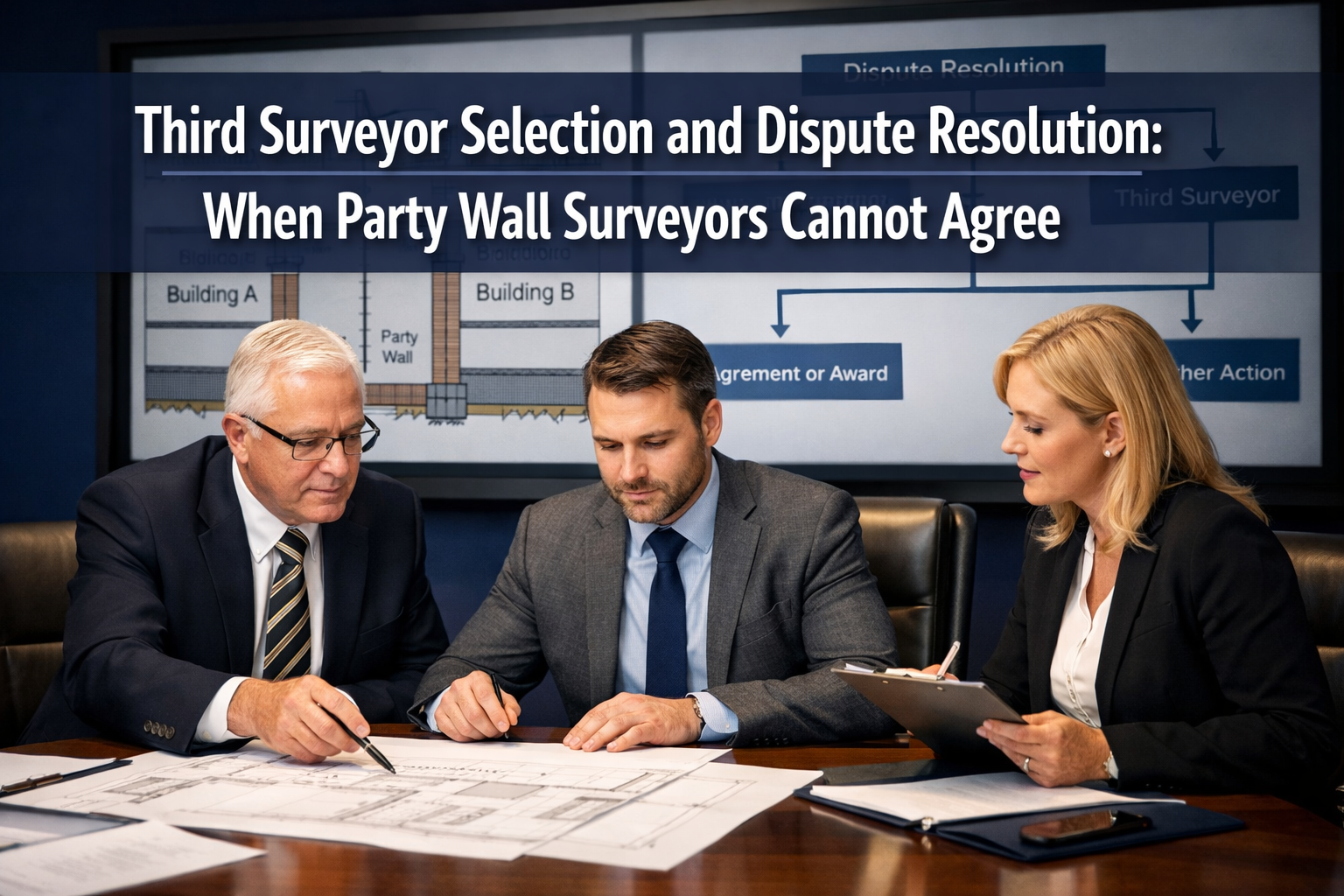
Professional surveyors often recommend joint surveyor appointments where possible, reducing costs and ensuring consistency. However, when parties appoint separate surveyors, the agreed surveyor selection becomes critical for dispute resolution.
Addressing Unreasonable Objections
Not all disputes arise from legitimate concerns. Some adjoining owners raise objections to:
- Delay projects for competitive advantage
- Extract financial concessions
- Express general opposition to development
- Retaliate for unrelated disagreements
Surveyors must distinguish between genuine concerns requiring accommodation and unreasonable objections that shouldn't prevent lawful work. The Party Wall Act provides mechanisms for proceeding despite unreasonable dissent, but navigating this requires careful judgment.
Professional approaches include:
✅ Documenting all objections in writing with requested remedies
✅ Providing technical responses addressing each concern specifically
✅ Offering reasonable accommodations that don't compromise the project
✅ Maintaining professional demeanor regardless of provocation
✅ Escalating appropriately to third surveyor or legal counsel when necessary
The goal remains avoiding injunctions while protecting the building owner's legal rights to proceed with permitted development.
The Impact of Development Density on Dispute Frequency
The UK's intensified development strategy has created unprecedented challenges for party wall management. As urban centres accommodate more housing through infill development, conversions, and vertical extensions, the frequency of party wall triggers has increased dramatically[2].
2026 development trends affecting party wall disputes:
- Basement excavations in areas with limited garden space
- Loft conversions requiring party wall work in terraced properties
- Rear extensions maximizing permitted development rights
- Change of use conversions involving structural alterations
- Brownfield redevelopment on sites with complex boundary relationships
Each trend brings specific challenges requiring specialized surveyor expertise. Basement excavations, for instance, demand particular attention to excavation notice requirements and underpinning specifications.
Best Practices for Property Owners and Developers
Selecting Qualified Party Wall Surveyors
The surveyor selection decision significantly impacts dispute outcomes. Property owners should prioritize:
Professional qualifications – RICS membership and party wall specialization
Local experience – Familiarity with regional building practices and courts
Communication skills – Ability to explain technical matters clearly
Reputation – Track record of dispute resolution without litigation
Availability – Capacity to respond promptly to emerging issues
While cost considerations matter, selecting surveyors based primarily on price often proves counterproductive. The differential between competent and exceptional party wall surveyors is minimal compared to potential dispute costs.
Timing Considerations for Notice Service
Strategic timing can prevent disputes from arising. Best practices include:
⏰ Serve notices early – Minimum two months before intended commencement
⏰ Avoid holiday periods – When adjoining owners may be absent or distracted
⏰ Coordinate with planning – Ensure permissions are secured before notice service
⏰ Consider neighbour circumstances – Avoid serving during known stressful periods
⏰ Allow negotiation time – Build flexibility into project schedules
Early service demonstrates respect for neighbours' rights and provides adequate time for surveyor appointment, award preparation, and any necessary negotiations.
Maintaining Positive Neighbour Relations
Technical compliance alone doesn't guarantee dispute-free projects. Successful outcomes require relationship management alongside legal compliance.
Relationship preservation strategies:
💬 Pre-notice informal discussion – Explaining plans before formal service
💬 Regular updates – Keeping neighbours informed of progress
💬 Responsive communication – Addressing concerns promptly
💬 Minimizing disruption – Respecting agreed working hours and access
💬 Prompt remediation – Fixing any damage immediately
These courtesies cost nothing but significantly reduce dispute likelihood. Even when disagreements arise, maintained goodwill facilitates resolution without legal escalation.
Legal Framework and Recent Developments
The Party Wall Act 1996 in 2026
While the fundamental statutory framework remains unchanged, its interpretation and application continue evolving through case law and professional practice developments. The Act's three main sections each address specific scenarios:
Section 1 – New building on or at the line of junction
Section 2 – Work to existing party structures
Section 6 – Excavation within specified distances of neighbouring structures
Understanding which section applies—or whether multiple sections apply simultaneously—requires professional expertise. Misidentifying the applicable section constitutes a common error leading to invalid notices.
Emerging Case Law Trends
Courts in 2026 demonstrate increasing sophistication in party wall matters, with several notable trends:
📚 Stricter notice requirements – Less tolerance for incomplete information
📚 Enhanced surveyor duties – Higher professional standards expected
📚 Cost consequences – Unreasonable parties bearing increased cost burdens
📚 Injunction thresholds – Clearer guidance on when injunctions are appropriate
These developments underscore the importance of professional surveyor involvement from project inception. The legal landscape increasingly penalizes shortcuts and rewards thorough professional management[1].
The Role of Alternative Dispute Resolution
While the Party Wall Act provides internal dispute resolution through the third surveyor mechanism, some disputes escalate beyond this framework. Alternative Dispute Resolution (ADR) methods including mediation and arbitration offer alternatives to court proceedings.
ADR advantages include:
- Lower costs than litigation
- Faster resolution timelines
- Confidential proceedings
- Preserved relationships
- Flexible solutions
However, ADR requires both parties' cooperation. When one party refuses engagement, court proceedings—including injunction applications—may become unavoidable.
Conclusion: Mastering Party Wall Disputes Through Professional Excellence
Party wall disputes in practice demand far more than superficial compliance with statutory requirements. As development intensity increases across UK urban centres in 2026, the margin for error continues shrinking. Invalid notices, incomplete documentation, or inadequate communication can trigger injunctions that halt projects, destroy budgets, and damage professional reputations.
The evidence is clear: professional surveyor involvement from project inception represents the most effective strategy for navigating invalid notices and preventing injunctions. Experienced surveyors bring technical expertise, procedural knowledge, and relationship management skills that transform potential disputes into collaborative processes.
Actionable Next Steps
For property owners and developers planning work that may trigger party wall requirements:
- Engage qualified surveyors early – Before finalizing project designs
- Invest in comprehensive notices – Ensuring all statutory requirements are met
- Prioritize neighbour communication – Building goodwill before formal processes
- Document everything thoroughly – Creating robust evidence trails
- Respond promptly to concerns – Preventing minor issues from escalating
For adjoining owners receiving party wall notices:
- Seek professional advice immediately – Don't attempt self-management
- Appoint your own surveyor – Protecting your interests properly
- Engage constructively – Focusing on legitimate concerns
- Document existing conditions – Protecting against unfounded damage claims
- Maintain communication channels – Facilitating efficient resolution
The construction boom of 2026 will continue generating party wall disputes, but these need not result in costly injunctions and relationship breakdowns. Through professional expertise, meticulous documentation, and genuine respect for all parties' rights, surveyors successfully navigate even the most complex party wall scenarios[4].
The difference between a dispute that escalates to injunction and one that resolves amicably often lies in the quality of professional management at the earliest stages. As the third edition of The Law and Practice of Party Walls emphasizes, technical excellence combined with practical wisdom remains the foundation of effective party wall practice[3].
By understanding how surveyors navigate invalid notices and prevent injunctions, property owners can approach development projects with confidence, knowing that professional management protects their investments while respecting neighbours' legitimate interests. In 2026's challenging development environment, this expertise isn't optional—it's essential.
References
[1] Legal Developments In Construction Law March 2026 – https://www.mayerbrown.com/en/insights/publications/2026/03/legal-developments-in-construction-law-march-2026
[2] Commercial Real Estate Disputes In 2026 Whats Coming Into View – https://www.ashurst.com/en/insights/commercial-real-estate-disputes-in-2026-whats-coming-into-view/
[3] The Third Edition Of The Law And Practice Of Party Walls Is Now Available – https://tanfieldchambers.co.uk/the-third-edition-of-the-law-and-practice-of-party-walls-is-now-available/
[4] Party Wall Surveys Amid 2026 Construction Boom Handling Disputes In High Demand Uk Housing Markets – https://nottinghillsurveyors.com/blog/party-wall-surveys-amid-2026-construction-boom-handling-disputes-in-high-demand-uk-housing-markets