

As the UK accelerates toward its ambitious net zero targets in 2026, heat network expansions are transforming from niche infrastructure projects into mainstream urban developments. Yet beneath the policy announcements and government funding commitments lies a complex web of property law challenges that many developers and local authorities are only beginning to navigate. The Party Wall Challenges for UK Heat Network Expansions: Survey Protocols Under 2026 Net Zero Infrastructure Push represent a critical intersection where Victorian-era property legislation meets 21st-century climate infrastructure—and the stakes have never been higher. 🏘️
With new heat network zoning regulations taking effect and mandatory Ofgem authorisation requirements beginning January 27, 2026, the practical challenges of installing district heating pipes through densely built terraced streets, beneath shared foundations, and across party wall boundaries demand urgent attention. For property owners, developers, and local authorities alike, understanding how the Party Wall etc. Act 1996 applies to heat network installations has become essential to avoiding costly delays, legal disputes, and project failures.

Key Takeaways
- Heat network zoning regulations introduced in 2026 create mandatory connection requirements for three building categories, necessitating comprehensive party wall assessments across designated zones [2]
- Traditional Party Wall Act 1996 procedures remain the primary legal framework for heat network installations, requiring proper notice serving, neighbour consent, and condition surveys before excavation work begins
- Zone Coordination Bodies (local authorities) must now integrate party wall considerations into competitive developer procurement processes, adding new complexity to infrastructure planning timelines [3]
- RICS professional standards provide the essential framework for conducting pre-installation surveys, documenting existing conditions, and resolving disputes when heat network works affect shared boundaries
- Proactive neighbour engagement and thorough survey protocols significantly reduce dispute risks, with proper documentation protecting all parties when underground pipe installations cross property boundaries
Understanding the 2026 Heat Network Regulatory Landscape
The regulatory environment governing UK heat networks underwent fundamental transformation in early 2026, creating new obligations that directly impact how party wall matters must be handled. The establishment of the Heat Network Zoning Authority as a national oversight body marks a significant shift from voluntary adoption to mandatory compliance frameworks [2].
New Regulatory Framework Components
From January 27, 2026, Ofgem assumed regulatory authority over heat network operators, introducing mandatory authorisation requirements with specific technical performance standards [4]. This regulatory expansion means that heat network developers can no longer treat party wall compliance as a secondary consideration—it has become integral to obtaining and maintaining operational licences.
The government's 2026 response established three distinct building categories subject to connection requirements:
- New buildings constructed after zone designation
- Pre-existing communally heated buildings already connected to shared heating systems
- Pre-existing non-domestic buildings with annual heat demand exceeding 100 MWh [2]
Each category presents unique party wall challenges, particularly when retrofitting existing properties or connecting buildings that share structural elements.
Zone Coordination Bodies and Property Surveys
Local authorities operating as Zone Coordination Bodies now carry responsibility for defining heat network zone boundaries and managing competitive developer procurement processes [3]. This responsibility necessarily includes ensuring that selected developers have robust protocols for addressing party wall matters across potentially hundreds of properties within designated zones.
The practical implication? Party wall surveys have evolved from individual property concerns to strategic infrastructure planning requirements affecting entire neighbourhoods simultaneously.
Party Wall Challenges for UK Heat Network Expansions: Legal Framework and Notice Requirements
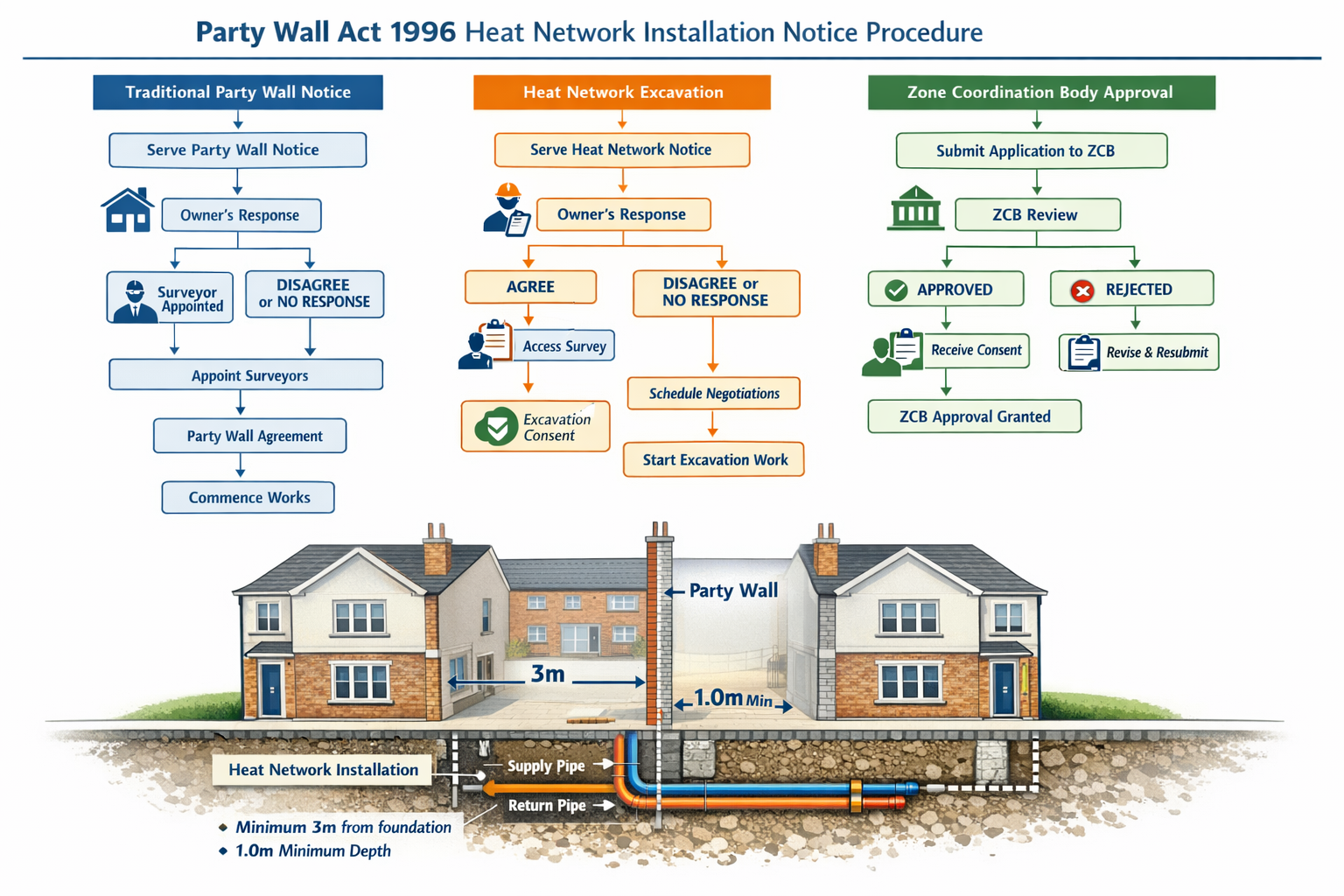
The Party Wall etc. Act 1996 remains the cornerstone legislation governing how heat network installations must navigate shared boundaries, despite being drafted decades before district heating became a national infrastructure priority. Understanding how this Act applies to modern heat network projects requires careful analysis of three key work categories.
Excavation Works Near Neighbouring Properties
Heat network pipe installations frequently require excavation within three metres of neighbouring buildings' foundations, triggering Section 6 notice requirements under the Party Wall Act. The three-meter rule becomes particularly relevant when routing underground distribution pipes through densely built terraced streets where Victorian properties often share continuous foundation structures.
Building owners must serve notice when excavation for heat network trenches:
- Extends within three metres of a neighbour's structure and goes deeper than the neighbour's foundations
- Occurs within six metres of a neighbour's structure and cuts through a line drawn at 45 degrees from the bottom of the neighbour's foundations Notice requirements for excavation near neighbours
For heat network developers working across multiple properties, this means potentially serving dozens or even hundreds of notices simultaneously—a logistical challenge requiring sophisticated project management systems.
Works Directly on Party Walls
When heat network infrastructure requires penetrating existing party walls to install pipe entry points, distribution manifolds, or heat interface units, Section 2 of the Party Wall Act applies. These works require consent for party wall work through proper notice procedures served at least two months before work commences.
Common scenarios include:
- Drilling through party walls to route connection pipes between properties
- Installing mounting brackets for distribution pipework on shared walls
- Creating access points for maintenance of shared heating infrastructure
- Modifying existing openings in party structures to accommodate larger diameter pipes
Building on the Line of Junction
Heat network plant rooms, energy centres, or substations built at property boundaries trigger Section 1 requirements when new structures are erected on or astride the boundary line. While less common than excavation works, these situations arise when heat network infrastructure requires dedicated buildings at strategic locations within the distribution network.
The Critical Importance of Proper Notice Serving
Failure to serve appropriate party wall notices before commencing heat network installation work creates significant legal and financial risks. When party wall notice is not served properly, affected neighbours can:
- Obtain injunctions halting all work immediately
- Claim damages for any harm caused to their property
- Refuse retrospective consent, requiring costly remediation
- Initiate formal disputes that delay project completion by months
Given the tight timelines and performance obligations now attached to heat network zone designations, these delays can jeopardize entire project viability and public sector funding commitments.
Survey Protocols Under 2026 Net Zero Infrastructure Push: Best Practices for Heat Network Projects
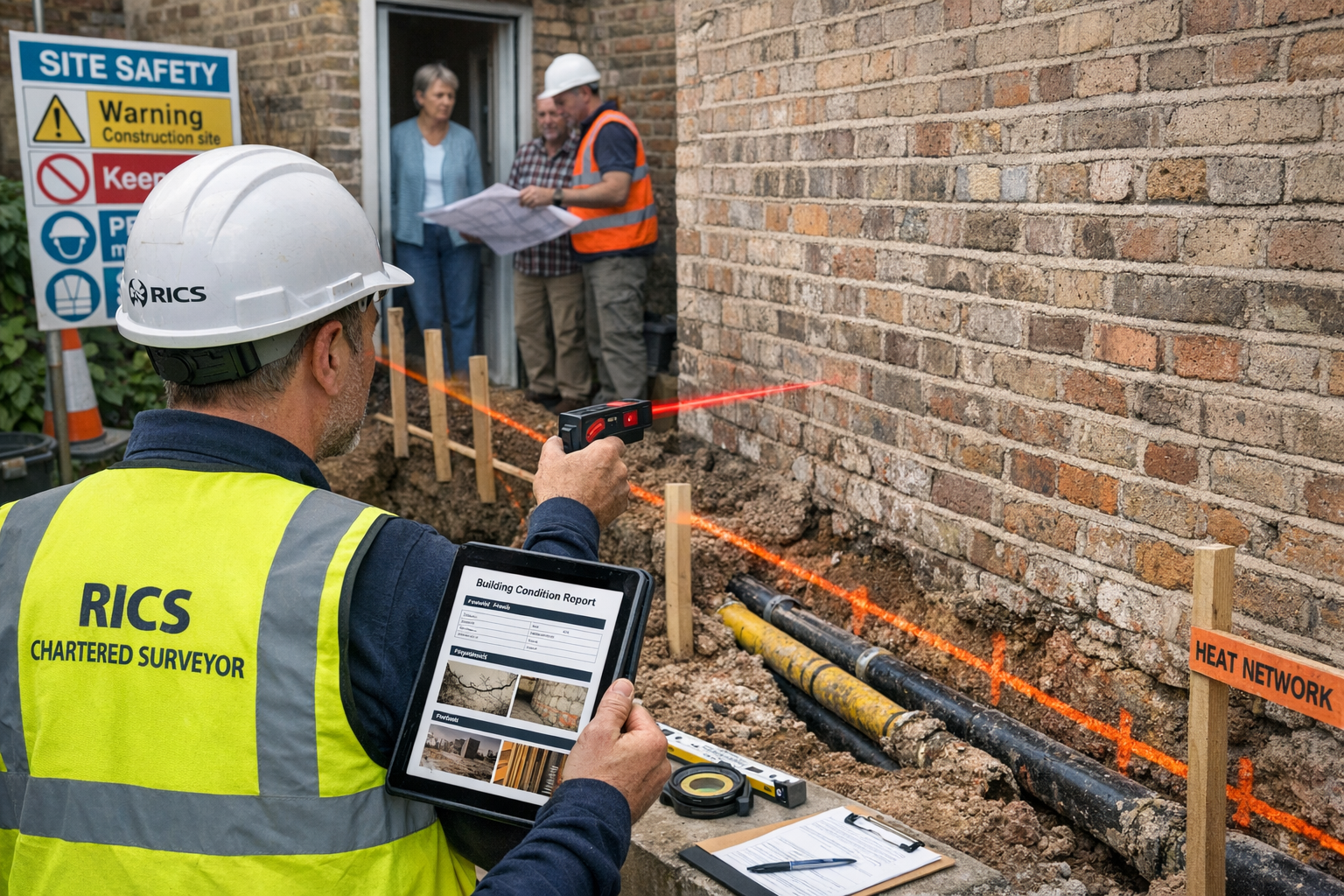
The 2026 net zero infrastructure push has elevated survey protocols from routine administrative tasks to strategic project enablers. Comprehensive pre-installation surveys now serve multiple purposes: legal compliance, risk mitigation, stakeholder confidence building, and regulatory reporting to Zone Coordination Bodies and Ofgem.
Pre-Installation Condition Surveys
Before any excavation or party wall work begins, RICS-qualified surveyors should conduct thorough condition surveys of all properties potentially affected by heat network installations. These surveys establish baseline conditions that protect both building owners and heat network developers from spurious damage claims.
Essential survey components include:
- Photographic documentation of all party walls, boundaries, and structural elements within the work zone
- Crack mapping showing existing defects, settlement patterns, and structural movement
- Foundation exposure assessment where excavation will occur near existing structures
- Services identification documenting existing utilities that may complicate heat network routing
- Structural integrity evaluation identifying properties with pre-existing vulnerabilities
The survey report should explicitly reference heat network installation plans, noting specific locations where pipes will cross boundaries, penetrate walls, or require excavation near foundations. This specificity proves invaluable if party wall disputes arise later.
Neighbour Notification Best Practices
While the Party Wall Act specifies minimum notice periods, heat network projects benefit significantly from early and comprehensive neighbour engagement that exceeds statutory requirements. Zone Coordination Bodies increasingly expect developers to demonstrate robust community consultation as part of procurement evaluation criteria.
Effective notification protocols include:
- Initial information sessions held 3-6 months before formal notices, explaining heat network benefits and addressing property owner concerns
- Written pre-notice communications describing the project scope, timeline, and party wall process in accessible language
- Formal statutory notices served with sufficient time (minimum two months for party wall works, one month for excavations)
- Follow-up consultations offering opportunities for property owners to ask questions and review survey findings
- Ongoing updates throughout construction, maintaining transparency about progress and any issues encountered
This proactive approach significantly reduces the likelihood that neighbours will dissent to party wall notices or initiate formal dispute procedures.
Appointing Party Wall Surveyors for Large-Scale Projects
Heat network projects spanning multiple properties create unique challenges for the traditional party wall surveyor appointment process. When dozens of neighbouring owners are affected, the standard model of individual appointments becomes impractical.
Streamlined appointment strategies include:
- Single agreed surveyor approach: Proposing one experienced surveyor to act for all parties, reducing costs and coordination complexity (requires consent from all affected neighbours)
- Panel of approved surveyors: Zone Coordination Bodies pre-qualifying a panel of RICS surveyors familiar with heat network projects, from which neighbours can select
- Phased appointment process: Grouping properties by construction phase and appointing surveyors sequentially as work progresses through different streets or blocks
Regardless of approach, surveyors must possess specific expertise in both party wall matters and heat network infrastructure to effectively balance competing interests and technical requirements.
Documentation and Award Preparation
When neighbours consent to heat network works or surveyors reach agreement on behalf of dissenting owners, comprehensive party wall awards must be prepared. These legal documents should specifically address heat network installation considerations:
- Permitted working hours balancing construction efficiency with residential amenity
- Access arrangements for ongoing maintenance of heat network infrastructure
- Vibration and noise limits during pipe installation and excavation works
- Temporary works provisions for shoring, propping, or supporting structures during excavation
- Monitoring protocols for detecting and addressing any movement or damage during construction
- Reinstatement standards specifying how disturbed ground, paving, and boundary features will be restored
Awards should also clarify long-term maintenance rights, as heat network infrastructure requires periodic access for repairs, upgrades, and equipment replacement over 25-40 year operational lifespans.
Dispute Resolution and Compliance Challenges
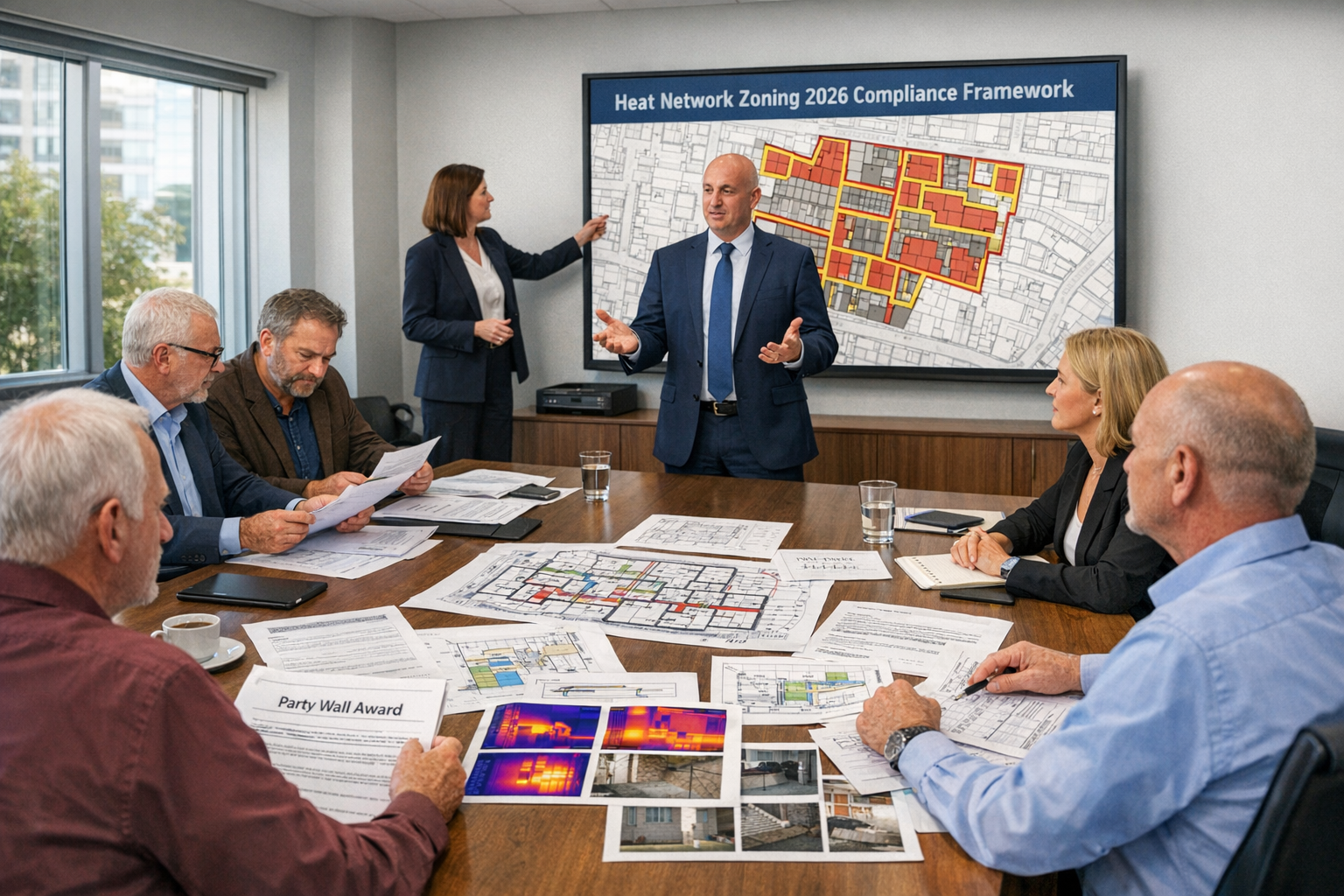
Despite best efforts at proactive engagement and thorough survey protocols, party wall disputes inevitably arise in large-scale heat network projects. The 2026 regulatory environment adds new dimensions to traditional dispute resolution processes, with Zone Coordination Bodies and Ofgem oversight creating additional stakeholder interests beyond the immediate property owners.
Common Sources of Party Wall Disputes in Heat Network Projects
Understanding typical dispute triggers helps developers implement preventive measures:
Construction methodology conflicts: Neighbours objecting to proposed excavation techniques, particularly when vibration-intensive methods like pile driving are proposed near sensitive structures
Timing and access disputes: Disagreements over working hours, site access routes through private property, or construction phase sequencing affecting multiple properties differently
Cost allocation disagreements: Conflicts over who bears survey costs, temporary works expenses, or reinstatement obligations when works benefit the broader heat network rather than individual properties
Damage attribution challenges: Disputes over whether observed cracking, settlement, or structural movement resulted from heat network installation or pre-existed the works
Long-term maintenance concerns: Neighbours resisting provisions that grant perpetual access rights for heat network maintenance, fearing ongoing disruption
The Party Wall Surveyor's Role in Heat Network Disputes
When neighbours dissent to party wall notices or disputes arise during construction, appointed surveyors must balance multiple competing interests while maintaining professional independence. In heat network contexts, this role becomes particularly complex because:
- Public interest considerations in achieving net zero targets may conflict with individual property rights
- Zone Coordination Body expectations for project delivery timelines create pressure that surveyors must resist when protecting neighbouring owners' legitimate interests
- Technical complexity of heat network systems requires surveyors to understand thermal engineering, pipe routing constraints, and infrastructure interdependencies
- Precedent-setting nature of awards may affect hundreds of subsequent properties as heat networks expand across zones
RICS professional standards require surveyors to prioritize their duty to the appointing owner while acting impartially when preparing awards. This balance proves challenging when heat network developers (as building owners) possess significantly greater resources and technical expertise than individual residential neighbours.
Alternative Dispute Resolution Mechanisms
Given the scale and public interest dimensions of heat network projects, traditional party wall dispute resolution through the appointment of a third surveyor may prove insufficient. Innovative approaches gaining traction in 2026 include:
Mediation services: Zone Coordination Bodies funding independent mediators to facilitate resolution before formal surveyor appointments become necessary
Community liaison panels: Establishing representative bodies for affected residents to collectively engage with developers, reducing individual dispute burdens
Technical advisory services: Local authorities providing free access to independent technical experts who can explain heat network proposals to concerned neighbours in accessible terms
Expedited determination processes: Agreeing to shortened timelines for surveyor decisions when project delays threaten zone designation compliance deadlines (with appropriate safeguards for neighbour interests)
These mechanisms supplement rather than replace statutory party wall procedures, offering additional pathways toward resolution when traditional approaches stall.
Consequences of Non-Compliance
The 2026 regulatory environment significantly increases the stakes for party wall non-compliance in heat network projects. Beyond traditional civil remedies available to affected neighbours, developers now face:
- Ofgem authorisation delays or refusals when party wall disputes indicate inadequate stakeholder engagement
- Zone Coordination Body contract termination provisions triggered by persistent legal conflicts with property owners
- Public funding clawback requirements when projects fail to meet delivery milestones due to party wall disputes
- Reputational damage affecting future procurement opportunities across multiple local authority zones
For individual property owners who proceed with heat network connections without proper party wall agreement, the risks include personal liability for damage to neighbouring properties, injunctions requiring removal of installed infrastructure, and potential criminal liability for trespass.
Integrating Party Wall Protocols with Heat Network Planning
The most successful heat network projects in 2026 treat party wall compliance not as a legal obstacle to overcome but as an integral component of infrastructure planning from initial feasibility assessment through to operational handover.
Early-Stage Feasibility Assessment
Before Zone Coordination Bodies designate heat network zones or developers submit procurement bids, preliminary party wall assessments should inform route selection and technology choices. Desktop studies can identify:
- High-risk property clusters where complex party wall situations (multiple ownerships, previous disputes, structural sensitivities) may cause delays
- Alternative routing options that minimize party wall interactions by utilizing public highways, existing utility corridors, or properties with single ownership
- Technology selection implications comparing trenched pipe installation (higher party wall impact) versus directional drilling (reduced surface disruption but different risk profile)
- Phasing opportunities that sequence construction to address simpler party wall situations first, building community confidence before tackling complex cases
This early assessment allows more realistic project timelines, accurate cost estimation, and risk-adjusted procurement evaluation criteria.
Procurement and Contract Structures
Zone Coordination Bodies should embed party wall competency requirements into developer procurement processes, evaluating:
- Track record of successful party wall management on previous district heating or linear infrastructure projects
- Survey protocols demonstrating RICS compliance and appropriate documentation standards
- Community engagement strategies showing commitment to exceeding statutory minimum notice requirements
- Dispute resolution resources including access to experienced party wall surveyors and mediation services
- Insurance provisions covering party wall-related claims and potential delay costs
Contract structures should clearly allocate party wall responsibilities, costs, and risk between Zone Coordination Bodies, developers, and property owners. Ambiguity in these allocations frequently causes disputes that delay projects and increase costs for all parties.
Ongoing Monitoring and Adaptive Management
Once heat network construction begins, systematic monitoring protocols help identify and address party wall issues before they escalate into formal disputes:
- Regular condition inspections of properties within the work zone, comparing current state to pre-installation survey baselines
- Vibration and settlement monitoring using automated sensors at sensitive locations, with alert thresholds triggering immediate investigation
- Community liaison officer maintaining regular contact with affected residents, addressing concerns promptly and informally
- Surveyor coordination meetings bringing together appointed surveyors to discuss emerging issues and coordinate responses across multiple properties
- Lessons learned documentation capturing successful approaches and challenges to inform subsequent project phases
This adaptive management approach recognizes that party wall challenges cannot be fully anticipated during planning and requires flexibility to respond as situations develop.
Future Outlook: Evolving Standards for Heat Network Party Wall Practice
As heat network deployment accelerates across UK cities in pursuit of 2026 net zero commitments, party wall practice continues evolving to meet infrastructure-scale challenges that the Party Wall Act 1996 never contemplated.
Emerging Professional Guidance
RICS and other professional bodies are developing supplementary guidance specifically addressing heat network party wall scenarios. Expected developments include:
- Standard survey templates adapted for heat network pre-installation assessments
- Model party wall awards with heat network-specific clauses addressing maintenance access, equipment replacement cycles, and thermal performance obligations
- Competency frameworks defining the knowledge and experience surveyors need to effectively handle heat network party wall matters
- Fee guidance reflecting the increased complexity and coordination requirements of multi-property heat network projects
These resources will help standardize practice and reduce the current variability in how different surveyors and local authorities approach party wall challenges.
Technology-Enabled Solutions
Digital tools increasingly support more efficient party wall management in large-scale heat network projects:
- Digital notice serving platforms streamlining the administrative burden of serving notices to dozens of property owners simultaneously
- 3D modeling and visualization helping neighbours understand proposed works and reducing anxiety about heat network installations
- Automated condition monitoring using AI-analyzed photographs to detect structural changes during construction
- Blockchain-based award registries creating permanent, tamper-proof records of party wall agreements that follow properties through ownership changes
These technologies promise to reduce costs, improve transparency, and accelerate dispute resolution processes.
Legislative Reform Considerations
Some practitioners advocate for legislative updates to better accommodate infrastructure-scale party wall challenges. Potential reforms under discussion include:
- Streamlined procedures for projects affecting more than a threshold number of properties (e.g., 20+)
- Public interest provisions allowing expedited processes when projects serve net zero or energy security objectives
- Cost-sharing mechanisms distributing party wall expenses more equitably when works primarily benefit public infrastructure rather than individual building owners
- Long-term access rights frameworks balancing heat network operational requirements with property owner privacy and amenity
However, any legislative changes must carefully balance infrastructure delivery efficiency with robust protection of individual property rights—a politically sensitive equilibrium that may limit reform ambitions.
Conclusion: Navigating Party Wall Challenges in the 2026 Heat Network Landscape
The Party Wall Challenges for UK Heat Network Expansions: Survey Protocols Under 2026 Net Zero Infrastructure Push represent a critical juncture where established property law meets urgent climate infrastructure imperatives. Success requires recognizing that effective party wall management is not merely a legal compliance exercise but a fundamental enabler of the heat network deployment essential to achieving national net zero commitments.
For property owners facing heat network connections in their neighbourhoods, understanding party wall rights and procedures ensures fair treatment while supporting essential infrastructure development. For developers and Zone Coordination Bodies, investing in thorough survey protocols, proactive neighbour engagement, and experienced RICS surveyors significantly reduces dispute risks and project delays.
The regulatory landscape established in 2026—with Ofgem oversight, mandatory zoning designations, and Zone Coordination Body responsibilities—has elevated party wall considerations from individual property concerns to strategic infrastructure planning requirements. Organizations that recognize this shift and adapt their approaches accordingly will navigate the challenges successfully, while those treating party wall matters as afterthoughts will face costly delays and conflicts.
Actionable Next Steps
For property owners affected by heat network proposals:
✅ Request early information about proposed works and timelines from developers or local authorities
✅ Understand your rights under the Party Wall Act, including the right to appoint your own surveyor at the building owner's expense
✅ Commission independent party wall advice from RICS-qualified surveyors when notices are served
✅ Document your property's current condition with photographs and notes before works commence
For heat network developers and Zone Coordination Bodies:
✅ Integrate party wall assessments into initial feasibility studies and route selection processes
✅ Engage RICS-qualified surveyors with specific heat network infrastructure experience
✅ Implement community engagement programs that exceed statutory minimum notice requirements
✅ Develop standardized survey protocols, notice templates, and award provisions adapted for heat network contexts
✅ Establish monitoring systems to detect and address structural concerns before they escalate into formal disputes
For professional surveyors:
✅ Pursue continuing professional development in heat network technologies and infrastructure planning
✅ Develop expertise in managing multi-party situations involving dozens of affected properties
✅ Contribute to emerging professional guidance development through RICS and industry working groups
✅ Build relationships with Zone Coordination Bodies and heat network developers to understand project-specific challenges
The path to net zero runs through thousands of shared property boundaries across UK cities. By approaching party wall challenges with professionalism, transparency, and genuine commitment to protecting all stakeholders' legitimate interests, the property and surveying professions can enable heat network expansion while upholding the fundamental property rights that the Party Wall Act was designed to protect. The 2026 infrastructure push demands nothing less than excellence in both technical competency and stakeholder engagement—and the future of UK decarbonization depends on delivering both. 🌱
References
[1] Heat Network Zoning Update January 2026 – https://www.neynetzerohub.com/wp-content/uploads/2026/01/Heat-Network-Zoning-Update-January-2026.pdf
[2] Heat Network Zoning What The Government S 2026 Response Means For Local Authorities – https://www.localgovernmentlawyer.co.uk/sharpeedge/808-sharpeedge-planning/99751-heat-network-zoning-what-the-government-s-2026-response-means-for-local-authorities
[3] Heat Network Zoning Explained What Developers And Local Authorities Need To Know In 2026 – https://www.geniusenergylab.com/blog/heat-network-zoning-explained-what-developers-and-local-authorities-need-to-know-in-2026
[4] A Hot Topic New Regulations Turn Up The Heat On Dhns – https://www.jonesday.com/en/insights/2026/01/a-hot-topic-new-regulations-turn-up-the-heat-on-dhns
[5] Party Wall Agreements In Data Centre Developments 2026 Compliance Amid Ai Driven Uk Demand – https://nottinghillsurveyors.com/blog/party-wall-agreements-in-data-centre-developments-2026-compliance-amid-ai-driven-uk-demand
[6] The Future Of Heat Networks Regulation Zoning And Growth In 2026 – https://www.bevanbrittan.com/insights/articles/2026/the-future-of-heat-networks-regulation-zoning-and-growth-in-2026/
[7] Heat Networks Regulation Consumer Protection Guidance – https://www.ofgem.gov.uk/sites/default/files/2026-01/Heat-networks-regulation-consumer-protection-guidance.pdf