
The renovation market across England and Wales is experiencing remarkable momentum in 2026, with homeowners increasingly turning to loft and basement conversions as cost-effective alternatives to relocation. As property values stabilize in Southern regions and affordability improves across Northern areas, understanding Party Wall Act Compliance for 2026 Loft and Basement Conversions: Surveyor Essentials in a Rising Renovation Market has become critical for surveyors navigating this expanding sector. With conversion costs ranging from £2,200-2,900 per square metre for lofts and £4,600-6,200 for basements in London alone, the financial stakes—and compliance requirements—have never been higher.[1]
For surveyors managing these projects, mastering the intricacies of party wall procedures isn't just about legal compliance. It's about protecting client investments, maintaining neighbour relations, and ensuring projects proceed smoothly from notice to completion. This comprehensive guide explores the essential surveyor responsibilities, procedural requirements, and practical strategies for successful party wall management in 2026's dynamic renovation landscape.
Key Takeaways
- Two-tier notice periods apply: 2 months for building works affecting party walls, 1 month for excavation work near boundaries
- Schedule of condition documentation with dated photographs is mandatory before works commence to protect all parties
- Surveyor independence is legally required—building owners cannot use their own surveyor for party wall agreements
- 2026 costs reflect significant investment: London loft conversions average £2,200-2,900/m², while basements command £4,600-6,200/m²[1]
- 14-day response windows for neighbours and appeals create strict timeline requirements that surveyors must manage carefully
Understanding Party Wall Act Fundamentals for 2026 Conversions
Geographic Scope and Regulatory Framework
The Party Wall etc. Act 1996 remains the governing legislation for England and Wales in 2026, with no regulatory changes to the core framework.[1] This geographical limitation is crucial for surveyors to understand—Scotland and Northern Ireland operate under entirely different regulations, making cross-border projects subject to varying compliance requirements.[2]
The Act establishes three primary categories of work requiring formal procedures:
- Building on or near a party wall (Section 2)
- Excavation within specified distances of neighbouring foundations (Section 6)
- Repair or maintenance of existing party structures
For party wall loft conversions, the critical determination is whether construction work affects shared walls. Loft conversions involving structural alterations to party walls mandate full party wall agreements, while purely internal modifications may fall outside the Act's scope.[2]
When Loft Conversions Trigger Party Wall Requirements
Loft conversions commonly trigger party wall procedures when they involve:
- Raising party walls to accommodate increased ceiling heights
- Installing steel beams that penetrate or rest on party walls
- Creating dormer extensions that affect the shared roof structure
- Cutting into party walls for new staircases or access points
Even seemingly minor interventions can require consent for party wall work if they impact the structural integrity or load-bearing capacity of shared elements.
Basement Conversion Excavation Rules
Basement conversions almost invariably trigger Section 6 excavation requirements when digging involves:
- Excavating within 3 metres of a neighbour's structure and going deeper than their foundations
- Excavating within 6 metres of a neighbour's structure and cutting a line at 45 degrees from the bottom of their foundations
These geometric thresholds make basement projects particularly complex from a party wall perspective. Surveyors must obtain precise foundation depth measurements from adjoining properties—often requiring intrusive investigation—before determining notice requirements. For detailed guidance, refer to our resource on notice for excavation near a neighbour.
Surveyor Responsibilities and Notice Procedures in 2026
The Two-Tier Notice Timeline System
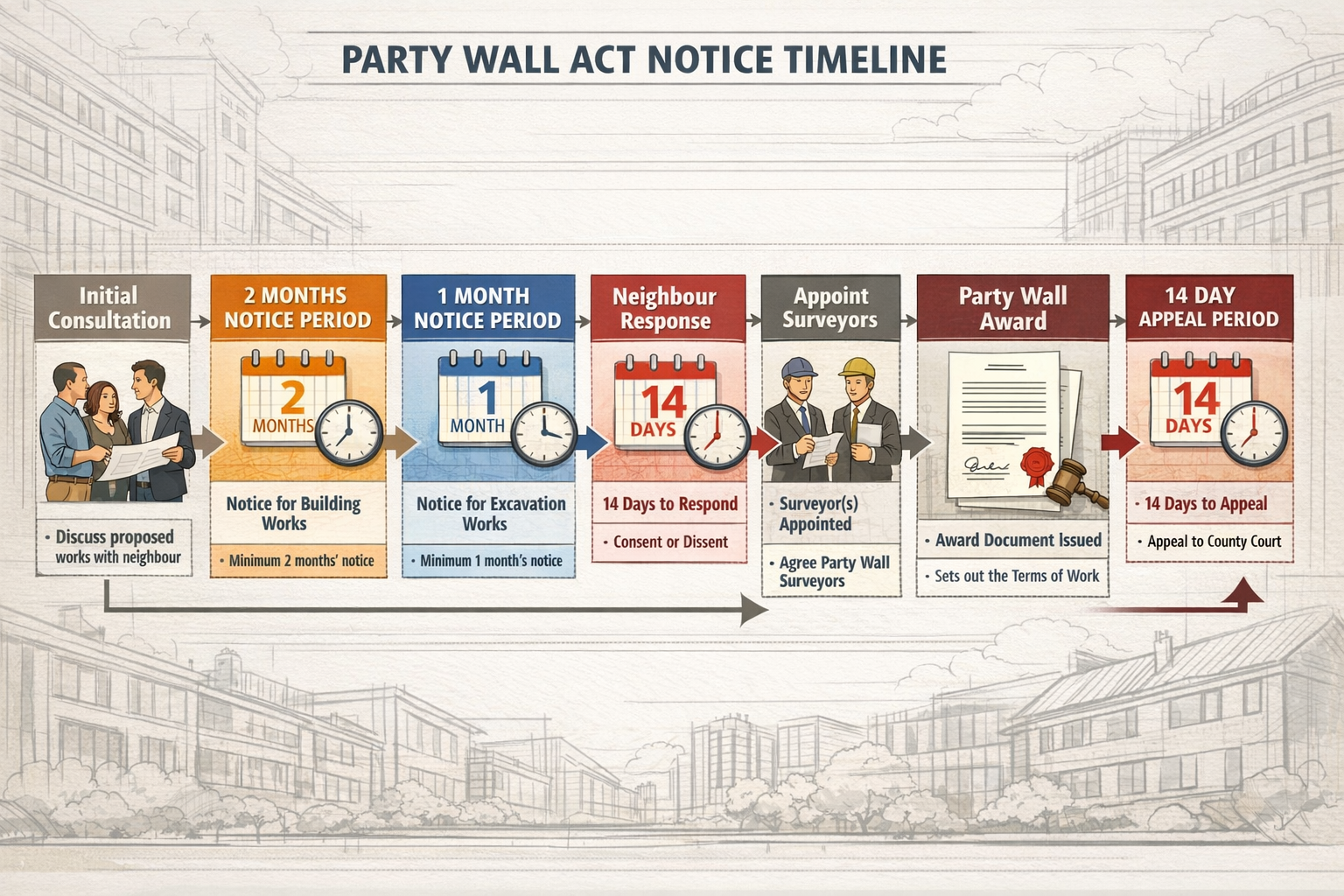
Understanding and managing notice periods represents one of the surveyor's most critical responsibilities. The Party Wall Act establishes distinct timelines based on work type:[2]
| Work Type | Notice Period | Key Requirements |
|---|---|---|
| Building works (party walls) | 2 months | Detailed drawings, work description, proposed start date |
| Excavation work (foundations) | 1 month | Excavation depth, proximity to boundary, structural details |
| Neighbour response | 14 days | Written consent or dissent required |
These non-negotiable timelines mean surveyors must build compliance windows into project schedules from the earliest planning stages. A common error is assuming notice periods run concurrently with planning permission applications—they are separate legal requirements that often extend project timelines by 8-12 weeks.
Crafting Compliant Party Wall Notices
Effective party wall notices must include:
- Accurate technical descriptions of proposed works
- Detailed architectural drawings showing party wall impacts
- Proposed commencement dates allowing for full notice periods
- Building owner contact information and appointed surveyor details
- Clear explanation of the neighbour's rights and response options
Surveyors should avoid technical jargon in notices, ensuring adjoining owners understand the scope and implications of proposed works. Ambiguous or incomplete notices frequently result in disputes that could have been prevented through clearer initial communication.
Managing the 14-Day Response Window
Once neighbours receive party wall notices, they have precisely 14 days to respond.[2] Three scenarios emerge:
- Written consent: Work may proceed without a formal Party Wall Award
- Written dissent: Triggers the surveyor appointment and award process
- No response: Treated as dissent, automatically requiring surveyor involvement
The "deemed dissent" provision protects building owners from indefinite delays but requires surveyors to document all communication attempts meticulously. Proof of service—through recorded delivery or personal hand-delivery with signed receipt—becomes essential evidence if disputes escalate.
Party Wall Awards and Schedule of Condition Documentation
The Surveyor Appointment Process
When neighbours dissent (or fail to respond), the surveyor appointment mechanism activates. The Act permits three approaches:[2]
- Agreed surveyor: Both parties jointly appoint a single impartial surveyor
- Two surveyors: Each party appoints their own surveyor, who then select a third surveyor
- Building owner's surveyor: If the adjoining owner doesn't appoint within 10 days, the building owner's surveyor may proceed
Surveyor independence is non-negotiable. Building owners cannot appoint their project architect or structural engineer as the party wall surveyor—this fundamental conflict of interest undermines the agreement's legal validity and frequently triggers neighbour objections.[2]
Creating Comprehensive Schedules of Condition
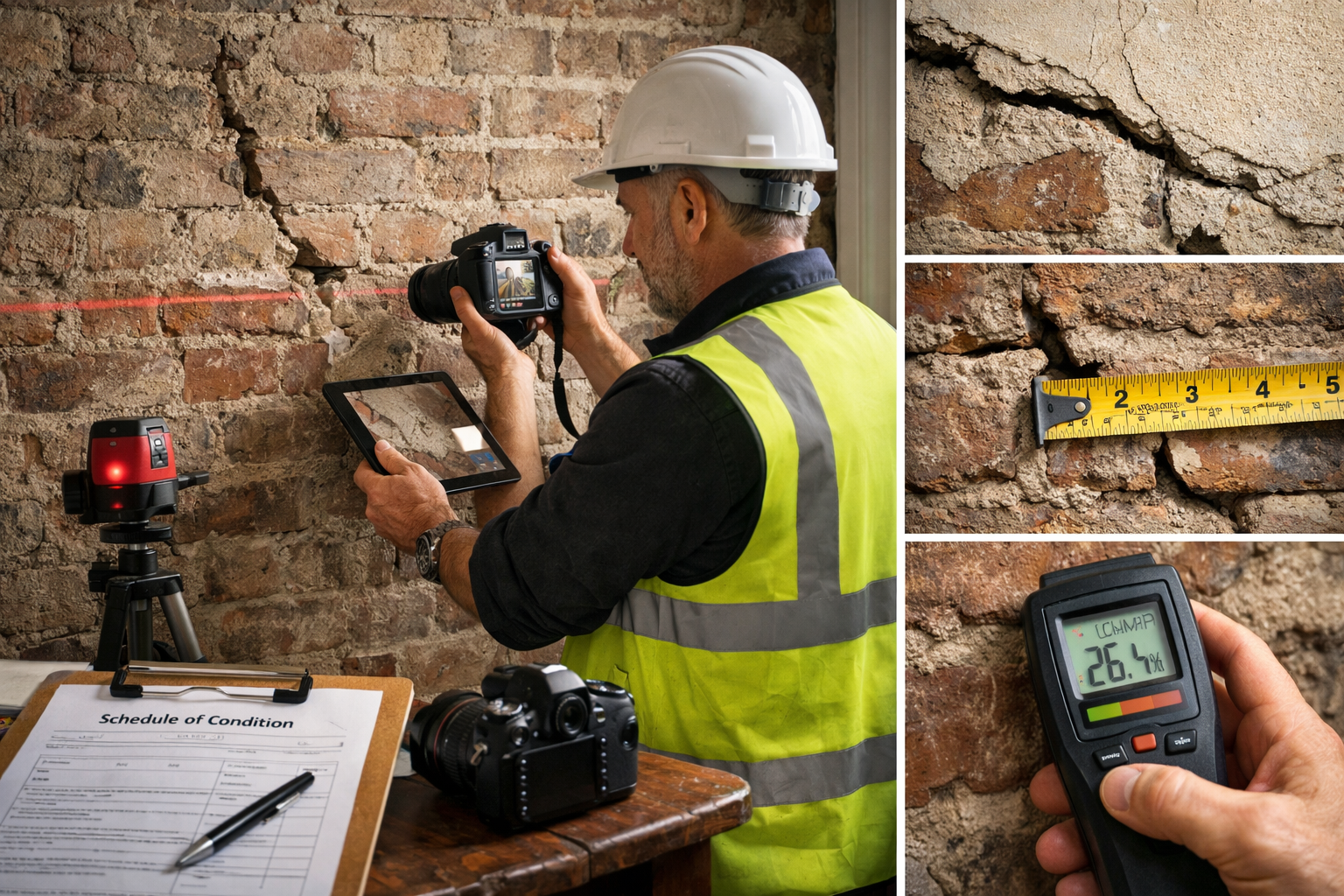
The schedule of condition represents the surveyor's most important protective document. This detailed record establishes the pre-works state of adjoining properties, providing the baseline for assessing any damage to property in party wall work.[2]
Professional schedules of condition should include:
- Dated photographs of all rooms adjoining the party wall
- Detailed written descriptions of existing defects, cracks, and conditions
- Measurements of significant cracks using crack width gauges
- External elevations showing the property's overall condition
- Drainage and foundation observations where accessible
For leasehold properties, additional considerations apply. Our guide on schedule of condition leasehold requirements addresses these specific complexities.
Drafting the Party Wall Award
The Party Wall Award is the legally binding document that permits works to proceed. Comprehensive awards specify:
- Permitted works in precise technical detail
- Working hours and access arrangements
- Protection measures for adjoining properties
- Dispute resolution procedures for unforeseen issues
- Cost allocation for surveyor fees and award preparation
- Insurance requirements and liability provisions
Surveyors must serve the award on both parties, who then have 14 days to appeal to the County Court if they consider the award inappropriate.[2] This appeal window requires careful management—works should not commence until it expires to avoid potential legal complications. For detailed guidance, see our resource on guidance for party wall award preparation.
Financial Considerations: Costs, Fees, and Market Trends for 2026
2026 Loft Conversion Cost Analysis
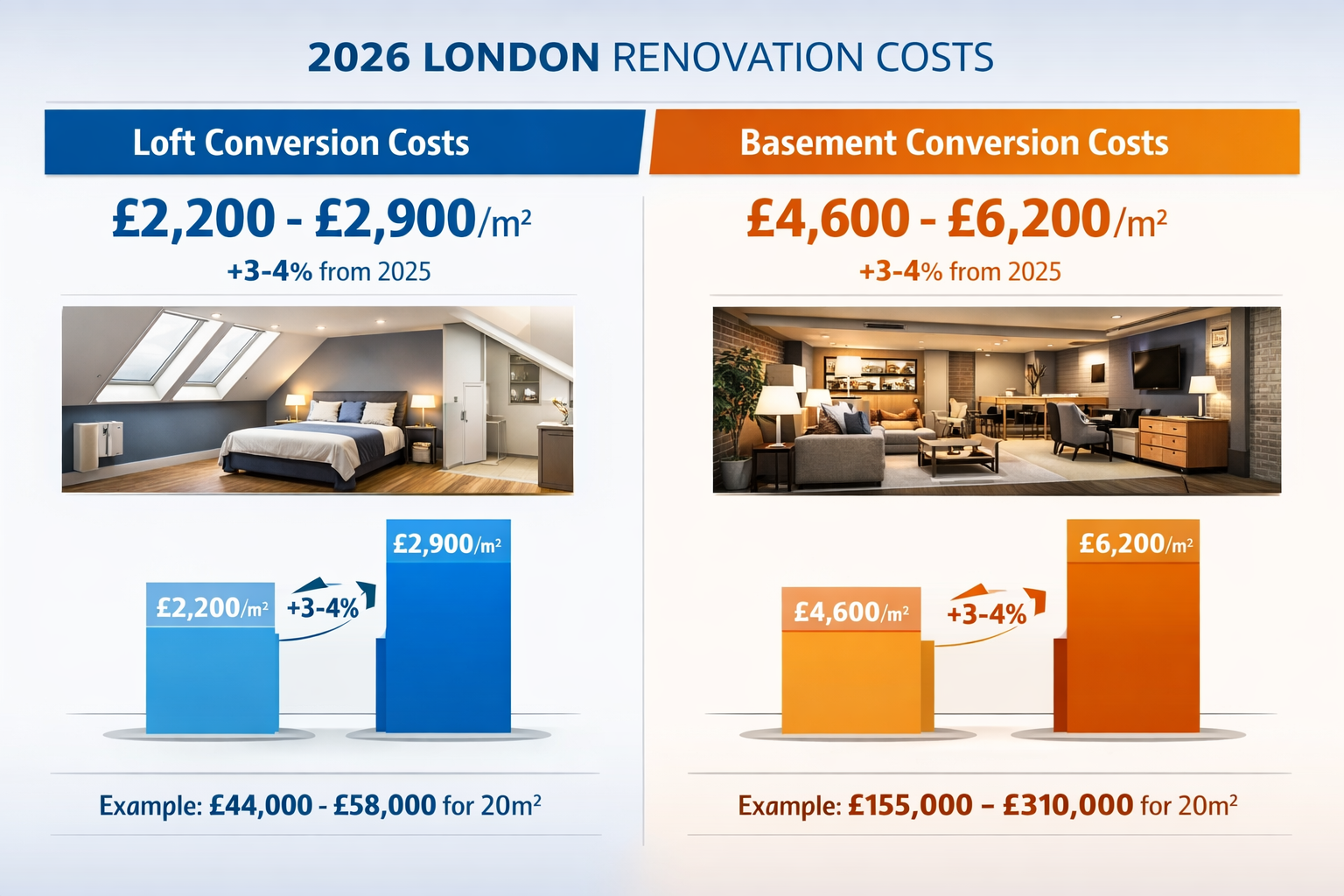
Based on analysis of over 5,000 UK projects completed in Q1 2026, loft conversion costs demonstrate significant regional variation:[1]
- London: £2,200-2,900 per square metre
- Southeast England: £1,800-2,400 per square metre
- Northern regions: £1,500-2,000 per square metre
These figures represent a 3-4% increase from 2025 pricing, reflecting ongoing material cost pressures and skilled labour shortages.[1] For a typical 20m² loft conversion in London, total project costs range from £44,000 to £58,000—making party wall compliance a relatively small but essential component of the overall investment.
2026 Basement Conversion Cost Realities
Basement conversions command substantially higher costs due to excavation complexity, structural requirements, and waterproofing demands:[1]
- London: £4,600-6,200 per square metre
- Total project costs: £155,000-£310,000 for 20m² conversions
The higher cost threshold makes party wall compliance even more critical—disputes that delay basement projects by weeks or months can add tens of thousands in holding costs, contractor standby fees, and extended professional fees.
Party Wall Surveyor Fee Structures
Party wall surveyor fees typically follow one of three models:
- Fixed fees: £700-1,500 per party wall notice for straightforward cases
- Hourly rates: £150-300 per hour for complex or disputed matters
- Percentage-based: 0.5-1% of total project costs for large-scale developments
The Party Wall Award typically allocates surveyor fees to the building owner (the party initiating works), though this can be negotiated. Surveyors should provide clear fee estimates upfront, with transparent explanations of potential additional costs if disputes arise.
Fixed-Price Design Services
Recognizing market demand for cost certainty, some architectural practices now offer fixed-price loft conversion packages at £1,595, including:[1]
- Comprehensive roof assessment and structural analysis
- Staircase planning and building regulation compliance
- Unlimited design revisions
- 6-month post-approval support
These packages can streamline the design phase, though party wall compliance remains a separate legal requirement with its own associated costs.
Navigating Common Challenges and Dispute Resolution
Addressing Neighbour Concerns Proactively
The most successful party wall processes begin with proactive neighbour engagement before formal notices are served. Surveyors should encourage building owners to:
- Explain the project in accessible terms before legal notices arrive
- Address concerns about noise, dust, access, and potential damage
- Offer reassurances about working hours and protective measures
- Provide contact information for ongoing communication
This "soft diplomacy" approach frequently prevents formal dissent, saving weeks of timeline and thousands in surveyor fees. Even when formal awards become necessary, established goodwill makes the process significantly smoother.
Managing the "No Response" Scenario
When neighbours fail to respond within the 14-day window, surveyors face the challenge of proceeding under "deemed dissent" while maintaining constructive relationships. Best practices include:
- Multiple contact attempts using different methods (post, email, personal visit)
- Clear documentation of all communication efforts
- Appointment of the neighbour's surveyor on their behalf if no response continues
- Continued outreach even after formal processes begin
The goal is compliance without conflict—recognizing that neighbours may simply be busy, confused, or unaware of the notice's significance rather than actively opposed to the works.
Handling Mid-Project Discoveries
Despite thorough planning, unexpected issues frequently emerge during conversions:
- Undocumented structural modifications in adjoining properties
- Shared services (drainage, utilities) not identified during initial surveys
- Foundation depths different from historical records
- Obstructions in party walls requiring design modifications
Well-drafted Party Wall Awards include provisions for addressing unforeseen circumstances, typically requiring surveyor consultation before proceeding with modified approaches. Surveyors should establish clear communication protocols for contractors to report discoveries immediately rather than attempting improvised solutions.
Legal Recourse When Agreements Fail
In rare cases where party wall processes break down completely, legal remedies include:
- County Court appeals against Party Wall Awards (within 14 days)
- Injunctions to prevent unauthorized works
- Damages claims for property damage resulting from non-compliance
The consequences of proceeding without a party wall agreement can be severe, including court orders to cease works, demolition of completed work, and substantial damages. For surveyors, this underscores the importance of refusing to certify or oversee projects that lack proper party wall compliance.
Market Dynamics Driving 2026 Renovation Demand
Regional Market Variations
The 2026 renovation market demonstrates distinct regional characteristics:
Northern England 🏗️
- Improved affordability driving first-time buyer renovations
- Increased demand for loft conversions to create home offices
- Growing interest in basement conversions for rental income potential
Southern England 📊
- Market stabilization after 2024-2025 volatility
- Focus on value-adding conversions before potential sales
- Higher-end basement projects creating luxury living spaces
London 🌆
- Space constraints maintaining premium on vertical expansion
- Basement conversions increasingly common in Victorian terraces
- Party wall disputes more frequent due to density and property values
Economic Factors Influencing Conversion Decisions
Several economic trends are fueling the 2026 renovation boom:
- Mortgage rate stabilization making staying-and-improving more attractive than moving
- Stamp duty costs creating financial incentive to expand existing homes
- Remote work normalization increasing demand for additional living/working space
- Property value appreciation from successful conversions (15-25% typical increase)
These factors combine to create a market environment where homeowners view conversions as strategic investments rather than mere home improvements—raising the stakes for proper party wall compliance.
Surveyor Market Opportunities
For surveyors, this expanding market presents significant opportunities:
- Increased demand for party wall services across all property types
- Premium fees for specialists with proven dispute resolution track records
- Recurring client relationships as satisfied clients return for additional projects
- Professional development opportunities in specialized areas like basement waterproofing and structural assessment
Surveyors who position themselves as trusted advisors—rather than mere compliance processors—can build sustainable practices in this growing sector.
Best Practices for Surveyors Managing 2026 Conversions
Pre-Project Assessment Protocols
Effective party wall management begins long before notices are served. Comprehensive pre-project assessments should include:
✅ Desktop research: Land Registry checks, historical planning applications, previous party wall awards
✅ Site inspection: Visual assessment of party walls, foundation exposure where possible, adjoining property observations
✅ Neighbour identification: Confirming all affected parties, including those potentially impacted by excavation
✅ Timeline development: Realistic scheduling incorporating full notice periods and potential dispute windows
✅ Risk assessment: Identifying high-risk factors (previous disputes, property condition, work complexity)
Documentation and Record-Keeping Standards
Professional surveyors maintain meticulous records throughout the party wall process:
- Photographic archives with timestamp and location metadata
- Written correspondence logs documenting all communications
- Site visit reports with detailed observations and recommendations
- Award drafts and revisions showing negotiation progression
- Post-completion inspections confirming compliance with award terms
Digital documentation systems with cloud backup ensure records remain accessible for the statutory 6-year liability period following project completion.
Communication Strategies for Complex Projects
Effective communication separates successful party wall processes from contentious disputes:
For building owners:
- Set realistic expectations about timelines and potential costs
- Explain the legal necessity of compliance regardless of neighbour relationships
- Provide regular updates on notice responses and award progression
For adjoining owners:
- Use plain language explanations of technical requirements
- Respond promptly to concerns and questions
- Demonstrate impartiality and professional independence
For contractors:
- Clearly communicate award restrictions and requirements
- Establish reporting protocols for unexpected discoveries
- Ensure understanding of working hour limitations and access arrangements
Technology Integration
Forward-thinking surveyors are leveraging technology to enhance party wall services:
- 3D laser scanning for precise condition documentation
- Digital collaboration platforms for multi-party communication
- Project management software tracking notice periods and deadlines
- Drone photography for roof and elevation documentation
- Electronic signature systems expediting award execution
These tools improve accuracy, efficiency, and client satisfaction while creating defensible documentation if disputes arise.
Conclusion: Positioning for Success in the 2026 Renovation Market
Party Wall Act Compliance for 2026 Loft and Basement Conversions: Surveyor Essentials in a Rising Renovation Market represents both a professional responsibility and a significant business opportunity for surveyors across England and Wales. As renovation activity continues expanding—fueled by improving Northern affordability and stabilizing Southern markets—demand for expert party wall services will only intensify.
The surveyors who thrive in this environment will be those who master the technical requirements while developing the interpersonal skills to navigate neighbour relationships diplomatically. Understanding the two-tier notice periods, creating comprehensive schedules of condition, maintaining strict independence, and managing the 14-day response windows are table-stakes competencies.
Beyond compliance, successful surveyors add value through proactive risk identification, clear communication, and efficient dispute resolution. With loft conversions averaging £2,200-2,900/m² and basement projects commanding £4,600-6,200/m² in London, the financial stakes justify investment in professional party wall expertise.[1]
Actionable Next Steps for Surveyors
-
Audit current processes against the standards outlined in this guide, identifying gaps in documentation or communication protocols
-
Develop template libraries for notices, schedules of condition, and awards that ensure consistency and completeness
-
Build professional networks with contractors, architects, and structural engineers who understand party wall requirements
-
Invest in continuing education on emerging issues like insulation in party walls and modern construction techniques
-
Create client education materials that explain party wall processes in accessible terms, positioning yourself as a trusted advisor
-
Establish quality assurance reviews for all party wall work, ensuring compliance with professional standards
The renovation market's momentum shows no signs of slowing in 2026. Surveyors who position themselves as essential partners in successful conversions—rather than regulatory obstacles—will build thriving practices while serving the critical function of protecting property rights and maintaining neighbourly relationships across England and Wales.
References
[1] Party Wall Agreement London 2026 – https://www.mayfairstudio.co.uk/blog/party-wall-agreement-london-2026
[2] Party Wall Agreement – https://hoa.org.uk/advice/guides-for-homeowners/i-am-improving/party-wall-agreement/