

The Northern England property market is experiencing a remarkable transformation in 2026. While London struggles with stagnant prices and southern regions face affordability challenges, Northern England is emerging as the UK's residential property growth engine. The Northern England Valuation Surge 2026: Surveyor Techniques for 3-5% Price Growth in Residential Markets represents a fundamental shift in how chartered surveyors approach valuations in this dynamic landscape.
For property professionals, understanding the technical methodologies behind accurate valuations in these appreciating markets has never been more critical. The 3-5% growth forecast for Northern England in 2026 demands sophisticated surveyor techniques that account for rapidly changing market conditions, evolving buyer demand signals, and improved affordability following interest rate cuts.[3]
This comprehensive guide explores the practical RICS valuation frameworks that surveyors are deploying across North West and North East England, providing actionable insights for professionals navigating this unprecedented regional surge.
Key Takeaways
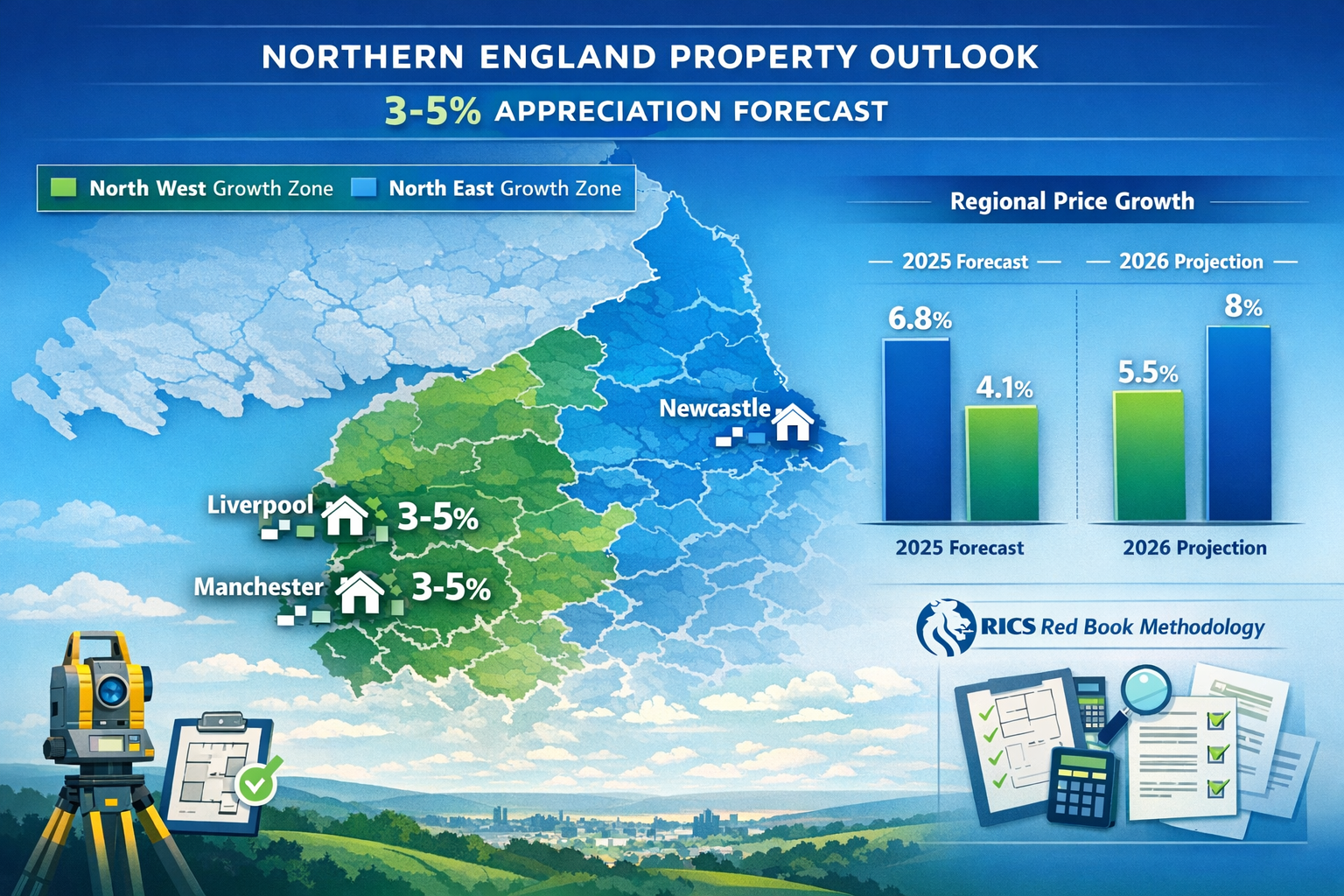
📊 Northern England leads UK growth: The North East achieved 6.8% annual growth in 2025, while the North West recorded 4.1%, both significantly outpacing the UK average and London's -1.2% decline.[2]
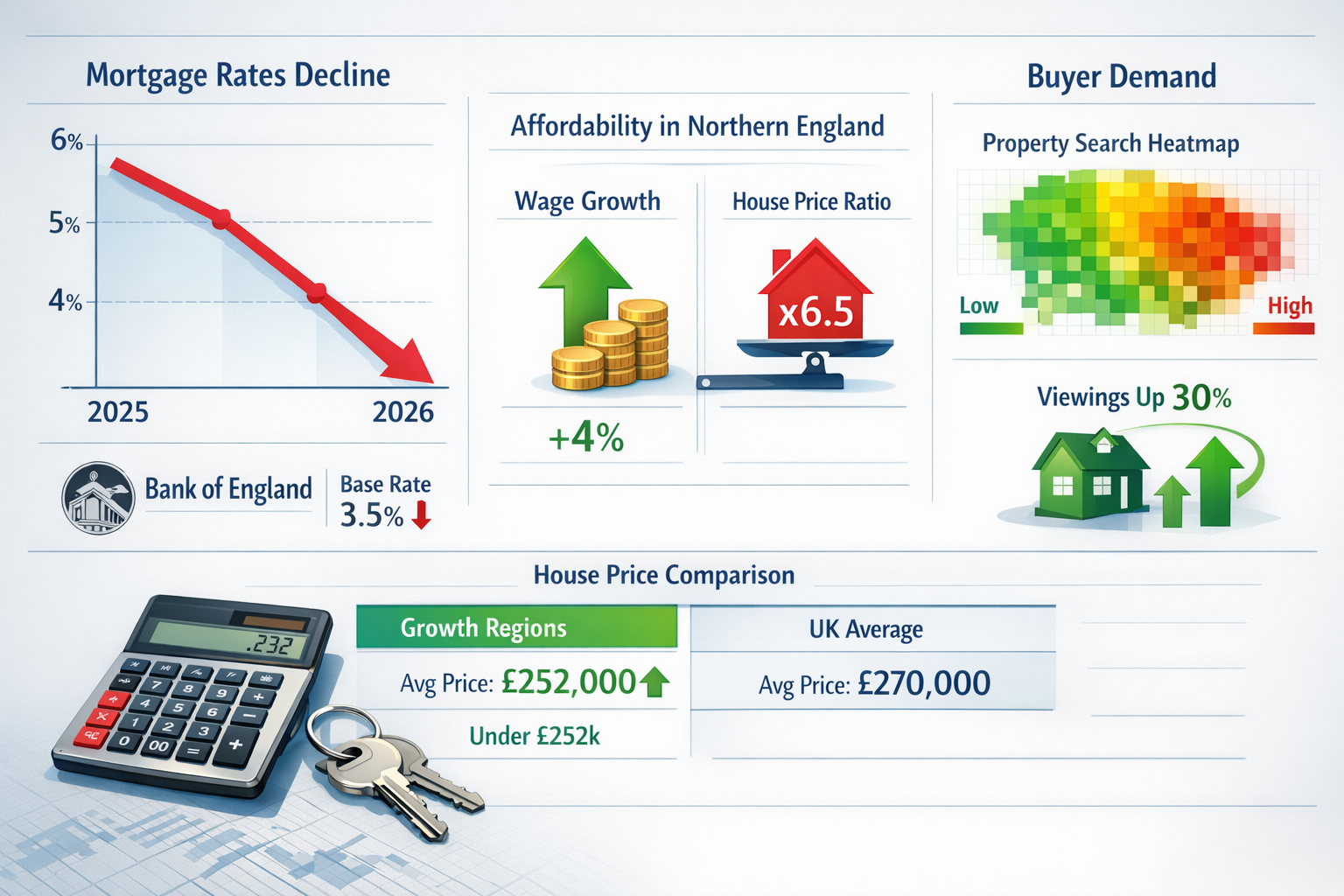
💰 Affordability drives demand: Average house prices in top Northern growth regions remain under £252,000, substantially below the UK average of £270,000, creating significant room for appreciation.[1]
🏡 RICS methodologies require adaptation: Surveyors must incorporate post-rate-cut affordability improvements, abundant housing stock dynamics, and regional buyer demand signals into their valuation frameworks.
📈 Moderate but sustained growth expected: The 3-5% forecast for 2026 represents a moderation from 2025's exceptional performance but signals sustained, healthy market appreciation.[3]
🔍 Data-driven techniques essential: Modern valuation approaches combine traditional comparable analysis with real-time market intelligence, mortgage approval trends, and regional economic indicators.
Understanding the Northern England Valuation Surge 2026 Market Context
The Regional Growth Landscape
The Northern England property market has fundamentally transformed over the past 18 months. The North East England region achieved exceptional 6.8% annual growth in 2025, while the North West demonstrated robust 4.1% appreciation during the same period.[2] These figures represent not merely statistical anomalies but a structural shift in UK residential property dynamics.
The performance contrast with southern regions tells a compelling story. While London experienced a -1.2% decline in 2025, Northern England markets surged ahead, driven by superior affordability metrics and abundant housing stock.[2] This divergence has created unique challenges and opportunities for chartered surveyors conducting property valuations in these regions.
Scotland's market provides additional context for understanding Northern growth patterns. With nine of the top 10 UK locations forecast for strongest growth located in Scotland, and Motherwell leading with 3.4% year-on-year growth in 2025, the broader northern UK trend demonstrates consistent momentum.[1] Northern Ireland's exceptional 7.1% annual growth in 2025 further reinforces the geographic pattern favoring regions outside the traditional southern England property hotspots.[2]
Economic Drivers Behind the Surge
Several interconnected economic factors underpin the Northern England Valuation Surge 2026: Surveyor Techniques for 3-5% Price Growth in Residential Markets phenomenon:
Interest Rate Environment 🏦
The Bank of England's anticipated interest rate cuts in 2026 represent a critical catalyst for Northern market appreciation. Lower borrowing costs directly improve affordability calculations, enabling buyers to qualify for larger mortgages without proportional income increases.[2] For surveyors, this translates to upward pressure on comparable sales data as buyer purchasing power expands.
Wage Growth Stability 💼
Steady wage growth across Northern England regions has improved the income-to-house-price ratio, particularly in areas where average property values remain below £252,000.[1] This affordability advantage creates sustained demand that surveyors must incorporate into forward-looking valuations.
Housing Stock Dynamics 🏘️
Abundant housing stock in Northern locations reduces the frequency of asking price cuts, creating a more stable valuation environment.[1] Unlike supply-constrained southern markets where scarcity drives volatility, Northern regions benefit from balanced inventory levels that support gradual, sustainable appreciation.
Migration Patterns 🚚
The continuation of remote and hybrid working arrangements has accelerated migration from expensive southern regions to more affordable Northern areas. This demographic shift brings purchasing power northward, supporting price growth in recipient markets.
The North-South Divide in 2026
The persistent north-south divide in England's property market has significant implications for surveyor methodologies. Southern England and London remain subdued despite greater housing supply, primarily due to price sensitivity at current elevated levels.[1][2]
In contrast, Northern regions with average prices substantially below the UK average of £269,862 to £270,000 offer greater room for appreciation.[2] This structural difference requires surveyors to apply different analytical frameworks when conducting Red Book valuations in Northern versus Southern markets.
The HomeOwners Alliance forecast of approximately 2.5% rise across Great Britain by Q4 2026 masks significant regional variation.[2] Northern England's anticipated 3-5% growth represents performance well above this national average, demanding specialized surveyor techniques to capture regional nuances accurately.
RICS Valuation Frameworks for Northern England Price Growth
Adapting Traditional Comparable Sales Analysis
The foundation of residential property valuation remains the comparable sales method, but the Northern England Valuation Surge 2026: Surveyor Techniques for 3-5% Price Growth in Residential Markets requires sophisticated adaptations to this traditional approach.
Time-Adjusted Comparables ⏰
In rapidly appreciating markets, comparables from even six months prior may significantly undervalue current market conditions. Surveyors must apply time adjustment factors that reflect the 3-5% annual growth trajectory. For example, a comparable sale from three months prior in a market experiencing 4% annual growth should receive approximately a 1% upward adjustment to reflect current value.
Geographic Micro-Market Analysis 📍
Northern England encompasses diverse micro-markets with varying growth rates. The North East's 6.8% performance in 2025 versus the North West's 4.1% demonstrates regional variation.[2] Within these broader regions, individual towns and neighborhoods exhibit further differentiation. Surveyors must establish tightly defined comparable search parameters that account for:
- Specific neighborhood characteristics
- Proximity to transport links and employment centers
- Local school quality and catchment areas
- Recent infrastructure investments
- Neighborhood demographic trends
Property Type Stratification 🏠
Different property types experience varying appreciation rates within the same market. Victorian terraces in Manchester city center may appreciate differently than suburban semi-detached properties in the same metropolitan area. Effective valuation techniques require stratified comparable analysis that matches property type, age, and condition precisely.
Incorporating Buyer Demand Signals
Modern valuation methodologies extend beyond historical sales data to incorporate real-time demand indicators that predict future price movements.
Days on Market Trends 📉
Decreasing days on market signals strengthening demand and supports higher valuations. Surveyors should track:
- Average days on market for comparable properties over rolling three-month periods
- Trend direction (increasing or decreasing)
- Comparison to historical norms for the specific micro-market
Properties selling significantly faster than historical averages indicate demand exceeding supply, justifying valuations toward the upper end of the comparable range.
Offer-to-Asking Price Ratios 💯
The percentage of asking price achieved in recent sales provides critical insight into market strength. In appreciating Northern markets, ratios approaching or exceeding 100% indicate robust demand. Surveyors should calculate:
- Average achieved price as percentage of asking price
- Trend over recent quarters
- Variation by property type and price band
Viewing Activity and Inquiry Rates 👥
While not directly observable in public records, surveyors can gather intelligence from estate agents regarding viewing activity and inquiry volumes. High viewing-to-offer conversion rates signal strong buyer motivation and support firmer valuations.
Mortgage Approval Trends 🏦
Regional mortgage approval data provides leading indicators of demand. Increasing approval volumes in Northern England regions correlate with sustained price growth. Surveyors should monitor:
- Monthly mortgage approval statistics for the region
- Average loan-to-value ratios (increasing LTVs suggest buyer confidence)
- First-time buyer versus mover-upper proportions
Affordability Modeling Post-Rate Cuts
The anticipated Bank of England interest rate cuts in 2026 fundamentally alter affordability calculations, requiring surveyors to incorporate forward-looking affordability metrics into their valuations.[2]
Mortgage Affordability Calculations 🧮
Traditional affordability analysis compares house prices to average earnings. Enhanced methodologies incorporate actual mortgage costs:
| Metric | Calculation | Application |
|---|---|---|
| Monthly Payment Ratio | (Monthly mortgage payment / Monthly gross income) × 100 | Should not exceed 35-40% for sustainable market |
| Effective Interest Rate | Current average mortgage rate for typical buyer profile | Adjust for anticipated rate cuts |
| Loan-to-Income Multiple | Mortgage amount / Annual gross income | Track against lender criteria (typically 4.5x) |
As mortgage rates decline from recent peaks, buyers can afford higher purchase prices at the same monthly payment level. A 0.5% reduction in mortgage rates can increase affordable purchase price by approximately 5-7%, directly supporting the 3-5% growth forecast for Northern England.[3]
Regional Income Analysis 💰
Northern England wage growth must be factored into affordability projections. Surveyors should analyze:
- Regional average earnings trends
- Sector-specific employment growth
- Public sector pay settlements (significant in many Northern cities)
- Remote worker migration bringing higher southern salaries
Deposit Availability 💳
First-time buyer deposit schemes and family assistance programs affect market entry points. The "Bank of Mum and Dad" remains a significant factor, particularly for properties under £250,000 where Northern England's affordability advantage is most pronounced.[1]
Red Book Compliance in Growth Markets
RICS Red Book standards require valuations to reflect market value as of the valuation date, but growth markets present unique compliance challenges when conducting Red Book valuations.
Market Value Definition 📋
The RICS definition of market value requires "the estimated amount for which an asset should exchange on the valuation date between a willing buyer and a willing seller in an arm's length transaction, after proper marketing and where the parties had each acted knowledgeably, prudently and without compulsion."
In rapidly appreciating markets, surveyors must resist both:
- Over-optimism: Projecting future growth into current valuations
- Excessive conservatism: Ignoring clear market momentum visible in recent comparables
Assumptions and Special Assumptions ⚠️
Red Book valuations must clearly state all assumptions. In Northern England growth markets, relevant assumptions might include:
- Continuation of current economic conditions
- Mortgage availability at current or improved rates
- No significant adverse changes to local employment or infrastructure
- Completion of anticipated transport or regeneration projects (as special assumption)
Uncertainty and Material Valuation Uncertainty 🔍
While Northern England markets show clear growth trends, surveyors must assess whether any factors warrant declaring material valuation uncertainty. The 2026 market benefits from:
- Established transaction volumes providing robust comparable evidence
- Clear economic drivers (rate cuts, affordability improvements)
- Sustained rather than speculative demand
These factors generally support confident valuations without material uncertainty declarations, contrasting with the uncertainty that characterized pandemic-era valuations.
Advanced Surveyor Techniques for 3-5% Growth Markets
Regression Analysis and Statistical Modeling
Professional surveyors increasingly employ statistical techniques to enhance valuation accuracy in the Northern England Valuation Surge 2026: Surveyor Techniques for 3-5% Price Growth in Residential Markets context.
Multiple Regression Analysis 📊
This technique identifies the specific contribution of various property characteristics to overall value:
- Dependent variable: Sale price
- Independent variables: Square footage, number of bedrooms, property age, condition rating, location score, garden size, parking availability
By analyzing a dataset of recent comparable sales, surveyors can determine the marginal value contribution of each characteristic. For example, analysis might reveal that each additional bedroom contributes £15,000 to value in a specific Northern England micro-market, while off-street parking adds £8,000.
This approach provides objective, data-driven valuations that reduce subjective judgment and improve consistency across different surveyors.
Time Series Analysis 📈
Tracking price indices over time reveals growth trajectories and seasonal patterns:
- Monthly price index for the specific postcode area
- Year-over-year growth rates
- Seasonal adjustment factors (Northern markets often show spring peaks)
- Trend extrapolation with confidence intervals
Time series analysis helps surveyors distinguish between sustainable growth trends and temporary fluctuations, essential for accurate valuations in 3-5% growth environments.
Hedonic Pricing Models 🏘️
These sophisticated models value properties as bundles of characteristics, each contributing to overall utility and price. Northern England applications might weight:
- Proximity to Manchester or Newcastle city centers
- Energy efficiency ratings (increasingly important)
- Period features in Victorian/Edwardian properties
- Modern kitchen and bathroom quality
- Outdoor space (premium increased post-pandemic)
Technology-Enhanced Valuation Methods
Modern surveying increasingly integrates technology solutions that enhance accuracy and efficiency when conducting different types of surveys.
Automated Valuation Models (AVMs) 🤖
While not suitable as standalone valuation tools for RICS-compliant work, AVMs provide valuable supporting data:
- Rapid comparable identification across large datasets
- Price trend analysis
- Initial valuation ranges for sense-checking
- Market heat maps showing appreciation patterns
Professional surveyors use AVMs as decision support tools rather than replacements for expert judgment, particularly valuable in Northern England's diverse property stock.
Geographic Information Systems (GIS) 🗺️
GIS technology enables sophisticated spatial analysis:
- Mapping comparable sales with distance and time filters
- Overlay of demographic data, transport links, and amenity locations
- Visualization of price gradients across neighborhoods
- Identification of emerging growth corridors
For Northern England valuations, GIS can reveal how proximity to new transport infrastructure (such as Northern Powerhouse Rail routes) affects property values, enabling more accurate forward-looking assessments.
Digital Property Inspection Tools 📱
Modern surveyors employ digital tools during site inspections:
- Laser measurement devices for accurate floor areas
- Thermal imaging for building performance assessment
- Digital photography with embedded GPS and timestamp data
- Cloud-based inspection apps for real-time data capture
These technologies improve inspection efficiency and documentation quality, particularly valuable when managing high volumes of valuation instructions in active Northern markets.
Blockchain and Property Data ⛓️
Emerging blockchain-based property registries promise to provide:
- Immutable transaction history
- Verified property characteristics
- Transparent ownership records
- Reduced data verification time
While still developing in the UK market, these technologies will increasingly support surveyor due diligence processes.
Specialist Valuation Scenarios in Northern England
Certain property types and transaction contexts require specialized approaches within the Northern England Valuation Surge 2026 framework.
New Build Valuations 🏗️
Northern England cities feature significant new residential development. New build valuations present unique challenges:
- Premium over comparable resales: New builds typically command 5-15% premiums for warranty coverage, modern specifications, and stamp duty incentives
- Help to Buy considerations: Government schemes affect achievable prices
- Estate maturity: Properties on developing estates require careful comparable selection
- Specification variations: Builder upgrades and plot positions create value differentials
Surveyors must assess whether new build premiums remain sustainable in the current market or whether resale properties offer better value, affecting buyer demand distribution.
Period Property Valuations 🏛️
Northern England's Victorian and Edwardian housing stock requires specialized knowledge:
- Period feature premiums: Original features (fireplaces, cornicing, sash windows) command premiums in gentrifying areas
- Modernization balance: Sympathetic updates versus over-modernization
- Conservation area implications: Restrictions affecting alteration potential
- Energy efficiency challenges: Period properties often have lower EPC ratings, increasingly important to buyers
Understanding which period features buyers value most in specific Northern markets enables accurate valuation adjustments.
Leasehold Valuations 📄
While less common in Northern England than London, leasehold properties require specialized techniques:
- Lease length impact: Properties with sub-80-year leases face significant value impairment
- Ground rent considerations: Onerous ground rents affect marketability
- Service charge analysis: High or unpredictable charges deter buyers
- Enfranchisement potential: Right to extend or purchase freehold affects value
Surveyors must apply appropriate deductions for leasehold factors, drawing on specialized valuation guidance for complex scenarios.
Probate and Matrimonial Valuations ⚖️
These statutory valuations require particular care in appreciating markets:
- Valuation date significance: Market value at specific date (death, separation) rather than current date
- Retrospective analysis: May require valuing property several months in the past
- Supporting evidence: Robust comparable evidence essential for potential court scrutiny
- Professional indemnity considerations: Higher risk profile requires careful methodology
For probate valuations in Northern England's rising market, surveyors must resist pressure to apply current values to historical dates, maintaining strict adherence to the specified valuation date.
Quality Assurance and Peer Review
In growth markets where valuation accuracy directly impacts lending decisions and transaction success, quality assurance processes become essential.
Internal Review Protocols ✅
Professional surveying practices should implement:
- Peer review: Second surveyor reviews valuations above certain thresholds
- Consistency checks: Comparing valuation approaches across similar properties
- Comparable verification: Confirming all comparable sales through independent sources
- Assumption documentation: Ensuring all assumptions are clearly stated and justified
Benchmarking Against Market Indices 📉
Completed valuations should be benchmarked against:
- Land Registry price paid data for the postcode area
- Regional house price indices (Halifax, Nationwide, ONS)
- Local estate agent market reports
- Mortgage lender valuation databases
Significant deviations from benchmark data should trigger additional review and justification.
Continuing Professional Development 🎓
Surveyors operating in Northern England's dynamic market must maintain current knowledge through:
- RICS-accredited CPD on valuation methodologies
- Regional market briefings and networking
- Economic and mortgage market updates
- Technology and data analytics training
Professional Indemnity Insurance 🛡️
Adequate PI cover remains essential, with particular attention to:
- Cover levels appropriate to typical valuation amounts
- Retroactive coverage for past valuations in appreciating markets
- Exclusions and policy conditions
- Run-off cover for retiring practitioners
Regional Deep Dive: North West and North East England

North West England Market Characteristics
The North West England region demonstrated robust 4.1% annual growth in 2025, with six North West locations featuring in Zoopla's top 10 growth prospects for England and Wales.[1][2] This region encompasses diverse markets requiring tailored surveyor approaches.
Greater Manchester 🏙️
Manchester's continued economic expansion drives residential demand:
- City center apartments: Strong rental yields support investor demand
- Suburban family homes: Commuter belt properties benefit from hybrid working
- Regeneration areas: Salford, Ancoats, and New Islington show exceptional growth
- Transport connectivity: Metrolink extensions enhance specific neighborhoods
Surveyors must understand micro-market variations within Greater Manchester, where values can vary dramatically across short distances based on school catchments, transport links, and neighborhood character.
Liverpool and Merseyside ⚓
Liverpool's cultural renaissance and economic diversification support property appreciation:
- Waterfront developments: Premium new builds with lifestyle appeal
- Georgian quarter: Period property restoration driving gentrification
- Affordable entry points: Terraced properties under £150,000 attract first-time buyers
- Rental market strength: Student and young professional demand
Valuation challenges include assessing sustainability of rapid appreciation in previously depressed areas and distinguishing between genuine regeneration and speculative bubbles.
Lancashire and Cheshire 🌳
These counties offer lifestyle appeal with Manchester accessibility:
- Commuter towns: Wilmslow, Altrincham, and Knutsford maintain premium positioning
- Market towns: Clitheroe, Ormskirk, and Nantwich offer village appeal
- Rural properties: Farmhouses and barn conversions serve affluent buyers
- Coastal areas: Southport and Lytham St Annes attract retirees and second-home buyers
Surveyors must apply different methodologies across this diverse geography, recognizing that rural properties require larger geographic search areas for comparables while urban properties demand tighter postcode-level analysis.
North East England Market Characteristics
The North East England region achieved exceptional 6.8% annual growth in 2025, the strongest performance of any English region.[2] This remarkable appreciation reflects fundamental market rebalancing from historically depressed levels.
Newcastle and Gateshead 🌉
The Tyneside conurbation leads regional growth:
- City center regeneration: Quayside and Baltic Quarter transformations
- Student market: Northumbria and Newcastle universities drive rental demand
- Suburban villages: Gosforth, Jesmond, and Ponteland command premiums
- Affordability advantage: Average prices significantly below UK mean
Surveyors must assess whether current growth rates represent sustainable appreciation or temporary catch-up from previous undervaluation. Historical context suggests the North East remains undervalued relative to economic fundamentals, supporting continued growth.
Durham and Darlington 🏰
These historic cities offer distinct market characteristics:
- Heritage properties: Cathedral city premium in Durham
- University influence: Student accommodation and young professional market
- Commuter accessibility: London rail links support professional migration
- New build estates: Significant development activity requires careful comparable selection
Teesside and Hartlepool 🏭
Industrial heritage areas experiencing regeneration:
- Freeport designation: Teesside Freeport driving economic investment
- Exceptional affordability: Terraced properties from £80,000 create entry opportunities
- Industrial diversification: Transition from heavy industry to advanced manufacturing
- Investor activity: Rental yields of 6-8% attract buy-to-let investors
Valuation challenges include limited comparable evidence in thinly traded markets and assessing impact of major economic interventions like Freeport designation on residential values.
Comparative Regional Analysis
Understanding relative performance across Northern regions enables surveyors to contextualize local market movements:
| Region | 2025 Growth | 2026 Forecast | Avg. Price | Key Drivers |
|---|---|---|---|---|
| North East | +6.8% | 3-5% | £180,000 | Catch-up growth, affordability |
| North West | +4.1% | 3-5% | £220,000 | Economic expansion, infrastructure |
| Scotland | +4.5% | 3-5% | £190,000 | Sustained demand, migration |
| N. Ireland | +7.1% | 3-5% | £175,000 | Exceptional affordability |
| UK Average | +1.8% | ~2% | £270,000 | Mixed regional performance |
This comparative context helps surveyors assess whether individual property valuations align with broader regional trends or represent micro-market anomalies requiring explanation.
Practical Implementation: Case Studies and Examples
Case Study 1: Victorian Terrace in Manchester
Property Details:
- Location: Didsbury, South Manchester
- Type: Mid-terrace Victorian house
- Bedrooms: 3
- Condition: Modernized with period features retained
- Garden: 40-foot rear garden
- Parking: On-street only
Valuation Approach:
The surveyor identified five comparable sales within 0.5 miles completed in the previous three months:
- Similar terrace, same street: £385,000 (2 months prior)
- Slightly larger terrace, adjacent postcode: £410,000 (1 month prior)
- Smaller terrace, same conservation area: £355,000 (3 months prior)
- End-terrace, premium position: £425,000 (2 months prior)
- Mid-terrace, less desirable road: £365,000 (3 months prior)
Adjustments Applied:
- Time adjustment: +1% for comparables 3 months old (reflecting 4% annual growth rate)
- Size adjustment: +£15,000 per additional bedroom based on regression analysis
- Position adjustment: -£20,000 for end-terrace premium (comparable 4)
- Location adjustment: +£10,000 for superior road position versus comparable 5
Final Valuation: £390,000
Rationale: The subject property sits mid-range within the adjusted comparable set, reflecting its good condition and desirable location while acknowledging on-street parking limitation. The valuation incorporates market growth momentum while remaining grounded in verifiable transaction evidence.
Case Study 2: New Build Apartment in Newcastle
Property Details:
- Location: Quayside, Newcastle city center
- Type: 2-bedroom apartment, 4th floor
- Development: New build, completed 6 months ago
- Amenities: Concierge, gym, river views
- Parking: One allocated space
- Lease: 999 years, £250 annual service charge
Valuation Approach:
Limited resale comparables available for this new development. Surveyor employed multiple methodologies:
Method 1: New Build Comparables
- Three similar apartments in same development sold 3-6 months ago: £245,000-£265,000
- Time adjustment: +2% for 3-month average age
- Adjusted range: £250,000-£270,000
Method 2: Resale Comparables with New Build Premium
- Five resale apartments in adjacent older developments: £210,000-£230,000
- Applied 12% new build premium based on market evidence
- Adjusted range: £235,000-£258,000
Method 3: Developer Pricing
- Current asking prices for remaining units in development: £275,000-£285,000
- Applied 5% discount for achievable versus asking price
- Adjusted range: £261,000-£271,000
Final Valuation: £260,000
Rationale: The surveyor weighted Method 1 most heavily (50%) as most directly comparable, Method 2 at 30% for market context, and Method 3 at 20% for current pricing signals. The triangulated valuation reflects strong demand for quality new build apartments in Newcastle's regenerated Quayside area while remaining conservative relative to developer asking prices.
Case Study 3: Family Home in Suburban North East
Property Details:
- Location: Gosforth, Newcastle upon Tyne
- Type: Detached 1930s house
- Bedrooms: 4
- Condition: Well-maintained, modernized
- Garden: Large rear garden, south-facing
- Parking: Double garage and driveway
- Catchment: Outstanding-rated primary school
Valuation Approach:
Comparable Analysis:
Six comparable sales identified within 1 mile, completed in previous 4 months:
Average unadjusted comparable price: £475,000
Range: £445,000-£505,000
Key Adjustments:
- School catchment premium: +£25,000 (three comparables outside catchment)
- Garden size: +£15,000 (subject property has larger than average garden)
- Garage: +£20,000 (two comparables had no garage)
- Time adjustment: +1.5% average (reflecting 6.8% annual growth in North East)
Demand Signal Analysis:
- Average days on market for similar properties: 28 days (down from 45 days six months prior)
- Achieved price as % of asking: 98.5% (up from 95% six months prior)
- Mortgage approval volumes in NE23 postcode: +15% year-over-year
These demand signals supported valuation toward upper end of adjusted comparable range.
Final Valuation: £520,000
Rationale: The combination of desirable school catchment, superior property features, and strong demand indicators justified a valuation above the average comparable price. The surveyor provided detailed justification for the school catchment premium, supported by analysis of price differentials between catchment and non-catchment properties in the local market.
Risk Management and Professional Considerations
Identifying Valuation Risks in Growth Markets
The Northern England Valuation Surge 2026: Surveyor Techniques for 3-5% Price Growth in Residential Markets presents specific risks that professional surveyors must identify and mitigate.
Over-Optimism Bias 📈
In rising markets, there's natural tendency to project recent growth indefinitely into the future. Surveyors must:
- Base valuations on current market evidence, not growth projections
- Distinguish between sustainable appreciation and temporary spikes
- Consider economic scenarios that might reverse growth trends
- Maintain professional skepticism about exceptional claims
Comparable Quality Issues 🔍
Rapid market appreciation can create situations where:
- Recent comparables are scarce in thinly traded areas
- Older comparables significantly understate current values
- Unusual transactions distort the comparable pool
- New build sales create misleading benchmarks for resale properties
Surveyors should expand geographic search areas if necessary while clearly documenting any compromises in comparable quality.
Lender Pressure 🏦
Mortgage lenders may pressure surveyors to support specific valuations that enable transactions to proceed. Professional surveyors must:
- Maintain independence and objectivity
- Document valuation methodology comprehensively
- Resist pressure to inflate valuations
- Report concerns about transaction viability honestly
Economic Uncertainty ⚠️
Despite positive 2026 forecasts, potential risks include:
- Interest rate volatility affecting affordability
- Economic recession reducing buyer demand
- Employment shocks in specific Northern cities
- Government policy changes affecting housing market
Surveyors should monitor economic indicators and adjust methodologies if material changes occur.
Documentation and Reporting Standards
Comprehensive documentation protects surveyors professionally while providing clients with valuable insights.
Essential Report Components 📋
Professional valuation reports for Northern England properties should include:
- Executive Summary: Valuation figure and key factors
- Property Description: Comprehensive details of subject property
- Market Context: Regional and local market analysis
- Methodology: Clear explanation of valuation approach
- Comparable Evidence: Detailed comparable analysis with adjustments
- Assumptions and Limitations: All assumptions clearly stated
- Supporting Data: Market statistics, indices, and demand indicators
- Photographs: Exterior and key interior features
- Location Maps: Site location and comparable locations
- Surveyor Credentials: Qualifications and experience
Assumption Clarity ✍️
All assumptions must be explicitly stated, including:
- Property condition assumptions (if not fully inspected)
- Market condition assumptions (continuation of current trends)
- Legal assumptions (clear title, no unusual restrictions)
- Environmental assumptions (no contamination or hazards)
- Economic assumptions (mortgage availability, employment stability)
Limitation Statements ⚠️
Reports should clearly state limitations such as:
- Areas not inspected
- Information not verified
- Reliance on third-party data
- Scope exclusions
- Validity period of valuation
Continuing Professional Development for Northern Markets
Surveyors operating in Northern England's dynamic market should pursue targeted CPD:
Regional Market Knowledge 🎓
- Attend regional property conferences and seminars
- Network with local estate agents and developers
- Monitor local authority planning and regeneration initiatives
- Study regional economic reports and forecasts
- Understand local buyer demographics and preferences
Technical Skills Development 💻
- Statistical analysis and regression modeling courses
- GIS and mapping technology training
- AVM and PropTech familiarization
- Advanced comparable analysis techniques
- Economic and mortgage market analysis
RICS Requirements 📚
Maintain compliance with RICS CPD requirements:
- Minimum 20 hours annual CPD
- At least 10 hours formal CPD
- Documentation of learning outcomes
- Reflection on professional development
- Ethics and professional standards updates
Future Outlook: Beyond 2026
Sustainability of Northern England Growth
The question facing surveyors and market participants is whether the Northern England Valuation Surge 2026: Surveyor Techniques for 3-5% Price Growth in Residential Markets represents a temporary phenomenon or a structural shift in UK property dynamics.
Supporting Factors for Sustained Growth ✅
Several factors suggest Northern England's outperformance may continue beyond 2026:
- Persistent affordability advantage: Even with 3-5% annual growth, Northern regions will remain substantially more affordable than southern England for years
- Levelling Up initiatives: Government investment in Northern infrastructure and economic development
- Remote working normalization: Reduced requirement for London proximity enables continued migration northward
- Quality of life factors: Northern cities offer cultural amenities, green space, and community at lower cost
- University presence: Major universities in Manchester, Liverpool, Newcastle, and Leeds create economic anchors
Potential Headwinds ⚠️
Factors that could moderate or reverse growth include:
- Interest rate increases: If inflation resurges, higher borrowing costs could dampen demand
- Economic recession: National or regional economic downturn reducing buyer confidence
- Oversupply: Excessive new build development exceeding demand
- Southern market recovery: If London and southern regions become more affordable, reducing Northern migration
- Infrastructure delays: Failure to deliver promised transport and regeneration projects
Most Likely Scenario 🎯
The consensus forecast of 3-5% growth in 2026 represents moderation from 2025's exceptional performance but continuation of positive trends.[3] This suggests a sustainable growth trajectory rather than boom-bust cycle, favorable for long-term market stability.
Emerging Trends Affecting Valuations
Several emerging trends will influence surveyor techniques in coming years:
Energy Efficiency Requirements 🌱
Increasing focus on environmental performance will affect valuations:
- EPC ratings becoming more significant to buyers
- Potential future regulations restricting sale/rental of low-EPC properties
- Retrofit costs for period properties affecting net value
- Premium for highly efficient new builds and renovated properties
Surveyors must incorporate energy performance into valuation adjustments, potentially applying discounts for properties with EPC ratings below C.
PropTech Integration 💻
Technology will increasingly enhance valuation processes:
- AI-powered comparable analysis
- Blockchain property registries
- Virtual property tours and remote inspections
- Real-time market data integration
- Automated report generation
Surveyors who embrace these technologies while maintaining professional judgment will deliver superior service.
Demographic Shifts 👥
Changing demographics will affect property preferences and values:
- Aging population increasing demand for accessible, single-level properties
- Smaller household sizes favoring apartments and smaller houses
- Multi-generational living creating demand for larger, adaptable homes
- Environmental consciousness influencing location and property choices
Understanding demographic trends enables surveyors to assess long-term value sustainability.
Build-to-Rent Sector Growth 🏢
Institutional investment in build-to-rent developments affects residential markets:
- Professional landlords offering higher-quality rental accommodation
- Potential impact on traditional buy-to-let investor demand
- Different valuation methodologies for BTR versus traditional residential
- Rental market dynamics affecting overall residential values
Surveyors may need to develop expertise in commercial property valuation techniques for BTR assets.
Conclusion: Mastering Northern England Valuations in 2026
The Northern England Valuation Surge 2026: Surveyor Techniques for 3-5% Price Growth in Residential Markets represents both opportunity and challenge for property professionals. The 3-5% growth forecast reflects genuine economic fundamentals—improved affordability following interest rate cuts, sustained wage growth, and abundant housing stock supporting stable appreciation.[3]
Successful surveyors in this environment must combine traditional valuation expertise with modern analytical techniques. Comparable sales analysis remains foundational, but must be enhanced with time adjustments reflecting market momentum, sophisticated regression modeling identifying value drivers, and real-time demand signals predicting future trends.
The regional context matters enormously. The North East's exceptional 6.8% growth in 2025 and the North West's robust 4.1% performance demonstrate that Northern England encompasses diverse micro-markets requiring localized expertise.[2] Surveyors must develop deep knowledge of specific cities, towns, and neighborhoods rather than applying generic regional assumptions.
Technology enhances but doesn't replace professional judgment. AVMs, GIS mapping, and statistical modeling provide valuable decision support, but the surveyor's experience, local knowledge, and professional skepticism remain irreplaceable. The most effective approach combines data-driven analysis with boots-on-the-ground market intelligence.
Quality assurance processes protect both surveyors and clients. Peer review, assumption documentation, and comprehensive reporting create defensible valuations that withstand scrutiny. In growth markets where valuations directly enable significant financial decisions, this professional rigor becomes even more critical.
Actionable Next Steps for Property Professionals
For Chartered Surveyors:
- 🎯 Develop regional expertise: Focus on specific Northern England markets, building deep knowledge of local comparables, buyer preferences, and economic drivers
- 📊 Enhance analytical capabilities: Invest in training on statistical analysis, regression modeling, and data visualization techniques
- 🤝 Build local networks: Establish relationships with estate agents, developers, and mortgage brokers in your target markets
- 💻 Embrace technology: Evaluate and adopt PropTech tools that enhance efficiency while maintaining professional standards
- 📚 Pursue targeted CPD: Focus professional development on Northern market dynamics, growth market valuation techniques, and emerging trends
For Property Buyers and Investors:
- 🔍 Commission professional valuations: Engage RICS-qualified surveyors for independent property valuations before making purchase decisions
- 📈 Understand regional variations: Recognize that Northern England encompasses diverse markets with different growth prospects
- ⏰ Consider timing carefully: While growth is forecast, individual circumstances and property-specific factors matter more than market timing
- 🏠 Focus on fundamentals: Prioritize location, property condition, and personal requirements over speculative growth expectations
- 💰 Assess affordability comprehensively: Consider total ownership costs including mortgage payments, maintenance, and potential rate increases
For Mortgage Lenders:
- ✅ Require robust valuations: Ensure valuation instructions specify comprehensive reporting and methodology transparency
- 🎓 Use qualified professionals: Engage RICS-qualified surveyors with demonstrable Northern England experience
- 📊 Monitor regional trends: Track market indicators to identify emerging risks or opportunities in specific Northern markets
- 🔍 Review valuation quality: Implement quality assurance processes to assess surveyor performance and methodology consistency
- ⚖️ Balance risk and opportunity: Recognize growth potential while maintaining prudent lending standards
The Northern England property market in 2026 offers genuine opportunities grounded in economic fundamentals rather than speculative excess. The 3-5% growth forecast represents sustainable appreciation that benefits homeowners, supports economic activity, and creates stable conditions for property transactions.[3]
For surveyors, mastering the techniques outlined in this guide—from sophisticated comparable analysis to demand signal interpretation to technology integration—positions you to deliver exceptional value to clients navigating this dynamic market. The professional who combines technical expertise with local knowledge and ethical practice will thrive in Northern England's evolving property landscape.
The valuation surge is real, the techniques are proven, and the opportunity is significant. The question is not whether Northern England will continue outperforming national averages, but whether property professionals will adapt their methodologies to capture this regional transformation accurately and ethically.
References
[1] Revealed The 10 Uk Locations Which Could See The Biggest House Price Growth In 2026 – https://moneyweek.com/investments/house-prices/revealed-the-10-uk-locations-which-could-see-the-biggest-house-price-growth-in-2026
[2] House Price Forecast – https://hoa.org.uk/advice/guides-for-homeowners/i-am-buying/house-price-forecast/
[3] Valuation Strategies For Northern Uk Price Surge Surveyor Tactics In Scotland Northern Ireland And North England 2026 – https://nottinghillsurveyors.com/blog/valuation-strategies-for-northern-uk-price-surge-surveyor-tactics-in-scotland-northern-ireland-and-north-england-2026
[4] Market Confidence Edges Higher In Early 2026 – https://www.winkworth.co.uk/articles/market-confidence-edges-higher-in-early-2026