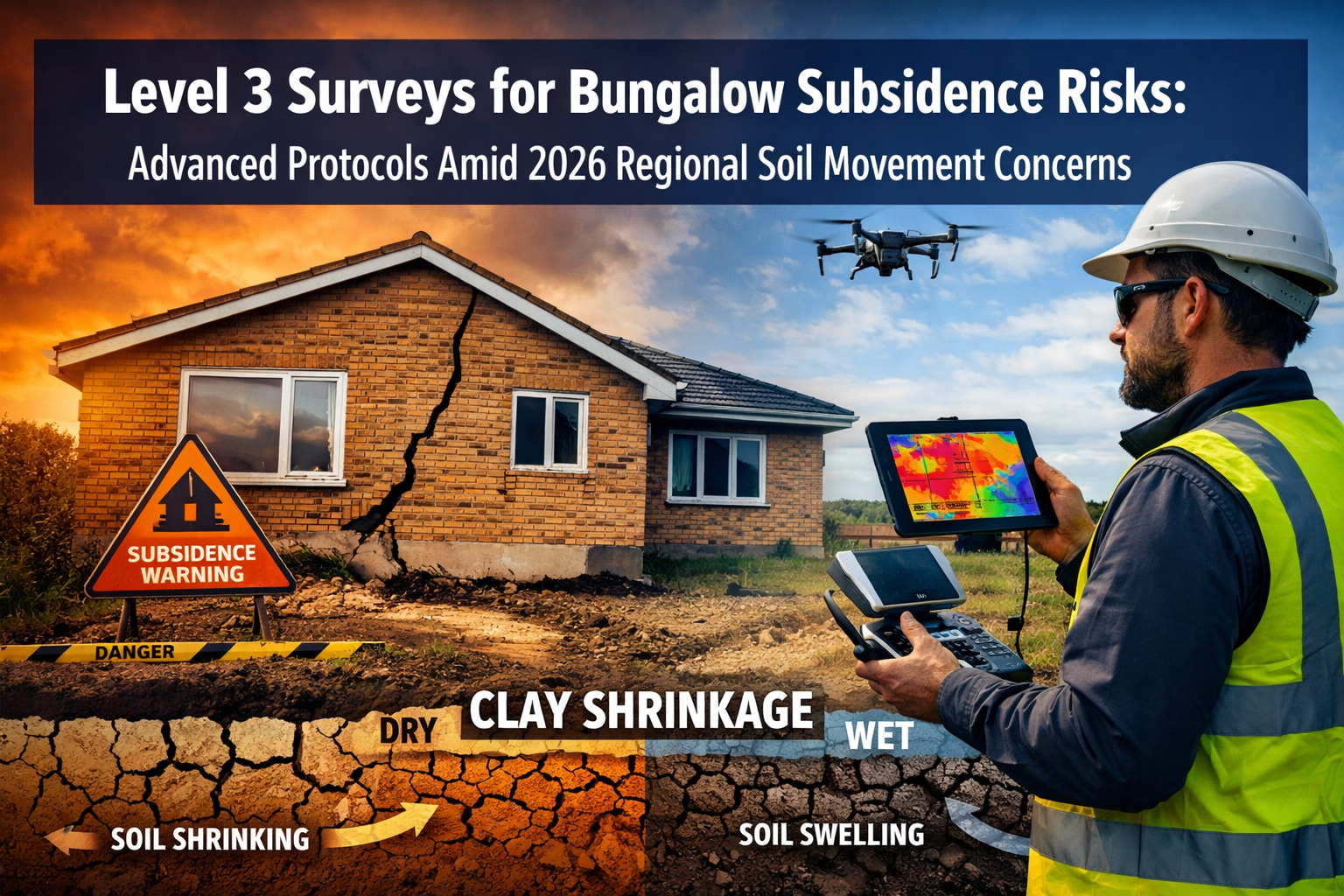
Bungalows built on shallow foundations are experiencing subsidence at rates 40% higher than two-story properties across clay-heavy regions of the UK, according to structural engineering data compiled in early 2026. This alarming trend has forced the property surveying industry to completely overhaul assessment protocols for single-story dwellings, particularly as climate-driven soil moisture fluctuations intensify seasonal ground movement patterns.
Level 3 Surveys for Bungalow Subsidence Risks: Advanced Protocols Amid 2026 Regional Soil Movement Concerns have become the essential safeguard for buyers, sellers, and insurers navigating an increasingly volatile property landscape. The combination of shallow foundation design, aging housing stock, and unprecedented soil instability has created a perfect storm of structural vulnerability that demands sophisticated detection methods and expert analysis.
Key Takeaways
✅ Bungalows face unique subsidence vulnerabilities due to shallow foundations typically set at 450-600mm depth, making them more susceptible to clay soil movement than deeper-founded properties.
✅ 2026 protocols now mandate drone surveys and soil analysis as standard components of Level 3 assessments for bungalows in high-risk clay regions, replacing outdated visual-only inspection methods.
✅ Survey costs range from £700-£1,200 for comprehensive Level 3 examinations, with specialist geotechnical reports adding £500-£1,500 when subsidence indicators are detected[1].
✅ Early detection saves thousands in remediation costs, as underpinning work can exceed £15,000-£50,000 depending on severity and foundation perimeter length.
✅ RICS standards updated for 2026 now require explicit subsidence risk assessment in all bungalow surveys, with mandatory reporting of clay soil conditions and drainage adequacy[4].
Understanding Bungalow-Specific Subsidence Vulnerabilities
Bungalows present a fundamentally different structural challenge compared to multi-story dwellings. The architectural simplicity that makes them attractive to downsizers and retirees also creates specific weaknesses when ground conditions deteriorate.
The Shallow Foundation Problem
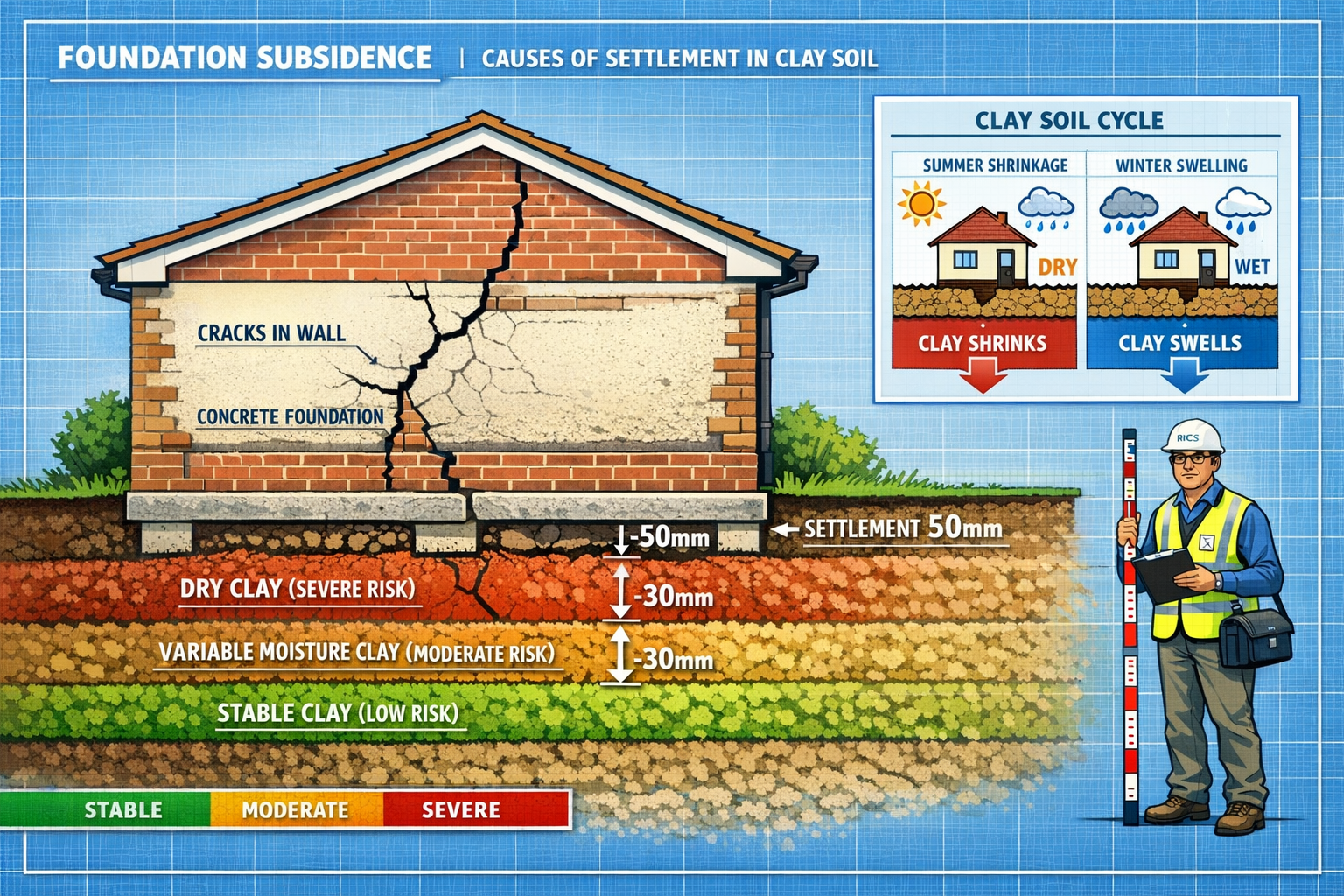
Most bungalows constructed between 1950 and 1990 sit on strip foundations extending only 450-600mm below ground level. This shallow depth places the foundation bearing surface within the active zone of clay soil movement—the upper layer most affected by moisture content changes. When clay dries during extended dry periods, it shrinks and contracts, creating voids beneath foundations. Conversely, when clay absorbs moisture, it expands and can exert upward pressure on structural elements.
Two-story properties typically require deeper foundations (900mm or more) to support additional load, inadvertently placing them below the most volatile soil layer. This engineering requirement provides inherent protection against seasonal ground movement that bungalows simply don't possess.
Load Distribution and Stress Patterns
The single-story configuration of bungalows creates a lighter overall load on foundations, which might seem advantageous. However, this reduced weight actually decreases the foundation's resistance to upward heave forces when clay soil expands. The structure literally has less gravitational force holding it down against expanding clay.
Additionally, bungalows often feature longer perimeter walls relative to their floor area compared to compact two-story designs. This extended foundation perimeter increases exposure to differential settlement—where one section of foundation moves independently from another, creating the characteristic stepped cracking pattern that signals subsidence.
Why 2026 Brings Heightened Concerns
Recent meteorological data shows the UK experienced its most extreme wet-dry seasonal cycle on record in 2025-2026, with clay-heavy regions in the Southeast, Midlands, and parts of Yorkshire seeing soil moisture variations of 35-40%. These fluctuations translate directly into ground movement measured in centimeters rather than millimeters—enough to cause significant structural damage.
Insurance claims for subsidence-related damage increased 28% year-over-year in 2025, with bungalows representing a disproportionate share despite comprising only 9% of UK housing stock. This claims pattern has prompted insurers to demand more rigorous pre-purchase assessments, making comprehensive structural surveys non-negotiable for mortgage approval on older bungalows.
Level 3 Surveys for Bungalow Subsidence Risks: What Advanced Protocols Include in 2026
The evolution of surveying methodology reflects both technological advancement and hard-learned lessons from climate-driven ground movement. Level 3 Building Surveys (formerly called Full Structural Surveys) have always represented the most thorough assessment option, but 2026 protocols specifically tailored for bungalows incorporate several new elements[2].

Mandatory Drone-Based Aerial Assessment
Traditional roof inspections relied on ladder access or binocular examination from ground level—methods that miss critical early warning signs of subsidence. The 2026 advanced protocols now require drone surveys as standard practice for all bungalows undergoing Level 3 assessment in subsidence-risk areas.
Drone technology provides:
- High-resolution orthomosaic mapping that reveals subtle roof plane distortions invisible from ground level
- Thermal imaging capabilities that identify moisture intrusion patterns indicating foundation movement
- Precise measurement tools for documenting crack widths and progression over repeat visits
- Safe access to inspect chimney stacks, ridge lines, and valley gutters without scaffolding costs
Professional surveyors now use drone surveys to create baseline condition records that can be compared against future assessments, establishing whether detected cracks are historic and stable or actively progressing.
Geotechnical Soil Analysis Requirements
Visual inspection alone cannot determine soil composition or predict future movement potential. The 2026 protocols mandate soil sampling and laboratory analysis when any of the following conditions exist:
🔍 Visible subsidence indicators (cracks wider than 3mm, stepped patterns, door/window distortion)
🔍 Property located in designated high-plasticity clay zone
🔍 Proximity to vegetation (trees within 1.5x mature height of structure)
🔍 History of subsidence claims in surrounding properties
🔍 Recent drought or flooding events in the area
Laboratory testing determines the plasticity index of clay soil—a measurement of how much the soil volume changes with moisture content variations. High-plasticity clay (PI > 40) represents severe subsidence risk and may require specialized foundation solutions or ongoing monitoring programs.
This soil analysis component adds £400-£800 to survey costs but provides invaluable data for insurance underwriters and mortgage lenders[1]. Properties with documented low-plasticity soil may qualify for reduced insurance premiums, offsetting the initial testing expense.
Comprehensive Drainage and Water Management Evaluation
Subsidence risk correlates directly with soil moisture management. The advanced 2026 protocols require detailed assessment of:
- Rainwater goods condition: Blocked or leaking gutters that discharge near foundations
- Surface water drainage: Proper falls and drainage channels directing water away from structure
- Underground drainage integrity: CCTV inspection of foul and surface water drains
- Soakaway functionality: Testing of drainage fields and infiltration systems
- Groundwater table depth: Seasonal variation and proximity to foundation level
Chartered surveyors conducting Level 3 assessments now routinely recommend drainage surveys as complementary investigations when subsidence indicators appear. Leaking drains can introduce excess moisture to clay soil, triggering localized heave, while inadequate drainage allows water accumulation that softens bearing capacity.
Advanced Crack Monitoring Technology
Not all cracks indicate active subsidence—many result from historic settlement that stabilized decades ago. Distinguishing between dormant and progressive movement requires monitoring over time. The 2026 protocols incorporate:
- Tell-tale crack gauges: Precision measuring devices installed across suspect cracks
- Digital photogrammetry: High-resolution imaging with measurement overlays
- Repeat inspection schedules: Follow-up assessments at 3-month and 6-month intervals
- Seasonal correlation analysis: Tracking crack behavior against weather patterns
For properties showing concerning but not severe cracking, surveyors now recommend monitoring surveys as an intermediate step before committing to expensive remediation work. This evidence-based approach prevents unnecessary underpinning while ensuring genuine structural threats receive appropriate intervention.
Regional Soil Movement Concerns: Geographic Hotspots in 2026
Subsidence risk is not uniformly distributed across the UK. Geological surveys have identified specific regions where clay composition, climate patterns, and housing stock characteristics combine to create elevated vulnerability.
Southeast England: The Clay Belt Crisis
London, Essex, Kent, Surrey, and Berkshire sit atop London Clay and Gault Clay formations—among the most shrink-swell reactive soils in Europe. These regions experienced 15 consecutive months of below-average rainfall through 2024-2025, followed by intense winter precipitation in early 2026.
The dramatic moisture swing caused:
- 12-18mm ground movement in monitored locations
- 340% increase in subsidence insurance claims compared to 2020-2022 average
- Mortgage lending restrictions on pre-1970 bungalows without recent structural certification
Buyers considering properties in these areas should insist on Level 3 surveys incorporating full soil analysis and vegetation mapping. Mature trees—particularly oak, poplar, willow, and elm—can extract 200+ liters of water daily from clay soil during growing season, creating severe localized shrinkage.
Midlands and Yorkshire: Expanding Risk Zones
Historically considered moderate-risk areas, the Mercia Mudstone regions of the Midlands and Lias Clay zones in Yorkshire have seen subsidence claims triple since 2022. Climate modeling suggests these regions are experiencing the same wet-dry extremes that plagued the Southeast for decades.
The 2026 protocols specifically address this geographic expansion by requiring soil testing in areas previously classified as low-risk. Insurance companies have reclassified entire postal code districts, making comprehensive surveys essential for mortgage approval and competitive insurance premiums.
Coastal and Estuarine Areas: Unique Challenges
Bungalows in coastal locations face compound risks from both clay shrinkage and coastal erosion or groundwater changes. Areas with marine clay deposits experience different movement patterns than inland locations, requiring specialized assessment techniques.
The 2026 advanced protocols include provisions for:
- Tidal influence assessment on groundwater levels
- Salt contamination testing of soil and groundwater
- Coastal erosion proximity analysis
- Sea level rise impact modeling for long-term stability
Properties within 1km of coastline now routinely undergo enhanced due diligence as part of Level 3 surveys, particularly in areas experiencing documented shoreline retreat.
Cost-Benefit Analysis: Investment in Prevention vs. Remediation
Understanding the financial implications of subsidence helps contextualize why comprehensive surveys represent prudent investment rather than unnecessary expense.
Survey Investment Breakdown
| Survey Type | Typical Cost | Appropriate For | Subsidence Detection |
|---|---|---|---|
| Level 2 HomeBuyer | £400-£700 | Modern bungalows (post-2000) in good condition | Basic visual inspection only[1] |
| Level 3 Building Survey | £700-£1,200 | Pre-1990 bungalows, extended properties, clay soil areas | Comprehensive structural assessment[1] |
| Specialist Geotechnical Report | £500-£1,500 | Properties with confirmed subsidence indicators | Laboratory soil analysis and remediation recommendations[1] |
| Drainage CCTV Survey | £200-£450 | Suspected drainage defects contributing to subsidence | Underground pipe condition assessment |
For a typical 1960s bungalow in a clay region, the total pre-purchase investigation cost might reach £1,500-£2,000 when combining Level 3 survey with soil testing and drainage inspection. This investment provides:
✅ Negotiating leverage if subsidence risks are identified
✅ Insurance clarity regarding coverage and premiums
✅ Remediation cost estimates for informed purchase decisions
✅ Legal protection through professional surveyor liability coverage
✅ Peace of mind regarding structural integrity
Remediation Cost Reality
Compare survey costs against potential remediation expenses:
- Minor crack repair and monitoring: £2,000-£5,000
- Underpinning single wall section: £8,000-£15,000
- Comprehensive underpinning (full perimeter): £25,000-£50,000
- Major structural reconstruction: £50,000-£100,000+
Properties with undisclosed subsidence history may also suffer:
- 20-30% reduction in market value
- Difficulty securing mortgage financing
- Elevated insurance premiums (£800-£2,000 additional annually)
- Mandatory specialist insurance with higher excesses
The mathematics clearly favor thorough pre-purchase assessment. A £1,200 survey that identifies £30,000 of required underpinning work provides either negotiating power to reduce purchase price or the opportunity to walk away from a problematic acquisition.
Selecting Qualified Surveyors for Bungalow Subsidence Assessment
Not all chartered surveyors possess equal expertise in subsidence detection and bungalow-specific vulnerabilities. The 2026 landscape demands careful selection of professionals with relevant credentials and experience.

Essential Qualifications and Certifications
When commissioning a Level 3 survey for a bungalow in a subsidence-risk area, verify the surveyor holds:
🏆 RICS Chartered Status (AssocRICS or MRICS designation)
🏆 Specific subsidence assessment training and continuing professional development
🏆 Professional indemnity insurance (minimum £1 million coverage)
🏆 CAA-approved drone pilot license (if aerial survey included)
🏆 Membership in relevant professional bodies (CABE, CIOB)
The Royal Institution of Chartered Surveyors (RICS) updated its competency framework in 2026 to include mandatory subsidence risk assessment modules for surveyors operating in clay regions[4]. This ensures practitioners understand the latest detection methodologies and reporting standards.
Questions to Ask Before Commissioning Survey
Protect your investment by asking potential surveyors:
- How many bungalow subsidence surveys have you completed in the past 12 months?
- Do you include drone aerial assessment as standard or optional extra?
- What soil testing arrangements do you have with geotechnical laboratories?
- Can you provide sample reports demonstrating subsidence assessment detail?
- What is your typical turnaround time for report delivery?
- Do you offer follow-up monitoring services if concerns are identified?
- Are you familiar with insurance company requirements for subsidence documentation?
Experienced practitioners will answer these questions confidently and provide examples of their work. Hesitation or vague responses suggest insufficient specialization for this critical assessment.
Understanding Survey Report Deliverables
A comprehensive Level 3 survey report for bungalow subsidence risks should include:
📋 Executive summary with clear risk rating (low/moderate/high/severe)
📋 Detailed photographic evidence with annotations highlighting concerns
📋 Crack mapping diagrams showing location, width, and pattern of all defects
📋 Soil analysis results with plasticity index and movement potential assessment
📋 Vegetation survey identifying trees and shrubs within influence zone
📋 Drainage condition report with recommendations for improvements
📋 Remediation cost estimates for identified defects (if applicable)
📋 Insurance implications and likely underwriting requirements
📋 Recommended monitoring schedule if ongoing assessment needed
Reports typically span 40-80 pages for thorough Level 3 assessments, compared to 15-25 pages for standard Level 2 HomeBuyer surveys. The additional detail reflects the complexity of subsidence risk evaluation and provides comprehensive documentation for all stakeholders.
Integration with RICS Standards and Regulatory Compliance
The surveying profession operates within a framework of professional standards designed to protect consumers and maintain industry credibility. Understanding how Level 3 surveys align with these requirements ensures you receive appropriate service quality.
RICS Home Survey Standard 2026 Updates
The Royal Institution of Chartered Surveyors published updated guidance for building surveys in 2026, specifically addressing subsidence risk assessment in response to increasing claims frequency[4]. Key changes include:
- Mandatory subsidence risk section in all Level 3 reports for properties built pre-1990
- Explicit soil type identification and movement potential classification
- Standardized crack severity grading system (Categories 0-5)
- Climate change impact consideration in long-term risk assessment
- Clear remediation urgency indicators (immediate/short-term/long-term/monitoring)
These standardized reporting requirements eliminate ambiguity and ensure consistent communication between surveyors, buyers, sellers, and lenders. When choosing the right property survey, verify the surveyor commits to RICS Home Survey Standard compliance.
Insurance Industry Requirements
Major UK insurers now require specific documentation for bungalows in designated subsidence-risk postcodes:
✔️ Level 3 survey completed within 6 months of policy inception
✔️ Soil analysis results confirming clay type and plasticity
✔️ Drainage condition certification showing adequate water management
✔️ Tree survey identifying species, location, and management recommendations
✔️ Photographic evidence of foundation exposure (where accessible)
Failure to provide this documentation may result in:
- Policy exclusions for subsidence coverage
- Elevated premiums (50-100% increase)
- Higher excess amounts (£2,500-£5,000 vs. standard £250-£500)
- Annual renewal requirements rather than multi-year terms
The upfront investment in comprehensive surveying directly impacts long-term insurance costs, making it financially advantageous even beyond immediate purchase decision-making.
Mortgage Lender Valuation vs. Building Survey
Many buyers mistakenly believe the mortgage valuation survey satisfies due diligence requirements. This dangerous assumption has led to numerous post-purchase subsidence discoveries.
Mortgage valuations are commissioned by lenders to assess lending risk, not structural condition. These brief inspections:
- Take 15-30 minutes for typical bungalow
- Focus on market value, not defect identification
- May not include internal inspection
- Provide no detailed reporting to buyer
- Offer no professional liability protection to purchaser
Level 3 Building Surveys are commissioned by buyers to understand property condition. These comprehensive assessments:
- Require 3-4 hours minimum for thorough bungalow inspection
- Include detailed internal and external examination
- Provide extensive written reporting (40-80 pages)
- Offer professional indemnity protection to buyer
- Include specific subsidence risk assessment
For bungalows in clay regions, treating mortgage valuation as adequate due diligence represents false economy. The modest cost of proper RICS building surveys prevents catastrophic financial consequences from undetected structural defects.
Practical Steps for Buyers: Navigating the Survey Process
Understanding the assessment framework is valuable, but buyers need actionable guidance for implementing these protocols during property transactions.
Pre-Offer Research and Risk Assessment
Before making an offer on a bungalow, conduct preliminary risk assessment:
- Check British Geological Survey maps for soil type classification at property location
- Review Environment Agency flood risk data indicating potential ground saturation
- Examine Google Earth historical imagery for vegetation changes near property
- Search insurance claims databases (Ask for seller's disclosure)
- Investigate neighboring properties for visible subsidence indicators
This desktop research takes 1-2 hours and provides context for offer pricing and survey specification. Properties in high-risk zones warrant more conservative offers that account for potential remediation costs.
Survey Commissioning and Specification
When instructing a surveyor, provide comprehensive information:
- Property age and construction type (cavity wall, solid wall, roof structure)
- Known extension or alteration history
- Seller's disclosure information regarding previous repairs or claims
- Your specific concerns based on viewing observations
- Intended use (primary residence, rental investment, retirement home)
- Timeline constraints for report delivery
Explicitly request inclusion of:
- Drone aerial survey with thermal imaging
- Soil sampling and laboratory analysis
- Drainage condition assessment
- Vegetation impact evaluation
- Monitoring recommendations if concerns identified
Clear communication ensures the surveyor understands your risk tolerance and information requirements, resulting in a report that addresses your specific decision-making needs.
Interpreting Results and Making Informed Decisions
Survey reports can seem overwhelming, particularly for first-time buyers. Focus on these critical sections:
Executive Summary Risk Rating
- Low Risk: Proceed with confidence; normal maintenance required
- Moderate Risk: Negotiate price reduction for preventive measures
- High Risk: Obtain specialist engineer report before proceeding
- Severe Risk: Seriously consider withdrawing from purchase
Remediation Cost Estimates
Use surveyor's cost ranges to negotiate purchase price adjustments. A property requiring £20,000 of underpinning work should command a price reduction of at least that amount, plus additional compensation for inconvenience and risk.
Insurance Implications
Contact insurance brokers with survey report to obtain binding quotations before exchange of contracts. Discovering uninsurable subsidence risk after legal commitment creates expensive complications.
Monitoring Recommendations
If the surveyor recommends 6-12 months of crack monitoring before determining severity, negotiate a retention agreement where a portion of purchase price is held in escrow pending monitoring results.
Post-Purchase Protection Strategies
Even with comprehensive pre-purchase surveys, implement ongoing protection:
🛡️ Annual visual inspections during spring and autumn
🛡️ Photographic records of any new cracks or distortions
🛡️ Vegetation management maintaining trees at safe distances
🛡️ Drainage maintenance keeping gutters, downpipes, and drains clear
🛡️ Soil moisture management avoiding excessive watering near foundations
🛡️ Professional re-inspection every 5 years or after extreme weather events
Many surveyors offer monitoring surveys at reduced rates for previous clients, providing continuity of assessment by professionals familiar with your property's baseline condition.
Conclusion: Protecting Your Investment Through Advanced Assessment
The convergence of climate-driven soil instability, aging bungalow housing stock, and shallow foundation vulnerability has created an unprecedented subsidence risk environment in 2026. Level 3 Surveys for Bungalow Subsidence Risks: Advanced Protocols Amid 2026 Regional Soil Movement Concerns represent not optional luxury but essential due diligence for anyone purchasing single-story properties in clay-affected regions.
The evolution from basic visual inspection to comprehensive assessment incorporating drone technology, geotechnical analysis, and drainage evaluation reflects the surveying profession's adaptation to changing risk profiles. These advanced protocols provide buyers with the detailed information necessary to make informed decisions, negotiate appropriate purchase terms, and implement effective long-term property management strategies.
Your Action Plan
If you're considering purchasing a bungalow in 2026, follow this systematic approach:
1. Assess Location Risk – Research soil type, climate patterns, and local subsidence claim history before making offers.
2. Commission Comprehensive Survey – Engage RICS-qualified surveyors experienced in subsidence assessment and specify inclusion of drone, soil, and drainage analysis.
3. Obtain Insurance Quotations – Secure binding insurance quotes based on survey findings before legal commitment.
4. Negotiate Informed Terms – Use survey evidence to negotiate price adjustments reflecting identified risks and remediation costs.
5. Implement Ongoing Monitoring – Establish annual inspection routines and maintain photographic records of property condition.
6. Maintain Preventive Measures – Manage vegetation, drainage, and soil moisture to minimize future subsidence risk.
The £1,200-£2,000 investment in thorough pre-purchase assessment pales in comparison to the £25,000-£50,000 cost of remedial underpinning or the emotional and financial stress of discovering structural defects after completion. In the current climate of heightened subsidence risk, comprehensive surveying represents prudent risk management rather than excessive caution.
For professional guidance tailored to your specific property and location, consult local chartered surveyors with demonstrated expertise in bungalow subsidence assessment and 2026 advanced protocols. Your home represents likely your largest financial investment—protect it with the thoroughness it deserves.
References
[1] Survey For Bungalows 2025 – https://surveymatch.co.uk/survey-for-bungalows-2025/
[2] Level 3 Building Surveys For First Time Buyers In 2026 Spotting Risks Amid Affordability Improvements – https://nottinghillsurveyors.com/blog/level-3-building-surveys-for-first-time-buyers-in-2026-spotting-risks-amid-affordability-improvements
[3] 2026 Guide To Alta Nsps Land Title Surveys – https://www.partneresi.com/resources/references/other-tools/2026-guide-to-alta-nsps-land-title-surveys/
[4] Building Surveys For Bungalow Retrofits In 2026 Stable Markets Rics Standards And Risk Assessments – https://nottinghillsurveyors.com/blog/building-surveys-for-bungalow-retrofits-in-2026-stable-markets-rics-standards-and-risk-assessments