

The build-to-rent sector is experiencing unprecedented growth in 2026 as institutional investors rush to fill the gap left by private landlords. With an estimated 600,000 rental properties lost over the past eight years due to private landlord exits [3], institutional players are expanding their portfolios at record pace. However, this rapid expansion brings significant risks that demand thorough due diligence. Level 3 Surveys for Build-to-Rent Schemes: Identifying Risks in 2026 Institutional Landlord Expansions have become essential tools for protecting multi-million-pound investments and ensuring long-term portfolio performance.
Unlike traditional residential purchases, institutional build-to-rent acquisitions involve complex structural assessments, compliance verification, and long-term maintenance forecasting across entire developments. A comprehensive Level 3 survey provides the detailed analysis needed to identify hidden defects, quantify repair costs, and validate investment assumptions before capital deployment.
Key Takeaways
✅ Level 3 surveys are the most comprehensive building inspection type, essential for institutional build-to-rent portfolio acquisitions involving older, larger, or complex properties
📊 Construction cost inflation of 5-8% annually in 2026 makes accurate defect identification and repair cost forecasting critical for investment returns
🏗️ Multi-property assessments require standardized RICS-aligned checklists to ensure consistent risk evaluation across entire build-to-rent portfolios
⚠️ Planning and compliance delays averaging 6-12 months necessitate early structural and regulatory risk identification through thorough surveys
💼 Institutional-scale surveys differ fundamentally from residential inspections, focusing on long-term maintenance forecasting and portfolio-wide risk aggregation
Understanding Level 3 Surveys in the Build-to-Rent Context
What Makes Level 3 Surveys Essential for Institutional Investors
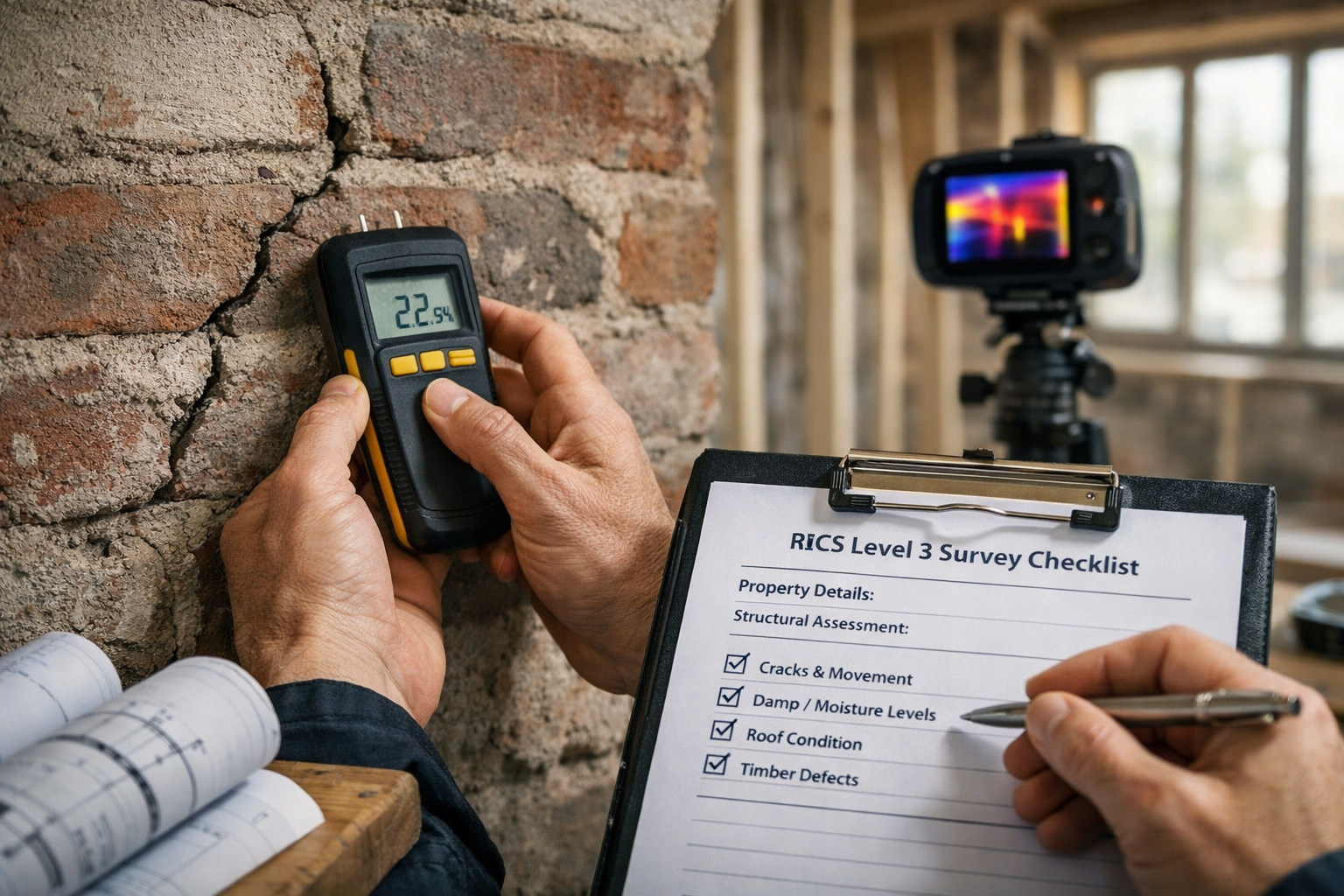
Level 3 surveys, formerly called Building Surveys, represent the most detailed building inspection available in the UK property market [5]. While traditionally associated with residential purchases, these comprehensive assessments have become indispensable for institutional landlords acquiring build-to-rent schemes in 2026.
Key characteristics of Level 3 surveys include:
- Comprehensive structural analysis covering all accessible areas of the property
- Detailed defect identification with severity ratings and repair urgency classifications
- Cost estimates for remedial works and future maintenance requirements
- Construction quality assessment evaluating materials, workmanship, and building methods
- Regulatory compliance verification ensuring building regulations and safety standards adherence
For institutional investors, Level 3 surveys provide the forensic detail needed to make informed acquisition decisions. Unlike a Level 2 Homebuyer Survey, which offers a more superficial assessment suitable for conventional properties, Level 3 surveys investigate every aspect of building condition and performance.
When Build-to-Rent Schemes Require Level 3 Assessments
Level 3 surveys are particularly suited for properties built before 1900, larger buildings, rundown structures, or those with unusual alterations [4]. In the build-to-rent context, several scenarios demand this comprehensive approach:
🏢 Portfolio acquisitions involving multiple properties with varying ages and construction types
🔧 Conversion projects where historic or commercial buildings are being repurposed for residential rental
⚠️ Distressed assets requiring extensive remediation before achieving rental-ready condition
📋 Pre-construction assessments of sites with existing structures that will be incorporated into new developments
🔍 Due diligence on older stock where previous maintenance records are incomplete or unreliable
The depth of analysis provided by Level 3 surveys enables institutional investors to accurately forecast capital expenditure requirements, negotiate purchase prices based on identified defects, and plan maintenance schedules that protect long-term asset values.
The Difference Between Residential and Institutional Survey Needs
While Level 3 surveys have traditionally targeted first-time buyers concerned about property condition [1], institutional applications require significant adaptation. Institutional investors need portfolio-level insights that go beyond individual property assessment.
| Residential Focus | Institutional Focus |
|---|---|
| Single property condition | Portfolio-wide risk aggregation |
| Immediate safety concerns | Long-term maintenance forecasting |
| Buyer protection | Investment return optimization |
| One-time assessment | Standardized evaluation protocols |
| Subjective prioritization | Quantified financial impact |
For build-to-rent schemes, surveys must evaluate properties through an investment lens, quantifying how structural issues impact rental income, tenant satisfaction, and eventual exit values. This requires specialist defect surveys that address specific concerns like subsidence risks, drainage adequacy, and damp penetration.
Level 3 Surveys for Build-to-Rent Schemes: Key Risk Categories in 2026 Expansions
Structural Integrity and Long-Term Durability
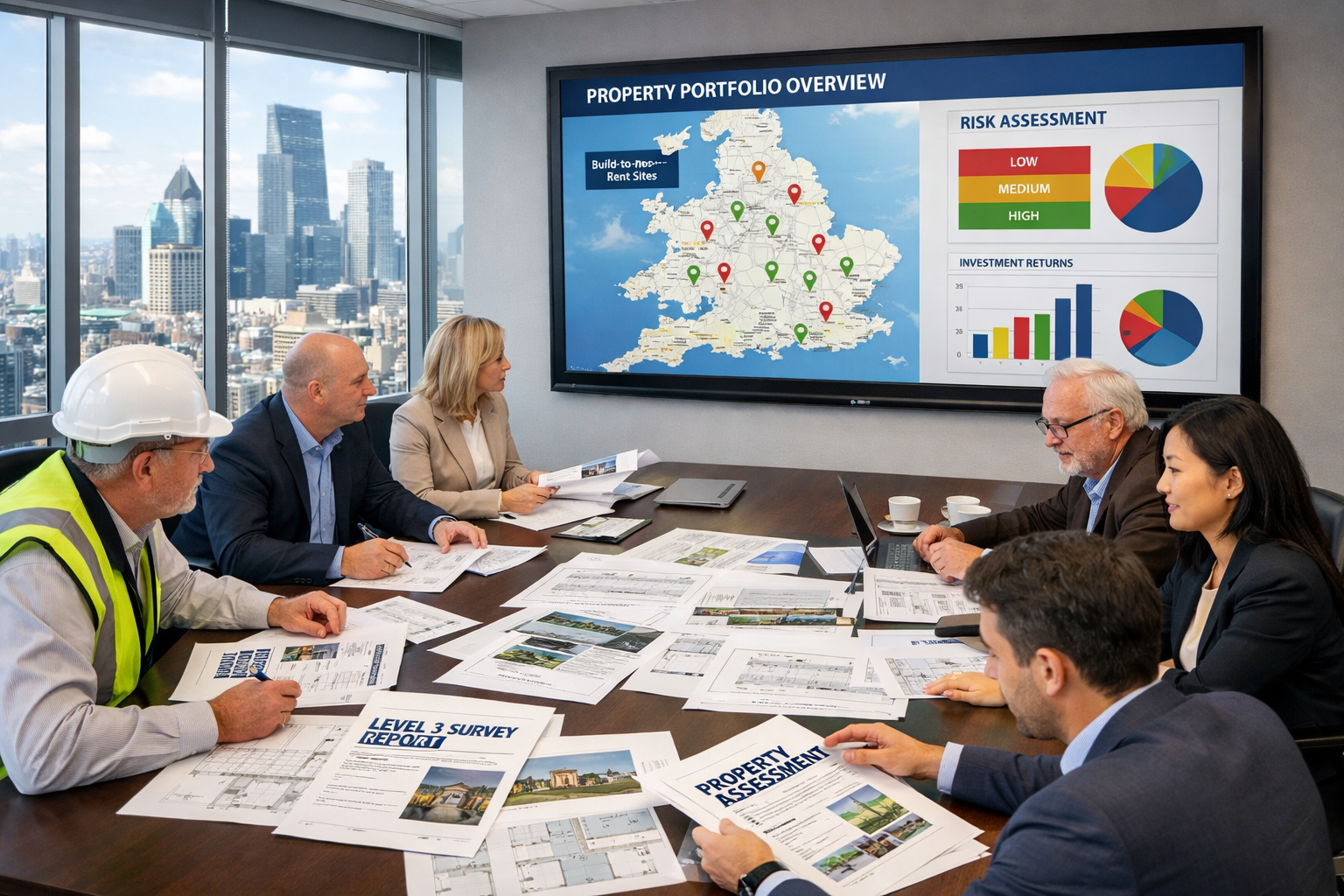
Structural defects represent the highest-cost risks in build-to-rent acquisitions. With construction costs rising 5-8% annually in 2026 [3], even minor structural issues can escalate into major financial burdens if left undetected.
Level 3 surveys must thoroughly evaluate:
Foundation stability – Settlement patterns, subsidence indicators, and soil condition assessments are critical, particularly for developments on challenging ground conditions. Detailed subsidence surveys may be required where ground movement is suspected.
Load-bearing elements – Walls, columns, beams, and floor structures require careful examination for cracks, deflection, or deterioration that could compromise building safety or necessitate costly reinforcement.
Roof condition – Roof surveys assess covering materials, structural timbers, insulation adequacy, and weatherproofing performance. Roof replacement represents a significant capital expense that must be factored into acquisition models.
External envelope – Walls, windows, doors, and cladding must maintain weather-tightness and thermal performance. Post-Grenfell building safety regulations make cladding assessment particularly critical in 2026.
"Institutional investors cannot afford to discover major structural defects after acquisition. Level 3 surveys provide the detailed analysis needed to quantify repair costs and negotiate appropriate price adjustments before capital deployment."
Building Services and Mechanical Systems
Modern build-to-rent schemes depend heavily on integrated building services. Mechanical and electrical systems represent substantial replacement costs and directly impact tenant satisfaction through heating, cooling, hot water, and ventilation performance.
Critical service assessments include:
- Heating systems – Boiler condition, distribution pipework, radiator performance, and energy efficiency ratings
- Electrical installations – Consumer units, wiring condition, earthing adequacy, and capacity for modern electrical loads
- Plumbing and drainage – Supply pipework, waste systems, drainage adequacy, and potential blockage risks
- Ventilation – Mechanical extraction systems, natural ventilation adequacy, and condensation risk mitigation
- Fire safety systems – Alarms, emergency lighting, sprinklers, and compartmentation integrity
Services typically have 15-25 year lifespans, making age assessment crucial for forecasting replacement capital expenditure. Institutional investors need detailed service life cycle analysis to model future cash flows accurately.
Regulatory Compliance and Safety Standards
The regulatory environment for rental properties has intensified significantly. Level 3 Surveys for Build-to-Rent Schemes: Identifying Risks in 2026 Institutional Landlord Expansions must verify compliance with current standards and identify potential regulatory liabilities.
Key compliance areas include:
🔥 Fire safety – Post-Grenfell regulations demand rigorous fire risk assessments, particularly for buildings over 11 meters. Compartmentation, escape routes, and fire door integrity require detailed evaluation.
⚡ Electrical safety – All rental properties require valid Electrical Installation Condition Reports (EICRs) demonstrating safe electrical systems.
🏠 Energy performance – Minimum Energy Performance Certificate (EPC) ratings apply to rental properties. Properties below minimum standards require improvement works before letting.
♿ Accessibility – Building regulations and equality legislation impose accessibility requirements that may necessitate modifications to common areas and individual units.
🏗️ Building regulations compliance – Retrospective building control verification may be needed where previous alterations lack proper certification.
Non-compliance can result in enforcement action, rental income loss, and reputational damage. Thorough compliance verification during Level 3 surveys protects institutional investors from these risks.
Environmental Hazards and Contamination
Environmental issues can render properties unlettable or expose landlords to significant remediation costs. Level 3 surveys must identify potential hazards that could impact tenant health or property value.
Priority environmental concerns:
- Asbestos – Common in pre-2000 buildings, asbestos requires professional survey and management plans
- Lead paint – Historic decorative finishes may contain lead, particularly in period properties
- Japanese knotweed – Invasive plant species that can damage building foundations and affect property values
- Radon – Naturally occurring radioactive gas requiring mitigation in affected areas
- Contaminated land – Previous industrial uses may leave soil contamination requiring remediation
Specialist defect reports may be commissioned to investigate specific environmental concerns identified during initial Level 3 surveys.
Creating RICS-Aligned Checklists for Portfolio-Scale Assessments
Standardization Across Multiple Properties
Consistency is paramount when assessing multiple properties within a build-to-rent portfolio. Standardized evaluation protocols enable meaningful comparison between assets and accurate portfolio-wide risk aggregation.
Institutional investors should develop comprehensive survey checklists aligned with RICS standards that ensure every property receives equivalent scrutiny. Key checklist components include:
📋 Property identification – Address, construction date, building type, number of units, and previous use
🏗️ Structural elements – Foundation type, wall construction, floor systems, roof structure, and external envelope
⚠️ Defect recording – Standardized severity classifications (minor, moderate, major, urgent) with photographic documentation
💰 Cost estimation – Repair cost ranges based on current construction rates and regional variations
📅 Urgency assessment – Timeline classifications (immediate, within 6 months, within 2 years, long-term monitoring)
🔍 Further investigation requirements – Identification of areas requiring specialist assessment or invasive testing
Standardized checklists enable efficient data aggregation and portfolio-level reporting that supports investment committee decision-making.
Technology Integration in Modern Survey Practice
The surveying profession has embraced technology to enhance accuracy and efficiency. Modern Level 3 surveys incorporate advanced tools that provide superior defect identification and documentation.
Technology applications include:
📱 Digital survey platforms – Tablet-based survey software enables real-time data capture, automatic report generation, and cloud-based collaboration
🚁 Drone surveys – Aerial inspection technology provides safe, cost-effective roof and high-level assessment without scaffolding requirements
🌡️ Thermal imaging – Infrared cameras identify insulation defects, moisture ingress, and thermal bridging invisible to conventional inspection
📏 Laser measurement – Precise dimensional surveys support accurate floor plans and volume calculations
🔬 Moisture meters – Electronic damp detection quantifies moisture levels and identifies hidden water penetration
📸 360-degree photography – Immersive visual documentation enables remote review and future condition comparison
Technology integration improves survey quality while reducing time on site and overall assessment costs—critical factors when surveying large build-to-rent portfolios.
Coordinating with Chartered Surveyors and Specialists
Complex build-to-rent assessments often require multi-disciplinary teams. Coordination between specialists ensures comprehensive risk identification across all building systems and compliance areas.
Key specialist roles include:
- Chartered building surveyors – Overall building condition assessment and defect identification
- Structural engineers – Detailed structural analysis where significant defects are identified
- Mechanical and electrical engineers – Building services evaluation and life cycle assessment
- Environmental consultants – Asbestos surveys, contaminated land assessment, and ecological surveys
- Fire safety engineers – Fire risk assessments and compartmentation surveys
- Quantity surveyors – Detailed cost estimation for remedial works and future maintenance
Local chartered surveyors with regional market knowledge provide valuable context for construction types, local building practices, and area-specific issues that may affect property condition.
Effective coordination requires clear briefing, standardized reporting formats, and integrated project management to ensure all specialist inputs feed into comprehensive investment appraisals.
Financial Implications and Investment Decision-Making
Quantifying Risk and Adjusting Acquisition Prices
Level 3 surveys directly inform purchase price negotiations by quantifying defect remediation costs. Institutional investors use survey findings to adjust offers, request vendor contributions, or walk away from acquisitions with unacceptable risk profiles.
Financial impact assessment includes:
Immediate repair costs – Urgent defects requiring remediation before properties can be let, directly reducing net acquisition value
Deferred maintenance – Issues requiring attention within 2-5 years that must be factored into cash flow projections
Capital replacement – Major components (roofs, services, windows) approaching end-of-life requiring scheduled replacement
Regulatory compliance costs – Works needed to meet current standards, including fire safety upgrades and energy efficiency improvements
Contingency reserves – Additional provisions for unforeseen issues in older or complex buildings
Accurate cost estimation requires current construction pricing data adjusted for regional variations and project-specific complexities. Understanding structural survey pricing helps investors budget appropriately for due diligence costs across portfolio acquisitions.
Long-Term Maintenance Forecasting
Institutional ownership demands long-term perspective. Unlike residential buyers focused on immediate condition, build-to-rent investors need 10-20 year maintenance forecasts to model investment returns accurately.
Level 3 surveys should provide component life cycle analysis estimating remaining service life for major building elements:
| Component | Typical Lifespan | Survey Assessment |
|---|---|---|
| Pitched roof covering | 40-60 years | Remaining life estimation |
| Flat roof membrane | 20-30 years | Condition grading |
| Windows | 25-40 years | Operation and seal integrity |
| Boilers | 15-20 years | Age and efficiency rating |
| Electrical systems | 25-30 years | Compliance and capacity |
| External decoration | 5-8 years | Current condition |
This data enables creation of planned maintenance schedules that smooth capital expenditure over time, avoiding unexpected cash flow impacts from emergency repairs.
Portfolio Risk Aggregation and Reporting
When acquiring multiple properties, institutional investors need portfolio-level risk analysis that aggregates findings across all assets. This enables informed decisions about:
Risk concentration – Are structural issues concentrated in specific property types or construction periods?
Geographic patterns – Do regional variations in building practices or environmental conditions create localized risks?
Compliance exposure – What proportion of the portfolio requires regulatory upgrade works?
Capital expenditure forecasting – What is the total immediate and medium-term investment requirement?
Asset prioritization – Which properties should be prioritized for remediation or potentially excluded from acquisition?
Effective portfolio reporting requires standardized data capture during individual Level 3 surveys, enabling meaningful comparison and analysis across multiple properties.
Navigating Planning Approvals and Development Timelines
Pre-Acquisition Planning Risk Assessment
Planning approvals for multi-family build-to-rent schemes currently average 6-12 months [3], creating significant timeline risk for institutional investors. Level 3 surveys must identify planning-related risks that could delay development or increase costs.
Critical planning considerations include:
Change of use requirements – Conversion projects may require planning permission for residential use
Building height and density – Proposed developments must comply with local plan policies
Affordable housing obligations – Section 106 agreements may require affordable unit provision
Conservation area restrictions – Historic building designations limit alteration scope
Neighboring objections – Potential opposition from adjacent properties or community groups
Early identification of planning constraints enables realistic timeline forecasting and appropriate risk contingencies in acquisition models.
Coordinating Survey Findings with Development Plans
For new-build or conversion schemes, Level 3 surveys of existing structures inform development feasibility. Survey findings must be integrated with architectural and engineering designs to ensure realistic project scoping.
Integration considerations include:
- Retention vs. demolition decisions – Structural condition influences whether existing buildings can be economically incorporated
- Foundation design – Ground conditions and existing foundation performance inform new construction approaches
- Services infrastructure – Existing utility capacity and condition affect development servicing strategies
- Access and logistics – Site constraints identified during surveys impact construction methodology
Effective coordination between surveyors, architects, and engineers ensures development plans reflect site realities rather than optimistic assumptions.
Post-Acquisition Validation and Handover
Following acquisition, comprehensive condition records protect institutional investors during the transition from vendor to new ownership. Level 3 surveys provide baseline documentation for:
Vendor liability claims – Defects discovered post-acquisition may be subject to warranty claims if not disclosed
Contractor briefing – Detailed defect schedules enable accurate tender preparation for remedial works
Insurance purposes – Comprehensive condition records support property insurance applications and claims
Future condition comparison – Baseline surveys enable objective assessment of condition changes over time
Schedule of condition reports provide formal photographic and written records that protect all parties' interests during property transactions.
Case Study Applications and Best Practice Examples
Successful Institutional Acquisitions Using Level 3 Surveys
Real-world applications demonstrate the value of comprehensive Level 3 surveys in protecting institutional investments. Consider a typical 2026 build-to-rent acquisition scenario:
Project: 150-unit conversion of 1980s office block to residential apartments
Survey findings:
- Concrete frame in good structural condition
- Asbestos-containing materials requiring removal (£180,000)
- Complete mechanical and electrical services replacement needed (£2.4 million)
- External envelope upgrades for thermal performance (£850,000)
- Fire compartmentation improvements required (£320,000)
Total remediation cost: £3.75 million
Impact: Purchase price reduced by £4.2 million to reflect works required, improving investment returns by 2.3% over the hold period.
Without comprehensive Level 3 surveys, these costs would have eroded projected returns, potentially rendering the acquisition unviable.
Common Pitfalls and How to Avoid Them
Institutional investors face recurring challenges when commissioning build-to-rent surveys. Common mistakes include:
❌ Insufficient survey scope – Standard residential surveys lack the detail needed for institutional decision-making
✅ Solution: Commission comprehensive Level 3 surveys with clear institutional requirements briefing
❌ Inadequate specialist input – Complex buildings require multi-disciplinary assessment
✅ Solution: Engage appropriate specialists for services, fire safety, and environmental assessment
❌ Poor cost estimation – Generic repair cost estimates fail to reflect regional pricing and project-specific factors
✅ Solution: Use quantity surveyors for detailed cost estimation based on current market rates
❌ Inconsistent assessment – Portfolio acquisitions assessed by different surveyors using varying standards
✅ Solution: Develop standardized assessment protocols and use consistent survey teams
❌ Delayed survey commissioning – Late-stage surveys create time pressure and inadequate investigation
✅ Solution: Commission surveys early in due diligence periods allowing time for follow-up investigations
Lessons from the 2026 Market Environment
The 2026 build-to-rent market presents unique challenges that inform survey best practices:
Construction cost inflation – With costs rising 5-8% annually [3], accurate defect cost estimation becomes increasingly critical. Survey reports must use current pricing data and include inflation assumptions for deferred works.
Regulatory intensification – Evolving building safety and energy efficiency standards require forward-looking compliance assessment, not just current regulation verification.
Private landlord exodus – The 600,000 property reduction in rental stock [3] creates acquisition opportunities but also increases competition, making thorough due diligence a competitive advantage.
Tenant expectation evolution – Modern renters demand high-quality, well-maintained properties. Survey findings inform refurbishment specifications that meet market expectations.
ESG investment criteria – Institutional investors increasingly apply environmental, social, and governance filters. Surveys must assess energy efficiency, accessibility, and sustainability characteristics.
Conclusion
Level 3 Surveys for Build-to-Rent Schemes: Identifying Risks in 2026 Institutional Landlord Expansions have become indispensable tools for protecting multi-million-pound property investments. As institutional investors continue expanding their portfolios to fill the void left by private landlord exits, comprehensive due diligence through detailed building surveys provides the foundation for sound investment decisions.
The comprehensive nature of Level 3 surveys—covering structural integrity, building services, regulatory compliance, and environmental hazards—enables institutional investors to accurately quantify acquisition risks, adjust purchase prices appropriately, and forecast long-term maintenance requirements. When conducted using standardized RICS-aligned checklists and supported by appropriate specialist input, these surveys provide portfolio-level insights that support strategic investment decisions.
Actionable Next Steps
For institutional investors planning build-to-rent acquisitions in 2026:
- Develop standardized survey protocols aligned with RICS standards for consistent portfolio assessment
- Engage experienced chartered surveyors with institutional client experience and build-to-rent sector knowledge
- Commission surveys early in due diligence periods allowing adequate time for specialist investigations
- Integrate survey findings with financial models to quantify impact on investment returns
- Maintain comprehensive condition records providing baseline documentation for ongoing asset management
The build-to-rent sector's continued growth creates substantial opportunities for institutional investors who approach acquisitions with appropriate diligence. Comprehensive Level 3 surveys provide the detailed risk assessment needed to capitalize on these opportunities while protecting capital and optimizing long-term returns.
For expert guidance on commissioning structural surveys for build-to-rent acquisitions, contact experienced chartered surveyors who understand institutional investment requirements and can deliver the comprehensive assessment your portfolio demands.
References
[1] Level 3 Building Surveys For First Time Buyers In 2026 Spotting Risks Amid Affordability Improvements – https://nottinghillsurveyors.com/blog/level-3-building-surveys-for-first-time-buyers-in-2026-spotting-risks-amid-affordability-improvements
[2] Uk Residential Market Survey February 2026 – https://www.rics.org/content/dam/ricsglobal/documents/market-surveys/uk-residential-market-survey/UK-Residential-Market-Survey_February-2026.pdf
[3] The Key To Solving The Uk Housing Crisis In 2026 And Beyond – https://ringley.co.uk/blogs/the-key-to-solving-the-uk-housing-crisis-in-2026-and-beyond
[4] Home Survey Level 2 Vs Level 3 Which Is Right For Your Next Move – https://awh.co.uk/2026/03/09/home-survey-level-2-vs-level-3-which-is-right-for-your-next-move/
[5] Level 3 Survey – https://surveymatch.co.uk/level-3-survey/