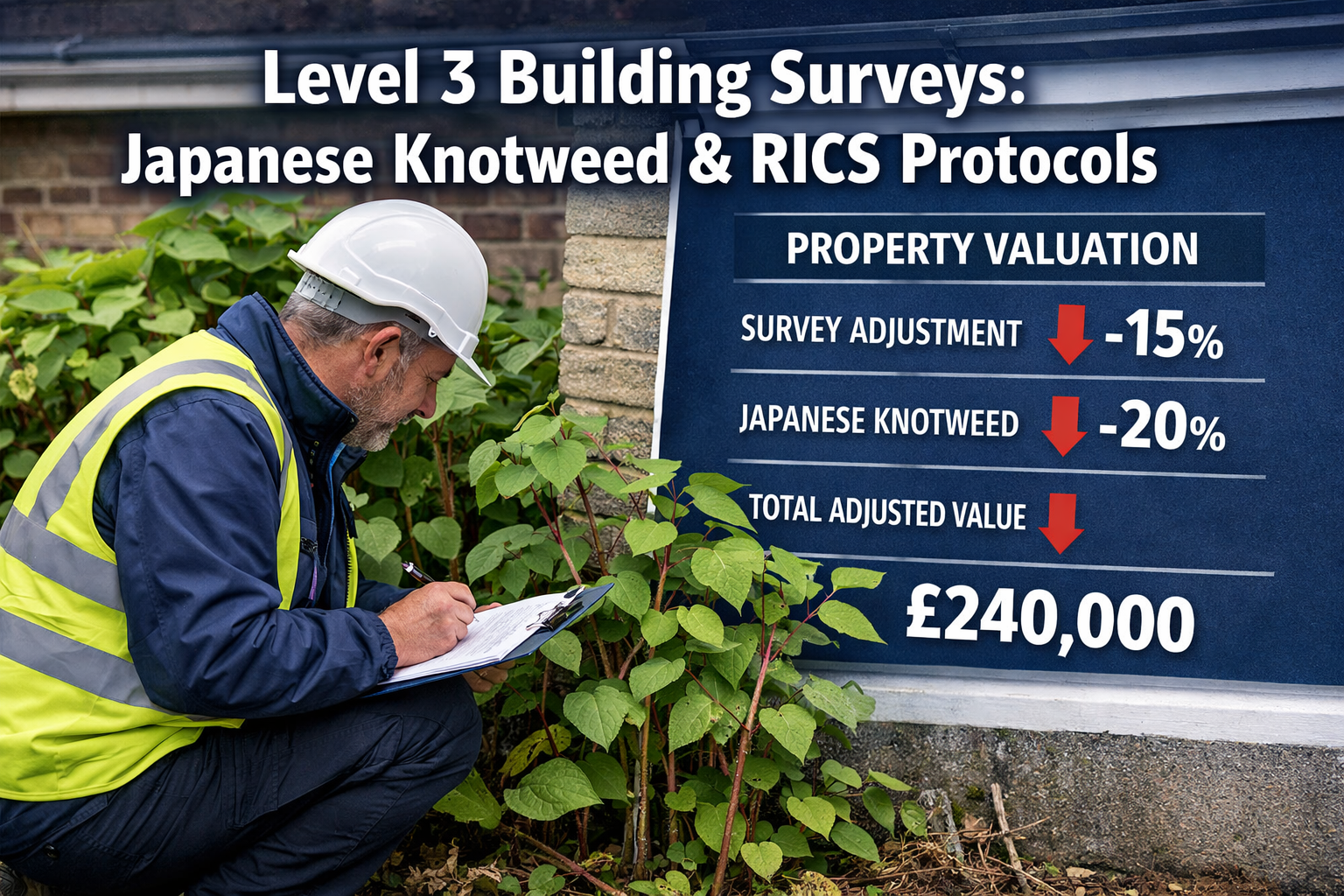

Japanese knotweed infestations have increased by 26% in UK urban areas since 2023, with approximately 5% of residential properties now affected within a 7-metre radius of the invasive plant. This surge has transformed how chartered surveyors conduct Level 3 building surveys, making Japanese knotweed identification a critical component of property assessment and valuation. Understanding Level 3 Building Surveys for Properties with Japanese Knotweed: RICS Protocols and Valuation Adjustments has become essential for buyers, sellers, and mortgage lenders navigating the 2026 property market.
The Royal Institution of Chartered Surveyors (RICS) updated its Japanese knotweed assessment framework in March 2022, introducing a four-category management system that replaced previous risk classifications [2]. This evidence-based approach focuses on actual impact rather than blanket assumptions, yet many property transactions still face delays or mortgage refusals when knotweed is discovered. The financial implications are substantial—remediation costs typically range from £3,000 to £10,000, while property valuations can decrease by 5-20% depending on infestation severity [4].
Key Takeaways
- Level 3 surveys provide the most comprehensive Japanese knotweed assessment through detailed grounds inspection, photographic evidence, and specialist recommendations based on RICS management categories A-D
- The 2022 RICS framework uses a 3-metre distance threshold and focuses on visible structural damage, amenity restrictions, and boundary location rather than applying automatic removal requirements
- Property valuation adjustments vary from minimal impact (Category C) to 10-20% reductions (Category A) depending on structural damage, remediation costs, and mortgage lender requirements
- Remediation timelines span 2-5 years for herbicide treatment programs with insurance-backed guarantees, while excavation offers immediate removal at higher cost
- Mortgage retention and specialist reports are commonly required for Category A and B infestations, making early identification through Level 3 surveys crucial for transaction planning
Understanding Level 3 Building Surveys and Japanese Knotweed Inspection Requirements
What Makes Level 3 Surveys Different for Knotweed Detection
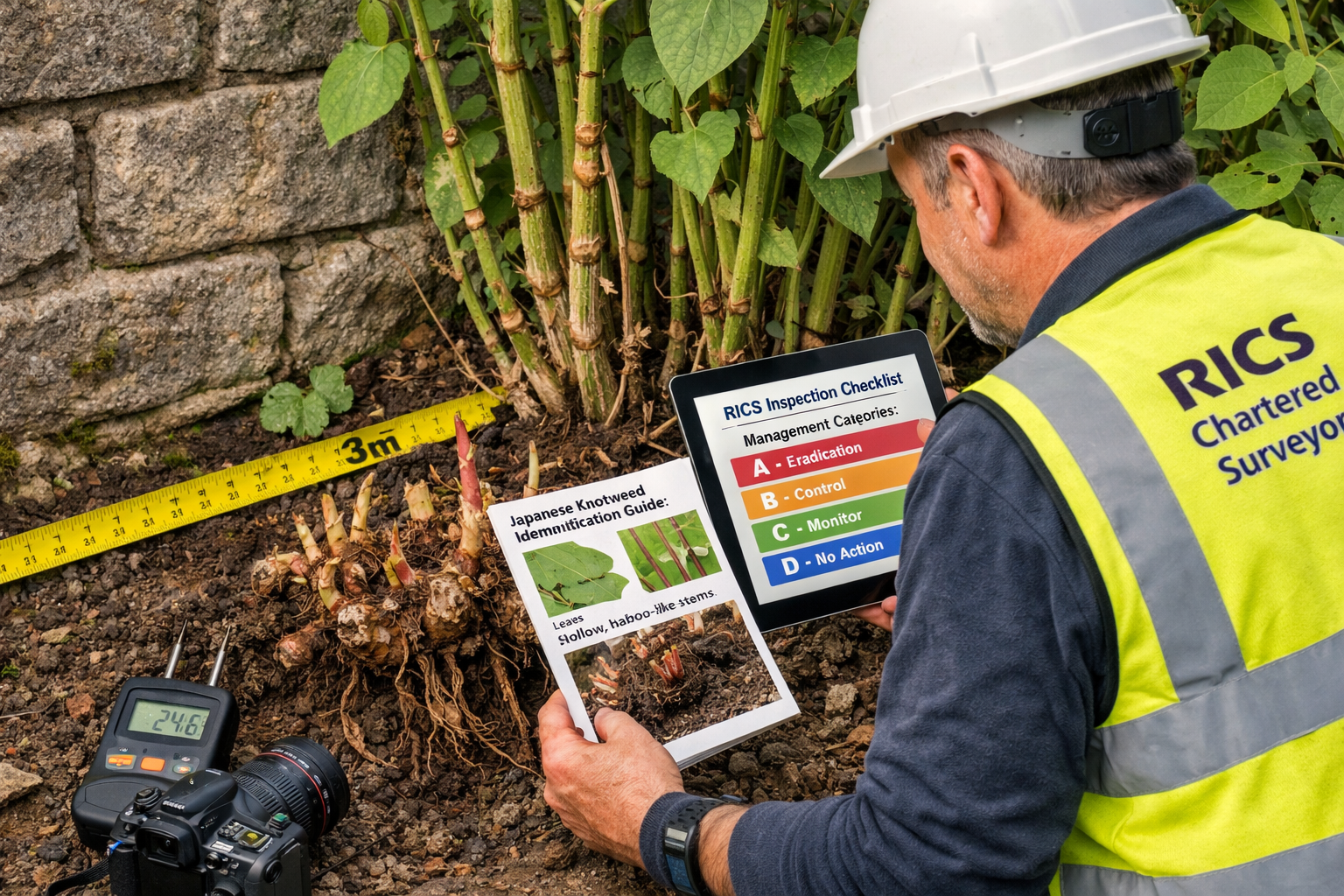
Level 3 building surveys represent the most thorough pre-purchase survey option available from RICS members, providing detailed assessment of building materials, construction methods, and property conditions that extend far beyond Level 2 surveys [8]. When it comes to Japanese knotweed, Level 3 surveys offer distinct advantages:
Comprehensive grounds assessment 🔍 – Surveyors conduct systematic visual inspection of all accessible areas within property boundaries, including gardens, driveways, boundary walls, and outbuildings where knotweed commonly establishes growth [1].
Detailed photographic documentation 📸 – Level 3 reports include extensive photographs showing any suspected knotweed growth, plant characteristics, proximity to structures, and contextual site conditions that inform management category assignment.
Specialist recommendations – Unlike basic surveys, Level 3 reports provide specific guidance on whether specialist Japanese knotweed surveys are needed, estimated remediation approaches, and potential impacts on property value and mortgage availability [3].
Boundary inspection protocols – Surveyors examine areas beyond property boundaries where visible and accessible, identifying off-site infestations that may pose future encroachment risks under Category D classification [1].
RICS Mandatory Inspection Standards
The RICS inspection standards for Japanese knotweed apply consistently across all survey levels, though Level 3 provides the most comprehensive documentation [1]. Surveyors must:
- Conduct visual inspection of grounds within property boundaries and, where reasonably possible, from outside boundaries to identify visible evidence of Japanese knotweed
- Assess likelihood of growth in areas where knotweed is not immediately visible but environmental conditions suggest reasonable possibility
- Note visible evidence through photographs and detailed descriptions when knotweed or suspected knotweed is identified
- Avoid invasive investigation – standard surveys remain non-invasive, meaning excavation, soil sampling, or destructive testing is not required [3]
It's important to understand that surveyors are not botanists. When plant identification is uncertain, RICS guidance requires surveyors to note the uncertainty and recommend specialist botanical confirmation [6]. This cautious approach protects both surveyor and client from misidentification risks.
Timing and Seasonal Considerations
Japanese knotweed identification presents seasonal challenges that affect survey accuracy:
| Season | Visibility | Identification Ease | Survey Considerations |
|---|---|---|---|
| Spring (March-May) | Red-purple shoots emerging | Moderate – distinctive shoots | Early growth phase, easier to miss small stands |
| Summer (June-August) | Full growth, white flowers | High – maximum visibility | Optimal identification period, full foliage |
| Autumn (September-November) | Dying foliage, brown stems | Moderate – distinctive dead canes | Visible structure but less obvious to untrained eye |
| Winter (December-February) | Dead stems only | Low – requires expertise | Challenging identification, may be missed entirely |
For properties surveyed during winter months, surveyors may recommend follow-up inspection during growing season if site conditions suggest knotweed presence [6].
RICS Management Categories A-D: Assessment Framework for Level 3 Building Surveys
The 2022 RICS Framework Revolution
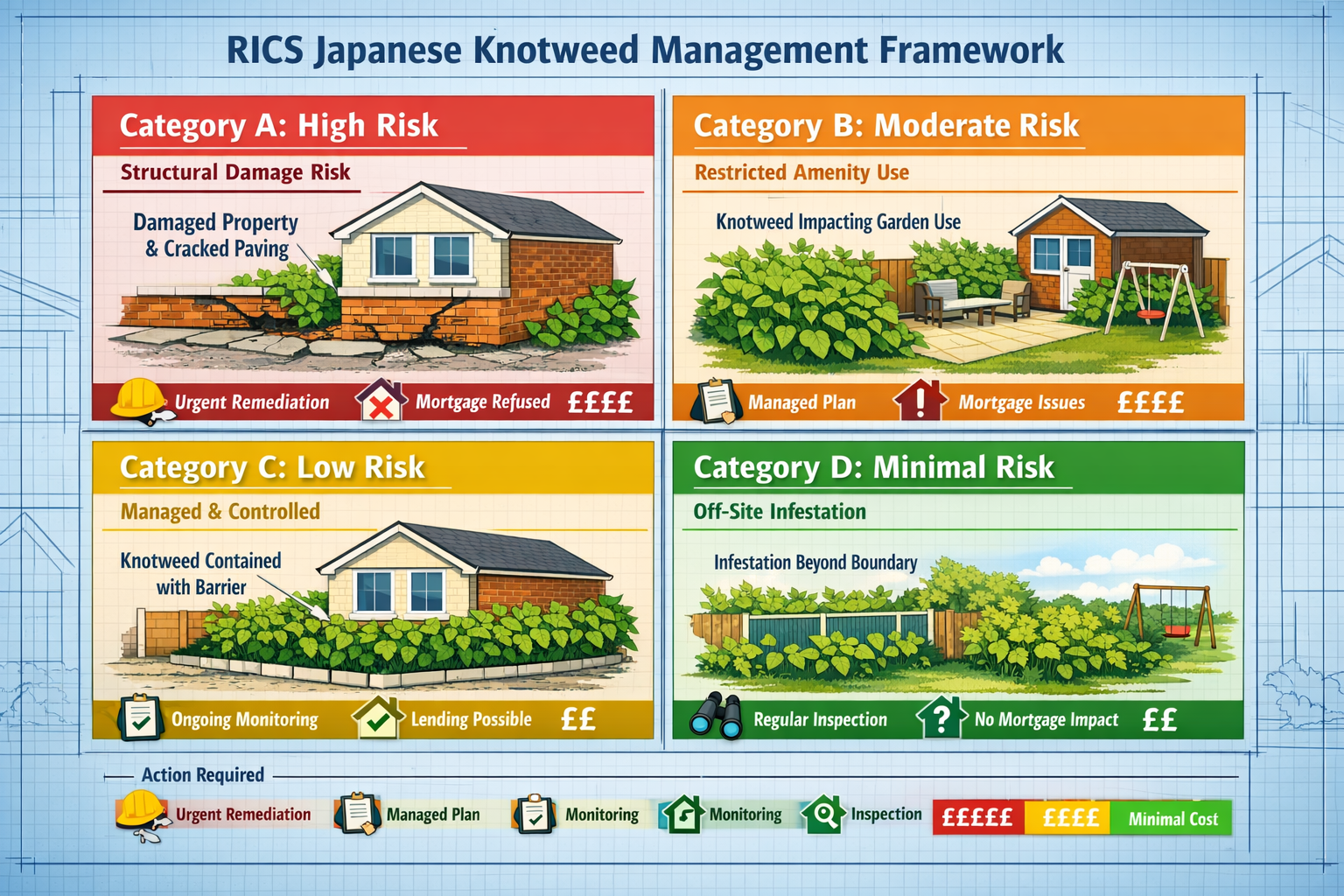
In March 2022, RICS introduced a fundamental shift in Japanese knotweed assessment, replacing distance-based risk categories with an evidence-led management framework [2]. This change reflects improved understanding of knotweed behavior and aims to prevent disproportionate responses to low-risk situations.
The four management categories focus on actual impact rather than proximity alone:
Category A: Action Required – Visible Structural Damage ⚠️
Definition: Japanese knotweed is causing visible material damage to structures, including walls, foundations, outbuildings, paths, driveways, or hardstanding [2].
Assessment criteria:
- Knotweed growth penetrating through concrete, tarmac, or building materials
- Visible displacement of paving, walls, or structural elements
- Root systems compromising drainage systems or underground utilities
- Growth within or immediately adjacent to building foundations
Valuation impact: 10-20% reduction in property value due to combined remediation costs (£5,000-£10,000+) and structural repair requirements [4]. Category A represents the highest financial impact scenario.
Mortgage implications: Most lenders apply mortgage retention (withholding funds) until specialist remediation reports confirm treatment plans with insurance-backed guarantees [4]. Some lenders may refuse mortgages entirely until remediation is complete.
Surveyor obligations: Level 3 reports must include detailed photographic evidence of structural damage, recommend immediate specialist investigation, and clearly state the Category A classification with associated risks [1].
Category B: Action Recommended – Amenity Restrictions
Definition: Knotweed restricts or is likely to restrict amenity space, gardens, or habitable areas without causing current structural damage [2].
Assessment criteria:
- Knotweed within 3 metres of habitable structures but not causing visible damage
- Growth restricting garden use, outdoor space, or planned extensions
- Presence in areas where future construction or landscaping is likely
- Potential for future structural interaction if left untreated
Valuation impact: 5-10% reduction primarily reflecting remediation costs (£3,000-£7,000) rather than structural damage [4]. Impact varies based on property size and garden proportion.
Mortgage implications: Many lenders require specialist reports and may apply retention pending confirmation of treatment plans. Some lenders accept properties with Category B classification if insurance-backed guarantees are in place [4].
Surveyor recommendations: Specialist surveys should be commissioned to confirm identification, assess extent, and develop remediation strategies before exchange of contracts [3].
Category C: Manage – Present Without Impact
Definition: Japanese knotweed is present on the property but is not causing visible damage or restricting amenity space [2].
Assessment criteria:
- Knotweed more than 3 metres from structures
- Growth in areas with no planned development
- No evidence of structural interaction or amenity restriction
- Contained growth with no immediate expansion concerns
Valuation impact: Minimal to 5% reduction – primarily reflecting disclosure requirements and potential future management costs rather than immediate remediation needs [4]. Many valuers apply no adjustment for Category C infestations in large properties.
Mortgage implications: Most lenders proceed without retention for Category C properties. Mortgage refusal is rare, though disclosure remains mandatory [2].
Management approach: Remediation is at owner discretion. Many property owners choose monitoring rather than immediate treatment, with herbicide application if growth patterns change [6].
Category D: Report Only – Off-Site Infestation
Definition: Japanese knotweed is present beyond property boundaries, typically more than 3 metres from the boundary line [2].
Assessment criteria:
- Growth on neighboring properties, public land, or railway embankments
- No current encroachment onto subject property
- Distance exceeds reasonable encroachment timeframe (typically 3+ metres)
- Control responsibility lies with adjacent landowner
Valuation impact: No adjustment – Category D infestations are noted for record purposes but do not affect property valuation as control is outside owner responsibility [4].
Mortgage implications: Not reported to lenders in most cases. No retention or specialist reports required [2].
Monitoring recommendations: While no immediate action is needed, Level 3 survey reports may suggest periodic monitoring if off-site growth is substantial or shows signs of spreading toward the property boundary [1].
Level 3 Building Surveys for Properties with Japanese Knotweed: Valuation Adjustments and Financial Implications
How Surveyors Calculate Valuation Adjustments
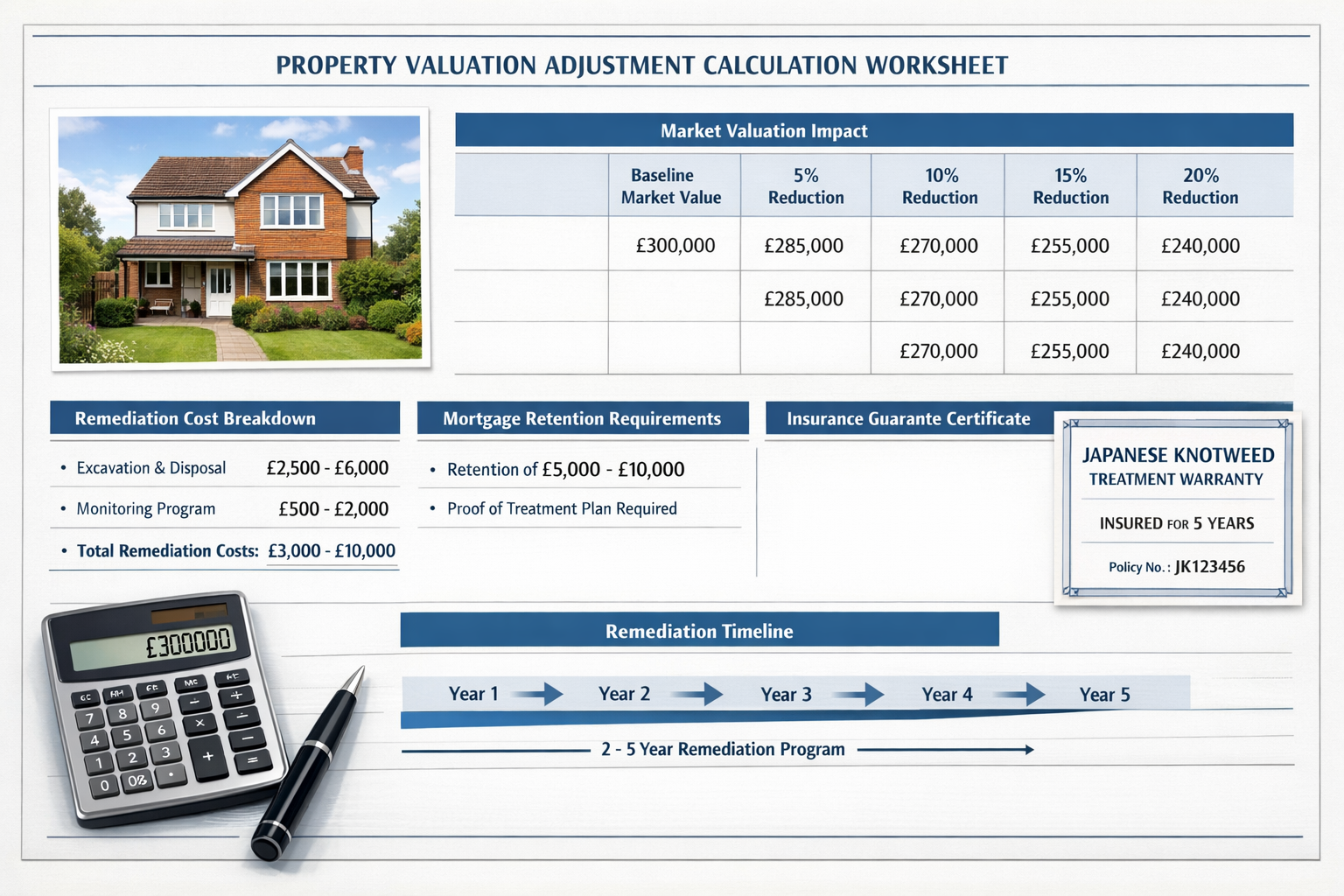
Property valuation for Japanese knotweed-affected properties follows a structured approach that considers multiple financial factors beyond simple remediation costs. RICS-qualified valuers apply the following methodology:
1. Baseline Market Value Establishment
- Determine property value assuming no knotweed presence
- Consider comparable sales of similar unaffected properties
- Account for location, condition, and market conditions in 2026
2. Direct Cost Assessment
- Remediation costs: £3,000-£10,000 depending on infestation extent and chosen treatment method [4]
- Structural repair costs: £2,000-£15,000+ for Category A properties with foundation or building damage
- Monitoring costs: £500-£1,500 annually for 2-5 year treatment programs
- Specialist survey costs: £300-£800 for detailed botanical and site investigation
3. Indirect Impact Factors
- Marketability reduction: Properties with knotweed history face restricted buyer pools
- Mortgage availability: Lender restrictions limit financing options
- Insurance implications: Some insurers increase premiums or exclude knotweed-related damage
- Future liability concerns: Buyers factor in potential neighbor disputes or encroachment claims
4. Category-Specific Adjustments
The management category assigned during Level 3 surveys directly determines valuation adjustment ranges:
| Category | Typical Adjustment | Primary Drivers |
|---|---|---|
| A | 10-20% reduction | Structural damage + remediation + repair costs |
| B | 5-10% reduction | Remediation costs + amenity restriction + mortgage limitations |
| C | 0-5% reduction | Disclosure requirements + potential future costs |
| D | 0% reduction | No direct impact or owner responsibility |
Mortgage Lender Requirements and Retention Policies
Mortgage availability represents one of the most significant financial impacts of Japanese knotweed discovery. In 2026, lender policies vary considerably:
Mainstream Lenders (Category A)
- 🏦 Nationwide, Halifax, Lloyds: Typically refuse mortgages until remediation complete or apply substantial retention (50-100% of treatment costs)
- 🏦 Santander, Barclays: May proceed with insurance-backed guarantees and specialist reports, retention applied
- 🏦 HSBC, NatWest: Case-by-case assessment, generally require Category C reclassification before lending
Mainstream Lenders (Category B)
- Most proceed with specialist reports confirming treatment plans
- Retention typically 100-150% of estimated remediation costs
- Insurance-backed guarantees (10-year minimum) usually mandatory
- Release of retained funds follows treatment completion and verification
Specialist Lenders
- Some lenders specialize in knotweed-affected properties
- Higher interest rates (typically 0.5-1.5% premium) reflect increased risk
- More flexible criteria but stricter valuation adjustments
- May require larger deposits (15-25% vs. standard 10%)
Remediation Timelines and Treatment Guarantees
Understanding remediation timelines is crucial for Level 3 Building Surveys for Properties with Japanese Knotweed: RICS Protocols and Valuation Adjustments, as treatment duration directly affects transaction timing and valuation:
Herbicide Treatment Programs 🌿
- Duration: 2-5 growing seasons (typically 3 years minimum)
- Cost: £3,000-£5,000 including monitoring and guarantee
- Process: Systematic glyphosate application during growing season, with quarterly monitoring
- Guarantee: 10-year insurance-backed guarantee standard for mortgage acceptance
- Advantages: Lower cost, less disruptive, suitable for most residential properties
- Disadvantages: Extended timeline, requires ongoing access, seasonal restrictions
Excavation and Removal 🚜
- Duration: 2-4 weeks for removal, 6-12 months for site restoration
- Cost: £7,000-£15,000+ depending on infestation size and disposal requirements
- Process: Complete excavation to 3-metre depth, off-site disposal at licensed facilities
- Guarantee: Immediate clearance with 10-year guarantee against regrowth
- Advantages: Rapid completion, enables immediate development, suitable for Category A
- Disadvantages: High cost, significant site disruption, requires specialist contractors
Hybrid Approaches
- Combination of targeted excavation near structures with herbicide treatment for wider areas
- Cost typically £5,000-£8,000
- Balances speed (immediate removal from critical areas) with economy (herbicide for low-risk zones)
- Increasingly popular for Category B properties where partial amenity restoration is priority
Insurance-Backed Guarantees and Legal Protection
For Level 3 surveys identifying Japanese knotweed, insurance-backed guarantees have become essential for mortgage approval and valuation protection:
Standard Guarantee Components:
- ✅ 10-year coverage against knotweed regrowth
- ✅ Treatment cost coverage if regrowth occurs
- ✅ Third-party liability protection (neighbor encroachment claims)
- ✅ Property damage coverage resulting from treatment failure
- ✅ Transferable to future property owners
Valuation Impact of Guarantees:
Properties with active insurance-backed guarantees typically receive 3-5% higher valuations compared to properties with completed treatment but no guarantee [4]. This reflects reduced future liability risk and improved mortgage availability.
Negotiation Strategies for Buyers and Sellers
When Level 3 surveys reveal Japanese knotweed, strategic negotiation can mitigate financial impact:
Buyer Strategies 💰:
- Request retention from purchase price equal to 150% of estimated remediation costs
- Demand seller-commissioned specialist reports before exchange to avoid survey cost burden
- Negotiate completion of treatment before purchase with insurance-backed guarantee transfer
- Seek price reduction reflecting both direct costs and marketability impact (typically 7-12% for Category B)
Seller Strategies 🏡:
- Commission proactive treatment before marketing to achieve Category C or D reclassification
- Obtain specialist reports early to demonstrate transparency and facilitate mortgage applications
- Provide insurance-backed guarantees to buyers, reducing perceived risk and valuation impact
- Consider cash buyers who avoid mortgage lender restrictions, accepting smaller discounts
Level 3 Survey Report Documentation and Specialist Recommendations
What Level 3 Reports Must Include for Japanese Knotweed
When chartered surveyors identify or suspect Japanese knotweed during Level 3 building surveys, RICS standards require specific documentation elements [1]:
Mandatory Report Components:
- Clear identification statement – Definitive confirmation if knotweed is positively identified, or statement of suspicion if identification is uncertain
- Management category assignment – Explicit classification as Category A, B, C, or D with justification based on observed conditions
- Photographic evidence – Multiple images showing plant characteristics, location relative to structures, extent of growth, and site context
- Location mapping – Site plan indicating knotweed locations, distances from structures, and boundary relationships
- Impact assessment – Description of any visible structural damage, amenity restrictions, or future risk factors
- Specialist recommendations – Specific guidance on whether botanical confirmation, specialist surveys, or immediate remediation is needed
- Valuation implications – Statement of potential impact on property value and mortgage availability
- Limitations of inspection – Clear disclosure of any areas not inspected and seasonal identification challenges
When to Commission Specialist Japanese Knotweed Surveys
Level 3 building surveys provide comprehensive assessment but are not substitute for specialist botanical investigation in certain circumstances [3]. Specialist surveys become necessary when:
Category A or B classifications are assigned – Mortgage lenders typically require detailed specialist reports including:
- Botanical confirmation by qualified ecologist
- Extent mapping using GPS or measured survey
- Root system assessment (may include trial pits)
- Detailed remediation specification with cost estimates
- Insurance-backed guarantee proposals
Plant identification is uncertain – When surveyors cannot definitively confirm Japanese knotweed presence, specialist botanical surveys provide certainty before transaction proceeds [6].
Development or extension is planned – Properties with Category C knotweed may require specialist assessment if building work could disturb growth or create new structural interaction risks.
Neighbor disputes exist – Specialist surveys provide expert evidence for legal proceedings related to encroachment or damage claims under the Anti-social Behaviour, Crime and Policing Act 2014.
Specialist Japanese knotweed surveys typically cost £300-£800 and take 1-2 weeks to complete, including laboratory analysis if required [6].
Integration with Other Specialist Surveys
Japanese knotweed assessment often intersects with other property concerns identified during Level 3 surveys:
- Structural surveys may be needed to assess foundation damage in Category A properties
- Drainage surveys can identify root penetration into underground systems
- Subsidence investigations may reveal knotweed as contributing factor to ground movement
- Damp surveys assess whether knotweed growth has compromised building envelope
Coordinating multiple specialist investigations provides comprehensive understanding of property condition and enables accurate remediation planning.
Legal Obligations and Disclosure Requirements in 2026
Seller Disclosure Obligations Under TA6 Forms
Property sellers in England and Wales face strict legal obligations regarding Japanese knotweed disclosure through the TA6 Property Information Form:
Question 7.8 specifically asks: "Is the property affected by Japanese knotweed?"
Sellers must answer:
- ✅ Yes – if knotweed is present on the property
- ✅ Yes – if knotweed has been present and treated (with treatment details)
- ✅ Not known – only if seller genuinely has no knowledge
- ❌ No – only if seller is certain no knotweed is or has been present
Consequences of non-disclosure:
- Misrepresentation claims allowing buyers to rescind contracts or claim damages
- Financial liability for treatment costs, valuation reduction, and legal expenses
- Criminal prosecution in extreme cases of deliberate concealment
- Mortgage fraud implications if non-disclosure affects lender security
The 2022 case of Williams v Network Rail established that Japanese knotweed encroachment can constitute actionable nuisance, increasing seller liability risks [5].
Surveyor Professional Obligations and Liability
RICS members conducting Level 3 building surveys face professional obligations regarding Japanese knotweed identification [1]:
Duty of care requirements:
- Conduct competent visual inspection of accessible grounds
- Identify knotweed when visible evidence exists or growth is reasonably likely
- Provide accurate management category classification based on observed conditions
- Recommend specialist investigation when identification is uncertain
- Document limitations of inspection clearly in reports
Liability exposure:
Surveyors may face negligence claims if:
- Knotweed is present and visible but not identified in reports
- Incorrect management category assignment leads to financial loss
- Failure to recommend specialist surveys when circumstances warrant
Professional indemnity insurance typically covers surveyor errors, but claims can affect premiums and professional reputation. In 2026, Japanese knotweed represents one of the most common sources of surveyor negligence claims.
Neighbor Rights and Encroachment Issues
Japanese knotweed growing on neighboring properties creates complex legal situations:
Schedule 9 of the Wildlife and Countryside Act 1981 makes it an offense to plant or cause Japanese knotweed to grow in the wild, establishing potential criminal liability for allowing spread to neighboring land.
The Anti-social Behaviour, Crime and Policing Act 2014 enables local authorities to issue Community Protection Notices requiring landowners to control knotweed growth, with fines up to £2,500 for non-compliance.
Civil nuisance claims allow affected neighbors to seek:
- Injunctions requiring treatment and control measures
- Damages for property devaluation and remediation costs
- Legal costs associated with enforcement action
Level 3 surveys identifying Category D (off-site) knotweed should note potential encroachment risks and recommend monitoring protocols to protect property owners from future liability.
Practical Guidance for Property Transactions Involving Japanese Knotweed
Pre-Purchase Due Diligence Checklist
Buyers commissioning Level 3 building surveys for properties with suspected or confirmed Japanese knotweed should follow this systematic approach:
Before Survey 📋:
- ✅ Instruct RICS-qualified surveyors with Japanese knotweed experience
- ✅ Schedule surveys during growing season (May-September) when identification is easiest
- ✅ Request specific Japanese knotweed assessment in survey instructions
- ✅ Provide any available information about previous treatments or neighbor infestations
After Survey Identification 🔍:
- ✅ Commission specialist botanical survey within 2 weeks to maintain transaction momentum
- ✅ Obtain minimum 3 remediation quotations with insurance-backed guarantees
- ✅ Contact mortgage lender immediately to confirm lending criteria and retention requirements
- ✅ Request seller's TA6 form and any previous treatment records
- ✅ Check Land Registry for any knotweed-related restrictions or notices
Before Exchange 📝:
- ✅ Negotiate price reduction or retention reflecting remediation costs plus 20-30% contingency
- ✅ Ensure specialist reports are provided to mortgage lender with sufficient time for review
- ✅ Confirm insurance-backed guarantee transferability to future owners
- ✅ Include contractual provisions requiring seller to provide access for treatment if needed
- ✅ Verify completion of any agreed remediation work before final payment release
Choosing the Right Survey Level
While this article focuses on Level 3 Building Surveys for Properties with Japanese Knotweed: RICS Protocols and Valuation Adjustments, buyers should understand when Level 3 is most appropriate:
Level 3 is recommended for:
- Properties built before 1900 or of non-standard construction
- Properties with visible defects or previous structural issues
- Properties with gardens, outbuildings, or extensive grounds where knotweed is more likely
- Properties near railway lines, waterways, or waste ground where knotweed commonly grows
- Properties requiring detailed condition assessment for renovation planning
Level 2 surveys may be sufficient for:
- Modern properties (post-1990) in good condition
- Apartments with minimal grounds
- Properties where seller has provided comprehensive knotweed clearance certificates
For guidance on choosing the right property survey, consider property age, condition, and transaction risk tolerance.
Working with Remediation Specialists
Selecting qualified Japanese knotweed remediation contractors is crucial for effective treatment and mortgage acceptance:
Essential Contractor Qualifications:
- 🏆 Property Care Association (PCA) membership
- 🏆 Invasive Non-Native Specialists Association (INNSA) registration
- 🏆 Minimum £5 million professional indemnity insurance
- 🏆 Environment Agency waste carrier license for excavation work
- 🏆 Insurance-backed guarantee provision (10-year minimum)
Red Flags to Avoid:
- ❌ Contractors offering "guaranteed removal" in single season
- ❌ Quotes significantly below market rates (£3,000-£10,000 range)
- ❌ Refusal to provide insurance-backed guarantees
- ❌ Lack of verifiable case studies or references
- ❌ Pressure to commit without specialist survey confirmation
Treatment Monitoring:
Effective remediation requires ongoing monitoring throughout treatment programs. Level 3 survey reports should recommend quarterly site visits during growing season, with photographic documentation of treatment progress and regrowth assessment.
Post-Purchase Management Strategies
For buyers who proceed with Japanese knotweed-affected properties, effective management minimizes long-term impact:
Year 1-2: Active Treatment Phase
- Implement herbicide program or excavation as specified in remediation plan
- Maintain detailed records of all treatments, site visits, and contractor reports
- Photograph treatment areas quarterly to document progress
- Ensure contractor compliance with guarantee conditions
Year 3-5: Monitoring Phase
- Continue scheduled monitoring visits per guarantee requirements
- Report any regrowth immediately to contractor and guarantee provider
- Maintain clear boundaries to prevent neighbor encroachment
- Update property records with treatment completion certificates
Year 5+: Long-Term Protection
- Conduct annual visual inspections during growing season
- Maintain transferable guarantee documentation for future sale
- Disclose treatment history accurately to future buyers
- Consider professional monitoring services (£150-£300 annually) for high-value properties
Future Outlook: Japanese Knotweed Regulation and Survey Practice Evolution
Anticipated RICS Guidance Updates
RICS continues to refine Japanese knotweed assessment protocols based on emerging research and industry feedback. Expected developments for 2026-2027 include:
Enhanced digital reporting standards – Integration of GPS mapping, drone imagery, and 3D modeling to provide more precise location documentation in Level 3 survey reports [7].
Refined management category criteria – Potential introduction of sub-categories within existing A-D framework to provide more granular risk assessment for complex situations.
Standardized valuation adjustment guidance – Development of more specific valuation reduction ranges based on accumulated transaction data and remediation outcome tracking.
Climate change considerations – Updated assessment protocols reflecting changing growth patterns and expansion rates as UK climate continues warming.
Technological Advances in Knotweed Detection
Emerging technologies are transforming how surveyors identify and assess Japanese knotweed:
Thermal imaging – Infrared cameras can detect underground rhizome networks invisible to visual inspection, providing more accurate extent mapping.
DNA testing – Soil sampling with laboratory analysis confirms knotweed presence even when plants are dormant or recently removed, addressing seasonal identification challenges.
Drone surveys – Aerial imagery enables assessment of large sites, roof areas, and inaccessible locations, particularly valuable for commercial properties and estates.
AI-powered identification – Machine learning algorithms trained on thousands of knotweed images can assist surveyors with species confirmation, reducing misidentification risks.
These technologies are gradually being incorporated into comprehensive Level 3 survey protocols, though visual inspection remains the primary assessment method in 2026.
Market Trends and Buyer Attitudes
Japanese knotweed perception among property buyers has evolved significantly:
Reduced stigma – As understanding of management categories improves, Category C and D properties face less severe market resistance than in previous years.
Treatment normalization – Buyers increasingly view Japanese knotweed as manageable condition rather than deal-breaker, similar to damp or subsidence.
Price adjustment expectations – Market participants have developed more realistic valuation adjustment expectations, reducing negotiation friction and transaction failures.
Specialist buyer opportunities – Some investors specifically target knotweed-affected properties, recognizing opportunity to acquire below-market value with manageable remediation costs.
These trends suggest Level 3 Building Surveys for Properties with Japanese Knotweed: RICS Protocols and Valuation Adjustments will remain essential but increasingly routine aspects of property transactions rather than exceptional circumstances.
Conclusion
Level 3 Building Surveys for Properties with Japanese Knotweed: RICS Protocols and Valuation Adjustments represent a critical intersection of property assessment, botanical expertise, and financial risk management in the 2026 property market. The RICS four-category management framework introduced in 2022 has brought much-needed proportionality to Japanese knotweed assessment, moving away from blanket assumptions toward evidence-based evaluation of actual impact.
Key principles for successful navigation:
-
Commission Level 3 surveys for any property with grounds where Japanese knotweed could reasonably be present, particularly properties near railway lines, waterways, or waste ground where infestations are common.
-
Understand that management category determines financial impact – Category A infestations with structural damage require immediate action and cause 10-20% valuation reductions, while Category C properties face minimal impact with proper disclosure.
-
Factor remediation timelines into transaction planning – Herbicide treatment programs require 2-5 years with insurance-backed guarantees, while excavation offers faster resolution at higher cost.
-
Recognize mortgage lender requirements vary significantly – Early engagement with lenders and provision of specialist reports prevents transaction delays and mortgage refusals.
-
Maintain comprehensive documentation throughout identification, treatment, and monitoring phases to protect property value and enable smooth future transactions.
Next Steps for Property Buyers and Sellers
If you're buying a property:
- Schedule a Level 3 building survey during May-September growing season for optimal identification
- Budget 3-5% contingency beyond purchase price for potential remediation if knotweed is discovered
- Contact mortgage lender before exchange to confirm lending criteria for knotweed-affected properties
- Commission specialist surveys immediately if Level 3 reports identify Category A or B infestations
If you're selling a property:
- Conduct pre-marketing inspection of grounds and commission treatment if knotweed is present
- Complete TA6 forms accurately and disclose any historical knotweed presence or treatment
- Provide buyers with specialist reports and insurance-backed guarantees to facilitate mortgage approval
- Consider obtaining independent valuation to establish realistic asking price reflecting any knotweed impact
If you're a property professional:
- Stay current with evolving RICS guidance and management category criteria
- Develop relationships with qualified Japanese knotweed specialists for rapid referral
- Incorporate seasonal considerations into survey scheduling recommendations
- Educate clients about proportionate risk assessment rather than perpetuating outdated assumptions
Japanese knotweed need not derail property transactions when identified through comprehensive RICS building surveys and managed according to current protocols. The combination of Level 3 survey thoroughness, evidence-based RICS management categories, and transparent valuation adjustments enables informed decision-making that protects all parties while maintaining transaction viability. As detection technologies advance and market understanding improves, Japanese knotweed is increasingly recognized as a manageable property condition rather than an insurmountable obstacle—provided proper assessment and remediation protocols are followed from the outset.
References
[1] Japanese%20knotweed October%202022 – https://www.rics.org/content/dam/ricsglobal/documents/standards/Japanese%20knotweed_October%202022.pdf
[2] Rics Japanese Knotweed Guidelines – https://www.knotweedservices.co.uk/rics-japanese-knotweed-guidelines/
[3] Do Surveyors Check For Japanese Knotweed – https://surveymatch.co.uk/do-surveyors-check-for-japanese-knotweed/
[4] Japanese Knotweed Surveyor – https://hardingsurveyors.co.uk/japanese-knotweed-surveyor
[5] Japanese Knotweed And Residential Property – https://www.rics.org/profession-standards/rics-standards-and-guidance/sector-standards/valuation-standards/japanese-knotweed-and-residential-property
[6] Japanese Knotweed Survey Requirements – https://www.japaneseknotweedkillers.com/japanese-knotweed-survey-requirements
[7] Building Survey Standards Evolution How Rics Quality Strengthening Initiatives Impact Surveyor Practice In 2026 – https://nottinghillsurveyors.com/blog/building-survey-standards-evolution-how-rics-quality-strengthening-initiatives-impact-surveyor-practice-in-2026
[8] Scope Of Inspection Home Survey Level Three – https://www.rics.org/profession-standards/rics-standards-and-guidance/sector-standards/building-surveying-standards/home-surveys/scope-of-inspection-home-survey-level-three