
{"cover":"Professional landscape format (1536×1024) hero image featuring bold text overlay 'Integrating Building Surveys with Scottish SSTP Model: Lessons for England and Wales in 2026' in extra large 70pt white sans-serif font with dark gradient shadow, positioned in upper third. Background shows split composition: left side displays modern Scottish architectural blueprints and building survey documents with SSTP framework diagrams, right side shows English and Welsh traditional property facades with surveyor equipment. Color scheme: deep navy blue, tartan green accents, white text, professional gradient overlay. Magazine cover quality, editorial style with clean hierarchy, high contrast for readability, architectural photography aesthetic with technical documentation overlay.","content":["Detailed landscape format (1536×1024) illustration showing the Scottish SSTP (Scottish Futures Trust) framework integration with building survey processes. Visual features a flowchart diagram with interconnected nodes showing survey stages, net zero building standards compliance checkpoints, and energy efficiency assessment protocols. Include architectural cross-section of a Scottish public building with survey annotation markers, thermal imaging overlay in blue-to-red gradient, and sustainability metrics displayed as infographic elements. Professional color palette of Scottish blue, green sustainability indicators, white background with subtle grid pattern, clean technical drawing aesthetic with data visualization elements and measurement tools.","Comprehensive landscape format (1536×1024) comparative infographic displaying England and Wales property transaction processes versus Scottish Home Report system. Split-screen design showing timeline comparison: left side illustrates traditional English/Welsh survey approach with multiple stages and potential delays marked in red, right side shows streamlined Scottish upfront survey model with green checkmarks. Include statistical charts showing transaction fall-through rates, average completion times, and cost comparisons. Visual elements: property icons, calendar symbols, percentage reduction graphics, professional surveyor silhouettes with clipboards, modern data visualization with bar graphs and pie charts in professional blue, green, and grey color scheme.","Detailed landscape format (1536×1024) concept illustration depicting future integration opportunities for 2026 and beyond. Shows modern UK map with Scotland, England, and Wales highlighted in different colors, connected by digital network lines representing knowledge transfer. Overlay includes icons for building survey types (Level 3 surveys, structural assessments, energy performance certificates), digital survey technology (tablets, thermal cameras, drone imagery), and sustainability metrics. Include visual representations of surveyor workforce development, training programs, and professional standards harmonization. Color palette: forward-looking tech blues, growth greens, innovation purples, with transparent overlay boxes containing key statistics and future projections in clean sans-serif typography."]"}
Scotland's property market has long operated differently from its southern counterparts, with upfront building surveys forming a cornerstone of transactions since 2008. Now, as England and Wales grapple with property market reforms and mounting pressure to reduce transaction failures, the Scottish model—particularly its integration with the Scottish Futures Trust's (SFT) sustainable building standards—offers valuable lessons. Integrating Building Surveys with Scottish SSTP Model: Lessons for England and Wales in 2026 represents more than academic interest; it's a practical blueprint for creating more efficient, transparent, and sustainable property markets across the United Kingdom.
The timing couldn't be more critical. With the Scottish Futures Trust currently reviewing its Net Zero Public Sector Buildings Standard after four years of implementation and projects exceeding £3 billion in value [1], the evidence base for what works—and what doesn't—has never been stronger. Meanwhile, England and Wales face their own challenges: rising transaction fall-through rates, surveyor shortages, and increasing demands for building sustainability compliance.
Key Takeaways
- Scotland's Home Report system combines upfront surveys with energy performance data, reducing transaction failures by establishing property condition transparency before offers are made
- The SSTP framework integrates building surveys with net zero standards, creating a comprehensive approach to property assessment that England and Wales could adapt for their own sustainability goals
- Surveyor workforce development remains critical across all UK nations, with Scotland requiring 10,000 additional construction professionals by 2028 to meet demand [2]
- Building safety reforms in Scotland mandate five-yearly inspections for freehold flats, offering a template for proactive maintenance that could prevent disasters in England and Wales
- Cross-border knowledge transfer in 2026 presents opportunities for harmonizing best practices while respecting regional property law differences
Understanding the Scottish SSTP Framework and Building Survey Integration
What Makes Scotland's Approach Different?
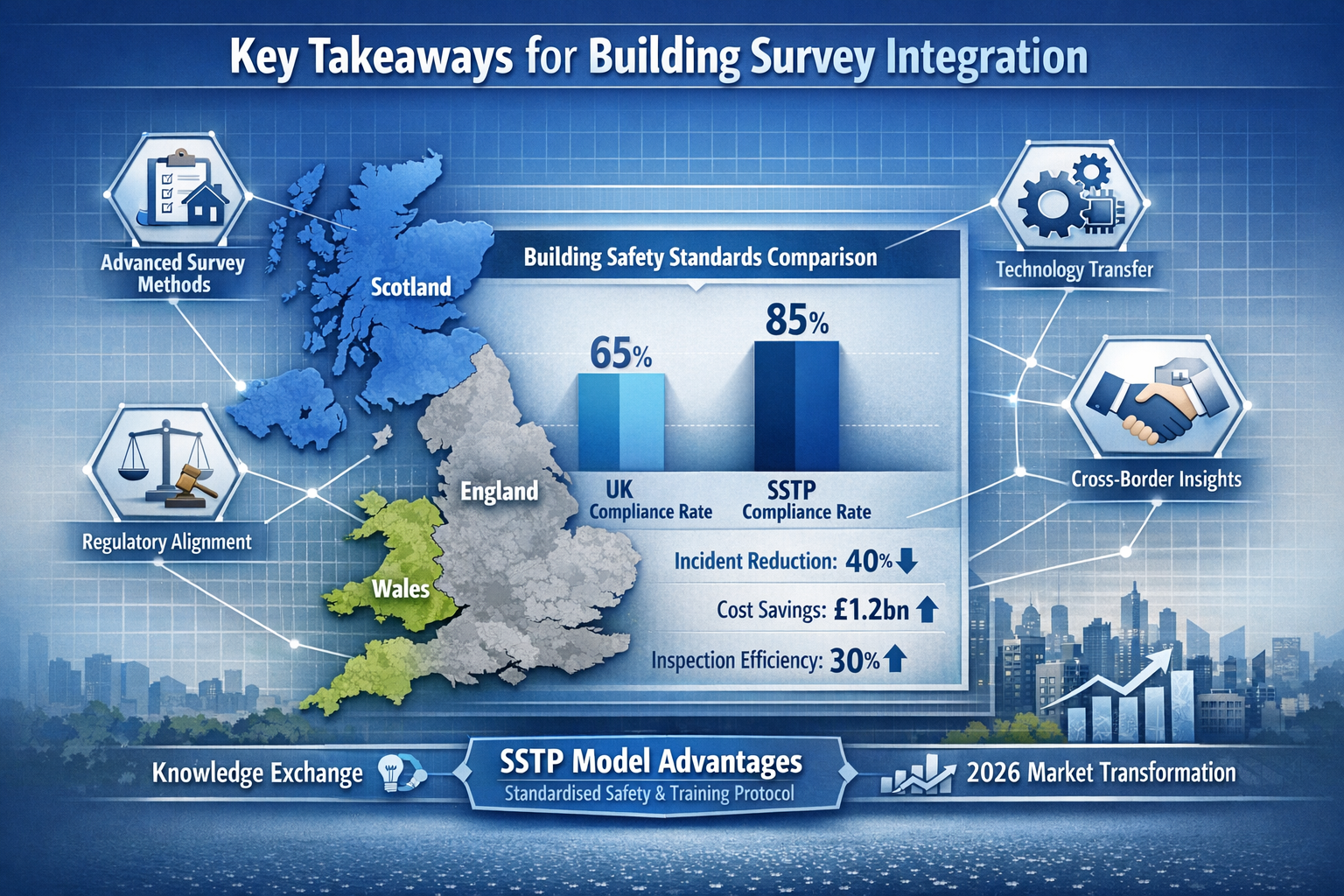
The Scottish property transaction system fundamentally differs from England and Wales through its mandatory Home Report requirement. Before marketing a property, Scottish sellers must commission a comprehensive report that includes:
- A Single Survey (equivalent to a RICS Building Survey Level 3 in England and Wales)
- An Energy Performance Certificate (EPC)
- A Property Questionnaire completed by the seller
This upfront approach eliminates the duplication of surveys that plagues the English and Welsh markets, where multiple interested buyers often commission separate RICS home surveys for the same property, only to withdraw from transactions after discovering issues.
The SSTP Model: Net Zero Integration
The Scottish Futures Trust's Net Zero Public Sector Buildings Standard (often referred to as the SSTP model in procurement contexts) takes building assessment further by integrating sustainability metrics directly into the survey and specification process. Launched in 2021, this framework requires public sector buildings to meet stringent environmental performance standards from design through construction and operation [1].
Key components of the SSTP approach include:
| Component | Purpose | Impact on Surveys |
|---|---|---|
| Whole-life carbon assessment | Measure embodied and operational carbon | Surveyors assess retrofit potential and material sustainability |
| Energy performance targets | Achieve net zero operational energy | Enhanced EPC integration with building condition data |
| Quality assurance protocols | Ensure standards compliance throughout project lifecycle | Regular inspection and verification surveys required |
| Reserve fund planning | Long-term maintenance budgeting | Survey findings inform financial planning for building owners |
This integrated approach means that building surveys in Scotland increasingly serve dual purposes: assessing current condition and evaluating sustainability improvement potential. For professionals conducting structural surveys or commercial building surveys, this represents a significant evolution in scope and expertise requirements.
Evidence from Four Years of Implementation
The Scottish Futures Trust's current review of the Net Zero Public Sector Buildings Standard, with feedback sought through December 23, 2026 [1], provides valuable data on real-world implementation. Projects exceeding £3 billion in value have now been delivered under this framework, offering insights into:
- Cost implications of enhanced survey requirements
- Time efficiencies gained through integrated assessment processes
- Quality outcomes in building performance and longevity
- Skills gaps identified in the surveying profession
"The integration of sustainability standards with traditional building surveys represents the future of property assessment across the UK. Scotland's four-year head start provides invaluable lessons for England and Wales as they develop their own net zero strategies." – Industry observation, 2026
Integrating Building Surveys with Scottish SSTP Model: Practical Applications for England and Wales
Addressing the Transaction Failure Crisis
England and Wales suffer from notoriously high rates of property transaction failures—often called "fall-throughs." Research consistently shows that 25-30% of agreed property sales collapse before completion, frequently due to survey findings that emerge late in the process.
Scotland's upfront survey model directly addresses this issue. By requiring comprehensive property assessment before marketing, the Scottish system ensures that:
- Buyers make informed offers based on known property conditions
- Pricing reflects reality rather than optimistic seller expectations
- Surveys aren't duplicated by multiple interested parties
- Transaction timelines shorten due to fewer post-offer surprises
For England and Wales, adopting elements of this approach could significantly reduce wasted survey costs and emotional distress. When choosing the right property survey, buyers currently face uncertainty about whether their investment will prove worthwhile if the transaction fails.
Adapting SSTP Sustainability Integration
While England and Wales don't have an exact equivalent to Scotland's SSTP framework, the principles of integrating sustainability assessment with building surveys can be adapted:
Energy Performance Integration: Current EPCs in England and Wales provide basic energy ratings but lack the detailed improvement roadmaps that Scottish surveys increasingly include. Building surveyors could expand their scope to provide:
- Specific retrofit recommendations with cost estimates
- Embodied carbon assessments for proposed alterations
- Long-term energy cost projections under different improvement scenarios
- Alignment with England's Future Homes Standard and Wales's decarbonization targets
Proactive Maintenance Planning: Scotland's Property Institute has called for mandatory five-yearly building inspections for the nation's 375,000 freehold flats, alongside reserve funds and common buildings insurance [3]. This proactive approach contrasts sharply with England and Wales's reactive maintenance culture, which often allows problems to escalate until they become crises.
Implementing periodic stock condition surveys for multi-unit buildings could prevent disasters while spreading maintenance costs more evenly over time.
Surveyor Training and Workforce Development
Both Scotland and the rest of the UK face critical surveyor shortages. RICS reports that Scotland needs at least 10,000 additional construction sector jobs by 2028 to meet demand, with surveyor shortages already constraining housing supply and delaying infrastructure projects [2].
Integrating Building Surveys with Scottish SSTP Model: Lessons for England and Wales in 2026 must include workforce development strategies:
- Enhanced training in sustainability assessment and net zero standards
- Cross-border knowledge exchange programs between Scottish and English/Welsh surveyors
- Technology adoption to improve survey efficiency and reduce time requirements
- Specialization pathways for different building types and assessment purposes
The shortage affects all survey types, from damp surveys to complex commercial property assessments, making workforce development a critical priority across the UK.
Building Safety and Maintenance: Scotland's Proactive Model as a Template
The Case for Mandatory Periodic Inspections
Scotland's building safety reforms, particularly the proposed mandatory five-yearly inspections for freehold flats, represent a fundamental shift from reactive to proactive building management [3]. This approach acknowledges that waiting for problems to become visible often means waiting until they're expensive—or dangerous.
The tragic Grenfell Tower fire in England catalyzed building safety reforms across the UK, but implementation has varied significantly. Scotland's approach of regular, mandatory inspections creates a systematic framework that could prevent future disasters while distributing costs more predictably.
Benefits of periodic inspection requirements include:
✅ Early problem detection before minor issues become major defects
✅ Improved building longevity through timely maintenance interventions
✅ Enhanced resident safety via systematic identification of hazards
✅ Better financial planning with predictable inspection and maintenance schedules
✅ Market transparency as inspection records become part of property history
For England and Wales, adopting similar requirements would necessitate significant expansion of the surveying workforce—another argument for prioritizing professional development and recruitment.
Reserve Funds and Long-term Financial Planning
Scotland's proposed requirement for reserve funds alongside periodic inspections addresses a chronic problem in UK property management: the tendency to defer maintenance until emergency repairs become unavoidable. Reserve funds ensure that money is available when inspections identify necessary work.
This integration of survey findings with financial planning represents best practice that England and Wales could emulate. Currently, many leaseholders and flat owners in England and Wales face unexpected large bills when major works become necessary, creating financial hardship and disputes.
Building surveyors conducting stock condition surveys could provide the data foundation for reserve fund planning, with periodic updates ensuring accuracy as buildings age and conditions change.
Common Buildings Insurance Requirements
Scotland's third pillar—mandatory common buildings insurance for freehold flats [3]—completes the risk management framework. This requirement ensures that when problems do occur despite inspections and maintenance, financial protection exists to address them.
For England and Wales, where insurance requirements vary and coverage gaps can leave residents vulnerable, Scotland's comprehensive approach offers a template for reform. The integration of survey data, maintenance planning, reserve funds, and insurance creates a robust system that protects both property values and resident wellbeing.
Technology and Innovation: Modernizing Survey Integration Across the UK

Digital Survey Tools and Data Sharing
The future of integrating building surveys with Scottish SSTP model: lessons for England and Wales in 2026 increasingly involves digital technology. Modern survey tools enable:
- Thermal imaging for energy efficiency assessment
- Drone photography for roof and elevation inspection
- 3D modeling for spatial analysis and planning
- Digital reporting platforms for consistent, accessible documentation
- Data analytics to identify patterns across building portfolios
Scotland's SSTP framework increasingly incorporates these technologies, particularly for large public sector projects where whole-life performance monitoring requires robust data collection from the outset.
For England and Wales, technology adoption could help address surveyor shortages by improving efficiency. A surveyor equipped with modern tools can complete assessments more quickly and comprehensively than traditional methods allow.
Standardization and Quality Assurance
One challenge in cross-border learning involves differing standards and qualifications. While RICS provides professional standards across the UK, specific survey requirements and reporting formats vary between jurisdictions.
Harmonizing standards where appropriate while respecting necessary regional differences could facilitate knowledge transfer and improve overall quality. Areas for potential standardization include:
- Energy performance assessment methodologies
- Sustainability metrics and reporting
- Digital survey data formats for interoperability
- Continuing professional development requirements for emerging specializations
- Quality assurance protocols for complex assessments
The Scottish Futures Trust's current review process [1] offers an opportunity for England and Wales to engage with standardization discussions, ensuring that any future integration efforts build on compatible foundations.
Retrofit and Decarbonization Assessment
RICS Scotland has called for a "joined-up national approach" to retrofit with robust quality assurance frameworks and ministerial oversight, alongside legislation to measure embodied carbon [2]. This comprehensive vision for building decarbonization requires surveyors to expand their expertise significantly.
Retrofit assessment represents a growing specialization that integrates:
- Traditional building condition analysis
- Energy performance evaluation
- Material sustainability assessment
- Cost-benefit analysis of improvement options
- Regulatory compliance verification
For building surveyors in England and Wales, developing retrofit assessment capabilities positions them to meet growing market demand while contributing to national climate goals. The Scottish experience with SSTP integration provides a roadmap for this professional evolution.
Overcoming Barriers to Cross-Border Implementation
Legal and Regulatory Differences
Property law differs significantly between Scotland and the rest of the UK, creating genuine barriers to direct policy transfer. Scotland's legal system, based on Scots law rather than English common law, treats property ownership and transactions differently in fundamental ways.
Key differences affecting survey integration include:
- Missives (Scotland) vs. contracts (England/Wales) in transaction processes
- Different legal frameworks for leasehold and freehold properties
- Varying building regulations and compliance requirements
- Distinct planning systems affecting development and alteration permissions
These differences mean that England and Wales cannot simply copy Scottish approaches wholesale. Instead, the lesson is about principles and outcomes rather than specific mechanisms. The goal of transaction transparency, sustainability integration, and proactive maintenance can be achieved through different legal instruments appropriate to each jurisdiction.
Political and Market Resistance
Any proposal to mandate upfront surveys in England and Wales faces predictable resistance:
- Estate agents may resist changes that complicate marketing processes
- Sellers may object to upfront costs and potential price implications
- Conveyancers have established practices that change would disrupt
- Political concerns about property market intervention and housing affordability
Scotland overcame similar resistance when introducing Home Reports in 2008, though not without controversy. The lesson for England and Wales is that phased implementation with stakeholder engagement proves more successful than sudden mandates.
Pilot programs in specific regions or property types could demonstrate benefits before wider rollout, building evidence and support gradually.
Cost Implications and Affordability
Upfront survey costs represent a genuine concern, particularly for sellers in lower-value properties where survey fees constitute a larger percentage of sale price. Scotland addressed this through:
- Standardized survey formats that enable competitive pricing
- Survey portability allowing buyers to rely on seller-commissioned reports
- Reduced overall transaction costs by eliminating duplicate surveys
For England and Wales, careful cost-benefit analysis should account for:
- Money saved by preventing failed transactions
- Time saved through faster, more certain processes
- Quality improvements from systematic rather than selective surveying
- Long-term building stock benefits from better maintenance information
The difference between Level 2 and Level 3 surveys affects costs significantly, and any mandatory system would need to balance comprehensiveness against affordability.
Future Directions: Building on Scottish Experience in 2026 and Beyond
Policy Recommendations for England and Wales
Based on Scotland's experience with integrated building surveys and sustainability standards, several policy directions emerge for England and Wales:
Short-term (2026-2027):
- Pilot upfront survey programs in selected regions to gather UK-specific data
- Enhance EPC integration with building condition reporting
- Develop surveyor training in retrofit and sustainability assessment
- Create digital platforms for survey data sharing and standardization
Medium-term (2027-2029):
- Implement periodic inspection requirements for multi-unit buildings
- Establish reserve fund frameworks linked to survey findings
- Harmonize sustainability metrics across UK jurisdictions where appropriate
- Expand surveyor workforce through recruitment and training initiatives
Long-term (2030+):
- Consider mandatory upfront surveys based on pilot program outcomes
- Integrate whole-life carbon assessment into standard survey practice
- Develop comprehensive building passports tracking condition and performance over time
- Align property transaction processes with net zero building targets
The Role of Professional Bodies and Industry
RICS and other professional bodies play crucial roles in facilitating cross-border learning and standard development. Their 2026 initiatives demonstrate growing recognition that surveyor expertise must evolve to meet contemporary challenges [2].
Professional development priorities should include:
- Sustainability competencies as core rather than optional specializations
- Technology proficiency in digital survey tools and data management
- Cross-jurisdiction awareness of different UK approaches and best practices
- Client communication skills for explaining complex technical findings
- Business model innovation to deliver services efficiently amid workforce constraints
Stakeholder Engagement and Public Awareness
Successful integration of Scottish lessons requires broad stakeholder support. Public awareness campaigns should emphasize:
- Transaction certainty benefits from upfront surveys
- Long-term cost savings from proactive maintenance
- Safety improvements from systematic inspections
- Environmental benefits from sustainability-integrated assessments
- Market fairness from transparent property information
Scotland's experience shows that initial skepticism can transform into acceptance when benefits become evident. England and Wales can accelerate this process by learning from Scottish implementation challenges and successes.
Conclusion: A Blueprint for Smarter Property Markets
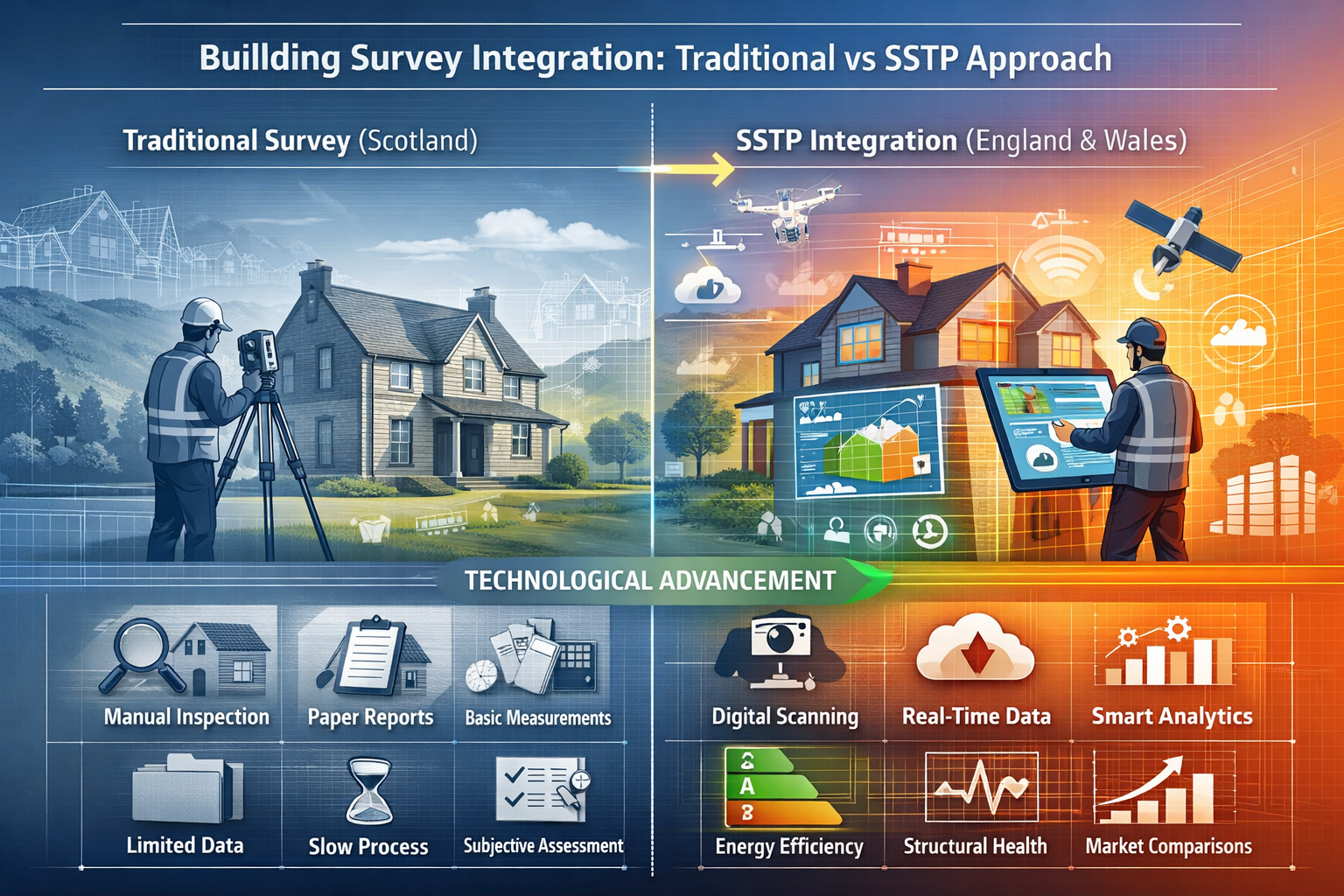
Integrating Building Surveys with Scottish SSTP Model: Lessons for England and Wales in 2026 offers more than theoretical interest—it provides a practical roadmap for creating more efficient, transparent, and sustainable property markets across the United Kingdom. Scotland's four-year experience with net zero building standards integration, combined with its longer history of upfront Home Reports, demonstrates that alternative approaches to property transactions can work effectively.
The evidence is compelling: projects exceeding £3 billion delivered under the SSTP framework [1], reduced transaction failures through upfront surveys, and emerging best practices in sustainability assessment all point toward systems that serve buyers, sellers, and society better than fragmented, reactive approaches.
For England and Wales, the path forward involves selective adaptation rather than wholesale adoption. Legal and market differences require bespoke solutions, but the underlying principles—transaction transparency, sustainability integration, proactive maintenance, and professional expertise—translate across borders.
Actionable Next Steps
For policymakers:
- Commission comparative studies of transaction outcomes across UK jurisdictions
- Establish pilot programs testing upfront survey models in England and Wales
- Develop cross-border working groups to share implementation experiences
For property professionals:
- Invest in sustainability and retrofit assessment training
- Adopt digital survey technologies to improve efficiency
- Engage with Scottish counterparts to learn from practical implementation experiences
- Participate in professional body initiatives developing enhanced standards
For property owners and buyers:
- Support transparency initiatives that reduce transaction uncertainty
- Consider commissioning comprehensive surveys even when not mandatory
- Engage with periodic inspection and maintenance planning for long-term value protection
- Stay informed about evolving standards and best practices
For surveyors specifically:
- Develop expertise in local chartered surveying while understanding cross-border developments
- Expand service offerings to include sustainability and retrofit assessment
- Contribute to workforce development by mentoring new professionals
- Participate in standard-setting processes shaping the profession's future
The surveyor shortage affecting Scotland [2] and the broader UK demands urgent attention—without adequate professional capacity, even the best policy frameworks will fail. Simultaneously, building safety concerns [3] require proactive rather than reactive approaches to property assessment and maintenance.
Scotland's integrated model demonstrates that building surveys can serve broader purposes than simply informing individual transactions. When properly structured, surveys become tools for market transparency, sustainability progress, safety assurance, and long-term building stock improvement. These benefits justify the investment in comprehensive assessment systems and the professional expertise to deliver them.
As 2026 progresses and Scotland's Net Zero Public Sector Buildings Standard undergoes review, England and Wales have a unique opportunity to learn from evidence-based implementation rather than theoretical proposals. The question is not whether to learn from Scottish experience, but how quickly and effectively those lessons can be adapted to different legal and market contexts.
The future of UK property markets lies in smarter integration—of surveys with sustainability standards, of transaction processes with building performance data, of professional expertise with technological tools, and of regional best practices with national policy frameworks. Scotland has shown one path forward; England and Wales can now chart their own, informed by their neighbor's successes and challenges.
References
[1] Industry Insight Sought On Net Zero Public Sector Buildings Standard To Help Shape The Future – https://www.scottishfuturestrust.org.uk/news/industry-insight-sought-on-net-zero-public-sector-buildings-standard-to-help-shape-the-future
[2] Rics Scotland Manifesto 2026 Surveying Scotland – https://www.rics.org/news-insights/rics-scotland-manifesto-2026-surveying-scotland
[3] Tpi Scotland Manifesto 17022026 – https://www.tpi.org.uk/media/wuwpoup2/tpi-scotland-manifesto-17022026.pdf