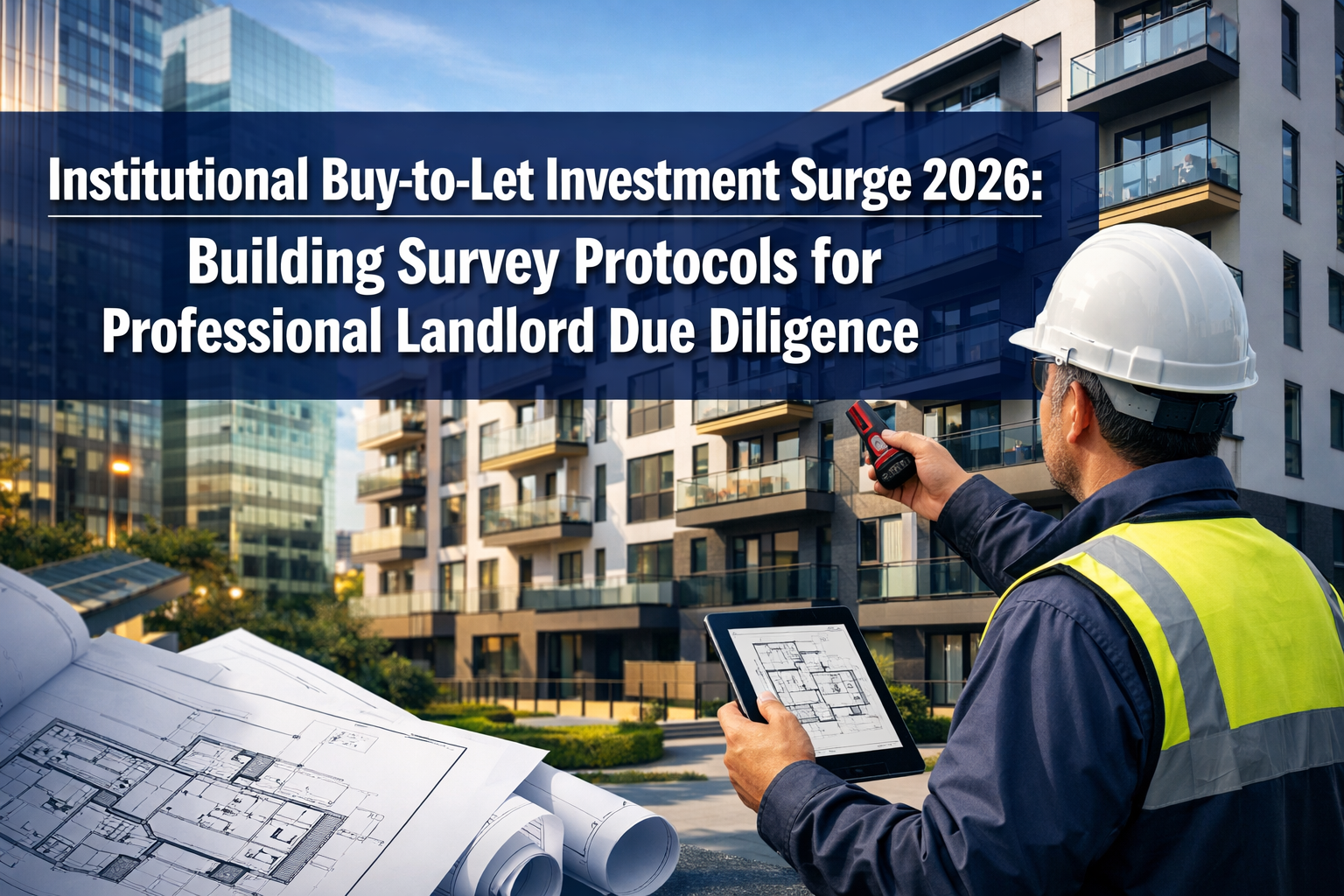

The institutional buy-to-let sector is experiencing unprecedented growth in 2026, with major investment funds and professional landlords deploying billions into residential rental portfolios. As market dynamics shift and institutional capital floods the sector, the need for rigorous, standardized building survey protocols has never been more critical. The Institutional Buy-to-Let Investment Surge 2026: Building Survey Protocols for Professional Landlord Due Diligence represents a fundamental evolution in how large-scale property acquisitions are assessed, validated, and integrated into professional portfolios.
Unlike individual landlords purchasing single properties, institutional investors require comprehensive, data-driven assessment frameworks that evaluate entire portfolios against strict investment criteria. This article explores the specialized survey methodologies, compliance requirements, and due diligence standards that define professional landlord operations in 2026.
Key Takeaways
- Institutional investors now control over 15% of the UK buy-to-let market, requiring standardized survey protocols that assess properties against investment-grade criteria rather than traditional homebuyer standards.
- Professional landlord due diligence demands multi-layered survey approaches including structural assessments, yield analysis, regulatory compliance verification, and long-term maintenance forecasting.
- Building survey protocols for institutional portfolios must incorporate ESG metrics, energy performance data, and tenant retention factors alongside traditional structural evaluations.
- Technology integration is transforming survey delivery, with digital reporting platforms, thermal imaging, and predictive maintenance algorithms becoming standard in institutional-grade assessments.
- Standardized reporting frameworks enable portfolio-level decision-making, allowing professional landlords to compare properties across regions and make data-informed acquisition choices.
Understanding the Institutional Buy-to-Let Investment Surge in 2026
The landscape of UK residential property investment has transformed dramatically. Institutional investors—including pension funds, real estate investment trusts (REITs), and specialist build-to-rent operators—have increased their market share substantially throughout 2025 and into 2026. 📈
Why Institutional Capital Is Flowing Into Buy-to-Let
Several converging factors explain the Institutional Buy-to-Let Investment Surge 2026:
Market Consolidation: Individual landlords facing increased regulatory burdens and tax changes have created acquisition opportunities for well-capitalized institutional players.
Yield Stability: Rental demand remains robust across major UK cities, with yields in prime locations offering attractive risk-adjusted returns compared to commercial real estate.
Professional Management Scale: Institutional operators achieve economies of scale through centralized property management, bulk maintenance contracts, and sophisticated tenant screening systems.
ESG Investment Mandates: Environmental, Social, and Governance criteria increasingly drive institutional capital allocation, with residential rental portfolios offering measurable social impact alongside financial returns.
Build-to-Rent Expansion: Purpose-built rental developments designed for institutional ownership have matured as an asset class, with established operational track records.
The Survey Challenge for Professional Landlords
Traditional building surveys designed for individual homebuyers fail to meet institutional requirements. Professional landlords need assessment frameworks that:
- Evaluate properties against portfolio-wide standards rather than absolute condition metrics
- Quantify remediation costs with precision for accurate financial modeling
- Assess regulatory compliance across multiple jurisdictions and licensing schemes
- Project long-term capital expenditure requirements over 10-20 year investment horizons
- Benchmark properties against comparable assets in the portfolio or market
This gap has driven the development of specialized survey protocols tailored to institutional buy-to-let due diligence.
Building Survey Protocols for Professional Landlord Due Diligence: Core Components
Institutional-grade property assessments require systematic, repeatable methodologies that generate comparable data across diverse property types and locations. The Building Survey Protocols for Professional Landlord Due Diligence framework encompasses multiple specialized assessment layers.
1. Structural and Building Fabric Assessment
The foundation of any institutional survey remains a comprehensive evaluation of structural integrity and building condition. However, professional landlord protocols extend beyond identifying defects to quantifying their impact on investment returns.
Key Assessment Areas:
- Foundation and substructure integrity: Settlement patterns, subsidence risk, drainage adequacy
- Structural frame condition: Load-bearing walls, timber frame integrity, steel or concrete element assessment
- Roof structure and covering: Remaining service life, replacement costs, maintenance requirements
- External envelope: Facade condition, weatherproofing, thermal performance
- Internal elements: Floor structures, partition walls, ceiling conditions
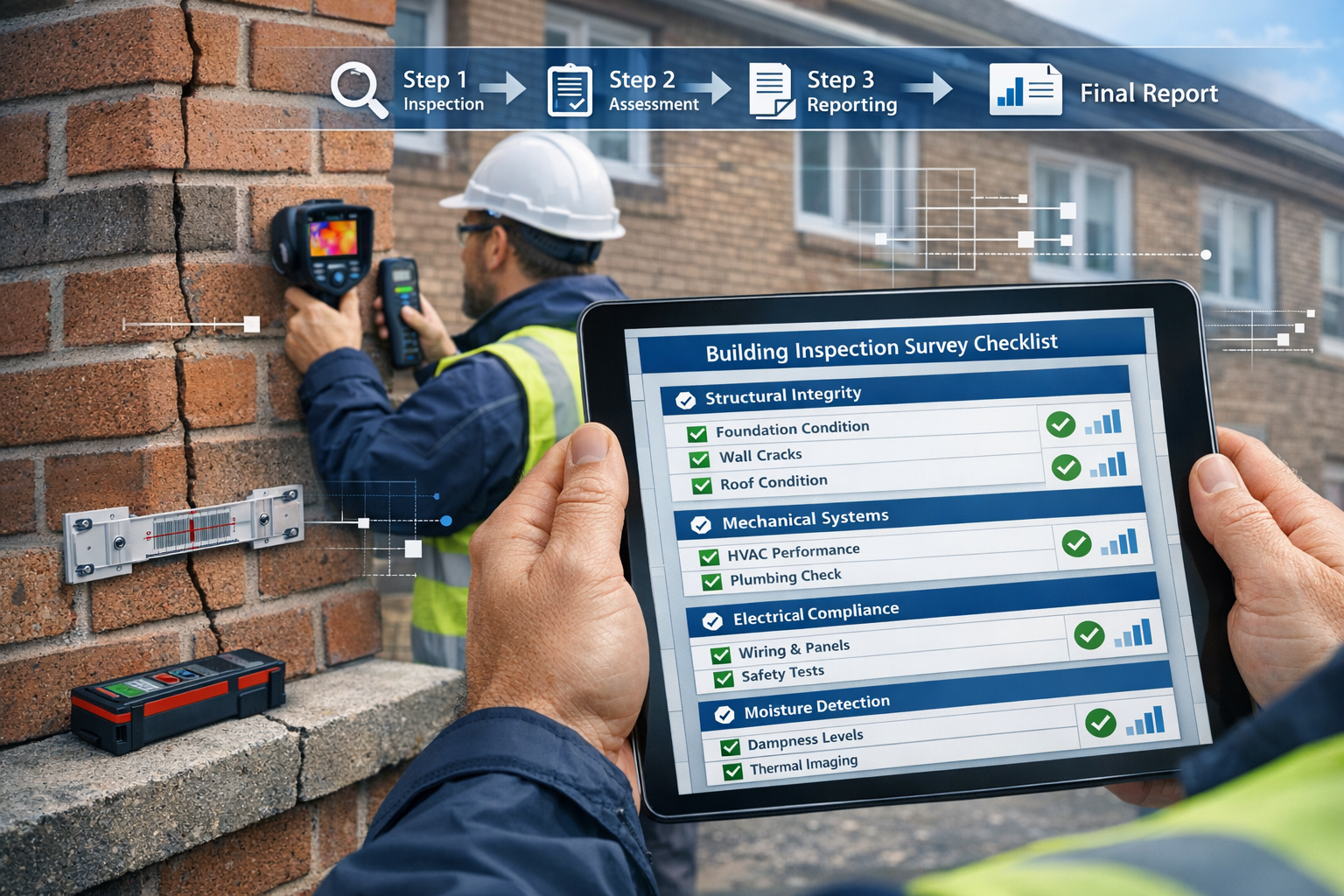
Professional surveyors conducting RICS building surveys for institutional clients must provide:
✅ Defect categorization by urgency (immediate, short-term, long-term)
✅ Remediation cost estimates with confidence intervals
✅ Service life projections for major building components
✅ Regulatory compliance status for building standards and safety regulations
2. Mechanical and Electrical Systems Evaluation
Building services represent significant capital expenditure and directly impact tenant satisfaction. Institutional survey protocols include detailed M&E assessments:
Heating Systems: Boiler age, efficiency ratings, distribution system condition, replacement timelines
Electrical Infrastructure: Consumer unit compliance, circuit capacity, testing certification status, upgrade requirements
Plumbing and Drainage: Pipe material assessment, water pressure adequacy, drainage condition, leak history
Ventilation: Compliance with current building regulations, condensation risk, mechanical ventilation performance
Fire Safety Systems: Alarm systems, emergency lighting, fire door compliance, compartmentation integrity
For multi-unit properties, commercial building surveys often provide the appropriate framework for assessing shared services and common areas.
3. Energy Performance and ESG Compliance
Environmental performance has become a critical investment criterion in 2026. Institutional landlords face increasing pressure from:
- Minimum Energy Efficiency Standards (MEES) regulations requiring EPC ratings of C or above
- Investor ESG mandates demanding measurable environmental performance
- Tenant expectations for energy-efficient, sustainable housing
- Future-proofing against anticipated regulatory tightening
Survey Protocol Requirements:
📊 Current EPC rating with detailed assessment methodology
📊 Pathway to EPC Band C (or higher) with cost projections
📊 Renewable energy integration potential (solar PV, heat pumps)
📊 Insulation upgrade opportunities and thermal performance modeling
📊 Carbon emissions baseline and reduction trajectory
4. Regulatory Compliance and Licensing Verification
Professional landlords operate within complex regulatory frameworks that vary by property type and location. Survey protocols must verify compliance across multiple dimensions:
Property Licensing: HMO licenses, selective licensing scheme compliance, additional licensing requirements
Safety Certifications: Gas safety certificates, electrical installation condition reports, fire risk assessments, legionella risk assessments
Planning and Building Control: Permitted development compliance, building regulation approval for alterations, planning permission verification
Accessibility Standards: Disabled access requirements for HMOs and larger developments
Non-compliance represents both immediate financial risk (fines, enforcement action) and operational disruption (inability to let properties). Institutional survey protocols include comprehensive regulatory audits as standard.
5. Yield Optimization and Investment Analysis
Beyond physical condition, institutional surveys assess properties through an investment lens:
Rental Income Potential: Market rent analysis, comparable property benchmarking, tenant demand assessment
Void Period Risk: Property attractiveness factors, local market dynamics, tenant turnover probability
Capital Appreciation Prospects: Location analysis, regeneration plans, transport infrastructure development
Operational Efficiency: Management intensity, maintenance requirements, tenant self-sufficiency features
Portfolio Fit: Strategic alignment with investment thesis, geographic diversification, risk profile compatibility
This investment-focused assessment distinguishes institutional survey protocols from traditional structural surveys designed purely for condition reporting.

Implementing Standardized Survey Checklists for Portfolio Acquisitions
Consistency and comparability are paramount when assessing multiple properties for portfolio acquisition. Standardized checklists enable systematic evaluation while maintaining flexibility for property-specific considerations.
Developing Institutional-Grade Survey Checklists
Effective survey checklists for professional landlords incorporate:
1. Property Classification Framework
Categorize properties by type, age, construction method, and investment strategy:
- Property Type: Houses, flats, HMOs, purpose-built blocks
- Construction Era: Pre-1919, inter-war, post-war, modern (post-2000)
- Construction Method: Traditional masonry, timber frame, concrete frame, steel frame, non-standard
- Investment Strategy: Core (stable income), value-add (improvement opportunity), opportunistic (distressed assets)
2. Condition Rating Matrices
Standardized rating systems enable portfolio-level comparison:
| Condition Grade | Description | Investment Implication |
|---|---|---|
| Grade 1 | Excellent condition, minimal maintenance required | Premium acquisition pricing justified |
| Grade 2 | Good condition, routine maintenance adequate | Standard pricing, low near-term capex |
| Grade 3 | Fair condition, some repairs needed | Discount required, budgeted remediation |
| Grade 4 | Poor condition, significant works required | Substantial discount, value-add opportunity |
| Grade 5 | Very poor, major structural concerns | Reject or deep value play only |
3. Component-Level Assessment Templates
Detailed evaluation frameworks for each building element:
Roof Assessment Template:
- Covering material and age
- Condition rating (1-5 scale)
- Remaining service life (years)
- Repair requirements (immediate/short-term/long-term)
- Replacement cost estimate
- Priority ranking
This granular approach enables accurate capital expenditure forecasting and portfolio-wide maintenance planning.
Technology Integration in Survey Delivery
Modern institutional survey protocols leverage technology for enhanced accuracy and efficiency:
Digital Survey Platforms: Cloud-based reporting systems with standardized templates, photo integration, and real-time collaboration
Thermal Imaging: Identifies insulation deficiencies, moisture ingress, and heating system inefficiencies not visible to conventional inspection
Drone Surveys: Safe, cost-effective assessment of roofs, chimneys, and high-level building elements
Moisture Meters and Environmental Sensors: Quantitative data on damp, humidity, and condensation risk
3D Scanning and BIM Integration: Creates digital building models for renovation planning and long-term asset management
These technologies enhance the quality of RICS commercial building surveys while reducing inspection time and improving documentation.
Portfolio-Level Reporting and Analytics
Individual property surveys feed into portfolio-wide analytics that inform strategic decision-making:
Aggregated Risk Profiles: Concentration of properties requiring major works, regulatory compliance gaps, energy performance distribution
Capital Expenditure Forecasting: Portfolio-wide maintenance budgets projected over 5-10 year horizons
Performance Benchmarking: Comparative analysis of properties by location, type, and vintage
Acquisition Prioritization: Data-driven ranking of target properties based on investment criteria
Portfolio Optimization: Identification of underperforming assets for disposal or improvement
This strategic layer transforms individual surveys into portfolio intelligence that guides institutional investment strategy.
Yield-Focused Property Assessment: Aligning Surveys with Investment Objectives
Professional landlords evaluate properties primarily through the lens of investment returns. Survey protocols must explicitly connect physical condition to financial performance.
Rental Yield Analysis Integration
Comprehensive yield assessment incorporates:
Gross Yield Calculation: Annual rental income / property value × 100
Net Yield Modeling: (Annual rental income – operating expenses) / property value × 100
Yield-on-Cost Projections: Expected returns including acquisition costs and required capital improvements
Comparative Yield Analysis: Benchmarking against portfolio averages and market comparables
Survey findings directly impact these calculations:
- Deferred maintenance reduces net yield through increased operating costs
- Energy inefficiency increases void periods and tenant complaints
- Regulatory non-compliance creates letting restrictions and legal costs
- Upgrade potential offers value-add opportunities to enhance yields
Risk-Adjusted Return Assessment
Institutional investors evaluate properties on a risk-adjusted basis. Survey protocols must identify and quantify risks:
Physical Risk Factors:
- Structural defects requiring major expenditure
- Building systems approaching end of service life
- Flood risk, subsidence risk, contamination risk
- Construction defects or non-standard building methods
Regulatory Risk Factors:
- Non-compliance with current standards
- Vulnerability to regulatory changes (EPC requirements, licensing)
- Planning restrictions limiting property use or modification
Market Risk Factors:
- Location-specific demand volatility
- Tenant demographic sustainability
- Competition from new developments
Quantifying these risks enables accurate pricing and informed portfolio construction decisions.
Long-Term Capital Expenditure Forecasting
Unlike individual landlords focused on immediate condition, institutional investors require multi-decade capital planning. Survey protocols include:
Component Lifecycle Analysis: Projected replacement timelines for major building elements (roof, windows, boilers, etc.)
Planned Maintenance Schedules: Regular maintenance requirements to preserve asset value
Regulatory Upgrade Pathways: Anticipated costs to meet evolving standards (EPC improvements, fire safety upgrades)
Enhancement Opportunities: Value-add improvements that increase rental income or asset value
This forward-looking approach aligns survey findings with institutional investment horizons and asset management strategies.
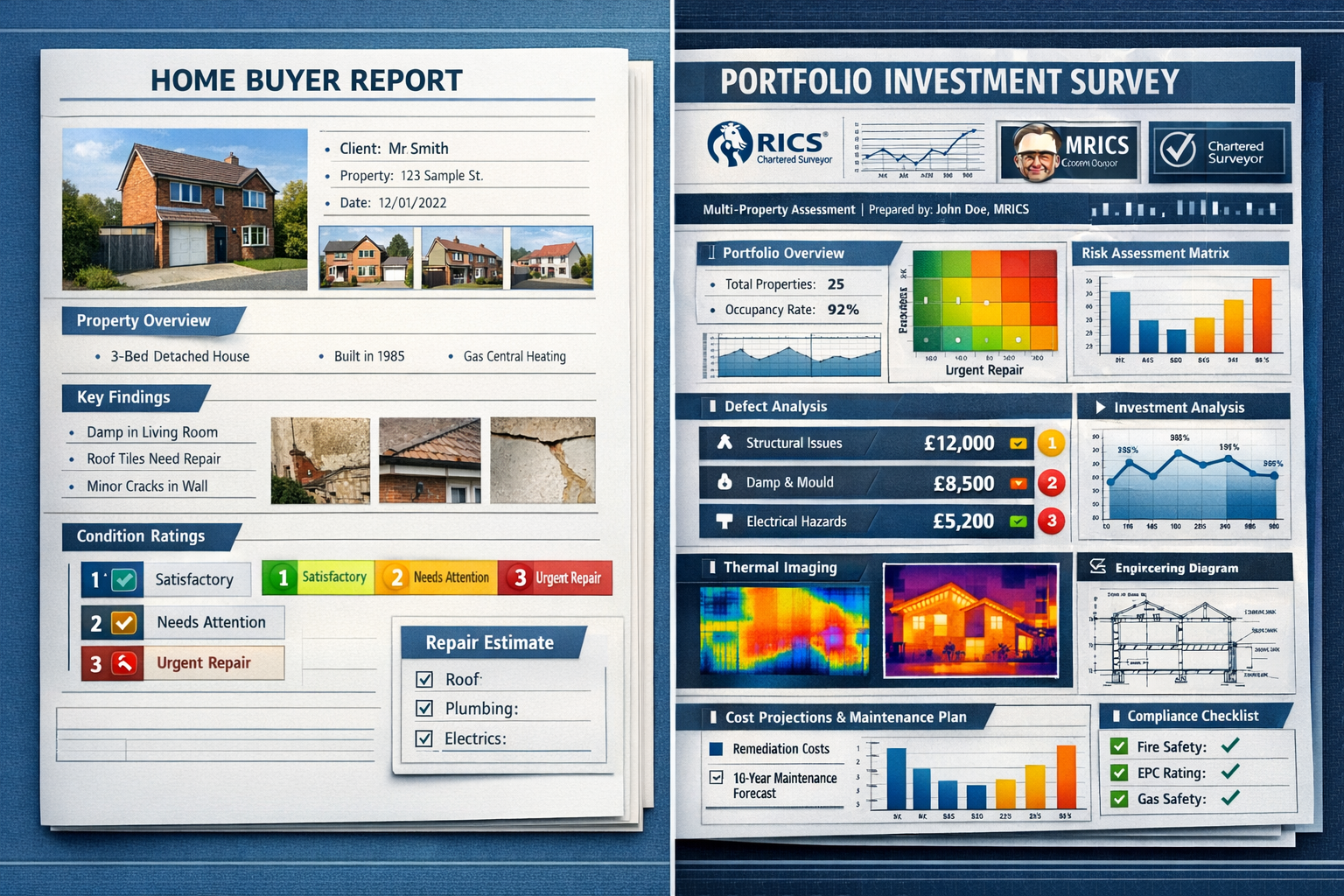
Institutional-Grade Reporting Standards for Professional Landlords
Survey reports for institutional clients must meet elevated standards of clarity, comprehensiveness, and actionability.
Report Structure and Content Requirements
Professional landlord survey reports typically include:
Executive Summary: Key findings, condition rating, investment recommendation, critical issues requiring immediate attention
Property Overview: Location, construction details, accommodation schedule, tenure information
Detailed Condition Assessment: Systematic evaluation of all building elements with photographic evidence
Regulatory Compliance Audit: Verification of licensing, safety certifications, planning compliance
Energy Performance Analysis: Current EPC rating, improvement pathway, cost-benefit analysis
Financial Implications: Remediation cost estimates, capital expenditure projections, yield impact analysis
Risk Assessment: Identified risks categorized by severity and probability
Recommendations: Prioritized action plan with timelines and budget estimates
Data Standardization and Comparability
Institutional portfolios require consistent data formats enabling aggregation and analysis:
Standardized Terminology: Consistent condition descriptors, defect categorization, and rating scales
Structured Data Fields: Machine-readable data enabling portfolio-level analytics
Photographic Standards: Consistent image quality, labeling, and documentation
Cost Estimation Methodology: Transparent assumptions and benchmarking sources
This standardization transforms individual property surveys into portfolio intelligence assets.
Professional Accreditation and Quality Assurance
Institutional clients demand surveys conducted by qualified professionals with appropriate credentials:
✅ RICS-qualified surveyors with relevant experience in residential investment property
✅ Professional indemnity insurance adequate for transaction values
✅ Quality assurance processes including peer review and technical oversight
✅ Continuing professional development ensuring current knowledge of regulations and best practices
Working with local chartered surveyors who understand regional market dynamics while maintaining institutional-grade standards provides optimal outcomes for professional landlords.
Regional Considerations for Institutional Buy-to-Let Surveys
Property markets vary significantly across UK regions, requiring survey protocols that adapt to local conditions while maintaining standardization.
London and Southeast England
The capital and surrounding areas present unique challenges:
- High property values demanding precision in condition assessment and cost estimation
- Diverse property stock from Georgian townhouses to modern apartment blocks
- Complex regulatory environment with multiple licensing schemes and planning restrictions
- Leasehold complexities requiring detailed lease review and service charge analysis
Professional landlords operating in London, Surrey, and surrounding areas benefit from surveyors with deep local market knowledge.
Regional Cities and Growth Markets
Cities like Manchester, Birmingham, Leeds, and Bristol offer different investment dynamics:
- Regeneration opportunities requiring assessment of area improvement potential
- Student and young professional markets with specific property requirements
- Lower entry prices enabling larger portfolio assembly
- Variable regulatory frameworks across different local authorities
Emerging Buy-to-Let Markets
Professional landlords are increasingly targeting secondary cities and commuter towns:
- Infrastructure development (HS2, Crossrail extensions) creating new demand centers
- Remote working trends driving population dispersal from major cities
- Affordability-driven migration to lower-cost regions
- Build-to-rent development in previously overlooked locations
Survey protocols must assess not just current condition but future market potential in these emerging locations.
The Future of Institutional Buy-to-Let Survey Protocols
As the Institutional Buy-to-Let Investment Surge 2026 continues, survey methodologies will evolve to meet emerging requirements:
Predictive Maintenance and AI Integration
Machine learning algorithms analyzing historical survey data will predict:
- Component failure probabilities
- Optimal maintenance intervention timing
- Portfolio-wide capital expenditure requirements
- Property-specific risk profiles based on comparable assets
Enhanced ESG Reporting
Environmental performance will become increasingly central to survey protocols:
- Embodied carbon assessments of building materials and construction methods
- Circular economy potential for material reuse and recycling
- Biodiversity impact of property and grounds
- Social value metrics including community benefit and tenant wellbeing
Real-Time Monitoring Integration
Internet of Things (IoT) sensors will complement traditional surveys:
- Continuous monitoring of temperature, humidity, and air quality
- Early warning systems for damp, leaks, and system failures
- Energy consumption tracking and optimization
- Tenant behavior analytics informing property management
Blockchain and Digital Property Passports
Distributed ledger technology may enable:
- Immutable records of survey findings and maintenance history
- Automated compliance verification
- Transparent property information for transactions
- Reduced due diligence costs through verified data sharing
Selecting Survey Providers for Institutional Portfolios
Professional landlords should evaluate survey providers based on:
Institutional Experience: Proven track record with portfolio acquisitions and professional landlord clients
Technical Capabilities: Access to modern survey technology and specialist expertise
Reporting Standards: Ability to deliver standardized, data-rich reports compatible with portfolio systems
Geographic Coverage: Capacity to survey properties across target investment regions
Turnaround Times: Ability to complete surveys within transaction timelines
Professional Credentials: RICS membership, appropriate insurance, quality assurance processes
Understanding surveyor pricing and service levels helps professional landlords budget appropriately for due diligence costs.
Conclusion: Building Survey Excellence for Institutional Success
The Institutional Buy-to-Let Investment Surge 2026: Building Survey Protocols for Professional Landlord Due Diligence represents a fundamental shift in how residential investment properties are assessed and acquired. As institutional capital continues flowing into the sector, standardized, comprehensive survey methodologies have become essential infrastructure for professional landlord operations.
Successful institutional investors recognize that robust due diligence—anchored by rigorous building surveys—protects capital, optimizes returns, and enables informed portfolio construction. The survey protocols outlined in this article provide a framework for evaluating properties against investment-grade criteria, ensuring acquisitions align with strategic objectives and risk parameters.
Actionable Next Steps for Professional Landlords
- Audit your current survey processes against institutional-grade standards to identify gaps and improvement opportunities
- Develop standardized survey checklists tailored to your investment strategy and property types
- Engage RICS-qualified surveyors with institutional experience and appropriate technology capabilities
- Implement portfolio-level reporting systems that aggregate survey data for strategic analysis
- Integrate ESG metrics into survey protocols to meet investor mandates and anticipate regulatory changes
- Establish long-term relationships with survey providers who understand your portfolio and investment approach
- Budget appropriately for comprehensive due diligence as a percentage of acquisition costs
The institutional buy-to-let sector will continue evolving throughout 2026 and beyond. Professional landlords who invest in robust survey protocols and due diligence frameworks will be best positioned to capitalize on opportunities while managing risks effectively. Whether acquiring single properties or entire portfolios, the quality of building surveys directly impacts investment outcomes—making survey excellence a competitive advantage in the institutional rental market.
For professional landlords seeking to elevate their due diligence standards, partnering with experienced commercial property surveyors who understand institutional requirements ensures survey protocols align with investment objectives and deliver actionable intelligence for portfolio decision-making.