
{"cover":"Professional landscape format (1536x1024) hero image featuring bold text overlay 'Impact of Falling Mortgage Rates on 2026 Property Valuations' in extra large 72pt white sans-serif font with dark gradient shadow, positioned in upper third with perfect alignment. Background shows split composition: left side displays downward trending mortgage rate graph from 7% to 6% with red arrow, right side shows modern residential properties with 'For Sale' signs and professional surveyor with clipboard examining home exterior. Color scheme: navy blue, white, gold accents representing affordability improvement. High contrast magazine cover quality with semi-transparent overlay box behind text ensuring crystal clear readability. Editorial style with rule of thirds composition, showing calculator, house keys, and mortgage documents subtly integrated into foreground. Professional financial aesthetic combining real estate photography with data visualization elements.","content":["Landscape format (1536x1024) editorial image showing detailed mortgage rate forecast chart for 2026 with multiple trend lines: 30-year fixed rate declining from 6.8% to 6.3%, Federal Reserve policy rate indicators, and shaded prediction bands. Chart includes data points for Q1-Q4 2026 with annotations showing Morgan Stanley forecast of 5.50%-5.75% mid-year rates. Background features Federal Reserve building facade subtly blurred. Foreground displays professional calculator, mortgage application documents, and interest rate comparison tables. Color coding: green for declining rates, blue for stable periods, orange for projected increases. Clean financial infographic style with percentage symbols, basis point markers, and timeline axis clearly labeled. Professional business aesthetic with high readability.","Landscape format (1536x1024) conceptual illustration showing property valuation adjustment process with RICS surveyor conducting exterior assessment of residential property. Split-screen composition: left shows traditional valuation report with crossed-out higher figures, right displays revised lower valuations reflecting improved affordability. Visual elements include surveyor's measuring tools, comparable property data sheets, affordability calculation formulas (income ratios, debt-to-income percentages), and before/after monthly payment comparisons. Infographic overlay shows 5.5 million household expansion in buyer pool with demographic icons. Background features suburban neighborhood with mix of property types. Color scheme: professional blue and white with green highlighting affordability improvements. Clean, educational style with annotated callouts and percentage change indicators.","Landscape format (1536x1024) strategic planning image showing real estate market dynamics for 2026 with multiple data visualization elements. Central focus on buyer qualification funnel expanding from narrow (high rates) to wide (lower rates) with household icons flowing through. Surrounding elements include: inventory growth chart showing rising supply, home price appreciation graph at modest 2% annual growth, builder incentive comparison table highlighting 5% price cuts and rate buydown programs. Visual representation of lock-in effect with homeowners staying put shown through retention statistics. Professional dashboard aesthetic combining bar charts, pie graphs, and trend lines. Color palette: navy blue, emerald green, gold accents. Clean business intelligence style with clear data labels, percentage markers, and year-over-year comparison indicators. Modern financial presentation quality."]}
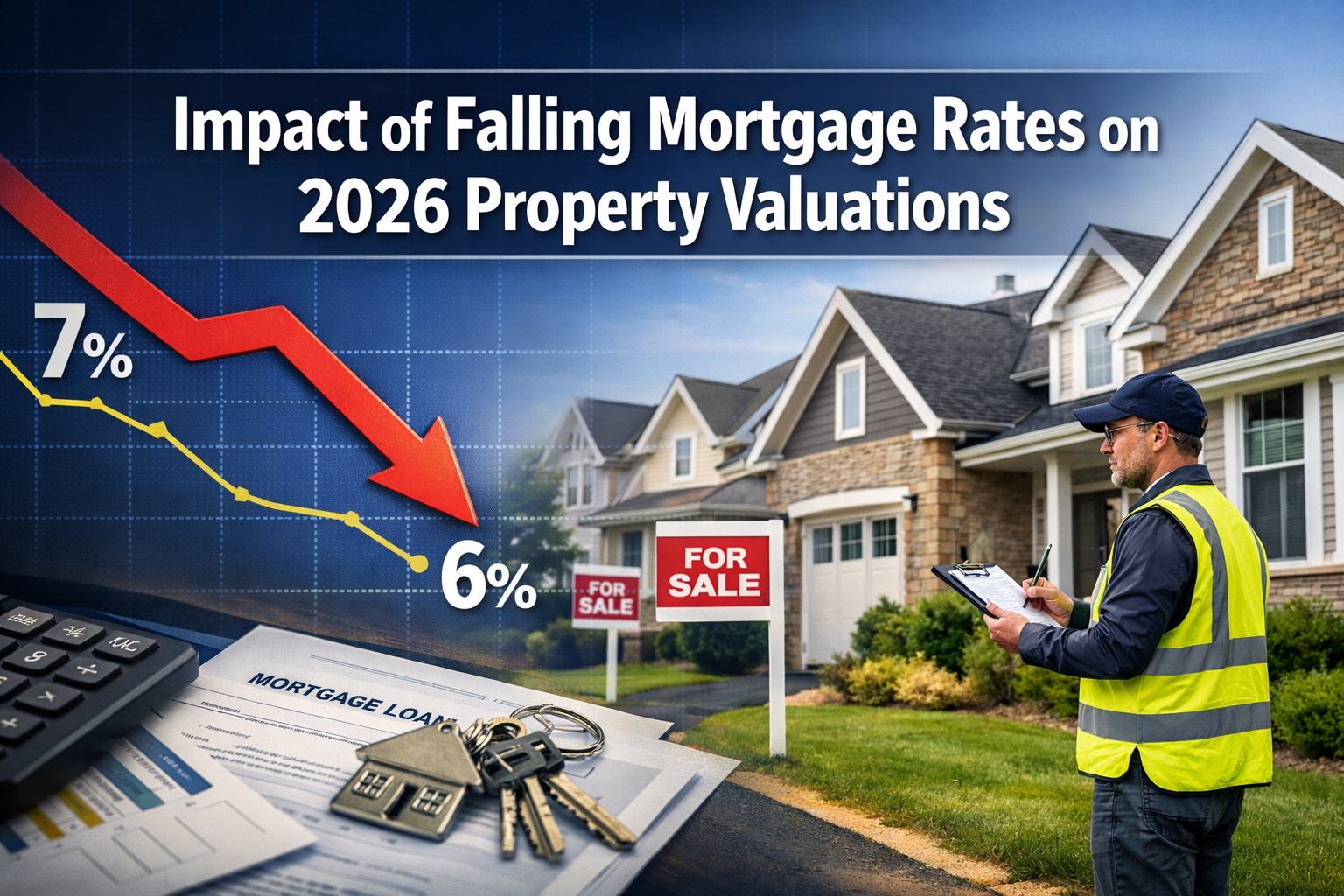
The UK property market stands at a pivotal crossroads in 2026. With mortgage rates forecasted to decline from recent peaks, property valuations are undergoing significant recalibration. This shift presents both opportunities and challenges for surveyors, lenders, and prospective homebuyers navigating an evolving affordability landscape.
The Impact of Falling Mortgage Rates on 2026 Property Valuations: Surveyor Adjustments for Improved Affordability represents more than just a market correction—it signals a fundamental transformation in how properties are assessed, valued, and financed. As rates trend downward, surveyors must adapt their methodologies to reflect changing buyer capacity, lender requirements, and market dynamics.
Key Takeaways
- 📉 Mortgage rates are projected to average 6.3% in 2026, down from 2025 levels, with potential mid-year dips to 5.50%-5.75% according to Morgan Stanley forecasts[1][4]
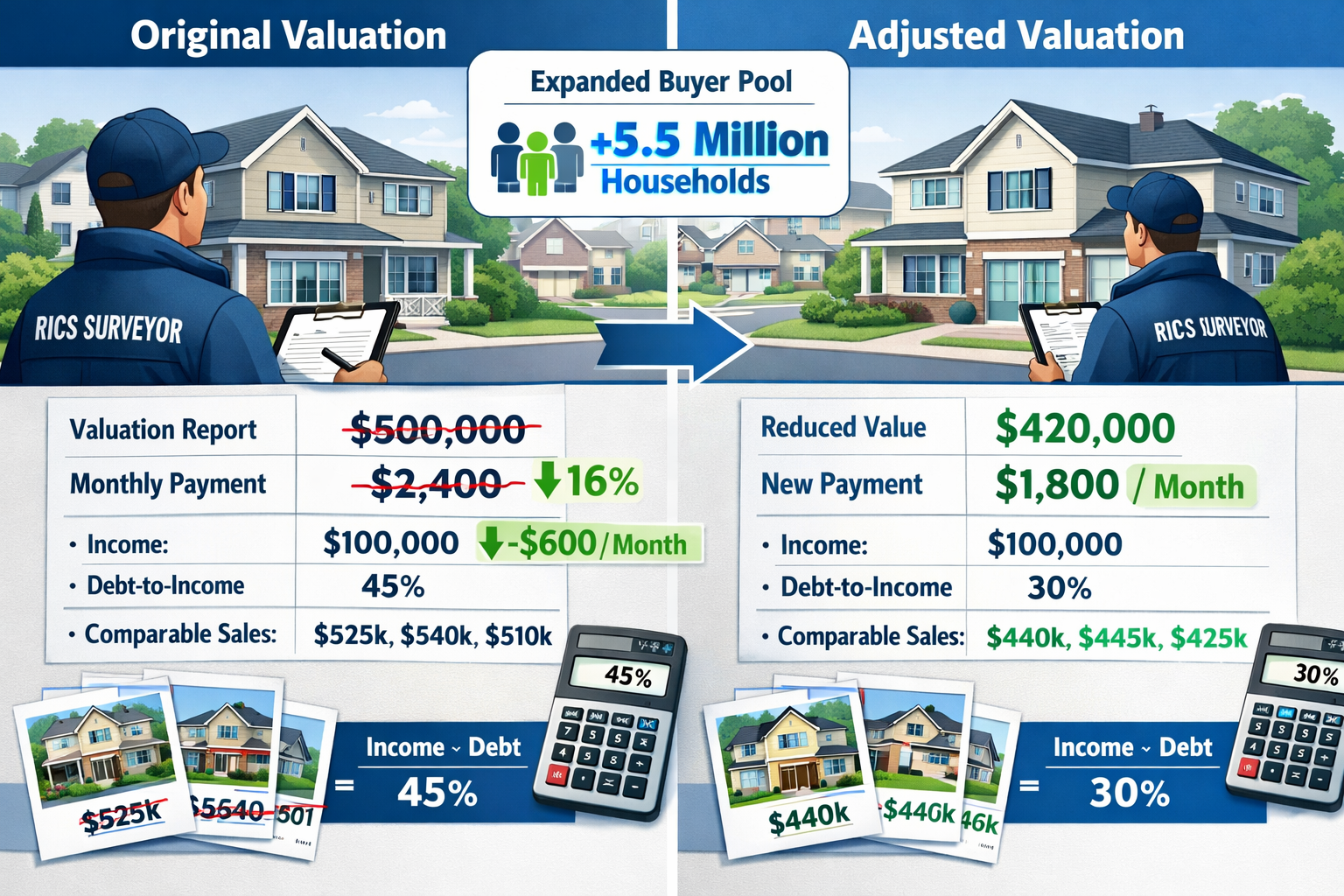
- 🏠 Property valuations require recalibration as improved affordability expands the qualified buyer pool by approximately 5.5 million households[7]
- 💰 Monthly payments will decline for the first time since 2020, making homeownership more accessible despite modest 2% price appreciation[7]
- 📊 RICS surveyors must integrate enhanced affordability metrics into valuation reports to reflect changing market conditions and lender requirements
- 🔄 Builder strategies including 5% price cuts and rate buydowns are reshaping new construction valuations and competitive positioning[5]
Understanding the 2026 Mortgage Rate Landscape
Projected Rate Trajectories and Federal Reserve Policy
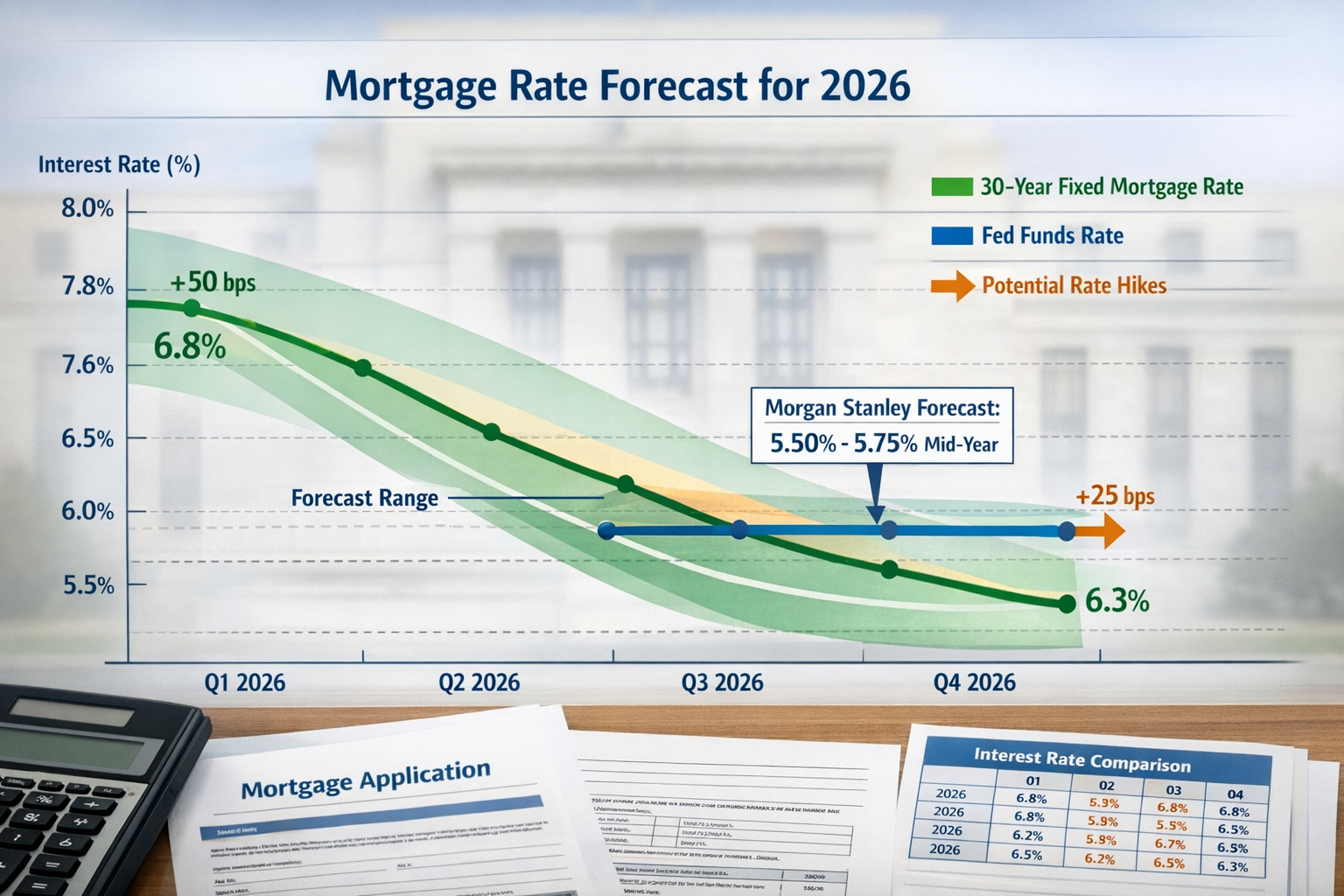
The mortgage rate environment in 2026 represents a moderate improvement from 2025 levels but remains significantly elevated compared to pandemic-era lows. Both Realtor.com and Redfin project that 30-year fixed mortgage rates will average 6.3% throughout 2026[1], providing measurable relief to prospective buyers who faced rates approaching 7% in previous quarters.
However, rate movements are expected to be dynamic rather than linear. Morgan Stanley strategists anticipate potential declines to the 5.50%-5.75% range by mid-2026, followed by upward pressure in the second half of the year and into 2027[4]. This volatility stems from Federal Reserve policy adjustments, with interest rate markets pricing in two Federal Reserve cuts in 2026[2].
For surveyors conducting property valuations, these rate fluctuations create both opportunities and complexities. Valuation reports must account for the temporal sensitivity of affordability calculations, recognizing that a property valued in Q2 2026 may face different buyer capacity constraints than one assessed in Q4 2026.
Rate Sensitivity and Buyer Qualification Thresholds
The relationship between mortgage rates and buyer qualification is exponential rather than linear. A decline from 6.8% to 6.0% mortgage rates can materially lower monthly payments enough to bring previously sidelined buyers back into qualification range[3]. This phenomenon creates a cascading effect on property valuations.
Consider a £400,000 property purchase:
- At 6.8% interest: Monthly payment approximately £2,590
- At 6.0% interest: Monthly payment approximately £2,398
- Monthly savings: £192 (7.4% reduction)
This £192 monthly difference translates to approximately £23,000 in additional purchasing power for buyers at typical debt-to-income ratios, fundamentally altering the competitive landscape for properties at various price points.
| Mortgage Rate | Monthly Payment (£400k) | Annual Cost | Buyer Income Required (28% DTI) |
|---|---|---|---|
| 7.0% | £2,661 | £31,932 | £114,000 |
| 6.5% | £2,528 | £30,336 | £108,343 |
| 6.0% | £2,398 | £28,776 | £102,771 |
| 5.5% | £2,271 | £27,252 | £97,329 |
Impact of Falling Mortgage Rates on 2026 Property Valuations: Market Dynamics
Home Price Appreciation in a Lower-Rate Environment
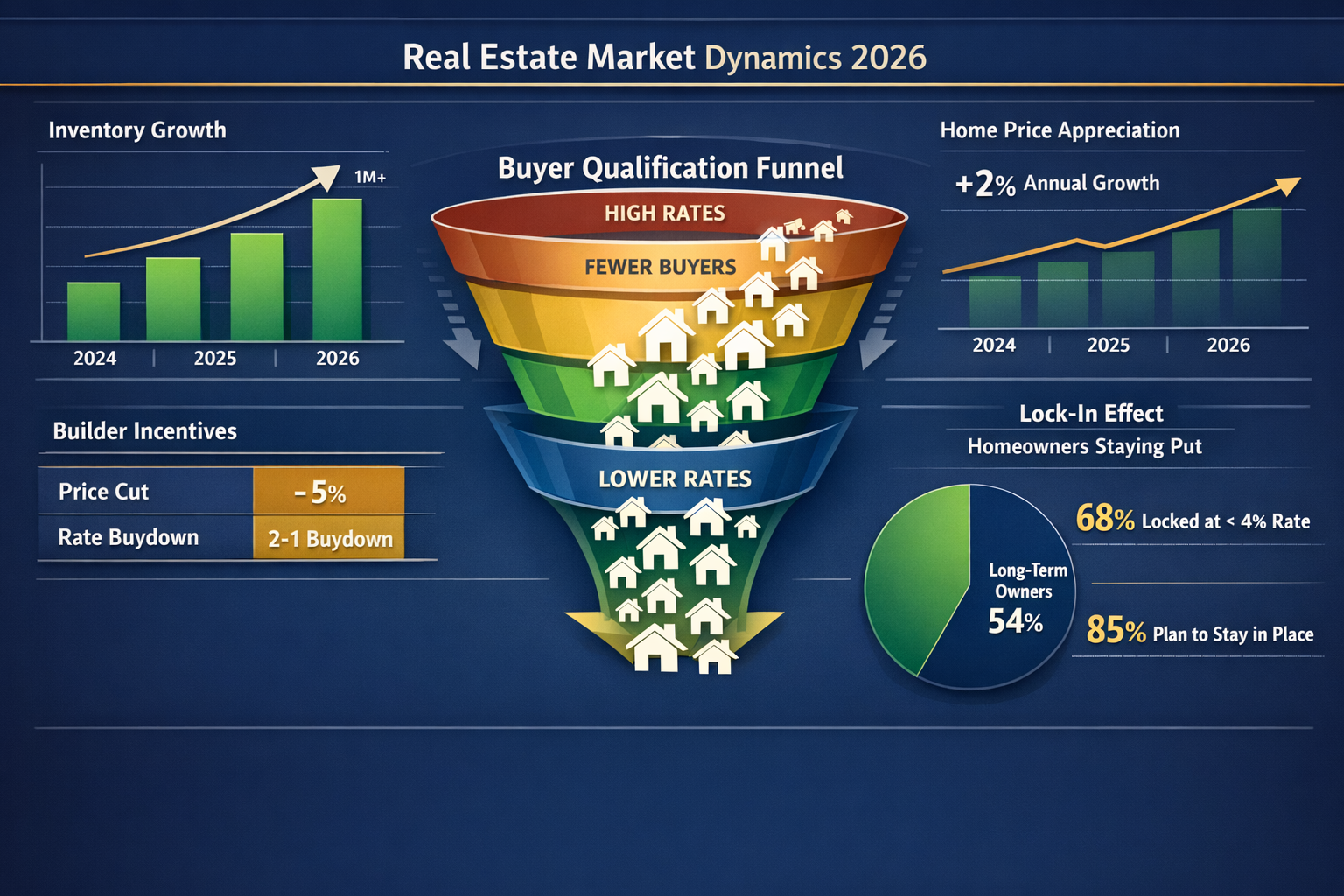
Despite improving mortgage affordability, home price growth is expected to remain modest at approximately 2% in 2026[7]. This restrained appreciation reflects a complex interplay of factors that surveyors must carefully weigh when conducting valuations.
The "lock-in effect" continues to constrain inventory as homeowners with sub-4% mortgage rates from 2020-2021 remain reluctant to sell and take on higher rates[2][4]. This supply constraint provides underlying price support even as affordability improves. However, increasing new-home construction and gradually rising existing-home listings are expected to moderate price pressures throughout 2026[5].
Importantly, while nominal prices may rise 2%, real-term prices (adjusted for inflation) are expected to decline in 2026[7]. This distinction matters significantly for surveyors preparing valuation reports, particularly for long-term investment analysis or estate planning purposes.
Transaction Volume Recovery and Market Velocity
The Impact of Falling Mortgage Rates on 2026 Property Valuations: Surveyor Adjustments for Improved Affordability extends beyond individual property assessments to market-wide transaction patterns. Realtor.com anticipates a 1.7% increase in sales of existing homes, while Redfin predicts a 3% rise in 2026[1].
This transaction volume recovery, though modest, represents a critical inflection point after years of subdued activity. Morgan Stanley strategists expect modest sales increases in 2026 with bigger growth anticipated in 2027[4], suggesting the market is in the early stages of a multi-year recovery cycle.
For surveyors, increased transaction velocity provides richer comparable data for valuation purposes. The expanded pool of recent sales enables more precise market value assessments, particularly in segments that experienced limited activity during the high-rate period of 2023-2024.
Regional Variation and Local Market Considerations
Not all markets will experience the Impact of Falling Mortgage Rates on 2026 Property Valuations: Surveyor Adjustments for Improved Affordability uniformly. Regional factors including:
- 🏘️ Local inventory levels and new construction pipelines
- 💼 Employment growth and wage trends
- 🚇 Infrastructure development and transportation access
- 📚 School quality and demographic shifts
These variables create micro-market dynamics that can significantly diverge from national trends. Surveyors must incorporate local market intelligence into their assessments, recognizing that a 6.3% average mortgage rate may translate to vastly different affordability improvements in different regions.
Surveyor Adjustments: RICS Methodologies for Enhanced Affordability Analysis
Integrating Affordability Metrics into Valuation Frameworks
Traditional valuation methodologies—comparison, income, and cost approaches—require supplementation with affordability-focused analysis in the current environment. RICS-qualified surveyors are increasingly incorporating buyer capacity modeling into their valuation reports.
This enhanced approach involves:
- Baseline affordability assessment: Calculating monthly payments at current mortgage rates
- Rate sensitivity analysis: Modeling valuation impacts across projected rate scenarios (5.5%-6.5% range)
- Buyer pool quantification: Estimating the number of qualified households at various price points
- Competitive positioning: Assessing subject property relative to alternatives within buyer budgets
When conducting different types of surveys, surveyors should explicitly address affordability dynamics in their commentary, particularly for properties priced near qualification thresholds where small rate changes create disproportionate demand shifts.
Lender-Specific Valuation Requirements
As mortgage rates decline, lender underwriting standards are evolving to reflect improved borrower capacity. Surveyors must stay current with lender-specific requirements, which increasingly emphasize:
- Stress testing at rates 2-3 percentage points above contract rates
- Debt-to-income ratio calculations incorporating updated payment schedules
- Loan-to-value considerations adjusted for changing market conditions
- Property condition assessments linked to insurability and long-term value retention
Understanding these lender requirements is essential when choosing the right property survey for mortgage purposes. A comprehensive Level 3 RICS Building Survey may reveal defects that affect both immediate valuation and future marketability as buyer pools expand.
Builder Incentive Programs and New Construction Valuations
Approximately 40% of builders are cutting prices on new construction homes by about 5% and offering additional incentives like mortgage rate buydowns[5]. These builder strategies create valuation complexities that surveyors must carefully navigate.
Rate buydown programs typically work as follows:
- Builder pays lender to temporarily reduce buyer's interest rate
- Common structures: 2-1 buydown (2% below market year 1, 1% below year 2, market rate year 3)
- Cost to builder: approximately 2-3% of loan amount
When valuing new construction, surveyors must determine whether to:
- Include incentive value in the comparable sales analysis
- Adjust for temporary vs. permanent cost reductions
- Account for competitive pressure on resale properties
The presence of significant builder incentives can create artificial price compression in the new construction segment, potentially affecting valuations of nearby resale properties. Surveyors should explicitly disclose incentive prevalence in their market commentary.
Practical Applications: Surveyor Strategies for 2026 Valuations
Comparable Selection in a Transitioning Market
The six-month comparable sales window traditionally used in valuations becomes problematic during periods of significant rate change. Sales from Q4 2025 (at higher rates) may not accurately reflect Q2 2026 market conditions (at lower rates).
Best practices for comparable selection include:
✅ Weighting recent sales more heavily to capture current market momentum
✅ Adjusting older comparables for rate-driven affordability changes
✅ Incorporating pending sales data to gauge forward-looking demand
✅ Analyzing days-on-market trends as leading indicators of market shifts
Surveyors should also consider time-adjusted pricing models that account for the trajectory of rate changes between comparable sale dates and the effective valuation date.
Enhanced Reporting and Client Communication
The Impact of Falling Mortgage Rates on 2026 Property Valuations: Surveyor Adjustments for Improved Affordability requires clear communication in valuation reports. Clients—whether lenders, buyers, or sellers—benefit from explicit discussion of:
- 📝 Rate assumptions underlying the valuation
- 📊 Sensitivity analysis showing value ranges across rate scenarios
- 🎯 Market positioning relative to buyer qualification thresholds
- ⏰ Temporal considerations affecting value stability
Professional surveyor pricing should reflect the additional analytical rigor required for these enhanced reports. Clients receive greater value from comprehensive affordability analysis that informs their decision-making beyond simple market value determination.
Technology Integration and Data Analytics
Advanced surveyors are leveraging technology platforms to enhance their affordability analysis capabilities:
- Automated payment calculators integrated into valuation software
- Buyer pool modeling tools using demographic and income data
- Rate scenario simulators for sensitivity testing
- Market velocity dashboards tracking transaction trends in real-time
These technological enhancements enable more sophisticated and defensible valuations while improving efficiency. Surveyors who invest in these capabilities position themselves as trusted advisors rather than mere compliance providers.
Strategic Implications for Stakeholders
Opportunities for First-Time Buyers
The expansion of the qualified buyer pool by approximately 5.5 million households, including about 1.6 million first-time renters[7], represents a generational opportunity for market entry. This demographic shift affects surveyor work in several ways:
- Increased demand for entry-level property surveys as new buyers enter the market
- Greater emphasis on condition reporting for buyers with limited reserves
- Enhanced focus on future maintenance costs in affordability calculations
Surveyors can add value by helping first-time buyers understand the total cost of ownership, not merely the monthly mortgage payment. This holistic approach builds client relationships and generates referral business.
Seller Positioning and Pricing Strategy
For sellers, the improving affordability environment creates strategic pricing opportunities. Properties priced just below key qualification thresholds may attract disproportionate buyer interest as rate declines expand the qualified pool.
Surveyors conducting pre-listing valuations should help sellers understand:
- Buyer capacity modeling at various price points
- Competitive positioning relative to alternative properties
- Timing considerations given projected rate movements
- Condition improvement ROI to maximize marketability
This consultative approach transforms the surveyor from a passive valuation provider to an active strategic advisor, enhancing professional reputation and client satisfaction.
Investor and Portfolio Considerations
For property investors and portfolio managers, the Impact of Falling Mortgage Rates on 2026 Property Valuations: Surveyor Adjustments for Improved Affordability creates both opportunities and risks:
Opportunities:
- 💹 Increased buyer demand supporting exit strategies
- 🏗️ Improved refinancing economics for leveraged holdings
- 📈 Enhanced rental demand from buyers delaying purchases
Risks:
- ⚠️ Compressed yields as property prices rise faster than rents
- 🔄 Increased competition from newly qualified buyers
- 📉 Potential rate volatility in H2 2026 affecting valuations
Surveyors providing commercial valuations or investment property assessments should explicitly address these dynamics, incorporating scenario analysis and risk commentary into their reports.
Conclusion
The Impact of Falling Mortgage Rates on 2026 Property Valuations: Surveyor Adjustments for Improved Affordability represents a fundamental shift in the UK property market. With rates projected to average 6.3% and potentially dipping to 5.50%-5.75% mid-year[1][4], surveyors face the challenge and opportunity of recalibrating valuation methodologies to reflect enhanced buyer capacity and evolving market dynamics.
Key conclusions include:
🎯 Affordability improvements are material: The expansion of the qualified buyer pool by 5.5 million households[7] creates genuine demand support for property values, even as nominal price growth remains modest at 2%.
📊 Valuation methodologies must evolve: Traditional approaches require supplementation with affordability analysis, rate sensitivity modeling, and builder incentive consideration to provide accurate, defensible valuations.
🔄 Market dynamics remain complex: The lock-in effect, regional variations, and rate volatility create a nuanced environment requiring sophisticated analysis and clear client communication.
💼 Professional opportunity exists: Surveyors who enhance their analytical capabilities and embrace technology-enabled affordability modeling position themselves as indispensable advisors in this transitioning market.
Actionable Next Steps
For Surveyors:
- Invest in technology platforms enabling sophisticated affordability analysis
- Develop standardized rate sensitivity reporting templates
- Build relationships with lenders to understand evolving underwriting requirements
- Enhance continuing professional development focused on market dynamics and buyer behavior
For Buyers:
- Engage qualified surveyors for comprehensive property assessments
- Request affordability analysis showing payment scenarios across rate ranges
- Consider timing strategies aligned with projected rate movements
- Evaluate total cost of ownership, not merely monthly payments
For Sellers:
- Obtain professional valuations incorporating current affordability dynamics
- Consider strategic pricing relative to buyer qualification thresholds
- Address condition issues that may affect buyer financing
- Time market entry to align with favorable rate environments
For Investors:
- Commission detailed valuations including scenario analysis
- Assess portfolio positioning relative to changing buyer demographics
- Evaluate refinancing opportunities as rates decline
- Monitor regional variations in affordability improvements
The property market of 2026 offers genuine opportunities for those who understand the interplay between mortgage rates, buyer capacity, and property valuations. By embracing enhanced analytical methodologies and maintaining focus on affordability dynamics, surveyors can deliver exceptional value to clients navigating this evolving landscape.
For professional guidance on property valuations and surveys tailored to current market conditions, consider consulting local chartered surveyors with expertise in your specific region and property type.
References
[1] Mortgage Rates Home Prices Predictions 2026 – https://www.axios.com/2026/01/01/mortgage-rates-home-prices-predictions-2026
[2] Interest Rates Impact On Housing Market – https://www.usbank.com/investing/financial-perspectives/investing-insights/interest-rates-impact-on-housing-market.html
[3] Q1 2026 Quarterly Economic Housing Market Update – https://www.veros.com/q1-2026-quarterly-economic-housing-market-update
[4] Mortgage Rates Forecast 2025 2026 Will Mortgage Rates Go Down – https://www.morganstanley.com/insights/articles/mortgage-rates-forecast-2025-2026-will-mortgage-rates-go-down
[5] 2026 Mortgage Industry Outlook Key Trends Impacting Home Ownership – https://www.fnbo.com/insights/mortgage/2026/2026-mortgage-industry-outlook-key-trends-impacting-home-ownership
[7] 2026 Real Estate Outlook What Leading Housing Economists Are Watching – https://www.nar.realtor/magazine/real-estate-news/2026-real-estate-outlook-what-leading-housing-economists-are-watching