

The UK housing market is witnessing a dramatic geographical shift in 2026, with young professionals increasingly abandoning London's sky-high property prices for the affordability and opportunity offered by northern cities. First-Time Buyer Surveys in Affordable Northern Regions: Capturing Demand as Young Professionals Migrate Away From London in 2026 represents not just a market trend, but a fundamental restructuring of where Britain's next generation chooses to put down roots. For chartered surveyors and property professionals, this migration presents an unprecedented opportunity to develop specialized practices focused on entry-level property assessment in high-growth northern markets.
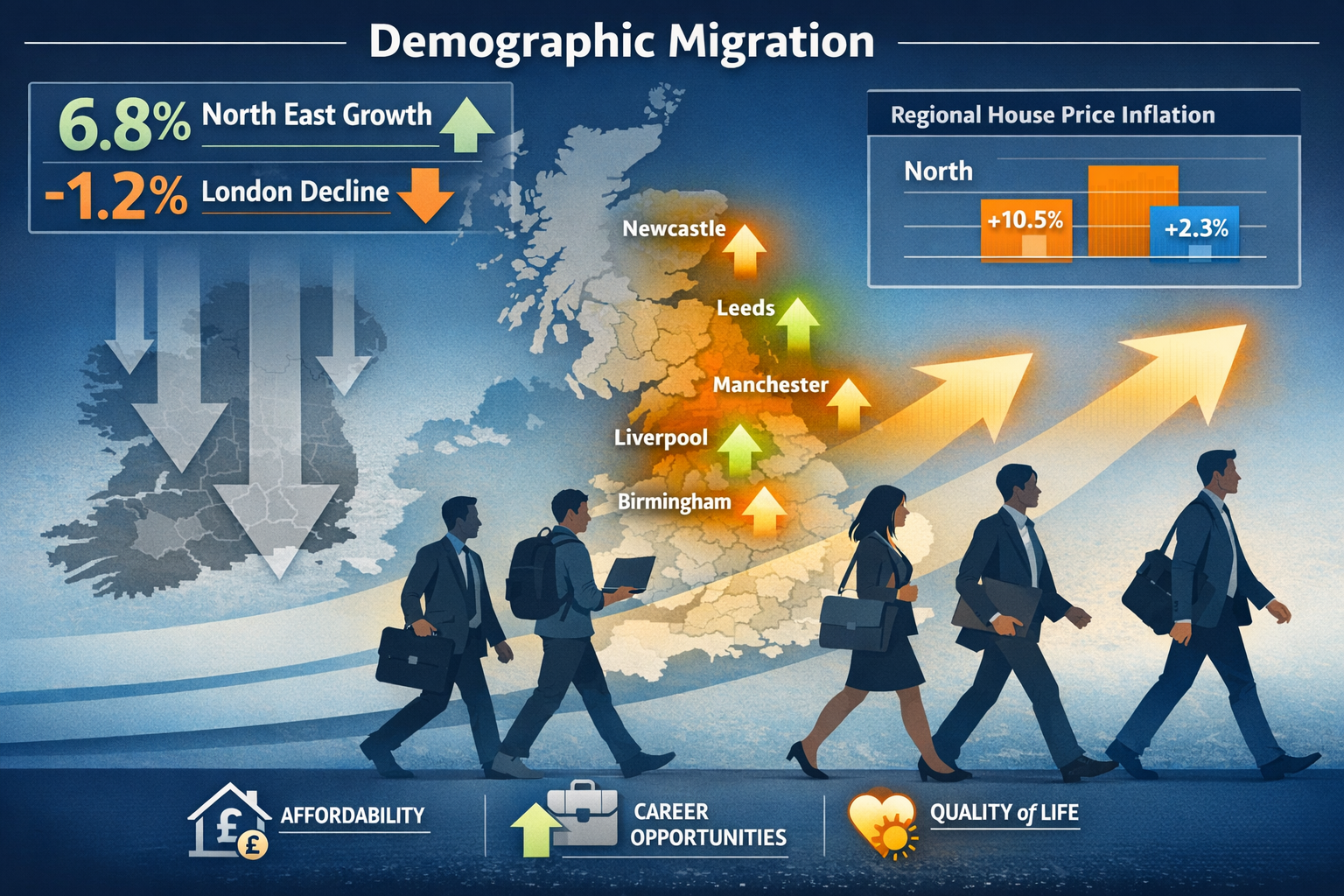
The numbers tell a compelling story. While London's property market languishes with a -1.2% annual decline, the North East surges ahead at +6.8%, the North West at +4.1%, and Yorkshire & Humber at +3.7%[2]. This isn't a temporary blip—it's a sustained demographic and economic realignment that's reshaping the entire property landscape. Manchester, Birmingham, Leeds, Liverpool, and Newcastle are no longer just "affordable alternatives" to London; they're becoming first-choice destinations for ambitious young professionals seeking both career opportunities and realistic homeownership prospects.
Key Takeaways
🏠 Regional price growth disparity: Northern regions are experiencing house price inflation of 3.7% to 6.8%, while London faces -1.2% decline, creating unprecedented opportunities for first-time buyers in affordable markets[2]
📊 First-time buyer activity surge: High loan-to-value lending (deposits of 15% or less) reached decade-high levels in 2025, with first-time buyer share of purchase activity above long-run averages[2]
🔍 Surveyor opportunity: Nine in 10 northern brokers expect increased business in 2026, signaling strong demand for specialized first-time buyer survey services in northern regions[4]
💼 Professional migration trend: Young professionals are permanently relocating from London to northern cities, driven by remote work flexibility and superior affordability ratios
📈 Sustained growth forecast: Expert analysis predicts the north-south divide will persist, with northern regions continuing to outperform southern markets throughout 2026 and beyond[2]
Understanding the Great Northern Migration of 2026
The Demographics Driving Change
The young professionals leaving London in 2026 represent a specific demographic cohort with distinct characteristics and priorities. Typically aged between 25 and 35, these individuals have established their careers sufficiently to consider homeownership but find London's property ladder impossibly steep. The average London property price remains approximately 13 times the average salary, while northern cities offer ratios closer to 5-7 times earnings—a difference that fundamentally alters what's achievable.
This migration isn't driven solely by affordability constraints. Remote and hybrid working arrangements, normalized during and after the pandemic, have permanently severed the necessity of London proximity for many professional roles. Technology, finance, marketing, and creative industries—traditionally London-centric—now routinely offer location-flexible positions. Young professionals can maintain London-level salaries while enjoying northern living costs, creating a financial arbitrage opportunity that's simply too attractive to ignore.
Economic Factors Fueling Northern Demand
The economic fundamentals supporting First-Time Buyer Surveys in Affordable Northern Regions: Capturing Demand as Young Professionals Migrate Away From London in 2026 extend beyond simple affordability. Northern cities have invested heavily in infrastructure, cultural amenities, and business districts that rival anything London offers. Manchester's Spinningfields, Birmingham's Brindleyplace, and Leeds' financial quarter provide sophisticated urban environments without the premium price tags.
The Bank of England's anticipated interest rate cuts in 2026 will further accelerate this trend by reducing mortgage costs and improving borrowing capacity[2]. For first-time buyers, even a 0.5% reduction in mortgage rates can translate to thousands of pounds in annual savings—money that goes significantly further in northern property markets. Combined with government schemes supporting high loan-to-value lending, the financial barriers to northern homeownership are lower than they've been in over a decade[2].
Northern Ireland and Scotland continue to lead UK house price growth, with Northern Ireland recording +7.1% annual inflation[1][2]. This sustained growth reflects genuine demand fundamentals rather than speculative bubbles, as these regions offer employment opportunities, educational institutions, and quality of life improvements that attract permanent residents rather than investor speculation.
First-Time Buyer Survey Requirements in Northern Markets
Why Specialized Survey Approaches Matter
First-time buyers purchasing in northern regions face unique property challenges that require specialized surveying expertise. Unlike London's predominantly modern developments and converted flats, northern cities feature extensive stocks of Victorian and Edwardian terraced housing, former industrial conversions, and inter-war semi-detached properties. Each building type presents distinct structural considerations that generic survey approaches may inadequately address.
Victorian terraced houses, ubiquitous in Manchester, Leeds, and Liverpool, frequently exhibit characteristic issues including solid wall construction requiring specialized damp management, original slate roofs nearing end-of-life, and subsidence risks from historic mining activity. A comprehensive homebuyer survey must account for these regional specificities rather than applying standardized London-centric assessment criteria.
Former industrial conversions—warehouses, mills, and factories transformed into residential lofts—represent another northern specialty requiring expert evaluation. These properties often feature non-standard construction methods, complex shared infrastructure, and potential contamination issues from previous industrial use. First-time buyers, typically lacking property experience, depend heavily on thorough surveyor guidance to understand these complexities before committing to purchase.
Essential Survey Components for Entry-Level Northern Properties
When conducting First-Time Buyer Surveys in Affordable Northern Regions: Capturing Demand as Young Professionals Migrate Away From London in 2026, surveyors should prioritize several critical assessment areas:
Structural integrity evaluation must address region-specific concerns including subsidence from historic coal mining (particularly in Yorkshire, Durham, and Lancashire), foundation settlement in clay soil areas, and wall tie corrosion in cavity wall construction from the 1930s-1960s. Understanding choosing the right property survey becomes crucial for first-time buyers navigating these technical considerations.
Damp and moisture assessment requires particular attention in northern climates with higher rainfall and humidity levels. Solid wall Victorian properties without damp-proof courses, penetrating damp from exposed positions, and condensation issues from inadequate ventilation all demand thorough investigation. Many first-time buyers underestimate the costs of addressing damp issues, making comprehensive surveyor reporting essential for informed decision-making.
Energy efficiency and insulation analysis carries heightened importance as young professionals prioritize sustainability and running costs. Northern properties frequently feature single-glazed windows, uninsulated solid walls, and inefficient heating systems. Surveyors should provide detailed cost estimates for improvement works, helping buyers budget realistically for both purchase and post-acquisition upgrades.
Roof condition assessment represents a critical value component, as slate and tile roof replacements can cost £8,000-£15,000 on typical terraced properties. Identifying imminent roof failures before purchase allows buyers to negotiate price reductions or plan financially for necessary works.
Adapting Survey Methodologies for First-Time Buyer Needs
First-time buyers require more explanatory, educational survey reports than experienced property investors. Survey documentation should avoid excessive technical jargon, include photographic evidence of identified issues, and provide clear cost ranges for remedial works. Many surveyors are developing supplementary "first-time buyer guides" that accompany formal reports, explaining common property terminology and prioritizing issues by urgency and cost.
The rise of technology-enhanced surveys offers particular value for first-time buyers. Thermal imaging identifies insulation deficiencies and hidden moisture penetration, while drone surveys provide comprehensive roof assessments without access difficulties. These modern approaches deliver more thorough evaluations while demonstrating professional sophistication that builds client confidence.
Regional Hotspots: Where First-Time Buyers Are Concentrating
Manchester: The Northern Powerhouse Leader
Manchester consistently tops the list for young professional migration, combining strong employment growth, cultural vibrancy, and relative affordability. The city's property market shows particular strength in areas like Ancoats, the Northern Quarter, and Chorlton, where Victorian terraces and modern developments attract first-time buyers seeking urban lifestyles.
Average property prices in Manchester's first-time buyer hotspots range from £180,000 to £250,000, compared to London equivalents exceeding £500,000. This affordability gap enables young professionals to purchase two or three-bedroom properties rather than studio flats, fundamentally improving quality of life and long-term wealth accumulation potential.
Surveyors operating in Manchester should develop expertise in the city's characteristic red brick terraced housing, canal-side warehouse conversions, and the growing new-build apartment sector around Salford Quays and Spinningfields. Understanding local planning policies, conservation area restrictions, and the city's ambitious development pipeline provides valuable contextual knowledge that enhances client advisory services.
Birmingham: Britain's Second City Renaissance
Birmingham's ongoing transformation from industrial heritage to modern economic hub has created exceptional opportunities for first-time buyers. The city's property market benefits from major infrastructure investment including HS2 rail connectivity, extensive city center regeneration, and growing technology and professional services sectors.
First-time buyer activity concentrates in areas like Digbeth, Jewellery Quarter, and Harborne, where period properties and new developments offer diverse options at accessible price points. The January 2026 RICS survey notes "early signs of increased activity…particularly in lower-priced flats and mid-market family houses"[1], a pattern particularly evident in Birmingham's diverse property stock.
Birmingham's Victorian terraced housing requires similar surveying considerations to Manchester, with additional attention to the city's extensive canal network and associated ground stability issues. Surveyors should also understand Birmingham's ambitious environmental initiatives, which may affect property values as sustainability becomes increasingly important to young professional buyers.
Leeds, Liverpool, and Newcastle: Emerging First-Time Buyer Markets
Leeds combines strong financial services employment with excellent transport connectivity and a thriving student population that transitions into young professional homeownership. Areas like Chapel Allerton, Headingley, and the city center's South Bank development offer varied property types at prices typically 40-50% below London equivalents.
Liverpool's cultural renaissance and waterfront regeneration have transformed the city's appeal to young professionals. The Georgian Quarter, Baltic Triangle, and Sefton Park areas provide characterful period properties requiring specialized survey expertise, particularly regarding the city's sandstone construction and historic building conservation requirements.
Newcastle and the wider North East region offer the UK's most affordable entry-level property market, with the region recording the highest annual house price inflation at +6.8%[2]. This combination of affordability and growth potential attracts first-time buyers seeking maximum value, though surveyors must address region-specific issues including former mining subsidence and exposed coastal weather conditions.
Market Dynamics: Understanding the 2026 Northern Property Landscape
Current Market Conditions and Trajectory
The January 2026 RICS Residential Market Survey suggests market conditions are "tentatively signalling a potential turning point," with activity measures improving significantly from -19% in October 2025[1]. This recovery is particularly pronounced in northern regions, where demand from first-time buyers and relocating professionals drives sustained transaction volumes.
Nine in 10 northern brokers expect to write more business in 2026, according to Primis broker surveys[4], reflecting confidence in sustained demand growth. This optimism contrasts sharply with southern market sentiment, where affordability constraints and economic uncertainty suppress activity levels. For surveyors, this divergence creates clear strategic imperatives: develop northern market expertise or risk missing the sector's primary growth opportunity.
The share of high loan-to-value lending reached its highest level for over a decade in 2025[2], directly benefiting first-time buyers who traditionally struggle with deposit accumulation. This credit availability, combined with anticipated Bank of England rate cuts, creates favorable financing conditions that support continued first-time buyer activity throughout 2026 and beyond.
Price Growth Forecasts and Regional Variations
Paula Higgins, CEO of HomeOwners Alliance, forecasts UK house prices will be around 2% higher in 2026, with the Midlands and North leading growth thanks to stronger market conditions[2]. This national average masks significant regional variation, with northern cities potentially experiencing 4-6% growth while London and the South East remain flat or decline modestly.
An April 2025 HomeOwners Alliance survey found 45% of UK adults expect house prices to rise in 2026, with only 10% expecting falls[2]. This sentiment reflects growing recognition of the north-south divide and the fundamental demand drivers supporting northern markets. For first-time buyers, purchasing in growth markets offers both immediate affordability and medium-term capital appreciation potential—a combination unavailable in stagnant southern markets.
The persistence of the north-south divide appears structurally embedded rather than cyclical. Remote working permanence, northern infrastructure investment, and the simple mathematics of affordability ratios suggest this pattern will continue well beyond 2026. Surveyors positioning themselves as northern market specialists are investing in long-term practice development rather than chasing temporary trends.
Building a Specialized First-Time Buyer Survey Practice

Service Offerings and Differentiation Strategies
Surveyors seeking to capitalize on First-Time Buyer Surveys in Affordable Northern Regions: Capturing Demand as Young Professionals Migrate Away From London in 2026 should develop comprehensive service packages addressing this demographic's specific needs. Beyond standard structural surveys, consider offering:
First-time buyer consultation services that educate clients about the survey process, property types, and regional considerations before formal instruction. This educational approach builds trust and positions surveyors as advisors rather than mere service providers.
Renovation potential assessments that evaluate properties not just for defects but for improvement opportunities. Young professionals often purchase properties requiring modernization, viewing renovation as both value-creation and personalization. Surveyors who can identify structural feasibility for extensions, loft conversions, or reconfiguration provide valuable strategic guidance beyond defect reporting.
Energy efficiency upgrade planning that details costs and benefits of insulation improvements, heating system replacements, and renewable energy installations. As sustainability consciousness grows among younger buyers, this advisory service addresses both environmental values and long-term cost management.
Ongoing support packages that include post-purchase consultations, contractor recommendation services, and periodic re-inspections as renovation works progress. This extended relationship model generates recurring revenue while building client loyalty and referral networks.
Marketing and Client Acquisition Approaches
Reaching first-time buyers in northern regions requires digital-first marketing strategies aligned with how this demographic researches and selects professional services. Online presence through comprehensive websites, Google Business optimization, and active social media engagement forms the foundation of effective client acquisition.
Content marketing addressing common first-time buyer questions—"What survey do I need for a Victorian terrace?", "How much should I budget for survey and repairs?", "What are common issues in Manchester properties?"—establishes expertise while improving search visibility. Educational blog posts, video content, and downloadable guides attract organic traffic from buyers actively researching their property purchases.
Partnership development with northern mortgage brokers, estate agents, and first-time buyer specialists creates referral networks that generate consistent instruction flow. The Primis broker survey showing 90% of northern brokers expecting business growth[4] highlights the opportunity for mutually beneficial professional relationships.
Local market specialization—positioning as "the first-time buyer survey specialist for Manchester" or "Leeds property experts for young professionals"—creates clear differentiation in crowded markets. Geographic and demographic focus allows concentrated marketing investment and genuine expertise development that generic competitors cannot match.
Pricing Strategies for First-Time Buyer Markets
First-time buyers operate under tight budget constraints, making pricing strategy critical for market penetration. Transparent, competitive pricing with clear service level differentiation allows buyers to select appropriate survey depth based on property type and budget availability.
Consider offering tiered service packages:
| Service Level | Typical Price Range | Appropriate For |
|---|---|---|
| Basic Condition Report | £300-£450 | Modern apartments, new-builds under warranty |
| Standard Homebuyer Survey | £450-£650 | Conventional properties in good condition |
| Comprehensive Building Survey | £650-£950 | Older properties, unusual construction, renovation projects |
| Enhanced First-Time Buyer Package | £750-£1,100 | Includes consultation, renovation assessment, energy analysis |
Regional pricing should reflect local market conditions while remaining competitive with established practices. Northern survey fees typically run 15-25% below London equivalents, reflecting both lower property values and regional cost structures. However, competing solely on price risks commoditization—emphasize value, expertise, and specialized first-time buyer service instead.
Flexible payment options including deposit-on-instruction with balance-on-completion, or integration with mortgage advance payments, reduce financial barriers for cash-constrained buyers. Some progressive practices offer "survey-and-fix" partnerships with approved contractors, where survey costs are credited against subsequent repair work—a model that addresses buyer concerns about unexpected expense accumulation.
Technology and Innovation in First-Time Buyer Surveys
Digital Tools Enhancing Survey Quality
Modern surveying technology offers particular benefits when serving first-time buyers who value transparency, comprehension, and thoroughness. Digital survey platforms enable real-time reporting, photographic documentation, and interactive floor plans that make technical findings more accessible to property novices.
Thermal imaging cameras identify insulation deficiencies, moisture penetration, and heating system inefficiencies that conventional visual inspection might miss. For first-time buyers prioritizing energy efficiency and running costs, thermal surveys provide valuable data supporting renovation investment decisions.
Drone surveys deliver comprehensive roof and chimney assessments without access equipment costs, while generating impressive visual documentation that demonstrates thoroughness and professionalism. The technology particularly suits northern terraced properties where traditional roof access proves difficult and dangerous.
Moisture meters, borescopes, and other diagnostic equipment enable evidence-based reporting that reduces ambiguity and supports clear client communication. First-time buyers appreciate definitive findings over cautious hedging, even when news is unfavorable—clarity enables informed decision-making.
Client Communication and Report Delivery
Report presentation significantly influences client satisfaction and referral likelihood. Traditional lengthy technical documents overwhelm first-time buyers unfamiliar with construction terminology and building pathology. Progressive surveyors are developing dual-format reporting: comprehensive technical documentation for legal protection, accompanied by executive summaries and visual guides for client accessibility.
Video walk-throughs where surveyors explain key findings while touring the property provide engaging, comprehensible communication that written reports alone cannot achieve. These videos become valuable reference materials as buyers proceed through purchase completion and subsequent renovation planning.
Mobile apps enabling clients to track survey progress, receive preliminary findings, and schedule follow-up consultations enhance service perception and reduce anxiety during the stressful purchase process. First-time buyers particularly value transparency and communication, making these technological touches significant competitive differentiators.
Data Analytics and Market Intelligence
Surveyors accumulating extensive first-time buyer survey data in northern regions can develop valuable market intelligence that informs both client advisory services and business development strategies. Defect pattern analysis by property age, type, and location identifies common issues that inform pre-survey client consultations and realistic budget planning.
Price-per-square-foot comparisons, renovation cost benchmarking, and neighborhood appreciation tracking provide contextual market intelligence that positions surveyors as comprehensive property advisors rather than narrow technical specialists. First-time buyers value this holistic guidance, particularly when relocating from other regions without local market knowledge.
Anonymized survey data can support content marketing through research reports, infographics, and trend analysis that demonstrate expertise while generating media coverage and inbound inquiries. "The State of Manchester First-Time Buyer Properties: 2026 Survey Analysis" becomes both a valuable industry contribution and a powerful marketing asset.
Regulatory Considerations and Professional Standards
RICS Standards and First-Time Buyer Surveys
All property surveys must comply with Royal Institution of Chartered Surveyors (RICS) standards regardless of client demographic or property location. However, first-time buyer surveys warrant particular attention to clarity, comprehensiveness, and educational value given clients' limited property experience.
The RICS Home Survey Standard mandates specific content, formatting, and professional conduct requirements that protect both clients and surveyors. Practices specializing in first-time buyer work should ensure all surveyors maintain current RICS membership, complete required continuing professional development, and carry appropriate professional indemnity insurance.
Quality assurance processes including peer review of reports, client satisfaction monitoring, and regular technical training maintain service standards while reducing professional liability risks. First-time buyers may be more likely to pursue complaints or legal action if survey deficiencies contribute to unexpected costs, making rigorous quality control essential.
Consumer Protection and Transparency Requirements
The Consumer Protection from Unfair Trading Regulations require clear, accurate service descriptions and pricing transparency. Terms of engagement should explicitly define survey scope, limitations, and exclusions in plain language accessible to first-time buyers without technical or legal backgrounds.
Pre-instruction consultations should establish realistic expectations about what surveys can and cannot identify, the difference between various survey levels, and the inherent uncertainties in assessing concealed building elements. Documented client acknowledgment of these limitations provides important legal protection while ensuring informed service selection.
Complaints handling procedures should be clearly communicated and readily accessible, with internal resolution processes preceding escalation to RICS dispute resolution services. Proactive client communication and responsive issue management typically resolve concerns before formal complaints arise, protecting both reputation and professional standing.
Case Studies: Successful First-Time Buyer Survey Practices
Manchester Practice: Specialization Driving Growth
A Manchester-based surveying practice repositioned itself in 2024 as "The First-Time Buyer Survey Specialist," developing targeted services, marketing, and client experience designed specifically for entry-level purchasers. Within 18 months, first-time buyer instructions grew from 30% to 75% of total survey volume, with average client acquisition costs falling 40% through referral network development.
Key success factors included educational content marketing addressing common first-time buyer questions, partnership development with local mortgage brokers and estate agents, and tiered service packages allowing budget-conscious buyers to select appropriate survey depth. The practice developed particular expertise in Victorian terraced properties and warehouse conversions, becoming the recognized specialist for these property types.
Client satisfaction scores exceeded 95%, driven by clear communication, comprehensive reporting, and post-survey consultation services that supported buyers through completion and early ownership. The practice's Google Business profile accumulated over 200 five-star reviews, creating powerful social proof that drove organic inquiry growth.
Birmingham Practice: Technology-Enhanced Service Delivery
A Birmingham surveying firm invested heavily in survey technology including thermal imaging, drone capabilities, and digital reporting platforms to differentiate its first-time buyer services. Marketing emphasized "The most thorough first-time buyer surveys in Birmingham," with sample reports, technology demonstrations, and educational videos showcasing the comprehensive assessment approach.
The technology investment enabled premium pricing 15-20% above local competitors while maintaining strong instruction volumes, as first-time buyers valued the thoroughness and modern approach. Thermal imaging regularly identified hidden issues that conventional surveys missed, generating word-of-mouth referrals and reinforcing the premium positioning.
The practice developed "renovation potential" assessment services that evaluated structural feasibility and cost estimates for common improvement projects—loft conversions, rear extensions, and internal reconfiguration. This forward-looking advisory approach attracted ambitious first-time buyers viewing properties as long-term homes requiring personalization and value enhancement.
Leeds Practice: Integrated Service Partnerships
A Leeds-based surveyor developed partnership arrangements with local contractors, architects, and project managers to offer integrated "survey-to-renovation" services for first-time buyers purchasing properties requiring improvement. Survey fees were credited against subsequent design or construction work, reducing the perceived cost barrier while generating referral fees from partner professionals.
This integrated approach particularly appealed to first-time buyers relocating from other regions who lacked local contractor networks and renovation expertise. The surveyor's role expanded from technical assessment to trusted advisor coordinating multiple specialists, generating both direct fee income and ongoing relationship value.
The practice maintained strict independence in survey reporting, with partnership arrangements disclosed transparently and no pressure on clients to engage recommended contractors. This ethical approach built trust while creating genuine value through vetted professional introductions and coordinated service delivery.
Future Outlook: Sustaining Success in Northern First-Time Buyer Markets

Long-Term Demographic and Economic Trends
The migration of young professionals from London to northern regions appears structurally embedded rather than cyclically temporary. Remote working permanence, northern infrastructure investment, and fundamental affordability mathematics suggest this pattern will persist throughout the 2020s and beyond. Surveyors investing in northern market expertise are positioning for sustained long-term opportunity rather than short-term trend exploitation.
Population projections indicate continued growth in northern cities as both domestic migration and international immigration favor affordable regions with employment opportunities. Manchester, Birmingham, and Leeds all project population increases of 8-12% by 2030, with young professional demographics showing particularly strong growth. This demographic expansion directly translates to sustained first-time buyer demand and property transaction volumes.
Climate change considerations may further reinforce northern migration as southern England faces increased flooding risks, water scarcity, and heat stress. Northern regions' relative climate resilience and water abundance could become increasingly important location factors for long-term property investment decisions.
Evolving Service Requirements and Practice Development
First-time buyer expectations will continue evolving toward comprehensive advisory services beyond narrow technical assessment. Surveyors who develop holistic property guidance covering structural condition, renovation potential, energy efficiency, and neighborhood dynamics will capture premium market positioning and client loyalty.
Sustainability assessment will grow from niche consideration to mainstream requirement as younger buyers prioritize environmental impact and energy costs. Surveyors should develop expertise in EPC ratings, retrofit potential, renewable energy feasibility, and embodied carbon considerations that inform both purchase decisions and post-acquisition improvement planning.
Technology integration will accelerate, with artificial intelligence supporting defect identification, automated report generation, and predictive maintenance planning. Surveyors who embrace these tools while maintaining personal client relationships will achieve optimal efficiency and service quality combinations.
Strategic Recommendations for Surveying Practices
Practices seeking to capitalize on First-Time Buyer Surveys in Affordable Northern Regions: Capturing Demand as Young Professionals Migrate Away From London in 2026 should consider these strategic priorities:
Develop genuine regional expertise through concentrated geographic focus, property type specialization, and local market intelligence accumulation. Generic national practices cannot match the depth of knowledge and network relationships that dedicated regional specialists build over time.
Invest in marketing and brand development that clearly positions the practice as first-time buyer specialists. Educational content, transparent pricing, accessible communication, and client testimonials build trust with this demographic more effectively than traditional professional service marketing.
Build referral networks with mortgage brokers, estate agents, financial advisors, and other professionals serving first-time buyers. Reciprocal referral arrangements and co-marketing initiatives generate consistent instruction flow while reducing client acquisition costs.
Embrace technology that enhances survey quality, improves client communication, and demonstrates professional sophistication. Thermal imaging, drones, digital reporting, and client portals differentiate modern practices from traditional competitors.
Maintain rigorous quality standards through RICS compliance, peer review processes, continuing professional development, and client satisfaction monitoring. First-time buyer work requires particular attention to clarity, comprehensiveness, and educational value given clients' limited property experience.
Conclusion: Seizing the Northern Opportunity
The convergence of demographic migration, regional price growth disparity, and favorable financing conditions creates an exceptional opportunity for surveyors specializing in First-Time Buyer Surveys in Affordable Northern Regions: Capturing Demand as Young Professionals Migrate Away From London in 2026. The data is unambiguous: northern regions are experiencing sustained house price growth of 3.7% to 6.8% while London declines[2], first-time buyer activity has reached decade-high levels[2], and nine in 10 northern brokers expect business growth in 2026[4].
This isn't a temporary market fluctuation—it's a fundamental restructuring of UK property demand driven by permanent remote working adoption, infrastructure investment, and the simple mathematics of affordability. Young professionals can no longer justify London's premium pricing when northern cities offer comparable career opportunities, superior quality of life, and realistic homeownership prospects. This migration will sustain first-time buyer demand in Manchester, Birmingham, Leeds, Liverpool, Newcastle, and other northern centers throughout the remainder of the 2020s and beyond.
For surveying practices, the strategic imperative is clear: develop specialized expertise in northern first-time buyer markets or risk missing the sector's primary growth opportunity. This specialization requires more than geographic presence—it demands deep understanding of regional property types, characteristic defects, local planning considerations, and the specific needs of first-time buyer clients. Victorian terraced housing, industrial conversions, and inter-war semi-detached properties each present distinct assessment challenges requiring genuine expertise rather than generic survey approaches.
Actionable Next Steps
Surveyors and practices seeking to capitalize on this opportunity should implement these concrete actions:
✅ Conduct market analysis identifying specific northern regions and neighborhoods experiencing strongest first-time buyer demand, then develop concentrated expertise in those areas
✅ Develop specialized service packages addressing first-time buyer needs including educational consultations, renovation potential assessments, energy efficiency analysis, and post-purchase support
✅ Invest in survey technology including thermal imaging, drone capabilities, and digital reporting platforms that enhance quality while demonstrating professional sophistication
✅ Build referral partnerships with northern mortgage brokers, estate agents, and financial advisors serving first-time buyers, creating consistent instruction flow and reduced acquisition costs
✅ Create educational content addressing common first-time buyer questions about property types, survey requirements, and regional considerations, establishing expertise while improving search visibility
✅ Implement transparent pricing with clear service level differentiation allowing budget-conscious buyers to select appropriate survey depth based on property characteristics and financial constraints
✅ Establish quality assurance processes ensuring RICS compliance, comprehensive reporting, clear communication, and client satisfaction monitoring that protects both buyers and professional reputation
The northern first-time buyer market represents the UK property sector's most significant growth opportunity in 2026 and beyond. Surveyors who recognize this trend early, develop genuine regional expertise, and build specialized service offerings will establish market-leading positions that generate sustained competitive advantage. The migration from London to affordable northern regions isn't slowing—it's accelerating. The question isn't whether to engage this market, but how quickly practices can develop the expertise and positioning to capture this exceptional opportunity.
For those ready to act, the path forward combines regional specialization, first-time buyer focus, technology adoption, and partnership development. The practices that execute this strategy effectively will not only capture immediate market share but establish long-term foundations for sustained growth as demographic and economic trends continue reshaping UK property demand throughout the remainder of this decade.
References
[1] Uk Residential Market Survey January 2026 – https://www.rics.org/content/dam/ricsglobal/documents/market-surveys/uk-residential-market-survey/UK-Residential-Market-Survey_January-2026.pdf
[2] House Price Forecast – https://hoa.org.uk/advice/guides-for-homeowners/i-am-buying/house-price-forecast/
[3] Uk Home Kerb Appeal Trends Report 2026 – https://thebespokesignhouse.com/blogs/news/uk-home-kerb-appeal-trends-report-2026
[4] Majority Of Primis Brokers In The North Optimistic About Prospects For 2026 – https://www.bridgingandcommercial.co.uk/article/22195/majority-of-primis-brokers-in-the-north-optimistic-about-prospects-for-2026