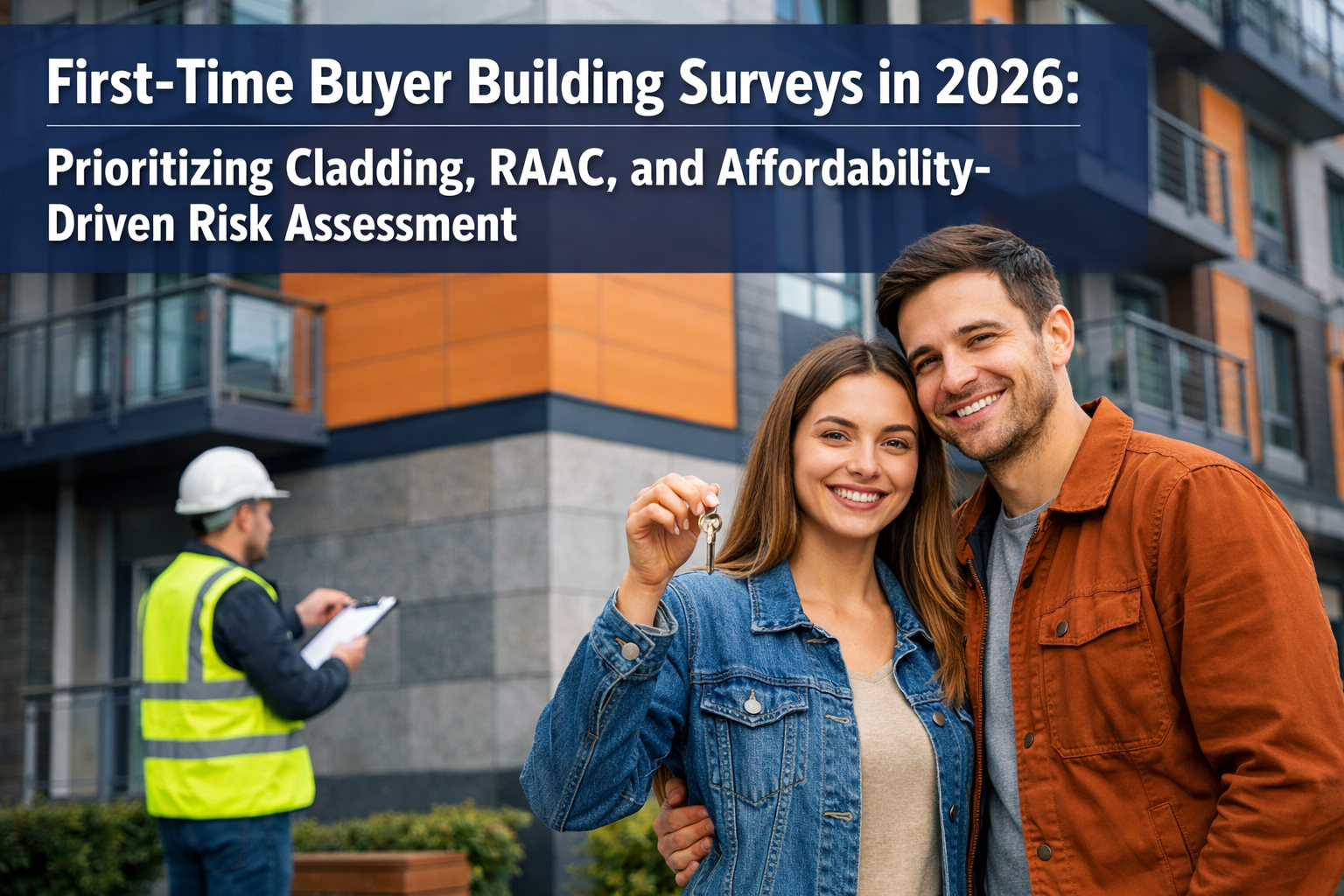

The property market in 2026 presents a unique window of opportunity for first-time buyers. With affordability slowly improving and market activity expected to surge, thousands of new buyers are preparing to take their first steps onto the property ladder. However, this optimism must be tempered with caution—particularly when it comes to building defects that can transform a dream home into a financial nightmare.
First-Time Buyer Building Surveys in 2026: Prioritizing Cladding, RAAC, and Affordability-Driven Risk Assessment has become essential guidance for both buyers and surveying professionals. The landscape has fundamentally changed since the Grenfell Tower tragedy exposed dangerous cladding systems, and the subsequent discovery of Reinforced Autoclaved Aerated Concrete (RAAC) in thousands of buildings has added another layer of complexity. For budget-conscious first-time buyers, identifying these high-risk materials before purchase isn't just prudent—it's financially critical.
This comprehensive guide explores how first-time buyers can navigate building surveys in 2026, focusing on the defects that pose the greatest financial and safety risks while maintaining affordability in an already expensive home-buying process.
Key Takeaways
✅ Level 2 (Homebuyer) surveys provide the optimal balance of thoroughness and affordability for most first-time buyers purchasing conventional properties in reasonable condition
🏗️ Cladding and RAAC identification should be explicit priorities in survey briefs, as these materials can render properties unmortgageable and require six-figure remediation costs
💰 Budget-conscious risk assessment means targeting inspections toward defects with the highest financial impact rather than comprehensive investigation of minor issues
📋 Survey costs range from £400-£1,500 depending on level and property complexity, representing essential insurance against far costier post-purchase discoveries
🔍 Targeted additional investigations for specific concerns (damp, drainage, structural movement) provide cost-effective depth without upgrading to full Level 3 surveys
Understanding Building Survey Levels for First-Time Buyers in 2026
The Royal Institution of Chartered Surveyors (RICS) updated its survey framework in March 2021, establishing three standardized levels that replaced the previous naming conventions.[2] Understanding these options is fundamental for first-time buyers making informed decisions about survey investment.
The Three-Tier RICS Survey Framework
Level 1 (Condition Report) represents the most basic assessment, suitable only for newer properties in excellent condition. These surveys cost between £300-£900 but provide limited protection.[2] For first-time buyers—who typically purchase older, more affordable properties—Level 1 surveys rarely offer adequate protection.
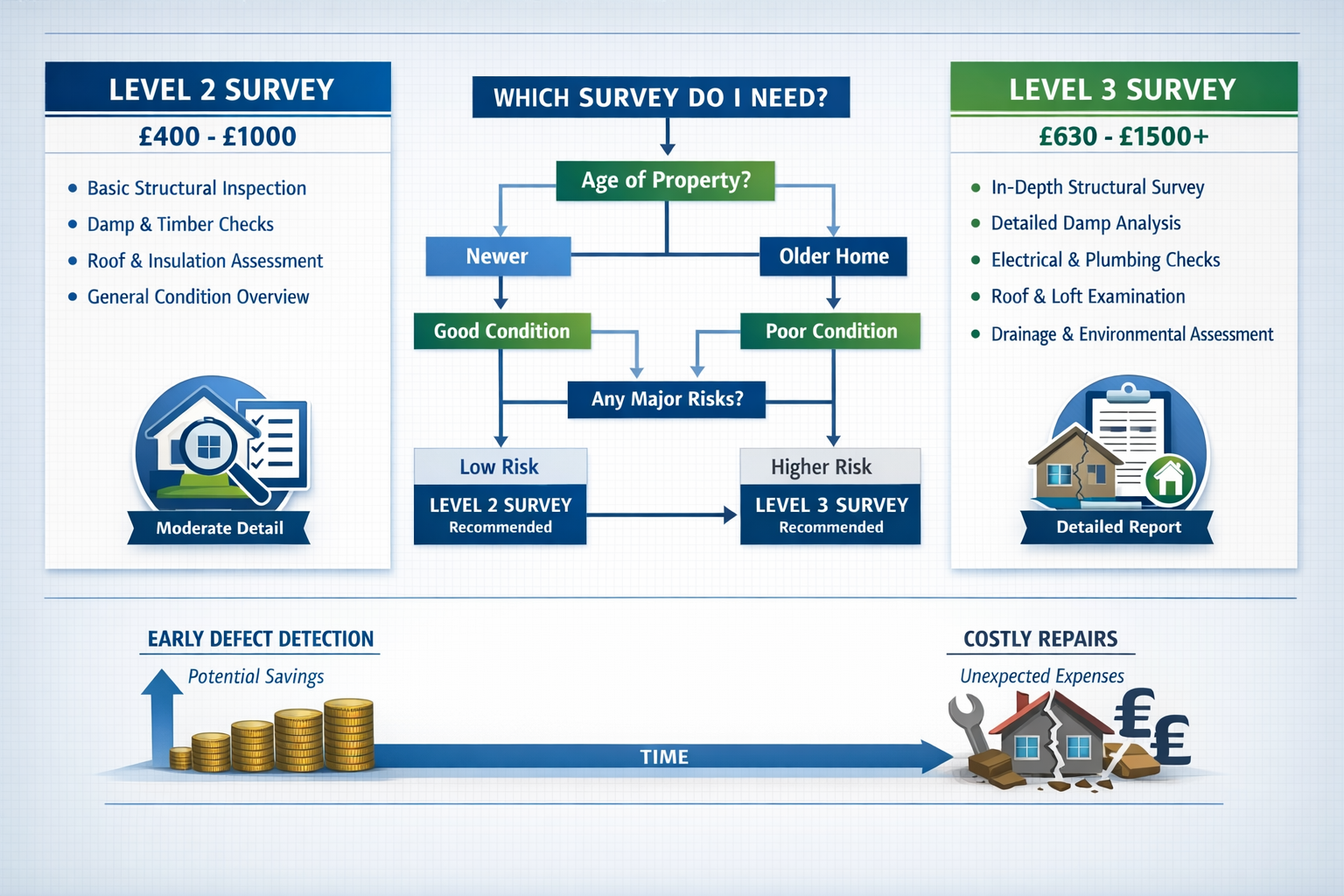
Level 2 (HomeBuyer Report) has become the recommended standard for first-time buyers purchasing conventional properties in reasonable condition.[1] These RICS home surveys cost £400-£1,000 and include crucial features absent from Level 1 inspections:
- Roof space and cellar inspections
- Recommendations for further specialist investigations
- Guidance on repair budgets and ongoing maintenance costs
- Assessment of visible defects and their urgency[2]
Level 3 (Building Survey) provides the most comprehensive assessment, specifically recommended for properties over 50 years old, those of unusual construction, listed buildings, properties in poor condition, or when renovations are planned.[2] These detailed building surveys cost £630-£1,500 or more, representing a significant investment for budget-conscious buyers.
Making the Right Choice for Your Circumstances
For first-time buyers in 2026, the decision matrix should prioritize:
| Property Characteristic | Recommended Survey Level | Rationale |
|---|---|---|
| Built post-2000, good condition | Level 2 | Standard protection at reasonable cost |
| Built 1950-2000, average condition | Level 2 with targeted add-ons | Core assessment plus specific risk investigations |
| Built pre-1950 or poor condition | Level 3 | Comprehensive protection justifies higher cost |
| Flat in building with cladding | Level 2 minimum + cladding assessment | Specific high-risk material identification essential |
| Unusual construction (timber frame, non-standard) | Level 3 | Non-conventional properties require specialist knowledge |
The key insight for 2026 is that survey selection should be risk-proportionate rather than cost-minimizing. A £600 Level 2 survey that identifies £40,000 in cladding remediation costs represents exceptional value, while a £300 Level 1 survey that misses the same issue proves catastrophically expensive.
Cladding, RAAC, and High-Risk Materials: Priority Assessments for 2026
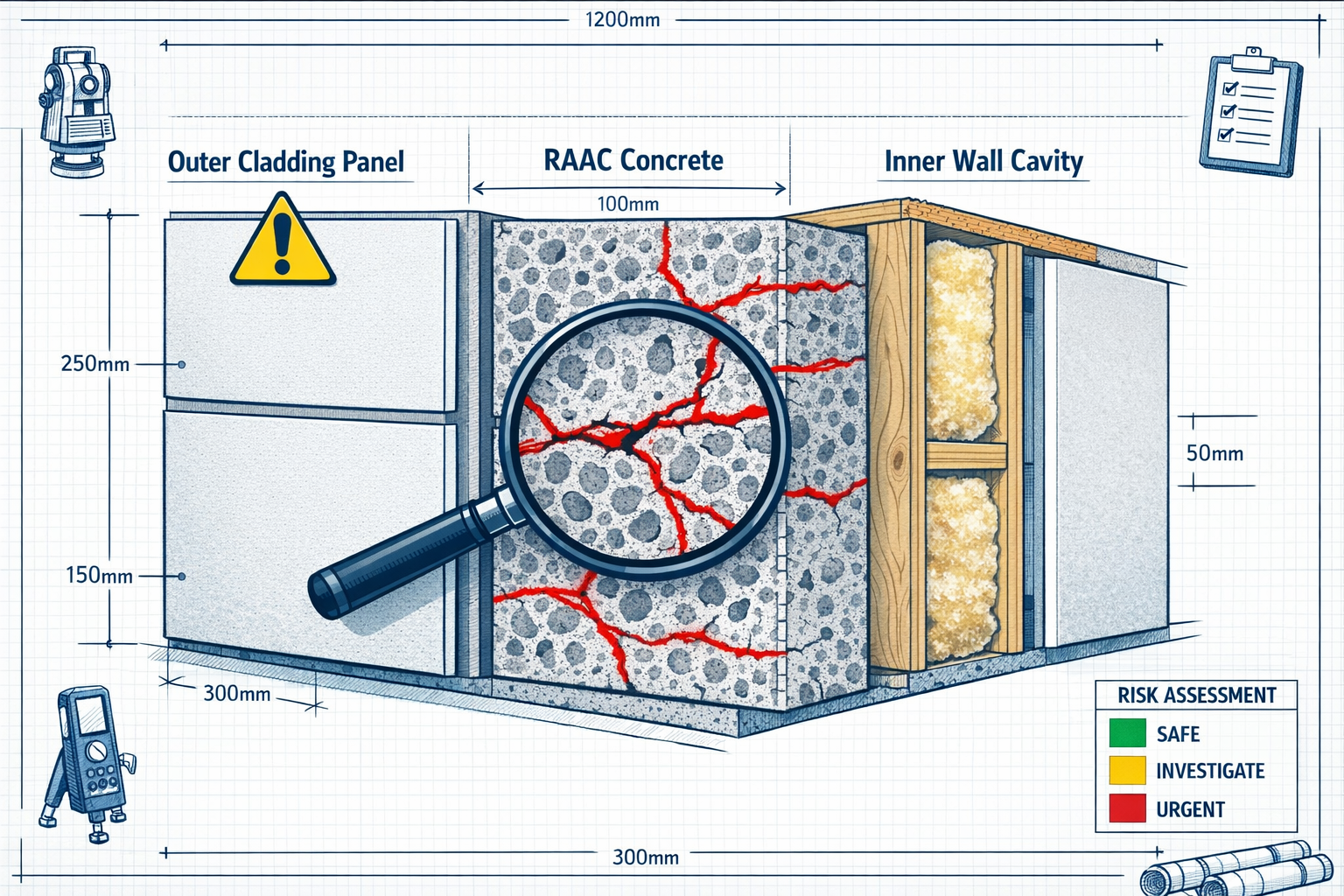
The building safety crisis that began with Grenfell Tower in 2017 continues to reverberate through the property market in 2026. For first-time buyers, understanding and identifying high-risk materials has become non-negotiable due to their profound financial implications.
The Cladding Crisis and First-Time Buyer Impact
Combustible cladding systems remain present on thousands of residential buildings across the UK. Properties with dangerous cladding face:
- Mortgage refusal from most lenders until remediation is complete
- Unmarketability even if purchase proceeds without mortgage
- Remediation costs ranging from £20,000-£100,000+ per flat
- Service charge increases to fund building-wide remediation
- Waking watch costs of £100-400+ monthly until remediation
For first-time buyers targeting flats—often the only affordable entry point in urban markets—cladding identification must be explicitly specified in survey instructions. Standard Level 2 surveys may note external cladding but won't necessarily identify the specific type or assess fire safety implications.
What First-Time Buyers Should Request
When commissioning surveys on flats or maisonettes built between 1990-2020, buyers should specifically request:
✅ Identification of external wall system type (ACM, HPL, render over insulation)
✅ Height of building (buildings over 11 meters face stricter requirements)
✅ Presence of EWS1 form or building safety certificate
✅ Evidence of remediation works completed or planned
✅ Current building insurance status (some insurers refuse cover)
"The single most important question a first-time buyer can ask in 2026 is whether a building has been assessed for dangerous cladding and what the outcome was. Without this information, you're buying blind into potentially catastrophic costs."
RAAC: The Hidden Structural Threat
Reinforced Autoclaved Aerated Concrete (RAAC) emerged as a major concern in 2023-2024 when its presence forced school closures and building evacuations. This lightweight concrete was used extensively in construction between 1950-1990, particularly in:
- Flat roof structures
- Floor slabs in multi-story buildings
- Wall panels in system-built properties
RAAC has a design life of approximately 30 years, meaning much of the material installed in the 1960s-1980s is now beyond its intended lifespan and at risk of sudden structural failure.[1] The material's porous structure makes it vulnerable to water ingress, which accelerates deterioration.
Identifying RAAC in Building Surveys
Standard building surveys may not specifically test for RAAC unless instructed. First-time buyers purchasing properties built between 1950-1990 should request:
📋 Visual inspection of roof spaces for characteristic aerated concrete panels
📋 Assessment of flat roof structures for RAAC deck construction
📋 Review of original construction documentation if available
📋 Specialist structural engineer referral if RAAC is suspected
Properties confirmed to contain RAAC typically require:
- Immediate structural assessment by specialist engineers
- Potential propping or temporary support installation
- Complete removal and replacement (costs often £50,000-£200,000+)
- Temporary accommodation during works
For first-time buyers operating on tight budgets, discovering RAAC post-purchase can prove financially devastating. The modest additional cost of requesting specific RAAC assessment during survey (typically £200-400 for specialist engineer consultation) provides essential protection.
Other High-Risk Materials Requiring Attention
Beyond cladding and RAAC, first-time buyers in 2026 should ensure surveys specifically address:
Japanese Knotweed – Can render properties unmortgageable and costs £5,000-£20,000 to treat professionally
Asbestos – Common in pre-2000 properties; survey should identify likely locations and recommend asbestos survey if disturbed materials present
Pyrite contamination – Affects properties built on certain fill materials; causes floor heave and foundation damage
High alumina cement – Used 1950s-1970s; degrades over time causing structural weakness
The connecting thread for first-time buyers is mortgage lender requirements. Materials that make properties unmortgageable must be identified before purchase, as discovering them afterward leaves buyers trapped with unsaleable assets.
Affordability-Driven Risk Assessment: Maximizing Survey Value on Limited Budgets
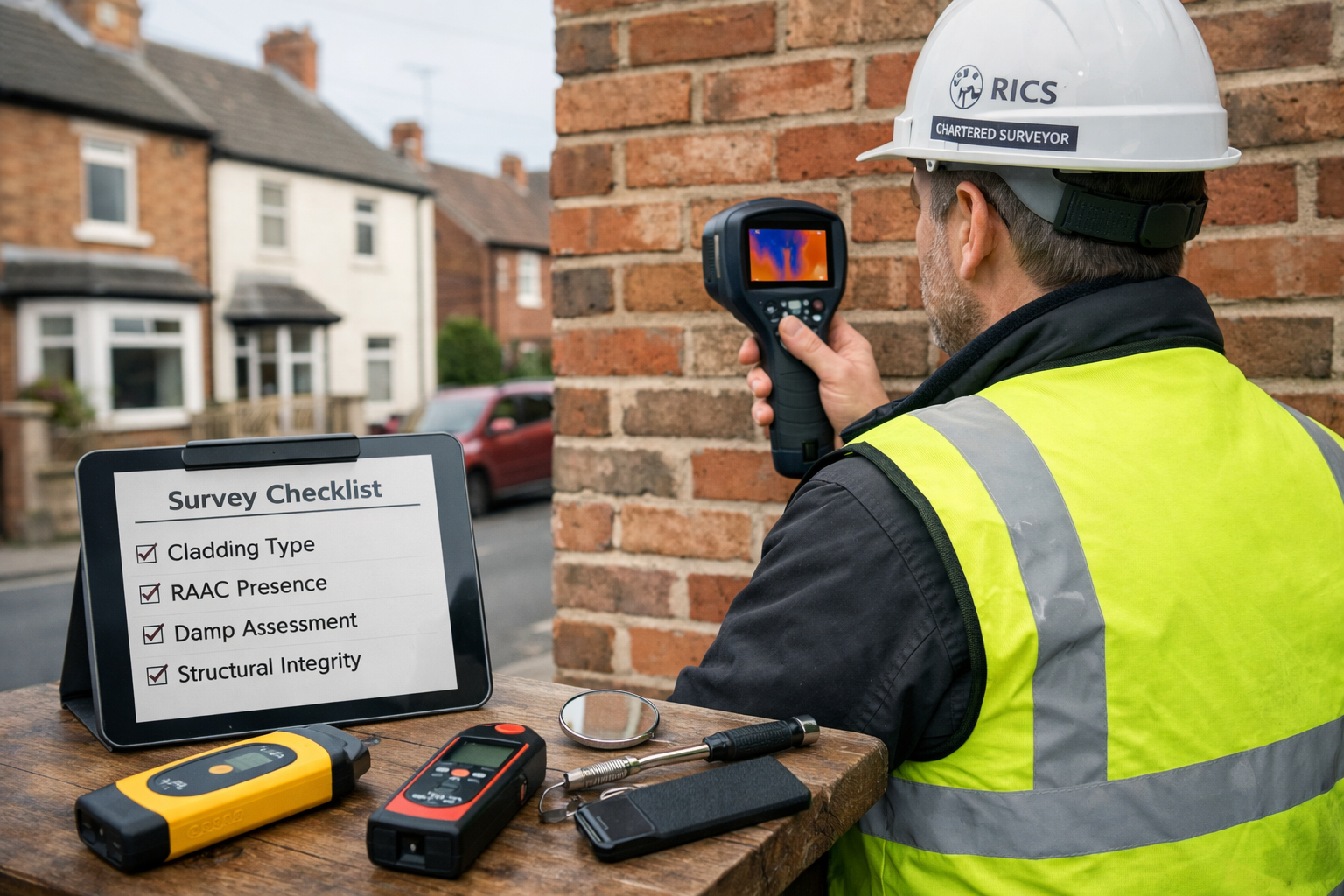
First-time buyers in 2026 face a challenging financial equation. Beyond deposits that now average 15-20% of purchase price, buyers must budget for:
- Conveyancing fees: £1,000-£1,500[1]
- Survey costs: £400-£1,500
- Stamp duty (on properties over threshold)
- Moving costs: £500-£1,500
- Immediate repairs and furnishing
With total transaction costs easily exceeding £5,000-£10,000 beyond the deposit, survey budgets face pressure. However, the cost of inadequate surveying far exceeds the cost of comprehensive assessment.
The Financial Logic of Survey Investment
Consider this realistic scenario:
Scenario A: Minimum Survey Approach
- Level 1 survey cost: £350
- Major damp issue missed
- Post-purchase discovery cost: £8,000 for damp-proofing and replastering
- Total cost: £8,350
Scenario B: Appropriate Survey Approach
- Level 2 survey cost: £650
- Damp issue identified pre-purchase
- Price renegotiation: £6,000 reduction
- Buyer arranges works with chosen contractor: £7,000
- Net cost: £1,650 (£6,700 saving vs. Scenario A)
The mathematics overwhelmingly favor appropriate survey investment. For first-time buyers, the question isn't whether to survey, but how to maximize survey value within budget constraints.
Strategic Approaches for Budget-Conscious Buyers
1. Right-Size the Core Survey
Match survey level to property risk profile rather than defaulting to cheapest option. A £650 Level 2 survey on a 1960s semi provides better value than a £350 Level 1 survey that misses critical issues.
2. Use Targeted Add-On Investigations
Rather than upgrading to expensive Level 3 surveys, commission specific additional investigations for identified concerns:
- Damp surveys for properties with visible moisture issues (£200-400)
- Drainage surveys for properties with drainage concerns (£300-600)
- Electrical condition reports for properties with old wiring (£150-300)
- Timber and damp reports for properties with suspected rot (£200-500)
This modular approach provides depth where needed without comprehensive Level 3 costs.
3. Prioritize High-Impact Defects
Not all defects carry equal financial weight. When reviewing survey findings, focus negotiation and investigation budgets on:
Highest Priority (£10,000+ potential costs):
- Structural movement and subsidence
- Roof replacement requirements
- Damp penetration and timber decay
- Dangerous cladding or RAAC
- Electrical rewiring needs
Medium Priority (£2,000-£10,000 potential costs):
- Boiler and heating system replacement
- Window and door replacement
- Drainage repairs
- Minor roof repairs
Lower Priority (under £2,000):
- Cosmetic repairs
- Minor maintenance items
- Decoration requirements
Negotiating Post-Survey: Maximizing Value from Findings
Survey findings provide powerful negotiation leverage. First-time buyers should approach post-survey negotiations strategically:
Option 1: Price Reduction
Request reduction equivalent to repair costs plus 10-20% contingency. This provides funds for repairs and compensates for disruption.
Option 2: Seller Completion of Works
Request seller arranges repairs before completion. Ensures work is done but removes buyer control over contractor selection and quality.
Option 3: Retention of Funds
Solicitors hold back agreed sum from purchase price until works complete. Useful for major items requiring specialist contractors.
Option 4: Walk Away
For properties with catastrophic defects (unmortgageable cladding, severe RAAC, major structural issues), withdrawal may be the only sensible option.
Understanding how long a homebuyers survey takes helps buyers plan negotiation timelines—typically 3-7 days for Level 2 surveys, allowing time for review and strategic response.
The 2026 Market Context for First-Time Buyers
Recent market data shows new buyer enquiries weakened significantly in February 2026, with a net balance of -26% compared to -15% in January.[3] Agreed sales remained subdued at -12%, though the 12-month outlook for first-time buyers shows resilience at +17%.[3]
This market softness creates enhanced negotiating power for first-time buyers. Sellers facing reduced demand are more likely to accept price reductions or agree to remediate defects identified in surveys. Buyers who invest in thorough surveys gain ammunition for negotiations that can recover survey costs many times over.
Industry experts anticipate the first-time buyer range will lead market recovery in 2026,[3] suggesting that properties in typical first-time buyer price brackets (£150,000-£300,000 outside London, £300,000-£450,000 in London) will see increased competition as the year progresses. Early movers who secure properties with thorough due diligence position themselves advantageously.
Survey Timing, Selection, and Process Optimization
The practical execution of building surveys significantly impacts their value. First-time buyers navigating the process for the first time benefit from understanding optimal timing, surveyor selection, and process management.
When to Commission Your Survey
Optimal timing: Immediately after offer acceptance and before significant conveyancing costs accumulate. This typically means commissioning within 3-5 days of offer acceptance.
Why timing matters:
- Early identification of deal-breakers minimizes wasted conveyancing costs
- Provides maximum time for negotiation before exchange
- Allows coordination with mortgage valuation if separate
- Prevents rushed decision-making under completion pressure
Some buyers commission surveys before making offers on properties of particular concern (older properties, visible defects, buildings with potential cladding issues). While this involves upfront cost risk if offers aren't accepted, it provides:
✅ Confident offer pricing based on true condition
✅ Faster transaction progression once offer accepted
✅ Elimination of unsuitable properties before emotional investment
Selecting the Right Surveyor
Not all chartered surveyors offer equivalent expertise. First-time buyers should prioritize:
RICS qualification – Ensure surveyors are RICS-registered and hold appropriate professional indemnity insurance
Local knowledge – Local chartered surveyors understand regional construction types, common defects, and local contractor costs
Relevant experience – For flats, ensure experience with leasehold properties and multi-occupancy buildings; for older properties, ensure period property expertise
Specific competencies – For properties with suspected cladding or RAAC, confirm surveyor has relevant training and experience
Clear reporting – Request sample reports to assess clarity and detail
Availability – Confirm turnaround times align with transaction timelines
Understanding structural survey pricing helps buyers budget appropriately and identify unusually low quotes that may indicate insufficient experience or thoroughness.
Briefing Your Surveyor Effectively
The quality of survey outputs directly correlates with the quality of instructions. First-time buyers should provide surveyors with:
📝 Specific concerns identified during viewings (damp patches, cracks, roof condition)
📝 Property history if known (previous uses, known alterations, age)
📝 High-risk material concerns (cladding type, RAAC potential, asbestos)
📝 Future plans (renovation intentions, extension plans)
📝 Budget constraints for any recommended further investigations
Clear communication ensures surveyors focus attention on areas of greatest concern while maintaining comprehensive coverage.
Understanding Survey Limitations
Even comprehensive Level 3 surveys have inherent limitations that first-time buyers must understand:
Non-invasive inspection – Surveyors don't remove floorboards, lift carpets, move furniture, or access locked areas
Weather-dependent – Certain defects (roof leaks, damp penetration) may not be evident during dry weather
Concealed defects – Issues hidden behind finishes, within walls, or underground remain undetectable
Specialist areas – Electrical systems, gas installations, and drainage require specialist surveys beyond building surveys
Future deterioration – Surveys assess current condition, not future failure rates
These limitations don't diminish survey value but establish realistic expectations. Surveyors will recommend further specialist investigations where they cannot reach conclusions with reasonable confidence.[2]
Acting on Survey Findings
Survey reports typically categorize defects using a traffic light system:
🟢 Condition Rating 1 – No repair currently needed
🟡 Condition Rating 2 – Repairs or replacement requiring future attention
🔴 Condition Rating 3 – Defects requiring urgent repair or further investigation
First-time buyers should:
- Read reports thoroughly – Don't rely solely on summaries
- Seek clarification – Contact surveyors to discuss unclear findings
- Obtain repair quotes – Get contractor estimates for significant defects
- Prioritize financially – Focus on high-cost and safety-critical items
- Negotiate strategically – Use findings to adjust price or require remediation
- Commission further investigations – Act on recommendations for specialist surveys
The difference between Level 2 and Level 3 surveys becomes most apparent in the depth of analysis and recommendations provided—understanding this helps buyers assess whether upgrade to Level 3 is justified for their specific property.
2026 Regulatory Changes and First-Time Buyer Implications
The regulatory landscape governing property transactions continues evolving in 2026, with several reforms designed to improve transparency and reduce transaction failures.
Digital Property Logbooks
The government's planned introduction of digital property logbooks aims to create comprehensive property histories accessible to buyers, including:
- Construction details and materials used
- Alteration and renovation history
- Safety certificates and compliance documentation
- Energy efficiency measures
- Warranty and guarantee information[1]
For first-time buyers, digital logbooks should reduce information asymmetry and facilitate identification of high-risk materials like cladding and RAAC. However, implementation remains incomplete in early 2026, meaning buyers cannot yet rely on comprehensive digital records.
Binding Conditional Contracts
Proposed reforms to prevent gazumping through binding conditional contracts would require sellers to commit to transactions at earlier stages, reducing the risk of buyers losing survey costs when sellers accept higher offers.[1]
This reform particularly benefits first-time buyers, who face greatest financial strain from aborted transactions and wasted survey fees.
Streamlined Conveyancing
Efforts to digitize and standardize conveyancing processes aim to reduce costs and timescales.[1] For first-time buyers, faster transactions mean:
- Reduced period of financial uncertainty
- Lower risk of market changes affecting affordability
- Decreased holding costs for sellers (potentially improving negotiating position)
Building Safety Act Implications
The Building Safety Act continues to reshape the landscape for residential buildings, particularly flats. First-time buyers purchasing leasehold flats must understand:
Building Safety Charges – Leaseholders may face charges for building safety remediation works
Accountable Persons – Buildings must have designated responsible persons for safety compliance
Safety Case Reports – Higher-risk buildings require comprehensive safety documentation
Lender Requirements – Mortgage lenders increasingly require evidence of building safety compliance
These regulatory changes reinforce the importance of thorough pre-purchase due diligence, particularly for flat purchases where building-wide issues can create ongoing financial liabilities.
Special Considerations: New Builds, Flats, and Non-Standard Construction
Different property types present unique survey considerations for first-time buyers in 2026.
New Build Properties
New build homes often appeal to first-time buyers due to Help to Buy scheme availability (now wound down but some completions still occurring in 2026) and perceived lower maintenance requirements. However, new builds require snagging surveys rather than traditional building surveys.
Snagging surveys cost £320-£600 and should ideally occur before exchange of contracts to maximize negotiating power for fixing identified defects.[2] Common new build issues include:
- Poor finish quality (paintwork, tiling, joinery)
- Incomplete works
- Damage during construction
- Installation defects (heating, plumbing, electrics)
- External works incomplete
New build buyers should also verify NHBC warranty coverage or equivalent buildmark protection, providing 10-year structural defect insurance.
Leasehold Flats
Flats present unique challenges requiring survey attention beyond the individual unit:
Building-wide issues – Cladding, RAAC, roof condition, communal areas
Service charge implications – Major works programs increasing charges
Lease terms – Ground rent, remaining lease length, restrictions
Management quality – Building maintenance standards
First-time buyers purchasing flats should commission homebuyer surveys that explicitly include assessment of communal areas and building exterior, not just the individual flat interior.
Non-Standard Construction
Properties built using non-standard construction methods (timber frame, concrete construction, steel frame, system builds) may face:
- Mortgage availability issues – Some lenders restrict lending on certain construction types
- Insurance challenges – Higher premiums or limited availability
- Specialist survey requirements – Standard surveyors may lack relevant expertise
- Future saleability concerns – Reduced buyer pool
First-time buyers considering non-standard construction should verify mortgage and insurance availability before commissioning surveys, as these properties may prove unmortgageable regardless of condition.
Conclusion: Strategic Survey Investment for First-Time Buyer Success in 2026
First-Time Buyer Building Surveys in 2026: Prioritizing Cladding, RAAC, and Affordability-Driven Risk Assessment represents more than a technical process—it's a strategic investment that protects what is typically the largest financial commitment most people ever make.
The key insights for first-time buyers navigating the 2026 market are:
✅ Right-size your survey level to property risk rather than minimizing costs—Level 2 surveys provide optimal value for most conventional properties
✅ Explicitly request cladding and RAAC assessment for properties built 1950-2020, as these high-risk materials can render properties unmortgageable and require catastrophic remediation costs
✅ Use modular additional investigations to achieve depth on specific concerns without comprehensive Level 3 costs
✅ Prioritize high-impact defects in negotiation and remediation planning, focusing on issues with £10,000+ potential costs
✅ Leverage market conditions to negotiate effectively—the softened market of early 2026 provides enhanced buyer negotiating power
✅ Select experienced local surveyors with relevant expertise for your property type and specific concerns
The modest cost difference between inadequate and appropriate surveying—typically £300-500—pales compared to the tens of thousands at stake from undiscovered defects. For first-time buyers operating on constrained budgets, survey investment represents essential insurance that pays for itself many times over when it identifies deal-breaking issues or provides negotiating leverage.
Your Next Steps
If you're a first-time buyer preparing to purchase in 2026:
- Budget appropriately – Allocate £500-800 for Level 2 survey plus £200-400 contingency for additional investigations
- Research surveyors early – Identify qualified local surveyors before making offers to enable rapid commissioning
- Prepare specific instructions – List concerns and high-risk materials for explicit surveyor attention
- Plan negotiation strategy – Determine your approach to different defect scenarios before receiving survey results
- Obtain multiple quotes – Compare surveyor pricing and scope to ensure value
- Read reports thoroughly – Invest time understanding findings rather than relying on summaries
- Act decisively – Use survey findings to negotiate, investigate further, or withdraw as appropriate
The path to successful first-time home ownership in 2026 runs through thorough, strategically-focused building surveys that identify high-risk materials and significant defects before financial commitment becomes irreversible. The investment in comprehensive pre-purchase due diligence provides both financial protection and peace of mind—ensuring your first home remains a source of pride rather than regret.
For professional survey services tailored to first-time buyer needs, explore our comprehensive RICS building surveys designed to provide the protection and clarity you need to purchase with confidence.
References
[1] First Time Buyer 2026 Changes Challenges Solutions – https://www.homewardlegal.co.uk/guides-advice/post/first-time-buyer-2026-changes-challenges-solutions
[2] What Sort Of Survey Should I Have – https://hoa.org.uk/advice/guides-for-homeowners/i-am-buying/what-sort-of-survey-should-i-have/
[3] Uk Residential Survey February 2026 – https://www.rics.org/news-insights/uk-residential-survey-february-2026