The tragic Grenfell Tower fire in 2017 fundamentally changed how property buyers, surveyors, and regulators approach building safety in the UK. As 2026 brings sweeping new fire safety regulations into force, understanding Fire Safety Audits in Property Surveys: Post-Grenfell Cladding Checks and Balcony Compliance for 2026 Buyers has become absolutely essential for anyone purchasing residential property—particularly flats, converted buildings, and high-rise developments. With major regulatory amendments taking effect on 30 September 2026, buyers face unprecedented scrutiny of external cladding materials, balcony construction, evacuation systems, and fire safety documentation that could dramatically impact property values, mortgage availability, and personal safety.
This comprehensive guide explores the critical survey protocols that protect buyers from inheriting dangerous fire safety liabilities, regulatory non-compliance, and potentially unmortgageable properties in the post-Grenfell landscape.
Key Takeaways
- 🔥 New regulations effective 30 September 2026 introduce stricter cladding standards, lower height thresholds (now 11 metres vs. 15 metres), and mandatory evacuation alert systems for buildings over 18 metres[1]
- 📋 Fire safety audits are now essential components of property surveys, identifying cladding defects, EWS1 form status, and compliance gaps that affect mortgage availability and property values
- 🏢 Medium-rise buildings (11-18 metres) face new combustible material restrictions and enhanced detection requirements, expanding buyer due diligence beyond traditional high-rise concerns[1]
- 💰 Remediation costs can exceed hundreds of thousands of pounds, making pre-purchase fire safety assessments critical for avoiding catastrophic financial liabilities
- ⚖️ Transitional rules apply for properties with building control applications submitted before 30 September 2026, creating a two-tier compliance landscape buyers must navigate[1]
Understanding the Post-Grenfell Regulatory Landscape for 2026 Property Buyers
The regulatory framework governing fire safety in residential buildings has undergone radical transformation since the Grenfell Tower tragedy claimed 72 lives. For buyers navigating the property market in 2026, understanding these changes is fundamental to making informed purchasing decisions.
The September 2026 Regulatory Milestone
The 2026 amendments to Approved Document B Part B represent the most significant fire safety regulatory update in decades, taking effect on 30 September 2026 in England[1]. These amendments introduce comprehensive new compliance requirements that fundamentally alter what buyers should examine during property surveys and homebuyer surveys.
The new regulations expand beyond traditional high-rise residential blocks to encompass a broader range of building types and heights. Crucially, combustible materials are now banned in external walls of hostels, hotels, and boarding houses—extending previous residential-only restrictions to commercial accommodation[1]. This expansion means buyers considering converted properties or mixed-use developments face additional scrutiny requirements.
Lower Height Thresholds Create Wider Compliance Net
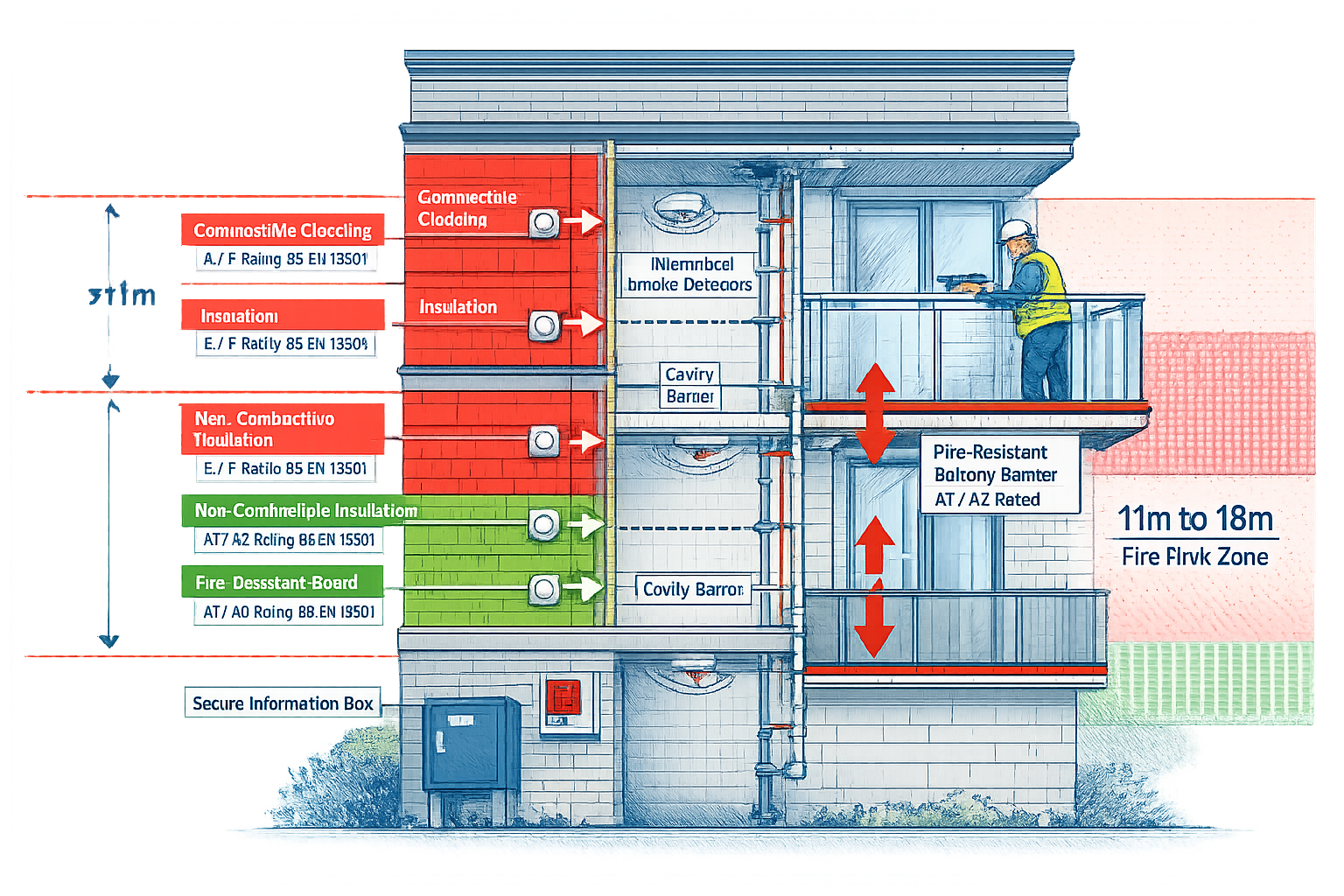
One of the most impactful changes for 2026 buyers involves the reduction of height thresholds triggering fire safety requirements. Material change of use rules now apply to buildings exceeding 11 metres in height (previously 15 metres), requiring external walls to comply with updated standards when buildings are repurposed[1].
This seemingly technical adjustment has profound practical implications. A typical three-storey building often exceeds 11 metres, bringing thousands of previously exempt properties into the regulatory framework. Buyers must now commission detailed fire safety assessments for mid-rise buildings that would have escaped scrutiny under previous regulations.
| Building Height | Previous Requirements | 2026 Requirements | Impact on Buyers |
|---|---|---|---|
| Under 11 metres | Minimal external wall restrictions | Basic fire safety standards | Lower risk, standard surveys sufficient |
| 11-18 metres | Limited restrictions | New combustible product limits, enhanced detection[1] | Medium risk, specialist fire safety audit recommended |
| Over 18 metres | Strict cladding rules | Mandatory evacuation alert systems (BS 8629), sprinklers[1][2] | High risk, comprehensive fire safety assessment essential |
Mandatory Safety Systems in New and Converted Buildings
The 2026 regulations introduce specific equipment requirements that buyers must verify during property surveys. New blocks of flats with a top storey more than 18 metres above ground level must install evacuation alert systems in accordance with BS 8629 standard[1]. These sophisticated systems enable building managers to communicate directly with residents during emergencies, replacing the traditional "stay put" strategy that proved fatal at Grenfell Tower.
Additionally, all new blocks of flats with a floor of 11 metres or more above ground level must now have secure information boxes installed[1]. These boxes provide emergency services with critical building information, floor plans, and utility shut-off locations—potentially saving precious minutes during fire response.
For buyers considering newly constructed or recently converted properties, verifying the presence and proper certification of these systems should be non-negotiable survey requirements. The absence of required safety equipment may indicate broader compliance failures or create future liability exposure.
The Transition from BS 476 to BS EN 13501 Standards
A technical but crucial regulatory shift involves the phased removal of outdated BS 476 standards, with the government transitioning all requirements to the internationally recognised BS EN 13501 standard. All BS 476 references related to fire resistance will be completely removed by 2 September 2029[1].
This transition creates a complex compliance landscape for buyers in 2026. Properties built or renovated under BS 476 standards may require reassessment and potential upgrades to meet BS EN 13501 requirements. When commissioning structural surveys or RICS building surveys, buyers should specifically request verification of which fire safety standards apply to the property and whether any transitional compliance issues exist.
Transitional Application Rules: A Two-Tier Compliance System
The regulations include important transitional provisions that create different compliance pathways depending on when building work commenced. Properties where building notices, initial notices, or building control approval applications with full plans were submitted before 30 September 2026 can continue using the 2019 Approved Document B with prior amendments[1].
This transitional arrangement means buyers in 2026 and beyond will encounter properties operating under different regulatory frameworks. A building with planning permission submitted in August 2026 follows different rules than one submitted in October 2026—even if both complete construction in 2027. Buyers must understand which regulatory regime applies to their prospective property and what implications this has for future compliance, insurance, and resale value.
Fire Safety Audits in Property Surveys: Essential Protocols for Identifying Cladding Defects and Regulatory Gaps
Understanding what fire safety audits should examine and how they integrate with traditional property surveys is critical for 2026 buyers seeking comprehensive protection against fire safety liabilities.
The EWS1 Form: Still Central to Fire Safety Assessment
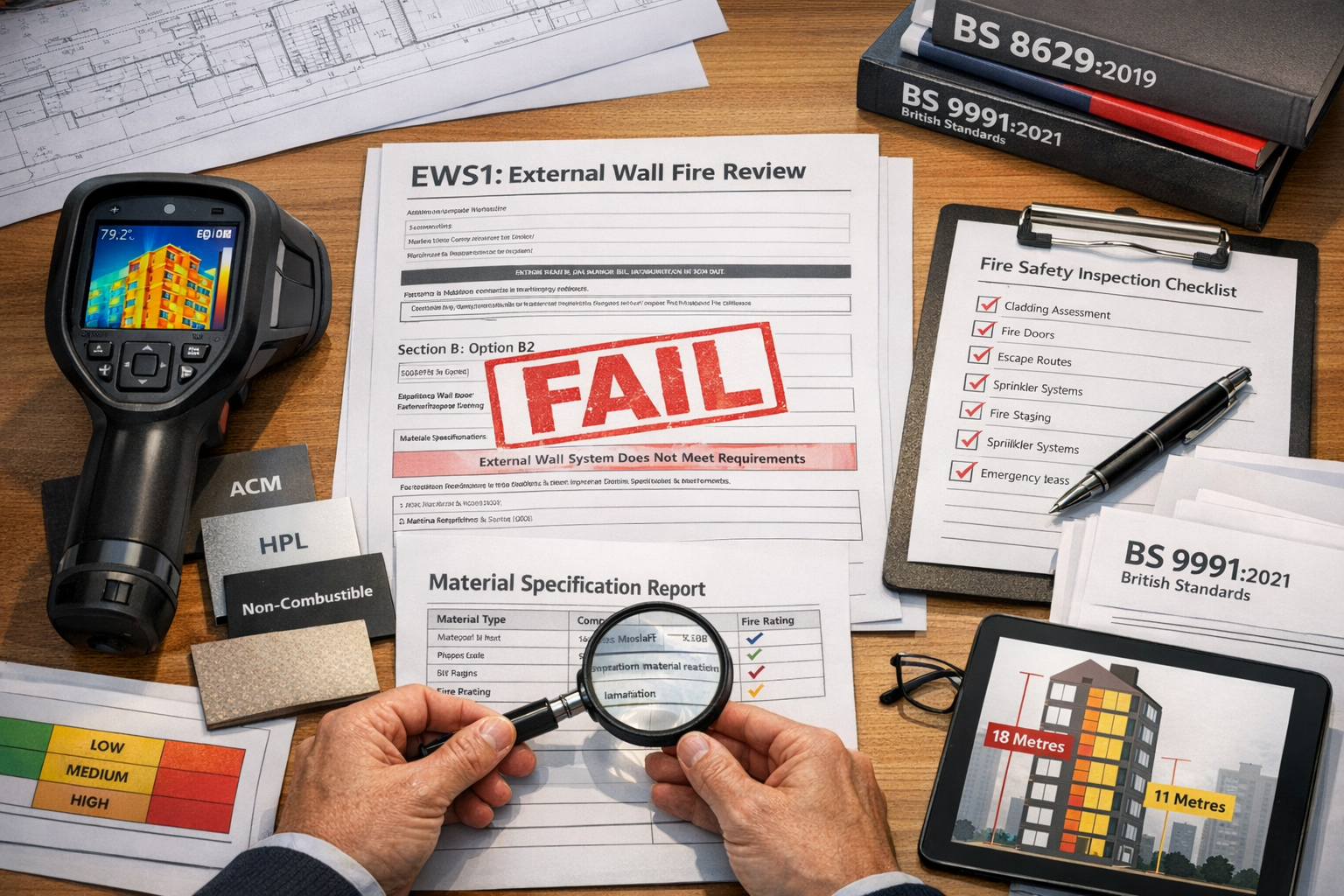
The External Wall Fire Review form (EWS1) remains the primary mechanism for assessing fire safety in residential buildings with external wall systems. Despite ongoing debate about its application, mortgage lenders continue to require EWS1 forms for buildings over 18 metres and frequently request them for properties between 11-18 metres where external wall concerns exist.
A comprehensive fire safety audit should verify:
- ✅ EWS1 form status – Does one exist? Is it current? What rating was assigned (A1-B2)?
- ✅ Qualified assessor credentials – Was the form completed by an appropriately qualified fire engineer or building surveyor?
- ✅ Assessment scope – Did the review examine all external wall systems, balconies, and attachments?
- ✅ Identified defects – What specific issues were noted, and what remediation is required?
- ✅ Remediation timeline – If defects exist, what is the plan and funding mechanism for correction?
Properties with failed EWS1 assessments or no assessment at all face severe mortgage restrictions. Many lenders simply refuse to provide financing for properties without satisfactory fire safety certification, rendering them effectively unsaleable except to cash buyers at substantial discounts.
Cladding Material Identification and Testing Protocols
The type of external cladding material fundamentally determines a building's fire safety profile and compliance status. Aluminium Composite Material (ACM) cladding with a polyethylene core—the material that accelerated the Grenfell fire—is now completely banned on residential buildings over 18 metres[5].
However, numerous other cladding materials present varying degrees of fire risk. A thorough fire safety audit should include:
Visual Inspection and Documentation:
- Photographic evidence of all external wall materials
- Identification of cladding type (ACM, High-Pressure Laminate, timber, render systems, etc.)
- Assessment of cladding condition, fixings, and cavity barriers
- Examination of balcony construction and fire resistance
Material Testing and Classification:
- Laboratory analysis of cladding samples to determine combustibility
- Verification of BS EN 13501 classification for all external materials[1]
- Assessment of insulation materials within external wall systems
- Testing of fire barriers between compartments and around openings
Thermal Imaging Surveys:
- Infrared thermography to identify cavity defects, missing fire barriers, and insulation gaps
- Detection of moisture ingress that may compromise fire resistance
- Verification of compartmentation integrity
Properties requiring specific defect reports for cladding issues benefit from these detailed investigative techniques, which go far beyond standard visual surveys.
Balcony Compliance: The Overlooked Fire Safety Risk
While cladding receives the most attention, balcony construction and materials represent a significant and often overlooked fire safety concern. The 2026 regulations include specific requirements for balcony fire resistance, particularly in buildings over 11 metres[1].
Critical balcony assessment points include:
🔍 Material Combustibility – Are balcony decking, railings, and privacy screens constructed from non-combustible materials compliant with current standards?
🔍 Fire Spread Pathways – Can fire travel vertically between balconies through combustible materials or inadequate separation?
🔍 Structural Fire Resistance – Do balcony support structures maintain integrity during fire exposure for the required duration?
🔍 Compartmentation Breaches – Do balcony penetrations through external walls compromise fire compartmentation?
🔍 Storage and Use Restrictions – Are appropriate restrictions in place preventing combustible storage (BBQ gas bottles, furniture, etc.)?
The tragic Barking fire in 2022, where flames spread rapidly up a building via timber balconies, demonstrated that balcony materials deserve the same scrutiny as wall cladding. Buyers should ensure their homebuyer survey specifically addresses balcony fire safety compliance.
Evacuation Systems and Fire Detection Infrastructure
The 2026 regulations mandate evacuation alert systems in buildings with a top storey more than 18 metres above ground level[1], along with enhanced smoke and heat detection throughout residential buildings[2]. A comprehensive fire safety audit must verify:
Evacuation Alert Systems (BS 8629 Compliance):
- System installation and certification documentation
- Speaker coverage and audibility testing results
- Integration with fire detection systems
- Regular maintenance and testing records
- Building manager training on system operation
Enhanced Detection Standards:
- Smoke and heat detectors meeting higher sensitivity requirements[2]
- Interlinked alarm systems providing immediate floor-by-floor alerts
- Power supply redundancy (mains with battery backup)
- Regular testing and maintenance documentation
Sprinkler System Requirements:
- Mandatory installations in care homes, student housing, and taller residential blocks[2]
- System design and certification documents
- Water supply adequacy and pressure testing
- Maintenance records and inspection reports
Properties lacking required safety systems face not only regulatory non-compliance but also significantly elevated insurance premiums and potential legal liability for building owners and leaseholders.
Documentation, Responsible Persons, and Compliance Records
The regulatory framework now requires every residential building to appoint a designated 'Responsible Person' to oversee fire risk assessments and overall fire safety management[4]. This administrative requirement creates an audit trail that buyers should examine during due diligence.
Essential documentation to review includes:
📄 Fire Risk Assessments – Current, comprehensive assessments identifying hazards and control measures
📄 Inspection and Maintenance Records – Documented evidence of regular equipment testing and building inspections
📄 Staff Training Documentation – Records proving fire wardens have received appropriate training
📄 Emergency Evacuation Plans – Clear, current procedures appropriate to the building's design and occupancy
📄 Regulatory Correspondence – Communications with building control, fire services, and the Building Safety Regulator
Regulatory bodies are increasingly auditing these documents with non-compliance resulting in penalties or closure notices[2]. Buyers purchasing properties in buildings with inadequate documentation face potential service charge increases to fund remedial compliance work or, in extreme cases, enforcement action affecting habitability.
Protecting Your Investment: Practical Guidance for 2026 Property Buyers Navigating Fire Safety Compliance
Armed with understanding of the regulatory landscape and audit protocols, buyers can take concrete steps to protect themselves from fire safety liabilities and ensure they're purchasing compliant, safe properties.
Choosing the Right Survey Type for Fire Safety Assessment
Not all property surveys provide equivalent fire safety scrutiny. Understanding different types of survey comparison helps buyers select appropriate assessment levels.
RICS Level 2 Homebuyer Survey:
- Includes basic visual assessment of external walls and obvious fire safety concerns
- Suitable for modern properties in low-rise buildings with no apparent cladding issues
- May identify concerns requiring specialist follow-up
- Typically does not include detailed cladding analysis or EWS1 assessment
RICS Level 3 Building Survey:
- Provides comprehensive examination of building construction and condition
- Includes detailed assessment of external wall systems and materials
- Identifies potential fire safety concerns requiring specialist investigation
- Recommended for converted properties, high-rise flats, and buildings with complex external wall systems
Specialist Fire Safety Audit:
- Dedicated assessment by qualified fire engineers or specialist surveyors
- Includes material testing, thermal imaging, and detailed compliance verification
- Produces EWS1 forms and comprehensive fire safety documentation
- Essential for buildings over 18 metres or those with known cladding concerns
For buyers considering flats in buildings over 11 metres, combining a Level 2 homebuyer survey with a specialist fire safety audit provides optimal protection. The additional cost of £500-£2,000 for specialist assessment pales in comparison to the potential liability of purchasing a non-compliant property.
Questions Every Buyer Should Ask Before Exchange
Before committing to purchase any flat or apartment, buyers should obtain satisfactory answers to these critical questions:
❓ Has an EWS1 form been completed? If yes, what rating was assigned? If no, why not, and will the seller commission one?
❓ What external wall materials are present? Are they compliant with current regulations for the building's height and use?
❓ Are there any ongoing or planned remediation works? What are the costs, timelines, and funding arrangements?
❓ What fire safety systems are installed? Do they meet 2026 regulatory requirements for evacuation alerts, detection, and suppression?
❓ Who is the designated Responsible Person? Are fire risk assessments current and comprehensive?
❓ Are there any outstanding enforcement notices or regulatory correspondence regarding fire safety?
❓ What insurance arrangements exist? Are premiums affected by fire safety concerns?
❓ What service charge implications exist? Are significant increases anticipated for fire safety compliance work?
Sellers and their agents have legal obligations to disclose material information about fire safety issues. However, buyers should independently verify all representations through professional surveys and documentation review rather than relying solely on seller disclosures.
Understanding Remediation Costs and Funding Mechanisms
When fire safety defects are identified, understanding who pays for remediation and how much it will cost becomes paramount. The government's Building Safety Fund and various developer remediation schemes have provided relief for some leaseholders, but coverage remains incomplete.
Potential Cost Scenarios:
| Issue Identified | Typical Cost Range | Who Typically Pays |
|---|---|---|
| ACM cladding replacement (full building) | £5-15 million | Government funding, developer liability, or leaseholder service charges |
| Non-ACM cladding remediation | £2-8 million | Mixed funding depending on building height and developer involvement |
| Balcony fire safety upgrades | £500,000-£2 million | Typically leaseholder service charges |
| Evacuation system installation | £100,000-£500,000 | Building owner/leaseholder service charges |
| Enhanced detection and sprinklers | £200,000-£1 million | Building owner/leaseholder service charges |
Leaseholder Protection Provisions:
Recent legislation provides some protection for leaseholders in buildings requiring cladding remediation:
✓ Leaseholders in properties worth less than £175,000 (£325,000 in London) generally cannot be charged for cladding remediation
✓ Leaseholders who have owned their property for more than 15 years have enhanced protections
✓ Developer liability provisions require original developers to fund remediation in many cases
✓ Capped contributions apply to eligible leaseholders (maximum £10,000 for properties under 11 metres, £15,000 for taller buildings)
However, these protections contain numerous exceptions and limitations. Buyers should obtain written confirmation of any remediation funding arrangements before exchange and consider whether potential service charge liabilities make the purchase financially viable.
The Mortgage Availability Challenge
Fire safety issues create severe mortgage availability constraints that buyers must navigate. Lenders apply varying criteria, but common restrictions include:
🏦 No lending on properties without satisfactory EWS1 forms (buildings over 18 metres)
🏦 Reduced loan-to-value ratios for properties with identified but remediable fire safety concerns
🏦 Complete lending prohibition on properties with ACM cladding or failed EWS1 assessments
🏦 Enhanced survey requirements for buildings between 11-18 metres with external wall systems
Buyers should obtain mortgage agreement in principle specifically referencing the target property's fire safety status before proceeding. Generic pre-approvals may not honour commitments once fire safety concerns emerge during underwriting.
Properties currently unmortgageable due to fire safety defects may become mortgageable once remediation completes, but buyers should not assume this outcome without written lender confirmation and verified remediation timelines.
Insurance Implications and Building Safety Certificates
Fire safety compliance directly impacts insurance availability and premiums. Buildings with identified defects face:
- Significantly increased premiums (sometimes 300-500% higher than comparable compliant buildings)
- Reduced coverage limits or fire-specific exclusions
- Complete insurance refusal in extreme cases
- Mandatory risk improvement conditions
The Building Safety Act 2022 introduced Building Assurance Certificates and Building Control Certificates that provide evidence of compliance with building regulations. For newly constructed or recently renovated properties, buyers should verify these certificates exist and cover all fire safety aspects[6].
Properties lacking appropriate certification may face future insurance difficulties even if no current defects are apparent. The absence of proper documentation creates uncertainty that insurers increasingly refuse to underwrite.
Negotiating Purchase Price Adjustments
When fire safety concerns are identified but buyers still wish to proceed, appropriate price adjustments should reflect:
Quantifiable Costs:
- Estimated remediation expenses (if not covered by existing funding arrangements)
- Anticipated service charge increases during remediation period
- Insurance premium increases compared to compliant properties
- Professional fees for ongoing compliance monitoring
Market Impact Factors:
- Reduced buyer pool due to mortgage restrictions
- Extended marketing periods for future resale
- Stigma associated with fire safety defects
- Opportunity cost of capital tied up in unmortgageable property
Risk Premiums:
- Uncertainty regarding remediation timelines and final costs
- Potential for additional defects to emerge during remediation
- Regulatory change risk requiring further upgrades
- Legal liability exposure during ownership period
Buyers should engage professional valuers familiar with fire safety issues to determine appropriate adjustments. Discounts of 20-40% below comparable compliant properties are not uncommon for properties with significant fire safety defects.
Working with Specialist Surveyors and Fire Safety Consultants
The complexity of fire safety compliance in 2026 demands specialist expertise beyond traditional surveying skills. Buyers benefit from engaging professionals with specific fire safety qualifications:
Chartered Surveyors with Fire Safety Specialisation:
- Hold relevant RICS qualifications and continuing professional development in fire safety
- Understand both building surveying and fire engineering principles
- Can interpret regulatory requirements and assess compliance
- Provide comprehensive reports integrating structural and fire safety concerns
Qualified Fire Engineers:
- Registered with the Institution of Fire Engineers or similar professional bodies
- Conduct detailed fire risk assessments and EWS1 evaluations
- Design remediation solutions and verify contractor work
- Provide expert witness services if disputes arise
Building Control Approved Inspectors:
- Verify compliance with Building Regulations including fire safety provisions
- Review building control certificates and historical approval documentation
- Identify regulatory non-compliance requiring rectification
When commissioning surveys, buyers should verify surveyor qualifications specific to fire safety assessment. General building surveyors may lack the specialist knowledge required to identify subtle compliance gaps or emerging regulatory requirements.
Long-Term Compliance Monitoring and Future-Proofing
Fire safety compliance is not a one-time assessment but an ongoing obligation. Buyers should understand the long-term compliance requirements they're assuming:
Annual Requirements:
- Fire risk assessment reviews and updates
- Fire safety equipment testing and certification
- Building inspection and maintenance programs
- Staff training and emergency drill programs
Regulatory Reporting:
- Compliance submissions to the Building Safety Regulator (for higher-risk buildings)
- Incident reporting and investigation documentation
- Resident safety information provision
- Mandatory occurrence reporting for safety concerns
Future Regulatory Change:
- Monitoring for additional regulatory amendments beyond 2026
- Budgeting for potential upgrade requirements as standards evolve
- Maintaining documentation proving compliance with regulations in force at time of construction
Buildings with robust compliance programs and professional management demonstrate lower long-term risk and typically command premium values compared to poorly managed equivalents.
Red Flags That Should Stop a Purchase
Certain fire safety situations present such significant risk that buyers should seriously consider walking away:
🚩 ACM cladding with no funded remediation plan – These properties remain potentially unmortgageable and dangerous indefinitely
🚩 Multiple failed EWS1 assessments with no remediation progress – Indicates systemic problems or uncooperative building management
🚩 Outstanding enforcement notices from fire authorities – Creates legal liability and potential habitability restrictions
🚩 Freeholder insolvency or absence – Eliminates ability to coordinate remediation or enforce compliance
🚩 Fundamental structural fire resistance deficiencies – Some defects are technically or economically impractical to remediate
🚩 Resident safety concerns documented but unaddressed – Indicates management failure and potential liability exposure
While some buyers may accept these risks with appropriate price discounts, most should recognise that certain properties simply cannot be made compliant at reasonable cost and represent unacceptable safety and financial risks.
Conclusion: Navigating Fire Safety Compliance as a 2026 Property Buyer
The landscape of Fire Safety Audits in Property Surveys: Post-Grenfell Cladding Checks and Balcony Compliance for 2026 Buyers represents one of the most complex and consequential areas of property due diligence in modern UK real estate. The regulatory changes taking effect on 30 September 2026 fundamentally alter what buyers must examine, verify, and understand before committing to purchase residential properties—particularly flats, converted buildings, and any property in structures exceeding 11 metres in height.
The tragic lessons of Grenfell Tower have driven comprehensive regulatory reform designed to prevent similar catastrophes. However, these necessary safety improvements create significant financial and practical challenges for property buyers navigating a market where thousands of buildings remain non-compliant, remediation timelines extend years into the future, and the full costs of compliance continue to emerge.
Actionable Next Steps for Prospective Buyers
Before viewing properties:
- Understand your risk tolerance – Determine whether you're willing to purchase properties requiring remediation or prefer only fully compliant buildings
- Arrange specialist finance – Speak with mortgage brokers experienced in fire safety lending restrictions
- Budget for comprehensive surveys – Allocate £1,500-£3,000 for combined building and fire safety assessments on higher-risk properties
During property search:
- Ask fire safety questions immediately – Request EWS1 status, cladding type, and remediation plans before viewing
- Review building documentation – Examine fire risk assessments, service charge accounts, and management company communications
- Verify building height and construction – Understand which regulatory thresholds apply to properties you're considering
When making offers:
- Make offers subject to satisfactory fire safety assessment – Include specific conditions regarding EWS1 forms and compliance verification
- Engage specialist surveyors – Commission appropriate survey levels including fire safety expertise
- Obtain written remediation commitments – Secure documented evidence of funding arrangements and timelines for any required work
Before exchange:
- Review all survey findings – Ensure you understand every identified defect and its implications
- Verify mortgage approval – Confirm your lender has reviewed fire safety documentation and maintains approval
- Negotiate appropriate adjustments – Ensure purchase price reflects any compliance costs or market restrictions
- Obtain legal advice – Have your solicitor review lease terms, building insurance, and liability provisions
After completion:
- Maintain compliance documentation – Keep comprehensive records of all fire safety assessments and certificates
- Engage with building management – Participate in resident safety committees and compliance programs
- Monitor regulatory developments – Stay informed about evolving requirements that may affect your property
- Budget for ongoing compliance – Anticipate service charge increases for safety improvements and maintenance
The investment in thorough fire safety due diligence—through comprehensive RICS building surveys, specialist fire safety audits, and expert legal advice—provides essential protection against catastrophic financial losses and, more importantly, ensures the safety of you and your family. While the complexity of fire safety compliance in 2026 may seem daunting, informed buyers working with qualified professionals can successfully navigate these challenges and purchase properties that are both safe and financially sound.
The post-Grenfell regulatory environment demands higher standards, greater scrutiny, and more comprehensive professional advice than ever before. Buyers who recognise this reality and invest appropriately in due diligence will be rewarded with safer homes, better long-term value, and peace of mind that their property meets the rigorous safety standards our built environment should have always maintained.
References
[1] Part B Changes England Wales – https://ww3.rics.org/uk/en/journals/built-environment-journal/part-b-changes-england-wales.html
[2] Fire Safety Regulations Whats New In 2026 – https://www.jensengroup.co.uk/fire-safety-regulations-whats-new-in-2026/
[3] Uk Fire Safety Regulations – https://safetyculture.com/topics/fire-safety/uk-fire-safety-regulations
[4] Is Your Business Fire Safety Compliant For 2026 – https://www.midlandfiresecurity.co.uk/fire-safety/is-your-business-fire-safety-compliant-for-2026/
[5] Fire Safety England – https://www.ddfire.gov.uk/fire-safety-england
[6] Building Safety Regulator Strategic Plan 2023 To 2026 – https://www.gov.uk/government/publications/building-safety-regulator-strategic-plan-2023-to-2026/building-safety-regulator-strategic-plan-2023-to-2026
[7] Fire Safety Policy And Procedure 2026 – https://integrating.org.uk/wp-content/uploads/2025/12/Fire-Safety-Policy-and-Procedure-2026.pdf
[8] Preparing For 2026 The Future Of Fire Safety Legislation And What It Means For You – https://www.totalfiregroup.org/preparing-for-2026-the-future-of-fire-safety-legislation-and-what-it-means-for-you/
[9] Are You 2026 Ready Fire Security Compliance Checks Every Building Needs – https://shieldservicesgroup.com/are-you-2026-ready-fire-security-compliance-checks-every-building-needs/