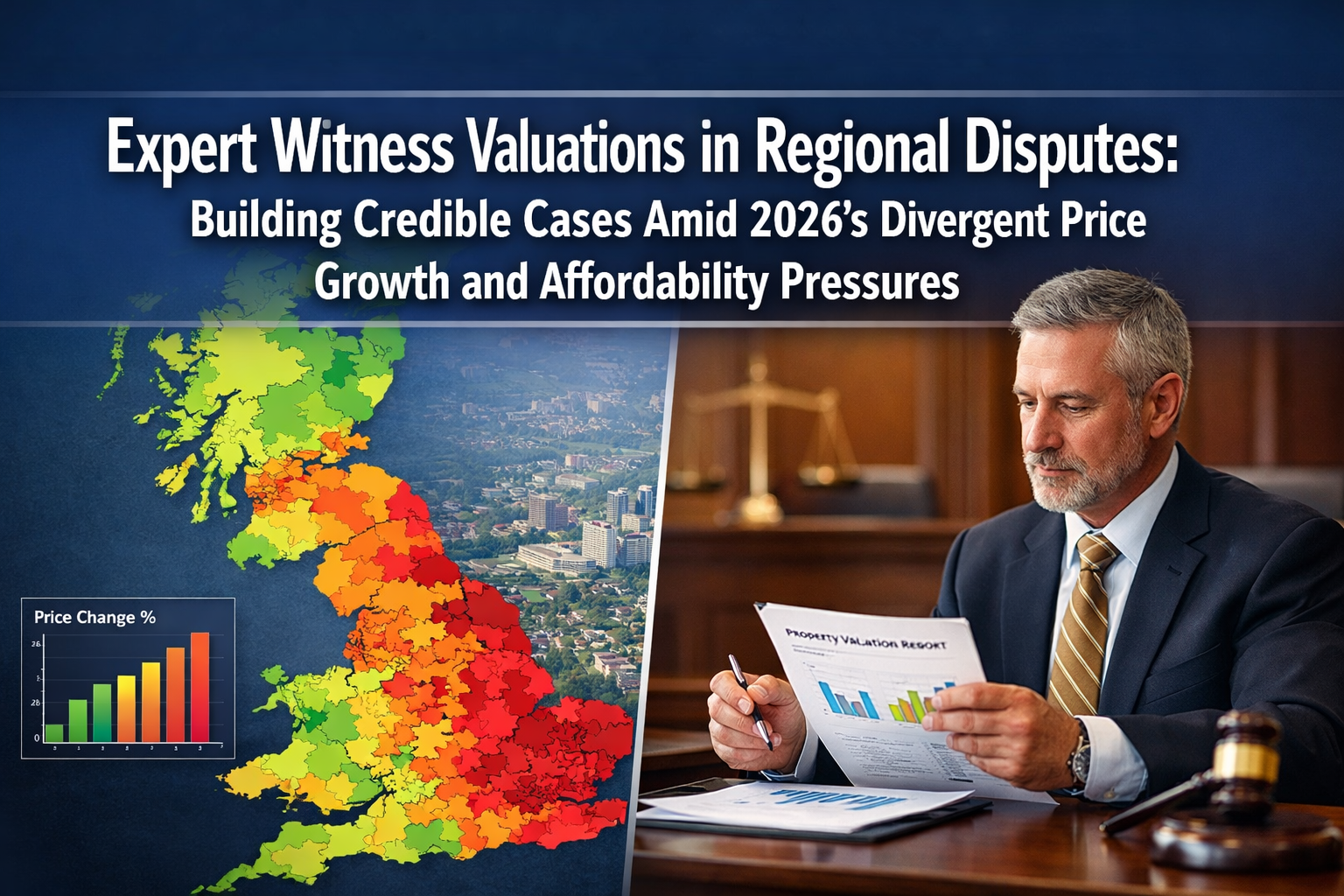
The property market in 2026 presents unprecedented challenges for valuation professionals. With some regions experiencing robust price growth while others face stagnation or decline, expert witness valuations in regional disputes have become increasingly complex and contentious. As affordability pressures mount across the UK and conflicting price signals emerge from different geographic areas, property disputes requiring expert testimony are surging. Understanding how to build credible, defensible cases using rigorous regional data, comparable evidence, and RICS standards has never been more critical for surveyors and valuation experts navigating this fractured market landscape.
Key Takeaways
- 📊 Regional price divergence in 2026 creates complex valuation challenges requiring expert witnesses to demonstrate deep local market knowledge and robust comparable evidence
- ⚖️ Credibility in court depends on methodical application of RICS standards, transparent methodology, and comprehensive documentation of all assumptions and adjustments
- 🏘️ Affordability pressures are influencing property valuations differently across regions, requiring experts to contextualize market conditions within broader economic factors
- 📋 Comparable evidence selection must account for micro-market variations, with experts able to defend adjustment calculations under cross-examination
- 🎯 Professional qualifications and adherence to established valuation methods form the foundation of expert witness credibility in 2026's challenging market
Understanding the 2026 Property Market Landscape
Divergent Regional Price Growth Patterns
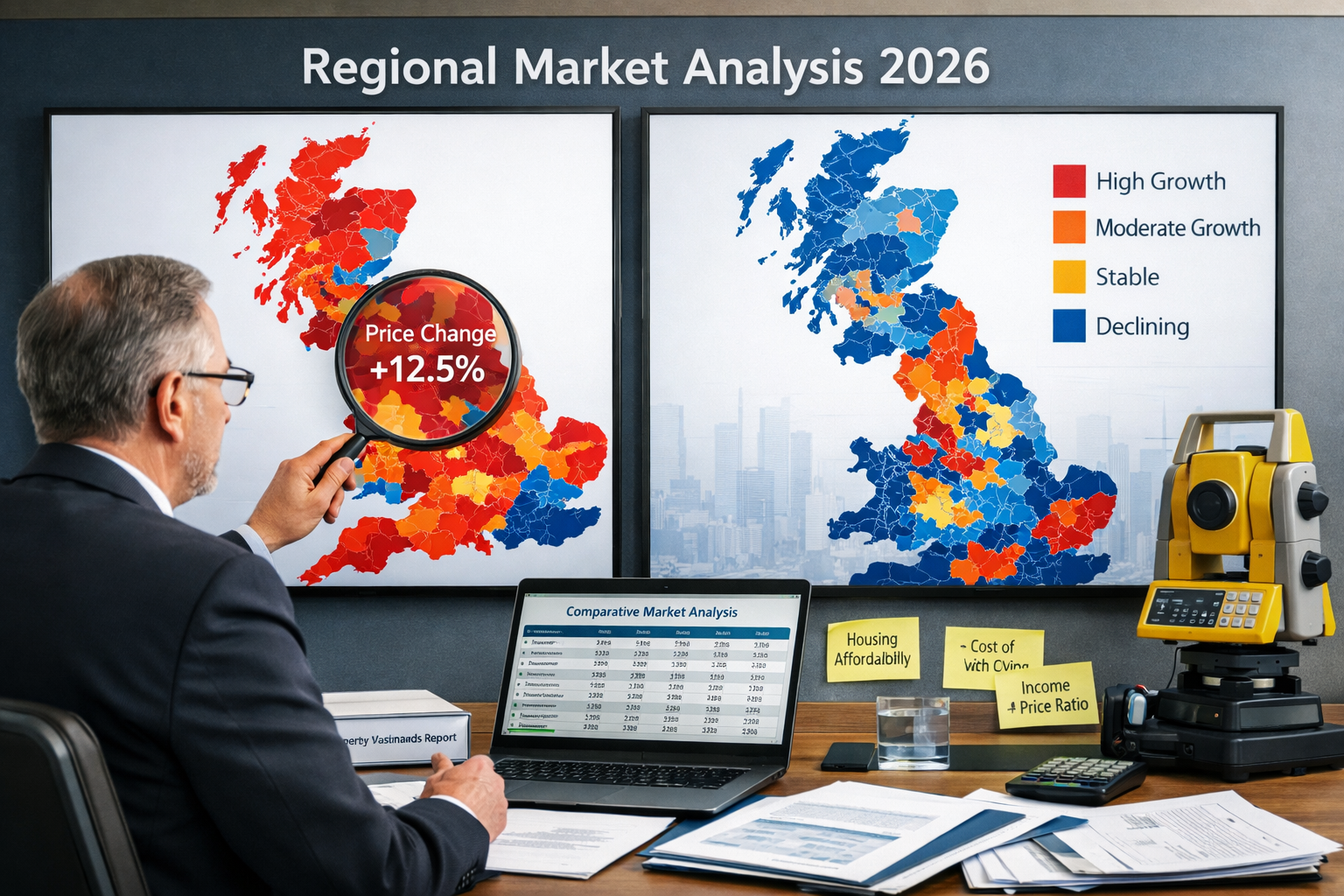
The property market in 2026 exhibits stark regional variations that complicate valuation work across the UK. While certain areas continue experiencing price appreciation driven by infrastructure investment, employment growth, and limited housing supply, other regions face declining values due to economic headwinds, population shifts, and affordability constraints.
Key regional trends in 2026 include:
- Northern England showing moderate growth (2-4% annually) supported by regeneration projects
- London and Southeast experiencing price stagnation or slight declines (-1% to +1%) as affordability limits demand
- Coastal and rural areas displaying mixed performance based on remote working patterns
- Regional cities benefiting from "leveling up" initiatives showing stronger growth (3-6% annually)
These divergent patterns create significant challenges for expert witness surveyors who must justify valuations in dispute scenarios. A property valued at £500,000 in one neighborhood might be worth £450,000 just two miles away, making comparable selection and adjustment calculations critical to building credible cases.
Affordability Pressures Reshaping Market Dynamics
Affordability remains a dominant factor influencing property values across all regions in 2026. With interest rates stabilizing at higher levels than the previous decade and wage growth failing to keep pace with accumulated price increases, many potential buyers face significant barriers to homeownership.
Affordability metrics affecting valuations:
| Factor | 2026 Impact | Valuation Consideration |
|---|---|---|
| Mortgage rates | 4.5-6.0% average | Higher borrowing costs reduce buyer purchasing power |
| Income multiples | 5-7x average earnings | Limits maximum achievable prices in many markets |
| Deposit requirements | 15-20% typical | Restricts buyer pool, particularly for first-time purchasers |
| Rental yields | 4-6% in most regions | Investment valuations increasingly scrutinized |
Expert witnesses must understand how these affordability constraints influence market behavior in specific locations. A valuation that ignores local income levels and financing realities will lack credibility when challenged in legal proceedings [1].
The Growing Role of Expert Witness Valuations in Regional Disputes
Types of Disputes Requiring Expert Testimony
Property disputes requiring expert witness testimony have increased significantly in 2026, driven by market volatility and divergent regional performance. Expert witness services are now essential in various legal contexts where property valuation forms a central issue.
Common dispute scenarios in 2026:
🏛️ Matrimonial proceedings – Divorcing parties disagreeing on property values for asset division
⚖️ Compulsory purchase disputes – Landowners challenging compensation offers from public authorities
🏢 Commercial lease disputes – Rent review disagreements requiring market rent determinations
🏗️ Development disputes – Planning and development value disagreements
💼 Partnership dissolutions – Business partners disputing property asset values
📜 Probate and inheritance – Estate beneficiaries challenging probate valuations
🏘️ Leasehold disputes – Disagreements over lease extension premiums or enfranchisement values
Each dispute type presents unique challenges, but all require expert witnesses to demonstrate comprehensive market knowledge, rigorous methodology, and unimpeachable professional standards [2].
The Expert Witness's Duty to the Court
Unlike advocacy roles, expert witnesses owe their primary duty to the court or tribunal, not to the party instructing them. This fundamental principle underpins credibility and ensures that expert testimony serves justice rather than partisan interests.
"The expert witness must provide independent, unbiased opinion based on facts and professional expertise, regardless of which party engaged their services." [2]
Key responsibilities include:
- Independence – Forming opinions based solely on evidence and professional judgment
- Objectivity – Avoiding advocacy for the instructing party's position
- Transparency – Clearly stating assumptions, limitations, and uncertainties
- Competence – Operating only within areas of genuine expertise
- Compliance – Adhering to Civil Procedure Rules and professional standards
In 2026's complex market environment, maintaining this independence while navigating pressure from instructing solicitors and clients requires strong professional integrity and clear communication about the expert's role [5].
Building Credible Expert Witness Valuations in Regional Disputes: Methodology and Best Practices
Establishing Professional Credibility and Qualifications
The foundation of any credible expert witness case begins with the professional's qualifications and experience. Courts and tribunals place significant weight on an expert's credentials when assessing the reliability of their testimony.
Essential qualifications for 2026:
✅ RICS membership – Chartered status (MRICS or FRICS) demonstrates professional competence
✅ Specialist expertise – Relevant experience in the specific property type and location
✅ Expert witness training – Formal courses on legal procedures and expert duties
✅ Continuing professional development – Current knowledge of market conditions and valuation standards
✅ Professional indemnity insurance – Adequate coverage for expert witness work
✅ Track record – Previous court experience and successful case outcomes
Registered RICS valuers must ensure their qualifications remain current and relevant to the disputes they undertake. In 2026, with market conditions changing rapidly, demonstrating recent comparable transaction experience in the relevant region becomes particularly important [3].
Comprehensive Market Research and Data Collection
Building a credible valuation case requires exhaustive market research that goes beyond basic comparable searches. Expert witnesses must demonstrate deep understanding of local market dynamics, transaction patterns, and the factors driving regional price variations.
Research components for robust cases:
📈 Transaction data analysis – Minimum 12-24 months of sales evidence in the relevant micro-market
📊 Market trend evaluation – Understanding whether the market is rising, falling, or stable
🗺️ Location-specific factors – Transport links, schools, employment centers, amenities
🏘️ Supply and demand dynamics – Housing stock characteristics and buyer demographics
💰 Affordability metrics – Local income levels, mortgage availability, and financing conditions
📉 Economic indicators – Employment rates, business investment, and population trends
In 2026's divergent market, experts must explain why their subject property's location is experiencing particular price trends. Simply citing comparable sales without contextualizing regional performance undermines credibility under cross-examination.
Selecting and Analyzing Comparable Evidence
The selection of comparable properties forms the cornerstone of most valuation opinions. In dispute scenarios, the opposing party will scrutinize comparable selection intensely, making methodical, defensible choices essential.
Criteria for comparable selection in 2026:
| Criterion | Ideal Standard | Acceptable Range | Documentation Required |
|---|---|---|---|
| Location proximity | Same street/development | Within 0.5 miles | Map showing locations |
| Transaction date | Within 3 months | Within 12 months | Adjustment for market movement |
| Property type | Identical | Same general category | Explanation of differences |
| Size | Within 10% | Within 25% | Adjustment calculation |
| Condition | Comparable | Documented differences | Adjustment for improvements |
| Transaction type | Arms-length sale | Verified circumstances | Exclusion of distressed sales |
Adjustment methodology must be transparent and defensible. Each adjustment should be:
- Based on market evidence where possible
- Clearly explained and quantified
- Applied consistently across all comparables
- Documented with supporting rationale
- Within reasonable market parameters (typically 5-20% total adjustments)
When using commercial valuation approaches, experts must apply appropriate methodology for the property type, whether investment, development, or trading premises [3].
Applying RICS Valuation Standards
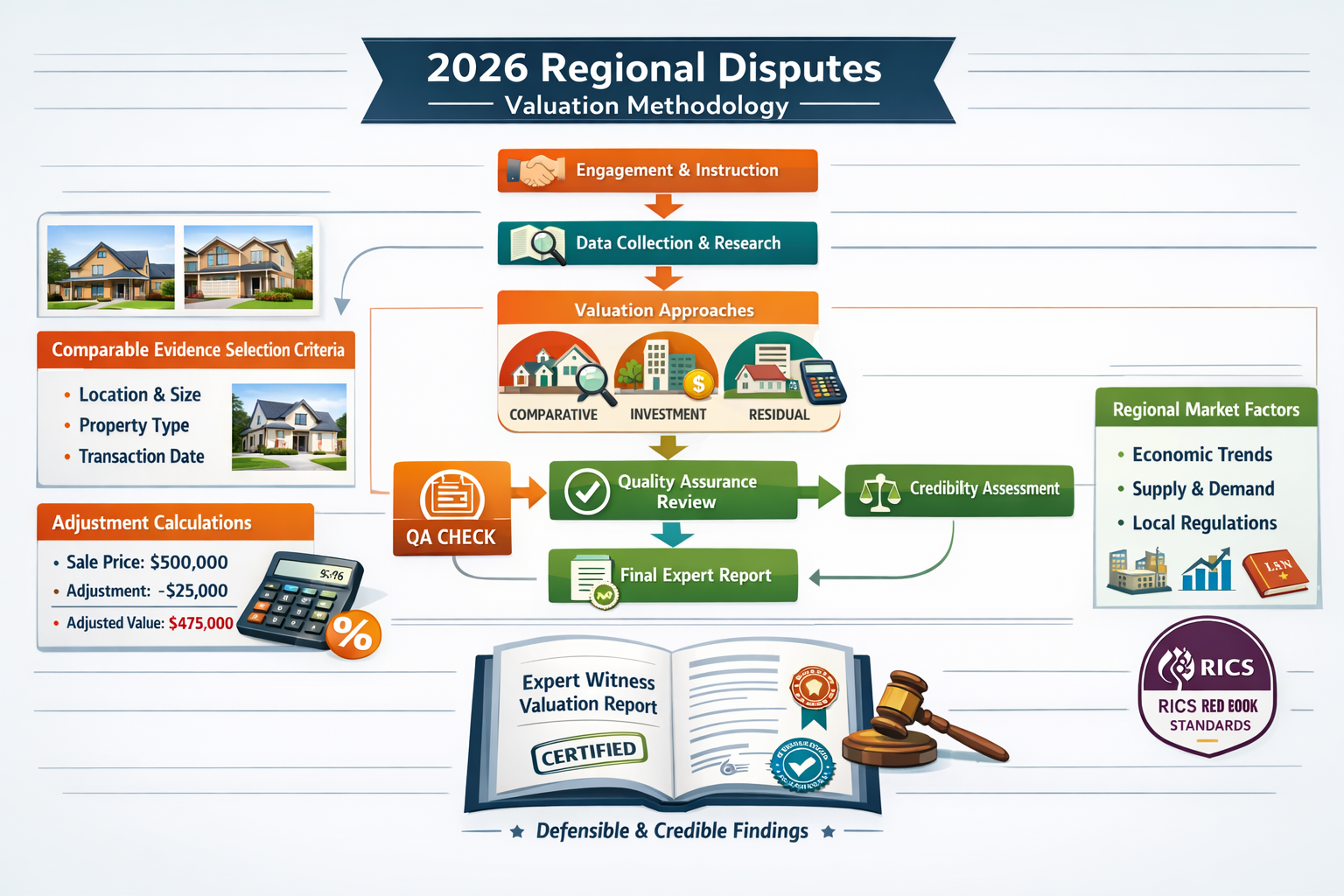
The RICS Red Book provides the professional framework for all valuation work, including expert witness assignments. Adherence to these standards is non-negotiable for credible expert testimony in 2026.
Key Red Book requirements:
🔴 Terms of engagement – Clear instruction confirming expert witness role and scope
🔴 Basis of value – Appropriate definition (Market Value, Fair Value, etc.)
🔴 Assumptions and special assumptions – Clearly stated and agreed with instructing party
🔴 Valuation approach – Appropriate methodology for property type and purpose
🔴 Inspection – Physical inspection unless desktop valuation specifically instructed
🔴 Reporting – Comprehensive report meeting Red Book standards
🔴 Compliance statement – Confirmation of Red Book compliance
In regional dispute cases, experts must be particularly careful about special assumptions that might affect value. For example, assuming planning permission for a development site requires clear statement and impact quantification.
Documentation and Report Preparation
The expert witness report serves as the primary evidence document and must meet both professional standards and legal requirements. In 2026, with increased scrutiny of expert evidence, report quality directly impacts case outcomes.
Essential report components:
Executive Summary
- Clear statement of valuation opinion
- Key factors supporting the conclusion
- Material uncertainties or limitations
Property Description
- Comprehensive details from physical inspection
- Location analysis and local market context
- Photographs and supporting documentation
Market Analysis
- Regional market conditions and trends
- Supply and demand factors
- Affordability considerations specific to 2026
Comparable Evidence
- Detailed analysis of selected comparables
- Adjustment calculations with clear rationale
- Explanation of comparable selection process
Valuation Approach
- Methodology explanation and justification
- Calculations and supporting analysis
- Alternative approaches considered
Assumptions and Limitations
- All assumptions clearly stated
- Limitations acknowledged
- Caveats appropriately expressed
Professional Declaration
- Statement of expert duties
- Confirmation of independence
- Qualifications and experience summary
Reports should be written in clear, accessible language avoiding unnecessary jargon. Remember that judges, arbitrators, and jury members may not have property expertise, so explanations must be comprehensible to intelligent lay readers [2].
Navigating 2026's Specific Challenges in Expert Witness Valuations

Addressing Divergent Regional Price Growth
One of the most significant challenges facing expert witnesses in 2026 is explaining and justifying valuations in markets experiencing divergent price trends. This requires sophisticated analysis beyond simple comparable selection.
Strategies for addressing regional divergence:
🎯 Micro-market definition – Clearly delineate the specific market segment relevant to the subject property
📊 Trend analysis – Present data showing price movements in the micro-market versus broader region
💡 Factor identification – Explain specific drivers of local performance (infrastructure, employment, amenities)
🔍 Comparable weighting – Give greater weight to recent transactions reflecting current market conditions
📈 Market direction – Address whether values are rising, falling, or stable at the valuation date
Expert witnesses must be prepared to defend why their subject property's location is experiencing particular trends. For example, a property near a new transport link might justify premium values despite regional stagnation elsewhere.
Incorporating Affordability Pressures into Valuations
Affordability constraints in 2026 directly impact achievable prices, particularly in markets where local incomes limit buyer purchasing power. Expert witnesses must demonstrate understanding of these economic realities.
Affordability analysis components:
- Local income data – Average and median household incomes in the catchment area
- Mortgage availability – Typical loan-to-value ratios and interest rates
- Affordability ratios – Price-to-income multiples for recent transactions
- Buyer demographics – First-time buyers versus movers versus investors
- Alternative tenure – Rental market dynamics and yields
When valuing properties in areas with severe affordability constraints, experts should explain how these factors limit the buyer pool and constrain achievable prices. Ignoring affordability realities creates vulnerability under cross-examination.
Dealing with Limited Transaction Evidence
Some regional markets in 2026 experience thin transaction volumes, making comparable evidence scarce. Expert witnesses must develop defensible approaches when ideal comparables are unavailable.
Techniques for limited evidence scenarios:
✓ Expand geographic search – Widen the search area while adjusting for location differences
✓ Extend time period – Use older transactions with appropriate market movement adjustments
✓ Alternative property types – Consider similar properties with careful adjustment
✓ Multiple valuation approaches – Use investment or residual methods to cross-check
✓ Expert judgment – Clearly explain where professional judgment fills evidence gaps
✓ Acknowledge limitations – Transparently state evidence constraints and their impact
Transparency about evidence limitations actually enhances credibility rather than undermining it. Courts appreciate honest acknowledgment of constraints rather than forced reliance on marginal comparables [1].
Preparing for Cross-Examination
The ultimate test of expert witness credibility occurs during cross-examination, where opposing counsel will challenge methodology, assumptions, and conclusions. Preparation for this scrutiny is essential.
Cross-examination preparation strategies:
🛡️ Anticipate challenges – Identify potential weaknesses and prepare responses
📚 Know your report intimately – Be able to explain and defend every statement
🔢 Verify all calculations – Ensure mathematical accuracy throughout
📖 Understand opposing position – Review the other expert's report thoroughly
⚖️ Maintain composure – Remain professional and objective under pressure
💬 Answer directly – Respond to questions clearly without evasion
📊 Use visual aids – Prepare charts and maps to illustrate complex points
The 2026 market's complexity means cross-examination will likely focus on comparable selection, adjustment calculations, and regional market assumptions. Experts must be prepared to defend these areas rigorously [5].
Case Studies: Expert Witness Valuations in Regional Disputes Amid 2026's Market Conditions
Case Study 1: Matrimonial Dispute in a Declining Regional Market
Background: A divorcing couple disputed the value of their family home in a regional city experiencing price declines due to local economic challenges. The husband's expert valued the property at £425,000, while the wife's expert concluded £475,000.
Key Issues:
- Regional market showing 3% annual decline
- Limited recent comparable transactions
- Property requiring modernization
- Emotional attachment influencing perceptions
Resolution Approach:
The appointed single joint expert conducted thorough market research, identifying six comparable transactions within 12 months. Adjustments for condition, size, and market movement were clearly documented. The expert's conclusion of £445,000 was accepted by both parties, avoiding court proceedings.
Lessons for 2026:
- Transparent adjustment methodology builds trust
- Acknowledging market decline requires robust evidence
- Single joint expert appointments can resolve disputes efficiently
- Condition assessments require detailed building survey expertise
Case Study 2: Commercial Rent Review in High-Growth Area
Background: A landlord and tenant disputed the market rent for a retail unit in a rapidly gentrifying urban area experiencing 8% annual rental growth.
Key Issues:
- Rapidly changing neighborhood character
- Mix of old and new rental transactions
- Tenant improvements affecting rental value
- Lease terms requiring "market rent" determination
Resolution Approach:
The expert witness analyzed rental transactions over 24 months, weighting recent evidence more heavily to reflect current market conditions. Adjustments for tenant improvements were carefully calculated using commercial property surveyor methodology. The expert's opinion of £32,000 per annum fell between the parties' positions and was accepted at arbitration.
Lessons for 2026:
- Rapidly changing markets require recent evidence prioritization
- Tenant improvement adjustments need clear documentation
- Understanding rent review lease provisions is essential
- Arbitration offers efficient dispute resolution
Case Study 3: Compulsory Purchase Compensation Dispute
Background: A local authority acquired residential land for infrastructure development, with the landowner challenging the compensation offer based on development potential.
Key Issues:
- Hope value for potential residential development
- Planning policy uncertainty
- Comparable development land transactions scarce
- Regional market showing divergent performance
Resolution Approach:
The expert witness analyzed development land transactions across the wider region, applying careful location adjustments. Planning policy analysis demonstrated limited development prospects, reducing hope value. The expert's valuation methodology, incorporating residual development appraisal techniques, provided a defensible middle ground accepted by the Lands Tribunal.
Lessons for 2026:
- Development valuations require specialized expertise
- Planning policy analysis is critical for development potential
- Residual valuation methods need transparent assumptions
- Regional comparables require careful location adjustment
Professional Development and Staying Current in 2026
Continuing Education for Expert Witnesses
The property market's complexity in 2026 demands ongoing professional development for expert witnesses. Staying current with market trends, legal developments, and valuation methodology is essential for maintaining credibility.
Recommended development activities:
📚 RICS CPD requirements – Minimum 20 hours annually, with expert witness-specific content
🎓 Expert witness training – Regular refresher courses on legal procedures and duties
📊 Market research – Continuous monitoring of regional price trends and transaction data
⚖️ Legal updates – Following case law developments affecting expert evidence
🤝 Peer review – Participating in professional discussion groups and case reviews
💻 Technology skills – Mastering valuation software and data analysis tools
The 33rd Annual National Expert Witness Conference in May 2026 offers valuable insights into current best practices and emerging legal standards [4].
Technology and Data Analytics
Modern expert witness work increasingly relies on sophisticated data analytics and technology tools. In 2026, experts who leverage these capabilities gain significant advantages in building credible cases.
Technology applications:
🖥️ Valuation software – Automated comparable analysis and adjustment calculations
📱 Mobile inspection tools – Digital photography, measurement, and note-taking applications
📊 Data visualization – Creating compelling charts and graphics for reports and court presentations
🗺️ GIS mapping – Geographic analysis of market trends and comparable locations
☁️ Cloud collaboration – Secure document sharing with instructing solicitors
🤖 AI-assisted research – Machine learning tools for comparable property identification
While technology enhances efficiency and analysis capabilities, expert judgment remains irreplaceable. Technology should support, not replace, professional expertise and market knowledge.
Building a Sustainable Expert Witness Practice
For surveyors developing expert witness capabilities in 2026's challenging market, building a sustainable practice requires strategic planning and professional positioning.
Practice development strategies:
🎯 Specialization – Focus on specific property types or dispute categories
🤝 Relationship building – Develop connections with solicitors and legal professionals
📝 Thought leadership – Publish articles and speak at professional events
⭐ Reputation management – Deliver consistently high-quality work and maintain independence
💼 Professional insurance – Ensure adequate coverage for expert witness liabilities
📊 Case management – Develop efficient systems for handling multiple instructions
The key to long-term success lies in building a reputation for independence, thoroughness, and credibility. Expert witnesses who consistently deliver well-reasoned, defensible opinions gain repeat instructions and professional recognition [3].
Regulatory and Professional Standards Framework
RICS Standards and Guidance
The Royal Institution of Chartered Surveyors provides comprehensive guidance for expert witnesses through various publications and standards. Compliance with these frameworks is essential for professional credibility in 2026.
Key RICS guidance documents:
📕 RICS Red Book Global Standards – Core valuation standards applicable to all work
📗 RICS Valuation – Global Standards: UK National Supplement – UK-specific requirements
📘 Surveyors Acting as Expert Witnesses – Specific guidance for expert witness roles
📙 Comparable Evidence in Property Valuation – Best practices for comparable analysis
These standards evolve regularly, and expert witnesses must maintain current knowledge of all applicable requirements. Non-compliance can undermine credibility and expose professionals to disciplinary action.
Civil Procedure Rules and Expert Duties
Expert witnesses in England and Wales operate under the Civil Procedure Rules (CPR), particularly Part 35, which defines expert duties and obligations.
CPR Part 35 key provisions:
⚖️ Overriding duty to court – Expert's duty is to help the court, not the instructing party
📋 Written reports – Must comply with specific content requirements
🤝 Discussions between experts – Obligation to identify areas of agreement and disagreement
📝 Joint statements – Documenting expert discussion outcomes
🎯 Questions to experts – Responding to written questions from opposing parties
Understanding these legal requirements is fundamental to effective expert witness practice. Failure to comply can result in evidence being excluded or professional reputation damage [2].
Professional Indemnity Insurance
Expert witness work carries significant professional liability risks. Adequate professional indemnity insurance (PII) is essential for protecting both the expert and their practice.
PII considerations for 2026:
💰 Coverage limits – Minimum £1 million, preferably £5-10 million for complex cases
📅 Run-off cover – Protection for claims arising after retirement or practice closure
📋 Policy terms – Ensure expert witness work is specifically covered
💼 Insurer notification – Promptly inform insurers of potential claims
🔍 Policy review – Annual review to ensure adequate coverage
Some insurers offer specialized policies for expert witness work, recognizing the unique risk profile compared to standard surveying services.
Future Trends and Preparing for Evolving Market Conditions
Anticipated Market Developments Beyond 2026
While focusing on 2026's immediate challenges, expert witnesses must also prepare for emerging trends that will shape future dispute scenarios.
Emerging factors to monitor:
🌍 Climate change impacts – Flood risk, energy efficiency, and sustainability affecting values
🏗️ Planning reform – Potential changes to development control and permitted development
💻 Remote working patterns – Continued influence on location preferences and regional demand
🏛️ Government policy – Housing initiatives, taxation changes, and market interventions
📊 Economic uncertainty – Interest rates, inflation, and employment affecting affordability
🤖 Proptech innovation – Technology disrupting traditional valuation and transaction processes
Expert witnesses who develop expertise in these emerging areas will be well-positioned for future instructions as disputes increasingly involve these factors.
Adapting Methodology for Changing Conditions
The valuation profession must continually adapt methodology to reflect changing market realities. In 2026 and beyond, traditional approaches may require enhancement to address new challenges.
Methodological adaptations:
🔄 Dynamic market analysis – More frequent valuation updates in volatile markets
🎯 Scenario modeling – Multiple valuation scenarios under different assumptions
📊 Probabilistic approaches – Expressing valuation uncertainty through ranges
🌐 Big data integration – Leveraging larger datasets for comparable analysis
♻️ Sustainability metrics – Incorporating environmental performance into valuations
These evolving approaches require ongoing professional development and willingness to embrace new analytical techniques while maintaining core professional standards.
Conclusion: Building Credible Expert Witness Cases in 2026's Complex Market
Expert witness valuations in regional disputes face unprecedented challenges in 2026 as divergent price growth patterns and persistent affordability pressures create complex valuation scenarios across the UK property market. Building credible cases requires a comprehensive approach combining rigorous methodology, deep market knowledge, transparent documentation, and unwavering professional standards.
The key to success lies in:
✅ Thorough market research that demonstrates understanding of regional dynamics and local factors driving price variations
✅ Methodical comparable selection with defensible adjustments and transparent calculations
✅ Strict adherence to RICS standards and professional guidance frameworks
✅ Clear, comprehensive reporting that explains complex issues in accessible language
✅ Preparation for scrutiny through anticipating challenges and maintaining detailed documentation
✅ Professional independence that prioritizes duty to the court over instructing party preferences
As regional markets continue diverging and affordability constraints reshape buyer behavior, the demand for credible expert witness services will only increase. Surveyors who invest in developing robust methodologies, maintaining current market knowledge, and upholding the highest professional standards will find significant opportunities in this challenging but rewarding specialty.
Actionable Next Steps
For surveyors looking to develop or enhance expert witness capabilities:
- Invest in formal expert witness training to understand legal procedures and duties thoroughly
- Develop regional market expertise through continuous monitoring of transaction data and local economic factors
- Build a comprehensive comparable database for your specialist geographic areas and property types
- Create standardized templates and checklists to ensure consistent methodology and documentation
- Seek mentorship from experienced expert witnesses who can provide guidance and case review
- Join professional networks focused on expert witness practice and dispute resolution
- Maintain meticulous records of all research, analysis, and decision-making processes
- Review recent case law to understand how courts are treating expert evidence in property disputes
The complexity of 2026's property market creates both challenges and opportunities for expert witnesses. Those who approach this work with professionalism, rigor, and commitment to independence will build sustainable practices serving the justice system while advancing the valuation profession's reputation and standards.
References
[1] Disputes Expert Testimony Valuations – https://www.thinkbrg.com/services/transaction-advisory/valuation-services/disputes-expert-testimony-valuations/
[2] Valuation Expert Witness Legal Proceedings – https://eqvista.com/company-valuation/valuation-expert-witness-legal-proceedings/
[3] Appraisal Valuation Expert Witness – https://www.seakexperts.com/specialties/appraisal-valuation-expert-witness
[4] 33rd Annual National Expert Witness Conference May 2 3 2026 Clearwater Beach Fl – https://store.seak.com/33rd-annual-national-expert-witness-conference-may-2-3-2026-clearwater-beach-fl/
[5] Expert Witness Preparation For 2026 Party Wall Disputes Managing Increased Development Activity And Neighbour Conflicts – https://nottinghillsurveyors.com/blog/expert-witness-preparation-for-2026-party-wall-disputes-managing-increased-development-activity-and-neighbour-conflicts