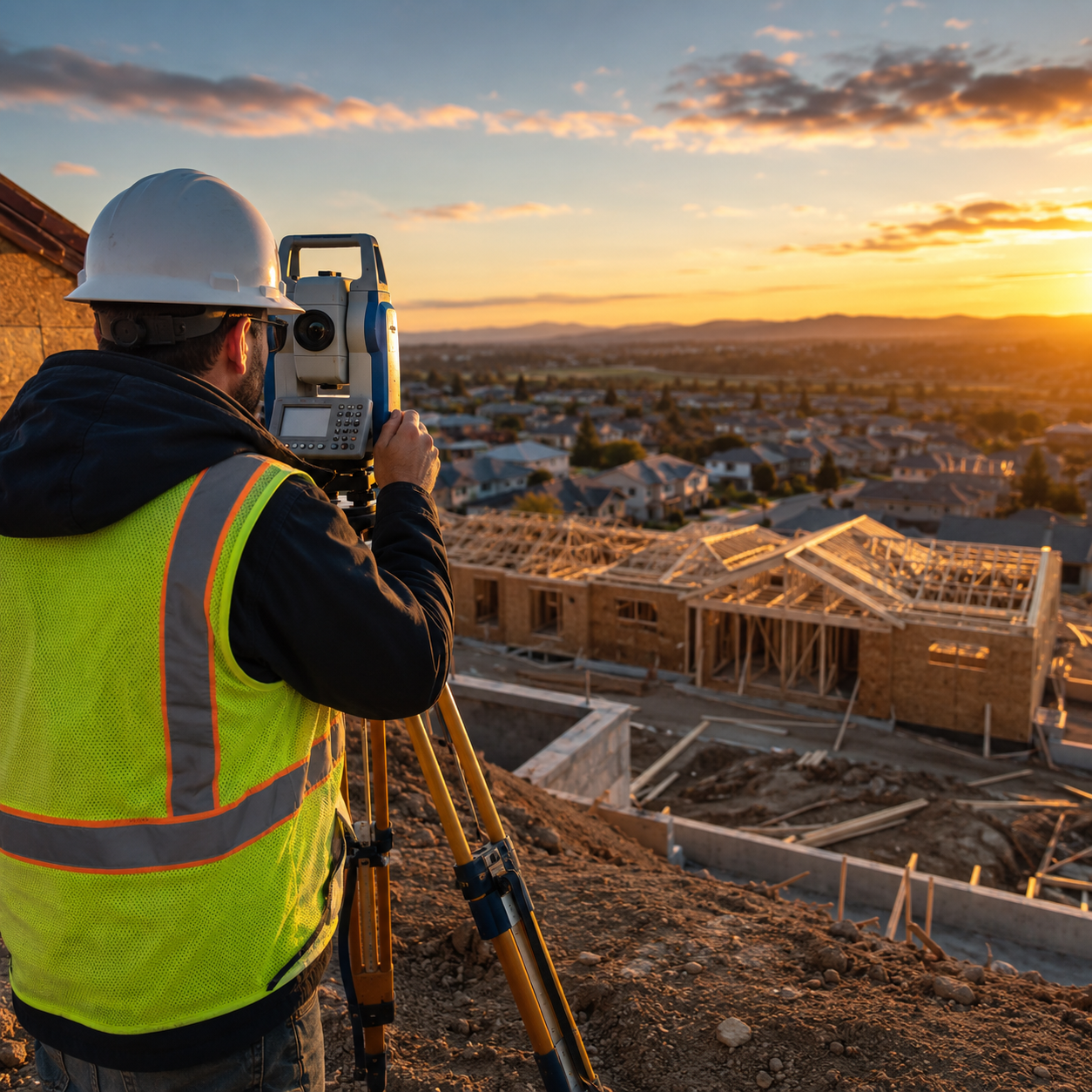
Construction defect litigation has surged by 40% since 2020, with expert witness testimony becoming the decisive factor in over 75% of successful claims. As building disputes grow more complex in 2026, the quality of valuation evidence presented in court determines whether property owners recover millions in damages or walk away empty-handed. Expert Witness Valuations in Defective Building Works: Building Court-Ready Evidence for 2026 Disputes represents the critical intersection where technical expertise meets legal scrutiny, and where thorough documentation transforms construction failures into compelling courtroom narratives.
The role of expert witnesses in construction defect cases extends far beyond simple property assessments. These professionals must bridge the gap between technical construction concepts and legal arguments that judges and juries can understand. With expert compensation ranging from $175 to $450 per hour, and potentially higher in complex circumstances, the stakes demand rigorous preparation and unimpeachable methodology[1].
Key Takeaways
- Early engagement is essential: Expert witnesses should be retained before lawsuits are filed to conduct comprehensive inspections and establish baseline evidence
- Documentation standards matter: Court-ready evidence requires photographic proof, detailed measurements, and compliance with CPR Part 35 requirements
- Valuation methodology must be defensible: Expert reports need transparent calculations showing repair costs, diminution in value, and market impact analysis
- Fire safety and cladding defects dominate 2026 disputes: Building Safety Act compliance issues require specialized expertise in mid-rise residential blocks[4]
- Cross-examination preparation determines credibility: Expert witnesses must defend their methodology, assumptions, and conclusions under rigorous legal scrutiny
Understanding Expert Witness Valuations in Defective Building Works: Building Court-Ready Evidence for 2026 Disputes
The Critical Role of Expert Witnesses in Construction Litigation
Expert witnesses serve as the technical translators between complex construction defects and legal proceedings. Unlike lay witnesses who testify based on personal observations, expert witnesses provide objective analysis grounded in specialized knowledge, professional qualifications, and industry experience[2].
In 2026, several categories of experts contribute to building defect cases:
🏗️ Structural Engineers assess foundational issues, load-bearing failures, and impacts from external forces such as subsidence or wind damage. Their expertise proves invaluable when determining whether structural defects pose safety risks or merely cosmetic concerns[2].
📋 Building Code Experts analyze compliance with local, state, and federal regulations. They determine whether defects arose from negligence, oversight, or conscious departures from code requirements—a distinction that significantly impacts liability determinations[2].
🔬 Materials Scientists evaluate the performance and deterioration of construction materials. When substandard materials contribute to failures, these experts provide forensic analysis linking material defects to property damage[2].
👷 Construction Managers assess whether execution complied with industry standards and project specifications. Their testimony addresses poor workmanship, contract non-compliance, and deviation from approved plans[2].
For property owners seeking comprehensive assessments, RICS specialist defect surveys provide the foundation for expert witness engagement.
When to Engage Expert Witnesses
Timing proves critical in construction defect litigation. Experts should be retained early in disputes—often before lawsuits are filed—to conduct thorough property inspections and preserve evidence[3]. This early engagement allows professionals such as structural engineers, building science experts, and certified specialists to document defects before conditions deteriorate or remediation begins.
Early expert involvement provides several strategic advantages:
- Evidence preservation before weather, occupancy, or emergency repairs alter conditions
- Comprehensive documentation establishing baseline defect conditions
- Cost-effective investigation before litigation expenses escalate
- Settlement leverage through credible expert opinions supporting claims
- Regulatory compliance with notice requirements under statutes like the Residential Construction Liability Act[3]
Inspection Protocols for Expert Witness Valuations in Defective Building Works
Comprehensive Site Investigation Methodology
Court-ready evidence begins with systematic inspection protocols that document every aspect of building defects. Expert witnesses must follow rigorous methodologies that withstand cross-examination and judicial scrutiny.
Essential Inspection Components
| Inspection Element | Documentation Required | Purpose |
|---|---|---|
| Visual Assessment | Photographic evidence with scale references | Establish visible defect extent |
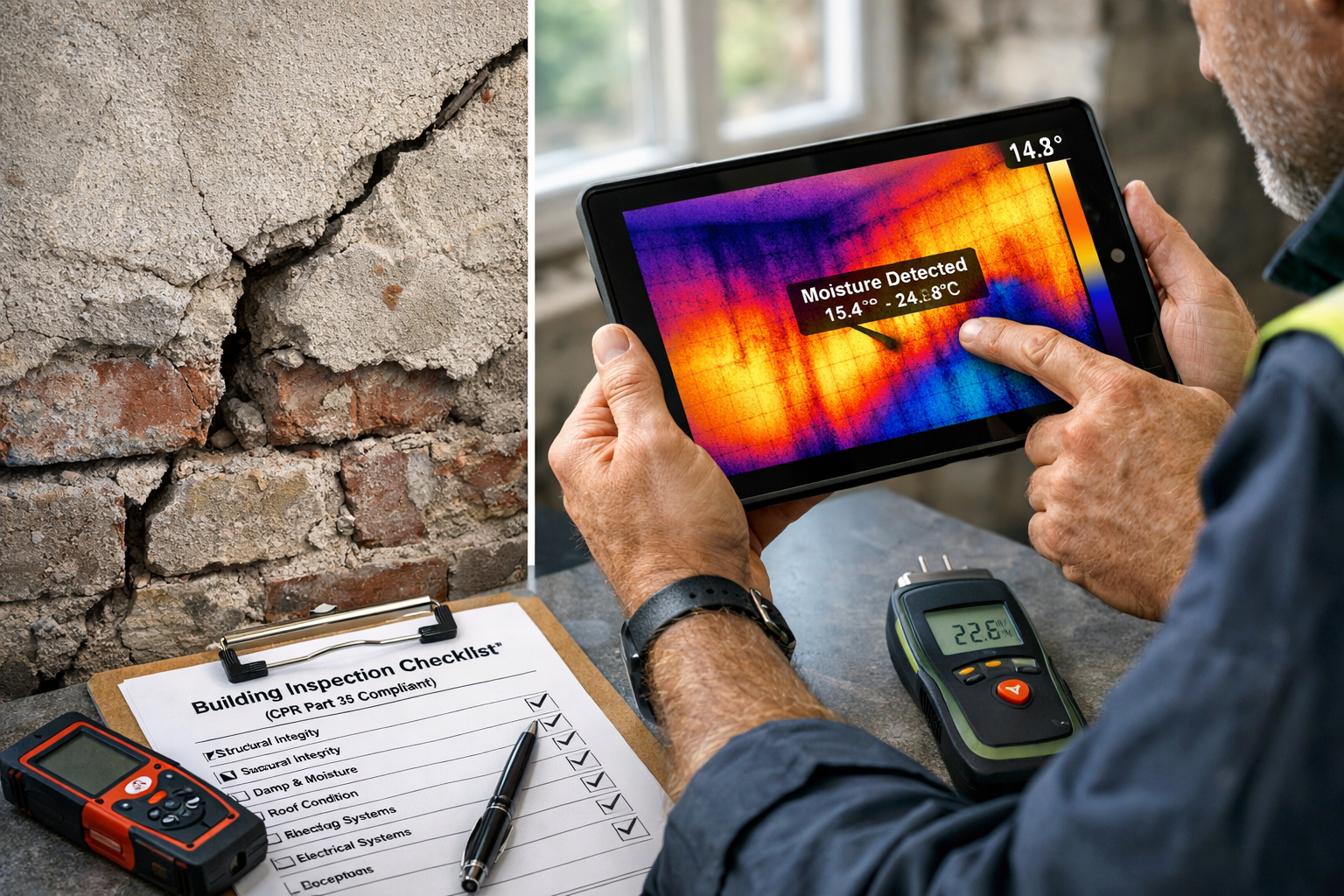
| Measurement Data | Precise dimensions, crack widths, deflections | Quantify defect severity |
| Material Testing | Laboratory analysis results | Determine material failures |
| Moisture Detection | Thermal imaging, moisture meter readings | Identify hidden water damage |
| Structural Analysis | Load calculations, stress assessments | Evaluate safety implications |
| Code Compliance Review | Regulatory comparison documentation | Establish standard-of-care breaches |
Professional building surveys establish the baseline for defect identification, while specialized investigations drill deeper into specific failure mechanisms.
Advanced Diagnostic Techniques
Modern expert witness valuations leverage technology-enhanced inspection methods that provide objective, verifiable data:
Thermal Imaging reveals hidden moisture intrusion, insulation defects, and air leakage patterns invisible to visual inspection. This non-invasive technique documents problems behind finished surfaces without destructive testing.
3D Laser Scanning creates precise digital models capturing existing conditions with millimeter accuracy. These scans provide permanent records of defect geometry and spatial relationships.
Drone Photography documents roof conditions, facade defects, and site context from perspectives impossible with ground-based photography. Aerial imagery proves particularly valuable for large-scale projects or dangerous access conditions.
Material Sampling with laboratory analysis determines whether installed materials meet specifications and industry standards. Chain-of-custody protocols ensure sample integrity for potential court proceedings.
For properties with suspected structural issues, subsidence surveys provide specialized investigation protocols addressing foundation and soil-related defects.
Documentation Standards Under CPR Part 35
Civil Procedure Rules Part 35 establishes the framework governing expert witness evidence in UK courts. Compliance with these standards separates admissible expert testimony from inadmissible advocacy.
Key CPR Part 35 requirements include:
✅ Duty to the Court: Expert witnesses owe their primary duty to the court, not the party retaining them. Objectivity and impartiality must guide all opinions.
✅ Statement of Truth: Expert reports must include declarations that the expert understands their duty and has complied with it.
✅ Qualifications Disclosure: Reports must detail the expert's qualifications, experience, and basis for claimed expertise.
✅ Methodology Transparency: Experts must explain their investigation methods, tests performed, and reasoning supporting conclusions.
✅ Assumptions Identification: Any assumptions underlying opinions must be clearly stated and justified.
✅ Alternative Viewpoints: Experts should acknowledge alternative interpretations and explain why their conclusions are preferred.
For commercial properties, commercial building surveys provide the comprehensive documentation foundation supporting expert witness engagement.
Building Court-Ready Evidence: Expert Report Writing Standards
Structuring the Expert Witness Report
A well-structured expert report transforms technical findings into persuasive legal evidence. The report architecture should guide readers logically from defect identification through causation analysis to valuation conclusions.
Essential Report Components
1. Executive Summary (2-3 pages)
Concise overview of key findings, causation conclusions, and valuation summary. This section should stand alone for busy legal professionals and judges.
2. Expert Qualifications (1-2 pages)
Detailed credentials establishing expertise relevant to the specific defects at issue. Include professional certifications, relevant experience, and prior expert witness testimony.
3. Instructions and Scope (1 page)
Clear statement of the retaining party's instructions and the expert's understanding of the assignment scope.
4. Property Description (2-3 pages)
Comprehensive property overview including construction type, age, size, use, and relevant history.
5. Inspection Findings (10-20 pages)
Detailed documentation of all identified defects with:
- Photographic evidence (properly labeled and referenced)
- Precise measurements and locations
- Severity assessments
- Relationship to building systems
6. Causation Analysis (5-10 pages)
Technical explanation linking defects to specific failures in design, materials, or workmanship. This section establishes liability foundations by demonstrating how defects occurred.
7. Valuation Methodology (5-8 pages)
Transparent explanation of valuation approach, including:
- Repair cost estimates with contractor quotations
- Diminution in value calculations
- Market impact analysis with comparable evidence
- Alternative remediation scenarios
8. Conclusions (2-3 pages)
Clear, defensible opinions answering the key questions posed by legal counsel.
9. Appendices
Supporting documentation including photographs, test results, calculations, and reference materials.
For properties requiring valuation reports, expert witnesses must demonstrate familiarity with recognized valuation methodologies and RICS standards.
Photographic Documentation Best Practices
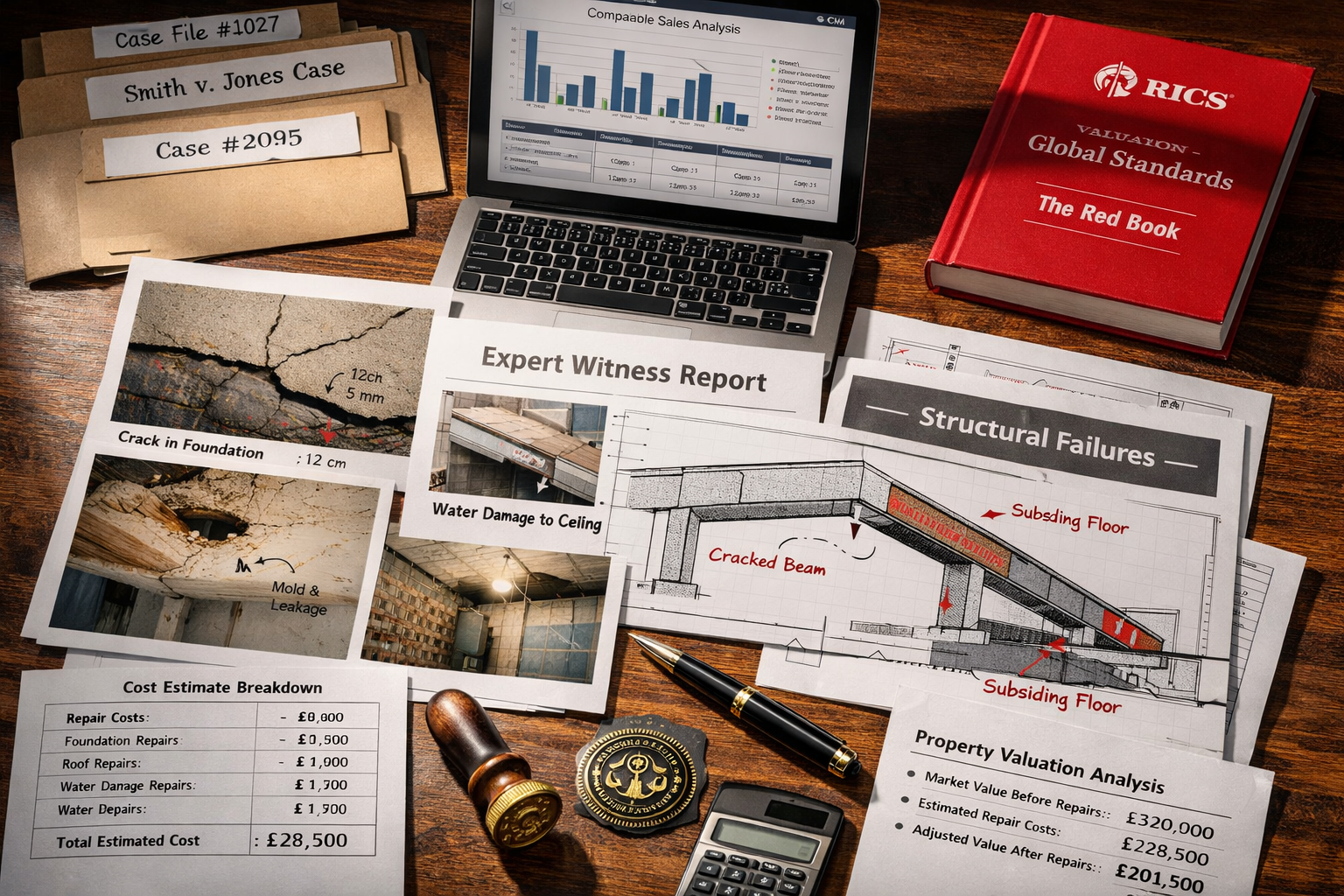
Visual evidence carries enormous weight in construction defect cases. Judges and juries understand photographs far more readily than technical descriptions. Expert witnesses must master photographic documentation techniques that tell compelling visual stories.
Photography Protocols
📸 Wide, Medium, and Close-Up Sequences: Document each defect at multiple scales showing context, location, and detail.
📸 Scale References: Include measuring tapes, rulers, or coins in close-up photographs to establish size.
📸 Consistent Lighting: Use supplemental lighting to eliminate shadows and ensure defect visibility.
📸 Reference Markers: Place numbered labels or arrows identifying specific defect features discussed in report text.
📸 Metadata Preservation: Maintain digital photograph metadata showing date, time, and camera settings.
📸 Before-and-After Documentation: When possible, obtain historical photographs showing property conditions before defects developed.
Expert reports with photographic documentation and written findings prove critical for substantiating claims and providing builders reasonable notice of all alleged defects[3].
Valuation Impact Analysis
Quantifying financial consequences represents the ultimate objective of expert witness valuations in defective building works. Courts require clear, defensible calculations showing how defects impact property value and what remediation costs are reasonable.
Cost-to-Cure Approach
The cost-to-cure method calculates the expense of repairing defects to restore the property to its intended condition. This approach requires:
- Detailed scope of work specifications
- Contractor quotations or cost estimating databases
- Allowances for professional fees, permits, and contingencies
- Consideration of temporary accommodation costs during repairs
Diminution in Value Approach
The diminution in value method measures the difference between the property's actual value (with defects) and its hypothetical value (without defects). This approach involves:
- Market analysis of comparable properties
- Buyer perception of defect severity
- Marketability impact assessment
- Stigma considerations for certain defect types
Hybrid Approach
Many experts employ a hybrid methodology comparing cost-to-cure against diminution in value, with the lower figure typically representing the appropriate measure of damages (unless safety concerns mandate repairs regardless of cost).
For comprehensive understanding of valuation principles, experts should reference methods of valuation guidance establishing industry-standard approaches.
Fire Safety and Cladding Defects in 2026
Building Safety Act compliance dominates construction defect litigation in 2026, particularly regarding fire safety and cladding defects in mid-rise residential blocks[4]. Expert witnesses must demonstrate specialized knowledge of:
- Combustible cladding identification and testing protocols
- Fire risk assessment methodologies specific to external wall systems
- Remediation cost estimation for cladding replacement programs
- Regulatory compliance standards under the Building Safety Act
- Valuation impact of fire safety defects on property marketability
The unique challenges of Building Safety Act disputes require experts who understand both technical fire safety engineering and the regulatory framework governing building safety in 2026[4].
Preparing for Cross-Examination and Testimony
Defending Your Methodology
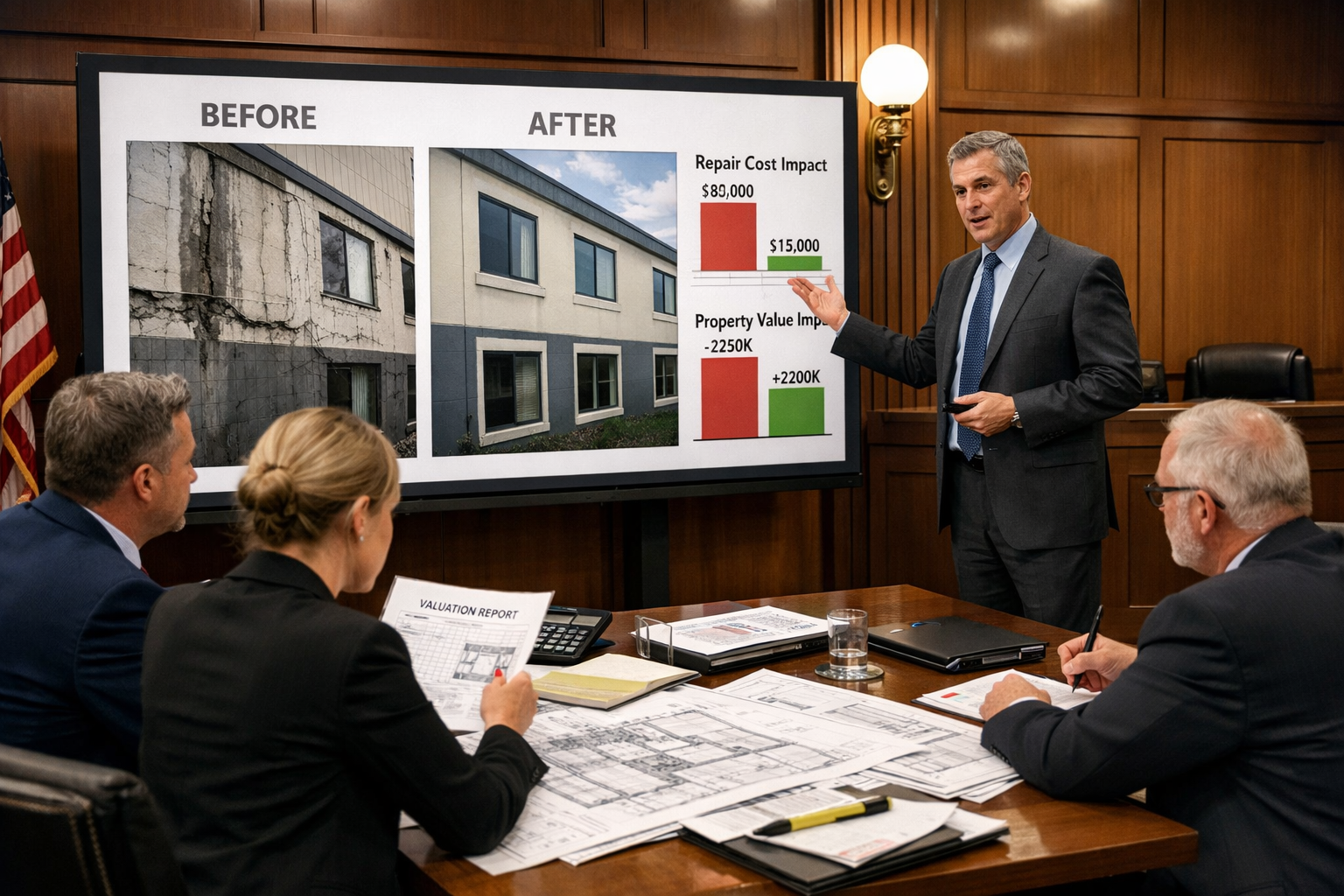
Cross-examination represents the ultimate test of expert witness credibility. Opposing counsel will scrutinize every assumption, calculation, and conclusion seeking to undermine the expert's testimony. Preparation determines whether expert opinions withstand this adversarial process.
Common Cross-Examination Challenges
Qualification Attacks: Opposing counsel may question whether the expert possesses relevant experience for the specific defects at issue. Experts must articulate how their background qualifies them for the particular assignment.
Methodology Critiques: Attorneys challenge whether inspection protocols met industry standards or whether alternative methods would have produced different conclusions. Experts must justify their chosen approaches with reference to recognized standards.
Assumption Challenges: Cross-examination often targets underlying assumptions supporting opinions. Experts must clearly distinguish between facts observed, information provided by others, and assumptions made.
Alternative Explanations: Opposing experts may offer competing causation theories. Testifying experts must acknowledge alternative possibilities while explaining why their conclusions are more probable.
Bias Allegations: Counsel may suggest the expert advocates for the retaining party rather than providing objective analysis. Demonstrating CPR Part 35 compliance and maintaining composure under questioning counters bias allegations.
Expert Witness Fees and Engagement Terms
Compensation structures for expert witnesses must be clearly established at engagement to avoid disputes and ensure independence. Expert compensation ranges from $175 to $450 per hour, with rates potentially higher for specialized expertise or complex cases[1].
Fee Components
- Inspection and investigation time: Site visits, testing, and evidence gathering
- Report preparation: Research, analysis, writing, and revision
- Deposition testimony: Pre-trial questioning under oath
- Trial testimony: Court appearance and examination
- Travel time and expenses: Transportation, accommodation, and meals
- File review and consultation: Document analysis and attorney meetings
Experts should establish written engagement agreements specifying hourly rates, estimated time requirements, billing procedures, and payment terms. Fee arrangements must never be contingent on case outcomes, as contingency fees compromise expert independence and admissibility.
Maintaining Professional Independence
Objectivity represents the cornerstone of expert witness credibility. Experts who appear to advocate for the retaining party rather than provide impartial analysis lose effectiveness and face potential exclusion of their testimony.
Maintaining independence requires:
🎯 Refusing inappropriate instructions: Declining requests to reach predetermined conclusions or omit unfavorable findings
🎯 Acknowledging limitations: Admitting when questions fall outside the expert's expertise or when available evidence proves insufficient for definitive opinions
🎯 Documenting methodology: Creating transparent records showing how conclusions were reached, allowing others to verify the analysis
🎯 Considering alternative viewpoints: Fairly evaluating competing theories and explaining why particular conclusions are preferred
🎯 Correcting errors: Promptly notifying instructing solicitors if mistakes are discovered in reports or testimony
For experts engaged in structural surveys supporting litigation, maintaining independence ensures testimony withstands judicial scrutiny and serves the court's truth-seeking function.
Emerging Trends in Expert Witness Valuations for 2026 Disputes
Technology Integration in Evidence Presentation
Digital evidence presentation has transformed how expert witnesses communicate complex technical information to judges and juries in 2026. Modern experts leverage technology to make defect evidence more accessible and persuasive.
Innovative Presentation Methods
Virtual Reality Walkthroughs: Immersive VR experiences allow judges and juries to "visit" properties and observe defects from multiple perspectives without physical site visits.
Animated Defect Progression: Time-lapse animations demonstrate how defects developed over time, clarifying causation theories that static photographs cannot convey.
Interactive Cost Models: Digital tools allowing real-time adjustment of repair scope assumptions, demonstrating how different remediation approaches impact valuation conclusions.
Comparative Market Analysis Dashboards: Visual presentations of comparable property data supporting diminution in value calculations with interactive filtering and sorting.
Regulatory Developments Affecting Expert Testimony
Building Safety Act enforcement continues evolving in 2026, creating new categories of defects requiring expert analysis. Experts must stay current with regulatory developments affecting:
- Accountability frameworks establishing clear responsibility chains for building safety
- Competence requirements for construction professionals involved in higher-risk buildings
- Gateway inspection regimes creating documentary evidence trails for compliance verification
- Remediation funding mechanisms affecting who bears financial responsibility for safety defects
Experts providing testimony in Building Safety Act disputes must demonstrate familiarity with these regulatory frameworks and their implications for liability and valuation[4].
Climate Resilience and Building Performance
Climate-related building failures represent a growing category of defect claims in 2026. Extreme weather events expose design and construction inadequacies that expert witnesses must evaluate:
- Flood resilience deficiencies in drainage and waterproofing systems
- Thermal performance failures as temperature extremes stress building envelopes
- Wind resistance inadequacies revealed by increasingly severe storm events
- Moisture management failures as precipitation patterns change
Expert witnesses must understand how climate change impacts interact with construction defects to provide forward-looking valuation analysis considering future performance risks.
Conclusion
Expert Witness Valuations in Defective Building Works: Building Court-Ready Evidence for 2026 Disputes demands rigorous methodology, comprehensive documentation, and unwavering professional independence. As construction defect litigation grows more complex, the quality of expert witness evidence increasingly determines case outcomes. Successful experts combine technical expertise with clear communication, transforming complex building failures into compelling narratives that judges and juries can understand and act upon.
The framework for building court-ready evidence rests on several foundational principles: early engagement to preserve evidence and establish baseline conditions, systematic inspection protocols leveraging modern diagnostic technology, CPR Part 35 compliance ensuring admissibility and credibility, transparent valuation methodology with defensible calculations, and thorough preparation for cross-examination challenges.
Actionable Next Steps
For expert witnesses preparing for construction defect litigation:
- Establish written engagement terms clearly defining scope, fees, and independence requirements before beginning work
- Develop standardized inspection checklists ensuring comprehensive defect documentation that meets CPR Part 35 standards
- Invest in photographic equipment and training to create compelling visual evidence supporting written findings
- Build relationships with specialist consultants who can provide testing and analysis beyond your core expertise
- Maintain continuing professional development in emerging areas like Building Safety Act compliance and climate resilience
- Create report templates incorporating all required CPR Part 35 elements while allowing customization for specific cases
- Practice testimony skills through mock cross-examinations and courtroom simulations
For property owners and legal professionals seeking expert witnesses:
- Engage experts early in the dispute process, ideally before litigation commences
- Verify qualifications ensuring the expert possesses relevant experience for the specific defects at issue
- Review sample reports assessing whether the expert's communication style suits your case needs
- Clarify fee structures establishing transparent billing arrangements that preserve expert independence
- Provide complete documentation giving experts access to all relevant property records, contracts, and correspondence
The intersection of technical expertise and legal requirements creates unique challenges for expert witnesses in construction defect cases. Those who master both domains—understanding building science while navigating courtroom procedures—provide invaluable service to the justice system. As building technologies evolve and regulatory frameworks expand in 2026, expert witnesses must continuously adapt their methodologies while maintaining the core principles of objectivity, thoroughness, and clarity that make their testimony credible and persuasive.
Whether addressing fire safety concerns under the Building Safety Act, quantifying repair costs for structural failures, or analyzing market impacts of construction defects, expert witnesses serve as the critical bridge between technical reality and legal resolution. Their work transforms construction failures from abstract technical problems into concrete evidence supporting just outcomes for property owners harmed by defective building works.
References
[1] jurispro – https://www.jurispro.com/category/construction-damages-s-88/TX
[2] The Role Of Expert Witnesses In Construction Defect Litigation – https://macyhanson.com/blog/the-role-of-expert-witnesses-in-construction-defect-litigation/
[3] Role Of Expert Witnesses In Construction Defect Litigation – https://www.porterfirm.com/blog/2025/10/role-of-expert-witnesses-in-construction-defect-litigation/
[4] Expert Witness Roles In 2026 Building Safety Act Disputes Evidence Standards For Mid Rise Residential Blocks – https://nottinghillsurveyors.com/blog/expert-witness-roles-in-2026-building-safety-act-disputes-evidence-standards-for-mid-rise-residential-blocks
[6] Construction Tech Soc Defect – https://www.thinkbrg.com/industries/construction-real-estate/construction-tech-soc-defect/
[8] Expert Witness Preparation For Construction Defect Claims In Scotland Rics Guidance Amid 2026 Stable Market Conditions – https://nottinghillsurveyors.com/blog/expert-witness-preparation-for-construction-defect-claims-in-scotland-rics-guidance-amid-2026-stable-market-conditions