As the UK housing market enters 2026 with stabilizing prices and renewed lender confidence, mortgage valuation disputes are evolving in both character and complexity. Expert Witness Valuations in 2026 Mortgage Disputes: Building Credible Cases Amid Stabilizing Prices and Improving Lender Confidence requires a sophisticated understanding of current market dynamics, rigorous adherence to RICS standards, and the ability to translate complex valuation methodologies into compelling courtroom testimony. 🏛️
The shifting landscape presents both challenges and opportunities for expert witnesses. With property values finding equilibrium after years of volatility, disputes increasingly hinge on nuanced interpretations of valuation methodology rather than dramatic market swings. This environment demands experts who can demonstrate not only technical proficiency but also credibility that withstands rigorous cross-examination.
Key Takeaways
- Admissibility standards under Rule 702 require expert witnesses to demonstrate reliable methodology specifically tailored to the valuation premise and standard of value required by each case
- Compensation structures for real estate valuation experts typically range from £135 to £350 per hour in 2026, reflecting the specialized expertise required in mortgage disputes
- Market stabilization in 2026 shifts dispute focus from volatile price movements to methodology selection, valuation date determination, and premise of value applications
- RICS Red Book compliance remains the cornerstone of credible expert testimony, with courts increasingly scrutinizing adherence to professional standards
- Data-driven preparation using stabilizing market trends strengthens expert opinions and withstands challenges regarding market condition assumptions
Understanding the 2026 Mortgage Dispute Landscape
The mortgage dispute environment in 2026 differs markedly from previous years. As house prices stabilize nationally and lender confidence improves, the nature of valuation disagreements has shifted from broad market interpretation disputes to more technical methodology debates.
The Stabilizing Market Context
The UK property market in 2026 shows clear signs of stabilization following the turbulence of 2022-2024. This creates a unique environment where:
- Price predictability has improved, reducing disputes based on market timing alone
- Lender confidence has strengthened, leading to more consistent lending criteria
- Transaction volumes have normalized, providing better comparable data
- Regional variations remain significant, requiring localized expertise
This stabilization paradoxically increases the importance of expert witness precision. When markets are volatile, large valuation discrepancies can be attributed to timing. In stable markets, differences demand more rigorous justification.
Common Types of Mortgage Valuation Disputes in 2026
Expert witnesses encounter several recurring dispute categories:
Lending Decision Disputes 💰
- Borrower challenges to down-valuations affecting mortgage approval
- Lender reliance on allegedly flawed valuations
- Purchase price versus valuation discrepancies
Refinancing Valuation Conflicts
- Disagreements over equity calculations for remortgage applications
- Disputes regarding property improvement value recognition
- Challenges to loan-to-value ratio determinations
Repossession and Forced Sale Cases
- Appropriate valuation premise selection (market value vs. forced sale value)
- Timing considerations in declining or recovering markets
- Comparable selection in distressed sale scenarios
Professional Negligence Claims
- Allegations of surveyor error in original valuations
- Claims regarding missed defects affecting value
- Disputes over RICS professional standards compliance
Understanding these dispute types helps expert witnesses prepare comprehensive opinions that address the specific issues at controversy.
Building Credible Expert Witness Foundations
Credibility forms the bedrock of effective expert testimony. Expert Witness Valuations in 2026 Mortgage Disputes: Building Credible Cases Amid Stabilizing Prices and Improving Lender Confidence begins with establishing unassailable professional credentials and demonstrating methodological rigor.
Meeting Admissibility Standards
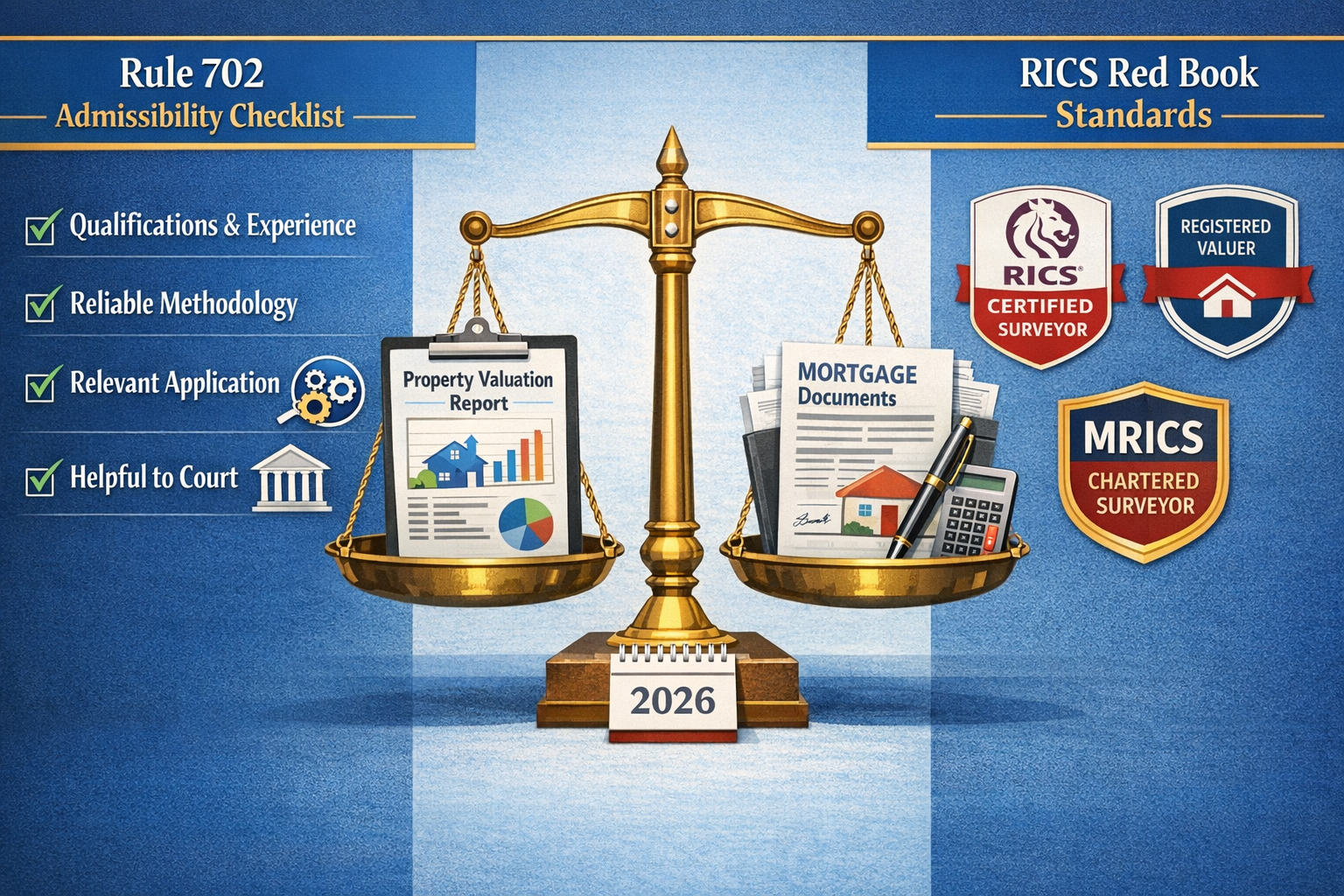
Expert testimony must satisfy Rule 702 requirements, which mandate that opinions are based on reliable methodology and actually help the trier of fact[3]. Courts have excluded experts who applied inappropriate valuation premises or failed to demonstrate methodological reliability.
The Four Pillars of Admissibility:
- Qualified Expert – Demonstrated knowledge, skill, experience, training, or education in property valuation
- Reliable Methodology – Application of accepted valuation principles and RICS standards
- Relevant Application – Methodology appropriately applied to the specific facts of the case
- Helpful to the Court – Testimony assists the judge or jury in understanding technical valuation issues
RICS Professional Standards Compliance
The RICS Red Book provides the framework for credible valuations in the UK. Expert witnesses must demonstrate thorough familiarity with:
- RICS Valuation – Global Standards (Red Book) requirements
- UK National Supplement provisions specific to mortgage valuations
- Professional competence requirements for the property type and valuation purpose
- Independence and objectivity standards that prevent bias
Registered RICS valuers bring inherent credibility to expert testimony, though qualification alone does not guarantee admissibility.
Establishing Independence and Objectivity
Courts scrutinize expert witness independence rigorously. Credible experts must:
✅ Disclose all relationships with parties, attorneys, or properties involved
✅ Avoid advocacy for the retaining party's position
✅ Present balanced opinions acknowledging limitations and alternative interpretations
✅ Maintain professional skepticism regarding provided information
✅ Document methodology transparently to allow independent verification
The duty to the court supersedes any duty to the instructing party. This principle must be evident throughout the expert's work and testimony.
Compensation and Fee Structures
Real estate valuation expert witnesses typically receive compensation ranging from £135 to £350 per hour in 2026, with fees varying based on complexity, urgency, and the expert's experience level[1]. Transparent fee agreements established at the outset prevent later disputes and maintain independence.
Typical Fee Components:
- Initial case review and conflict check
- Document review and analysis
- Site inspection and comparable research
- Report preparation and revisions
- Deposition or court testimony preparation
- Actual testimony time
- Travel and expenses
Contingency fee arrangements are generally prohibited as they compromise independence and objectivity.
Methodology Selection and Application in Mortgage Disputes
The technical heart of Expert Witness Valuations in 2026 Mortgage Disputes: Building Credible Cases Amid Stabilizing Prices and Improving Lender Confidence lies in selecting and applying appropriate valuation methods that withstand scrutiny.
Critical Methodology Decisions
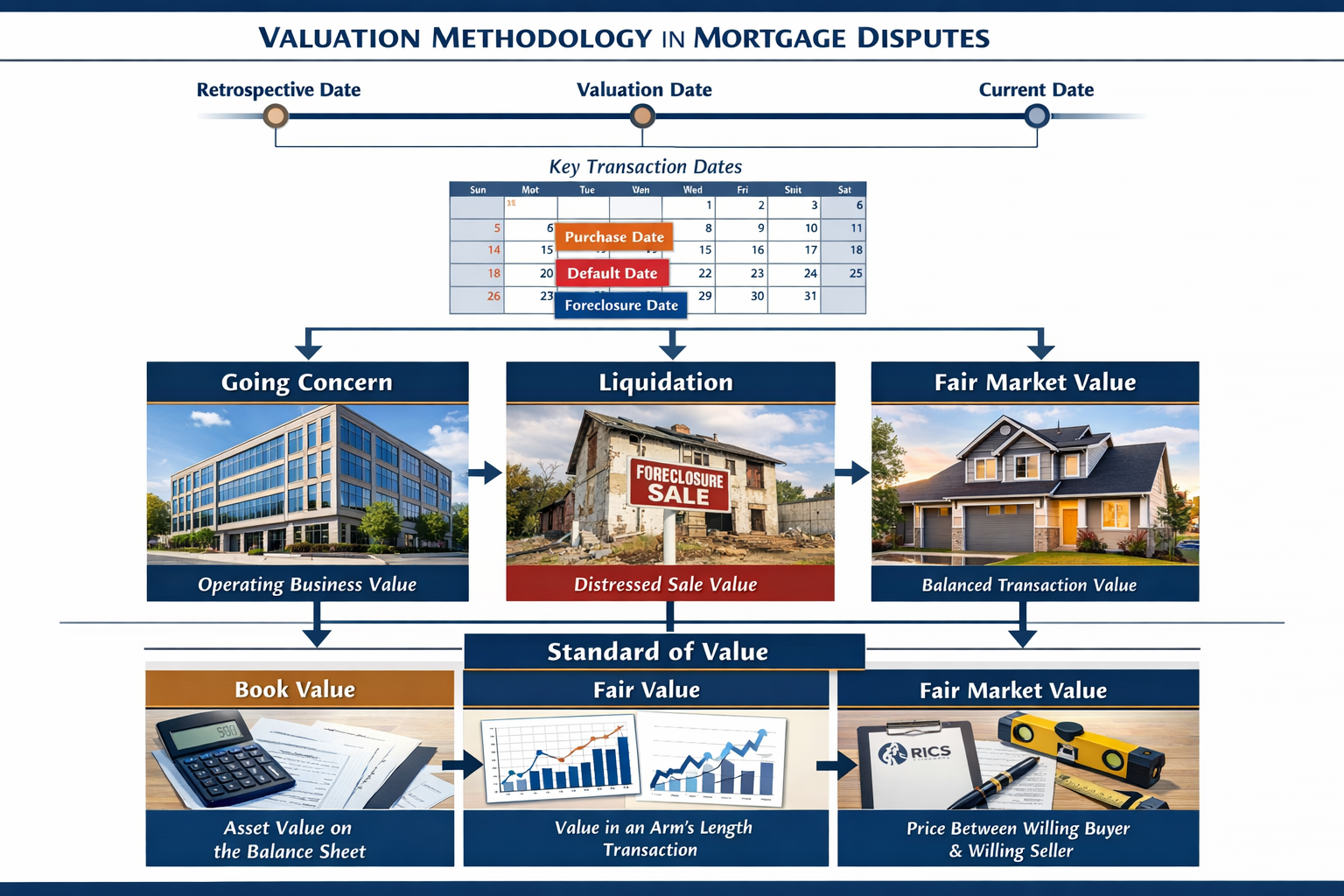
Experts must carefully determine three fundamental elements[3]:
1. Valuation Date Selection
The valuation date significantly impacts conclusions, particularly in markets experiencing change. Experts must:
- Identify the legally relevant valuation date (transaction date, breach date, trial date)
- Consider retrospective versus prospective valuation challenges
- Account for information reasonably available at the valuation date
- Avoid hindsight bias when conducting retrospective valuations
In 2026's stabilizing market, valuation date selection may generate less dramatic value differences than in volatile periods, but precision remains essential.
2. Premise of Value
The premise of value defines the assumptions underlying the valuation[3]:
| Premise | Application | Typical Scenario |
|---|---|---|
| Going Concern | Property valued as operational entity | Investment properties, commercial mortgages |
| Orderly Liquidation | Reasonable marketing period assumed | Standard residential mortgage valuations |
| Forced Liquidation | Compressed sale timeline | Repossession cases, distressed sales |
| Assemblage | Value considering combination with adjacent properties | Development site valuations |
Courts have excluded experts who applied synergistic value premises when fair value was required, or going concern valuations when liquidation value was appropriate[3]. Premise selection must align precisely with the legal question at issue.
3. Standard of Value
Different legal contexts require different value standards:
Market Value 🏠
The estimated amount for which an asset should exchange between a willing buyer and willing seller in an arm's-length transaction. This is the most common standard in mortgage disputes.
Fair Value
Often used in shareholder disputes and certain statutory contexts, fair value may exclude minority discounts or marketability discounts.
Investment Value
Value to a particular investor based on individual investment requirements. Rarely appropriate in mortgage disputes.
Book Value
Historical cost-based value from accounting records. Generally not relevant to mortgage disputes.
Misapplication of value standards represents a common basis for expert exclusion and opinion challenge.
The Comparative Method in Stabilizing Markets
The comparative method (sales comparison approach) dominates residential mortgage valuations. In 2026's stabilizing market, this approach benefits from:
Enhanced Comparable Availability
Normalized transaction volumes provide robust comparable evidence, strengthening opinion reliability.
Reduced Adjustment Uncertainty
Stable pricing reduces the magnitude of time adjustments required between comparable sales and valuation dates.
Clearer Market Trends
Stabilization allows experts to identify genuine market trends rather than noise from volatility.
Critical Comparable Selection Criteria:
- Geographic proximity (ideally within 0.5 miles for residential)
- Property type and characteristics similarity
- Transaction timing (preferably within 3-6 months)
- Transaction nature (arm's-length, market-based sales)
- Adjustment magnitude (minimizing total adjustments enhances reliability)
Income and Cost Approaches
While less common in residential mortgage disputes, income and cost approaches may be relevant for:
Income Approach Applications:
- Buy-to-let mortgage valuations
- Commercial property valuations
- Multi-unit residential properties
- Properties with income-generating potential
Cost Approach Applications:
- Newly constructed properties with limited comparables
- Unique or specialized properties
- Insurance reinstatement valuations
- Properties in emerging markets with limited transaction data
Experts must justify methodology selection with reference to available data, property characteristics, and valuation purpose.
Leveraging 2026 Market Data for Robust Opinions
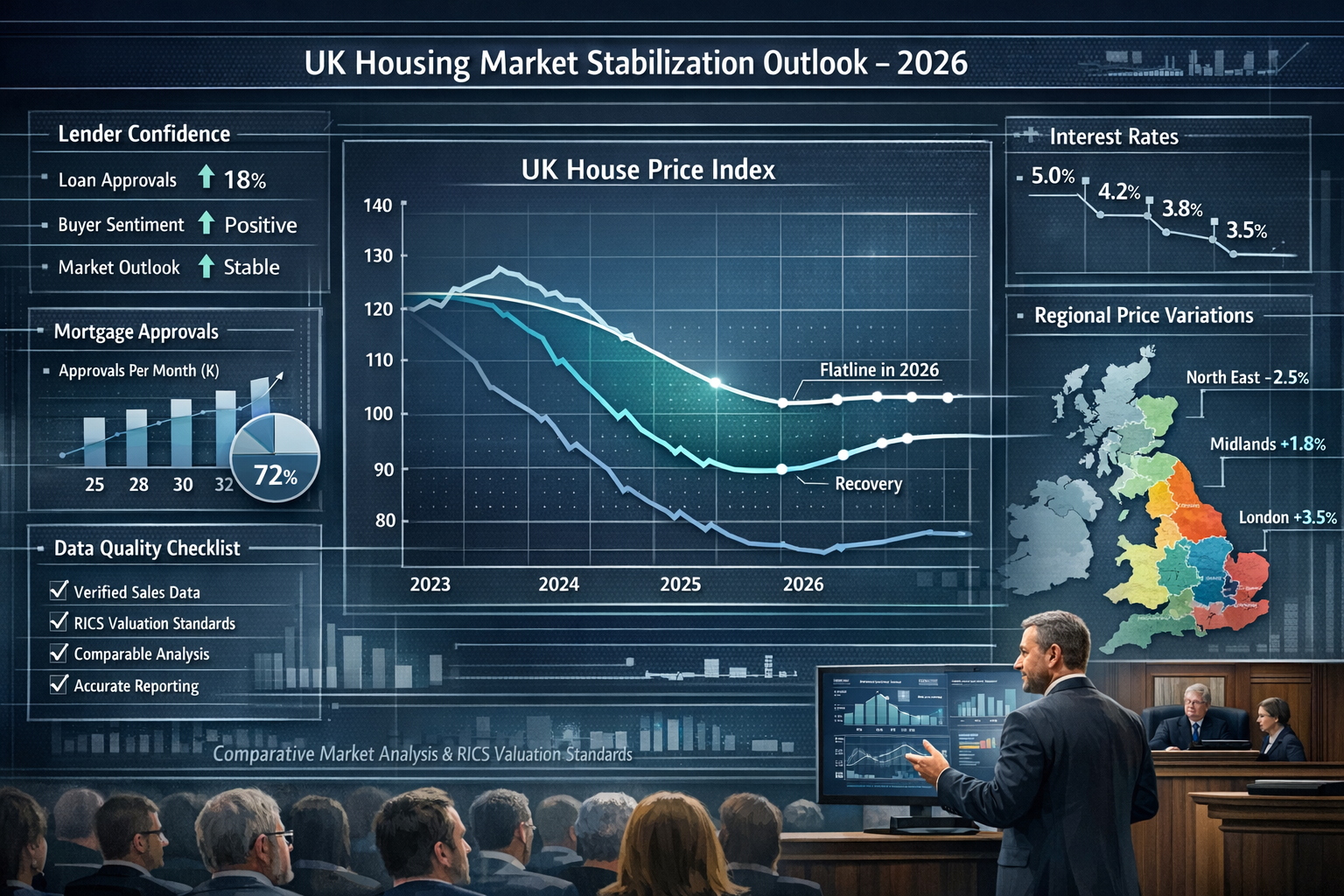
Expert Witness Valuations in 2026 Mortgage Disputes: Building Credible Cases Amid Stabilizing Prices and Improving Lender Confidence increasingly relies on sophisticated data analysis demonstrating market condition understanding.
Data Sources and Quality Verification
Credible expert opinions rest on reliable data foundations. In 2026, experts should utilize:
Primary Data Sources:
- Land Registry price paid data
- Local authority planning and building control records
- Multiple Listing Service (MLS) data where available
- Professional valuation databases (e.g., Rightmove, Zoopla commercial data)
- Direct market participant interviews (estate agents, mortgage brokers)
Data Quality Verification Steps:
- Cross-reference multiple data sources for consistency
- Verify transaction details directly when possible
- Identify and exclude non-arm's-length transactions
- Confirm property characteristics through independent inspection
- Document data sources transparently for opposing expert review
Poor data quality undermines otherwise sound methodology. Courts increasingly expect experts to demonstrate data verification procedures.
Analyzing Stabilizing Price Trends
The 2026 market stabilization creates specific analytical opportunities:
Trend Analysis Benefits:
- Reduced volatility allows clearer identification of underlying value patterns
- Improved lender confidence correlates with more consistent valuation practices
- Regional variations become more apparent against stable national backdrop
- Seasonal patterns emerge more clearly in stable markets
Statistical Tools for Trend Analysis:
- Moving averages to smooth short-term fluctuations
- Regression analysis to quantify price-characteristic relationships
- Confidence intervals to express valuation uncertainty
- Comparative market analysis across time periods
Experts who demonstrate sophisticated understanding of market trends enhance credibility and opinion persuasiveness.
Regional Variation Considerations
Despite national stabilization, significant regional variations persist in 2026. Expert witnesses must account for:
London and Southeast England 🏙️
Continued price premiums with stabilization at elevated levels. Experts must justify premium valuations with specific market evidence.
Northern England and Midlands
Stronger relative growth in some areas as affordability attracts buyers. Regional comparable selection becomes critical.
Scotland and Wales
Distinct market dynamics requiring jurisdiction-specific expertise and data sources.
Rural versus Urban
Divergent trends based on post-pandemic lifestyle preferences and remote work patterns.
Generic national trend application without regional adjustment weakens expert opinions and invites successful challenge.
Lender Confidence Indicators
Improving lender confidence in 2026 affects valuation disputes through:
- Loan-to-value ratios – More generous LTV offerings in stable markets
- Valuation scrutiny levels – Potentially reduced conservatism in valuations
- Acceptable property types – Broader lending criteria for previously restricted property types
- Speed of approval – Faster processes may affect valuation thoroughness
Experts should reference lender behavior patterns when explaining valuation approaches and market participant perspectives.
Report Preparation and Presentation Standards
A comprehensive expert witness report forms the foundation of effective testimony. Valuation reports in mortgage disputes must meet both RICS standards and legal admissibility requirements.
Essential Report Components
Executive Summary
Concise statement of the valuation conclusion, property identification, valuation date, and key assumptions.
Expert Qualifications
Detailed CV demonstrating relevant experience, qualifications, RICS membership status, and previous expert witness experience.
Instructions and Scope
Clear statement of who instructed the expert, the questions to be addressed, and any limitations on scope.
Property Description
Comprehensive description based on inspection, including location, accommodation, condition, and any factors affecting value.
Market Analysis
Discussion of relevant market conditions, trends, and valuation factors affecting the subject property.
Methodology Explanation
Detailed justification for selected valuation approach, premise of value, and standard of value with reference to RICS standards.
Comparable Analysis
Presentation of comparable evidence with adjustments explained and quantified, including maps and photographs where helpful.
Valuation Conclusion
Clear statement of opinion with appropriate qualification regarding uncertainty ranges if applicable.
Assumptions and Limiting Conditions
Transparent disclosure of all assumptions underlying the opinion and any limitations on the analysis.
Declaration of Truth
Statement that the expert understands their duty to the court and believes the facts stated are true and opinions expressed are genuinely held.
Common Report Weaknesses to Avoid
❌ Advocacy tone – Writing as if representing one party rather than assisting the court
❌ Insufficient comparable analysis – Presenting conclusions without adequate supporting evidence
❌ Methodology mismatch – Applying inappropriate methods for the valuation purpose
❌ Assumption opacity – Failing to disclose critical assumptions affecting conclusions
❌ Data source ambiguity – Not clearly identifying where information originated
❌ Qualification overstatement – Claiming expertise beyond actual experience
❌ Hindsight bias – Incorporating information not available at the valuation date
Visual Presentation Techniques
Effective reports use visual elements to enhance understanding:
- Location maps showing subject property and comparables
- Photographs documenting property condition and characteristics
- Adjustment grids clearly showing comparable adjustments
- Market trend charts illustrating price movements over time
- Valuation reconciliation tables when multiple approaches are used
Visual clarity enhances credibility and helps non-technical audiences understand complex valuation concepts.
Testimony Preparation and Courtroom Performance
Written reports establish the foundation, but courtroom testimony often determines case outcomes. Effective expert witnesses prepare meticulously for both direct examination and cross-examination.
Direct Examination Strategy
Work collaboratively with instructing solicitors to structure direct examination that:
- Establishes credibility through qualification presentation
- Explains methodology in accessible language
- Presents key evidence supporting the valuation conclusion
- Addresses weaknesses proactively before cross-examination
- Uses visual aids to enhance jury or judge understanding
Communication Best Practices:
- Avoid jargon or explain technical terms clearly
- Speak directly to the judge or jury, not just the attorney
- Maintain professional demeanor regardless of questioning tone
- Acknowledge limitations and uncertainty appropriately
- Use analogies to make complex concepts accessible
Anticipating Cross-Examination Challenges
Opposing counsel will attempt to undermine expert credibility and opinions through various strategies:
Common Cross-Examination Tactics:
Qualification Challenges 🎯
Questions about experience with similar properties, prior testimony record, or specific technical knowledge gaps.
Preparation: Review CV thoroughly, prepare to explain relevant experience, acknowledge areas outside expertise honestly.
Methodology Attacks
Challenges to valuation approach selection, comparable choices, or adjustment calculations.
Preparation: Document methodology decisions with reference to professional standards, prepare alternative analysis if reasonable, explain why rejected approaches are inappropriate.
Bias Allegations
Questions about fees, relationship with instructing party, or previous work for the same client.
Preparation: Maintain transparent fee records, document independence, prepare to explain that opinions are unchanged by who pays fees.
Data Credibility Challenges
Questions about data sources, verification procedures, or selective data presentation.
Preparation: Document all data sources, maintain complete files including data that doesn't support conclusions, explain data selection criteria objectively.
Hypothetical Scenarios
"What if" questions designed to show opinion variability or weakness.
Preparation: Understand the range of reasonable opinions, acknowledge when hypothetical changes would affect conclusions, explain why actual facts support stated opinion.
Maintaining Composure Under Pressure
Cross-examination can be confrontational. Effective experts:
- Pause before answering to ensure understanding and formulate clear responses
- Request clarification when questions are ambiguous or compound
- Admit uncertainty when appropriate rather than speculating
- Avoid defensiveness by focusing on facts and methodology
- Stay within expertise by declining to answer questions outside professional knowledge
- Maintain consistency with written report while explaining apparent contradictions
Remember: the expert's duty is to assist the court, not to "win" for either party.
Emerging Challenges in 2026 Mortgage Disputes
The evolving market and regulatory environment presents new challenges for expert witnesses in mortgage valuation disputes.
Interest Rate Environment Considerations
While house prices have stabilized, interest rate volatility continues to affect mortgage markets. Experts must understand:
- How rate changes affect affordability and buyer behavior
- The relationship between interest rates and property values
- Lender risk assessment modifications in response to rate changes
- The impact on buy-to-let investment calculations
Expert witness challenges in 2026 interest rate volatility disputes require sophisticated understanding of monetary policy impacts on property markets[6].
Technology and Valuation Methodology
Automated Valuation Models (AVMs) increasingly influence mortgage lending decisions. Expert witnesses must:
- Understand AVM methodology and limitations
- Explain when human expertise provides superior accuracy
- Address AVM-based valuation challenges effectively
- Incorporate appropriate technology while maintaining professional judgment
The tension between algorithmic efficiency and professional expertise creates new dispute categories requiring expert navigation.
Climate and Sustainability Considerations
Environmental factors increasingly affect property valuations:
- Flood risk assessments and insurance availability
- Energy performance certificates (EPCs) and value impacts
- Future regulatory compliance costs affecting value
- Sustainability features and market premiums
Experts must stay current with environmental valuation factors and demonstrate competence in this evolving area.
Leasehold and Shared Ownership Complexities
Disputes involving shared ownership properties and lease extension valuations require specialized expertise. The 2026 leasehold reform environment creates additional complexity requiring expert witnesses to understand:
- Statutory valuation frameworks for lease extensions
- Ground rent capitalization approaches
- Marriage value calculations and disputes
- Reform legislation impacts on valuation methodology
Case Study: Stabilizing Market Valuation Dispute
Scenario: A borrower challenged a lender's down-valuation of a property in Greater Manchester, claiming the £285,000 valuation was £35,000 below the agreed purchase price in a stabilizing 2026 market.
Expert Witness Approach:
- Comprehensive comparable analysis – Identified 12 comparable sales within 0.75 miles, completed within 90 days of valuation date
- Adjustment transparency – Documented all adjustments for size, condition, location with clear justification
- Market trend analysis – Demonstrated stabilizing prices with 3-month moving average showing flat trend
- Property-specific factors – Identified condition issues (deferred maintenance) justifying value adjustment
- Alternative methodology – Prepared income approach analysis as secondary support given rental market data
Outcome: Expert testimony supported the lender's valuation. The court found the expert's methodology reliable, comparable selection appropriate, and adjustments well-justified. The borrower's challenge was dismissed.
Key Success Factors:
- Thorough documentation of methodology decisions
- Proactive identification of property-specific value factors
- Clear communication of technical concepts to non-expert judge
- Maintenance of objectivity despite lender instruction
Practical Guidance for Expert Witnesses
Building Your Expert Witness Practice
For surveyors and valuers considering expert witness work:
Develop Specialized Knowledge 📚
Focus on specific property types or dispute categories to build recognized expertise.
Obtain Appropriate Training
Complete expert witness training courses covering courtroom procedures, report writing, and testimony skills.
Build a Track Record
Start with smaller cases to develop experience before accepting complex, high-value disputes.
Maintain Professional Development
Stay current with RICS standards, case law developments, and market trends through continuing education.
Network Strategically
Develop relationships with solicitors specializing in property disputes through professional organizations and conferences.
Fee Negotiation and Engagement Terms
Establish clear engagement terms addressing:
- Hourly rates for different activities (review, inspection, testimony)
- Retainer requirements and billing frequency
- Scope limitations and additional work authorization procedures
- Report delivery timelines and revision expectations
- Cancellation and postponement policies
- Expense reimbursement procedures
Written engagement letters prevent misunderstandings and protect both expert and instructing solicitor.
Managing Multiple Instructions
Expert witnesses often juggle multiple cases simultaneously. Effective practice management requires:
- Conflict checking systems to identify potential independence issues
- Calendar management preventing testimony scheduling conflicts
- File organization maintaining clear separation between cases
- Time tracking for accurate billing and workload assessment
- Quality control procedures ensuring consistent report standards
Professional practice management enhances credibility and client satisfaction.
The Future of Expert Witness Valuations in Mortgage Disputes
Looking beyond 2026, several trends will shape expert witness practice:
Increased Data Sophistication
Big data analytics and machine learning will enhance market analysis capabilities while requiring experts to explain algorithmic limitations.
Greater Regulatory Scrutiny
Tighter regulation of expert witnesses may emerge following high-profile cases of inadequate or biased testimony.
Technology Integration
Virtual inspections, 3D property modeling, and digital evidence presentation will become standard practice.
Specialization Intensification
The breadth of knowledge required will drive further specialization, with experts focusing on narrow property types or dispute categories.
International Standards Convergence
Greater harmonization between RICS standards and international valuation standards may affect methodology and reporting.
Successful expert witnesses will adapt to these changes while maintaining the core principles of independence, reliability, and clarity that define credible testimony.
Conclusion
Expert Witness Valuations in 2026 Mortgage Disputes: Building Credible Cases Amid Stabilizing Prices and Improving Lender Confidence demands a sophisticated blend of technical expertise, professional integrity, and communication skill. As the UK property market stabilizes and lender confidence improves, valuation disputes increasingly turn on methodology precision rather than broad market interpretation.
The most effective expert witnesses in 2026 distinguish themselves through:
✅ Rigorous adherence to RICS professional standards and Rule 702 admissibility requirements
✅ Transparent methodology selection tailored to specific case requirements
✅ Sophisticated data analysis leveraging stabilizing market conditions
✅ Clear communication making complex valuation concepts accessible to courts
✅ Unwavering independence maintaining objectivity regardless of instruction source
Actionable Next Steps
For Surveyors Developing Expert Witness Practices:
- Invest in specialized training covering expert witness procedures, report writing standards, and testimony skills
- Develop niche expertise in specific property types or dispute categories to build recognized authority
- Create systematic processes for case acceptance, conflict checking, and quality control
- Build professional networks with solicitors specializing in property disputes
- Stay current with RICS standards, case law developments, and market trends through continuing professional development
For Legal Professionals Instructing Experts:
- Select experts early in case development to inform strategy and identify evidentiary needs
- Provide comprehensive instructions clearly defining the questions to be addressed and available information
- Ensure independence by avoiding any pressure for particular conclusions or advocacy
- Facilitate thorough analysis by providing access to all relevant documents and site inspection opportunities
- Prepare for testimony through mock cross-examination and clear communication of case strategy
For Property Professionals Facing Disputes:
- Engage qualified experts promptly when valuation disputes emerge
- Provide complete information including all facts that might affect valuation conclusions
- Understand methodology by asking experts to explain their approach and assumptions
- Maintain realistic expectations recognizing that credible experts acknowledge uncertainty and limitations
- Consider professional valuation services proactively to prevent disputes
The stabilizing market conditions of 2026 create both opportunities and challenges for expert witnesses in mortgage disputes. Those who combine technical excellence with professional integrity and clear communication will find themselves in high demand, serving the essential function of helping courts understand complex property valuation issues. By maintaining unwavering commitment to RICS standards, methodological rigor, and independence, expert witnesses contribute to fair and informed dispute resolution in the UK property market.
Understanding the price of professional valuation services and engaging qualified experts early in disputes can prevent costly litigation and facilitate resolution. Whether you're a property professional, legal practitioner, or surveyor developing expert witness capabilities, the principles outlined in this guide provide a roadmap for building credible cases that withstand scrutiny and serve the interests of justice.
References
[1] Real Estate Valuation S 82 – https://www.jurispro.com/category/real-estate-valuation-s-82
[2] Valuation Disputes – https://glassratner.com/service/forensic-accounting-litigation-support-expert-witness/valuation-disputes/
[3] Litigation Leu Wilson Smith Dont Get Struck Financial Expert – https://quickreadbuzz.com/2026/02/04/litigation-leu-wilson-smith-dont-get-struck-financial-expert/
[4] Disputes Expert Testimony Valuations – https://www.thinkbrg.com/services/transaction-advisory/valuation-services/disputes-expert-testimony-valuations/
[5] Expert Witness Testimony – https://steinsperling.com/areas-of-interest/expert-witness-testimony/
[6] Expert Witness Challenges In 2026 Interest Rate Volatility Disputes Rics Data Driven Preparation – https://nottinghillsurveyors.com/blog/expert-witness-challenges-in-2026-interest-rate-volatility-disputes-rics-data-driven-preparation