The landscape of leasehold property disputes has transformed dramatically in 2026, with sweeping reforms reshaping how expert witnesses approach valuations in ground rent challenges and enfranchisement cases. As the UK government introduced the Commonhold and Leasehold Reform Bill on January 27, 2026, expert witnesses now face unprecedented complexities in providing valuation evidence that meets both statutory requirements and evolving RICS standards[4].
For chartered surveyors and valuation professionals serving as expert witnesses, understanding the intersection of Expert Witness Valuations in 2026 Leasehold Reform Disputes: RICS Protocols for Ground Rent Challenges has become essential. The stakes are higher than ever, with leaseholders increasingly challenging ground rent valuations and freeholders defending their interests through sophisticated legal arguments.
This comprehensive guide equips expert witnesses with the knowledge needed to navigate these emerging disputes, structure robust valuation reports, and prepare effectively for tribunal hearings and court proceedings.
Key Takeaways
✅ RICS is actively reviewing leasehold reform valuation guidance to align with 2026 legislative changes, requiring expert witnesses to stay current with evolving standards[5]
✅ Statutory valuation frameworks under the Leasehold Reform Act remain foundational, but must now incorporate new reform provisions affecting ground rent calculations
✅ Expert witness reports must demonstrate compliance with both RICS Red Book standards and specific tribunal requirements for admissibility
✅ Ground rent challenges require specialized expertise in capitalization rates, comparable evidence, and market analysis within the reformed legislative context
✅ Court preparation extends beyond technical valuation to include understanding cross-examination procedures and maintaining professional independence
Understanding the 2026 Leasehold Reform Landscape
The New Legislative Framework
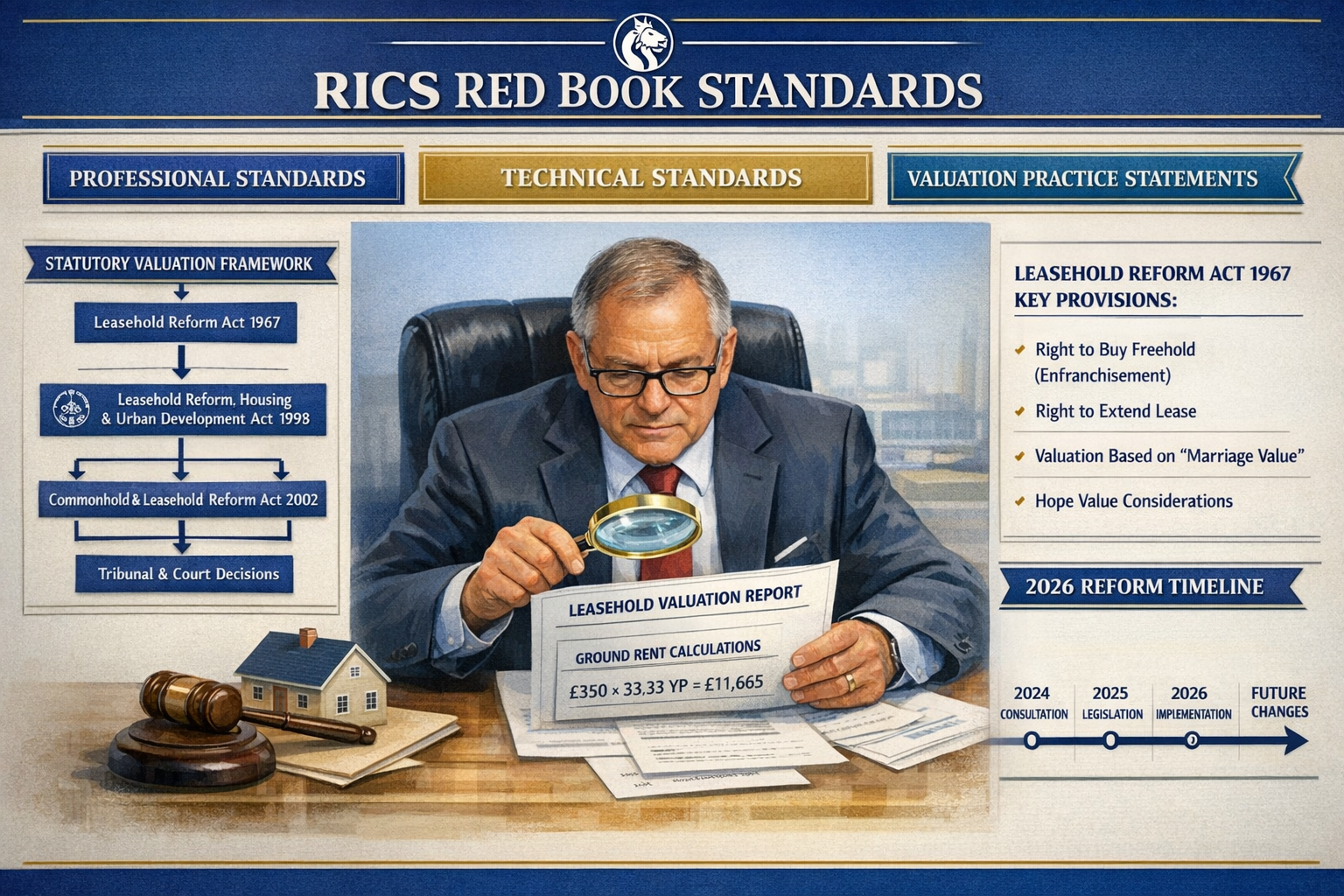
The January 2026 Commonhold and Leasehold Reform Bill represents the most significant overhaul of leasehold property law in decades. This legislation fundamentally alters the ground rent landscape, creating new challenges for expert witnesses tasked with providing valuation evidence in disputes.
Key provisions affecting Expert Witness Valuations in 2026 Leasehold Reform Disputes: RICS Protocols for Ground Rent Challenges include:
- Ground rent restrictions on new leases
- Modified enfranchisement calculations affecting freehold acquisition costs
- Enhanced leaseholder rights in right-to-manage scenarios
- Revised tribunal procedures for dispute resolution
- Transparency requirements for ground rent arrangements
These changes create a complex environment where traditional valuation methodologies must adapt to new statutory parameters while maintaining professional rigor.
RICS Standards in Transition
RICS is currently reviewing leasehold reform valuation guidance for members, recognizing that existing frameworks require updates to reflect 2026 legislative changes[5]. Expert witnesses must navigate this transitional period by:
Adhering to Core Principles 📋
The RICS Valuation – Global Standards (Red Book) UK National Supplement continues to provide the foundational framework for all valuation work, including expert witness assignments[1]. These standards emphasize:
- Professional competence and objectivity
- Transparent methodology disclosure
- Appropriate use of comparable evidence
- Clear statement of assumptions and limitations
Monitoring Guidance Updates
As RICS refines its technical guidance notes, expert witnesses should establish systems for tracking updates. Professional development in 2026 requires active engagement with:
- RICS webinars on leasehold reform implications
- Updated technical standards publications
- Tribunal decision analyses
- Peer review discussions within professional networks
RICS Protocols for Expert Witness Valuations in Leasehold Disputes
Professional Standards and Duties
Expert witnesses in Expert Witness Valuations in 2026 Leasehold Reform Disputes: RICS Protocols for Ground Rent Challenges must balance multiple responsibilities. The primary duty remains to the tribunal or court, not to the instructing party—a fundamental principle that distinguishes expert evidence from advocacy.
Core Professional Obligations
| Obligation | Requirement | RICS Standard |
|---|---|---|
| Independence | Provide unbiased opinion regardless of who instructs | Red Book VPS 3 |
| Competence | Accept instructions only within area of expertise | PS 1 |
| Transparency | Disclose methodology, assumptions, and limitations | VPS 3 |
| Objectivity | Base conclusions on evidence, not desired outcomes | PS 2 |
| Disclosure | Reveal any conflicts of interest | PS 1 |
These obligations become particularly critical in ground rent disputes, where commercial pressures may influence parties to seek favorable valuations.
Statutory Valuation Frameworks
Expert witnesses must demonstrate mastery of the statutory valuation frameworks governing leasehold disputes. The Leasehold Reform Act provides specific formulas and methodologies that expert witnesses cannot ignore, even when applying professional judgment[2].
Enfranchisement Valuations
When leaseholders exercise their right to acquire the freehold, expert witnesses must calculate the premium using statutory components:
- Diminution in value of the landlord's interest
- Landlord's share of marriage value (where applicable)
- Compensation for other losses
The 2026 reforms have modified how marriage value calculations apply, particularly for leases with specific remaining terms. Expert witnesses must articulate these changes clearly in their lease extension valuation reports.
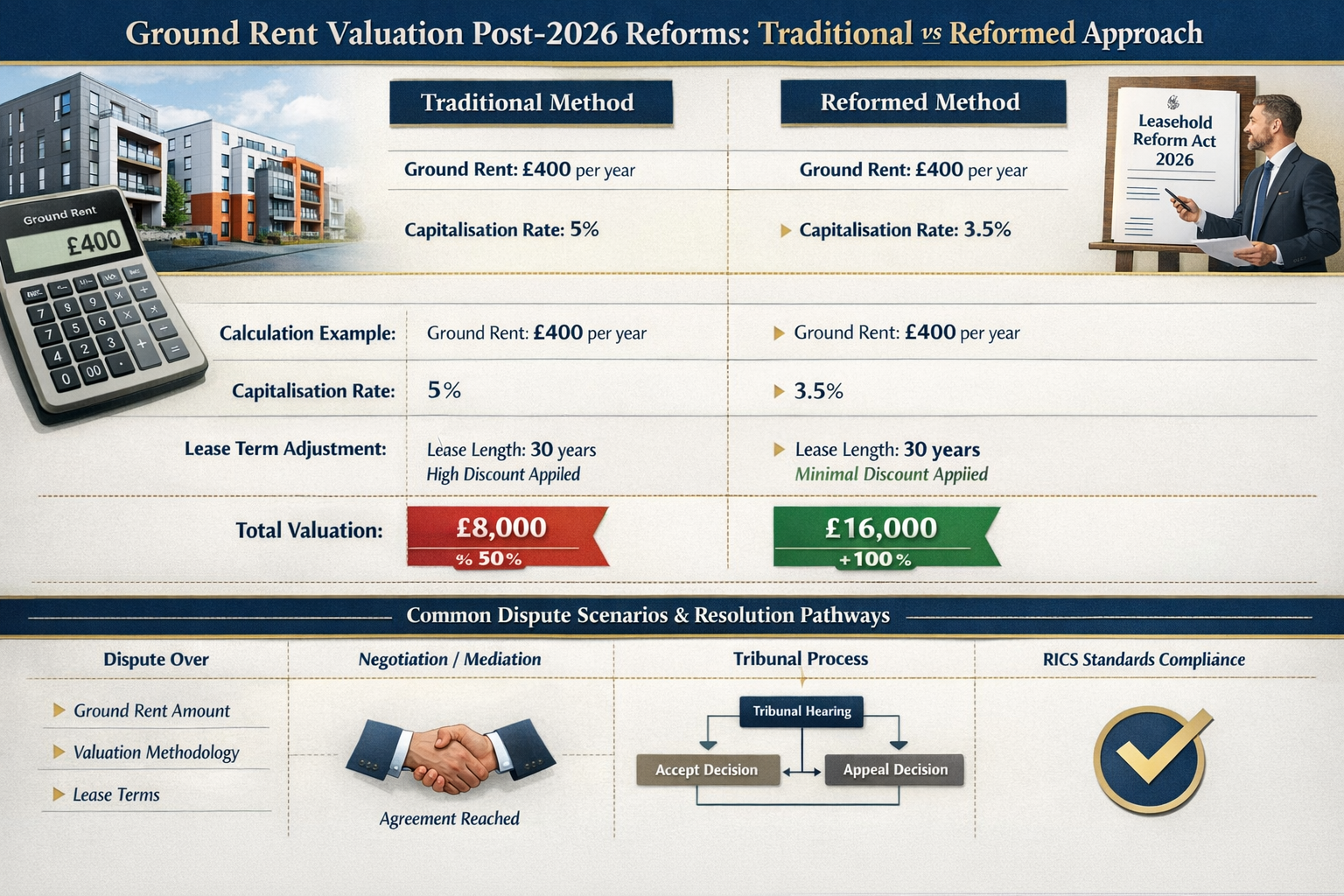
Ground Rent Capitalization
Capitalizing ground rent streams requires expert witnesses to:
- Select appropriate capitalization rates based on market evidence
- Apply deferment rates that reflect current market conditions
- Consider reform-related restrictions on future ground rent increases
- Analyze comparable transactions in similar properties
The selection and justification of these rates often becomes the central battleground in tribunal disputes.
Structuring Expert Witness Reports for Ground Rent Challenges
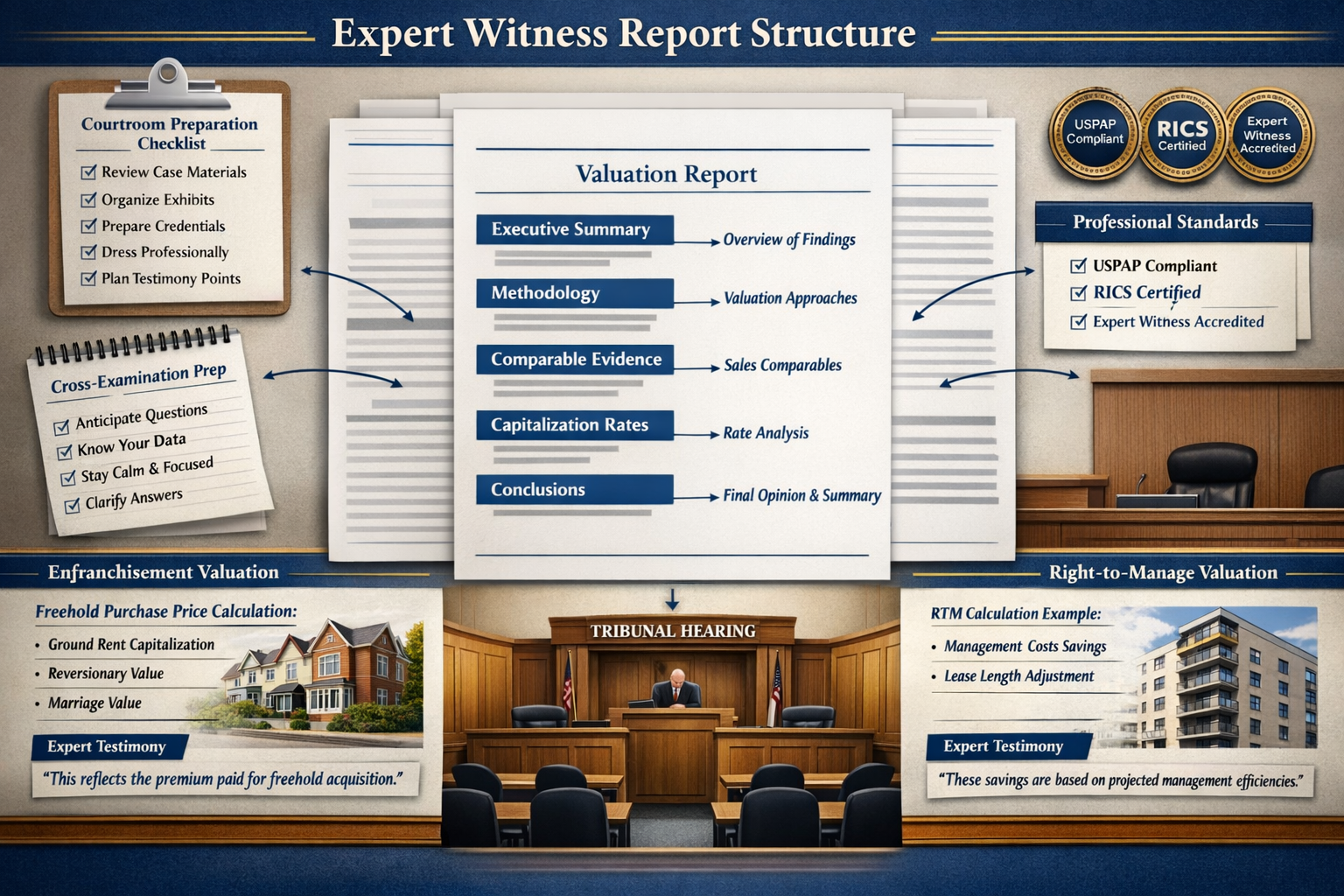
Essential Report Components
A robust expert witness report in Expert Witness Valuations in 2026 Leasehold Reform Disputes: RICS Protocols for Ground Rent Challenges must follow a clear structure that satisfies both RICS standards and tribunal requirements.
1. Executive Summary 📊
Begin with a concise overview stating:
- The instruction received
- The property inspected
- The valuation date
- The principal conclusions
- The valuation figure (if applicable)
2. Introduction and Qualifications
Establish credibility by detailing:
- Professional qualifications (MRICS, FRICS)
- Relevant experience in leasehold valuations
- Specific expertise in ground rent disputes
- Confirmation of understanding expert witness duties
3. Property Description
Provide comprehensive details including:
- Location and address
- Property type and construction
- Accommodation schedule
- Condition assessment
- Photographs and plans
- Lease terms and provisions
4. Valuation Methodology
This section demonstrates technical competence through:
Clear Methodology Statement
Explain the valuation approach adopted, referencing:
- Statutory requirements under relevant legislation
- RICS Red Book compliance[5]
- Market evidence supporting methodology choice
- Any departures from standard approaches (with justification)
Assumptions and Special Assumptions
Transparently disclose all assumptions, particularly:
- Property condition assumptions
- Market conditions at valuation date
- Legislative interpretation assumptions
- Hypothetical scenarios (if instructed)
5. Market Analysis and Comparable Evidence
Support conclusions with robust market evidence:
- Comparable transactions in similar properties
- Ground rent yield analysis from market data
- Capitalization rate justification with reference points
- Deferment rate selection based on established precedents
Expert witnesses should maintain detailed comparable evidence files, updated regularly to reflect current market conditions. This preparation proves invaluable when facing cross-examination on rate selections.
6. Valuation Calculations
Present calculations with clarity:
Ground Rent Valuation Example:
Current ground rent: £250 per annum
Capitalization rate: 7%
Term to next review: 25 years

Calculation:
£250 × YP 25 years @ 7% = £250 × 11.654 = £2,913.50
Include sensitivity analysis showing how variations in key assumptions affect the valuation outcome.
7. Conclusions
Summarize findings concisely, ensuring conclusions:
- Flow logically from the analysis presented
- Address the specific questions posed in instructions
- Remain within the expert's area of competence
- Acknowledge any limitations or uncertainties
Common Pitfalls to Avoid
Expert witnesses in ground rent challenges frequently encounter these issues:
❌ Advocacy creep – Allowing instructing party's interests to influence conclusions
❌ Insufficient comparable evidence – Relying on limited market data
❌ Unexplained rate selections – Failing to justify capitalization or deferment rates
❌ Ignoring reform implications – Not accounting for 2026 legislative changes
❌ Poor documentation – Inadequate record-keeping of inspection notes and analysis
Addressing these pitfalls requires disciplined professional practice and regular peer review.
Preparing for Tribunal Hearings and Cross-Examination
Pre-Hearing Preparation
Success in tribunal proceedings requires preparation extending far beyond the written report. Expert witnesses must anticipate challenges to their methodology, assumptions, and conclusions.
Understanding the Tribunal Process
Familiarize yourself with:
- First-tier Tribunal (Property Chamber) procedures
- Upper Tribunal appeal processes
- Court of Appeal considerations in complex cases
- Specific procedural rules governing expert evidence
Reviewing Opposing Expert Reports
When joint expert meetings occur or opposing reports are disclosed:
- Identify areas of agreement – Establish common ground
- Analyze differences – Understand why conclusions diverge
- Prepare rebuttals – Develop reasoned responses to criticisms
- Test your assumptions – Ensure your position withstands scrutiny
Coordinating with Legal Teams
While maintaining independence, effective communication with instructing solicitors ensures:
- Clarity on questions the tribunal must answer
- Understanding of case strategy (without compromising objectivity)
- Awareness of procedural requirements
- Efficient use of hearing time
Effective Cross-Examination Techniques
Cross-examination in Expert Witness Valuations in 2026 Leasehold Reform Disputes: RICS Protocols for Ground Rent Challenges tests both technical knowledge and professional composure.
Key Principles for Expert Witnesses 🎯
Stay Within Your Expertise
Never speculate beyond your professional competence. Acceptable responses include:
- "That falls outside my area of expertise"
- "I would need to undertake further research to answer that question"
- "That requires legal interpretation rather than valuation judgment"
Maintain Professional Composure
Opposing counsel may attempt to:
- Challenge your qualifications
- Question your independence
- Highlight apparent inconsistencies
- Pressure you toward unfavorable admissions
Respond calmly, referring to your report and supporting evidence. Remember that your duty is to assist the tribunal, not to "win" for either party.
Answer Questions Directly
Avoid evasiveness, which undermines credibility:
- Listen carefully to the complete question
- Pause before responding
- Answer the question asked
- Expand only when clarification aids understanding
Use Your Report as Reference
Your written report serves as your foundation:
- Refer to specific paragraphs when questioned
- Highlight supporting evidence within the report
- Acknowledge if you would now modify any conclusions
- Maintain consistency with your written analysis
Common Cross-Examination Topics
Anticipate questioning on:
Comparable Evidence Selection
- Why specific comparables were included or excluded
- How differences between comparables and subject property were adjusted
- Whether additional comparable evidence exists
- Time adjustments applied to historical transactions
Rate Justification
- Basis for capitalization rate selection
- Market evidence supporting chosen rates
- Treatment of risk factors in rate determination
- Sensitivity of conclusions to rate variations
Methodology Choices
- Why particular valuation approach was adopted
- Alternative methodologies considered and rejected
- Compliance with RICS standards
- Treatment of 2026 reform provisions
Assumptions and Limitations
- Impact of assumptions on valuation outcome
- Whether assumptions remain valid
- Alternative scenarios under different assumptions
- Disclosure adequacy in the report
Specialized Considerations for Different Dispute Types
Enfranchisement Disputes
When leaseholders seek to acquire the freehold, expert witnesses must address specific valuation challenges unique to enfranchisement proceedings.
Marriage Value Calculations
The concept of marriage value—the additional value created by merging leasehold and freehold interests—remains contentious. Expert witnesses must:
- Determine whether marriage value applies (based on remaining lease term)
- Calculate the marriage value quantum
- Apply the statutory 50/50 split between landlord and leaseholder
- Consider 2026 reform modifications to marriage value treatment
Hope Value Assessment
In certain circumstances, landlords claim "hope value"—the prospect of future lease renewals or other value-enhancing events. Expert witnesses should:
- Assess whether hope value legitimately exists
- Quantify hope value using appropriate methodology
- Distinguish hope value from marriage value
- Support conclusions with market evidence
Right-to-Manage Cases
Right-to-manage disputes involve different valuation considerations, often focusing on service charge disputes rather than capital values.
Expert witnesses in these cases may need to:
- Value management rights being transferred
- Assess compensation for landlord's loss of management
- Analyze service charge reasonableness
- Consider impact on property values
Ground Rent Review Disputes
Lease terms often provide for ground rent reviews, creating disputes about the appropriate reviewed rent level.
Review Mechanisms
Common review provisions include:
- Fixed increases – Predetermined amounts or percentages
- RPI-linked reviews – Tied to inflation indices
- Market rent reviews – Requiring valuation evidence
- Doubling provisions – Controversial clauses under scrutiny in 2026 reforms
Expert witnesses must interpret lease language carefully, often requiring collaboration with legal advisors on clause interpretation.
Market Rent Determination
When leases require market rent reviews, expert witnesses should:
- Analyze comparable ground rent evidence
- Consider property-specific factors affecting rent
- Apply appropriate valuation methodology
- Account for legislative restrictions on ground rent levels
For comprehensive guidance on valuing freehold interests, expert witnesses should consult specialized resources addressing these complex calculations.
Emerging Trends and Future Developments
Impact of 2026 Reforms on Valuation Practice
The 2026 legislative changes continue to evolve, with implementation guidance emerging throughout the year. Expert witnesses must monitor:
Transitional Provisions
How reforms apply to:
- Existing leases granted before reform implementation
- Pending tribunal cases
- Properties in mixed-use buildings
- Leases with unusual terms
Tribunal Precedents
Early tribunal decisions interpreting 2026 reforms will establish important precedents. Expert witnesses should:
- Review published tribunal decisions regularly
- Analyze how tribunals interpret new provisions
- Adapt valuation methodologies based on emerging case law
- Participate in professional discussions on precedent implications
Technology and Valuation Evidence
Modern expert witnesses increasingly leverage technology to enhance their evidence:
Digital Comparable Databases 💻
Sophisticated databases now enable:
- Rapid comparable property identification
- Statistical analysis of market trends
- Automated adjustments for property differences
- Visual presentation of market evidence
Virtual Inspections
While physical inspections remain preferable, technology enables:
- Remote property assessments using video technology
- Drone surveys for roof and external condition
- 3D modeling for spatial analysis
- Digital measurement tools
These technologies must be used appropriately, with expert witnesses clearly disclosing when remote methods were employed and any resulting limitations.
Professional Development Requirements
Maintaining expertise in Expert Witness Valuations in 2026 Leasehold Reform Disputes: RICS Protocols for Ground Rent Challenges requires ongoing professional development:
Recommended CPD Activities
- Attending leasehold reform seminars and conferences
- Participating in RICS working groups on valuation standards
- Reviewing tribunal decisions and appeal judgments
- Engaging in peer discussion forums
- Completing formal training on expert witness duties
Expert witnesses should document CPD activities meticulously, as qualifications and currency of knowledge may be challenged during cross-examination.
Practical Checklists for Expert Witnesses
Pre-Instruction Checklist
Before accepting an expert witness instruction:
✓ Confirm the assignment falls within your area of competence
✓ Check for any conflicts of interest
✓ Verify you have adequate professional indemnity insurance
✓ Ensure sufficient time available for thorough analysis
✓ Clarify the scope of work and fee arrangements
✓ Obtain clear instructions in writing
✓ Confirm understanding of tribunal deadlines
Report Preparation Checklist
When preparing your expert witness report:
✓ Conduct thorough property inspection with detailed notes
✓ Photograph all relevant features and defects
✓ Research and document comparable evidence
✓ Verify lease terms and statutory provisions
✓ Perform calculations with sensitivity analysis
✓ Review RICS standards compliance
✓ Disclose all assumptions and limitations
✓ Have report peer-reviewed before submission
✓ Retain all working papers and supporting documents
✓ Submit report within tribunal deadlines
Hearing Preparation Checklist
Before attending tribunal or court:
✓ Re-read your report thoroughly
✓ Review opposing expert's report and identify differences
✓ Prepare responses to anticipated challenges
✓ Organize supporting documents for easy reference
✓ Confirm hearing logistics (location, time, duration)
✓ Dress professionally and arrive early
✓ Bring multiple copies of your report and exhibits
✓ Have calculator and reference materials available
✓ Maintain professional demeanor throughout proceedings
Conclusion
Expert Witness Valuations in 2026 Leasehold Reform Disputes: RICS Protocols for Ground Rent Challenges represents a dynamic and evolving area of professional practice. The January 2026 legislative reforms have fundamentally reshaped the landscape, requiring expert witnesses to adapt their methodologies while maintaining rigorous professional standards.
Success in this specialized field demands:
🎯 Technical Excellence – Mastery of statutory valuation frameworks, RICS standards, and market analysis techniques
🎯 Professional Integrity – Unwavering commitment to independence, objectivity, and duty to the tribunal
🎯 Continuous Learning – Active engagement with evolving legislation, RICS guidance updates, and tribunal precedents
🎯 Effective Communication – Clear report writing and confident presentation of evidence under cross-examination
🎯 Meticulous Preparation – Thorough research, documentation, and organization of supporting evidence
Actionable Next Steps
For expert witnesses seeking to enhance their practice in leasehold reform disputes:
-
Review the 2026 Reform Legislation – Ensure comprehensive understanding of new statutory provisions affecting ground rent valuations
-
Update Your Methodology – Align valuation approaches with current RICS guidance and emerging tribunal precedents
-
Strengthen Your Comparable Evidence Base – Develop robust databases of ground rent transactions and market evidence
-
Invest in Professional Development – Attend specialized training on expert witness duties and leasehold valuation techniques
-
Establish Quality Assurance Processes – Implement peer review and systematic compliance checks for all expert reports
-
Build Your Professional Network – Engage with other specialists in leasehold valuation to share insights and discuss complex cases
-
Monitor RICS Updates – Stay current with evolving guidance as RICS continues reviewing leasehold reform valuation standards[5]
The expert witnesses who thrive in this challenging environment will be those who combine technical excellence with professional integrity, delivering clear, well-reasoned evidence that assists tribunals in resolving complex ground rent disputes fairly and efficiently.
For professional assistance with expert witness services, freehold valuation, or guidance on whether to buy your freehold, consulting with experienced RICS-qualified professionals ensures compliance with current standards and optimal outcomes in leasehold reform disputes.
References
[1] Residential Valuations – https://www.rics.org/profession-standards/rics-standards-and-guidance/sector-standards/valuation-standards/residential-valuations
[2] Expert Witness Valuations In 2026s Stabilizing Market Rics Standards For Mortgage Disputes And Property Disagreements – https://nottinghillsurveyors.com/blog/expert-witness-valuations-in-2026s-stabilizing-market-rics-standards-for-mortgage-disputes-and-property-disagreements
[3] Residential Property – https://www.rics.org/about-rics/corporate-governance/professional-group-panels/residential-property
[4] Enfranchisement Valuation – https://enfranchisementsolicitors.co.uk/enfranchisement-valuation/
[5] Valuation Standards – https://www.rics.org/profession-standards/rics-standards-and-guidance/sector-standards/valuation-standards