
When party wall disputes escalate beyond the statutory resolution process and enter the courtroom, surveyors face a dramatic shift in their professional obligations. A 2025 analysis of UK property litigation revealed that 78% of party wall cases reaching court involved expert witness testimony, yet only 42% of initial expert reports fully complied with Civil Procedure Rules Part 35 requirements—resulting in costly delays, rejected evidence, and professional embarrassment for unprepared surveyors.
Understanding Expert Witness Roles in Party Wall Litigation: CPR Part 35 Compliance for Surveyors has become essential for any professional operating in this specialized field. When neighbouring property owners cannot resolve disputes through the Party Wall etc. Act 1996 procedures, litigation becomes inevitable. At this juncture, surveyors transition from party-appointed advisors to court-appointed experts with overriding duties that supersede client interests.
This comprehensive guide explores how surveyors navigate this complex dual role, examining the strict compliance requirements of CPR Part 35, the preparation of court-admissible reports, and real-world case examples that illustrate the consequences of both exemplary and deficient expert witness performance in 2026's evolving legal landscape.
Key Takeaways
- Duty to the court supersedes client obligations: Expert witnesses must provide impartial, objective evidence regardless of who instructs them, with CPR Part 35 establishing this overriding duty [1]
- Report compliance is non-negotiable: Expert witness reports must include specific declarations, statements of truth, and compliance confirmations or risk rejection by the court [6]
- Impartiality determines admissibility: Courts rigorously scrutinize expert independence, and any evidence of advocacy or bias can disqualify testimony entirely
- Pre-litigation preparation matters: Experts instructed before proceedings commence must still ensure reports meet full CPR Part 35 standards if they may be used in litigation [8]
- Continuing professional obligations: Surveyors must update their knowledge, respond to Part 35 questions appropriately, and participate in expert discussions when directed by the court [4]
Understanding CPR Part 35: The Foundation of Expert Witness Duties
What CPR Part 35 Requires from Expert Witnesses
Civil Procedure Rules Part 35 establishes the fundamental framework governing expert evidence in civil proceedings throughout England and Wales. For surveyors involved in party wall litigation, these rules transform professional practice from client advocacy to court service [3].
The core principle is unambiguous: an expert's overriding duty is to help the court on matters within their expertise [1]. This duty takes precedence over any obligation to the person instructing or paying the expert. Many surveyors initially struggle with this paradigm shift, particularly when their findings may disadvantage the party who engaged them.
Key CPR Part 35 requirements include:
- Independence and objectivity: Experts must provide opinions based solely on professional expertise, not client preferences
- Scope limitation: Expert evidence must remain within the witness's area of genuine expertise
- Factual basis transparency: Reports must clearly distinguish facts, assumptions, and opinions
- Alternative viewpoints: Experts should acknowledge legitimate alternative interpretations or approaches
- Material changes: Any change in expert opinion must be communicated immediately to all parties [2]
For party wall matters specifically, surveyors must demonstrate expertise in the Party Wall etc. Act 1996, construction methodology, structural assessment, and damage causation—not merely general surveying competence. Courts have rejected expert evidence when witnesses strayed beyond their demonstrable expertise into areas like structural engineering calculations without appropriate qualifications.
The Statement of Truth and Declaration of Understanding
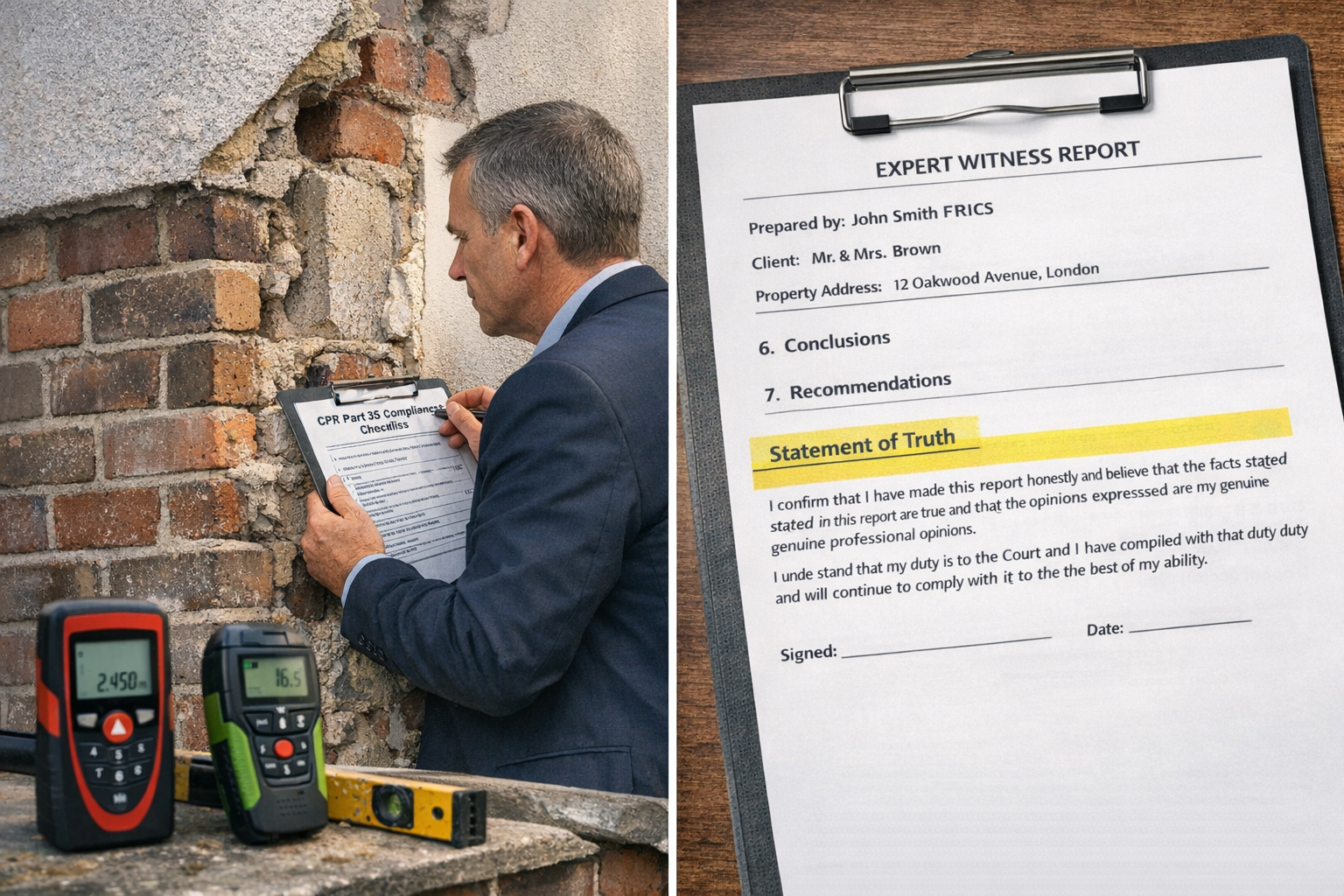
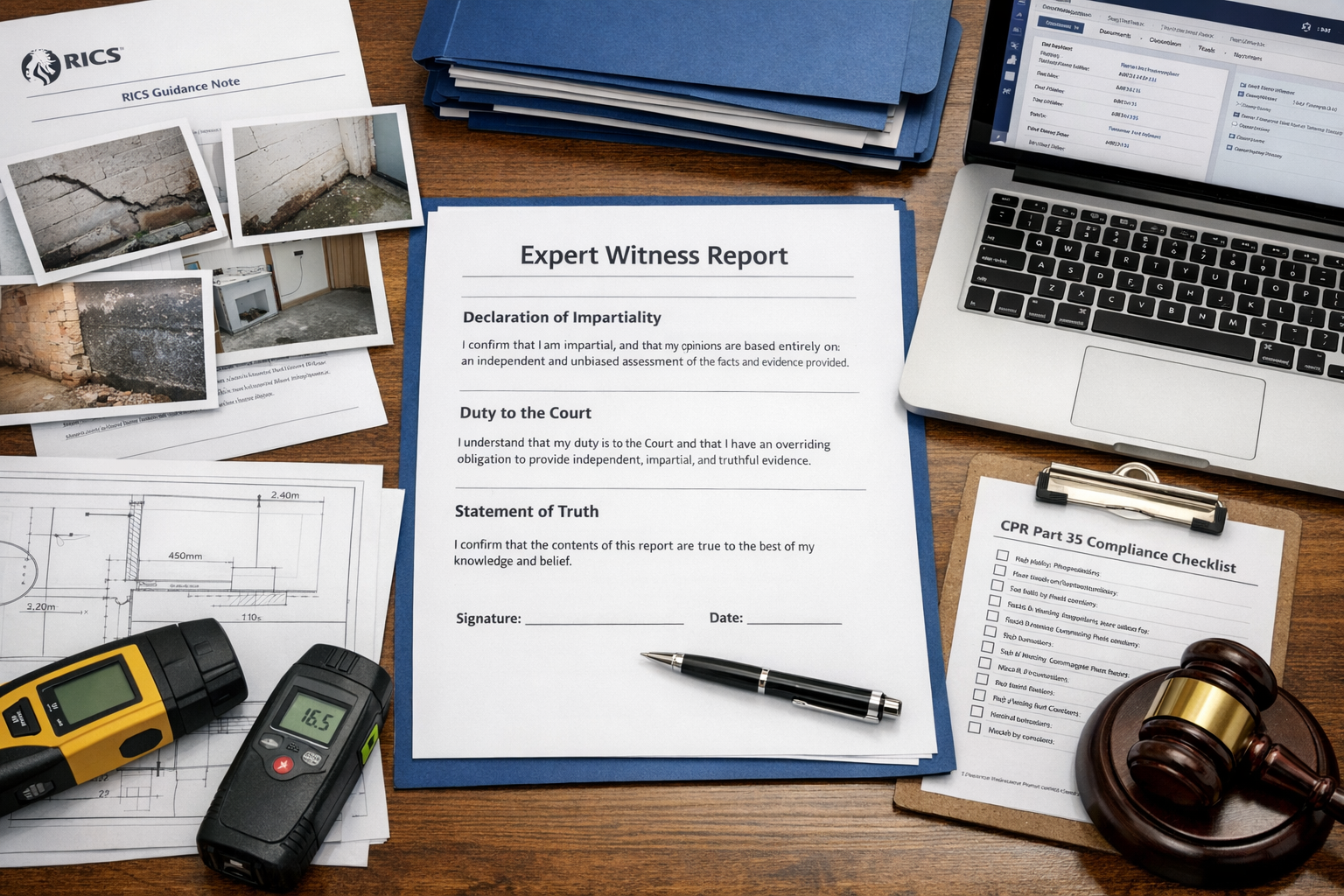
Every CPR Part 35 compliant report must conclude with a statement of truth and a declaration confirming the expert understands their duties [6]. These aren't mere formalities—they carry legal weight and potential consequences for false statements.
The standard declaration typically includes:
"I confirm that I have made clear which facts and matters referred to in this report are within my own knowledge and which are not. Those that are within my own knowledge I confirm to be true. The opinions I have expressed represent my true and complete professional opinions on the matters to which they refer."
Additionally, experts must explicitly state: "I understand my duty to the court and have complied with that duty" [1].
Failure to include these declarations, or including them without genuine understanding, has resulted in reports being struck out and experts being barred from giving evidence. In one notable 2024 case, a surveyor's party wall damage assessment was excluded entirely because the statement of truth was signed by an assistant rather than the named expert—highlighting the personal accountability inherent in expert witness roles.
For more context on how party wall procedures work before litigation, see our comprehensive party wall guidance.
Expert Witness Roles in Party Wall Litigation: From Appointment to Testimony
The Transition from Party-Appointed Surveyor to Court Expert
Party wall disputes typically begin with surveyors appointed under the Party Wall etc. Act 1996—either as the building owner's surveyor, the adjoining owner's surveyor, or as the agreed surveyor. These roles involve advocacy for the appointing party's interests within the statutory framework.
When disputes escalate to litigation, the role fundamentally changes. Courts may direct parties to jointly instruct a single expert, or permit each party to instruct their own expert witness. In either scenario, the surveyor's duty shifts entirely to the court [3].
This transition creates several practical challenges:
🔍 Conflict of Interest Management: A surveyor who previously acted as a party-appointed surveyor under the Act may face challenges serving as an expert witness in subsequent litigation involving the same dispute. Courts scrutinize whether prior involvement compromises the required impartiality.
📋 Evidence Gathering Limitations: Unlike party-appointed surveyors who can advocate for specific investigative approaches, expert witnesses must maintain objectivity about methodology and cannot push for investigations that serve one party's narrative.
💼 Client Communication Boundaries: Experts must avoid discussions that could be construed as coaching or advocacy. All substantive communications should be documented and disclosable.
Many experienced expert witness surveyors establish clear engagement protocols that define these boundaries from the outset, protecting both their professional independence and the admissibility of their evidence.
Preparing CPR Part 35 Compliant Reports for Party Wall Disputes
The expert witness report is the cornerstone of litigation evidence. For party wall disputes, these reports must address technical surveying matters while meeting strict procedural requirements [6].
Essential Report Components:
| Section | Content Requirements | Party Wall Specific Considerations |
|---|---|---|
| Expert Credentials | Qualifications, experience, expertise areas | RICS membership, party wall case history, relevant CPR training |
| Instructions Received | Summary of what the expert was asked to do | Clarify if initial instruction was pre-litigation or for court proceedings |
| Factual Background | Chronology and undisputed facts | Party Wall Act notices, awards, correspondence timeline |
| Site Investigation | Methodology, observations, measurements | Schedule of condition details, photographic evidence, testing results |
| Technical Analysis | Application of expertise to facts | Causation assessment, structural implications, compliance with awards |
| Opinion and Conclusions | Professional judgment on key issues | Damage attribution, remediation recommendations, cost assessments |
| Statement of Truth | Formal declaration of compliance | Personal signature, dated, with CPR Part 35 acknowledgment |
Common Compliance Failures:
- ❌ Omitting the range of opinion on disputed matters
- ❌ Failing to identify assumptions or limitations
- ❌ Including advocacy language ("my client's position is correct")
- ❌ Not disclosing prior involvement in the dispute
- ❌ Inadequate explanation of technical methodology
The 2025 case Henderson v. Blackwell Properties Ltd illustrates these pitfalls. A surveyor's expert report was given reduced weight after the judge noted it "read more like a party-appointed surveyor's advocacy document than an impartial expert assessment," specifically criticizing the failure to acknowledge legitimate alternative interpretations of crack patterns in a party wall.
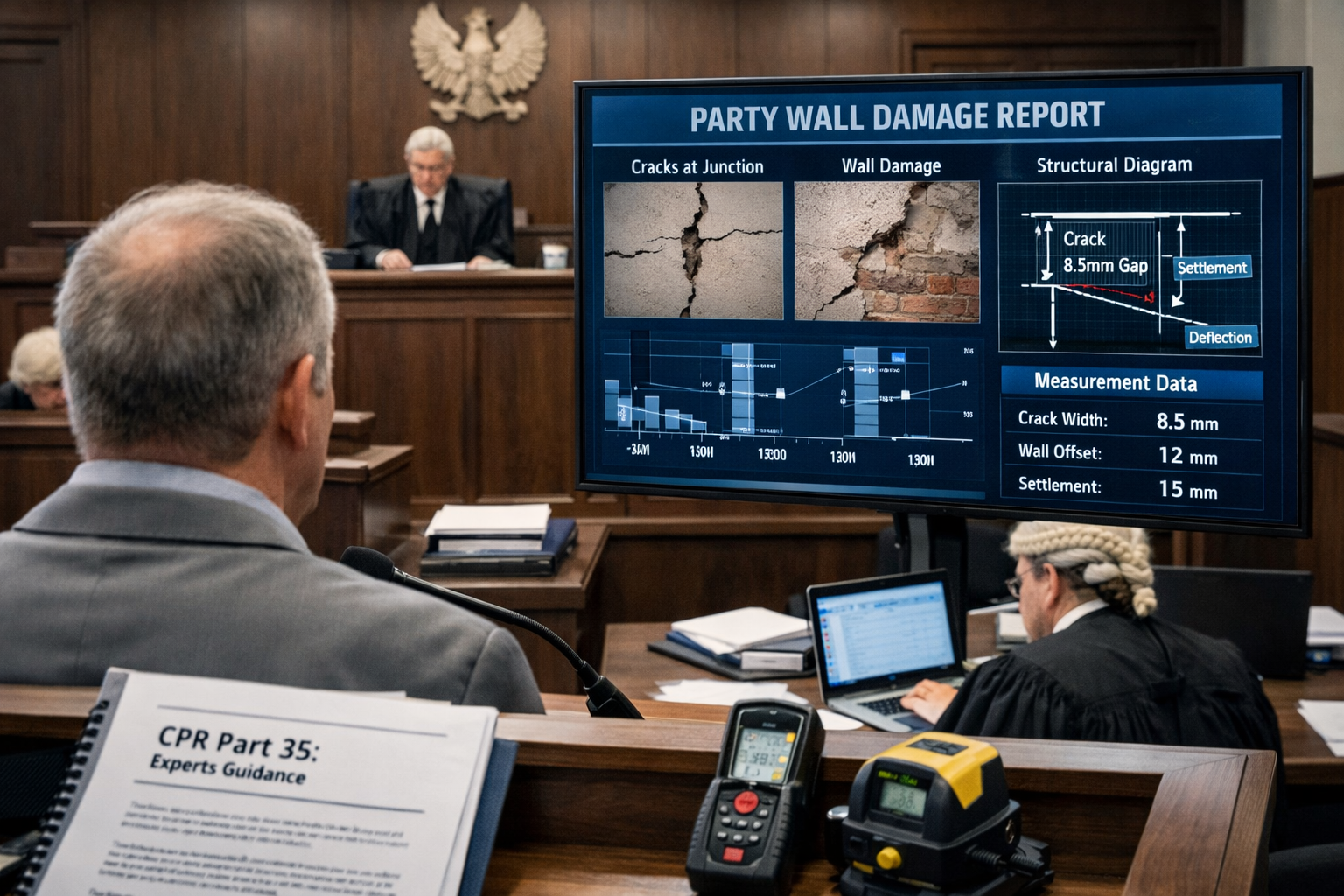
For disputes involving damage to property in party wall matters, experts must be particularly rigorous in distinguishing pre-existing conditions, natural deterioration, and construction-related damage—all supported by objective evidence rather than assertion.
Responding to CPR Part 35 Questions
After expert reports are exchanged, parties may submit written questions to experts under CPR Part 35.6 [4]. These questions must seek clarification or address matters within the expert's report scope—they cannot introduce entirely new instructions.
Surveyors must respond to Part 35 questions:
- Within 28 days unless the court orders otherwise
- In writing and with the same formality as the original report
- Honestly, even if answers undermine the instructing party's position
- Within expertise boundaries, declining to answer questions outside their competence
Strategic considerations include:
Clarification vs. New Opinion: Questions asking for clarification of existing opinions must be answered. Questions effectively seeking a new expert opinion on different matters may be objected to as exceeding CPR Part 35.6 scope.
Maintaining Consistency: Responses must align with the original report. Any material change in opinion requires formal amendment and disclosure to all parties.
Avoiding Advocacy Traps: Questions may be framed to elicit advocacy responses. Experts must remain objective regardless of how questions are phrased.
A 2024 guidance note from the Society of Expert Witnesses emphasized that 78% of expert witness challenges arise from Part 35 question responses rather than original reports, highlighting the importance of maintaining professional discipline throughout the process.
When disputes involve technical matters like shared chimneys and shared chimney stacks, Part 35 questions often probe the expert's methodology for attributing deterioration to specific causes—requiring detailed, evidence-based responses.
Expert Witness Roles in Party Wall Litigation: Courtroom Procedures and Best Practices
Expert Discussions and Joint Statements
Courts frequently direct experts to meet and produce a joint statement identifying areas of agreement and disagreement [5]. For party wall litigation, these discussions can significantly narrow issues and facilitate settlement.
The joint statement process requires:
📅 Pre-Meeting Preparation: Experts should review all relevant materials, identify key technical disagreements, and prepare supporting evidence for their positions.
🤝 Without Prejudice Discussions: Expert meetings occur without legal representatives present, allowing frank technical discussion. However, the resulting joint statement is disclosable.
📝 Structured Documentation: The joint statement must clearly list:
- Matters on which experts agree
- Matters on which experts disagree
- Brief reasons for disagreement
- Any further information needed to resolve disagreements
Professional Conduct: Experts must engage constructively while maintaining their independent opinions. Pressure to agree for settlement purposes violates CPR Part 35 duties.
The 2025 case Riverside Developments v. Thompson demonstrated the value of effective expert collaboration. Two party wall surveyors initially disagreed on the extent of construction-related damage, but their joint statement identified that the core disagreement centered on the interpretation of three meter rule application to foundation depth—allowing the court to focus on this specific legal-technical issue rather than reviewing all evidence de novo.
Giving Evidence in Court: Testimony Best Practices
When party wall litigation proceeds to trial, expert witnesses may be called to give oral evidence and face cross-examination. This represents the most challenging aspect of expert witness roles for many surveyors.
Preparation Essentials:
- Master Your Report: You will be questioned extensively on every statement, assumption, and conclusion
- Review All Materials: Ensure familiarity with all disclosed documents, not just those you referenced
- Understand Legal Context: Know the specific issues the court must decide and how your evidence relates
- Practice Explaining Technical Concepts: Courts require clear explanations accessible to non-specialists
Testimony Guidelines:
✅ Answer the question asked: Don't volunteer additional information or advocate
✅ Admit limitations: "That's outside my expertise" or "I cannot determine that from available evidence" demonstrates credibility
✅ Maintain composure: Cross-examination may challenge your methodology, qualifications, or conclusions—remain professional
✅ Refer to evidence: Ground answers in documented observations rather than general experience
✅ Acknowledge uncertainty: Express confidence levels appropriately ("highly likely," "possible," "cannot exclude")
Common Pitfalls:
- ❌ Becoming defensive when challenged
- ❌ Arguing with counsel rather than answering questions
- ❌ Changing opinions under pressure without legitimate basis
- ❌ Appearing to advocate for the instructing party
- ❌ Using technical jargon without explanation
The 2024 High Court decision in Barrington Estate v. Caldwell Construction highlighted exemplary expert witness testimony. The judge specifically commended the surveyor for "acknowledging the limitations of visual inspection in determining foundation adequacy, clearly explaining the basis for opinions formed, and maintaining objectivity even when cross-examination suggested alternative interpretations that would favor the instructing party."
For cases involving no party wall agreement scenarios that escalate to litigation, experts must carefully explain both the statutory framework and the technical implications of proceeding without proper notices or awards.
Recent Case Law and Compliance Developments in 2026
The landscape of expert witness obligations continues to evolve through case law and practice directions. Several 2025-2026 developments particularly impact surveyors in party wall litigation:
Enhanced Scrutiny of Independence: Following Meadowcroft Properties Ltd v. Hassan (2025), courts now routinely inquire about the financial relationship between experts and instructing parties, particularly in cases involving repeat instructions. Experts should be prepared to demonstrate that repeat business does not compromise independence.
Digital Evidence Standards: New practice guidance issued in January 2026 addresses the admissibility of digital survey evidence, including photogrammetry, drone imagery, and 3D modeling. Experts must now explicitly address the methodology, calibration, and limitations of digital evidence tools in their reports.
Proportionality Requirements: Courts increasingly scrutinize whether expert evidence is proportionate to the dispute value. In party wall matters involving modest damage claims, simplified expert reports may be directed, requiring surveyors to adapt their approach while maintaining CPR Part 35 compliance [7].
Pre-Action Expert Evidence: Clarification issued in Thompson v. Riverside Developments (2025) confirmed that expert reports commissioned before litigation commences must still fully comply with CPR Part 35 if subsequently relied upon in proceedings—ending the previous ambiguity about pre-action expert evidence standards [8].
These developments underscore the importance of continuous professional development for surveyors undertaking expert witness roles. Regular training on CPR Part 35 compliance, case law updates, and courtroom procedure has become essential rather than optional.
For surveyors seeking to expand their practice into expert witness work, engaging with local chartered surveyors who have established litigation experience can provide valuable mentorship and practical insights into compliance requirements.
Practical Compliance Strategies for Surveyors
Building an Expert Witness Practice: Qualifications and Training
Transitioning from general surveying practice to expert witness work requires deliberate professional development. The following pathway represents current best practice in 2026:
Foundation Qualifications:
- RICS membership (preferably Chartered status)
- Specialist knowledge in party wall matters
- Minimum 5-10 years practical experience in relevant field
- Professional indemnity insurance with expert witness coverage
Essential Training:
- CPR Part 35 compliance courses (updated annually)
- Expert witness skills training (report writing, testimony)
- Cross-examination preparation workshops
- Ethics and professional conduct for expert witnesses
Ongoing Development:
- Regular case law updates
- Technical skills advancement (new survey technologies, methodologies)
- Peer review participation
- Court observation (attending hearings to understand judicial expectations)
Many professional bodies now offer accredited expert witness certifications that demonstrate commitment to compliance standards. While not legally required, these credentials enhance credibility when courts assess expert qualifications.
The Society of Expert Witnesses reported in early 2026 that surveyors with formal expert witness training were 65% less likely to have reports challenged on procedural grounds compared to those without specialized training—a compelling argument for investment in professional development.
Documentation and Quality Assurance Systems
Maintaining CPR Part 35 compliance requires systematic approaches to case management and quality control:
Instruction Management:
- Document all instructions in writing
- Clarify scope, timeline, and budget upfront
- Identify potential conflicts of interest before accepting instructions
- Establish communication protocols that preserve independence
Evidence Control:
- Maintain comprehensive case files with all reviewed materials
- Document site visits with detailed notes, photographs, and measurements
- Record methodology decisions and their rationale
- Preserve all drafts and working papers (potentially disclosable)
Report Quality Assurance:
- Use CPR Part 35 compliance checklists before finalizing reports
- Implement peer review for complex or high-value cases
- Verify all factual statements against source documents
- Ensure technical terminology is clearly defined
Continuing Obligations:
- Monitor for material changes in circumstances or opinion
- Track Part 35 question deadlines
- Maintain availability for expert discussions and court attendance
- Document all communications with legal representatives
Several surveying firms have implemented dedicated expert witness protocols separate from their general practice procedures, recognizing that the compliance requirements and professional obligations differ fundamentally from standard client work.
For those handling party wall FAQs and general inquiries, establishing clear boundaries between advisory work and expert witness instructions prevents confusion and protects the integrity of both services.
Common Challenges and How to Address Them
Managing Client Expectations and Independence
One of the most difficult aspects of expert witness roles involves managing instructing party expectations while maintaining court-directed independence. Clients accustomed to advocacy-based professional services may struggle to understand why their expert won't simply support their position.
Effective strategies include:
🎯 Front-Loading Expectations: During initial instructions, explicitly explain CPR Part 35 duties and that opinions will be evidence-based regardless of client preferences.
📊 Transparent Reporting: Provide preliminary findings early, allowing clients to understand likely expert conclusions before formal reports are finalized.
🛡️ Professional Boundaries: Decline requests to modify opinions, omit inconvenient facts, or emphasize particular aspects that would compromise objectivity.
💬 Education: Help legal representatives understand how expert independence ultimately serves their client's interests by ensuring evidence credibility.
The 2025 guidance note "Managing Expert Witness Instructions" from the Expert Witness Institute emphasized that clear communication at the instruction stage prevents 80% of subsequent disputes about expert independence and report content.
Addressing Technical Complexity for Non-Specialist Audiences
Party wall litigation often involves highly technical surveying concepts that judges, juries, and legal representatives may not readily understand. Experts must bridge this knowledge gap without oversimplifying to the point of inaccuracy.
Communication techniques:
- Analogies and Examples: Relate technical concepts to everyday experiences
- Visual Aids: Use diagrams, photographs, and annotated drawings extensively
- Progressive Explanation: Build from basic principles to complex conclusions
- Defined Terminology: Create a glossary for technical terms used in reports
- Quantified Uncertainty: Express confidence levels numerically when possible
For instance, explaining differential settlement in party wall foundations might use the analogy of "two books on a soft surface—when one is heavier, it sinks more, creating a gap between them" before progressing to technical discussion of soil bearing capacity and foundation loading.
Courts particularly appreciate experts who can explain their reasoning process transparently, allowing non-specialists to follow the logical progression from observations to conclusions even when the underlying technical knowledge is complex.
Conclusion: Excellence in Expert Witness Roles for Party Wall Litigation
The role of expert witness in party wall litigation demands a fundamental shift in professional identity—from client advocate to court servant, from partisan advisor to impartial educator. Expert Witness Roles in Party Wall Litigation: CPR Part 35 Compliance for Surveyors represents not merely a procedural obligation but a professional discipline that protects both the integrity of justice and the reputation of the surveying profession.
As party wall disputes continue to increase alongside urban densification and property development activity, the demand for qualified, compliant expert witnesses will only grow. Surveyors who invest in understanding CPR Part 35 requirements, develop robust compliance systems, and commit to genuine independence will find themselves well-positioned to serve both the courts and the profession.
Actionable Next Steps
For surveyors seeking to develop or enhance their expert witness practice in party wall litigation:
-
Assess Current Competence: Honestly evaluate whether your technical knowledge, experience level, and understanding of CPR Part 35 requirements meet current standards for expert witness work
-
Invest in Training: Complete accredited CPR Part 35 compliance courses and expert witness skills training before accepting instructions—reactive learning after problems arise is costly and professionally damaging
-
Develop Systems: Implement documentation, quality assurance, and case management protocols specifically designed for expert witness work, separate from general practice procedures
-
Seek Mentorship: Connect with experienced expert witnesses who can provide practical guidance on navigating the transition from general practice to litigation support
-
Start Selectively: Build expertise gradually with straightforward cases before accepting complex, high-value, or contentious instructions
-
Maintain Independence: Establish and enforce professional boundaries that protect your impartiality, even when doing so may cost you instructions
-
Stay Current: Commit to ongoing professional development, monitoring case law developments, practice direction updates, and evolving standards for expert evidence
The surveying profession's credibility in party wall litigation depends on individual practitioners' commitment to excellence in expert witness roles. By prioritizing compliance, objectivity, and professional integrity, surveyors not only serve justice but elevate the entire profession's standing in the eyes of the courts and the public.
For additional guidance on party wall procedures and surveying services, explore our comprehensive resources or contact us for specialized expert witness support.
References
[1] The Responsibilities Of An Expert Witness Under Civil Procedure Rules Part 35 – https://paramedic-expert.com/the-responsibilities-of-an-expert-witness-under-civil-procedure-rules-part-35/
[2] What Is An Expert Witnesses Part 35 – https://www.jonathanlea.net/blog/what-is-an-expert-witnesses-part-35/
[3] Part35 – https://www.justice.gov.uk/courts/procedure-rules/civil/rules/part35
[4] A Guide To Part 35 Questions For Experts – https://www.stewartslaw.com/news/a-guide-to-part-35-questions-for-experts/
[5] fenwickelliott – https://www.fenwickelliott.com/research-insight/newsletters/insight/39
[6] Part 35 Compliant Expert Witness Report What Is It And Why Is It Important – https://www.circlecasemanagement.com/news/article/part-35-compliant-expert-witness-report-what-is-it-and-why-is-it-important
[7] Valuation Reports For Uk Restructuring Plans Must Comply With Formal Requirements – https://www.kirkland.com/publications/kirkland-alert/2024/11/valuation-reports-for-uk-restructuring-plans-must-comply-with-formal-requirements
[8] Where A Party Instructs An Expert To Prepare A Part 35 Compliant Report Before A Claim Has Been Issued – https://www.lexisnexis.co.uk/legal/guidance/where-a-party-instructs-an-expert-to-prepare-a-part-35-compliant-report-before-a-claim-has-been-issued