
The landscape of property disputes is undergoing a seismic shift. As 2026 brings sweeping reforms to homebuying processes, expert witnesses face unprecedented challenges in presenting survey evidence that meets new mandatory standards. For surveyors called to testify in court, the integration of standardized condition reports isn't just a procedural change—it's a complete transformation of how property defects are documented, analyzed, and defended in legal proceedings.
With upfront survey reforms now in effect, expert witness surveyors must navigate a complex intersection of regulatory compliance, technical accuracy, and courtroom credibility. The stakes have never been higher for both buyers seeking redress and sellers defending against claims.

Key Takeaways
- Mandatory survey data introduced in 2026 requires expert witnesses to align testimony with standardized RICS reporting frameworks and digital documentation protocols
- Pre-litigation preparation must now incorporate comprehensive review of condition reports, defect categorization systems, and regulatory compliance verification
- Courtroom credibility depends on demonstrating mastery of both traditional surveying principles and new mandatory data integration requirements
- Template-based testimony frameworks help expert witnesses deliver consistent, defensible opinions that withstand cross-examination
- RICS standards compliance forms the foundation of expert witness credibility in post-reform homebuying dispute resolution
Understanding the 2026 Survey Reform Landscape
What Changed in 2026?
The homebuying reforms implemented this year represent the most significant regulatory overhaul in decades. Central to these changes is the mandatory upfront survey requirement, which mandates that sellers commission and disclose comprehensive property condition reports before listing properties for sale.
This shift fundamentally alters the evidentiary landscape for disputes. Previously, buyers typically commissioned their own surveys, creating a fragmented documentation ecosystem. Now, standardized survey data exists for virtually every transaction, providing a consistent baseline for expert witness analysis.
Key elements of the 2026 reforms include:
- Standardized reporting templates aligned with RICS Level 2 and Level 3 survey protocols
- Digital data integration requirements for property condition databases
- Mandatory defect disclosure thresholds and categorization systems
- Timestamp verification for survey completion and property viewings
- Quality assurance protocols for surveyor qualifications and report accuracy
Impact on Expert Witness Roles
For professionals serving as expert witnesses, these reforms create both opportunities and challenges. The standardization of survey data provides more reliable baseline evidence, but it also raises the bar for technical expertise and procedural compliance.
Expert witnesses must now demonstrate proficiency in:
✅ Interpreting standardized condition reports across multiple survey formats
✅ Identifying discrepancies between mandatory surveys and actual property conditions
✅ Assessing surveyor competence and report quality in original documentation
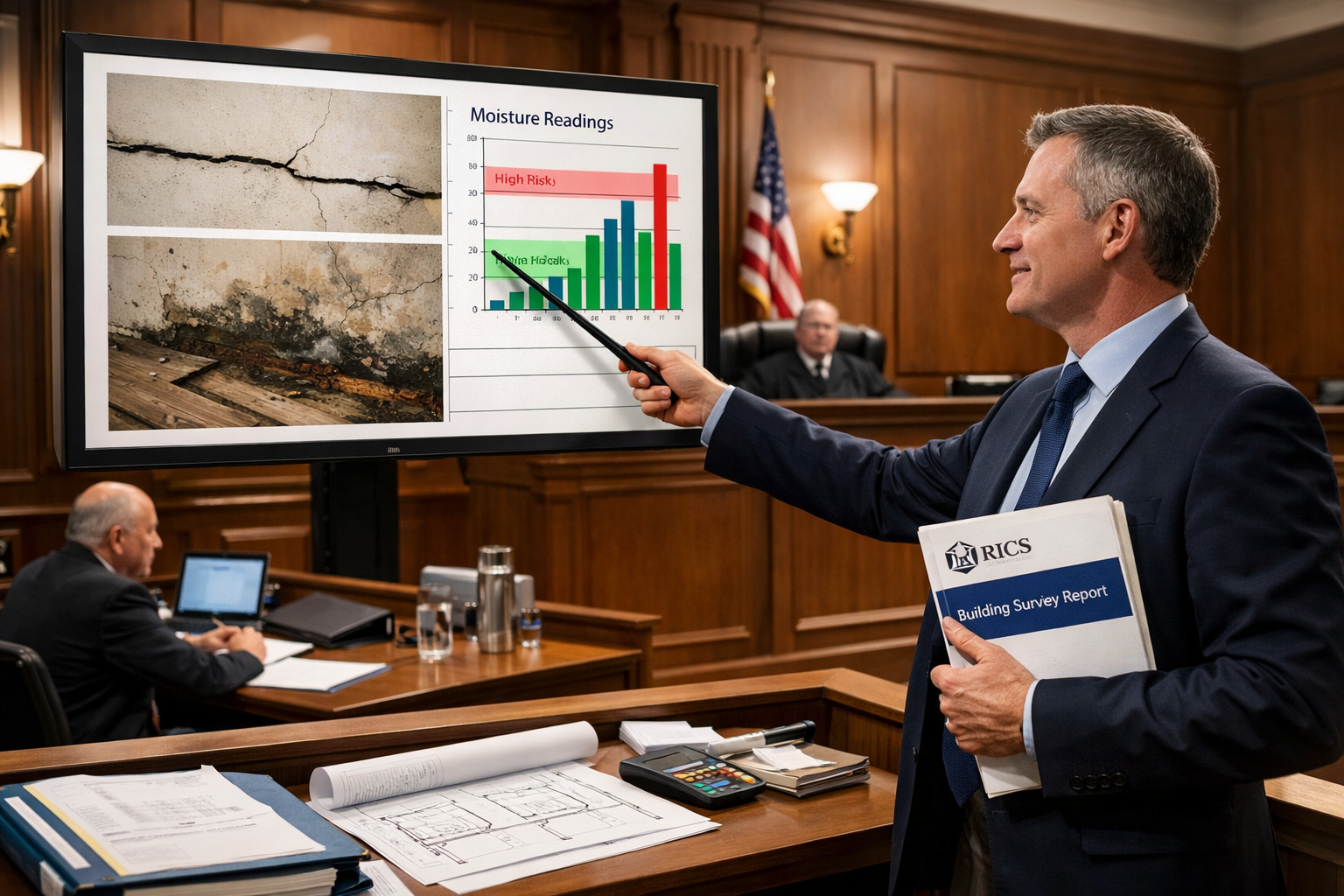
✅ Integrating digital data sources including photographs, thermal imaging, and moisture readings
✅ Explaining technical findings to legal professionals and juries unfamiliar with surveying terminology
The transition period has revealed significant gaps in expert witness preparation, with many professionals struggling to adapt traditional testimony frameworks to the new regulatory environment.
Expert Witness Preparation for Post-Reform Homebuying Disputes: Core Competencies

Mastering RICS Standards for Testimony
The Royal Institution of Chartered Surveyors (RICS) standards form the bedrock of credible expert witness testimony. In 2026, understanding these standards isn't optional—it's essential for maintaining professional credibility under cross-examination.
Critical RICS frameworks for expert witnesses include:
| RICS Standard | Application to Expert Testimony | Key Compliance Points |
|---|---|---|
| RICS Level 3 Building Survey | Detailed defect analysis for high-value disputes | Comprehensive inspection protocols, structural assessment methodology |
| RICS Guidance Note on Surveys | Standardized reporting terminology | Condition rating systems (1-3), defect categorization |
| RICS Practice Statement on Expert Witness | Professional conduct and report preparation | Duty to court, independence requirements, disclosure obligations |
| RICS Valuation Standards | Property value impact assessment | Red Book compliance, diminution calculations |
Expert witnesses should maintain current copies of all relevant RICS publications and be prepared to cite specific sections during testimony. When reviewing mandatory survey data, cross-reference findings against RICS building surveys to identify compliance gaps or methodological concerns.
Document Review Protocols
The foundation of effective expert witness preparation lies in systematic document analysis. With mandatory survey data now standard, expert witnesses must develop rigorous review protocols that identify both obvious defects and subtle inconsistencies.
Essential document review steps:
- Obtain complete survey package including original condition report, photographs, appendices, and surveyor qualifications
- Verify compliance with 2026 mandatory disclosure requirements and RICS standards
- Cross-reference survey findings with transaction timeline, property marketing materials, and buyer communications
- Identify gaps in inspection coverage, missing photographs, or incomplete defect descriptions
- Assess surveyor competence through qualification verification and report quality analysis
- Document discrepancies between survey findings and actual property conditions at dispute date
For complex structural issues, expert witnesses should review structural surveys and specific defect reports to understand the full scope of property condition concerns.
Defect Categorization and Causation Analysis
One of the most challenging aspects of expert witness testimony involves explaining defect causation and distinguishing between pre-existing conditions, progressive deterioration, and new damage.
The 2026 reforms introduce standardized defect categorization systems that expert witnesses must master:
🔴 Category 1 Defects: No immediate action required
🟡 Category 2 Defects: Repairs or replacement requiring future attention
🔴 Category 3 Defects: Urgent repairs or serious safety risks
However, expert witnesses must go beyond simple categorization to provide causation analysis:
- Progressive defects: Subsidence, damp penetration, timber decay that worsens over time
- Latent defects: Hidden conditions not reasonably discoverable during standard surveys
- Patent defects: Obvious conditions that should have been identified in mandatory surveys
- Consequential damage: Secondary issues resulting from primary defects
Understanding the distinction between these categories is crucial when addressing whether defects should have been identified in the mandatory upfront survey. For subsidence-related disputes, expert witnesses should reference surveys for subsidence to establish appropriate investigation protocols.
Integrating 2026 Mandatory Survey Data: Practical Templates
Template 1: Pre-Litigation Case Assessment Framework
Before accepting an expert witness appointment, professionals should conduct a preliminary case assessment to determine the strength of the claim and the quality of available evidence.
Pre-Litigation Assessment Template:
CASE REFERENCE: [Number]
PROPERTY ADDRESS: [Full address]
DISPUTE TYPE: [Buyer claim / Seller defense / Third party]

MANDATORY SURVEY REVIEW:
□ Survey date: ___________
□ Surveyor credentials verified: Y/N
□ RICS compliance confirmed: Y/N
□ Survey level: Level 2 / Level 3
□ Defects identified: [List]
□ Category ratings: C1___ C2___ C3___

DEFECT ANALYSIS:
Primary defect alleged: ___________
Survey disclosure: Disclosed / Not disclosed / Partially disclosed
Causation assessment: Pre-existing / Progressive / New
Reasonable discoverability: Y/N

EVIDENCE QUALITY:
Mandatory survey quality: Strong / Adequate / Weak
Supporting documentation: Complete / Partial / Insufficient
Photographic evidence: Comprehensive / Limited / None
Expert opinion viability: Strong / Moderate / Weak

PRELIMINARY OPINION:
Claim merit: High / Medium / Low
Recommended action: Proceed / Request additional evidence / Decline
This template provides a systematic framework for evaluating whether a case has sufficient evidentiary foundation to support expert witness involvement.
Template 2: Expert Witness Report Structure
The expert witness report represents the cornerstone of testimony preparation. In 2026, reports must integrate mandatory survey data while maintaining compliance with Civil Procedure Rules and RICS professional standards.
Comprehensive Report Template:
1. EXECUTIVE SUMMARY
- Brief case overview
- Key findings summary
- Primary conclusions
2. EXPERT QUALIFICATIONS
- Professional credentials and RICS membership
- Relevant experience in property surveying and expert witness testimony
- Continuing professional development in 2026 reforms
3. INSTRUCTIONS AND SCOPE
- Instructing party and legal representatives
- Questions to be addressed
- Site inspection details and limitations
4. MANDATORY SURVEY ANALYSIS
- Review of upfront survey commissioned under 2026 requirements
- Assessment of RICS compliance and surveyor competence
- Evaluation of defect identification and categorization
- Analysis of disclosure adequacy
5. SITE INSPECTION FINDINGS
- Independent inspection methodology
- Photographic documentation
- Defect identification and measurement
- Comparison with mandatory survey findings
6. TECHNICAL ANALYSIS
- Defect causation assessment
- Building pathology evaluation
- Structural implications
- Repair methodology and costings
7. OPINION ON MATERIAL QUESTIONS
- Should defects have been identified in mandatory survey?
- Were disclosure obligations met under 2026 requirements?
- What is the appropriate remedy or compensation?
8. DECLARATION
- Confirmation of expert witness duties to court
- Statement of independence
- Acknowledgment of CPR compliance
When preparing reports involving homebuyer surveys, ensure that the analysis clearly distinguishes between Level 2 and Level 3 survey obligations and what defects should reasonably have been identified at each level.
Template 3: Cross-Examination Preparation Checklist
Effective courtroom testimony requires anticipating opposing counsel's challenges and preparing robust responses grounded in technical expertise and regulatory compliance.
Cross-Examination Preparation Checklist:
Technical Foundations:
- Review all RICS standards relevant to property type and defects
- Prepare explanations of technical terms in plain language
- Create visual aids demonstrating defect progression or causation
- Calculate alternative repair cost scenarios
Mandatory Survey Defense:
- Identify specific survey limitations or exclusions
- Prepare explanation of reasonable inspection standards
- Document industry norms for defect identification
- Review surveyor's qualifications and experience
Causation and Timing:
- Establish timeline of defect development
- Prepare evidence of pre-existing conditions
- Document environmental factors affecting property
- Explain progressive vs. sudden deterioration
Professional Standards:
- Confirm independence and absence of conflicts
- Prepare CV highlighting relevant experience
- Review previous expert witness testimony if applicable
- Ensure report complies with all procedural requirements
Anticipated Challenges:
- Prepare responses to "why didn't the surveyor find this?"
- Explain limitations of non-invasive inspection techniques
- Address alternative causation theories
- Justify cost estimates and repair methodologies
Documentation:
- Organize exhibits in logical sequence
- Prepare enlarged photographs for courtroom display
- Create summary charts of defect categorization
- Ensure all references are properly cited
Expert Tip: "The most effective expert witnesses don't just know the technical answers—they can explain complex surveying concepts to non-experts without condescension. Practice translating technical jargon into everyday language that judges and juries can understand."
Advanced Considerations for Expert Witness Preparation for Post-Reform Homebuying Disputes
Digital Evidence Integration
The 2026 reforms emphasize digital documentation, creating new opportunities and challenges for expert witnesses. Mandatory surveys now typically include:
- Digital photograph libraries with metadata timestamps
- Thermal imaging data for moisture and insulation assessment
- Laser measurement records for dimensional accuracy
- Drone footage for roof and chimney inspections
- 3D property models showing spatial relationships
Expert witnesses must develop competence in analyzing and presenting digital evidence, including verification of metadata authenticity and assessment of image quality and coverage.
Dealing with Surveyor Competence Questions
A particularly sensitive aspect of post-reform disputes involves questioning the competence or thoroughness of the surveyor who prepared the mandatory upfront survey. Expert witnesses must navigate this carefully to maintain professional courtesy while fulfilling their duty to the court.
Appropriate approaches include:
✅ Focusing on objective standards rather than personal criticism
✅ Citing RICS guidance on inspection methodology
✅ Explaining industry norms for defect identification
✅ Acknowledging legitimate limitations of non-invasive surveys
✅ Distinguishing between negligence and reasonable professional judgment
When reviewing building surveys prepared by other professionals, maintain objectivity and avoid inflammatory language that could undermine credibility.
Multi-Defect Disputes and Prioritization
Complex homebuying disputes often involve multiple defects spanning different building elements and severity levels. Expert witnesses must develop frameworks for prioritizing issues and explaining their relative significance.
Defect prioritization matrix:
| Defect Category | Safety Impact | Financial Impact | Urgency | Priority Level |
|---|---|---|---|---|
| Structural movement | High | High | Immediate | Critical |
| Roof defects | Medium | High | Short-term | High |
| Damp penetration | Medium | Medium | Medium-term | Moderate |
| Cosmetic issues | Low | Low | Long-term | Low |
This systematic approach helps courts understand which defects warrant immediate attention and significant remedies versus those that represent minor concerns.
Regional Variations and Local Building Practices
Expert witnesses must account for regional variations in construction methods, materials, and building practices when assessing whether defects should have been identified in mandatory surveys.
Factors to consider include:
- Local soil conditions affecting foundation design and subsidence risk
- Regional climate influencing weathering patterns and material durability
- Historical building methods in period properties
- Local authority building control variations
For disputes involving properties in specific regions, expert witnesses should familiarize themselves with local construction norms and common defect patterns.
Emerging Challenges and Future Developments
Technology-Enhanced Survey Methods
The rapid evolution of surveying technology creates both opportunities and complications for expert witness testimony. Emerging tools include:
🔧 AI-powered defect detection algorithms
🔧 Augmented reality property inspection tools
🔧 Blockchain verification for survey data integrity
🔧 Predictive analytics for defect progression modeling
Expert witnesses must stay current with technological developments while maintaining the ability to explain their limitations and potential for error.
Regulatory Evolution Beyond 2026
The 2026 reforms represent an initial framework that will likely evolve based on implementation experience. Expert witnesses should monitor:
- Regulatory guidance updates from RICS and government bodies
- Case law developments establishing precedents for survey adequacy
- Industry consultation on reform effectiveness
- Professional standards revisions addressing emerging issues
Maintaining awareness of regulatory evolution ensures expert testimony remains current and authoritative.
Professional Development and Continuing Education
The specialized knowledge required for effective expert witness work in post-reform homebuying disputes demands ongoing professional development. Recommended activities include:
- RICS expert witness training courses and certifications
- Legal procedure workshops on civil litigation and evidence rules
- Technical seminars on building pathology and defect analysis
- Mock trial exercises to practice testimony delivery
- Peer review groups for case discussion and methodology refinement
Investment in continuing education directly correlates with expert witness credibility and effectiveness.
Conclusion
Expert Witness Preparation for Post-Reform Homebuying Disputes: Integrating 2026 Mandatory Survey Data represents a critical competency for surveyors navigating the transformed landscape of property litigation. The mandatory upfront survey requirements have fundamentally altered the evidentiary foundation of homebuying disputes, creating new standards for expert witness testimony and professional accountability.
Success in this evolving environment requires mastery of multiple disciplines: technical surveying expertise, RICS standards compliance, legal procedure understanding, and effective communication skills. Expert witnesses who develop systematic preparation frameworks, maintain current knowledge of regulatory developments, and cultivate courtroom credibility will find themselves well-positioned to serve clients and courts effectively.
Actionable Next Steps
For surveyors seeking to develop or enhance expert witness capabilities:
- Obtain specialized training in expert witness procedures and civil litigation requirements
- Review and update professional indemnity insurance to cover expert witness activities
- Develop template systems for case assessment, report preparation, and testimony organization
- Build relationships with legal professionals specializing in property disputes
- Maintain comprehensive CPD records demonstrating expertise in 2026 reform requirements
- Join professional networks focused on expert witness practice and case law developments
- Conduct mock testimony sessions to refine communication skills and courtroom presence
The integration of mandatory survey data into homebuying transactions creates unprecedented opportunities for qualified expert witnesses to provide valuable guidance in dispute resolution. By combining technical excellence with procedural compliance and effective communication, surveyors can establish themselves as trusted authorities in this specialized field.
For comprehensive support in property surveying matters, including expert witness services, professional surveyors can provide the technical expertise and litigation support necessary for successful dispute resolution in the post-reform environment.