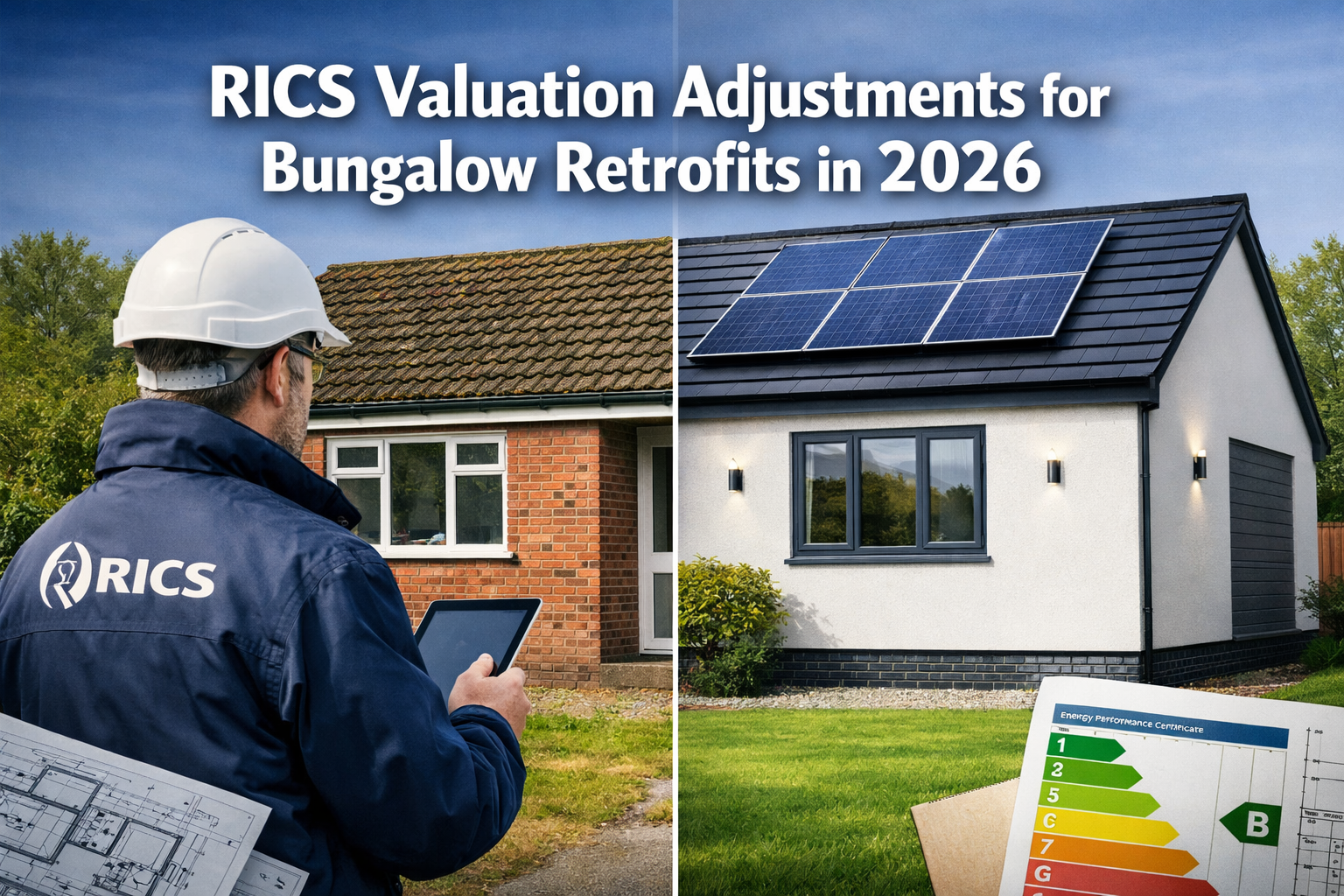

The UK property market is experiencing a remarkable transformation in 2026, with bungalows emerging as unexpected stars in the residential sector. As energy efficiency becomes non-negotiable and retrofit demand accelerates toward government targets, property valuers face a critical question: How do you accurately assess the value uplift of a retrofitted bungalow in today's high-demand markets?
This Evergreen Guide to RICS Valuation Adjustments for Bungalow Retrofits in High-Demand 2026 Markets provides chartered surveyors, property investors, and homeowners with a comprehensive framework for understanding how energy retrofits impact bungalow valuations. With the UK residential property market showing tentative signs of recovery [4] and bungalows commanding premium attention from downsizers and accessibility-focused buyers, mastering these valuation adjustments has never been more important.
Key Takeaways
- 🏡 Energy retrofits represent the most significant value-add opportunity for bungalow improvements in 2026, with EPC A-rated properties achieving an average 2.9% price premium per square meter [1][4]
- 📊 RICS professional standards now mandate specific retrofit assessment protocols effective from October 31, 2024, requiring valuers to follow standardized methodologies [2]
- 💷 Only upgrades reaching EPC A rating show positive market pricing, while intermediate improvements (B and C ratings) may actually show modest discounts of -2.3% and -1.2% respectively [4]
- ⚡ The UK must achieve 500,000 residential retrofits annually from 2025, rising to 1 million by 2030, creating unprecedented demand for professional valuation expertise [3]
- 🔍 Building surveys form the foundation of accurate retrofit valuations, identifying both opportunities and risks that directly impact final property values [1]
Understanding the 2026 Bungalow Retrofit Market Context
Why Bungalows Are Experiencing Unprecedented Demand
Bungalows occupy a unique position in the 2026 property landscape. These single-story dwellings appeal to multiple demographic segments simultaneously: aging homeowners seeking accessible living, young families prioritizing outdoor space, and investors recognizing the retrofit potential of properties built predominantly between 1950-1980.
The January 2026 RICS UK Residential Market Survey revealed tentative signs of recovery across the residential sector [4], with bungalows showing particularly strong performance in areas with aging populations and accessibility requirements. This demographic shift creates sustained demand pressure that amplifies the value impact of energy efficiency improvements.
The Retrofit Imperative: Regulatory and Market Drivers
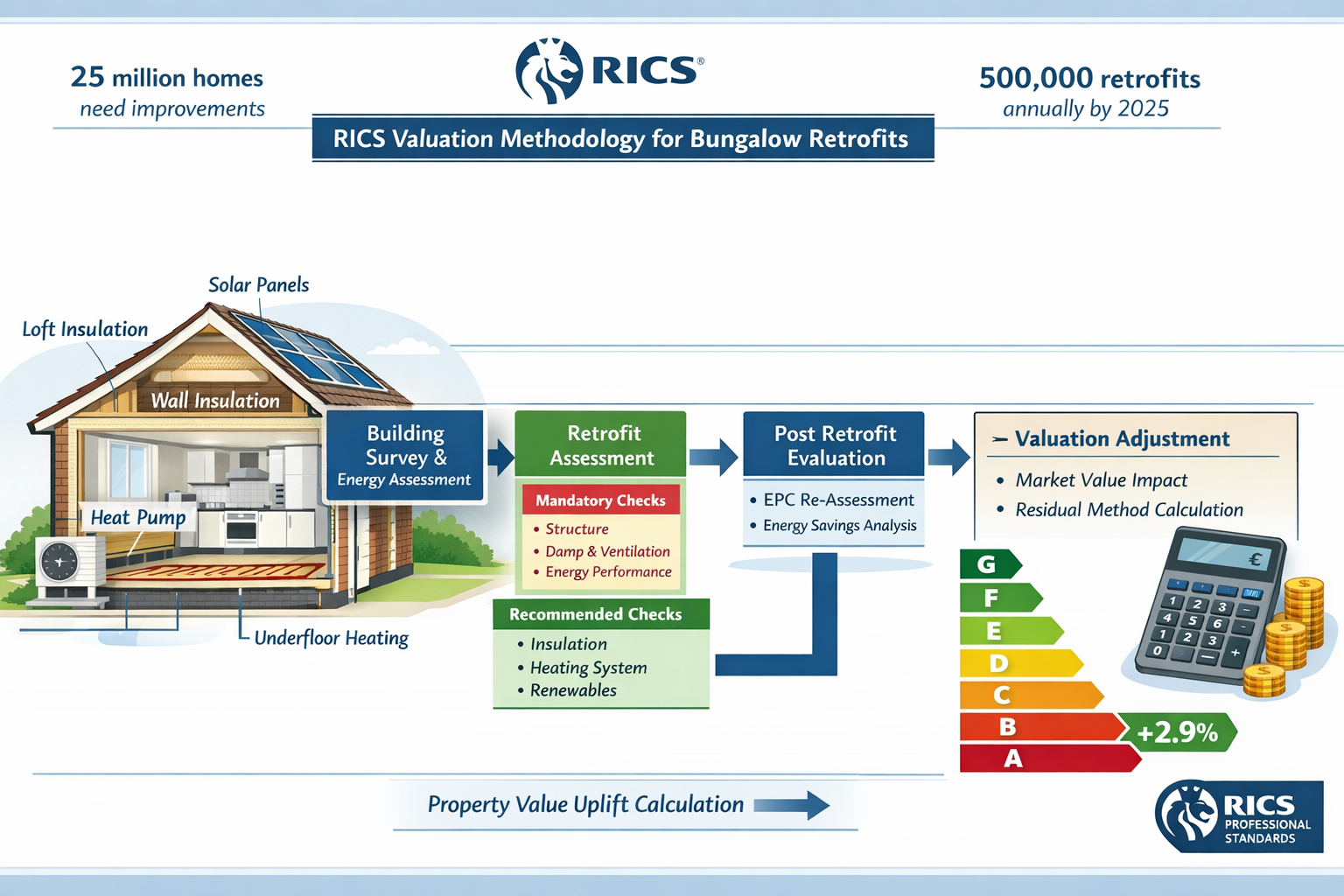
An estimated 25 million homes in the UK require some form of energy improvement [2], with bungalows representing a significant proportion of this stock. The Climate Change Committee's targets require residential retrofits to accelerate dramatically—from current levels to 500,000 per year from 2025, eventually reaching 1 million annually by 2030 [3].
For property owners and valuers, this creates both opportunity and obligation. The Minimum Energy Efficiency Standards (MEES) regulation already requires rental properties to achieve at least an EPC rating of E [4]. Properties failing to meet this threshold face liquidity risks and demonstrable value reductions, making retrofit not just environmentally responsible but financially essential.
RICS Professional Standards for Retrofit Valuation
The RICS issued a comprehensive professional standard for residential retrofit that became effective on October 31, 2024 [2]. This standard establishes both mandatory and recommended requirements for professionals involved in retrofit works, including valuers assessing post-improvement property values.
Working with registered RICS valuers ensures compliance with these evolving standards and provides property owners with defensible, market-recognized valuations. The RICS retrofit pathway accreditation program has already achieved oversubscription [5], demonstrating strong professional commitment to standardized retrofit competency.
The Evergreen Guide to RICS Valuation Adjustments for Bungalow Retrofits: Core Methodology
Step 1: Comprehensive Building Survey and Baseline Assessment
Before any retrofit valuation adjustment can be calculated, valuers must establish an accurate baseline through detailed property assessment. A thorough RICS home survey identifies:
- Current EPC rating and energy performance metrics
- Existing building fabric condition (walls, roof, floors, windows)
- Heating and hot water systems (efficiency, age, capacity)
- Structural constraints that may limit retrofit options
- Damp, ventilation, and air quality issues requiring remediation
For bungalows specifically, surveyors must assess the roof structure's capacity for solar panel installation, the feasibility of external wall insulation without compromising aesthetic character, and the suitability of underfloor insulation given the typically suspended timber or solid concrete construction.
Building surveys for bungalow retrofits serve dual purposes: they identify value-enhancing opportunities while flagging potential risks that could undermine retrofit effectiveness [1]. A bungalow with unaddressed subsidence issues or chronic dampness will not achieve projected energy savings, directly impacting valuation adjustments.
Step 2: Retrofit Specification and Compliance Verification
Once the baseline is established, valuers must assess the proposed or completed retrofit specification against RICS standards and building regulations. This includes verification of:
Insulation Improvements:
- Loft insulation depth (minimum 270mm recommended)
- External or internal wall insulation systems
- Floor insulation (particularly critical in bungalows with suspended floors)
- Thermal bridging mitigation at junctions
Heating System Upgrades:
- Heat pump installation (air source or ground source)
- Solar thermal or photovoltaic panels
- Upgraded heating controls and zoning
- Hot water cylinder insulation and efficiency
Ventilation and Air Quality:
- Mechanical ventilation with heat recovery (MVHR) systems
- Passive ventilation strategies
- Moisture management post-insulation
Glazing and Doors:
- Double or triple glazing specifications
- Door thermal performance
- Draught-proofing measures
Understanding methods of valuation helps contextualize how these physical improvements translate into monetary value adjustments through the comparative, income, or cost approaches.
Step 3: EPC Rating Projection and Market Premium Calculation
The relationship between EPC ratings and property values follows a clear pattern based on analysis of 6.8 million housing transactions in England and Wales between 2014-2024 [4]:
| EPC Rating | Price Adjustment vs. Baseline (D Rating) |
|---|---|
| A | +2.9% per square meter ✅ |
| B | -2.3% per square meter |
| C | -1.2% per square meter |
| D | Baseline (0%) |
| E | Modest discount |
| F | Larger discount |
| G | Significant discount |
This data reveals a critical insight: only the possibility of reaching an EPC A rating is positively priced by the market [4]. Intermediate upgrade paths show no significant positive price effects, and in some cases demonstrate modest negative adjustments.
For bungalow retrofit valuations, this means:
- Calculate the projected post-retrofit EPC rating based on the specification
- Apply the appropriate percentage adjustment to the baseline property value
- Account for market-specific factors that may amplify or diminish the standard premium
- Consider the temporal value of energy cost savings over the property's investment horizon
Step 4: Cost-Benefit Analysis and Net Value Uplift
The gross value premium from improved EPC ratings must be balanced against retrofit costs to determine net value uplift. A comprehensive valuation adjustment includes:
Retrofit Cost Assessment:
- Material and labor costs for all improvements
- Professional fees (architects, engineers, surveyors)
- Compliance and certification costs
- Disruption and temporary accommodation expenses
Value Enhancement Calculation:
- Direct market value premium (EPC-based)
- Reduced energy costs (capitalized over holding period)
- Enhanced marketability and reduced time to sale
- Rental yield improvements for investment properties
- MEES compliance value (avoiding regulatory penalties)
Net Uplift Formula:
Net Value Uplift = (Market Value Premium + Capitalized Energy Savings + Marketability Premium) - Total Retrofit Costs
For a typical three-bedroom bungalow in a high-demand 2026 market:
- Baseline value: £350,000 (EPC rating D)
- Retrofit cost: £35,000 (comprehensive package to EPC A)
- Post-retrofit value: £360,150 (£350,000 × 1.029)
- Annual energy savings: £1,800
- Capitalized savings (10 years): £18,000
- Net uplift: £28,150 + enhanced marketability
Step 5: Risk Assessment and Adjustment Factors
Professional valuers must account for risks that could diminish projected value uplifts:
⚠️ Workmanship Quality Risks: Poorly executed retrofits can create new problems (condensation, thermal bridging, structural issues) that reduce rather than enhance value. Engaging specialists for RICS specialist defect surveys during and after retrofit work mitigates this risk.
⚠️ Technology Obsolescence: Rapidly evolving heat pump and solar technologies may render current installations less competitive within 10-15 years.
⚠️ Regulatory Changes: Future tightening of EPC requirements could shift the baseline, affecting relative value positions.
⚠️ Market Acceptance: Regional variations in buyer preferences for specific retrofit technologies (particularly heat pumps) can impact realized value.
⚠️ Aesthetic Impact: External wall insulation and solar panels may affect bungalow character, particularly in conservation areas, potentially limiting buyer appeal.
Applying This Evergreen Guide to RICS Valuation Adjustments in Practice
Case Study: Detached Bungalow in High-Demand Suburban Market
Property Profile:
- 1960s-built detached bungalow
- 110 square meters floor area
- Original single-glazed windows
- Gas central heating (20-year-old boiler)
- Minimal loft insulation (50mm)
- Current EPC rating: E
Retrofit Specification:
- External wall insulation (EWI) system
- Loft insulation upgrade to 300mm
- Triple-glazed windows throughout
- Air source heat pump installation
- 4kW solar PV system
- MVHR system
- Projected EPC rating: A
Valuation Adjustment Calculation:
- Baseline market value: £380,000
- Retrofit investment: £42,000
- Post-retrofit market value: £391,020 (£380,000 × 1.029)
- Direct value uplift: £11,020
- Annual energy cost reduction: £2,100
- 10-year capitalized savings: £21,000
- MEES compliance premium: Eliminates future rental restriction risk
- Enhanced marketability: Estimated 15% reduction in time to sale
- Total economic benefit: £32,020 + marketability advantages
Net Position: While the direct market value premium (£11,020) doesn't fully recover the retrofit cost (£42,000), the combination of capitalized energy savings, regulatory compliance, and enhanced marketability creates a compelling value proposition, particularly for owner-occupiers planning extended residence periods.
Regional Market Variations in 2026
The application of this evergreen guide must account for significant regional variations:
High-Demand Markets (Southeast, commuter belts):
- Stronger EPC premium realization
- Greater buyer sophistication regarding energy efficiency
- Premium for "move-in ready" retrofitted properties
- Faster capital recovery on retrofit investments
Moderate-Demand Markets (Regional cities, towns):
- Standard EPC premium application
- Mixed buyer awareness of energy efficiency benefits
- Longer capital recovery periods
- Greater emphasis on cost-benefit analysis
Lower-Demand Markets (Rural, declining populations):
- Muted EPC premium effects
- Energy cost savings as primary value driver
- Extended payback periods
- Regulatory compliance as key motivation
Understanding these variations helps valuers provide context-appropriate assessments that reflect actual market behavior rather than theoretical premiums.
The Trust Factor in Retrofit Valuation
The retrofit sector faces what industry observers call a fundamental "trust problem" [5]. Homeowners remain uncertain about which professionals to trust, which technologies to adopt, and whether promised benefits will materialize. This trust deficit directly impacts valuation adjustments.
Properties retrofitted by RICS-accredited professionals with proper certification and warranties command measurably higher confidence—and therefore value—than equivalent technical specifications executed by uncertified contractors. The RICS positioning as the authority to restore professional confidence through standardized practices [5] creates tangible value differentiation.
When conducting valuation reports, chartered surveyors should explicitly note:
- Professional credentials of retrofit designers and installers
- Warranty coverage and duration
- Certification and compliance documentation
- Quality assurance processes followed
- Post-installation performance verification
These factors directly influence buyer confidence and, consequently, realized market values.
Advanced Considerations for the Evergreen Guide to RICS Valuation Adjustments
Rental Property Specific Adjustments
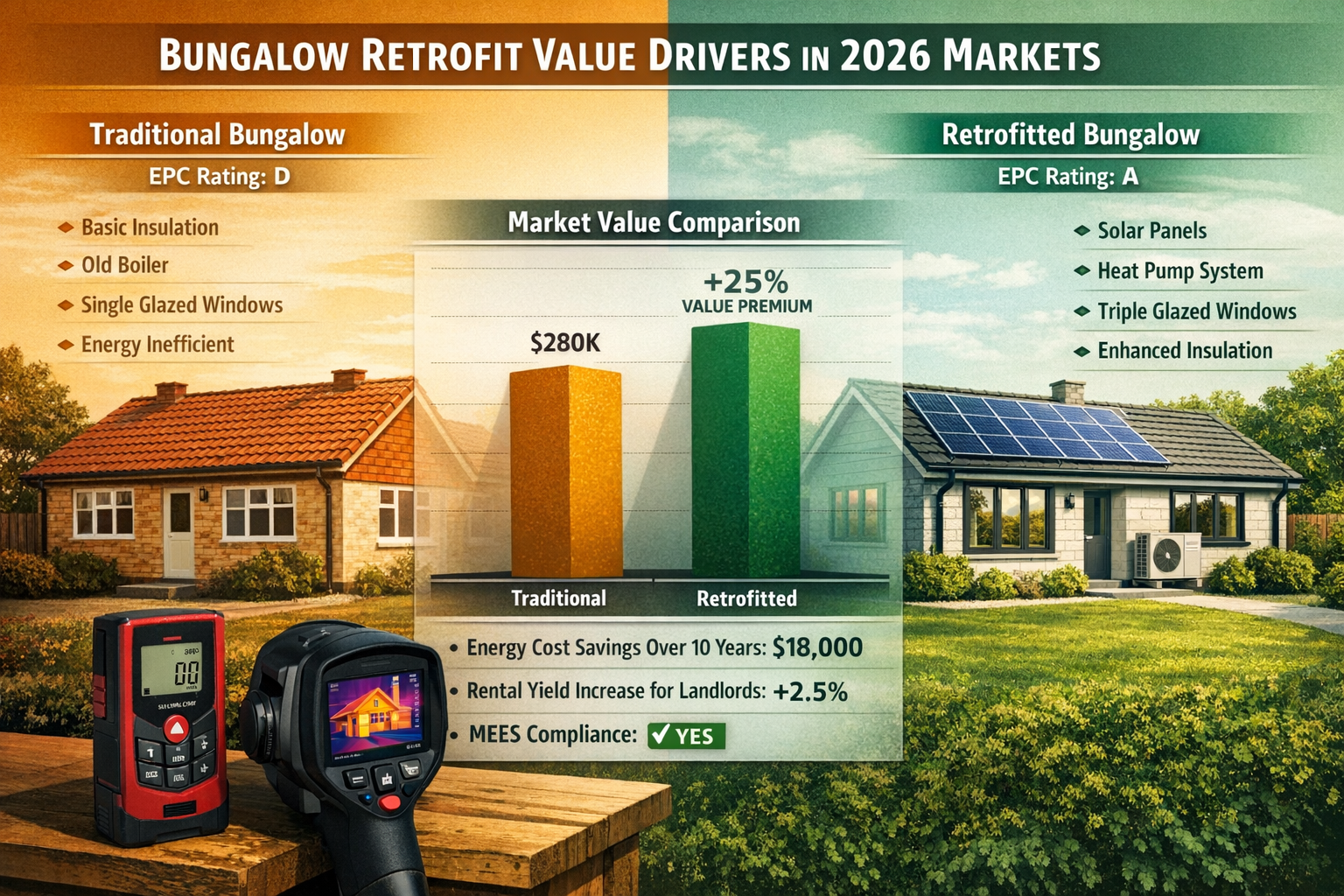
For buy-to-let investors, retrofit valuation adjustments incorporate additional factors:
Rental Yield Enhancement:
- Premium rents achievable for energy-efficient properties (typically 3-5% above baseline)
- Reduced void periods due to enhanced marketability
- Lower tenant turnover (comfort and cost savings create retention)
Regulatory Compliance Value:
- MEES compliance eliminates rental restriction risk
- Future-proofing against anticipated EPC C minimum (expected 2028-2030)
- Reduced exposure to potential energy efficiency penalties
Operational Cost Reduction:
- Lower maintenance requirements for modern heating systems
- Reduced emergency repair callouts
- Extended component lifecycles
Capital Growth Potential:
- Energy-efficient properties showing stronger capital appreciation
- Reduced obsolescence risk in evolving regulatory environment
Bungalow-Specific Retrofit Advantages
Bungalows offer unique retrofit advantages that can enhance value adjustments:
✅ Roof Area Advantage: Large roof areas relative to floor area maximize solar PV potential, with typical bungalows accommodating 4-6kW systems versus 2-3kW for equivalent-sized two-story homes.
✅ Simplified Heating Zoning: Single-story layouts facilitate efficient heat pump operation with minimal zoning complexity, improving system efficiency and reducing installation costs.
✅ Accessible Loft Spaces: Easy loft access simplifies insulation upgrades and ongoing maintenance, reducing long-term costs.
✅ External Wall Treatment: Bungalows typically present straightforward geometries for external wall insulation without complex scaffolding requirements.
✅ Underfloor Accessibility: Many bungalows feature accessible underfloor spaces, facilitating floor insulation and services upgrades.
These technical advantages should inform valuation adjustments, as they reduce retrofit costs and enhance performance outcomes compared to equivalent improvements on two-story properties.
Integration with Other Property Improvements
Retrofit valuations rarely occur in isolation. Bungalows frequently undergo concurrent improvements that interact with energy efficiency upgrades:
Loft Conversions: Adding habitable loft space fundamentally changes retrofit economics and valuation calculations. Understanding party wall considerations for loft conversions becomes relevant for semi-detached bungalows.
Extensions and Annexes: Ground-level extensions common in bungalow developments must meet current building regulations for energy efficiency, potentially creating performance disparities with existing structures.
Accessibility Modifications: Level-access showers, wider doorways, and other accessibility improvements complement the single-story advantage, creating synergistic value enhancements for aging-in-place buyers.
Landscaping and External Works: Bungalows typically feature larger garden areas, and ground source heat pump installations may utilize this space, requiring integrated valuation of building and landscape modifications.
Quality Assurance and Professional Standards in Retrofit Valuation
The RICS Quality in Retrofit Framework
RICS held a Quality in Retrofit Summit in partnership with the Retrofit Academy at the start of 2026 [4], establishing enhanced quality frameworks for retrofit professionals. Key elements include:
Competency Requirements:
- Retrofit Coordinator accreditation
- Retrofit Assessor qualifications
- Specialist installer certifications
- Ongoing professional development
Process Standards:
- Pre-retrofit assessment protocols
- Design specification requirements
- Installation quality assurance
- Post-completion verification
- Performance monitoring
Documentation Standards:
- Comprehensive retrofit plans
- As-built documentation
- Warranty and guarantee records
- Energy performance verification
- Handover information for occupants
Valuers assessing retrofitted bungalows should verify compliance with these standards, as properties meeting RICS quality frameworks command demonstrable market premiums over technically similar but less rigorously documented retrofits.
Common Valuation Pitfalls to Avoid
Even experienced valuers can fall into traps when assessing retrofit value adjustments:
❌ Assuming Linear EPC-Value Relationships: The market data clearly shows non-linear pricing, with only EPC A achieving premiums [4]. Don't extrapolate intermediate ratings.
❌ Ignoring Aesthetic Impact: External wall insulation and solar panels affect property character. In conservation areas or architecturally sensitive contexts, these impacts may reduce rather than enhance value.
❌ Overlooking Installation Quality: Two identical EPC A specifications can have vastly different actual performance and longevity based on installation quality. Physical inspection remains essential.
❌ Neglecting Maintenance Requirements: Heat pumps, MVHR systems, and solar installations require ongoing maintenance. Properties with established maintenance contracts and service histories command higher values.
❌ Failing to Account for Technology Evolution: Rapid advances in battery storage, smart controls, and heat pump efficiency mean recent retrofits may significantly outperform older installations with identical EPC ratings.
Documentation and Reporting Best Practices
Professional retrofit valuations require comprehensive documentation:
Essential Documentation:
- Current and projected EPC certificates
- Retrofit specification and design documents
- Installation certification and warranties
- Building control approval and completion certificates
- Photographic evidence of work quality
- Performance monitoring data (if available)
- Maintenance schedules and service records
Valuation Report Components:
- Clear baseline value establishment
- Detailed retrofit specification summary
- EPC rating analysis and projection
- Market premium calculation with supporting comparables
- Cost-benefit analysis including capitalized savings
- Risk assessment and adjustment factors
- Net value uplift conclusion
- Recommendations for optimization or remediation
Following these documentation standards ensures valuations withstand scrutiny from lenders, buyers, and regulatory authorities while providing clear audit trails for professional indemnity purposes.
Future-Proofing Bungalow Retrofit Valuations
Anticipated Regulatory Developments
The regulatory landscape continues evolving, with several anticipated changes affecting retrofit valuations:
EPC C Minimum for Rentals (Expected 2028-2030): The government has signaled intention to raise MEES requirements to EPC C for rental properties. Properties currently achieving this threshold will avoid future compliance costs, enhancing relative value.
Embodied Carbon Considerations: Future regulations may account for embodied carbon in building materials, potentially affecting valuation of different retrofit approaches (e.g., natural insulation materials versus synthetic alternatives).
Smart Home Integration Requirements: Emerging standards for smart energy management and grid interaction may create additional value differentiators beyond basic EPC ratings.
Heat Pump Readiness: Anticipated gas boiler phase-out timelines make heat pump installations increasingly valuable, particularly in areas without gas grid connections.
Technology Evolution and Value Implications
Rapid technology advancement creates both opportunities and challenges for retrofit valuations:
Battery Storage Integration: Solar PV systems with battery storage achieve significantly higher self-consumption rates and energy independence, creating value premiums beyond basic solar installations.
Heat Pump Efficiency Improvements: Modern heat pumps achieve seasonal coefficients of performance (SCOP) exceeding 4.0, substantially outperforming earlier generations and reducing operating costs.
Smart Controls and AI Optimization: Machine learning-enabled heating controls adapt to occupancy patterns and weather forecasts, improving comfort while reducing energy consumption.
Vehicle-to-Grid (V2G) Capability: Properties with EV charging infrastructure capable of bidirectional power flow can monetize vehicle batteries for grid services, creating additional value streams.
Valuers must stay informed about these technological developments to accurately assess the relative value of different retrofit specifications and vintages.
Conclusion
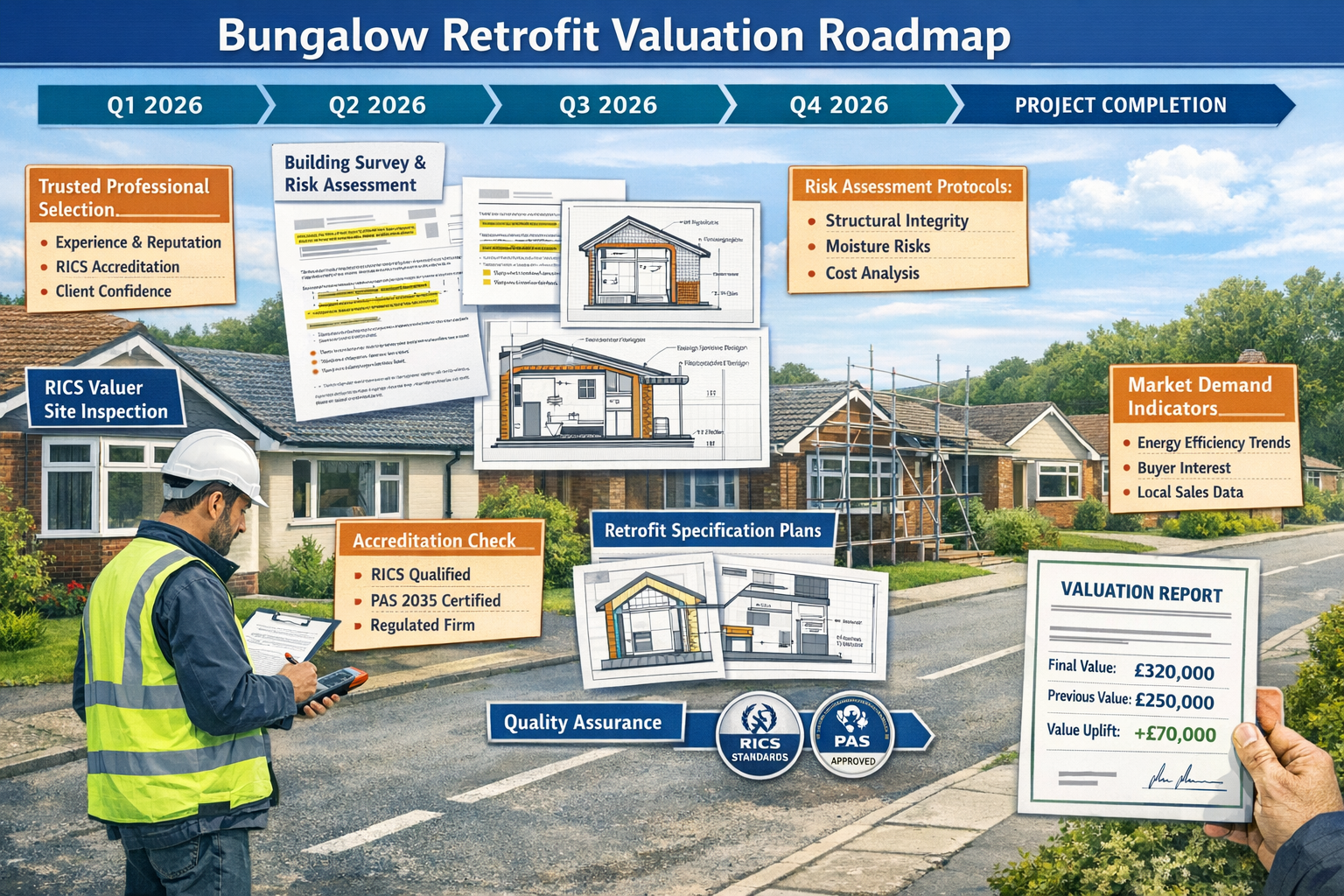
This Evergreen Guide to RICS Valuation Adjustments for Bungalow Retrofits in High-Demand 2026 Markets provides a comprehensive framework for understanding how energy efficiency improvements impact property values in today's recovering residential market. With 25 million UK homes requiring energy improvements [2] and government targets demanding 500,000 annual retrofits from 2025 [3], professional valuation expertise has never been more critical.
The evidence is clear: EPC A-rated properties achieve measurable market premiums of 2.9% per square meter [4], while lower-rated properties face discounts and regulatory risks. However, successful retrofit valuations require more than simple percentage applications—they demand comprehensive building surveys, detailed specification analysis, cost-benefit calculations, and careful risk assessment.
Key Takeaways for Implementation
For property owners considering bungalow retrofits:
- Engage registered RICS valuers before committing to retrofit specifications
- Target EPC A ratings to maximize market value recognition
- Prioritize quality installation and comprehensive documentation
- Consider long-term ownership horizons to realize full economic benefits
For valuers assessing retrofitted bungalows:
- Follow RICS professional standards effective from October 2024 [2]
- Conduct thorough building surveys to establish accurate baselines
- Apply market-evidenced EPC premiums while accounting for regional variations
- Verify installation quality and professional credentials
- Document comprehensively to support valuation conclusions
For investors and developers:
- Recognize bungalows' unique retrofit advantages (roof area, heating simplicity, accessibility)
- Account for both direct value premiums and capitalized energy savings
- Consider rental market dynamics and MEES compliance value
- Future-proof specifications against anticipated regulatory tightening
Next Steps
The bungalow retrofit opportunity in 2026's high-demand markets combines demographic trends, regulatory imperatives, and environmental necessity. Property professionals who master the valuation adjustments outlined in this evergreen guide position themselves to serve clients effectively while contributing to the UK's net-zero transition.
To implement these principles for specific properties, consider engaging professional support through comprehensive valuation services that incorporate retrofit-specific expertise. The combination of standardized RICS methodologies and property-specific analysis ensures accurate, defensible valuations that reflect true market value in this rapidly evolving sector.
The retrofit revolution is transforming UK housing stock, and bungalows stand at the forefront of this change. With the right professional guidance and rigorous valuation methodologies, property owners, investors, and valuers can navigate this transformation successfully, creating value while advancing sustainability objectives.
References
[1] Building Surveys For Bungalow Retrofits In 2026 Demand Boom Assessing Value Uplifts And Compliance – https://nottinghillsurveyors.com/blog/building-surveys-for-bungalow-retrofits-in-2026-demand-boom-assessing-value-uplifts-and-compliance
[2] Retrofit – https://www.rics.org/profession-standards/rics-standards-and-guidance/sector-standards/real-estate-standards/retrofit
[3] Rics Launches Residential Retrofit And Improving Energy In Your Home Guide – https://www.rics.org/news-insights/rics-launches-residential-retrofit-and-improving-energy-in-your-home-guide
[4] Future Property Valuation Influence Esg Criteria Residential Buildings – https://www.rics.org/news-insights/future-property-valuation-influence-esg-criteria-residential-buildings
[5] Sparks Of 2026 9 Rics And The Return Of Professional Trust In Retrofit – https://www.refurbandretrofit.com/sparks-of-2026-9-rics-and-the-return-of-professional-trust-in-retrofit/