In 2026, the property market faces a pivotal transformation. With energy costs remaining stubbornly high and government regulations tightening around energy efficiency standards, prospective homebuyers find themselves navigating an increasingly complex landscape. Energy Performance and Retrofit Assessment in Building Surveys: Guiding Buyers Through Rising Costs and EPC Band Improvements has emerged as a critical service that building surveyors can offer to help clients make informed decisions about their property investments.
The stakes have never been higher. With the government confirming on January 21, 2026, that all privately rented properties must achieve a minimum EPC Band C rating by October 1, 2030[4], property buyers need expert guidance to understand not just the current condition of a building, but its energy performance potential and the realistic costs of bringing it up to modern standards. This shift represents more than regulatory compliance—it's about long-term financial planning, environmental responsibility, and protecting property values in an evolving market.
Key Takeaways
✅ October 1, 2030 deadline confirmed: All privately rented properties in England and Wales must achieve EPC Band C, with a unified deadline replacing the previous phased approach[4].
✅ Cost cap set at £10,000: Landlords must spend up to £10,000 per property on energy efficiency improvements, reduced from the initially proposed £15,000[1].
✅ 52% of rental properties need upgrades: More than half of the private rental sector currently falls below Band C, creating significant demand for retrofit assessments[1].
✅ New four-metric EPC system coming: The reformed Energy Performance Certificate will measure Fabric Performance, Heating System Performance, Smart Readiness, and Energy Cost separately[1].
✅ Building surveyors as retrofit advisors: Professional surveys that include energy performance assessments help buyers understand hidden costs and improvement opportunities before purchase.
Understanding the New EPC Landscape and Regulatory Requirements
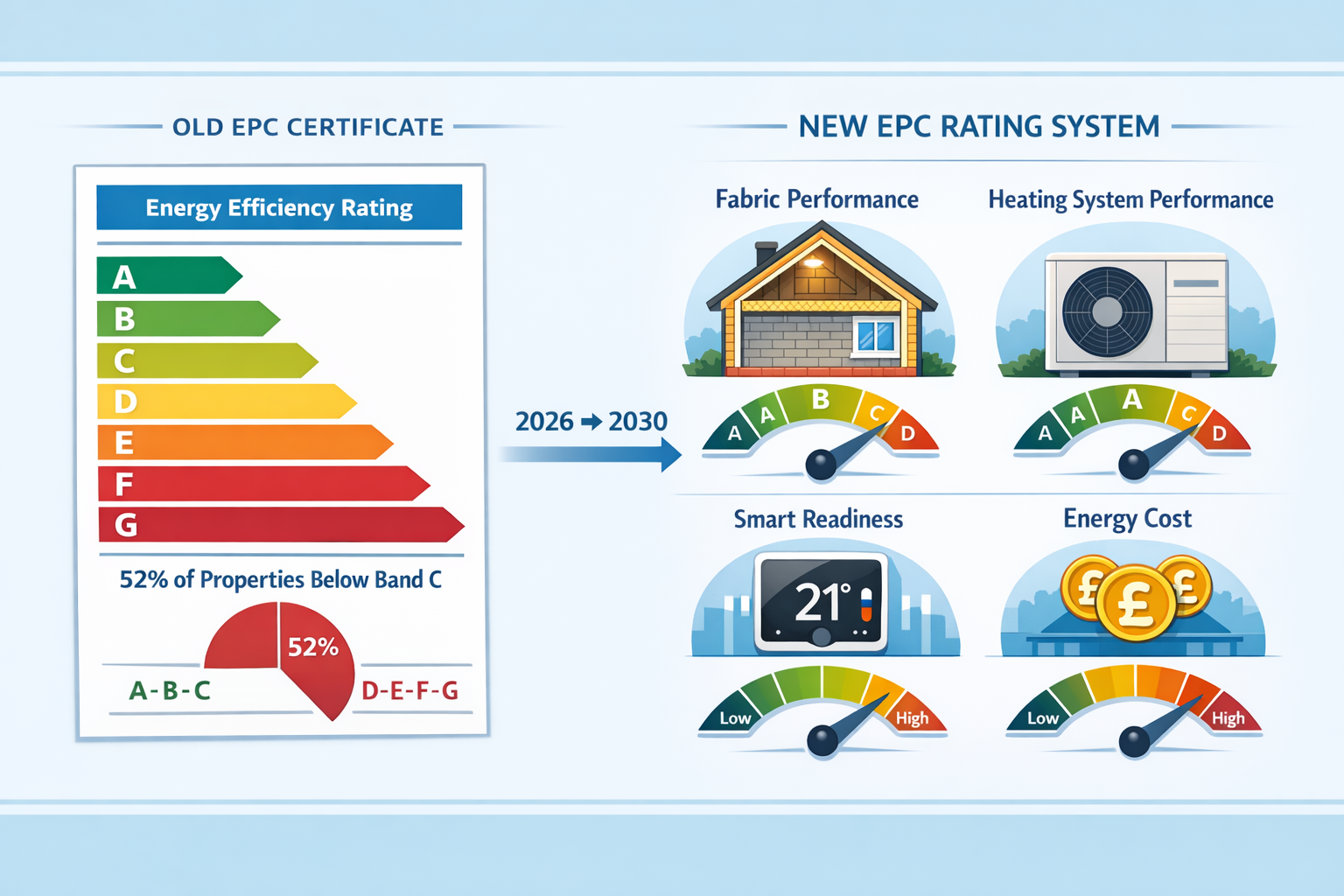
The 2030 Deadline: What Property Buyers Need to Know
The landscape of energy efficiency regulations underwent a significant shift in January 2026 when the government published its Warm Homes Plan. For buyers considering properties—whether for personal use or as rental investments—understanding these changes is essential for making sound financial decisions.
The October 1, 2030 deadline applies to all privately rented properties, with no exemptions based on tenancy type[2]. This unified approach means that whether a property has an existing tenancy or is newly let, it must meet the Band C standard by the same date. For buyers planning to rent out their purchase, this timeline creates a clear window for planning and executing necessary improvements.
The government has set a £10,000 spending cap per property, which represents the maximum amount landlords must invest to meet the standard[1]. However, this figure comes with an important caveat: for properties valued under £100,000, the cap is reduced if £10,000 represents 10% or more of the property's value[5]. This nuanced approach recognizes the proportional burden on lower-value properties.
The Four-Metric Revolution: How EPCs Are Changing
Perhaps the most significant development for property assessment is the fundamental restructuring of how energy performance is measured. The new EPC system, currently under consultation following its January 2026 launch, will replace the single overall score with four distinct metrics[1]:
1. Fabric Performance Metric 🏠
This measures how well a building retains heat, focusing on insulation quality, window efficiency, and air tightness. It represents the physical "envelope" of the property—the walls, roof, floors, and openings that separate the interior from the exterior environment.
2. Heating System Performance Metric ♨️
This assesses the carbon impact and efficiency of the heating system, including boilers, heat pumps, and renewable heating technologies. It reflects both operational efficiency and environmental impact.
3. Smart Readiness Metric 📱
This new metric evaluates a property's capacity to support smart energy technologies, including smart thermostats, energy monitoring systems, and integration with renewable energy sources.
4. Energy Cost Metric 💷
Rather than an abstract score, this presents estimated annual energy bills, giving buyers and tenants a tangible understanding of running costs.
From October 1, 2030, landlords must meet Band C against two metrics: the Fabric Performance Metric plus either the Heating System Metric or Smart Readiness Metric (landlord's choice)[4]. This dual-metric approach provides flexibility while ensuring minimum standards across the most critical performance areas.
The Reality Gap: Current Stock vs. Future Requirements
The challenge facing the market is substantial. Currently, 52% of private rental sector properties are rated below Band C[1], meaning more than half of rental properties require some level of improvement. For buyers, this statistic has important implications:
- Investment properties purchased today may require immediate or near-term upgrades
- Owner-occupied properties being considered for future rental potential need assessment
- Properties currently rated D, E, F, or G may require significant investment to meet standards
- Market values may increasingly reflect energy performance, with poorly rated properties potentially harder to sell or rent
The gap between current performance and future requirements creates both risks and opportunities. Buyers who understand retrofit potential can identify properties where strategic improvements deliver strong returns, while those who overlook energy performance may face unexpected costs.
Energy Performance and Retrofit Assessment in Building Surveys: The Surveyor's Critical Role
Integrating Energy Assessment into Traditional Building Surveys
Modern building surveys must evolve beyond traditional structural and maintenance assessments to include comprehensive energy performance evaluation. This integration transforms the surveyor's role from documenting current condition to advising on future potential and costs.
A comprehensive energy-focused building survey should include:
Current EPC Analysis 📊
- Review of existing EPC rating and recommendations
- Assessment of when the current certificate expires
- Evaluation of previous improvement measures already implemented
- Comparison with similar properties in the area
Fabric Performance Evaluation 🔍
- Detailed inspection of insulation in loft spaces, walls, and floors
- Assessment of window and door quality and condition
- Identification of thermal bridging and cold spots
- Air tightness considerations and draught proofing opportunities
Heating System Assessment 🔧
- Age, condition, and efficiency rating of current heating system
- Suitability for upgrade to modern condensing boilers or heat pumps
- Hot water system efficiency and insulation
- Radiator sizing and distribution effectiveness
Smart Technology Readiness 💻
- Electrical system capacity for smart controls
- Existing smart heating controls or thermostats
- Potential for renewable energy integration
- Broadband connectivity for smart home systems
When conducting a Level 2 Homebuyer Survey or more comprehensive Level 3 Building Survey, chartered surveyors can provide invaluable context about retrofit potential that standard EPC assessments may miss.
Identifying Retrofit Opportunities and Prioritizing Improvements
Understanding which improvements deliver the best return—both in terms of EPC points gained and cost-effectiveness—is crucial for buyers planning their investment strategy. Based on current data, here's how common improvements stack up:
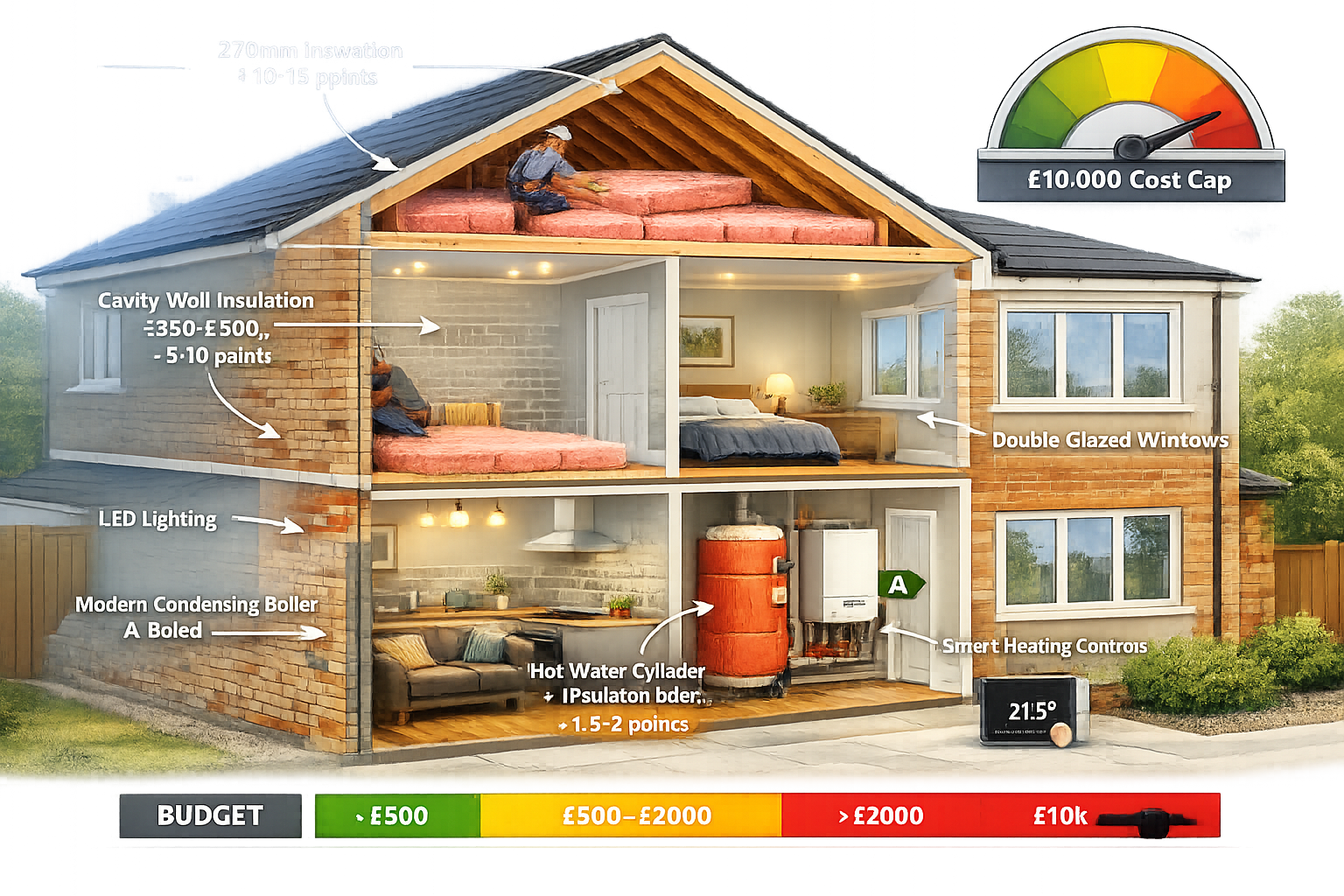
| Improvement Type | Typical Cost | EPC Points Gained | Cost per Point |
|---|---|---|---|
| Loft Insulation (0mm to 270mm) | £300-£500 | 10-15 points | £20-£50 |
| Cavity Wall Insulation | £350-£500 | 5-10 points | £35-£100 |
| Hot Water Cylinder Insulation | £15-£30 | 1.5-2 points | £8-£20 |
| LED Lighting Conversion | £100-£200 | 1-2 points | £50-£200 |
| Condensing Boiler Upgrade | £2,000-£3,500 | 5-15 points | £140-£700 |
| Double Glazing | £3,000-£6,000 | 3-8 points | £375-£2,000 |
| External Wall Insulation | £8,000-£15,000 | 10-20 points | £400-£1,500 |
These figures demonstrate that roof insulation represents one of the most cost-effective improvements, potentially increasing an EPC rating by 10-15 points for a relatively modest investment[1]. Similarly, cavity wall insulation at £350-£500 delivers 5-10 points improvement, making it an excellent early priority[1].
At the other end of the spectrum, measures like LED lighting conversion and hot water cylinder insulation require minimal investment and, while delivering smaller point gains, can be implemented immediately[1].
The £10,000 Question: Strategic Spending for Maximum Impact
With the government's £10,000 spending cap in mind, buyers need strategic advice on how to allocate retrofit budgets effectively. A building surveyor's assessment can help prioritize improvements based on:
Quick Wins (Under £1,000) 💡
- Loft insulation upgrade
- Cavity wall insulation (if applicable)
- Hot water cylinder jacket
- LED lighting throughout
- Draught proofing
- Thermostat upgrades
These measures combined typically cost £800-£1,500 and can deliver 15-25 EPC points improvement for properties with basic existing insulation.
Medium Investment (£1,000-£5,000) 🔨
- Condensing boiler replacement
- Secondary glazing or window upgrades
- Floor insulation
- Solar thermal hot water
- Smart heating controls
Properties requiring heating system upgrades will likely fall into this category, with modern condensing boilers delivering significant efficiency improvements.
Major Retrofit (£5,000-£10,000) 🏗️
- Heat pump installation
- External or internal wall insulation
- Complete window replacement
- Solar PV panels
- Comprehensive insulation package
For properties with solid walls (no cavity) or very poor existing insulation, reaching Band C may require investment approaching the £10,000 cap.
However, research reveals a concerning gap: 45% of landlords indicated they would only spend up to £2,000 per property[1], significantly below the £10,000 cap. This creates opportunities for buyers who can identify properties where strategic spending below the cap can achieve compliance, potentially negotiating purchase prices that reflect required improvements.
Energy Performance and Retrofit Assessment in Building Surveys: Practical Implementation for Buyers
Pre-Purchase Assessment: Questions Buyers Should Ask
When commissioning a RICS Home Survey with energy performance focus, buyers should request specific information:
About Current Performance 📋
- What is the current EPC rating and when does it expire?
- Which specific improvements are recommended in the existing EPC?
- How does this property compare to similar properties in the area?
- Are there any energy efficiency measures already in place?
About Retrofit Potential 🎯
- What improvements would be needed to reach Band C?
- What is the estimated cost to implement these improvements?
- Which improvements offer the best cost-to-benefit ratio?
- Are there any structural limitations that would prevent certain improvements?
About Hidden Costs 💰
- Are there any damp issues that must be resolved before insulation work?
- Does the electrical system need upgrading to support improvements?
- Would planning permission be required for any recommended measures?
- Are there any heritage or conservation area restrictions?
Understanding these factors before purchase allows buyers to negotiate prices that reflect true costs and make informed decisions about whether a property represents good value.
Case Study: Transforming a Band D Property to Band C
Consider a typical three-bedroom semi-detached house built in the 1970s, currently rated EPC Band D with a score of 58 points. To reach Band C (69+ points), the property needs an 11-point improvement.
Current Situation:
- 50mm loft insulation (inadequate)
- Cavity walls (uninsulated)
- Single-glazed windows in some rooms
- 15-year-old non-condensing boiler
- No heating controls beyond basic thermostat
- Traditional light bulbs throughout
Recommended Improvement Strategy:
Phase 1: Low-Cost Quick Wins (£600)
- Upgrade loft insulation to 270mm: £400 (+12 points)
- Install hot water cylinder jacket: £25 (+2 points)
- Convert to LED lighting: £150 (+1 point)
- Install room thermostats: £25 (+1 point)
Total Investment: £600
Points Gained: 16 points
New Rating: Band C (74 points)
In this scenario, the property achieves Band C compliance well below the £10,000 cap, making it an attractive investment opportunity. A surveyor identifying this potential during the purchase process provides significant value, potentially justifying a higher purchase price or avoiding the property being overlooked by less informed buyers.
Addressing Common Retrofit Challenges
Building surveyors must also identify potential obstacles that could complicate or increase the cost of improvements:
Damp and Moisture Issues 💧
Before installing insulation, existing damp problems must be resolved. Trapping moisture within walls or roof spaces can cause serious structural damage and health issues. A comprehensive damp survey may be necessary before proceeding with retrofit work.
Structural Limitations 🏛️
Older properties, particularly those with solid walls, present greater challenges. External wall insulation may alter the appearance of period properties, while internal wall insulation reduces room sizes. Listed buildings face additional restrictions requiring specialist advice.
Electrical System Capacity ⚡
Modern heat pumps, electric vehicle chargers, and smart home systems require adequate electrical capacity. Properties with older consumer units or insufficient earthing may need electrical upgrades before energy efficiency improvements can be fully implemented.
Ventilation Requirements 🌬️
Improving air tightness through draught proofing and insulation can create ventilation issues if not properly managed. Adequate ventilation is essential for indoor air quality and preventing condensation problems.
Planning and Conservation Restrictions 📜
Properties in conservation areas or with listed status face restrictions on external alterations. Solar panels, external wall insulation, and window replacements may require planning permission or listed building consent.
A thorough building survey identifies these issues early, allowing buyers to factor additional costs into their decision-making process.
The Financial Implications: Costs, Values, and Long-Term Returns
Understanding the True Cost of Retrofit
While the £10,000 cap provides a ceiling for required spending, understanding the realistic costs for different property types helps buyers budget accurately.
Property Age and Construction Type Matter:
Modern Properties (Post-2000) 🆕
These typically already meet or approach Band C standards, requiring minimal investment—often under £1,000 for minor upgrades like LED lighting and improved heating controls.
1980s-1990s Properties 🏘️
Usually built with some insulation and cavity walls, these properties typically need £2,000-£4,000 investment focusing on loft insulation upgrades, heating system improvements, and glazing enhancements.
1960s-1970s Properties 🏠
Often featuring cavity walls but minimal insulation, these properties typically require £4,000-£7,000 investment including cavity wall insulation, loft upgrades, and heating system replacement.
Pre-1960s Properties 🏛️
Frequently built with solid walls and minimal insulation, these properties may require £7,000-£10,000+ investment, potentially including expensive solid wall insulation solutions.
Victorian and Older Properties 🏰
These present the greatest challenges, often requiring creative solutions and potentially exceeding the £10,000 cap to reach Band C. Heritage considerations may limit options.
Property Value Implications
Research increasingly shows that energy performance affects property values. While comprehensive UK data is still emerging, several trends are clear:
Rental Market Impact 📈
Properties unable to achieve Band C by 2030 will become unlettable, effectively reducing their value as investments. Buyers planning to rent properties must factor this into valuations.
Buyer Preferences 👥
Energy-conscious buyers increasingly prioritize efficient properties, particularly as energy costs remain high. Properties with good EPC ratings command premium interest and potentially higher prices.
Mortgage Considerations 🏦
Some lenders offer preferential rates for energy-efficient properties, while others may require improvement plans for poorly rated properties. This trend is likely to strengthen as environmental, social, and governance (ESG) considerations influence lending policies.
Future-Proofing 🔮
Properties already meeting Band C standards avoid future compliance costs and regulatory risks, making them more attractive long-term investments.
Calculating Return on Investment
For buyers considering properties requiring improvement, calculating the return on retrofit investment involves several factors:
Energy Bill Savings 💷
Improving from Band D to Band C typically reduces annual energy bills by 15-25%, or £200-£400 per year for an average property. Over a 10-year period, this represents £2,000-£4,000 in savings.
Rental Income Protection 🏘️
For buy-to-let investors, achieving Band C protects rental income streams beyond 2030. The cost of improvements should be weighed against the total rental income over the property's investment horizon.
Capital Value Enhancement 📊
While difficult to quantify precisely, properties meeting modern efficiency standards are likely to maintain value better than non-compliant properties, particularly as regulations tighten and buyer awareness increases.
Avoided Penalties ⚠️
Non-compliant rental properties face potential fines of up to £30,000 per property[8], making compliance investment essential for landlords.
Choosing the Right Survey for Energy Performance Assessment
Survey Types and Energy Focus
Different survey levels offer varying degrees of energy performance insight:
RICS Level 1 (Condition Report) 📄
Basic visual inspection with limited energy assessment. Suitable only for newer properties in good condition where energy performance is already likely to be adequate.
RICS Level 2 (Homebuyer Report) 📋
Includes more detailed assessment of building elements affecting energy performance, such as insulation, heating systems, and windows. Appropriate for most conventional properties where buyers want to understand retrofit requirements.
RICS Level 3 (Building Survey) 📑
Comprehensive inspection ideal for older properties, those in poor condition, or where significant retrofit may be required. Provides detailed analysis of fabric performance and improvement opportunities.
For properties where energy performance is a key concern—particularly older buildings or those currently rated below Band C—a comprehensive building survey provides the most valuable information for decision-making.
Specialist Assessments to Consider
Beyond standard building surveys, buyers may benefit from additional specialist assessments:
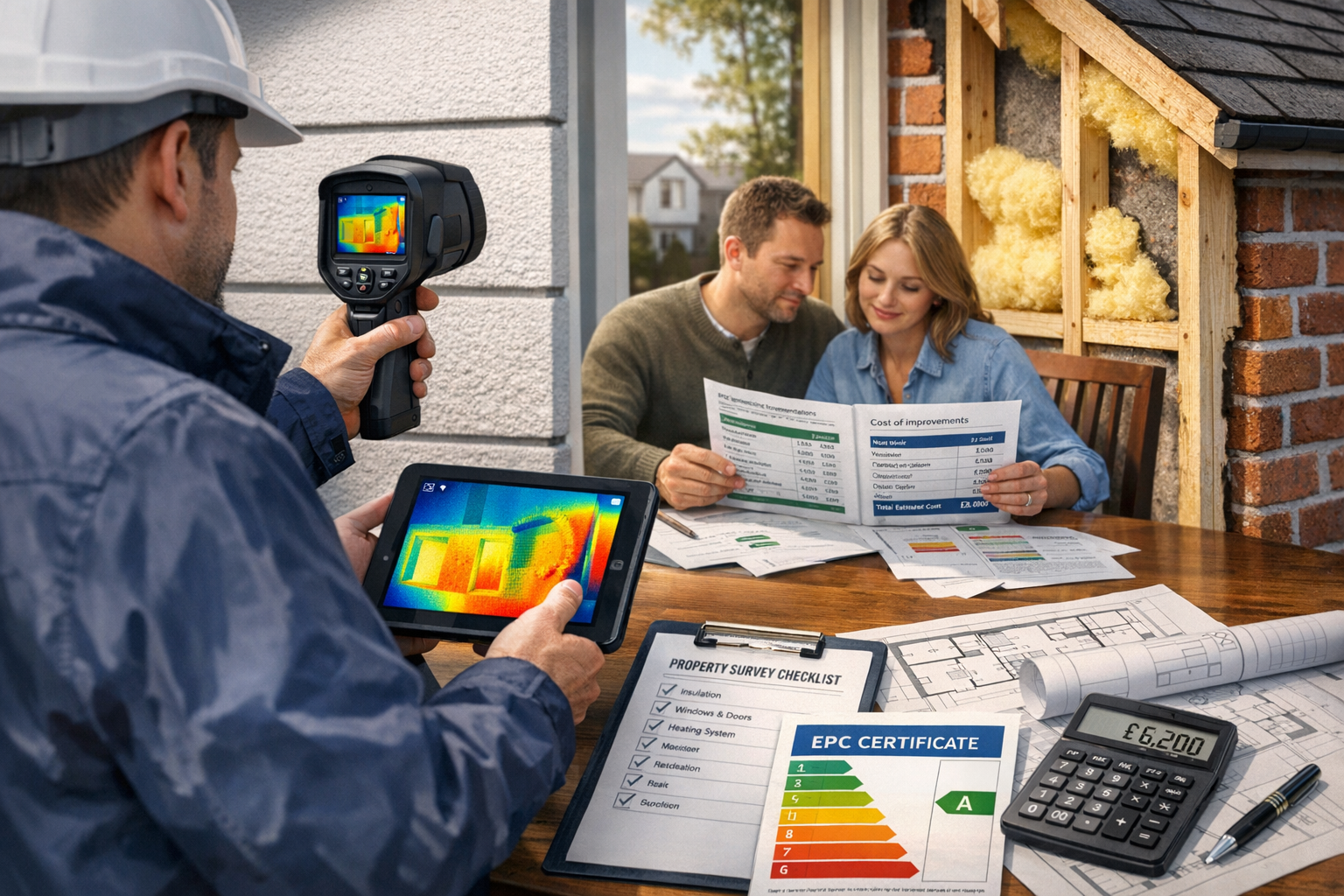
Thermal Imaging Survey 🌡️
Uses infrared cameras to identify heat loss, thermal bridging, and insulation gaps not visible during standard inspections. Particularly valuable for properties where hidden defects may affect retrofit effectiveness.
Energy Consultant Assessment 🔬
Specialist energy assessors can provide detailed modeling of improvement options, predicted EPC scores after improvements, and cost-benefit analysis of different retrofit strategies.
Damp and Timber Survey 🌲
Essential before installing insulation in properties with suspected moisture issues. Comprehensive damp and timber reports identify problems that must be resolved before retrofit work proceeds.
Structural Survey for Major Works 🏗️
Properties requiring external wall insulation or significant alterations may need structural engineering input to ensure proposed improvements won't compromise building integrity.
Understanding Survey Costs vs. Value
The investment in comprehensive surveying pays dividends through informed decision-making. While structural survey pricing varies based on property size and complexity, the cost of surveys typically represents a small fraction of potential retrofit expenses or property value adjustments.
Consider this scenario: A buyer pays £800 for a comprehensive building survey that identifies £6,000 of necessary energy improvements. Armed with this information, they negotiate a £5,000 reduction in purchase price, effectively gaining a £4,200 benefit from the £800 survey investment—a 525% return.
Conversely, a buyer who skips the detailed survey and discovers retrofit requirements after purchase has no negotiating leverage and must absorb the full cost of improvements.
Working with Surveyors: Getting Maximum Value from Energy Assessments
Preparing for Your Survey
To maximize the value of an energy-focused building survey, buyers should:
Gather Existing Documentation 📚
- Current EPC certificate and recommendations
- Previous survey reports if available
- Planning permissions for any alterations
- Building control certificates for recent work
- Utility bills showing actual energy consumption
Communicate Your Intentions 💬
Inform your surveyor whether you plan to:
- Occupy the property yourself
- Rent it out (triggering EPC Band C requirements)
- Undertake immediate improvements or phase them over time
- Sell the property within a specific timeframe
This context allows the surveyor to tailor recommendations to your specific situation.
Ask Specific Questions ❓
Request that the survey report addresses:
- Estimated costs to reach Band C
- Priority order for improvements
- Any obstacles to common retrofit measures
- Comparison with similar properties
- Potential for exceeding Band C to reach Band B or A
Interpreting Survey Findings
When reviewing a survey report with energy performance focus, look for:
Clear Cost Estimates 💰
The report should provide realistic cost ranges for recommended improvements, not just generic suggestions. Costs should reflect current market rates and property-specific factors.
Prioritized Recommendations 📊
Improvements should be ranked by cost-effectiveness, urgency, and impact on EPC rating. This helps you plan phased implementation if needed.
Risk Identification ⚠️
The surveyor should highlight any factors that could complicate or increase the cost of improvements, such as asbestos, structural issues, or access difficulties.
Opportunity Highlighting ✨
Good surveys identify properties where strategic improvements can deliver excellent returns, helping you recognize value opportunities other buyers might miss.
Negotiating Based on Survey Findings
Armed with comprehensive energy performance information, buyers can negotiate effectively:
Price Reduction Strategy 💷
Request reductions based on documented improvement costs. If a property needs £5,000 to reach Band C, this provides objective justification for price negotiation.
Retention Approach 🏦
Propose retaining funds from the purchase price to cover specific improvements, with work completed to agreed standards before funds are released.
Condition-Based Offers 📝
Make offers conditional on the seller completing certain improvements before completion, shifting the cost and risk to the seller.
Walk-Away Clarity 🚶
Understand your maximum acceptable cost for improvements. If a property requires investment exceeding your budget or the £10,000 cap, you can walk away before incurring legal costs.
Future Trends: What's Coming Beyond 2030
The Evolution of Energy Standards
While the 2030 Band C deadline dominates current discussion, forward-thinking buyers should consider longer-term trends:
Potential Band B Requirements 📈
Some policy experts anticipate that Band C may be a stepping stone, with Band B requirements possible for rental properties by 2035-2040. Properties capable of reaching Band B with reasonable investment may prove more resilient long-term investments.
Owner-Occupied Standards 🏠
Currently, minimum energy standards apply only to rental properties. However, future regulations may extend requirements to owner-occupied properties, particularly at point of sale. Scotland has already indicated movement in this direction.
Embodied Carbon Considerations 🌍
Future regulations may consider not just operational energy efficiency but also the embodied carbon in building materials and retrofit measures. This could influence which improvement strategies are recommended.
Grid Decarbonization Impact ⚡
As the UK electricity grid becomes cleaner through renewable energy expansion, the carbon impact of electric heating and heat pumps improves, potentially shifting the relative value of different heating technologies.
Technology Developments to Watch
Several emerging technologies may influence retrofit strategies:
Heat Pump Advancements 🔥
Ongoing improvements in heat pump efficiency, noise levels, and suitability for older properties may make them increasingly attractive alternatives to gas boilers.
Battery Storage 🔋
Domestic battery systems paired with solar panels enable greater energy independence and may feature in future EPC assessments.
Smart Home Integration 📱
The new Smart Readiness Metric reflects growing importance of intelligent energy management systems that optimize consumption based on tariffs, weather, and occupancy.
Retrofit Materials 🧱
Innovations in insulation materials, particularly those suitable for heritage properties or challenging applications, continue to expand retrofit options.
Market Adaptation
The property market is adapting to the new energy efficiency reality:
Specialist Retrofit Services 🔧
Growing numbers of contractors specialize in energy efficiency improvements, improving quality and potentially reducing costs through competition.
Green Mortgages 💚
Lenders increasingly offer preferential rates for efficient properties or provide additional borrowing for improvement works, making retrofit more financially accessible.
Energy Performance Transparency 🔍
Property portals and marketing materials increasingly highlight EPC ratings prominently, making energy performance a primary consideration rather than an afterthought.
Professional Development 📖
Building surveyors, estate agents, and other property professionals are developing expertise in energy assessment and retrofit advice, improving the quality of guidance available to buyers.
Conclusion: Empowering Buyers Through Expert Assessment
Energy Performance and Retrofit Assessment in Building Surveys: Guiding Buyers Through Rising Costs and EPC Band Improvements represents more than regulatory compliance—it's about making informed property investments in a changing market. As we navigate 2026 with the October 1, 2030 deadline approaching, the integration of energy performance assessment into building surveys has become essential rather than optional.
The statistics paint a clear picture: with 52% of rental properties currently below Band C[1] and landlords facing a £10,000 spending cap[1], the market is undergoing significant transformation. Buyers who understand retrofit potential, realistic costs, and long-term value implications position themselves to make superior investment decisions.
Actionable Next Steps for Property Buyers
1. Commission Comprehensive Surveys 🔍
Don't rely solely on basic EPCs. Invest in professional building surveys that include detailed energy performance assessment and retrofit cost analysis.
2. Request Specific Energy Information 📋
Ask surveyors to provide:
- Estimated costs to reach Band C
- Priority order for improvements
- Identification of any obstacles
- Comparison with similar properties
3. Factor Retrofit Costs into Budgets 💰
When determining your maximum purchase price, include realistic allowances for necessary energy improvements. A property £10,000 cheaper but requiring £8,000 in upgrades may not represent better value than a more efficient property.
4. Negotiate from Knowledge 💪
Use survey findings to negotiate prices that reflect true costs, ensuring you don't overpay for properties requiring significant improvement investment.
5. Consider Long-Term Trends 🔮
Look beyond the 2030 Band C requirement to consider whether properties can reasonably achieve Band B or better, future-proofing your investment against potential regulatory tightening.
6. Engage Qualified Professionals 👨🔧
Work with RICS-qualified surveyors who understand both traditional building pathology and modern energy performance requirements. Their expertise bridges the gap between structural integrity and energy efficiency.
7. Plan Strategically 📅
For properties requiring improvements, develop a phased implementation plan that prioritizes cost-effective measures and aligns with your occupancy or rental timeline.
The property market of 2026 and beyond rewards informed decision-making. By integrating energy performance and retrofit assessment into the building survey process, buyers gain the insights needed to navigate rising costs, regulatory requirements, and changing market dynamics. The investment in comprehensive professional advice pays dividends through better purchase decisions, effective negotiations, and long-term property performance.
Whether you're buying your first home, expanding a property portfolio, or making a lifestyle purchase, understanding energy performance is no longer optional—it's essential. The building surveyors who embrace this expanded advisory role provide invaluable service to clients navigating one of the most significant transitions in the UK property market's history.
References
[1] New Epc Regulations – https://blog.goodlord.co/new-epc-regulations
[2] Epc Guide For Landlords – https://blog.openrent.co.uk/epc-guide-for-landlords/
[3] An Efficient New Year How To Improve Your Epc And Energy Efficiency In 2026 – https://cucumbereco.co.uk/an-efficient-new-year-how-to-improve-your-epc-and-energy-efficiency-in-2026/
[4] New Epc Rules – https://theindependentlandlord.com/new-epc-rules/
[5] New Energy Efficiency Rules For Rental Properties – https://www.simplybusiness.co.uk/knowledge/landlord-regulation/new-energy-efficiency-rules-for-rental-properties/
[6] Epc Rental Property 2026 – https://www.cribsestates.co.uk/blog/epc-rental-property-2026
[7] Prs Homes Energy Performance Government Response – https://assets.publishing.service.gov.uk/media/69722b193f2908a349040547/prs-homes-energy-performance-government-response.pdf
[8] Domestic Private Rented Property Minimum Energy Efficiency Standard Landlord Guidance – https://www.gov.uk/guidance/domestic-private-rented-property-minimum-energy-efficiency-standard-landlord-guidance
[9] 5 Ways To Make Your Office Epc Compliant Before The Legislation Changes – https://coel.co.uk/5-ways-to-make-your-office-epc-compliant-before-the-legislation-changes/